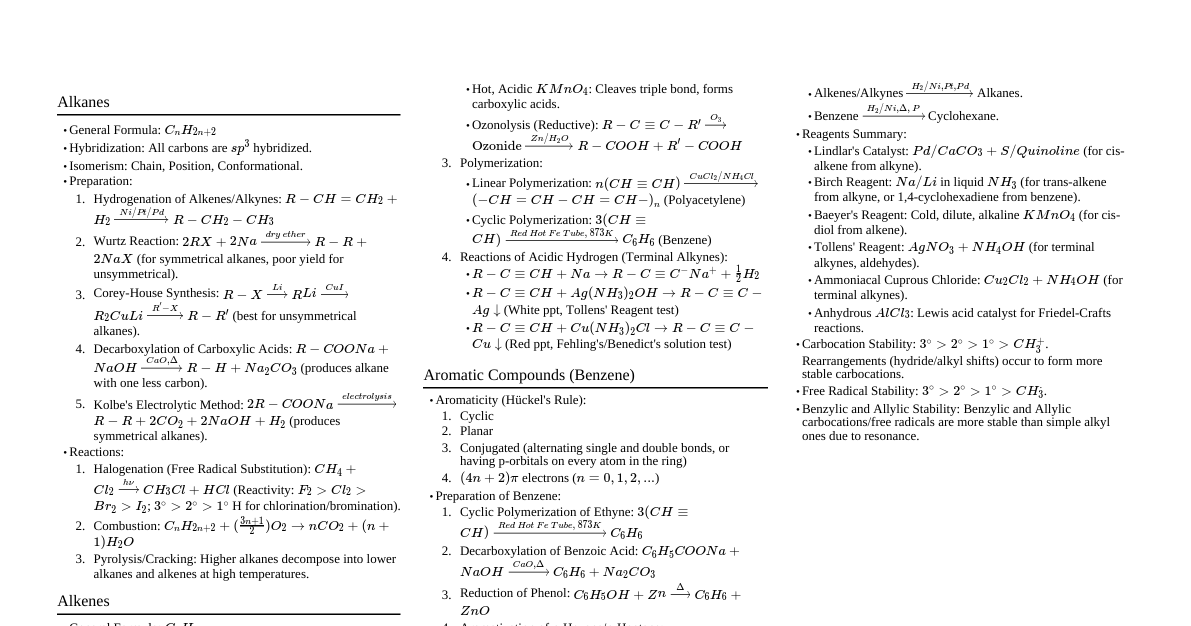
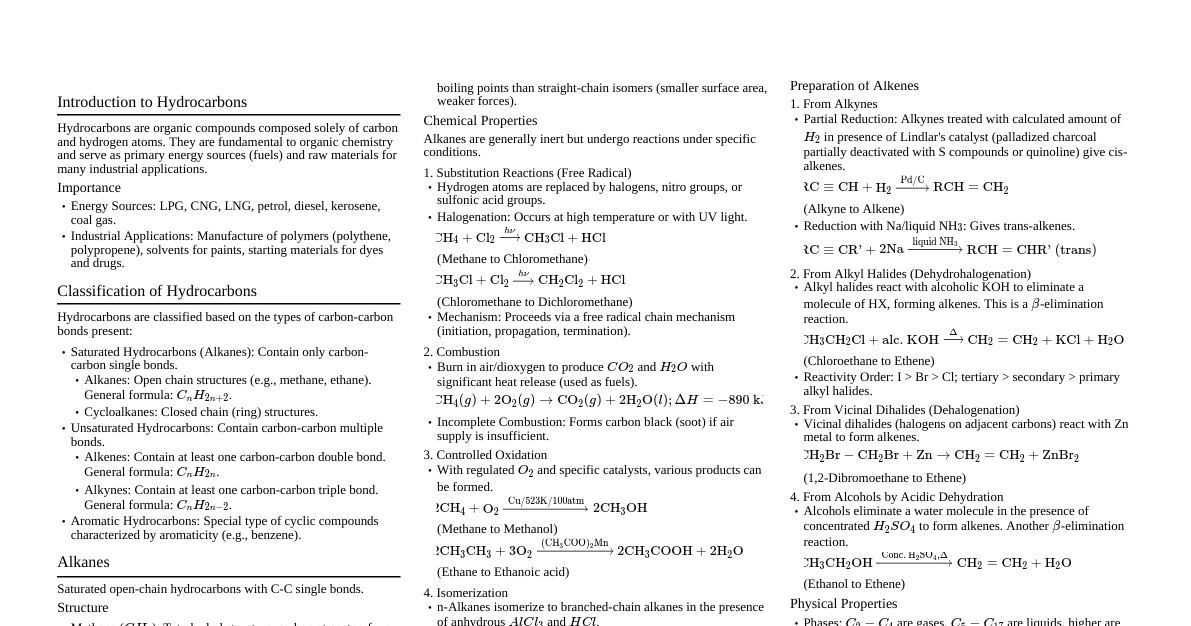
Hydrocarbons Cheatsheet
Cheatsheet Content
### Introduction to Periodic Classification The Periodic Table systematically organizes elements based on their properties. Early attempts at classification, like Dobereiner's Triads and Newlands' Law of Octaves, focused on atomic weights. Mendeleev's Periodic Law (1869) stated that "the properties of the elements are a periodic function of their atomic weights" and famously predicted unknown elements. The Modern Periodic Law (1913, Henry Moseley) revised this, stating that "the physical and chemical properties of the elements are periodic functions of their atomic numbers." This is a more fundamental property, directly related to electronic configuration. ### Modern Periodic Table (Long Form) The modern Periodic Table arranges elements by increasing atomic number into **periods** (horizontal rows) and **groups** (vertical columns). #### Key Features - **Periods:** There are 7 periods. The period number corresponds to the highest principal quantum number ($n$) of the elements in that period. - Period 1: 2 elements (1s orbital filling) - Period 2: 8 elements (2s, 2p orbitals filling) - Period 3: 8 elements (3s, 3p orbitals filling) - Period 4: 18 elements (4s, 3d, 4p orbitals filling - includes 3d transition series) - Period 5: 18 elements (5s, 4d, 5p orbitals filling - includes 4d transition series) - Period 6: 32 elements (6s, 4f, 5d, 6p orbitals filling - includes 4f lanthanoid series) - Period 7: 32 elements (incomplete, includes 5f actinoid series) - **Groups:** There are 18 groups. Elements in the same group have similar valence shell electronic configurations and thus similar chemical properties. - Older notation: IA - VIIA, VIII, IB - VIIB, 0. - IUPAC notation: 1-18. #### Electronic Configurations in Periods The number of elements in a period is determined by the number of orbitals available in the energy level being filled. Each orbital can hold 2 electrons. - **Example (5th period, $n=5$):** Orbitals available are 5s, 4d, 5p. - Order of filling: $5s ### Nomenclature of Elements ($Z > 100$) IUPAC provides a systematic nomenclature for elements with atomic numbers above 100 before official names are assigned. This involves using numerical roots for digits 0-9 and adding the suffix "-ium". #### Numerical Roots | Digit | Name | Abbreviation | |:-----:|:----:|:------------:| | 0 | nil | n | | 1 | un | u | | 2 | bi | b | | 3 | tri | t | | 4 | quad | q | | 5 | pent | p | | 6 | hex | h | | 7 | sept | s | | 8 | oct | o | | 9 | enn | e | #### Example - **Z = 120:** un (1) bi (2) nil (0) + ium = Unbinilium (Ubn) - **Z = 114:** un (1) un (1) quad (4) + ium = Ununquadium (Uuq) ### Classification into s-, p-, d-, f-Blocks Elements are classified into blocks based on the type of atomic orbital that receives the last electron in their electronic configuration. 1. **s-Block Elements:** - **Groups:** 1 and 2 - **Outer Electronic Configuration:** $ns^1$ (Group 1, alkali metals) and $ns^2$ (Group 2, alkaline earth metals) - **Properties:** Reactive metals, low ionization enthalpies, form ionic compounds (except Li and Be), lose electrons to form 1+ or 2+ ions. 2. **p-Block Elements:** - **Groups:** 13 to 18 - **Outer Electronic Configuration:** $ns^2np^{1-6}$ - **Properties:** Includes metals, non-metals, and metalloids. Non-metallic character increases across a period and decreases down a group. Group 17 (halogens) and Group 16 (chalcogens) have high electron gain enthalpies. Group 18 (noble gases) have stable $ns^2np^6$ configurations. - **Exceptions:** Helium (1s²) is s-block but placed in p-block (Group 18) due to noble gas properties. Hydrogen (1s¹) is unique, often placed separately. 3. **d-Block Elements (Transition Elements):** - **Groups:** 3 to 12 - **Outer Electronic Configuration:** $(n-1)d^{1-10}ns^{0-2}$ - **Properties:** All metals, form colored ions, exhibit variable oxidation states, paramagnetism, and often act as catalysts. These elements bridge s-block and p-block elements. - **Exceptions:** Zn, Cd, Hg (with $(n-1)d^{10}ns^2$) do not show typical transition element properties. 4. **f-Block Elements (Inner-Transition Elements):** - **Lanthanoids:** $Z=58-71$ (4f-series), placed after Lanthanum (La). - **Actinoids:** $Z=90-103$ (5f-series), placed after Actinium (Ac). - **Outer Electronic Configuration:** $(n-2)f^{1-14}(n-1)d^{0-1}ns^2$ - **Properties:** All metals, properties within each series are similar. Actinoids are radioactive and have complex chemistry due to many oxidation states. ### Periodic Trends in Physical Properties Physical properties of elements show periodic variations. 1. **Atomic Radius:** - **Definition:** Covalent radius (half the distance between two atoms bonded by a single covalent bond) or metallic radius (half the internuclear distance in a metallic crystal). - **Trend across a period (L to R):** Generally **decreases**. This is because the effective nuclear charge increases across a period, pulling the valence electrons closer to the nucleus, even though electrons are added to the same main energy shell. - **Trend down a group (Top to Bottom):** Generally **increases**. New shells are added, and inner electrons shield the valence electrons from the nuclear charge, causing the atomic size to expand. - **Noble gases:** Have very large non-bonded (van der Waals) radii, not directly comparable to covalent/metallic radii. 2. **Ionic Radius:** - **Cation:** Formed by losing electrons. **Smaller** than its parent atom because of fewer electrons and increased effective nuclear charge. Greater positive charge leads to smaller ionic radius. - **Anion:** Formed by gaining electrons. **Larger** than its parent atom because of increased electron-electron repulsion and decreased effective nuclear charge. Greater negative charge leads to larger ionic radius. - **Isoelectronic species:** Ions/atoms with the same number of electrons (e.g., $O^{2-}, F^-, Na^+, Mg^{2+}$ all have 10 electrons). Their radii decrease with increasing nuclear charge. Example: $O^{2-} > F^- > Na^+ > Mg^{2+}$ 3. **Ionization Enthalpy ($\Delta_i H$):** - **Definition:** Energy required to remove an electron from an isolated gaseous atom ($X_{(g)} \rightarrow X^+_{(g)} + e^-$). Always positive (endothermic). - **Successive Ionization Enthalpies:** $\Delta_i H_1 B) - **Group 16 vs Group 15:** $ns^2np^3$ (Group 15) has a half-filled p-orbital, which is stable. Removing an electron from $ns^2np^4$ (Group 16) results in a stable half-filled $ns^2np^3$ configuration, making it easier than from Group 15. (e.g., N > O) - **Trend down a group (Top to Bottom):** Generally **decreases**. Due to increasing atomic size and increased shielding by inner electrons, the outermost electron is less tightly held. 4. **Electron Gain Enthalpy ($\Delta_{eg} H$):** - **Definition:** Enthalpy change when an electron is added to an isolated gaseous atom ($X_{(g)} + e^- \rightarrow X^-_{(g)}$). Can be positive or negative. - **Negative $\Delta_{eg} H$ (exothermic):** Energy released when electron is added (e.g., halogens, Group 17, due to strong attraction for electron to achieve stable noble gas configuration). - **Positive $\Delta_{eg} H$ (endothermic):** Energy absorbed when electron is added (e.g., noble gases, Group 2, due to electron-electron repulsion and stable configurations). - **Trend across a period (L to R):** Generally becomes more **negative** (more energy released). Due to increasing effective nuclear charge and decreasing atomic size, the atom has a stronger attraction for an incoming electron. - **Trend down a group (Top to Bottom):** Generally becomes less **negative**. Due to increasing atomic size, the attraction for an incoming electron decreases. - **Exception:** For Group 16 (O vs S) and Group 17 (F vs Cl), the electron gain enthalpy of the second period element (O, F) is less negative than the third period element (S, Cl). This is because the small size of O/F leads to significant electron-electron repulsion when an incoming electron enters the compact 2p-orbital. 5. **Electronegativity:** - **Definition:** Qualitative measure of the ability of an atom in a chemical compound to attract shared electrons to itself. Not a measurable quantity. (Pauling scale: F = 4.0, highest). - **Trend across a period (L to R):** Generally **increases**. Due to increasing effective nuclear charge and decreasing atomic size, the nucleus has a stronger pull on shared electrons. Non-metallic character increases. - **Trend down a group (Top to Bottom):** Generally **decreases**. Due to increasing atomic size and shielding effect, the nucleus's attraction for shared electrons decreases. Metallic character increases. ### Periodic Trends in Chemical Properties 1. **Periodicity of Valence/Oxidation States:** - **Valence:** Number of electrons in outermost shell or 8 minus number of outermost electrons. - **Oxidation State:** Charge acquired by an atom in a compound based on electronegativity. - **Across a period:** Valence tends to increase from 1 to 4 and then decrease to 1. Many elements show variable valence (especially transition elements). - **Oxides:** - Extreme left (Group 1): Most **basic** (e.g., $Na_2O$). - Extreme right (Group 17): Most **acidic** (e.g., $Cl_2O_7$). - Centre: **Amphoteric** (e.g., $Al_2O_3$) or **neutral** (e.g., CO, NO). 2. **Chemical Reactivity:** - **Across a period (L to R):** High at extremes, low in the middle. - **Left side (metals):** High reactivity due to ease of losing electrons (low $\Delta_i H$). - **Right side (non-metals):** High reactivity due to ease of gaining electrons (high negative $\Delta_{eg} H$). - **Down a group:** - **Metals (e.g., Group 1):** Reactivity **increases** (easier to lose electrons). - **Non-metals (e.g., Group 17):** Reactivity **decreases** (harder to gain electrons). 3. **Anomalous Properties of Second Period Elements:** - Elements of the second period (Li to F) differ significantly from other members of their respective groups. - **Reasons:** Small size, high charge/radius ratio, high electronegativity, and lack of d-orbitals. - **Consequences:** - Form covalent compounds (e.g., Li, Be). - Maximum covalency is 4 (no d-orbitals for expansion). - Ability to form $p\pi-p\pi$ multiple bonds (e.g., C=C, C=O, N=N). - **Diagonal Relationship:** Second period elements show similarities with elements of the next group and period (e.g., Li with Mg, Be with Al). ### Cheatsheet Questions **Q1. Identify the block, period, and group for the element with atomic number 117.** A. Using the IUPAC nomenclature rules: - Atomic number 117 is Ununseptium (Uus). - The maximum principal quantum number for elements in Period 7 is 7. - Elements with $Z=117$ would fill the $7s^27p^5$ orbitals, similar to halogens ($ns^2np^5$). - Therefore, it belongs to the **p-block**, **Period 7**, and **Group 17**. **Q2. Arrange the following species in order of increasing ionic radii: $Na^+, Mg^{2+}, F^-, O^{2-}$.** A. All these species are isoelectronic, meaning they have the same number of electrons (10 electrons). For isoelectronic species, ionic radius decreases with increasing nuclear charge. - Nuclear charges: $O (Z=8), F (Z=9), Na (Z=11), Mg (Z=12)$. - The increasing order of nuclear charge is $O^{2-}