GOC & Hydrocarbons Cheatsheet
Cheatsheet Content
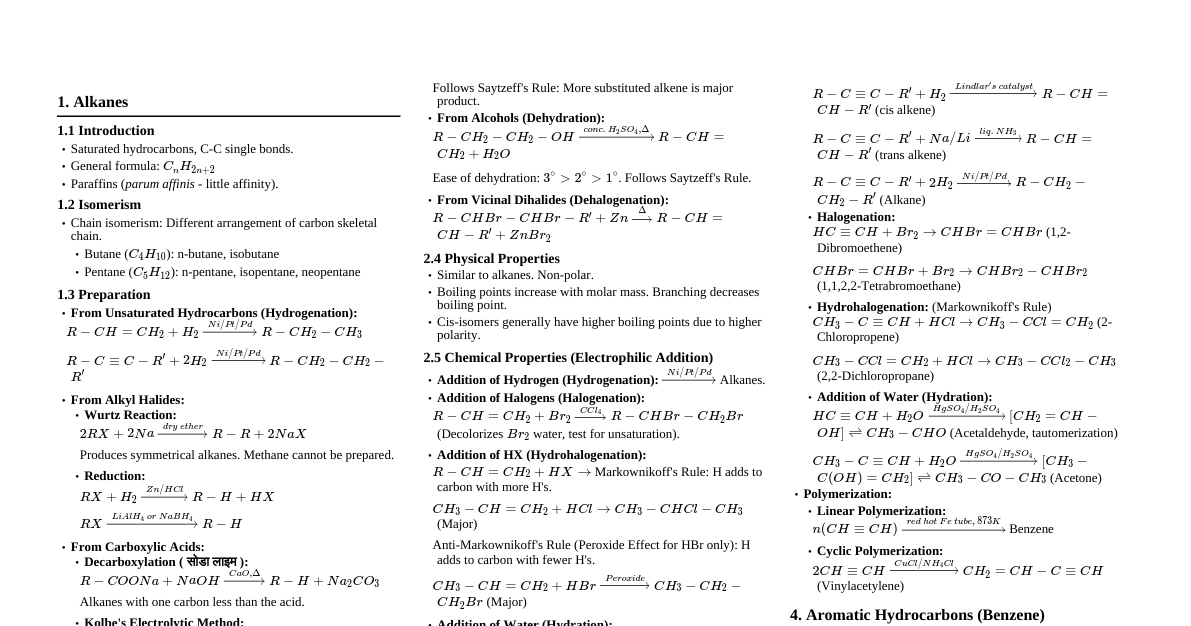
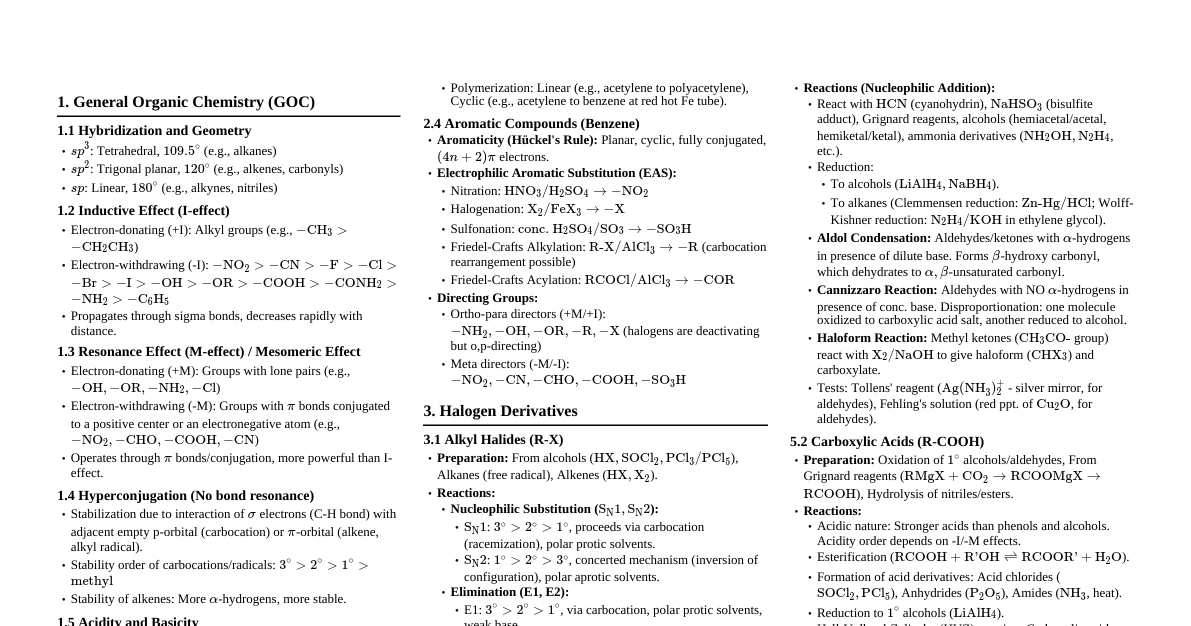
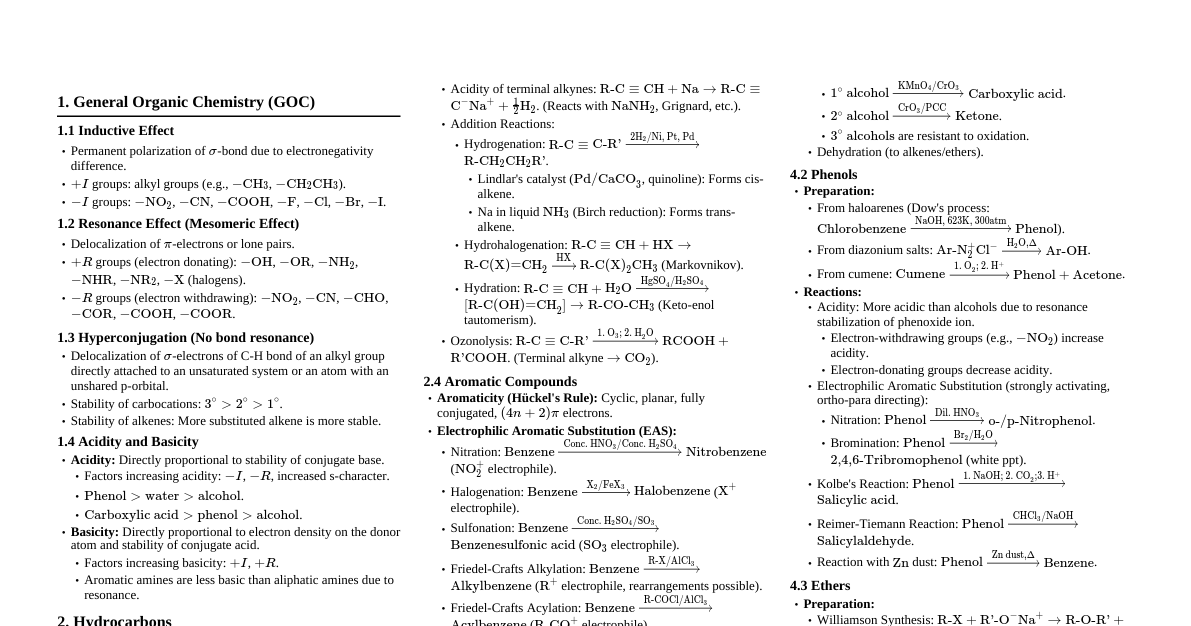
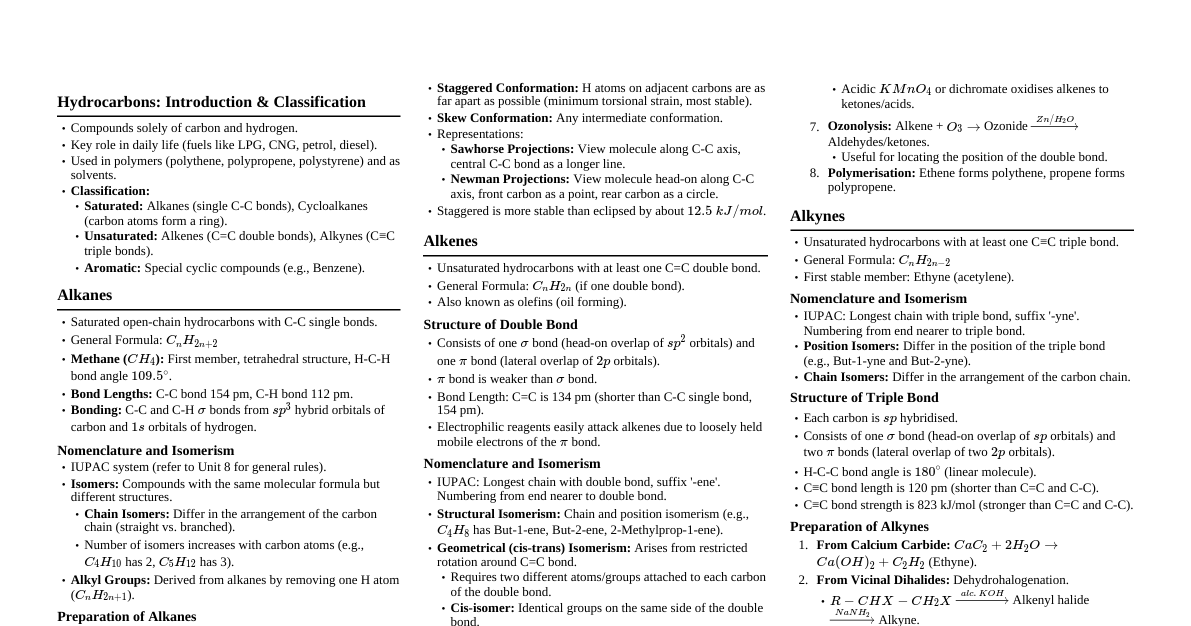
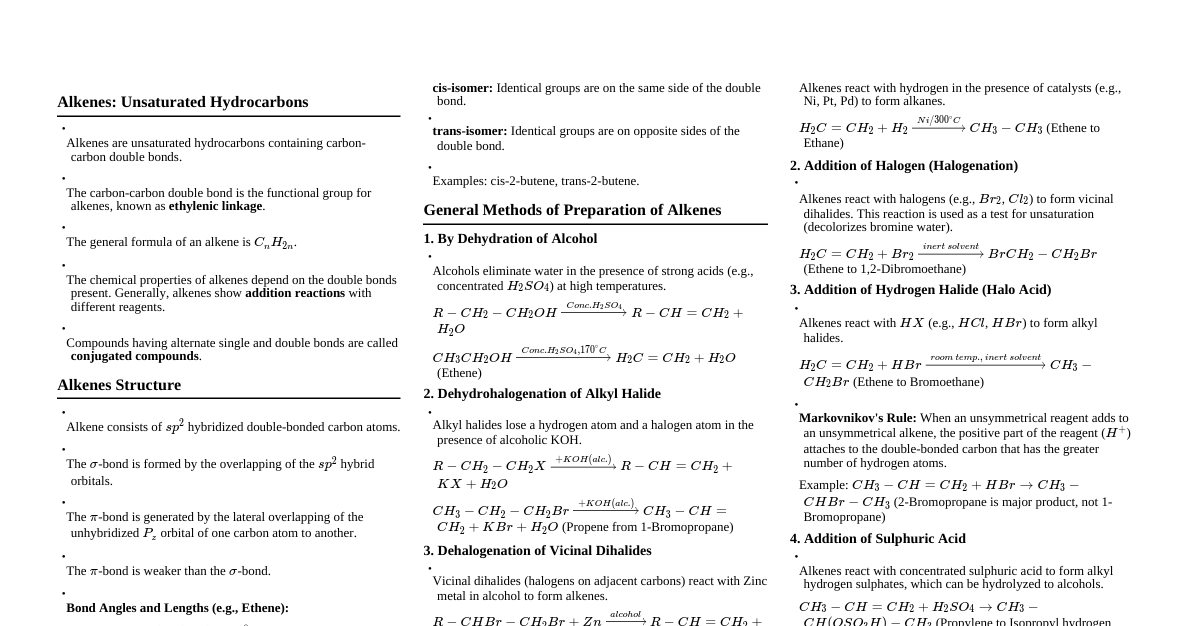
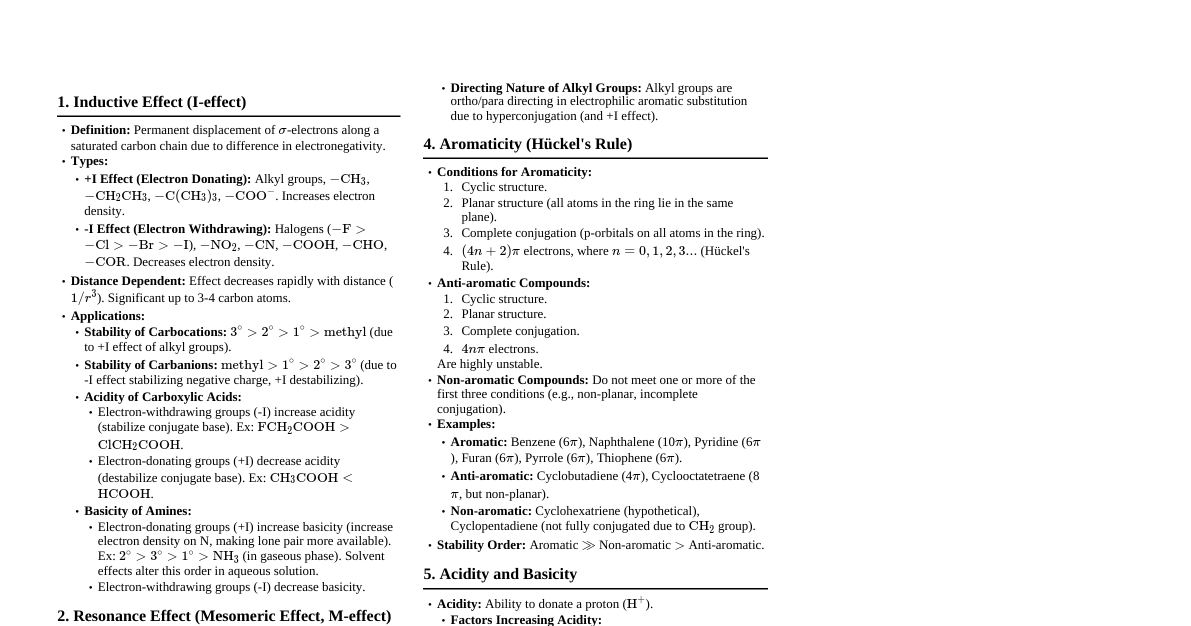
General Organic Chemistry (GOC) 1. Electronic Effects Inductive Effect (I-effect): Permanent displacement of $\sigma$-electrons along a carbon chain. $+$I-effect (electron donating): Alkyl groups ($-\text{CH}_3$, $-\text{CH}_2\text{CH}_3$), $-\text{COO}^-$. $-$I-effect (electron withdrawing): $-\text{NO}_2$, $-\text{CN}$, $-\text{F}$, $-\text{Cl}$, $-\text{Br}$, $-\text{I}$, $-\text{OH}$, $-\text{COOH}$. Decreases rapidly with distance. Resonance Effect (Mesomeric Effect, M-effect): Permanent delocalization of $\pi$-electrons or lone pairs through conjugation. $+$M-effect (electron donating): $-\text{OH}$, $-\text{OR}$, $-\text{NH}_2$, $-\text{NR}_2$, $-\text{Cl}$, $-\text{Br}$. $-$M-effect (electron withdrawing): $-\text{NO}_2$, $-\text{CHO}$, $-\text{COR}$, $-\text{COOH}$, $-\text{CN}$. Requires conjugation ($\text{C=C-C=C}$, $\text{C=C-X}$, etc.). Hyperconjugation (No-bond Resonance): Delocalization of $\sigma$-electrons of $\text{C-H}$ bond of an alkyl group directly attached to an unsaturated system (double bond, triple bond, carbocation, free radical). Stabilizes carbocations, free radicals, and alkenes. More $\alpha$-hydrogens $\implies$ more hyperconjugative structures $\implies$ more stability. Electromeric Effect (E-effect): Temporary and complete transfer of $\pi$-electrons to one of the bonded atoms in a multiple bond in the presence of an attacking reagent. $+E$-effect: Electron transfer towards attacking reagent. $-E$-effect: Electron transfer away from attacking reagent. 2. Reaction Intermediates Carbocation: $\text{sp}^2$ hybridized, trigonal planar, electron deficient (6 electrons). Stability: $3^\circ > 2^\circ > 1^\circ > \text{methyl}$ (due to +I and hyperconjugation). Resonance stability also increases carbocation stability. Carbanion: $\text{sp}^3$ hybridized, pyramidal, electron rich (8 electrons, one lone pair). Stability: $\text{methyl} > 1^\circ > 2^\circ > 3^\circ$ (due to -I effect). Resonance stability increases carbanion stability. Free Radical: $\text{sp}^2$ hybridized, trigonal planar, electron deficient (7 electrons). Stability: $3^\circ > 2^\circ > 1^\circ > \text{methyl}$ (due to hyperconjugation). Resonance stability increases free radical stability. 3. Acidity and Basicity Acidity: Ability to donate a proton ($\text{H}^+$). Factors increasing acidity: electron withdrawing groups (-I, -M), greater s-character, resonance stabilization of conjugate base. $\text{COOH} > \text{H}_2\text{O} > \text{ROH} > \text{HC}\equiv\text{CH} > \text{NH}_3$. Basicity: Ability to accept a proton or donate a lone pair of electrons. Factors increasing basicity: electron donating groups (+I, +M), availability of lone pair. Alkylamines (gas) > $\text{NH}_3$. In aqueous solution, $2^\circ > 1^\circ > 3^\circ > \text{NH}_3$ (due to solvation and steric hindrance). 4. Isomerism Structural Isomerism: Same molecular formula, different connectivity. Chain, Position, Functional Group, Metamerism, Tautomerism. Stereoisomerism: Same molecular formula and connectivity, different spatial arrangement. Geometrical (cis-trans): Restricted rotation around $\text{C=C}$ bond or in cyclic compounds. Different groups on same side (cis) or opposite side (trans). Optical: Chiral carbon (four different groups). Non-superimposable mirror images (enantiomers). Dextrorotatory (d or +) and Levorotatory (l or -). Racemic mixture: equimolar mix of enantiomers, optically inactive. Meso compounds: chiral carbons but optically inactive due to internal plane of symmetry. Hydrocarbons 1. Alkanes General Formula: $\text{C}_n\text{H}_{2n+2}$ Hybridization: $\text{sp}^3$ (tetrahedral geometry) Preparation: Hydrogenation of alkenes/alkynes (Sabatier-Senderens reaction). Wurtz reaction ($2\text{RX} + 2\text{Na} \xrightarrow{\text{dry ether}} \text{R-R} + 2\text{NaX}$). Decarboxylation of carboxylic acids ($\text{RCOONa} + \text{NaOH} \xrightarrow{\text{CaO, heat}} \text{RH} + \text{Na}_2\text{CO}_3$). Kolbe's electrolytic method ($2\text{RCOONa} \xrightarrow{\text{electrolysis}} \text{R-R} + 2\text{CO}_2 + 2\text{NaOH} + \text{H}_2$). Reactions: Combustion: $\text{C}_nH_{2n+2} + (\frac{3n+1}{2})\text{O}_2 \rightarrow n\text{CO}_2 + (n+1)\text{H}_2\text{O}$. Halogenation (Free Radical): $\text{CH}_4 + \text{Cl}_2 \xrightarrow{h\nu} \text{CH}_3\text{Cl} + \text{CH}_2\text{Cl}_2 + \dots$. Reactivity: $\text{F}_2 > \text{Cl}_2 > \text{Br}_2 > \text{I}_2$. Selectivity: $3^\circ > 2^\circ > 1^\circ$. Nitration, Sulphonation: At high temperature. Isomerization: $\text{n-alkane} \xrightarrow{\text{AlCl}_3/\text{HCl}} \text{branched alkane}$. 2. Alkenes General Formula: $\text{C}_nH_{2n}$ Hybridization: $\text{sp}^2$ (trigonal planar geometry around $\text{C=C}$) Preparation: Dehydration of alcohols ($\text{R-CH}_2\text{-CH}_2\text{-OH} \xrightarrow{\text{conc. H}_2\text{SO}_4, \text{heat}} \text{R-CH=CH}_2 + \text{H}_2\text{O}$, Saytzeff's rule). Dehydrohalogenation of alkyl halides ($\text{R-CH}_2\text{-CH}_2\text{-X} \xrightarrow{\text{alc. KOH}} \text{R-CH=CH}_2 + \text{HX}$, Saytzeff's rule). Dehalogenation of vicinal dihalides ($\text{R-CH(X)-CH(X)-R'} \xrightarrow{\text{Zn dust}} \text{R-CH=CH-R'} + \text{ZnX}_2$). Partial hydrogenation of alkynes (Lindlar's catalyst for cis-alkene, Na/liquid $\text{NH}_3$ for trans-alkene). Reactions (Electrophilic Addition): Hydrogenation: $\text{C=C} + \text{H}_2 \xrightarrow{\text{Ni/Pt/Pd}} \text{C-C}$. Halogenation: $\text{C=C} + \text{Br}_2 \rightarrow \text{vicinal dibromide}$ (decolorizes bromine water, test for unsaturation). Hydrohalogenation: $\text{C=C} + \text{HX} \rightarrow \text{alkyl halide}$ (Markovnikov's rule: H adds to C with more H; Anti-Markovnikov's rule with HBr/peroxide). Hydration: $\text{C=C} + \text{H}_2\text{O} \xrightarrow{\text{H}^+} \text{alcohol}$ (Markovnikov's rule). Oxidation: $\text{Cold, dil. KMnO}_4$ (Baeyer's reagent): forms vicinal diols. Hot, conc. $\text{KMnO}_4$: cleaves double bond, forms ketones/carboxylic acids. Ozonolysis ($\text{O}_3/\text{Zn/H}_2\text{O}$): cleaves double bond, forms aldehydes/ketones. Polymerization: E.g., ethene to polythene. 3. Alkynes General Formula: $\text{C}_nH_{2n-2}$ Hybridization: $\text{sp}$ (linear geometry) Acidity of Terminal Alkynes: $\text{R-C}\equiv\text{C-H}$ (acidic due to s-character of sp-hybridized carbon). Reacts with $\text{Na}$, $\text{NaNH}_2$, ammoniacal $\text{AgNO}_3$ (Tollens' reagent), ammoniacal $\text{CuCl}$ to form acetylides. Preparation: Dehydrohalogenation of vicinal/geminal dihalides (with strong base like $\text{NaNH}_2$). From tetrahalides. From calcium carbide ($\text{CaC}_2 + 2\text{H}_2\text{O} \rightarrow \text{Ca(OH)}_2 + \text{C}_2\text{H}_2$). Reactions (Electrophilic Addition): Hydrogenation: $\text{alkyne} \xrightarrow{\text{H}_2/\text{Ni/Pt/Pd}} \text{alkene} \xrightarrow{\text{H}_2/\text{Ni/Pt/Pd}} \text{alkane}$. Halogenation: Adds 1 or 2 moles of halogen. Hydrohalogenation: Adds 1 or 2 moles of HX (Markovnikov's rule). Hydration: $\text{R-C}\equiv\text{CH} + \text{H}_2\text{O} \xrightarrow{\text{HgSO}_4/\text{H}_2\text{SO}_4} \text{ketone}$ (for propyne and higher), $\text{ethyne} \rightarrow \text{acetaldehyde}$. Oxidation: Hot, conc. $\text{KMnO}_4$ cleaves triple bond to form carboxylic acids. Cyclic Polymerization: $3\text{C}_2\text{H}_2 \xrightarrow{\text{red hot Fe tube}} \text{C}_6\text{H}_6$ (benzene). 4. Arenes (Aromatic Hydrocarbons) Aromaticity (Hückel's Rule): Cyclic, planar, fully conjugated. $(4n+2)\pi$ electrons ($n=0,1,2,\dots$). E.g., Benzene (6$\pi$), Naphthalene (10$\pi$). Benzene Structure: Resonant hybrid of Kekulé structures. All C-C bonds are equivalent (139 pm). Preparation: Cyclic polymerization of ethyne ($\text{3C}_2\text{H}_2 \xrightarrow{\text{red hot Fe tube}} \text{C}_6\text{H}_6$). Decarboxylation of sodium benzoate. Reduction of phenol ($\text{C}_6\text{H}_5\text{OH} + \text{Zn} \rightarrow \text{C}_6\text{H}_6 + \text{ZnO}$). Reactions (Electrophilic Aromatic Substitution, EAS): Nitration: $\text{C}_6\text{H}_6 + \text{HNO}_3 \xrightarrow{\text{conc. H}_2\text{SO}_4} \text{nitrobenzene} + \text{H}_2\text{O}$. Halogenation: $\text{C}_6\text{H}_6 + \text{Cl}_2 \xrightarrow{\text{anhyd. AlCl}_3} \text{chlorobenzene} + \text{HCl}$. Sulphonation: $\text{C}_6\text{H}_6 + \text{conc. H}_2\text{SO}_4 \xrightarrow{\text{heat}} \text{benzenesulphonic acid} + \text{H}_2\text{O}$. Friedel-Crafts Alkylation: $\text{C}_6\text{H}_6 + \text{RCl} \xrightarrow{\text{anhyd. AlCl}_3} \text{alkylbenzene} + \text{HCl}$. Friedel-Crafts Acylation: $\text{C}_6\text{H}_6 + \text{RCOCl} \xrightarrow{\text{anhyd. AlCl}_3} \text{acylbenzene} + \text{HCl}$. Directing Groups: Ortho/Para-directing & Activating: Alkyl groups, $-\text{OH}$, $-\text{OR}$, $-\text{NH}_2$, $-\text{NR}_2$. Ortho/Para-directing & Deactivating: Halogens ($-\text{F}$, $-\text{Cl}$, $-\text{Br}$, $-\text{I}$). Meta-directing & Deactivating: $-\text{NO}_2$, $-\text{CN}$, $-\text{CHO}$, $-\text{COOH}$, $-\text{SO}_3\text{H}$. Side Chain Reactions of Alkylbenzenes: Oxidation: Alkyl group on benzene ring with benzylic hydrogen is oxidized to carboxylic acid by $\text{KMnO}_4$. Halogenation (free radical): $\text{Toluene} + \text{Cl}_2 \xrightarrow{h\nu} \text{benzyl chloride}$.