Hydrocarbons Cheatsheet
Cheatsheet Content
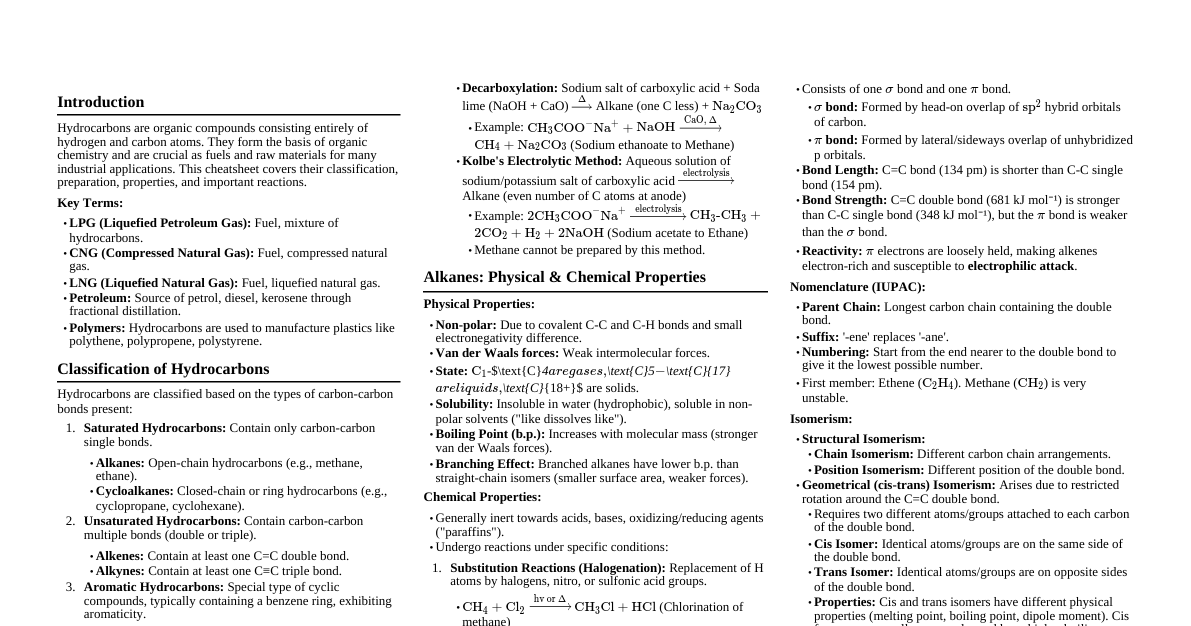
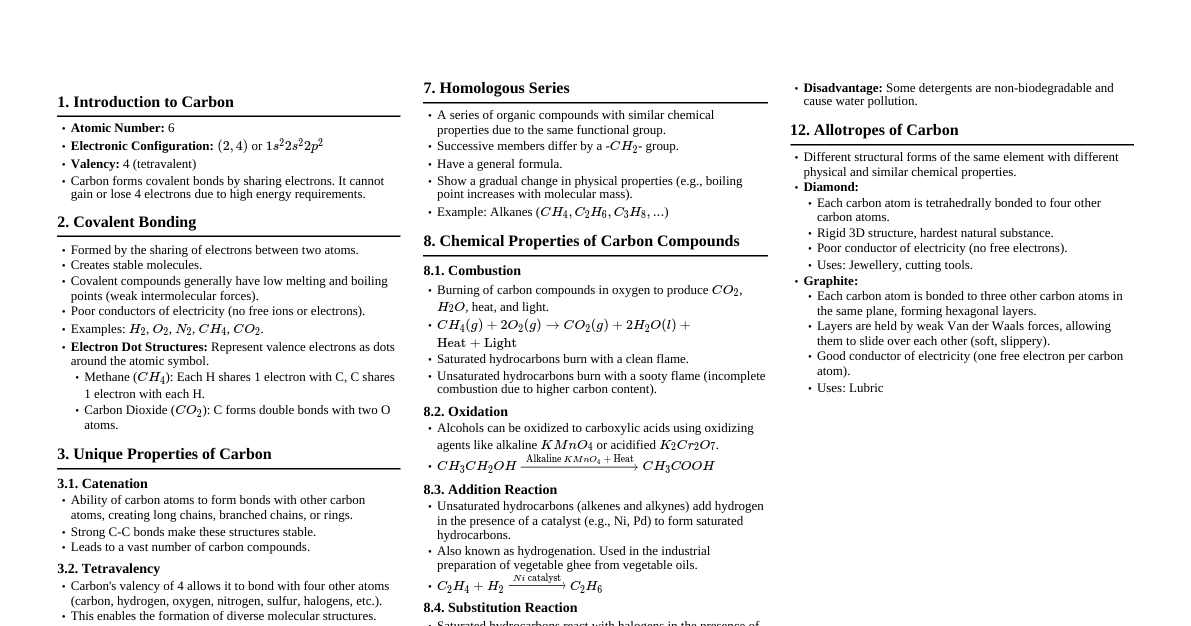
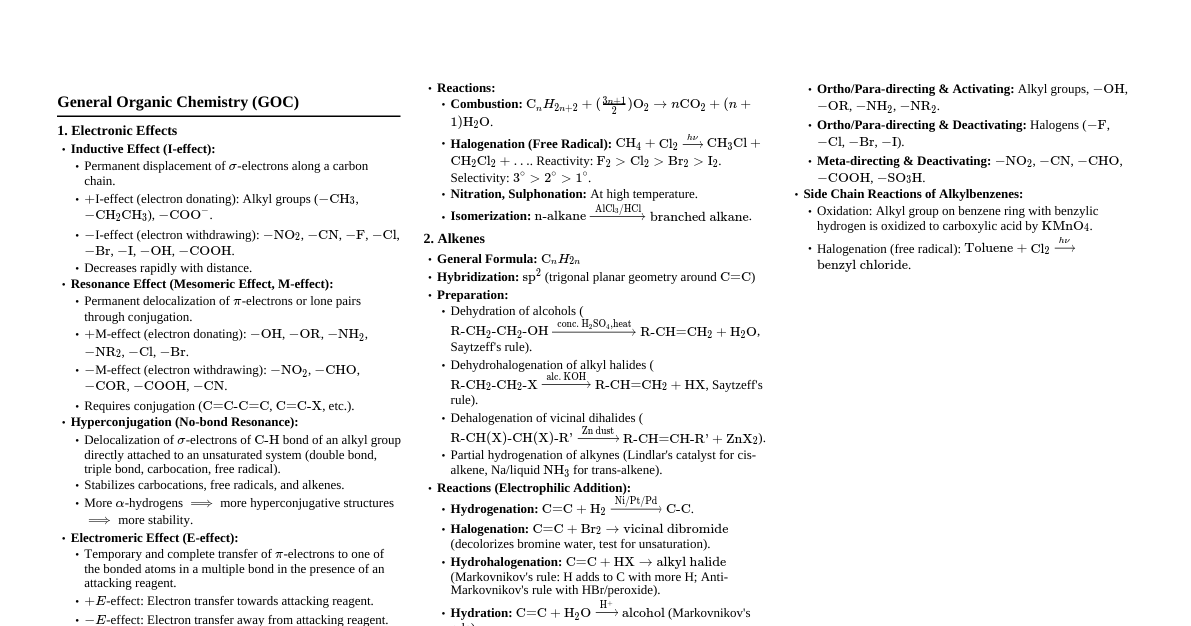
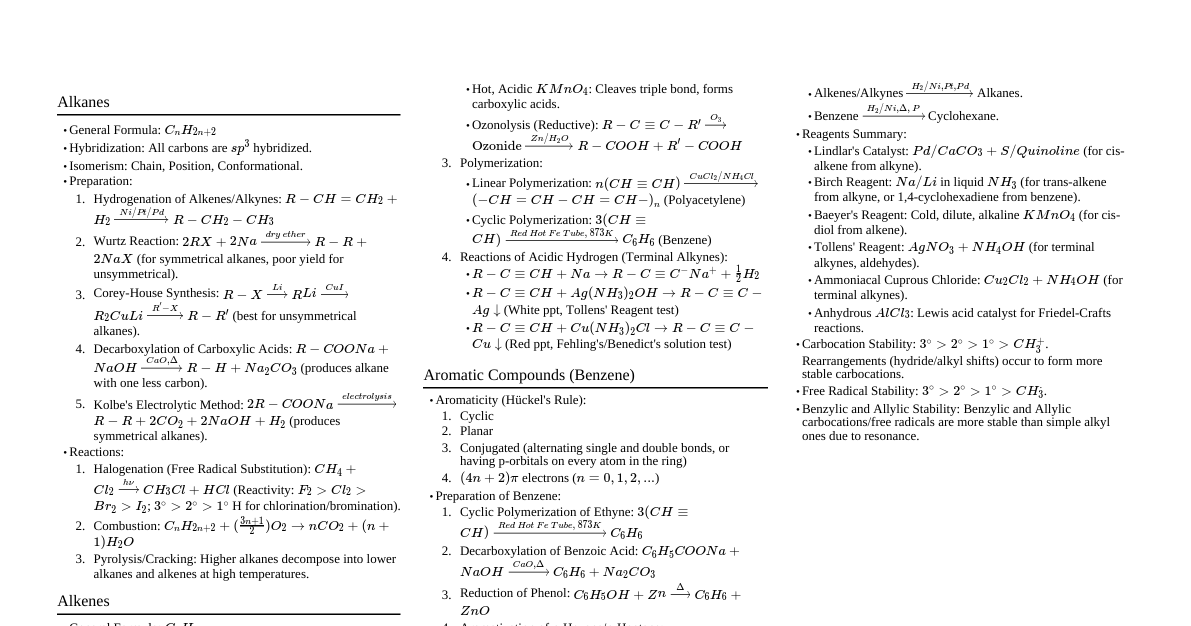
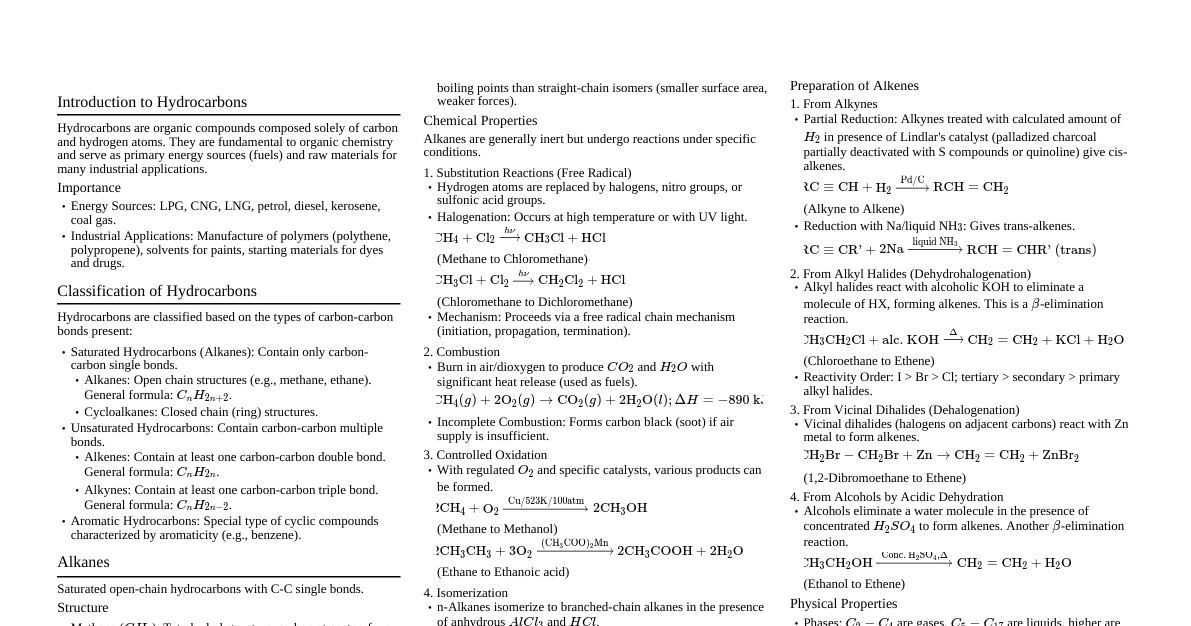
### Introduction to Hydrocarbons - **Definition:** Organic compounds composed exclusively of hydrogen and carbon atoms. - **Sources:** Primarily fossil fuels (petroleum, natural gas, coal) and biomass. - **Classification:** Categorized by their structure and bonding: - **Aliphatic:** Open-chain or cyclic, non-aromatic. - **Aromatic:** Containing benzene rings. ### Alkanes (Saturated Hydrocarbons) - **General Formula:** $C_nH_{2n+2}$ - **Bonding:** All carbon-carbon bonds are single bonds (sp$^3$ hybridization). - **Structure:** Can be straight-chain, branched, or cyclic. - **Nomenclature (IUPAC):** 1. Find the longest continuous carbon chain (parent chain). 2. Number the carbon atoms in the parent chain starting from the end closest to the first substituent. 3. Name substituents (alkyl groups: methyl, ethyl, propyl, etc.). 4. List substituents alphabetically with their position numbers. Use prefixes (di-, tri-, tetra-) for multiple identical substituents. 5. Examples: - Methane ($CH_4$) - Ethane ($C_2H_6$) - Propane ($C_3H_8$) - Butane ($C_4H_{10}$) - 2-Methylpropane (isobutane) - **Cycloalkanes:** - **General Formula:** $C_nH_{2n}$ - **Examples:** Cyclopropane, Cyclobutane, Cyclopentane, Cyclohexane. - **Conformations:** Cyclohexane exists in chair and boat forms, with chair being more stable. - **Physical Properties:** - Nonpolar, only London dispersion forces. - Low boiling and melting points (increase with chain length). - Insoluble in water, soluble in nonpolar solvents. - Less dense than water. - **Chemical Properties (Reactions):** - **Combustion:** React with $O_2$ to produce $CO_2$ and $H_2O$. (e.g., $CH_4 + 2O_2 \rightarrow CO_2 + 2H_2O$) - **Halogenation (Free Radical Substitution):** Reaction with halogens ($Cl_2$, $Br_2$) in the presence of UV light or heat. - Initiation: $Cl_2 \xrightarrow{UV} 2Cl \cdot$ - Propagation: $CH_4 + Cl \cdot \rightarrow CH_3 \cdot + HCl$ - Propagation: $CH_3 \cdot + Cl_2 \rightarrow CH_3Cl + Cl \cdot$ - Termination: $Cl \cdot + Cl \cdot \rightarrow Cl_2$ ### Alkenes (Unsaturated Hydrocarbons) - **General Formula:** $C_nH_{2n}$ - **Bonding:** Contain at least one carbon-carbon double bond (sp$^2$ hybridization). - **Structure:** Planar geometry around the double bond. - **Nomenclature (IUPAC):** 1. Longest chain containing the double bond is the parent chain (suffix -ene). 2. Number chain to give double bond the lowest possible number. 3. Indicate position of double bond with a number. 4. Cis-Trans Isomerism (Geometric Isomerism): Occurs when each carbon of the double bond is attached to two different groups. - **Cis:** Identical groups on the same side of the double bond. - **Trans:** Identical groups on opposite sides of the double bond. - **Examples:** - Ethene (Ethylene) - Propene (Propylene) - But-1-ene, But-2-ene (cis- and trans- isomers) - **Physical Properties:** Similar to alkanes, but boiling points slightly higher for comparable size due to $\pi$-electron polarizability. - **Chemical Properties (Reactions - Electrophilic Addition):** - **Hydrogenation:** Addition of $H_2$ across the double bond (catalyst: Pt, Pd, Ni). - $CH_2=CH_2 + H_2 \xrightarrow{Ni} CH_3-CH_3$ - **Halogenation:** Addition of $X_2$ ($Cl_2$, $Br_2$) across the double bond. - $CH_2=CH_2 + Br_2 \rightarrow CH_2Br-CH_2Br$ (Decolorizes bromine water, test for unsaturation) - **Hydrohalogenation:** Addition of $HX$ ($HCl$, $HBr$) across the double bond. - **Markovnikov's Rule:** The hydrogen adds to the carbon with more hydrogens already, and the halogen adds to the carbon with fewer hydrogens. - $CH_3-CH=CH_2 + HBr \rightarrow CH_3-CHBr-CH_3$ (major product) - **Hydration:** Addition of $H_2O$ in the presence of an acid catalyst ($H_2SO_4$) to form an alcohol (Markovnikov addition). - $CH_2=CH_2 + H_2O \xrightarrow{H_2SO_4} CH_3-CH_2OH$ - **Polymerization:** Alkenes can link together to form long-chain polymers (e.g., polyethylene from ethene). ### Alkynes (Unsaturated Hydrocarbons) - **General Formula:** $C_nH_{2n-2}$ - **Bonding:** Contain at least one carbon-carbon triple bond (sp hybridization). - **Structure:** Linear geometry around the triple bond. - **Nomenclature (IUPAC):** 1. Longest chain containing the triple bond is the parent chain (suffix -yne). 2. Number chain to give triple bond the lowest possible number. - **Examples:** - Ethyne (Acetylene) - Propyne - **Physical Properties:** Similar to alkanes and alkenes, generally higher boiling points than comparable alkanes/alkenes due to linear shape allowing better packing. - **Chemical Properties (Reactions - Electrophilic Addition):** - Undergo similar addition reactions to alkenes, but can add two equivalents of reagents across the triple bond. - **Hydrogenation:** - $CH \equiv CH + H_2 \xrightarrow{Pd} CH_2=CH_2$ - $CH_2=CH_2 + H_2 \xrightarrow{Pd} CH_3-CH_3$ (Complete saturation) - Partial hydrogenation to cis-alkene using Lindlar's catalyst. - **Halogenation:** - $CH \equiv CH + Br_2 \rightarrow CHBr=CHBr$ - $CHBr=CHBr + Br_2 \rightarrow CHBr_2-CHBr_2$ - **Hydrohalogenation:** - $CH \equiv CH + HBr \rightarrow CH_2=CHBr$ - $CH_2=CHBr + HBr \rightarrow CH_3-CHBr_2$ (Markovnikov's rule twice) - **Acidity of Terminal Alkynes:** - Terminal alkynes (RC≡CH) are weakly acidic due to the sp-hybridized carbon, which makes the C-H bond more polar. - Can react with strong bases (e.g., $NaNH_2$) to form acetylide anions. - $RC \equiv CH + NaNH_2 \rightarrow RC \equiv C^-Na^+ + NH_3$ ### Aromatic Hydrocarbons (Arenes) - **Definition:** Cyclic, planar compounds with delocalized $\pi$ electrons, exhibiting enhanced stability (aromaticity). - **Hückel's Rule:** A compound is aromatic if it is cyclic, planar, fully conjugated, and has $(4n+2)$ $\pi$ electrons (where n = 0, 1, 2...). - **Benzene ($C_6H_6$):** The simplest aromatic hydrocarbon. - Resonance stabilized, C-C bond lengths are intermediate between single and double bonds. - Planar hexagonal structure. - **Nomenclature:** - **Monosubstituted benzenes:** Toluene (methylbenzene), Phenol (hydroxybenzene), Aniline (aminobenzene). - **Disubstituted benzenes:** Use ortho- (1,2), meta- (1,3), para- (1,4) prefixes or numbers. - **Polysubstituted benzenes:** Number the ring to give substituents the lowest possible numbers. - **Polycyclic Aromatic Hydrocarbons (PAHs):** Naphthalene, Anthracene, Phenanthrene. - **Chemical Properties (Reactions - Electrophilic Aromatic Substitution, EAS):** - Benzene does NOT undergo addition reactions easily due to aromatic stability. - **Nitration:** Reaction with nitric acid ($HNO_3$) and sulfuric acid ($H_2SO_4$). - Benzene + $HNO_3 \xrightarrow{H_2SO_4} $ Nitrobenzene + $H_2O$ - **Halogenation:** Reaction with $X_2$ ($Cl_2$, $Br_2$) and a Lewis acid catalyst ($FeCl_3$, $FeBr_3$). - Benzene + $Br_2 \xrightarrow{FeBr_3} $ Bromobenzene + $HBr$ - **Sulfonation:** Reaction with fuming sulfuric acid ($H_2SO_4 + SO_3$). - Benzene + $H_2SO_4/SO_3 \rightarrow $ Benzenesulfonic acid + $H_2O$ - **Friedel-Crafts Alkylation:** Reaction with an alkyl halide ($R-X$) and a Lewis acid catalyst ($AlCl_3$). - Benzene + $CH_3Cl \xrightarrow{AlCl_3} $ Toluene + $HCl$ (Can undergo polyalkylation and rearrangements) - **Friedel-Crafts Acylation:** Reaction with an acyl halide ($RCO-X$) or acid anhydride and a Lewis acid catalyst ($AlCl_3$). - Benzene + $CH_3COCl \xrightarrow{AlCl_3} $ Acetophenone + $HCl$ (No rearrangements, no polyacylation) - **Substituent Effects on EAS:** - **Activating Groups:** Electron-donating groups (e.g., $-OH, -NH_2, -CH_3$) increase reactivity and direct *ortho/para*. - **Deactivating Groups:** Electron-withdrawing groups (e.g., $-NO_2, -COOH, -SO_3H$) decrease reactivity and direct *meta*. - **Halogens:** Deactivating but *ortho/para* directing (due to resonance effects). ### Common Functional Groups (Containing C, H, O, N, X) | Functional Group | General Formula | Example | |------------------|-----------------|---------| | Alkane | $R-H$ | Ethane ($CH_3CH_3$) | | Alkene | $R_2C=CR_2$ | Ethene ($CH_2=CH_2$) | | Alkyne | $RC \equiv CR'$ | Ethyne ($HC \equiv CH$) | | Aromatic (Arene) | $Ar-H$ | Benzene | | Alcohol | $R-OH$ | Ethanol ($CH_3CH_2OH$) | | Ether | $R-O-R'$ | Diethyl ether ($CH_3CH_2OCH_2CH_3$) | | Aldehyde | $R-CHO$ | Ethanal ($CH_3CHO$) | | Ketone | $R-CO-R'$ | Propanone ($CH_3COCH_3$) | | Carboxylic Acid | $R-COOH$ | Ethanoic acid ($CH_3COOH$) | | Ester | $R-COOR'$ | Ethyl ethanoate ($CH_3COOCH_2CH_3$) | | Amine | $R-NH_2$ | Methylamine ($CH_3NH_2$) | | Amide | $R-CONH_2$ | Ethanamide ($CH_3CONH_2$) | | Alkyl Halide | $R-X$ | Chloromethane ($CH_3Cl$) | ### Isomerism - **Definition:** Compounds with the same molecular formula but different structural formulas or spatial arrangements of atoms. - **Structural Isomers (Constitutional Isomers):** Different connectivity of atoms. - **Chain Isomers:** Different arrangement of the carbon skeleton (e.g., n-butane vs. isobutane). - **Positional Isomers:** Same carbon skeleton, but different position of functional group or substituent (e.g., but-1-ene vs. but-2-ene). - **Functional Group Isomers:** Different functional groups (e.g., ethanol vs. dimethyl ether). - **Stereoisomers:** Same connectivity, but different spatial arrangement of atoms. - **Geometric Isomers (cis-trans):** Restricted rotation around a double bond or in a ring (discussed under Alkenes). - **Optical Isomers (Enantiomers):** Non-superimposable mirror images. Requires a chiral center (carbon with four different groups attached). - **Chiral Center:** A carbon atom bonded to four different groups. - **Enantiomers:** Pair of optical isomers. - **Diastereomers:** Stereoisomers that are not mirror images. - **Racemic Mixture:** An equimolar mixture of two enantiomers (optically inactive). - **Specific Rotation:** $[\alpha]_D = \frac{\alpha}{l \times c}$ (where $\alpha$ is observed rotation, $l$ is path length, $c$ is concentration). ### Basic Spectroscopy for Hydrocarbons - **Infrared (IR) Spectroscopy:** - Detects functional groups by their characteristic bond vibrations. - **C-H stretches:** - Alkanes: ~2850-2960 cm$^{-1}$ (sp$^3$) - Alkenes: ~3020-3100 cm$^{-1}$ (sp$^2$) - Alkynes: ~3300 cm$^{-1}$ (sp, terminal alkyne) - Aromatics: ~3030 cm$^{-1}$ (sp$^2$) - **C=C stretch:** ~1620-1680 cm$^{-1}$ (alkenes) - **C$\equiv$C stretch:** ~2100-2260 cm$^{-1}$ (alkynes) - **Aromatic overtones/out-of-plane bending:** ~690-900 cm$^{-1}$ (fingerprint region) - **Nuclear Magnetic Resonance (NMR) Spectroscopy:** - Provides information about the carbon-hydrogen framework. - **$^1$H NMR (Proton NMR):** - **Chemical Shift ($\delta$):** Position of signal (ppm), indicates electronic environment. - Alkanes: ~0.9-1.7 ppm - Allylic H: ~1.7-2.3 ppm - Vinylic H: ~4.5-6.0 ppm - Acetylenic H: ~2.0-3.0 ppm - Aromatic H: ~6.5-8.0 ppm - **Integration:** Area under signal, proportional to number of equivalent protons. - **Multiplicity (Splitting):** (n+1) rule, where n is number of equivalent adjacent protons. (e.g., doublet, triplet, quartet). - **$^{13}$C NMR (Carbon NMR):** - **Chemical Shift ($\delta$):** Position of signal (ppm), indicates electronic environment of carbon atoms. - Alkanes: ~0-50 ppm - Alkenes: ~100-150 ppm - Alkynes: ~65-90 ppm - Aromatics: ~120-170 ppm - Each chemically distinct carbon gives a signal. - **Mass Spectrometry (MS):** - Determines molecular weight and provides structural information from fragmentation patterns. - **Molecular Ion ($M^+$):** Peak corresponding to the intact molecule. - **Fragmentation:** Breaking of bonds leads to smaller ions, characteristic patterns useful for identification.