Hydrocarbons Cheatsheet
Cheatsheet Content
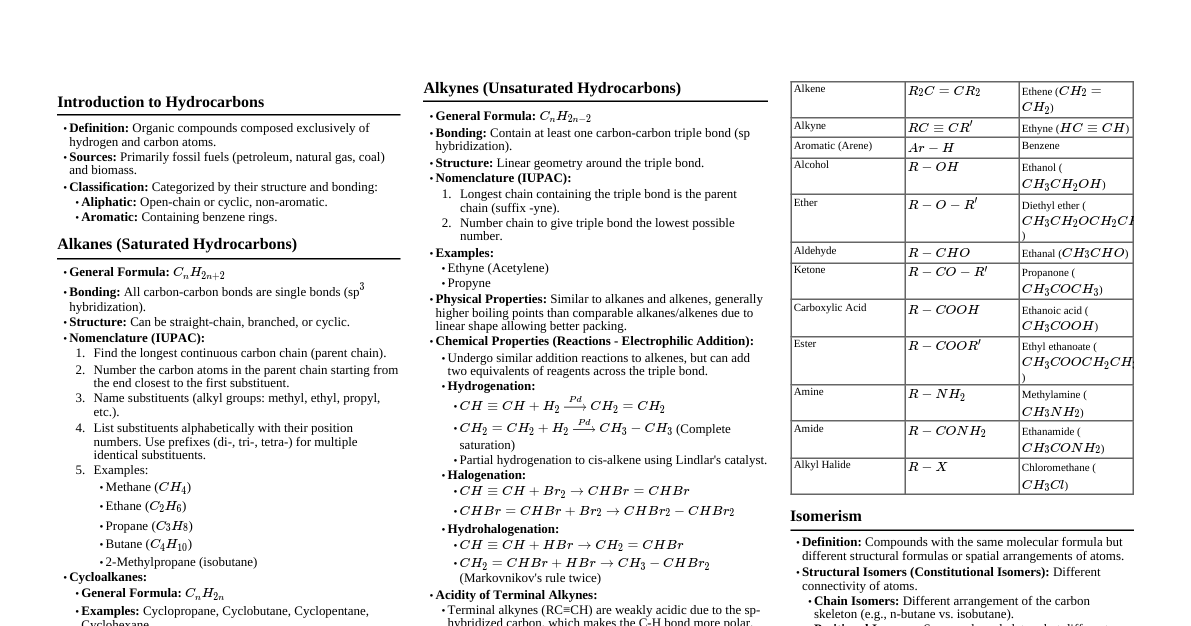
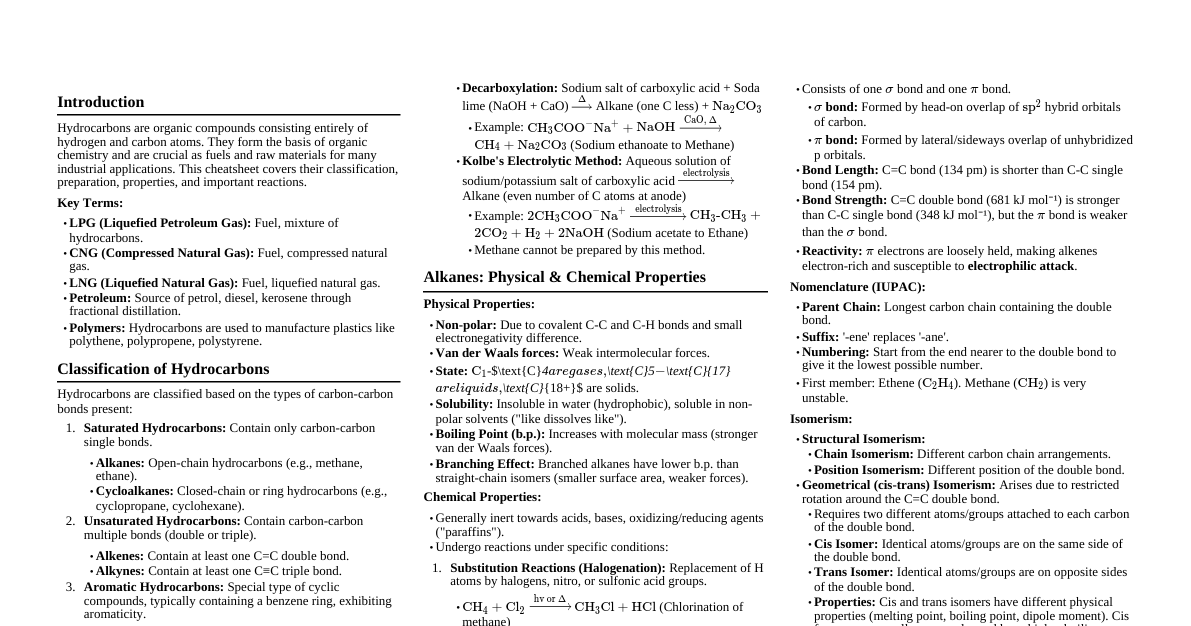
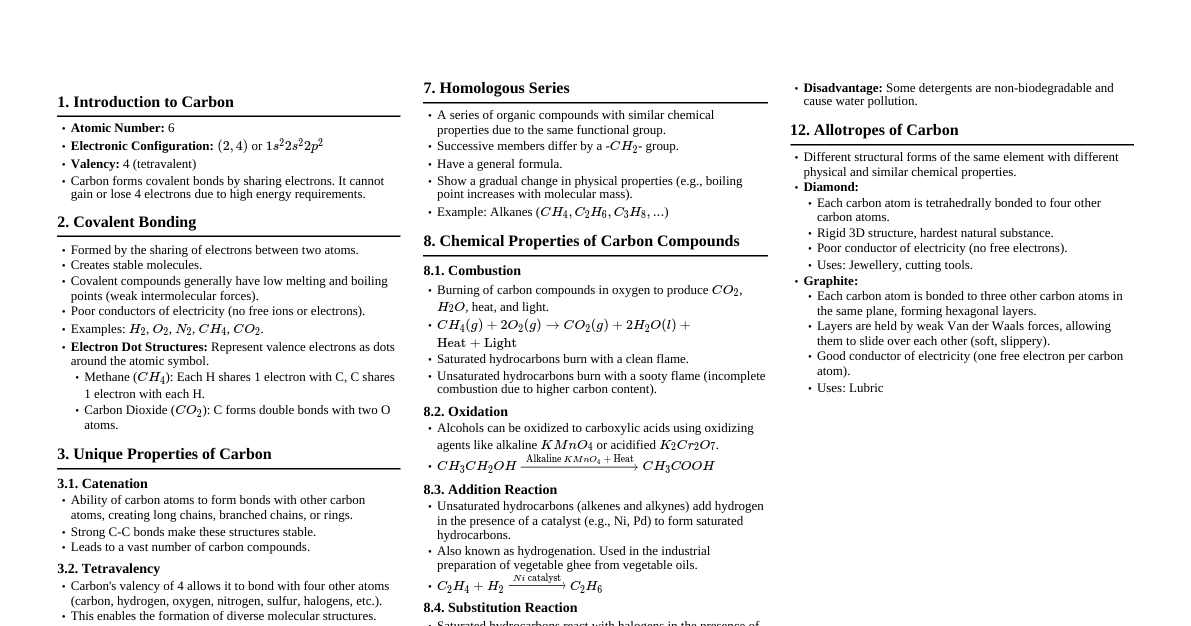
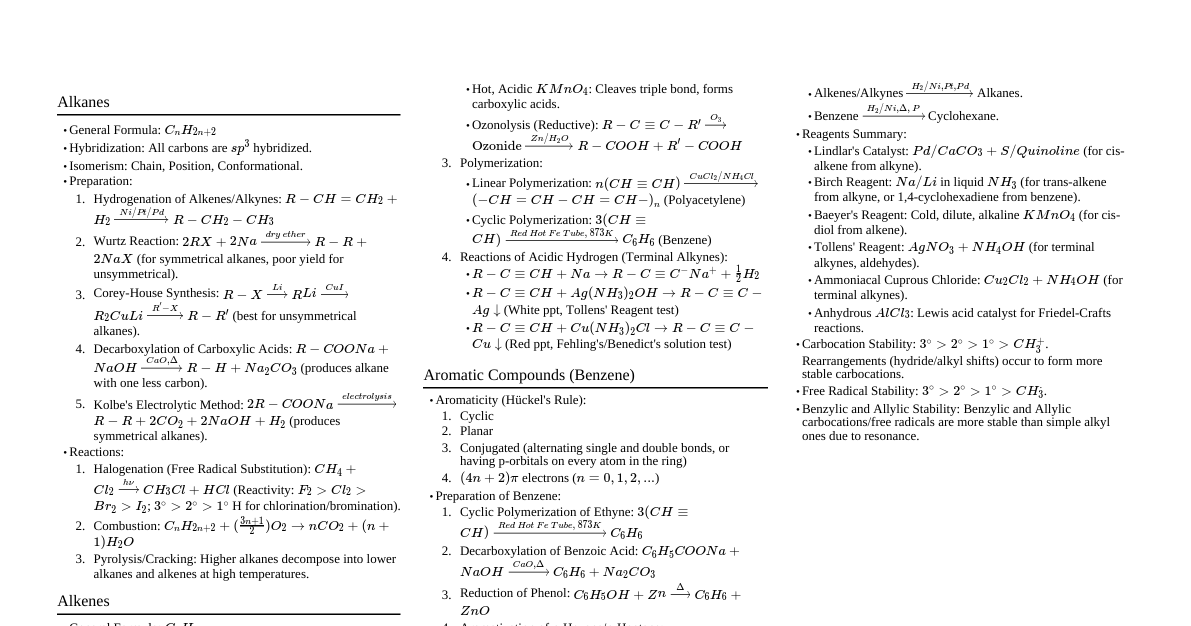
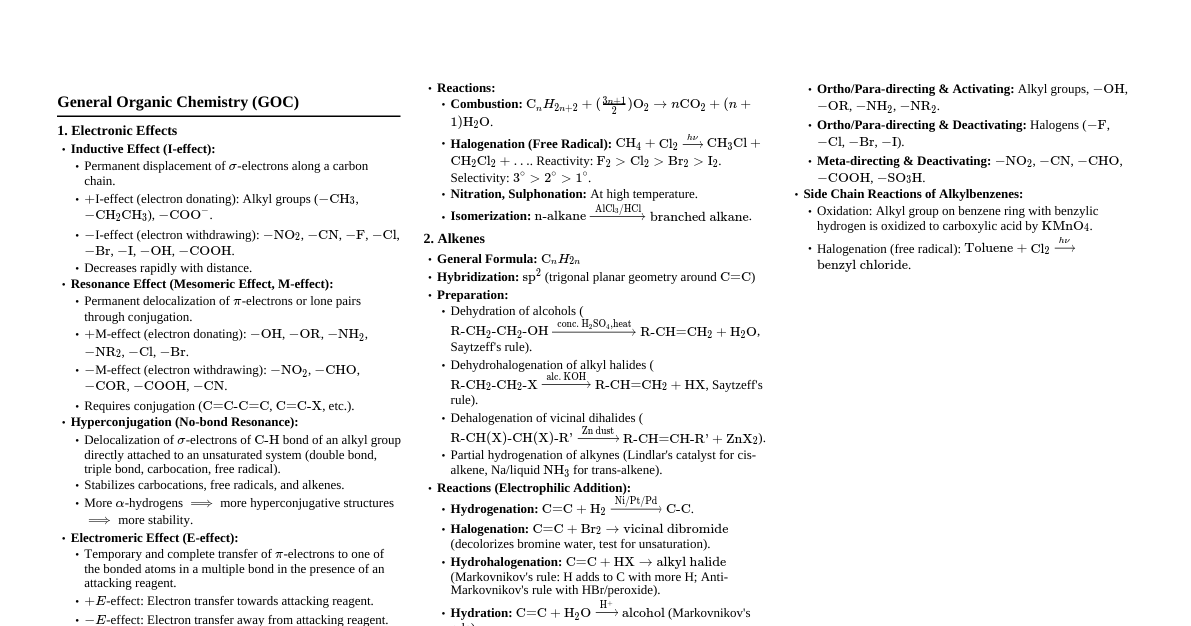
### Introduction to Hydrocarbons Hydrocarbons are organic compounds composed solely of carbon and hydrogen atoms. They are fundamental to organic chemistry and serve as primary energy sources (fuels) and raw materials for many industrial applications. #### Importance - **Energy Sources:** LPG, CNG, LNG, petrol, diesel, kerosene, coal gas. - **Industrial Applications:** Manufacture of polymers (polythene, polypropene), solvents for paints, starting materials for dyes and drugs. ### Classification of Hydrocarbons Hydrocarbons are classified based on the types of carbon-carbon bonds present: - **Saturated Hydrocarbons (Alkanes):** Contain only carbon-carbon single bonds. - **Alkanes:** Open chain structures (e.g., methane, ethane). General formula: $C_nH_{2n+2}$. - **Cycloalkanes:** Closed chain (ring) structures. - **Unsaturated Hydrocarbons:** Contain carbon-carbon multiple bonds. - **Alkenes:** Contain at least one carbon-carbon double bond. General formula: $C_nH_{2n}$. - **Alkynes:** Contain at least one carbon-carbon triple bond. General formula: $C_nH_{2n-2}$. - **Aromatic Hydrocarbons:** Special type of cyclic compounds characterized by aromaticity (e.g., benzene). ### Alkanes Saturated open-chain hydrocarbons with C-C single bonds. #### Structure - **Methane ($CH_4$):** Tetrahedral structure, carbon at center, four hydrogens at corners. H-C-H bond angle $109.5^\circ$. - **Alkanes:** C-C bond length $154 \text{ pm}$, C-H bond length $112 \text{ pm}$. C-C and C-H $\sigma$ bonds formed by $sp^3$ hybrid orbitals of carbon and $1s$ orbitals of hydrogen. #### Nomenclature and Isomerism - **Nomenclature:** Follows IUPAC system (refer to Unit 8 for detailed rules). - **Isomerism:** - **Butane ($C_4H_{10}$):** Exhibits two structural isomers (n-butane, isobutane). - **Pentane ($C_5H_{12}$):** Exhibits three structural isomers (n-pentane, isopentane, neopentane). - **Chain Isomers:** Differ in the chain of carbon atoms. - **Carbon Atom Classification:** - **Primary ($1^\circ$):** Attached to no other or only one carbon atom. - **Secondary ($2^\circ$):** Attached to two carbon atoms. - **Tertiary ($3^\circ$):** Attached to three carbon atoms. - **Quaternary ($4^\circ$):** Attached to four carbon atoms. #### Preparation of Alkanes ##### 1. From Unsaturated Hydrocarbons (Hydrogenation) - Alkenes and alkynes add dihydrogen gas in the presence of catalysts (Pt, Pd, or Ni) to form alkanes. - **Example:** $$\text{CH}_2=\text{CH}_2 + \text{H}_2 \xrightarrow{\text{Pt/Pd/Ni}} \text{CH}_3-\text{CH}_3$$ (Ethene to Ethane) $$\text{CH}_3-\text{C}\equiv\text{C}-\text{H} + 2\text{H}_2 \xrightarrow{\text{Pt/Pd/Ni}} \text{CH}_3-\text{CH}_2-\text{CH}_3$$ (Propyne to Propane) ##### 2. From Alkyl Halides - **Reduction:** Alkyl halides (except fluorides) react with Zn and dilute HCl to give alkanes. $$\text{CH}_3-\text{Cl} + \text{H}_2 \xrightarrow{\text{Zn, H}^+} \text{CH}_4 + \text{HCl}$$ (Chloromethane to Methane) - **Wurtz Reaction:** Alkyl halides react with sodium metal in dry ether to form higher alkanes with an even number of carbon atoms. $$2\text{CH}_3-\text{Br} + 2\text{Na} \xrightarrow{\text{dry ether}} \text{CH}_3-\text{CH}_3 + 2\text{NaBr}$$ (Bromomethane to Ethane) ##### 3. From Carboxylic Acids - **Decarboxylation:** Sodium salts of carboxylic acids are heated with soda lime (NaOH + CaO) to yield alkanes with one carbon atom less. $$\text{CH}_3\text{COO}^-\text{Na}^+ + \text{NaOH} \xrightarrow{\Delta, \text{CaO}} \text{CH}_4 + \text{Na}_2\text{CO}_3$$ (Sodium ethanoate to Methane) - **Kolbe's Electrolytic Method:** Electrolysis of aqueous solutions of sodium or potassium salts of carboxylic acids gives alkanes (even number of carbon atoms) at the anode. $$2\text{CH}_3\text{COO}^-\text{Na}^+ + 2\text{H}_2\text{O} \xrightarrow{\text{Electrolysis}} \text{CH}_3-\text{CH}_3 + 2\text{CO}_2 + \text{H}_2 + 2\text{NaOH}$$ (Sodium acetate to Ethane) #### Physical Properties - **Non-polar:** Due to covalent C-C and C-H bonds and small electronegativity difference. - **Phases:** $C_1-C_4$ are gases, $C_5-C_{17}$ are liquids, $C_{18}$ and higher are solids at $298 \text{ K}$. - **Colorless and Odorless.** - **Insoluble in water:** Hydrophobic. Soluble in non-polar solvents. - **Boiling Point:** Increases with molecular mass (due to increased van der Waals forces). Branched-chain alkanes have lower boiling points than straight-chain isomers (smaller surface area, weaker forces). #### Chemical Properties Alkanes are generally inert but undergo reactions under specific conditions. ##### 1. Substitution Reactions (Free Radical) - Hydrogen atoms are replaced by halogens, nitro groups, or sulfonic acid groups. - **Halogenation:** Occurs at high temperature or with UV light. $$\text{CH}_4 + \text{Cl}_2 \xrightarrow{h\nu} \text{CH}_3\text{Cl} + \text{HCl}$$ (Methane to Chloromethane) $$\text{CH}_3\text{Cl} + \text{Cl}_2 \xrightarrow{h\nu} \text{CH}_2\text{Cl}_2 + \text{HCl}$$ (Chloromethane to Dichloromethane) - **Mechanism:** Proceeds via a free radical chain mechanism (initiation, propagation, termination). ##### 2. Combustion - Burn in air/dioxygen to produce $CO_2$ and $H_2O$ with significant heat release (used as fuels). $$\text{CH}_4(g) + 2\text{O}_2(g) \rightarrow \text{CO}_2(g) + 2\text{H}_2\text{O}(l); \Delta H= -890 \text{ kJ mol}^{-1}$$ - **Incomplete Combustion:** Forms carbon black (soot) if air supply is insufficient. ##### 3. Controlled Oxidation - With regulated $O_2$ and specific catalysts, various products can be formed. $$2\text{CH}_4 + \text{O}_2 \xrightarrow{\text{Cu/523K/100atm}} 2\text{CH}_3\text{OH}$$ (Methane to Methanol) $$2\text{CH}_3\text{CH}_3 + 3\text{O}_2 \xrightarrow{(\text{CH}_3\text{COO})_2\text{Mn}} 2\text{CH}_3\text{COOH} + 2\text{H}_2\text{O}$$ (Ethane to Ethanoic acid) ##### 4. Isomerization - n-Alkanes isomerize to branched-chain alkanes in the presence of anhydrous $AlCl_3$ and $HCl$. $$\text{CH}_3(\text{CH}_2)_4\text{CH}_3 \xrightarrow{\text{Anhy. AlCl}_3/\text{HCl}} \text{CH}_3\text{CH}(\text{CH}_3)\text{CH}_2\text{CH}_2\text{CH}_3 + \text{CH}_3\text{CH}_2\text{CH}(\text{CH}_3)\text{CH}_2\text{CH}_3$$ (n-Hexane to 2-Methylpentane and 3-Methylpentane) ##### 5. Aromatization - n-Alkanes with six or more carbon atoms, when heated to $773 \text{ K}$ at $10-20 \text{ atm}$ in the presence of oxides of V, Mo, or Cr supported on alumina, dehydrogenate and cyclize to benzene and its homologues. $$\text{CH}_3(\text{CH}_2)_4\text{CH}_3 \xrightarrow{\text{Cr}_2\text{O}_3 \text{ or V}_2\text{O}_5 \text{ or Mo}_2\text{O}_3 / 773\text{K}} \text{C}_6\text{H}_6 + 4\text{H}_2$$ (n-Hexane to Benzene) ##### 6. Reaction with Steam - Methane reacts with steam at $1273 \text{ K}$ in the presence of nickel catalyst to form $CO$ and $H_2$. $$\text{CH}_4 + \text{H}_2\text{O} \xrightarrow{\text{Ni}/1273\text{K}} \text{CO} + 3\text{H}_2$$ ##### 7. Pyrolysis (Cracking) - Higher alkanes decompose into lower alkanes, alkenes, etc., upon heating. A free radical reaction. $$\text{C}_6\text{H}_{14} \xrightarrow{773\text{K}} \text{C}_6\text{H}_{12} + \text{H}_2$$ (Hexane to Hexene) $$\text{C}_{12}\text{H}_{26} \xrightarrow{\text{Pt/Pd/Ni}/973\text{K}} \text{C}_7\text{H}_{16} + \text{C}_5\text{H}_{10}$$ (Dodecane to Heptane + Pentene) #### Conformations of Ethane - **Conformations:** Different spatial arrangements of atoms that can be interconverted by rotation around C-C single bonds. - **Torsional Strain:** Repulsive interaction between adjacent bonds, hindering free rotation. - **Eclipsed Conformation:** Hydrogens on adjacent carbons are as close as possible (maximum torsional strain, least stable). - **Staggered Conformation:** Hydrogens on adjacent carbons are as far apart as possible (minimum torsional strain, most stable). - **Skew Conformation:** Intermediate between eclipsed and staggered. - **Representations:** Sawhorse and Newman projections. ### Alkenes Unsaturated hydrocarbons containing at least one C=C double bond. General formula: $C_nH_{2n}$. Also known as olefins. #### Structure of Double Bond - Consists of one strong $\sigma$ bond (head-on overlap of $sp^2$ hybrid orbitals) and one weak $\pi$ bond (sideways overlap of $2p$ orbitals). - **Bond Length:** C=C bond ($134 \text{ pm}$) is shorter than C-C single bond ($154 \text{ pm}$). - **Reactivity:** The $\pi$ bond makes alkenes a source of loosely held mobile electrons, making them susceptible to attack by electrophilic reagents. #### Nomenclature and Isomerism - **Nomenclature:** Longest chain containing the double bond is selected. Suffix 'ene'. - **Structural Isomerism:** Similar to alkanes, but higher alkenes have more structures. - **Geometrical Isomerism (cis-trans):** Due to restricted rotation around the C=C double bond. - If two identical atoms/groups are on the same side of the double bond, it's a **cis-isomer**. - If two identical atoms/groups are on opposite sides, it's a **trans-isomer**. - **Properties:** Cis-isomers are generally more polar and have lower melting points than trans-isomers. #### Preparation of Alkenes ##### 1. From Alkynes - **Partial Reduction:** Alkynes treated with calculated amount of $H_2$ in presence of Lindlar's catalyst (palladized charcoal partially deactivated with S compounds or quinoline) give **cis-alkenes**. $$\text{RC}\equiv\text{CH} + \text{H}_2 \xrightarrow{\text{Pd/C}} \text{RCH}=\text{CH}_2$$ (Alkyne to Alkene) - **Reduction with Na/liquid NH$_3$:** Gives **trans-alkenes**. $$\text{RC}\equiv\text{CR'} + 2\text{Na} \xrightarrow{\text{liquid NH}_3} \text{RCH}=\text{CHR'} \text{ (trans)}$$ ##### 2. From Alkyl Halides (Dehydrohalogenation) - Alkyl halides react with alcoholic KOH to eliminate a molecule of HX, forming alkenes. This is a $\beta$-elimination reaction. $$\text{CH}_3\text{CH}_2\text{Cl} + \text{alc. KOH} \xrightarrow{\Delta} \text{CH}_2=\text{CH}_2 + \text{KCl} + \text{H}_2\text{O}$$ (Chloroethane to Ethene) - **Reactivity Order:** I > Br > Cl; tertiary > secondary > primary alkyl halides. ##### 3. From Vicinal Dihalides (Dehalogenation) - Vicinal dihalides (halogens on adjacent carbons) react with Zn metal to form alkenes. $$\text{CH}_2\text{Br}-\text{CH}_2\text{Br} + \text{Zn} \rightarrow \text{CH}_2=\text{CH}_2 + \text{ZnBr}_2$$ (1,2-Dibromoethane to Ethene) ##### 4. From Alcohols by Acidic Dehydration - Alcohols eliminate a water molecule in the presence of concentrated $H_2SO_4$ to form alkenes. Another $\beta$-elimination reaction. $$\text{CH}_3\text{CH}_2\text{OH} \xrightarrow{\text{Conc. H}_2\text{SO}_4, \Delta} \text{CH}_2=\text{CH}_2 + \text{H}_2\text{O}$$ (Ethanol to Ethene) #### Physical Properties - **Phases:** $C_2-C_4$ are gases, $C_5-C_{17}$ are liquids, higher are solids. - **Colorless and Odorless** (except ethene, faint sweet smell). - **Insoluble in water, soluble in non-polar solvents.** - **Boiling Point:** Increases with molecular mass. Straight-chain alkenes have higher boiling points than branched isomers. #### Chemical Properties Alkenes are rich in $\pi$ electrons and primarily undergo addition reactions. ##### 1. Addition of Dihydrogen (Hydrogenation) - Same as alkane preparation. $$\text{CH}_2=\text{CH}_2 + \text{H}_2 \xrightarrow{\text{Ni/Pt/Pd}} \text{CH}_3-\text{CH}_3$$ ##### 2. Addition of Halogens - Halogens (Cl$_2$, Br$_2$) add to alkenes to form vicinal dihalides. This is an electrophilic addition reaction. $$\text{CH}_2=\text{CH}_2 + \text{Br}_2 \xrightarrow{\text{CCl}_4} \text{CH}_2\text{Br}-\text{CH}_2\text{Br}$$ (Ethene to 1,2-Dibromoethane) - Used as a test for unsaturation (reddish-orange color of bromine solution disappears). ##### 3. Addition of Hydrogen Halides (HCl, HBr, HI) - Form alkyl halides. Reactivity: HI > HBr > HCl. - **Symmetrical Alkenes:** $$\text{CH}_2=\text{CH}_2 + \text{HBr} \rightarrow \text{CH}_3-\text{CH}_2\text{Br}$$ - **Unsymmetrical Alkenes (Markovnikov's Rule):** The negative part of the addendum (e.g., Br$^-$ from HBr) attaches to the carbon atom with fewer hydrogen atoms. $$\text{CH}_3-\text{CH}=\text{CH}_2 + \text{HBr} \rightarrow \text{CH}_3-\text{CH}(\text{Br})-\text{CH}_3$$ (Propene to 2-Bromopropane, major product) - **Anti-Markovnikov Addition (Peroxide Effect/Kharash Effect):** Only with HBr and in the presence of peroxides, the negative part adds to the carbon with more hydrogen atoms. $$\text{CH}_3-\text{CH}=\text{CH}_2 + \text{HBr} \xrightarrow{(\text{C}_6\text{H}_5\text{CO})_2\text{O}_2} \text{CH}_3-\text{CH}_2-\text{CH}_2\text{Br}$$ (Propene to 1-Bromopropane, major product) ##### 4. Addition of Sulphuric Acid - Cold, concentrated $H_2SO_4$ adds according to Markovnikov's rule to form alkyl hydrogen sulfates. $$\text{CH}_2=\text{CH}_2 + \text{HOSO}_2\text{OH} \rightarrow \text{CH}_3-\text{CH}_2-\text{OSO}_2\text{OH}$$ (Ethene to Ethyl hydrogen sulphate) ##### 5. Addition of Water (Hydration) - In the presence of a few drops of concentrated $H_2SO_4$, alkenes react with water to form alcohols (Markovnikov's rule). $$\text{CH}_3-\text{CH}=\text{CH}_2 + \text{H}_2\text{O} \xrightarrow{\text{H}^+} \text{CH}_3-\text{CH}(\text{OH})-\text{CH}_3$$ (Propene to Propan-2-ol) ##### 6. Oxidation - **Baeyer's Reagent (cold, dilute, aqueous $KMnO_4$):** Forms vicinal glycols. $$\text{CH}_2=\text{CH}_2 + \text{H}_2\text{O} + [\text{O}] \xrightarrow{\text{dil. KMnO}_4/273\text{K}} \text{CH}_2\text{OH}-\text{CH}_2\text{OH}$$ (Ethene to Ethane-1,2-diol) - **Acidic $KMnO_4$ or $K_2Cr_2O_7$:** Oxidizes alkenes to ketones and/or acids depending on the structure. $$(\text{CH}_3)_2\text{C}=\text{CH}_2 \xrightarrow{\text{KMnO}_4/\text{H}^+} (\text{CH}_3)_2\text{C}=\text{O} + \text{CO}_2 + \text{H}_2\text{O}$$ (2-Methylpropene to Propan-2-one) ##### 7. Ozonolysis - Alkenes react with ozone to form ozonides, which are then cleaved by Zn-$H_2O$ to smaller molecules (aldehydes or ketones). Useful for locating the double bond position. $$\text{CH}_3\text{CH}=\text{CH}_2 + \text{O}_3 \rightarrow \text{Ozonide} \xrightarrow{\text{Zn/H}_2\text{O}} \text{CH}_3\text{CHO} + \text{HCHO}$$ (Propene to Ethanal + Methanal) ##### 8. Polymerisation - Alkenes combine to form large polymer molecules (e.g., polythene from ethene). $$n\text{CH}_2=\text{CH}_2 \xrightarrow{\text{high temp./pressure, catalyst}} -(\text{CH}_2-\text{CH}_2)_n-$$ (Ethene to Polythene) ### Alkynes Unsaturated hydrocarbons containing at least one C≡C triple bond. General formula: $C_nH_{2n-2}$. #### Structure of Triple Bond - Consists of one $\sigma$ bond (head-on overlap of $sp$ hybrid orbitals) and two $\pi$ bonds (sideways overlap of $2p$ orbitals). - **Bond Length:** C≡C bond ($120 \text{ pm}$) is shorter than C=C ($134 \text{ pm}$) and C-C ($154 \text{ pm}$). - **Geometry:** Ethyne is a linear molecule (H-C≡C bond angle is $180^\circ$). #### Nomenclature and Isomerism - **Nomenclature:** Suffix 'yne'. Position of triple bond indicated by the first triply bonded carbon. - **Isomerism:** - **Position Isomers:** Differ in the position of the triple bond (e.g., but-1-yne and but-2-yne). - **Chain Isomers:** Differ in the carbon chain. #### Preparation of Alkynes ##### 1. From Calcium Carbide - Ethyne is prepared industrially by treating calcium carbide with water. $$\text{CaC}_2 + 2\text{H}_2\text{O} \rightarrow \text{Ca(OH)}_2 + \text{C}_2\text{H}_2$$ (Calcium carbide to Ethyne) ##### 2. From Vicinal Dihalides (Dehydrohalogenation) - Vicinal dihalides undergo dehydrohalogenation with alcoholic KOH, followed by reaction with sodamide ($NaNH_2$) to form alkynes. $$\text{CH}_2\text{Br}-\text{CH}_2\text{Br} + \text{alc. KOH} \rightarrow \text{CH}_2=\text{CHBr} + \text{H}_2\text{O} + \text{KBr}$$ $$\text{CH}_2=\text{CHBr} + \text{NaNH}_2 \rightarrow \text{HC}\equiv\text{CH} + \text{NaBr} + \text{NH}_3$$ (1,2-Dibromoethane to Ethyne) #### Physical Properties - **Phases:** $C_2-C_4$ are gases, next eight are liquids, higher are solids. - **Colorless** (ethyne has characteristic odor). - **Weakly polar, lighter than water, immiscible with water.** - **Boiling Point:** Increases with molar mass. #### Chemical Properties ##### A. Acidic Character of Alkyne - Terminal alkynes (with H attached to a triply bonded carbon) are acidic due to the high electronegativity of $sp$ hybridized carbon. - They react with strong bases like Na or $NaNH_2$ to liberate $H_2$. $$\text{HC}\equiv\text{CH} + \text{Na} \rightarrow \text{HC}\equiv\text{C}^-\text{Na}^+ + \frac{1}{2}\text{H}_2$$ (Ethyne to Monosodium ethynide) - **Acidity Order:** Alkynes > Alkenes > Alkanes. ##### B. Addition Reactions Alkynes undergo addition of two molecules of reagents (e.g., $H_2$, halogens, hydrogen halides). ##### 1. Addition of Dihydrogen (Hydrogenation) - Adds $H_2$ in presence of catalysts to form alkenes, then alkanes. $$\text{HC}\equiv\text{CH} + \text{H}_2 \xrightarrow{\text{Ni/Pt/Pd}} \text{CH}_2=\text{CH}_2 \xrightarrow{\text{H}_2} \text{CH}_3-\text{CH}_3$$ ##### 2. Addition of Halogens - Adds two molecules of halogens to form tetrahaloalkanes. $$\text{CH}_3-\text{C}\equiv\text{CH} + \text{Br}_2 \rightarrow \text{CH}_3-\text{CBr}=\text{CHBr} \xrightarrow{\text{Br}_2} \text{CH}_3-\text{CBr}_2-\text{CHBr}_2$$ (Propyne to 1,1,2,2-Tetrabromopropane) - Used as a test for unsaturation. ##### 3. Addition of Hydrogen Halides - Adds two molecules of hydrogen halides to form gem dihalides (both halogens on the same carbon). Follows Markovnikov's rule. $$\text{H-C}\equiv\text{C-H} + \text{HBr} \rightarrow \text{CH}_2=\text{CHBr} \xrightarrow{\text{HBr}} \text{CH}_3-\text{CHBr}_2$$ (Ethyne to Bromoethene, then 1,1-Dibromoethane) ##### 4. Addition of Water - Adds water in the presence of $Hg^{2+}$ and $H^+$ ($333 \text{ K}$) to form carbonyl compounds (aldehydes or ketones). $$\text{HC}\equiv\text{CH} + \text{H}_2\text{O} \xrightarrow{\text{Hg}^{2+}/\text{H}^+} [\text{CH}_2=\text{CHOH}] \rightarrow \text{CH}_3\text{CHO}$$ (Ethyne to Ethanal via vinyl alcohol intermediate) $$\text{CH}_3-\text{C}\equiv\text{CH} + \text{H}_2\text{O} \xrightarrow{\text{Hg}^{2+}/\text{H}^+} [\text{CH}_3-\text{C}(\text{OH})=\text{CH}_2] \rightarrow \text{CH}_3-\text{CO}-\text{CH}_3$$ (Propyne to Propanone via enol intermediate) ##### C. Polymerisation ##### 1. Linear Polymerisation - Ethyne undergoes linear polymerization to produce polyacetylene, which conducts electricity. $$n\text{HC}\equiv\text{CH} \rightarrow -(\text{CH}=\text{CH}-\text{CH}=\text{CH})_n-$$ ##### 2. Cyclic Polymerisation - Ethyne passes through a red hot iron tube at $873 \text{ K}$ to form benzene. $$3\text{HC}\equiv\text{CH} \xrightarrow{\text{Red hot Fe tube}/873\text{K}} \text{C}_6\text{H}_6$$ (Ethyne to Benzene) ### Aromatic Hydrocarbons (Arenes) Cyclic compounds with special stability due to aromaticity. Most contain a benzene ring (benzenoids). #### Structure of Benzene - **Formula:** $C_6H_6$. - **Kekulé Structure:** Proposed cyclic structure with alternating single and double bonds. Fails to explain unusual stability. - **Resonance:** Benzene is a hybrid of several resonating structures, with delocalized $\pi$ electrons. - **Properties:** Planar, all C-C bond lengths are equal ($139 \text{ pm}$, intermediate between single and double bonds). #### Aromaticity (Hückel's Rule) - Planarity. - Complete delocalization of $\pi$ electrons in the ring. - Presence of $(4n+2)\pi$ electrons, where $n$ is an integer ($0, 1, 2, ...$). Examples: benzene ($6\pi e^-$), naphthalene ($10\pi e^-$). #### Preparation of Benzene ##### 1. Cyclic Polymerisation of Ethyne - As described above. $$3\text{HC}\equiv\text{CH} \xrightarrow{\text{Red hot Fe tube}/873\text{K}} \text{C}_6\text{H}_6$$ ##### 2. Decarboxylation of Aromatic Acids - Sodium salt of benzoic acid heated with soda lime gives benzene. $$\text{C}_6\text{H}_5\text{COONa} + \text{NaOH} \xrightarrow{\Delta, \text{CaO}} \text{C}_6\text{H}_6 + \text{Na}_2\text{CO}_3$$ ##### 3. Reduction of Phenol - Phenol vapors passed over heated zinc dust yield benzene. $$\text{C}_6\text{H}_5\text{OH} + \text{Zn} \xrightarrow{\Delta} \text{C}_6\text{H}_6 + \text{ZnO}$$ #### Physical Properties - Non-polar liquids or solids, characteristic aroma. - Immiscible with water, miscible with organic solvents. - Burn with sooty flame. #### Chemical Properties Arenes primarily undergo electrophilic substitution reactions due to their stability. ##### 1. Electrophilic Substitution Reactions - Attacking reagent is an electrophile ($E^+$). - **Mechanism:** 1. **Generation of Electrophile:** E.g., $Cl_2 + AlCl_3 \rightarrow Cl^+ + AlCl_4^-$. 2. **Formation of Carbocation (Arenium Ion):** Electrophile attacks the benzene ring, forming a resonance-stabilized carbocation. 3. **Removal of Proton:** Proton is removed from the carbocation to restore aromaticity. - **Nitration:** Introduction of a nitro group ($-NO_2$). $$\text{C}_6\text{H}_6 + \text{HNO}_3 (\text{conc.}) \xrightarrow{\text{Conc. H}_2\text{SO}_4/323-333\text{K}} \text{C}_6\text{H}_5\text{NO}_2 + \text{H}_2\text{O}$$ (Benzene to Nitrobenzene) - **Halogenation:** Introduction of a halogen. $$\text{C}_6\text{H}_6 + \text{Cl}_2 \xrightarrow{\text{Anhyd. AlCl}_3} \text{C}_6\text{H}_5\text{Cl} + \text{HCl}$$ (Benzene to Chlorobenzene) - **Sulphonation:** Introduction of a sulfonic acid group ($-SO_3H$). $$\text{C}_6\text{H}_6 + \text{H}_2\text{SO}_4 (\text{fuming}) \rightarrow \text{C}_6\text{H}_5\text{SO}_3\text{H} + \text{H}_2\text{O}$$ (Benzene to Benzenesulfonic acid) - **Friedel-Crafts Alkylation:** Introduction of an alkyl group. $$\text{C}_6\text{H}_6 + \text{CH}_3\text{Cl} \xrightarrow{\text{Anhyd. AlCl}_3} \text{C}_6\text{H}_5\text{CH}_3 + \text{HCl}$$ (Benzene to Toluene) - **Friedel-Crafts Acylation:** Introduction of an acyl group. $$\text{C}_6\text{H}_6 + \text{CH}_3\text{COCl} \xrightarrow{\text{Anhyd. AlCl}_3} \text{C}_6\text{H}_5\text{COCH}_3 + \text{HCl}$$ (Benzene to Acetophenone) ##### 2. Directive Influence of Substituents in Monosubstituted Benzene - **Ortho- and Para-Directing Groups:** Direct incoming electrophiles to ortho and para positions (e.g., $-OH, -NH_2, -CH_3, -Cl$). These are generally activating groups (except halogens, which are deactivating but o,p-directing due to resonance). - **Example:** Phenol ($ -OH$) activates o/p positions by resonance. - **Meta-Directing Groups:** Direct incoming electrophiles to meta positions (e.g., $-NO_2, -CN, -CHO, -COOH, -SO_3H$). These are generally deactivating groups. - **Example:** Nitrobenzene ($-NO_2$) deactivates o/p positions more than meta due to strong -I effect. ##### 3. Addition Reactions (under vigorous conditions) - **Hydrogenation:** $$\text{C}_6\text{H}_6 + 3\text{H}_2 \xrightarrow{\text{Ni}} \text{C}_6\text{H}_{12}$$ (Benzene to Cyclohexane) - **Halogenation:** $$\text{C}_6\text{H}_6 + 3\text{Cl}_2 \xrightarrow{h\nu} \text{C}_6\text{H}_6\text{Cl}_6$$ (Benzene to Benzene hexachloride, BHC) ##### 4. Combustion - Burn with sooty flame. $$2\text{C}_6\text{H}_6 + 15\text{O}_2 \rightarrow 12\text{CO}_2 + 6\text{H}_2\text{O}$$ ### Carcinogenicity and Toxicity - **Polynuclear Hydrocarbons:** Hydrocarbons with more than two fused benzene rings (e.g., 1,2-Benzanthracene, 3-Methylcholanthrene) are toxic and carcinogenic (cancer-causing). - Formed during incomplete combustion of organic materials like tobacco, coal, petroleum.