JEE Hydrocarbons Cheatsheet
Cheatsheet Content
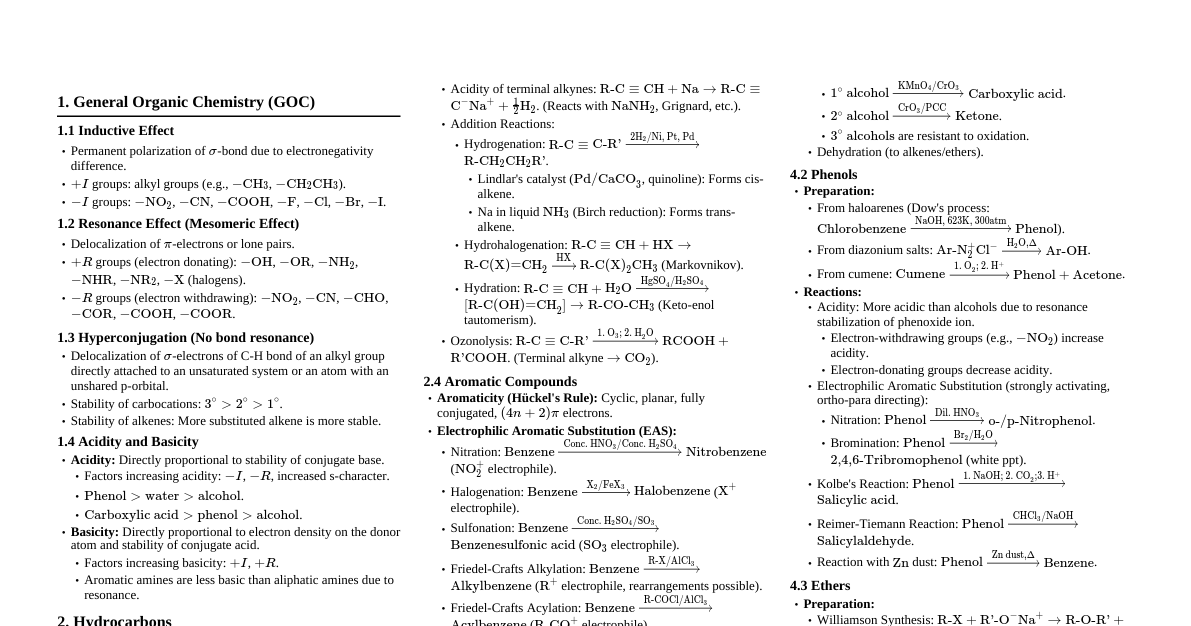
### Alkanes - **General Formula:** $C_nH_{2n+2}$ - **Hybridization:** All carbons are $sp^3$ hybridized. - **Isomerism:** Chain, Position, Conformational. - **Preparation:** 1. **Hydrogenation of Alkenes/Alkynes:** $R-CH=CH_2 + H_2 \xrightarrow{Ni/Pt/Pd} R-CH_2-CH_3$ 2. **Wurtz Reaction:** $2RX + 2Na \xrightarrow{dry \ ether} R-R + 2NaX$ (for symmetrical alkanes, poor yield for unsymmetrical). 3. **Corey-House Synthesis:** $R-X \xrightarrow{Li} RLi \xrightarrow{CuI} R_2CuLi \xrightarrow{R'-X} R-R'$ (best for unsymmetrical alkanes). 4. **Decarboxylation of Carboxylic Acids:** $R-COONa + NaOH \xrightarrow{CaO, \Delta} R-H + Na_2CO_3$ (produces alkane with one less carbon). 5. **Kolbe's Electrolytic Method:** $2R-COONa \xrightarrow{electrolysis} R-R + 2CO_2 + 2NaOH + H_2$ (produces symmetrical alkanes). - **Reactions:** 1. **Halogenation (Free Radical Substitution):** $CH_4 + Cl_2 \xrightarrow{h\nu} CH_3Cl + HCl$ (Reactivity: $F_2 > Cl_2 > Br_2 > I_2$; $3^\circ > 2^\circ > 1^\circ$ H for chlorination/bromination). 2. **Combustion:** $C_nH_{2n+2} + (\frac{3n+1}{2})O_2 \rightarrow nCO_2 + (n+1)H_2O$ 3. **Pyrolysis/Cracking:** Higher alkanes decompose into lower alkanes and alkenes at high temperatures. ### Alkenes - **General Formula:** $C_nH_{2n}$ - **Hybridization:** $sp^2$ hybridized carbons in double bond. - **Isomerism:** Chain, Position, Geometrical (cis-trans). - **Preparation:** 1. **Dehydration of Alcohols:** $R-CH_2-CH_2-OH \xrightarrow{conc. \ H_2SO_4, \Delta} R-CH=CH_2 + H_2O$ (Saytzeff's Rule: more substituted alkene is major product). 2. **Dehydrohalogenation of Alkyl Halides:** $R-CH_2-CH_2-X \xrightarrow{alc. \ KOH, \Delta} R-CH=CH_2 + HX$ (Saytzeff's Rule). 3. **Dehalogenation of Vicinal Dihalides:** $R-CHBr-CHBr-R' \xrightarrow{Zn, \Delta} R-CH=CH-R' + ZnBr_2$ 4. **Partial Hydrogenation of Alkynes:** - **Cis-alkene:** $R-C\equiv C-R' + H_2 \xrightarrow{Lindlar's \ Catalyst} R-CH=CH-R'$ (Syn addition) - **Trans-alkene:** $R-C\equiv C-R' \xrightarrow{Na/Li \ in \ liquid \ NH_3} R-CH=CH-R'$ (Anti addition, Birch Reduction) - **Reactions:** 1. **Electrophilic Addition:** (Markovnikov's Rule: H adds to carbon with more H's; Anti-Markovnikov for HBr in presence of peroxide). - **Addition of HX:** $CH_2=CH_2 + HCl \rightarrow CH_3-CH_2Cl$ - **Addition of $H_2O$ (Hydration):** $CH_2=CH_2 + H_2O \xrightarrow{H^+} CH_3-CH_2OH$ 2. **Oxidation:** - **Baeyer's Reagent (Cold, Dilute, Alkaline $KMnO_4$):** Forms vicinal diols (Syn hydroxylation). - **Hot, Acidic $KMnO_4$ or Ozonolysis:** Cleaves double bond, forms ketones/carboxylic acids. - **Ozonolysis (Reductive):** $R_2C=CR_2 \xrightarrow{O_3} \text{Ozonide} \xrightarrow{Zn/H_2O} R_2C=O + R_2C=O$ (useful for determining double bond position). 3. **Polymerization:** $n(CH_2=CH_2) \xrightarrow{High \ T, \ P} -(CH_2-CH_2)_n-$ ### Alkynes - **General Formula:** $C_nH_{2n-2}$ - **Hybridization:** $sp$ hybridized carbons in triple bond. - **Acidity of Terminal Alkynes:** Terminal alkynes have acidic H atoms (e.g., $HC\equiv CH$, $R-C\equiv CH$) due to $sp$ carbons' high electronegativity. They react with strong bases (Na, NaNH$_2$) and form metal acetylides. - **Preparation:** 1. **Dehydrohalogenation of Geminal/Vicinal Dihalides:** $R-CH_2-CHX_2 \xrightarrow{NaNH_2} R-C\equiv CH$ 2. **From Calcium Carbide:** $CaC_2 + 2H_2O \rightarrow HC\equiv CH + Ca(OH)_2$ - **Reactions:** 1. **Electrophilic Addition:** (Similar to alkenes, but two additions possible). Follows Markovnikov's rule. - **Addition of HX:** $HC\equiv CH + HCl \rightarrow CH_2=CHCl \xrightarrow{HCl} CH_3-CHCl_2$ - **Addition of Water (Hydration):** $HC\equiv CH + H_2O \xrightarrow{HgSO_4/H_2SO_4} CH_3-CHO$ (Acetylene gives acetaldehyde, other alkynes give ketones). 2. **Oxidation:** - **Hot, Acidic $KMnO_4$:** Cleaves triple bond, forms carboxylic acids. - **Ozonolysis (Reductive):** $R-C\equiv C-R' \xrightarrow{O_3} \text{Ozonide} \xrightarrow{Zn/H_2O} R-COOH + R'-COOH$ 3. **Polymerization:** - **Linear Polymerization:** $n(CH\equiv CH) \xrightarrow{CuCl_2/NH_4Cl} (-CH=CH-CH=CH-)_n$ (Polyacetylene) - **Cyclic Polymerization:** $3(CH\equiv CH) \xrightarrow{Red \ Hot \ Fe \ Tube, \ 873K} C_6H_6$ (Benzene) 4. **Reactions of Acidic Hydrogen (Terminal Alkynes):** - $R-C\equiv CH + Na \rightarrow R-C\equiv C^-Na^+ + \frac{1}{2}H_2$ - $R-C\equiv CH + Ag(NH_3)_2OH \rightarrow R-C\equiv C-Ag \downarrow$ (White ppt, Tollens' Reagent test) - $R-C\equiv CH + Cu(NH_3)_2Cl \rightarrow R-C\equiv C-Cu \downarrow$ (Red ppt, Fehling's/Benedict's solution test) ### Aromatic Compounds (Benzene) - **Aromaticity (Hückel's Rule):** 1. Cyclic 2. Planar 3. Conjugated (alternating single and double bonds, or having p-orbitals on every atom in the ring) 4. $(4n+2)\pi$ electrons ($n=0, 1, 2, ...$) - **Preparation of Benzene:** 1. **Cyclic Polymerization of Ethyne:** $3(CH\equiv CH) \xrightarrow{Red \ Hot \ Fe \ Tube, \ 873K} C_6H_6$ 2. **Decarboxylation of Benzoic Acid:** $C_6H_5COONa + NaOH \xrightarrow{CaO, \Delta} C_6H_6 + Na_2CO_3$ 3. **Reduction of Phenol:** $C_6H_5OH + Zn \xrightarrow{\Delta} C_6H_6 + ZnO$ 4. **Aromatization of n-Hexane/n-Heptane:** - n-Hexane $\xrightarrow{Cr_2O_3/Al_2O_3, \ 773K, \ 10-20atm} C_6H_6$ - n-Heptane $\xrightarrow{Cr_2O_3/Al_2O_3, \ 773K, \ 10-20atm} \text{Toluene}$ - **Reactions (Electrophilic Aromatic Substitution - EAS):** - **General Mechanism:** Electrophile ($E^+$) attacks benzene ring. 1. **Nitration:** $C_6H_6 + HNO_3 \xrightarrow{conc. \ H_2SO_4} C_6H_5NO_2 + H_2O$ ($E^+ = NO_2^+$) 2. **Halogenation:** $C_6H_6 + Cl_2 \xrightarrow{FeCl_3} C_6H_5Cl + HCl$ ($E^+ = Cl^+$) 3. **Sulfonation:** $C_6H_6 + H_2SO_4 \xrightarrow{\Delta} C_6H_5SO_3H + H_2O$ ($E^+ = SO_3$) 4. **Friedel-Crafts Alkylation:** $C_6H_6 + R-Cl \xrightarrow{anhyd. \ AlCl_3} C_6H_5-R + HCl$ (Can have rearrangements, polyalkylation) 5. **Friedel-Crafts Acylation:** $C_6H_6 + CH_3COCl \xrightarrow{anhyd. \ AlCl_3} C_6H_5COCH_3 + HCl$ (No rearrangements, stops after monoacylation) - **Directing Groups in EAS:** - **Ortho-Para Directors & Activating:** $-OH, -NH_2, -OR, -NHCOR, -R, -CH_3, -OCH_3$ - **Meta Directors & Deactivating:** $-NO_2, -CN, -CHO, -COOH, -SO_3H, -COR$ - **Halogens:** Ortho-Para Directors & Deactivating (due to strong -I effect outweighing +M effect). ### JEE Tricks & Important Points - **Saytzeff's vs. Hofmann Elimination:** Saytzeff (major product is more substituted alkene) is preferred with bulky bases/less hindered substrates. Hofmann (major product is less substituted alkene) is preferred with bulky bases (e.g., $(CH_3)_3CO^-K^+$) or when a quaternary ammonium salt is eliminated. - **Markovnikov's vs. Anti-Markovnikov:** - **Markovnikov:** H goes to carbon with more H's. Applies to HX addition (except HBr with peroxide) and hydration. - **Anti-Markovnikov:** H goes to carbon with fewer H's. Only for HBr in presence of peroxides (free radical mechanism). - **Syn vs. Anti Addition:** - **Syn:** Both groups add to the same face (e.g., $H_2$ with Lindlar's, Baeyer's reagent). - **Anti:** Groups add to opposite faces (e.g., $H_2$ with Na/Li in liquid $NH_3$, bromination of alkenes). - **Distinguishing Hydrocarbons:** - **Alkanes:** No reaction with Tollens', Fehling's, Baeyer's. - **Alkenes:** Decolorize Baeyer's reagent (pink $\rightarrow$ colorless), Decolorize Bromine water (red-brown $\rightarrow$ colorless). - **Alkynes (Terminal):** Form precipitates with Tollens' ($AgC\equiv CR$, white) and Ammoniacal Cuprous Chloride ($CuC\equiv CR$, red). Decolorize Baeyer's, Bromine water. - **Alkynes (Internal):** Do NOT react with Tollens' or Ammoniacal Cuprous Chloride. Decolorize Baeyer's, Bromine water. - **Aromatic:** Do not decolorize Baeyer's or Bromine water easily. Undergo EAS. - **Oxidation of Alkylbenzenes:** Alkyl groups attached to benzene ring are oxidized to -COOH by strong oxidizing agents like $KMnO_4$, regardless of the length of the alkyl chain, as long as there is at least one benzylic hydrogen. (e.g., Toluene $\rightarrow$ Benzoic Acid). - **Birch Reduction:** Reduces aromatic rings to non-conjugated 1,4-cyclohexadienes. $Na/Li \text{ in liquid } NH_3 \text{ with } alcohol$. - **Catalytic Hydrogenation:** - Alkenes/Alkynes $\xrightarrow{H_2/Ni, Pt, Pd}$ Alkanes. - Benzene $\xrightarrow{H_2/Ni, \Delta, \ P}$ Cyclohexane. - **Reagents Summary:** - **Lindlar's Catalyst:** $Pd/CaCO_3 + S/Quinoline$ (for cis-alkene from alkyne). - **Birch Reagent:** $Na/Li$ in liquid $NH_3$ (for trans-alkene from alkyne, or 1,4-cyclohexadiene from benzene). - **Baeyer's Reagent:** Cold, dilute, alkaline $KMnO_4$ (for cis-diol from alkene). - **Tollens' Reagent:** $AgNO_3 + NH_4OH$ (for terminal alkynes, aldehydes). - **Ammoniacal Cuprous Chloride:** $Cu_2Cl_2 + NH_4OH$ (for terminal alkynes). - **Anhydrous $AlCl_3$:** Lewis acid catalyst for Friedel-Crafts reactions. - **Carbocation Stability:** $3^\circ > 2^\circ > 1^\circ > CH_3^+$. Rearrangements (hydride/alkyl shifts) occur to form more stable carbocations. - **Free Radical Stability:** $3^\circ > 2^\circ > 1^\circ > CH_3^\cdot$. - **Benzylic and Allylic Stability:** Benzylic and Allylic carbocations/free radicals are more stable than simple alkyl ones due to resonance.