Carbon & Its Compounds Cheatsheet
Cheatsheet Content
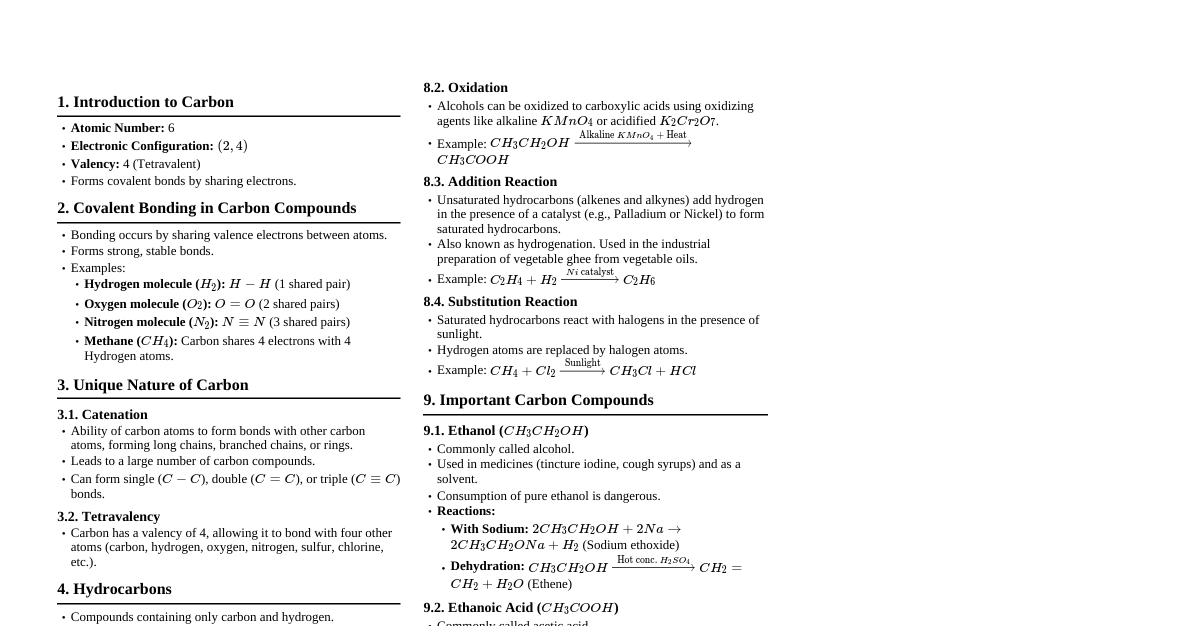
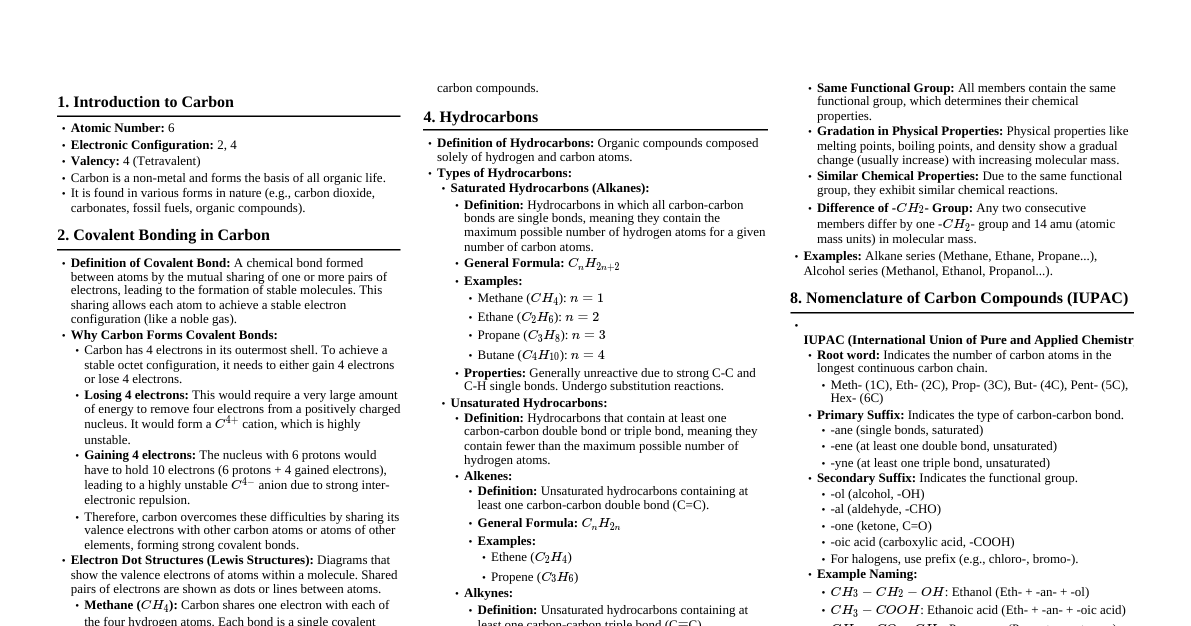
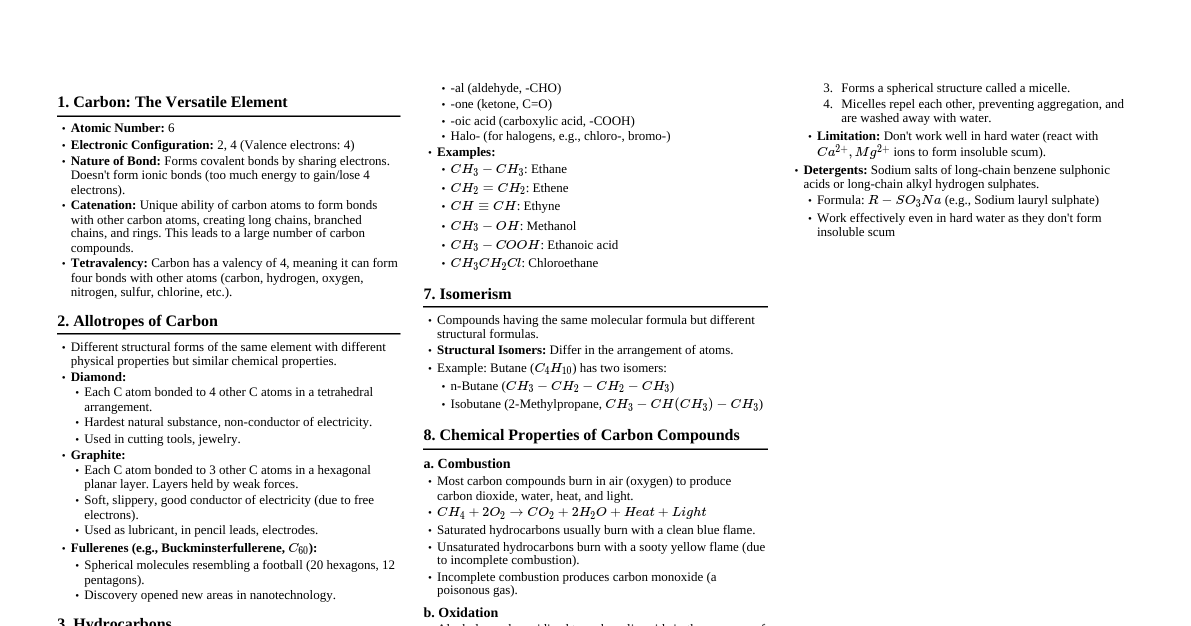
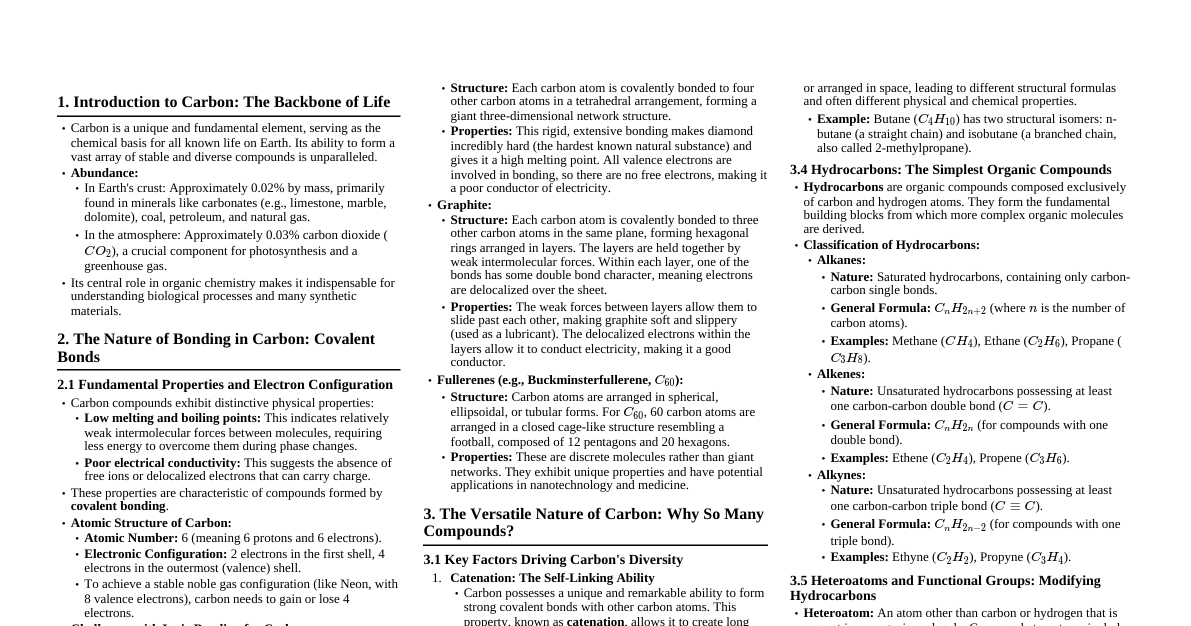
1. Introduction to Carbon Atomic Number: 6 Electronic Configuration: $(2, 4)$ or $1s^2 2s^2 2p^2$ Valency: 4 (tetravalent) Carbon forms covalent bonds by sharing electrons. It cannot gain or lose 4 electrons due to high energy requirements. 2. Covalent Bonding Formed by the sharing of electrons between two atoms. Creates stable molecules. Covalent compounds generally have low melting and boiling points (weak intermolecular forces). Poor conductors of electricity (no free ions or electrons). Examples: $H_2$, $O_2$, $N_2$, $CH_4$, $CO_2$. Electron Dot Structures: Represent valence electrons as dots around the atomic symbol. Methane ($CH_4$): Each H shares 1 electron with C, C shares 1 electron with each H. Carbon Dioxide ($CO_2$): C forms double bonds with two O atoms. 3. Unique Properties of Carbon 3.1. Catenation Ability of carbon atoms to form bonds with other carbon atoms, creating long chains, branched chains, or rings. Strong C-C bonds make these structures stable. Leads to a vast number of carbon compounds. 3.2. Tetravalency Carbon's valency of 4 allows it to bond with four other atoms (carbon, hydrogen, oxygen, nitrogen, sulfur, halogens, etc.). This enables the formation of diverse molecular structures. 4. Hydrocarbons Compounds containing only carbon and hydrogen. Saturated Hydrocarbons (Alkanes): Single bonds between carbon atoms. General formula: $C_nH_{2n+2}$ Examples: Methane ($CH_4$), Ethane ($C_2H_6$), Propane ($C_3H_8$). Butane ($C_4H_{10}$): CH₃-CH₂-CH₂-CH₃ Unsaturated Hydrocarbons: Contain double or triple bonds between carbon atoms. Alkenes: Contain at least one C=C double bond. General formula: $C_nH_{2n}$ Examples: Ethene ($C_2H_4$), Propene ($C_3H_6$). Ethene ($C_2H_4$): H₂C=CH₂ Alkynes: Contain at least one C$\equiv$C triple bond. General formula: $C_nH_{2n-2}$ Examples: Ethyne ($C_2H_2$), Propyne ($C_3H_4$). Ethyne ($C_2H_2$): HC≡CH Cyclic Hydrocarbons: Carbon atoms form a ring structure. Cyclohexane ($C_6H_{12}$ - saturated) Benzene ($C_6H_6$ - unsaturated, aromatic): Alternating single and double bonds (delocalized electrons). 5. Isomerism Compounds with the same molecular formula but different structural formulas. Example: Butane ($C_4H_{10}$) has two isomers: n-Butane (straight chain): CH₃-CH₂-CH₂-CH₃ Isobutane (2-methylpropane, branched chain): CH₃ | CH₃-CH-CH₃ 6. Functional Groups An atom or group of atoms that determines the chemical properties of a carbon compound. Halogenoalkanes (-X, where X=Cl, Br, I): Example: Chloromethane ($CH_3Cl$) Alcohols (-OH): Hydroxyl group. General formula: R-OH Example: Ethanol ($CH_3CH_2OH$) Aldehydes (-CHO): Carbonyl group at the end of a chain. General formula: R-CHO Example: Ethanal ($CH_3CHO$) Ketones (C=O): Carbonyl group within a chain. General formula: R-CO-R' Example: Propanone ($CH_3COCH_3$) Carboxylic Acids (-COOH): Carboxyl group. General formula: R-COOH Example: Ethanoic acid ($CH_3COOH$) Esters (-COOR): Formed from carboxylic acids and alcohols. General formula: R-COO-R' Example: Ethyl ethanoate ($CH_3COOCH_2CH_3$) 7. Homologous Series A series of organic compounds with similar chemical properties due to the same functional group. Successive members differ by a -$CH_2$- group. Have a general formula. Show a gradual change in physical properties (e.g., boiling point increases with molecular mass). Example: Alkanes ($CH_4, C_2H_6, C_3H_8, ...$) 8. Chemical Properties of Carbon Compounds 8.1. Combustion Burning of carbon compounds in oxygen to produce $CO_2$, $H_2O$, heat, and light. $CH_4(g) + 2O_2(g) \rightarrow CO_2(g) + 2H_2O(l) + \text{Heat + Light}$ Saturated hydrocarbons burn with a clean flame. Unsaturated hydrocarbons burn with a sooty flame (incomplete combustion due to higher carbon content). 8.2. Oxidation Alcohols can be oxidized to carboxylic acids using oxidizing agents like alkaline $KMnO_4$ or acidified $K_2Cr_2O_7$. $CH_3CH_2OH \xrightarrow{\text{Alkaline } KMnO_4 \text{ + Heat}} CH_3COOH$ 8.3. Addition Reaction Unsaturated hydrocarbons (alkenes and alkynes) add hydrogen in the presence of a catalyst (e.g., Ni, Pd) to form saturated hydrocarbons. Also known as hydrogenation. Used in the industrial preparation of vegetable ghee from vegetable oils. $C_2H_4 + H_2 \xrightarrow{Ni \text{ catalyst}} C_2H_6$ 8.4. Substitution Reaction Saturated hydrocarbons react with halogens in the presence of sunlight. One or more hydrogen atoms are replaced by halogen atoms. $CH_4 + Cl_2 \xrightarrow{\text{Sunlight}} CH_3Cl + HCl$ 9. Ethanol (Ethyl Alcohol, $CH_3CH_2OH$) Properties: Colourless liquid, pleasant smell, burning taste, miscible with water, volatile. Uses: Solvent, in medicines (tincture iodine, cough syrups), alcoholic beverages. Reactions: Reaction with Sodium: $2CH_3CH_2OH + 2Na \rightarrow 2CH_3CH_2ONa \text{ (Sodium ethoxide)} + H_2$ Dehydration: Heating with concentrated $H_2SO_4$ at $443K$ to form ethene. CH₃CH₂OH $\xrightarrow{\text{Conc. } H₂SO₄, 443K}$ CH₂=CH₂ + H₂O Denatured Alcohol: Ethanol mixed with poisonous substances (e.g., methanol, pyridine) to make it unfit for drinking. 10. Ethanoic Acid (Acetic Acid, $CH_3COOH$) Properties: Colourless liquid, sour taste, pungent smell. Melting point $290K$ (freezes in winter, hence 'glacial' acetic acid). Vinegar: 5-8% solution of ethanoic acid in water. Reactions: Esterification: Reaction with alcohol in presence of acid catalyst to form an ester. CH₃COOH + CH₃CH₂OH $\xrightarrow{\text{Conc. } H₂SO₄}$ CH₃COOCH₂CH₃ + H₂O (Ethyl ethanoate, a sweet-smelling compound) Reaction with Bases: Forms salt and water. $CH_3COOH + NaOH \rightarrow CH_3COONa + H_2O$ Reaction with Carbonates/Bicarbonates: Forms salt, water, and $CO_2$. $2CH_3COOH + Na_2CO_3 \rightarrow 2CH_3COONa + H_2O + CO_2$ 11. Soaps and Detergents 11.1. Soaps Sodium or potassium salts of long-chain carboxylic acids. Structure: Long hydrocarbon chain (hydrophobic tail) and ionic carboxylate head (hydrophilic head). CH₃(CH₂)₁₄COO⁻Na⁺ (Sodium stearate, common soap) Micelle Formation: In water, the hydrocarbon tails point inwards, and the ionic heads point outwards, forming a spherical structure called a micelle. Cleansing Action: Hydrophobic tails attach to grease/oil (dirt), forming a micelle. The hydrophilic heads face outwards into water. The micelles repel each other and remain suspended in water, washing away the dirt. Limitation: Soaps do not work effectively in hard water (water containing $Ca^{2+}$ and $Mg^{2+}$ ions) because they form insoluble precipitates (scum) with these ions. 11.2. Detergents Sodium salts of long-chain benzene sulphonic acids or long-chain alkyl hydrogen sulphates. Structure: Similar to soap, with a long hydrocarbon tail and a hydrophilic head (sulphate or sulphonate group). Advantage: Detergents work effectively in hard water because their calcium and magnesium salts are soluble in water, thus no scum is formed. Disadvantage: Some detergents are non-biodegradable and cause water pollution. 12. Allotropes of Carbon Different structural forms of the same element with different physical and similar chemical properties. Diamond: Each carbon atom is tetrahedrally bonded to four other carbon atoms. Rigid 3D structure, hardest natural substance. Poor conductor of electricity (no free electrons). Uses: Jewellery, cutting tools. Graphite: Each carbon atom is bonded to three other carbon atoms in the same plane, forming hexagonal layers. Layers are held by weak Van der Waals forces, allowing them to slide over each other (soft, slippery). Good conductor of electricity (one free electron per carbon atom). Uses: Lubricant, pencil leads, electrodes. Fullerenes (e.g., $C_{60}$ Buckminsterfullerene): Spherical molecules resembling a football (20 six-membered rings and 12 five-membered rings). Uses: Research, potential in nanotechnology.