Banking System History
Cheatsheet Content
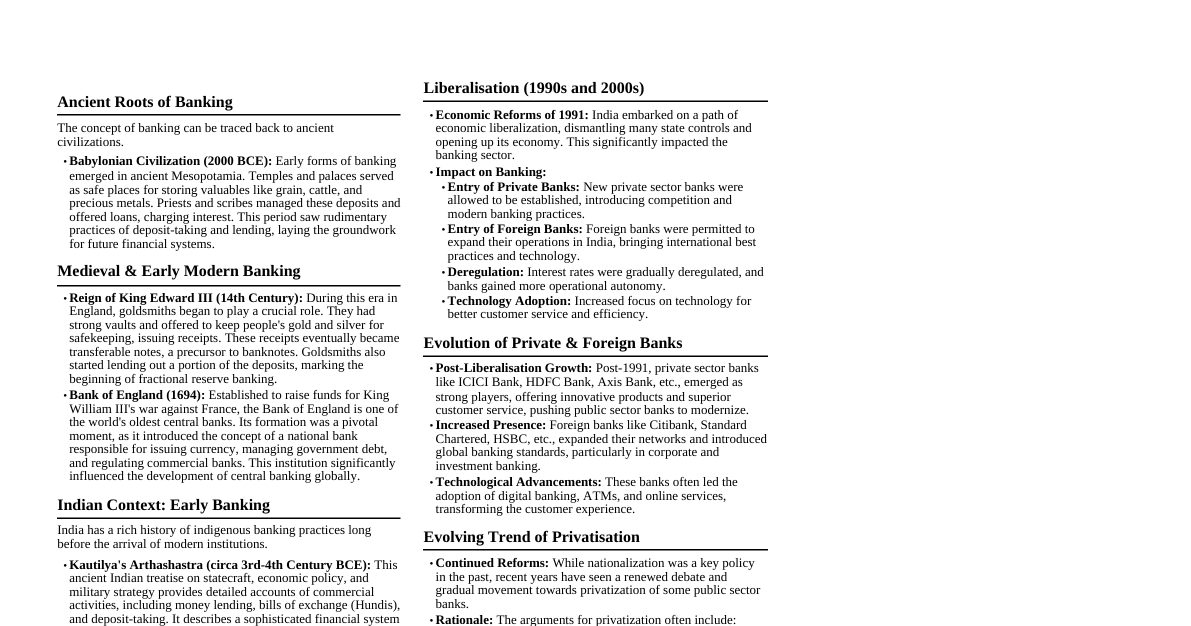
### Global History of Banking #### Babylonian Civilization (2000 BCE) The origins of banking trace back to ancient Mesopotamia around 2000 BCE. Temples served as the earliest banks, functioning as repositories for grain and precious metals. Babylonian priests lent resources to farmers and merchants, keeping written records of transactions. The **Code of Hammurabi** later regulated lending practices and interest rates. #### Medieval Europe and Reign of King Edward III (14th Century) After the fall of Rome, banking re-emerged in medieval Europe. The **Knights Templar** provided secure storage and facilitated fund transfers. Italian city-states like Florence, Venice and Genoa became major banking centres. The **Medici Bank** popularised double-entry bookkeeping. During Edward III's reign, Italian banking families like the Bardi and Peruzzi dominated English finance. Edward III's default on loans in 1345 bankrupted several Italian banking houses, reshaping European banking practices. #### Sveriges Riksbank (1668) The **Sveriges Riksbank** of Sweden was established in 1668, making it the world's oldest central bank. It was created by the Swedish Parliament and introduced early banknote innovations in Europe. #### Bank of England (1694) The **Bank of England** was established in 1694, making it the world's second oldest central bank after Sweden's Riksbank. It was founded to raise funds for King William III's War of the Grand Alliance against France. Importantly, it began as a private shareholders' bank and was only nationalised in 1946. It introduced key innovations like issuing banknotes backed by reserves, acting as the government's banker, managing national debt, and serving as lender of last resort. It became the model for central banks worldwide. ### Banking in India #### Kautilya's Artha Shastra (4th Century BCE) **Kautilya's Artha Shastra**, written during the Maurya Empire, contained detailed provisions for banking and financial management. It covered state-controlled treasury management, regulation of moneylenders, interest rates, agricultural and commercial loans, and concepts of deposits. Merchant bankers issued letters of credit for fund transfers as early as 300 BCE, demonstrating sophisticated financial practices in ancient India. #### Presidency Banks The modern banking system in India began with three Presidency Banks established by the British: - **Bank of Calcutta** (1806, renamed Bank of Bengal 1809) - **Bank of Bombay** (1840) - **Bank of Madras** (1843) These were joint-stock companies with government participation. In 1921, all three were merged to form the **Imperial Bank of India**, which was later nationalised and renamed the **State Bank of India** in 1955 under the State Bank of India Act, 1955. #### Reserve Bank of India (1934-35) The **RBI** was established on April 1, 1935, under the Reserve Bank of India Act, 1934. It initially functioned as a private shareholders' bank and took over central banking functions from the Imperial Bank of India. After independence it was nationalised on January 1, 1949, becoming India's central banking authority responsible for monetary policy, currency issuance and banking regulation. #### Banking Regulation Act, 1949 This Act provided the legal framework for banking regulation in India. It covered licensing of banks, minimum capital requirements, restrictions on loans and investments, powers of RBI to inspect and supervise banks, and provisions for amalgamation and liquidation. It remains the primary legislation governing banking in India. #### Establishment of Small Scale and Agricultural Banks Post-independence India recognised the need for specialised institutions for rural and agricultural sectors. - **Regional Rural Banks** were established in 1976 to serve small farmers and artisans. - **NABARD** was established in 1982 for agriculture and rural development. - **SIDBI** was established in 1990 for small-scale industries. These institutions addressed the financial inclusion gap in rural India. #### Bank Nationalisation India underwent two major phases of nationalisation: - **1969**: 14 major banks were nationalised under Prime Minister Indira Gandhi's government to extend credit to agriculture, small industries and exports. - **1980**: 6 more banks were nationalised for further consolidation. The objectives were to eliminate concentration of economic power, ensure credit for priority sectors and promote financial inclusion. #### Liberalisation (1991-2000) The economic liberalisation of 1991 based on the **Narasimham Committee** reforms transformed India's banking sector. Key reforms included: - Reduction in SLR and CRR - Deregulation of interest rates - Entry of private sector banks - Technology adoption - Introduction of prudential norms By 2000, India had moved from a controlled to a market-oriented banking system. #### Private Banks and Foreign Banks Post-1991 liberalisation saw new private banks like **HDFC Bank, ICICI Bank, Axis Bank** and **Kotak Mahindra Bank** enter the sector, introducing modern banking practices and technology. Foreign banks like **HSBC** and **Deutsche Bank** also expanded their presence, bringing international best practices and global connectivity. #### Evolving Trend of Privatisation Recent years have seen a shift toward privatisation and strategic disinvestment of public sector banks. The government has pursued mergers of PSBs and is moving toward reducing government stake while encouraging private sector participation. The debate continues between improved efficiency on one side and concerns about financial inclusion and government control on the other.