Modern Indian History (UPSC)
Cheatsheet Content
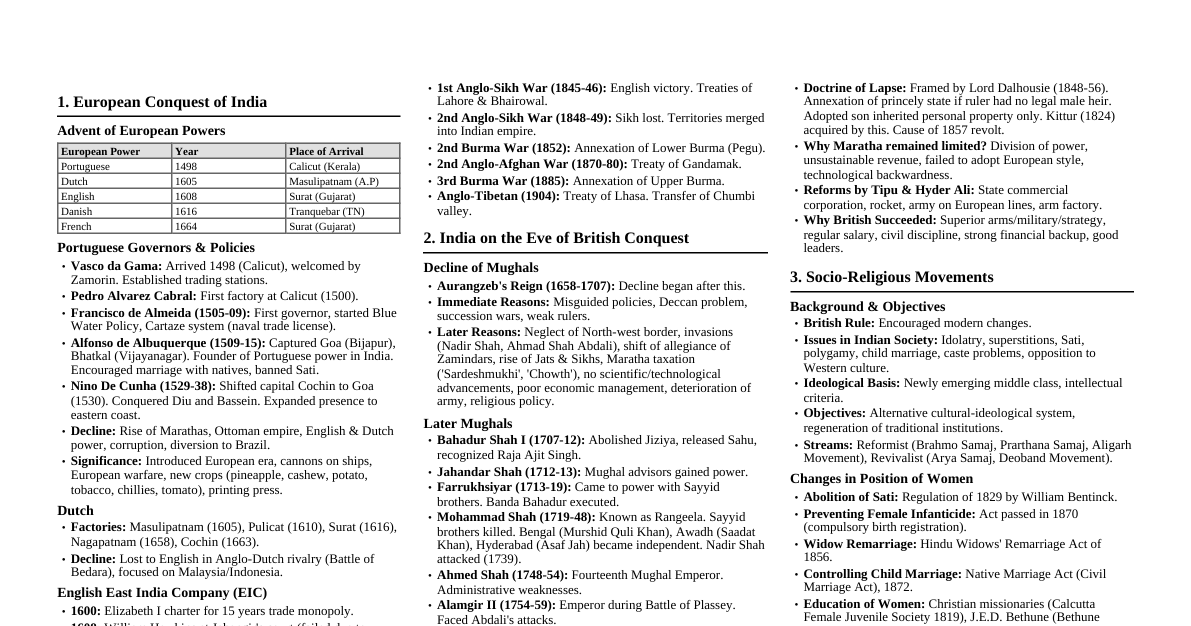
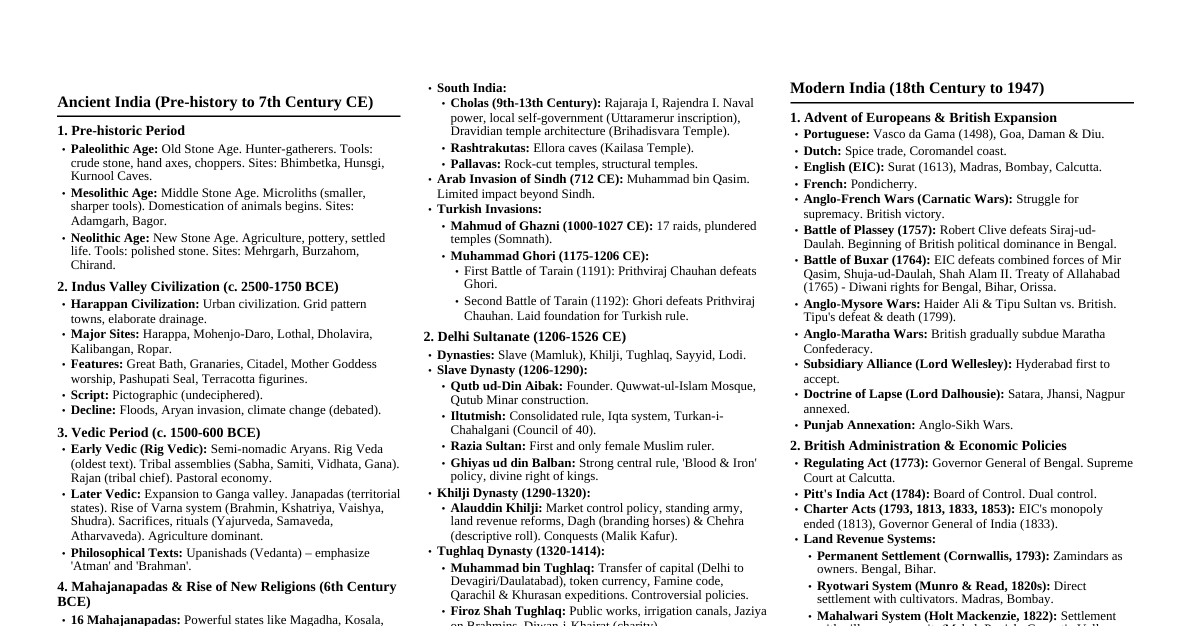
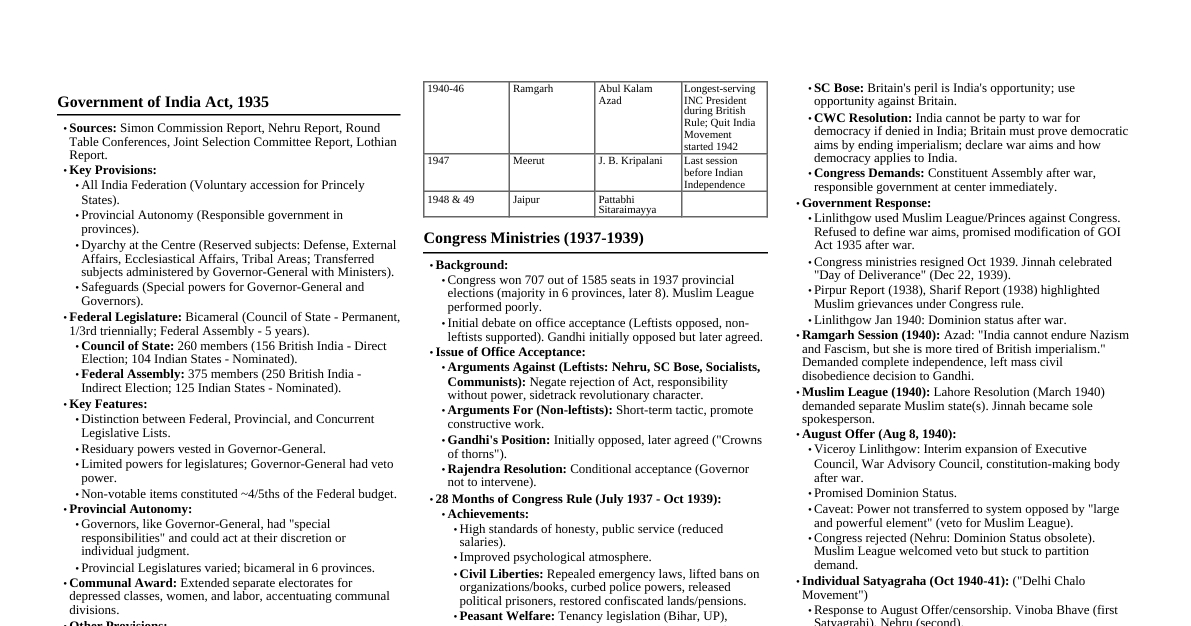
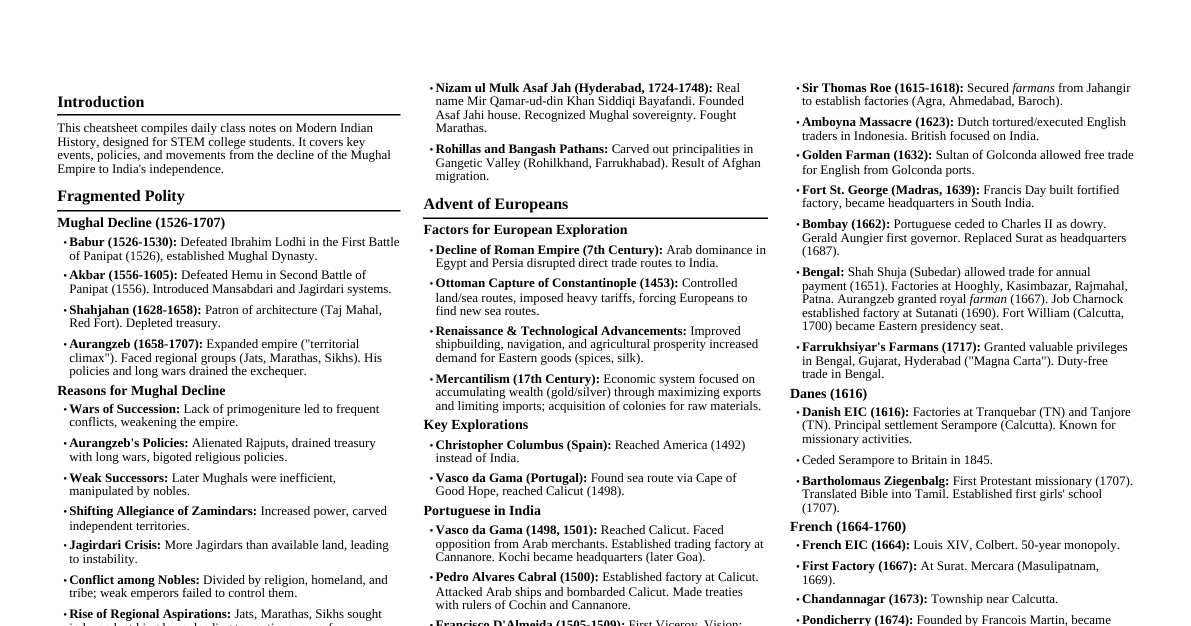
### Advent of Europeans - **Portuguese:** Vasco da Gama (1498) at Calicut, established trade posts (Cochin, Goa, Daman & Diu). First to arrive, last to leave (Goa liberated 1961). - **Dutch:** East India Company (1602), established factories at Masulipatnam, Pulicat, Surat, Chinsura. Main interest in spices (Indonesia). Defeated by British in Battle of Biderra (1759). - **English:** East India Company (1600), Surat (1613), Madras (1639), Bombay (1668), Calcutta (1690). Emerged as dominant power. - **French:** French East India Company (1664), Pondicherry (1673), Chandernagore. Anglo-French rivalry (Carnatic Wars) led to their decline. - **Danes:** Tranquebar (1620), Serampore. Sold settlements to British in 1845. #### Carnatic Wars (Anglo-French Rivalry) - **First (1746-48):** Treaty of Aix-la-Chapelle. - **Second (1749-54):** Treaty of Pondicherry. Dupleix recalled. - **Third (1758-63):** Battle of Wandiwash (1760) – British decisively defeat French. Treaty of Paris. ### British Expansion & Consolidation - **Bengal:** - **Battle of Plassey (1757):** Robert Clive defeats Siraj-ud-Daulah. Mir Jafar becomes Nawab. EIC gets Diwani rights. - **Battle of Buxar (1764):** Hector Munro defeats Mir Qasim, Shuja-ud-Daulah (Awadh), Shah Alam II (Mughal). Treaty of Allahabad (1765) – EIC gets Diwani of Bengal, Bihar, Orissa. - **Dual Government (1765-72):** Clive introduced. EIC had Diwani, Nawab had Nizamat (administration). Ended by Warren Hastings. - **Mysore:** - **Hyder Ali & Tipu Sultan:** Strong resistance. - **Anglo-Mysore Wars:** - First (1767-69): Treaty of Madras. - Second (1780-84): Treaty of Mangalore. - Third (1790-92): Treaty of Seringapatam (Tipu loses half territory). - Fourth (1799): Tipu killed. Mysore annexed. - **Marathas:** - **Anglo-Maratha Wars:** - First (1775-82): Treaty of Salbai. - Second (1803-05): Subsidiary Alliance. - Third (1817-18): Maratha power crushed. Peshwa Baji Rao II exiled. - **Punjab:** - **Maharaja Ranjit Singh:** Powerful Sikh kingdom. - **Anglo-Sikh Wars:** - First (1845-46): Treaty of Lahore. - Second (1848-49): Punjab annexed. - **Doctrine of Lapse (Dalhousie):** Annexed Satara, Sambalpur, Udaipur, Nagpur, Jhansi. Awadh annexed on grounds of misgovernance. #### Administration & Policies - **Regulating Act (1773):** Governor of Bengal becomes Governor-General of Bengal (Warren Hastings). Supreme Court at Calcutta. - **Pitt's India Act (1784):** Board of Control (political) & Court of Directors (commercial). Dual system. - **Charter Acts:** - **1813:** EIC's monopoly ended (except tea & China trade). Christian missionaries allowed. - **1833:** Governor-General of Bengal becomes Governor-General of India (Lord William Bentinck). EIC becomes purely administrative body. Law Commission. - **1853:** Last Charter Act. Open competition for Civil Services. - **Permanent Settlement (1793, Cornwallis):** Zamindars recognized as owners of land, revenue fixed. - **Ryotwari Settlement (Madras, Bombay):** Direct settlement with cultivators. - **Mahalwari Settlement (Gangetic Valley, Punjab):** Settlement with village community/headman. - **Subsidiary Alliance (Wellesley):** Indian states lose sovereignty, accept British paramountcy, resident. First accepted by Nizam of Hyderabad. - **Drain of Wealth (Dadabhai Naoroji):** Economic critique of British rule. ### Socio-Religious Reform Movements - **Brahmo Samaj (1828):** Raja Ram Mohan Roy. Monotheism, opposed idolatry, Sati, caste system. Later split (Adi Brahmo Samaj, Brahmo Samaj of India). - **Arya Samaj (1875):** Swami Dayananda Saraswati. "Go back to Vedas," Shuddhi movement, opposed idolatry, child marriage, caste. - **Ramakrishna Mission (1897):** Swami Vivekananda. Service to humanity is service to God. Neo-Vedantism. - **Theosophical Society (1875):** Annie Besant. Revived ancient religions, universal brotherhood. - **Young Bengal Movement (Henry Vivian Derozio):** Radical, questioned authority. - **Aligarh Movement (Syed Ahmed Khan):** Modern education for Muslims, loyal to British. - **Deoband Movement:** Orthodox Muslim scholars, preserved Islamic traditions. - **Satyashodhak Samaj (1873):** Jyotiba Phule. Upliftment of lower castes, women's education. - **Prarthana Samaj (1867):** Atmaram Pandurang. Social reform, monotheism. - **Sati Abolition (1829):** Lord William Bentinck, with Raja Ram Mohan Roy's efforts. - **Widow Remarriage Act (1856):** Lord Dalhousie, with Ishwar Chandra Vidyasagar's efforts. - **Age of Consent Act (1891):** Raised age of consent for girls to 12. ### Revolt of 1857 - **Causes:** - **Political:** Doctrine of Lapse, annexation of Awadh, disrespect to Mughals. - **Economic:** Heavy taxation, destruction of traditional industries, famines. - **Social-Religious:** Interference with customs (Sati, Widow Remarriage), fear of conversion, greased cartridges. - **Military:** Low pay, poor prospects, racial discrimination. - **Centres & Leaders:** - Delhi: Bahadur Shah Zafar, Gen. Bakht Khan - Lucknow: Begum Hazrat Mahal - Kanpur: Nana Saheb, Tantia Tope - Jhansi: Rani Lakshmibai - Bareilly: Khan Bahadur Khan - Bihar (Jagdishpur): Kunwar Singh - **Nature:** Sepoy Mutiny (British historians); First War of Independence (V.D. Savarkar). - **Consequences:** - End of EIC rule, Crown takes over (Government of India Act 1858). - Secretary of State for India created. - Policy of annexation abandoned. - Army reorganized (more Europeans, less Indians). - Divide and Rule policy intensified. ### Rise of Indian Nationalism - **Factors:** - **Political Unity:** British administration unified India. - **Western Education:** Introduced modern ideas (democracy, nationalism). - **Press & Literature:** Spread nationalist ideas. - **Economic Exploitation:** Common grievance against British rule. - **Racial Arrogance:** Ilbert Bill controversy (1883). - **Famines:** British indifference. - **Early Political Associations:** - British Indian Association (1851) - East India Association (1866, Dadabhai Naoroji) - Indian League (1875, Sisir Kumar Ghosh) - Indian Association of Calcutta (1876, Surendranath Banerjee) #### Indian National Congress (INC) - **Formation (1885):** A.O. Hume, Bombay. First session presided by W.C. Bonnerjee. - **Phases:** - **Moderates (1885-1905):** - Leaders: Dadabhai Naoroji, Pherozeshah Mehta, Gopal Krishna Gokhale, Surendranath Banerjee. - Methods: Petitions, prayers, constitutional agitation. - Goals: Administrative reforms, Indianization of services, self-government within British Empire. - Contributions: Exposed economic exploitation (Drain Theory), laid foundation for mass movement. - **Extremists (1905-1919):** - Leaders: Bal Gangadhar Tilak ("Swaraj is my birthright"), Lala Lajpat Rai, Bipin Chandra Pal (Lal-Bal-Pal). - Methods: Swadeshi, Boycott, National Education, Passive Resistance. - Goals: Complete Swaraj/self-rule. - Events: Partition of Bengal (1905, Curzon), Swadeshi Movement, Surat Split (1907). - **Revolutionary Nationalists:** - Early: Vasudev Balwant Phadke. - Bengal: Anushilan Samiti, Jugantar. - Maharashtra: Chapekar Brothers (Rai-Ryot Association). - Abroad: Ghadar Party (USA), Berlin Committee (Germany). ### Gandhian Era (1917-1947) - **Arrival in India (1915):** From South Africa (fought against apartheid, used Satyagraha). - **Early Movements:** - **Champaran Satyagraha (1917):** Indigo cultivators (Tinkathia system). First Civil Disobedience. - **Ahmedabad Mill Strike (1918):** Textile workers, plague bonus. First Hunger Strike. - **Kheda Satyagraha (1918):** Peasants against revenue collection despite crop failure. First Non-Cooperation. #### Major Movements - **Non-Cooperation Movement (1920-22):** - Causes: Jallianwala Bagh Massacre (1919), Rowlatt Act (1919), Khilafat Movement. - Programme: Boycott of schools, colleges, courts, foreign goods; surrender of titles. - End: Chauri Chaura incident (1922) – Gandhi withdraws movement. - **Civil Disobedience Movement (1930-34):** - Causes: Simon Commission (1927), Nehru Report (1928), Great Depression, Lahore Session (1929) – Purna Swaraj. - **Dandi March (Salt Satyagraha, 1930):** Gandhi breaks salt law. - Programme: Breaking salt laws, boycott of foreign goods, picketing liquor shops, non-payment of taxes. - **Gandhi-Irwin Pact (1931):** Congress agrees to attend Second Round Table Conference. - Failure of RTC, movement resumed. Withdrawn in 1934. - **Quit India Movement (1942):** - Causes: Failure of Cripps Mission (1942), fear of Japanese invasion, British refusal to grant independence. - Slogan: "Do or Die." - Leaders arrested, spontaneous mass uprising. Parallel governments (Ballia, Tamluk, Satara). #### Other Important Events - **Rowlatt Act (1919):** "No Vakil, No Daleel, No Appeal." - **Jallianwala Bagh Massacre (1919):** Gen. Dyer fires on unarmed crowd. - **Khilafat Movement (1919-24):** Ali Brothers, Gandhi. Against dismemberment of Ottoman Caliphate. - **Swaraj Party (1923):** C.R. Das, Motilal Nehru. Council entry. - **Simon Commission (1927):** All-white commission to review Govt. of India Act 1919. Boycotted. - **Lahore Session (1929):** Purna Swaraj (complete independence) resolution. Jan 26, 1930 declared Independence Day. - **Round Table Conferences (1930, 31, 32):** Discuss constitutional reforms. Gandhi attended only 2nd RTC. - **Communal Award (1932):** Ramsay MacDonald. Separate electorates for depressed classes. - **Poona Pact (1932):** Gandhi & Ambedkar. Joint electorates for depressed classes with reserved seats. - **Government of India Act 1935:** All India Federation (never materialized), Provincial Autonomy, Dyarchy at Centre. - **August Offer (1940):** Viceroy Linlithgow. Dominion status as goal, constituent assembly. Rejected. - **Cripps Mission (1942):** Sir Stafford Cripps. Dominion status after war, constituent assembly. Rejected. - **C.R. Formula (1944):** Rajagopalachari. Plebiscite in Muslim majority areas. Jinnah rejects. - **Wavell Plan & Simla Conference (1945):** Failed to break deadlock. - **Cabinet Mission (1946):** Pethick-Lawrence, Stafford Cripps, A.V. Alexander. Rejected Pakistan, proposed federal union, interim government, constituent assembly. - **Direct Action Day (1946):** Muslim League calls for mass protest, widespread communal violence. - **Mountbatten Plan (June 3, 1947):** Partition of India, transfer of power. - **Indian Independence Act (1947):** India and Pakistan become independent dominions. ### Key Personalities & Movements - **Subhas Chandra Bose:** Forward Bloc, Indian National Army (INA) in Singapore/East Asia. "Jai Hind." - **Bhagat Singh:** Hindustan Socialist Republican Association (HSRA), Lahore Conspiracy Case, Central Assembly Bombing. - **Sardar Vallabhbhai Patel:** Bardoli Satyagraha (1928), integration of princely states. - **Jawaharlal Nehru:** First PM, architect of modern India, non-alignment. - **B.R. Ambedkar:** Architect of Indian Constitution, leader of depressed classes. - **Maulana Abul Kalam Azad:** First Education Minister, staunch nationalist. - **Rani Gaidinliu:** Naga spiritual and political leader, resisted British. - **Alluri Sitarama Raju:** Rampa Rebellion (1922-24) in Andhra. - **Tribal Revolts:** Santhal Rebellion (1855-56), Munda Rebellion (Birsa Munda, 1899-1900). - **Peasant Movements:** Indigo Revolt (1859-60), Pabna Agrarian Unrest (1870s), Deccan Riots (1875). - **Working Class Movements:** Early trade unions (Madras Labour Union 1918). AITUC (1920). ### Important Governors-General & Viceroys - **Warren Hastings (1772-85):** End of Dual Govt., Rohilla War, First Anglo-Maratha War, Pitt's India Act. - **Lord Cornwallis (1786-93):** Permanent Settlement, Civil Services, Judicial Reforms. - **Lord Wellesley (1798-1805):** Subsidiary Alliance, Fourth Anglo-Mysore War. - **Lord William Bentinck (1828-35):** First Governor-General of India, Abolition of Sati, Suppression of Thuggee, English as official language. - **Lord Dalhousie (1848-56):** Doctrine of Lapse, annexation of Punjab, Awadh. First railway, telegraph, postal reforms. Public Works Department. - **Lord Canning (1856-62):** Last Governor-General, First Viceroy. Revolt of 1857, Govt. of India Act 1858. - **Lord Lytton (1876-80):** Vernacular Press Act, Arms Act, Second Afghan War, Famine Commission. - **Lord Ripon (1880-84):** Repeal of Vernacular Press Act, Ilbert Bill, Local Self-Government, Hunter Commission (education). - **Lord Curzon (1899-1905):** Partition of Bengal, Archaeological Survey of India, Police Commission, Universities Act. - **Lord Minto II (1905-10):** Minto-Morley Reforms (1909), Surat Split. - **Lord Hardinge II (1910-16):** Annulment of Partition of Bengal (1911), transfer of capital to Delhi. - **Lord Chelmsford (1916-21):** Montagu-Chelmsford Reforms (1919), Rowlatt Act, Jallianwala Bagh, Non-Cooperation Movement. - **Lord Reading (1921-26):** Chauri Chaura, Swaraj Party. - **Lord Irwin (1926-31):** Simon Commission, Lahore Session, Dandi March, Gandhi-Irwin Pact. - **Lord Willingdon (1931-36):** Second & Third RTCs, Communal Award, Poona Pact, Govt. of India Act 1935. - **Lord Linlithgow (1936-44):** Quit India Movement, August Offer, Cripps Mission. - **Lord Wavell (1944-47):** Wavell Plan, Simla Conference, Cabinet Mission. - **Lord Mountbatten (1947-48):** Partition of India, Indian Independence Act. - **C. Rajagopalachari (1948-50):** Last Governor-General of India. ### Constitutional Acts & Reforms - **Regulating Act 1773:** First step towards centralized administration. - **Pitt's India Act 1784:** Distinguished EIC's commercial and political functions. - **Charter Act 1813:** Ended EIC's monopoly (except tea & China). - **Charter Act 1833:** Governor-General of India, EIC purely administrative. - **Charter Act 1853:** Open competition for Civil Services. - **Government of India Act 1858:** Crown rule, Secretary of State for India, Viceroy. - **Indian Councils Act 1861:** Indians nominated to legislative council. - **Indian Councils Act 1892:** Indirect elections to legislative councils. - **Minto-Morley Reforms 1909:** Separate electorates for Muslims, increased size of legislative councils. - **Montagu-Chelmsford Reforms 1919 (Government of India Act 1919):** Dyarchy in provinces, bicameral legislature at Centre, separate electorates for Sikhs, Anglo-Indians, Christians. - **Government of India Act 1935:** All India Federation, Provincial Autonomy, Dyarchy at Centre, separate electorates for depressed classes, women, labour. - **Indian Independence Act 1947:** Partition, end of British rule, two independent dominions. ### Important Organizations & Newspapers - **Newspapers/Journals:** - *Sambad Kaumudi:* Raja Ram Mohan Roy - *Mirat-ul-Akbar:* Raja Ram Mohan Roy - *Indian Mirror:* Devendranath Tagore - *Amrita Bazar Patrika:* Sisir Kumar Ghosh, Motilal Ghosh - *The Hindu:* G. Subramania Aiyar - *Kesari, Mahratta:* Bal Gangadhar Tilak - *Young India, Harijan, Indian Opinion:* Mahatma Gandhi - *Al-Hilal:* Maulana Abul Kalam Azad - *Comrade:* Maulana Mohammad Ali - *Hindustan Times:* K.M. Panikkar - *Pioneer:* George Allen - **Political Organizations:** - **Indian National Congress (1885):** A.O. Hume - **Muslim League (1906):** Aga Khan, Nawab Salimullah - **Home Rule Leagues (1916):** Annie Besant, Bal Gangadhar Tilak - **Hindustan Republican Association (1924, later HSRA):** Sachindra Nath Sanyal, Bhagat Singh, Chandrashekhar Azad - **Forward Bloc (1939):** Subhas Chandra Bose - **Communist Party of India (1925):** M.N. Roy (Tashkent 1920), Kanpur (1925) - **Congress Socialist Party (1934):** Acharya Narendra Dev, Jayaprakash Narayan, Minoo Masani - **Depressed Classes Association (1930):** B.R. Ambedkar - **Servants of India Society (1905):** Gopal Krishna Gokhale ### Cultural Developments - **Education:** - **Orientalist-Anglicist Controversy:** Debate over medium of instruction. - **Macaulay's Minute (1835):** English as medium of instruction. - **Wood's Despatch (1854):** "Magna Carta of English Education in India." Recommended hierarchy of educational institutions. - **Hunter Commission (1882):** Primary and secondary education. - **Universities Act (1904):** Curzon, greater government control. - **Saddler Commission (1917):** Calcutta University reforms. - **Literature & Arts:** - Rise of vernacular literature, nationalist poetry. - Raja Ravi Varma (paintings), Bengal School of Art (Abanindranath Tagore). - Rabindranath Tagore (Nobel Prize for Gitanjali, 1913). - **Archaeology:** - Asiatic Society of Bengal (1784). - Archaeological Survey of India (1861, Alexander Cunningham).