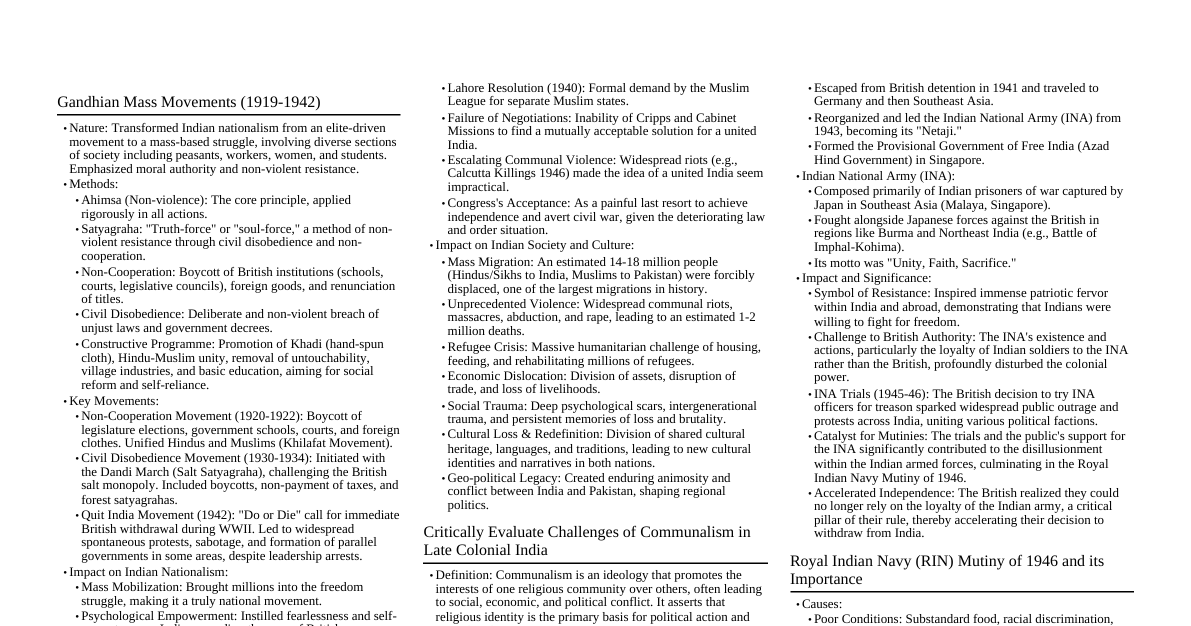
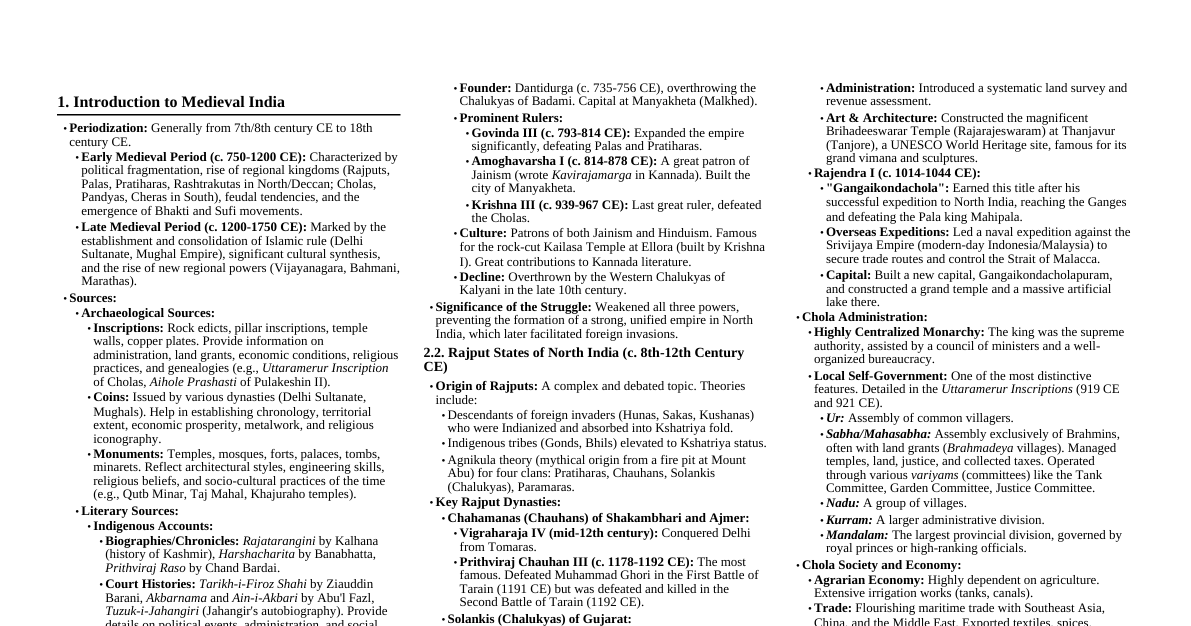
Indian Knowledge System History
Cheatsheet Content
History of Indian Knowledge System (IKS) Spans thousands of years, covering philosophy, science, mathematics, medicine, literature, and spirituality. Categorized into distinct periods with unique characteristics and global influence. Vedic Period (1500 BCE - 500 BCE) Foundation: Composition of the Vedas (Rigveda, Yajurveda, Samaveda, Atharvaveda). Topics: Philosophy, rituals, cosmology, worship of nature, music, medicine, ethics, mathematics, astronomy. Society: Organized by the Varna system. Concepts: Rita (cosmic order), Dharma (duty/righteousness), Atman (individual soul). Preservation: Oral transmission by Brahmins. Upanishadic Period (800 BCE - 200 BCE) Texts: Composition of the Upanishads (Vedanta), exploring reality, self-realization, relationship between Atman and Brahman. Key Concepts: Brahman (ultimate reality), Atman, Maya (illusionary nature), Karma, reincarnation, Moksha (liberation). Philosophy: Groundwork for Indian philosophical schools (Vedanta, Nyaya, Vaisheshika, Samkhya, Yoga, Mimamsa). Classical Period (200 BCE - 1200 CE) Scientific Advancements: Mathematics & Astronomy: Aryabhata, Brahmagupta, Bhaskara (concept of zero, decimal notation, algebra, trigonometry). Medicine: Charaka and Sushruta authored Ayurveda texts (Charaka Samhita, Sushruta Samhita) on medicine and surgery. Literature: Flourishing of classical Sanskrit literature (Ramayana, Mahabharata, works by Kalidasa like Shakuntala). Philosophy: Flourishing of Darshanas (Vedanta, Nyaya, Vaisheshika, Samkhya, Yoga, Mimamsa). Arts & Architecture: Golden age with magnificent temples and monuments (Khajuraho, Ellora, Ajanta, Konark). Medieval Period (1200 CE - 1700 CE) Islamic Influence: Synthesis of Indian and Islamic knowledge systems with scholars like Al-Baruni and Ibn Sina. Political Landscape: Delhi Sultanate and Mughal Empire (Akbar, Shah Jahan) leading to Indo-Islamic architecture and culture. Rise of regional kingdoms (Vijayanagara, Maratha). Movements: Bhakti and Sufi movements emphasizing personal devotion and mystical experience. End: Decline of Mughal Empire and arrival of European powers. Colonial Period (1700 CE - 1947 CE) Impact on IKS: Marginalization of traditional IKS in favor of Western education. British Rule: Establishment of British Raj after 1857 rebellion, characterized by administrative centralization and economic exploitation (deindustrialization). Revitalization Efforts: Indian scholars like Raja Ram Mohan Roy and Swami Vivekananda worked to preserve and revitalize indigenous knowledge. Modernization: Western influence led to modernization of IKS (establishment of institutions like Indian Institute of Science, IITs/IIMs). Culmination: Rise of Indian nationalism and struggle for independence (Mahatma Gandhi). Post-Independence Era (1947 CE - Present) Nation-building: India gained independence, followed by partition. Jawaharlal Nehru emphasized secularism, democracy, and socialism. IKS Revival: Efforts to revive and promote traditional IKS in healthcare (Ayurveda, Yoga) and agriculture. Economy: Mixed economy model, Green Revolution, economic liberalization in 1990s. Global Integration: India actively integrates with and contributes to the global knowledge ecosystem, becoming a global player in technology and IT services. Global Influence of Ancient Bharat (India) Trade & Commerce: Extended through Silk Road and maritime trade. Culture & Religion: Spread of Buddhism and Hinduism to Asia, influencing art, architecture (Angkor Wat), and governance. Science: Transmission of Indian mathematics (zero, decimal system) and Ayurvedic medicine to the Islamic world and Europe. Language & Scripts: Indian languages (Sanskrit) and scripts (Brahmi, Kharosthi) influenced Southeast Asian languages and scripts. Epistemology of Indian Knowledge System Pramana Theory: Focuses on means of obtaining knowledge. Key Pramanas: Pratyaksha (Perception): Direct sensory perception. Anumana (Inference): Logical reasoning. Shabda (Verbal Testimony): Knowledge from reliable sources (scriptures, trustworthy individuals). Upamana (Comparison or Analogy): Knowledge through analogy. Arthapatti (Postulation or Presumption): Knowledge inferred from circumstances. Anupalabdhi (Non-cognition or Absence): Knowledge from absence of something. Major Philosophical Schools and their Pramanas Nyaya (Sage Gautam): 4 pramanas (perception, inference, comparison, verbal testimony); focus on logic. Vaisheshika (Sage Kanada): Perception and inference; focus on categorization of reality, atomic theory. Samkhya (Sage Kapila): Perception, inference, verbal testimony; dualism between consciousness (purusha) and matter (prakriti). Yoga (Sage Patanjali): Samkhya framework; discipline and practice for spiritual liberation. Mimamsa (Sage Jaimini): Perception, inference, verbal testimony, comparison, postulation, non-cognition; authority of Vedas and ritualistic knowledge. Vedanta (Sage Veda Vyas): Builds on Mimamsa; integrates intuitive knowledge, Brahman (ultimate reality); Advaita Vedanta emphasizes self-realization. Buddhism: Direct perception (pratyaksha), inference (anumana); experiential knowledge, impermanence. Jainism: Multiple forms of knowledge; unique concept of syadvada (conditional predication). Charvaka: Rejects metaphysics; only perception (pratyaksha) as reliable source. Construction of Indian Epistemology Scriptural Foundations: Vedas (Rig Veda), Upanishads (Vedanta), Sutras (Nyaya Sutras, Brahma Sutras), Smriti Texts (Bhagavad Gita), Puranas, Itihasas (Ramayana, Mahabharata). Logical & Rational Inquiry: Nyaya school developed five-step syllogism and rigorous debate (vada). Ethical & Practical Considerations: Knowledge aims for righteous life, intertwined with dharma (ethics) and artha (practical wisdom). Key concepts: Dharma, Ahimsa, Samsara, Karma, Purusharthas. Experiential & Intuitive Knowledge: Vedanta stresses anubhava (direct experiential knowledge) and aparokshaanubhuti (intuitive understanding). Indian Knowledge System: Holistic Framework Recognizes multiple pramanas for knowledge acquisition. Rich debates on nature, sources, and limits of knowledge (empirical vs. transcendental). Influences modern philosophy and cognitive science. Knowledge Frameworks and Classification Taxonomy: Science of classification. Ontology: Philosophical study of being, existence, reality. Epistemology: Study of nature, scope, validity of knowledge. Hierarchical Classification: Nested levels of organization. Typologies: Classification by shared characteristics. Domain-specific Frameworks: Tailored to disciplines (e.g., Dewey Decimal, Colon Classification). Conceptual Models: Abstract representations (e.g., cognitive-behavioral model). Interdisciplinary Frameworks: Integrate concepts, methods, perspectives (e.g., Systems theory). The Indian Scheme of Knowledge (Epistemology) Pramana (Means of Valid Knowledge): Pratyaksha (perception), Anumana (inference), Shabda (testimony). Darshanas (Philosophical Systems): Nyaya, Vaisheshika, Samkhya, Yoga, Mimamsa, Vedanta. Pratyabhijna (Recognition/Self-Recognition): Kashmir Shaivism framework for divine consciousness. Jnana Yoga (Path of Knowledge): Cultivation of wisdom (jnana) for spiritual liberation. Buddhist Epistemology: Cognition and valid knowledge within dependent origination and emptiness. Tantra: Experiential knowledge and transformative practices for divine realization. The Knowledge Triangle in Ancient Indian System Integrates three dimensions: acquisition, transmission, application. Shruti (Revealed Knowledge): Sacred scriptures (Vedas). Yukti (Logical Reasoning): Dialectical analysis (Nyaya, Vaisheshika). Anubhava (Direct Experience): Experiential knowledge through spiritual practice (Yoga, Vedanta). Prameya - A Vaiśeşikan Approach to Physical Reality Objects of valid knowledge in Vaiśeşika philosophy. Nine Padārthas (Categories of Reality): Dravya (Substance): Earth, water, fire, air, ether, time, space, self, mind. Guna (Quality): Attributes (color, taste, sound). Karma (Action): Dynamic aspect, changes, motions. Samanya (Universality) Vishesha (Particularity) Samavaya (Inherence) Abhava (Non-existence) Artha (Cognition/Object of knowledge) Pratyaksa (Perception) Attributes (Gunas) and Action (Karma) in Vaiśeşika Philosophy Attributes (Gunas): Inherent properties defining essential nature and distinguishing features (24 universal qualities). Action (Karma): Dynamic aspect of reality, processes of conjunction and disjunction between substances, governed by causation. Sāmānya, Viśēşa, Samavāya (Vaiśeşika Concepts) Sāmānya (Universality): Generic aspect shared by multiple entities of the same class. Viśeşa (Particularity): Specific aspect distinguishing one entity from another. Samavāya (Inherence): Inseparable connection between a substance and its qualities. Pramāņa – The Means of Valid Knowledge (Detailed) Sources of valid knowledge: Pratyakşa (Perception): Direct apprehension through senses. Anumāna (Inference): Logical reasoning from observation to conclusion. Upamāna (Comparison): Knowledge by comparing new object with familiar one. Śabda (Testimony): Knowledge from reliable sources (scriptures, experts). Arthā patti (Presumption): Knowledge inferred based on necessity to explain phenomena. Anupalabdhi (Non-perception): Knowledge from absence of object. Samśaya - Ambiguities in Existing Knowledge Doubt or uncertainty from ambiguities/contradictions. Caused by perceptual limitations, logical contradictions, testimonial disputes. Resolved through critical analysis, inquiry, investigation; cultivates epistemic humility. Framework for Establishing Valid Knowledge in Ancient Education Relies on primary sources, historical context, classical texts (Vedic scriptures), oral traditions, transmission methods. Deductive and Inductive Logic Frameworks in Ancient Education Deductive Logic: Identifying foundational principles (axioms) and tracing logical deductions (e.g., Socratic reasoning). Inductive Logic: Observing educational practices, collecting empirical data, identifying patterns, formulating generalizations. Potential Fallacies in the Reasoning Process (Ancient India) Appeal to Tradition, Appeal to Authority, Argument from Ignorance, Ad Hominem, False Analogy, Equivocation, Begging the Question, Confirmation Bias, Appeal to Emotion, Red Herring. Siddhānta: Established Tenets in a Field of Study Authoritative and foundational tenets. Examples: Nyaya Siddhanta (logic, epistemology), Vedanta Siddhanta (philosophical doctrines), Ayurveda Siddhanta (health, disease, diagnosis, treatment), Yoga Siddhanta (philosophy, Yoga Sutras). Impact of Knowledge Frameworks Organize knowledge, facilitate learning/teaching, enhance research, advance knowledge, preserve cultural contexts, promote communication, guide practical application. Ancient Scripts of the World Cuneiform (Mesopotamia, ~3400 BCE): Sumerians, Akkadians, Babylonians, Assyrians; administrative, legal, literature (Epic of Gilgamesh). Egyptian Hieroglyphs (Egypt, ~3100 BCE): Religious texts, monumental inscriptions, funerary texts (Book of the Dead). Indus Script (Indus Civilization, ~2600 BCE): Undeciphered; administrative, trade purposes on seals and pottery. Linear A (Minoans, ~1800 BCE): Undeciphered. Linear B (Mycenaeans, ~1450 BCE): Early Greek; administrative records. Chinese Oracle Bone Script (China, ~1200 BCE, late Shang): Divination records. Phoenician Alphabet (Phoenicia, ~1050 BCE): Consonantal alphabet (abjad); ancestor of many modern alphabets. Greek Alphabet (Greece, ~800 BCE): Derived from Phoenician; includes vowels. Latin Alphabet (Ancient Rome, ~7th century BCE): Derived from Etruscan and Greek; basis of modern Western alphabet. Mayan Hieroglyphs (Mesoamerica, ~3rd century BCE): Historical records, religious texts, astronomical records. Brahmi Script (Indian subcontinent, ~3rd century BCE): Ancestor of many modern Indian scripts; used by Maurya Empire for Edicts of Ashoka and Buddhist manuscripts. Scripts of Importance in Ancient India Crucial for cultural, religious, and administrative life. Brahmi Script (3rd century BCE onwards): Earliest Indian writing system; progenitor of Devanagari, Tamil, Bengali; used for Edicts of Ashoka, Buddhist manuscripts. Kharosthi Script (NW subcontinent, 3rd century BCE to 3rd century CE): Modern-day Pakistan and Afghanistan; inscriptions, Gandhara Buddhist texts. Devanagari Script (7th century CE): Widely used for Sanskrit, Hindi, Marathi, Nepali; Hindu scriptures (Vedas, epics). Gupta Script (4th to 6th century CE): Descendant of Brahmi, precursor to Devanagari; Allahabad Pillar inscription. Sharada Script (Kashmir, 8th century CE onwards): Precursor to Gurmukhi. Tamil-Brahmi Script (3rd century BCE to 4th century CE): Earliest Tamil script; Grantham main script for Tamil in ancient India. Grantha Script (South India, 5th century CE onwards): Primarily for Sanskrit. Modi Script (Maharashtra, 13th to early 20th century CE): Administrative purposes; Maratha Empire records. Decipherment: Brahmi deciphered by James Prinsep (19th century) crucial for understanding ancient Indian inscriptions. Sacred Scriptures of Ancient India Rich tradition influencing culture, philosophy, religion. The Vedas: Oldest, most authoritative Hindu scriptures, in Vedic Sanskrit. Rk Veda: Oldest, 1028 hymns to deities (Indra, Agni, Varuna); creation, nature. Yajur Veda: Ritual formulas, instructions for sacrifices; prose and verse. Sama Veda: Melodies, chants; Rigvedic hymns set to music for rituals. Atharva Veda: 730 hymns, spells, incantations for everyday life (healing, protection). Parts of each Veda: Samhitas (hymns/mantras), Brahmanas (ritualistic prose), Aaranyakas (forest treatises), Upanishads (philosophical texts/Vedanta). The Upanishads: Philosophical texts, concluding part of Vedas (Vedanta); concepts like Brahman (ultimate reality), Atman (soul/self). Examples: Brihadaranyaka, Chandogya, Katha Upanishads. The Itihasas: Teachings on Dharma, Artha, Kama, Moksha. The Ramayana (Valmiki): Prince Rama, Sita, Ravana; duty, honor, righteousness (dharma), sacrifice, devotion, victory of good. The Mahabharata (Vyasa): 100,000 verses, 18 chapters; Kurukshetra War (Pandavas vs. Kauravas). Themes: Dharma, Karma, duty, loyalty, family. Includes Bhagavad Gita. The Puranas: Mythological narratives, cosmology, theology, genealogy (18 Mahapuranas: Brahma, Vaishnava, Saiva). The Agamas & Tantras: Agamas: Traditional scriptures for temple worship, rituals, iconography, deity worship. Shaiva, Vaishnava, Shakta Agamas. Tantras: Esoteric texts on spiritual practices, rituals, meditation, occult sciences. Shaiva, Vaishnava, Shakta Tantras. The Sutras: Concise, aphoristic style for philosophy, spirituality, law, grammar. Examples: Vedanta Sutras, Yoga Sutras, Dharma Sutras, Ashtadhyayi. The Smritis: "That which is remembered" or tradition; secondary to Vedas, authoritative for Hindu law and morality. Examples: Manusmriti, Yajnavalkya Smriti. Buddhist Sacred Texts: Tripitaka (Pali Canon) with Vinaya Pitaka (monastic rules), Sutta Pitaka (discourses), Abhidhamma Pitaka (philosophy). Mahayana Sutras (Heart Sutra, Lotus Sutra). Jain Sacred Texts: Agamas (teachings of Mahavira). Shvetambara Agamas (Ardhamagadhi Prakrit), Digambara Agamas (Maharashtri Prakrit). Examples: Acharanga Sutra, Tattvartha Sutra. Influence of Sacred Texts on Indian Society Religion & Spirituality: Core of Hindu thought, guiding Buddhist/Jain practices. Philosophy: Underpins Vedanta, Samkhya, Yoga, Nyaya, Vaisheshika, Buddhist philosophy. Law & Ethics: Dharmashastras (Manusmriti) governed social conduct; Buddhist Vinaya influenced monastic ethics. Social Structure: Influenced Varna system and Ashramas. Rituals & Festivals: Guidelines for rituals (Vedas, Agamas), rooted Hindu festivals (Diwali, Holi). Arts: Inspired literature, performing arts (dance, music), visual arts. Education: Basis of Gurukula system, centers like Nalanda, Takshashila. Cultural Identity: Fostered unity, moral, ethical values. Ancient Indian Education System: Role Towards Society Preservation & Transmission: Custodian of cultural heritage (scriptures, rituals, languages, arts). Social Cohesion & Harmony: Instilled ethics (truthfulness, compassion, responsibility); merit-based access to knowledge. Spiritual & Personal Development: Facilitated moksha (spiritual enlightenment), inner transformation. Governance & Administration: Prepared individuals for leadership (ethics, law, politics, statecraft). Economic Prosperity & Sustainable Living: Provided practical skills (agriculture, trade, craftsmanship); emphasized environmental stewardship. Arts, Literature, & Culture: Nurtured artistic talents, fostered cultural identity. Characteristics of Ancient Indian Education System Holistic Approach: Intellectual, moral, spiritual, practical dimensions. Spiritual Foundation: Rooted in spiritual traditions, ultimate goal moksha. Guru-Shishya Tradition: Personalized instruction, mutual respect, oral transmission. Residential Learning (Gurukula System): Students lived with guru; holistic immersion. Diverse Curriculum: Vedic scriptures, philosophy, mathematics, astronomy, ethics, arts, literature, practical skills. Merit-Based Access: Accessible based on merit and aptitude. Cultural Preservation: Preserved and transmitted heritage (language, literature, rituals, arts). Methods of Study: Oral tradition (memorization), Shravana, Manana, Nididhyasana, Dialogues/Debates (Prashna, Shastrartha), Practical Application, Storytelling, Writing/Documentation, Rituals, Ethical/Moral Education, Yoga/Meditation. Assessment & Evaluation: Continuous through daily interactions, oral exams, practical demonstrations. Role of Women: Received education (Gargi, Maitreyi participated in debates). Types of Education Institutes in Ancient India Gurukulas (Residential Schools): Students lived with guru; Vedic scriptures, philosophy, literature, math, astronomy, practical skills; oral instruction, memorization, experiential learning. Viharas & Mathas (Monastic Institutions): Buddhist/Jain centers; Buddhist/Jain scriptures, meditation, philosophy, ethics. Ashramas (Hermitages): Secluded retreats for spiritual seekers; meditation, contemplation, philosophy; spiritual practices, self-discipline, moral development. Temples & Royal Courts: Centers of learning, patronage; theology, philosophy, law, politics, arts, literature, administration. Household Education: Informal learning; practical skills, moral values, cultural traditions, religious rituals, vocational training. Main Aims of Education in Ancient India Spiritual Enlightenment: Self-realization (Atman), union with divine (Brahman/yoga), moksha. Moral & Ethical Development: Cultivating virtues (satya, dharma, karuna, ahimsa). Intellectual Inquiry & Wisdom: Critical thinking, philosophical inquiry, wisdom (jnana). Practical Skills & Vocational Training: Sustainable living, professional excellence (agriculture, trade, administration). Cultural Preservation & Transmission: Preserving traditions, scriptures, arts. System of Ancient Indian Education Gurukula System: Primary residential form, personalized learning. Stages of Education (Ashramas): Brahmacharya (Student Life): Age 8-12 to 25; disciplined studies, self-discipline, moral development. Grihastha (Householder): Applying knowledge in family/societal roles; informal education continued. Vanaprastha (Forest Dweller): Gradual withdrawal for contemplation, meditation, learning. Sannyasa (Renunciant): Dedication to spiritual pursuits, imparting wisdom. Curriculum & Subjects: Vedic Studies, Vedangas, Darsanas, Science/Mathematics, Medicine (Ayurveda), Arts/Crafts. Teaching & Learning Methods: Oral traditions, memorization, recitation, dialogues/debates (Shastrartha), reflection (Manana), meditation (Nididhyasana), practical application. Assessment & Evaluation: Continuous, daily observations, oral exams, practical demonstrations. Role of Women: Received education; scholars like Gargi, Maitreyi. Institutions of Higher Learning: Takshashila, Nalanda, Vikramashila, Vallabhi. Teacher-Student Relationship in Ancient Education Respect & Reverence: Guru as spiritual guide, mentor. Holistic Guidance: Academic, moral, ethical, spiritual development. Mutual Commitment: Students lived in gurukula, service (seva) to guru. Transmission of Knowledge: Oral tradition (recitation, dialogues, discourse), critical thinking. Lifelong Bond: Extended beyond formal education. Discipline & Code of Conduct: Strict code, self-control, celibacy (brahmacharya). Intellectual Freedom: Encouraged questioning and debate. Qualification of Guru in Ancient Education System Intellectual & Academic: Mastery of subject, scriptural knowledge (Vedas, Upanishads, Vedangas), Sanskrit proficiency. Moral & Ethical: Integrity, honesty, self-discipline, compassion, patience. Spiritual: Spiritual progress, yoga/meditation practice. Pedagogical Skills: Teaching experience, communication, adaptability. Lifelong Learning & Humility: Continuous learning, humble demeanor. Personal Conduct & Lifestyle: Simple living, modesty, service-oriented. Ancient Universities Takshashila (Taxila): Modern-day Pakistan, 5th BCE - 5th CE; Vedas, medicine, politics. Alumni: Chanakya, Charaka, Panini. Nalanda: Bihar, India, 5th - 12th CE; Buddhist studies, logic, mathematics. Massive library (Dharma Gunj). Vikramashila: Bihar, India, 8th - 12th CE; Tantric Buddhism. Vallabhi: Gujarat, India, 6th - 12th CE; practical subjects (law, administration); Buddhist and Vedic studies. Odantapuri: Bihar, India, 7th - 12th CE (Pala dynasty); Buddhist philosophy, logic. Mithila: Bihar, India, ancient to medieval; Nyaya (logic), Mimamsa (ritual exegesis). Kanchipuram: Tamil Nadu, India, early medieval; Hindu learning, religious scholarship. Key Features: Residential campuses, holistic education, international influence, extensive libraries, state patronage. Hierarchical Structure of Education System Reflected societal norms, division of labor. Corresponded to Ashramas (Brahmacharya, Grihastha, Vanaprastha, Sannyasa). Guru (Teacher): Top position, guided students' education and moral development. Role of Gurus (Teachers) Central and indispensable. Transmission of Knowledge (oral traditions). Guidance & Mentorship (holistic development). Facilitation of Learning (structured, experiential). Role Modeling & Inspiration. Evaluation & Assessment. Community & Social Cohesion. Admission to Studentship Brahmacharya significant, structured process (age 8-12). Selection of Guru & Gurukula (reputation, curriculum, moral character). Initiation Ceremony (Upanayana): Sacred ritual, sacred thread (Yajnopavita), Gayatri mantra. Duties of a Student Fostering discipline and character. Adherence to Guru's Instructions (Guru Seva). Dedication to Learning (attendance, focused study, memorization). Adherence to Discipline (routine, self-control, celibacy). Moral & Ethical Conduct (honesty, respect, compassion, non-violence). Physical & Mental Health (exercises, mindfulness/meditation). Social Responsibility (service to society, environmental stewardship). Continuous Learning & Growth. Preparation for Future Roles. Relationship Between Teachers and Students Mutual respect, trust, devotion (spiritual, emotional connection). Guru-Shishya Parampara (lifelong spiritual bond). Respect & Reverence (Guru Vandana), Holistic Guidance. Service & Devotion (Guru Seva), Intellectual Exchange. Guru as Role Model & Inspiration. Grades of Teachers Classified by expertise, experience, contributions (not modern grades). Rishi/Maharishi: Revered sages, profound spiritual wisdom, highest authorities on Vedic knowledge. Acharya/Guru: Learned teachers, deep knowledge in specific disciplines, mentors. Upadhyaya/Shastri: Intermediate-level teachers, assisted senior gurus. Adhyapaka/Acharya: Instructing in specific subjects, assessing progress. Shikshak/Pracharya: General teachers, basic education. Women's Education Access through alternative avenues. Home-Based Education (informal learning from family). Gurukula System (limited access, privileged families, specialized training). Religious Education (rituals, scriptures, spiritual teachings). Prominent Female Scholars (Gargi, Maitreyi, Lopamudra). Women shaped family values, transmitted cultural traditions. Critique of Modern Physics and its Methodological Restriction Scientific Exactness: Modern physics is precise but restricted to material instruments and measurements. Human Experience: Divides into objective (quantifiable) and subjective (personal experiences). Limits of Inquiry: Focus on material instruments may limit scientific inquiry by neglecting subjective aspects. Exclusion of Subjective Investigation: Rules out subjective investigation as personal and partial. Need for a Broader and Holistic Scientific Approach Impartial Subjective Knowing: Needed to make subjective knowing scientific. Historical Approach: Earlier approach included external world and conceiving minds. Comprehensive Integration: Integrate subjective and objective experiences for deeper understanding of consciousness. Expanded Scientific Rigor: Systematically investigate subjective experiences beyond strict material measurements. Prakrti (Nature): Broad concept of functioning activity, physical and mental. Holistic Nature: Encompasses external world and faculties of sense and mind. Objective Experience: All instruments and faculties of personality included within objective experience, distinct from knowing consciousness. Ethical Goal: All Indian knowledge aims for welfare and happiness of all beings. Dichotomy of Doing and Knowing (Objective Nature and Subjective Consciousness) Doing: Actions of nature, executed through instruments, producing physical and mental phenomena in an objective realm. Knowing: Actionless illumination of subjective consciousness, self-illuminating, impersonal, distinct from objects and actions. Objective Nature: All activities and phenomena across time and space, independent of individual experiences. Subjective Consciousness: Constant, unchanging illumination revealing phenomena, detached from activities. Pure Consciousness: Detached from personal activities, impersonal, actionless, no trace of physical/mental personality. Actions: Belong to objective nature, illuminated by knowing light of consciousness. Purusha: Central essence of a person, unmoved, impersonal core of subjective knowing, illuminates actions without mixing. Role of Prāņa (Energy/Universal Life) Life's Expression: Consciousness expressed through nature's functioning, evident in living body and speech. Meaning: "Breath" and "energy," flow of consciousness into manifest world. Subtle Energy: Vibrant energy expressing consciousness, making appearances meaningful, acting as vital air. Universal Consciousness: Expressed personally, operates universally in nature, driven by universal principles. Benefits of a Holistic Approach Broader Conception: Integrated understanding of subjective and objective realms. Inward Reflection: Methodologies for personal/scientific investigation leading to deeper insights. Universal Principles: Aligns with holistic and systemic approaches in various fields. Mechanism of Integration of Subjective Experiences with Objective Phenomena Prāņa and Its Role: Living energy expressing consciousness in all aspects of nature; acts from underlying consciousness. Material & Subtle Energy: Prāņa similar to energy of modern physics; "anu" (tiny elements of dynamic energy) interconnects objects. Reflective Observation: Unlike modern physics, observing prāņa requires inward reflection into living faculties; reveals prāņa as inspiration, encompassing purposes, meanings, values. Nature's Impersonal Functioning: Animated by prāņa, functions from inner inspiration to express consciousness, unmoved by external acts. Unmoved Ground of Consciousness: Source of all natural movement/activity, akin to Aristotle's "unmoved mover." Impersonal Nature & Personal Perception: Limited faculties lead to personal, partial perception; complete reflection back into inmost ground of consciousness corrects misunderstanding. Holistic Integration: Recognizing prāņa as living energy integrates subjective experiences with objective phenomena. Cycle of Expression & Reflection: Mind expresses understanding outwardly, then reflects back to underlying consciousness for learning. Levels of Experience: Vaikhari (Objective World): Articulated through words/symbols. Madhyam (Manifesting Level): Flowing stream of perceptions, thoughts, feelings. Para (Ground Beyond): Fundamental ground of consciousness, identity of knowing/being, subjective foundation. Ground Reality of Consciousness Para & Science: "Para" cannot be captured by scientific theories focused on objective phenomena; significance in education for deeper understanding. Types of Reasoning and Elements Deductive Reasoning: Deducing specific results from general assumptions (physical sciences). Inductive Reasoning: Reflecting from specific observations to general principles. Traditional Five Elements & Koshas (Sheaths of Personality): Subtle elements (ether, air, fire, water, earth) form gross body. Earth (Annamaya Kosha): Physical body, gross matter. Water (Pranamaya Kosha): Living energy, dynamic flow. Fire (Manomaya Kosha): Mind, intellect, illuminating information. Air (Vijnanamaya Kosha): Discernment of qualities, values. Ether (Akasha): Subtlest element, pervading space, continuity of space/time, coordinates experiences. Integrating Qualitative Discernment in Modern and Older Sciences Modern Physics & Quantitative Comparison: Fundamentally quantitative, mathematical values, precise calculation/prediction; often excludes subjective qualities. Older Sciences & Qualitative Discernment: Meditative psychology, ethics; prioritize systematic clarification of qualitative experiences, inner sense of value, intuitive judgment. "Air" represents "qualitative" element. Integration & Applications: Holistic understanding; practical applications: Educational Practices: Reflective enquiry, curricula balancing quantitative problem-solving with qualitative discernment. Psychological & Medical Sciences: Combining traditional treatments with therapies for emotional/spiritual well-being; training practitioners for intuition with empirical data. Ethics & Decision-Making: Frameworks incorporating quantitative data and qualitative values, cultivating inner sense of value. Astronomy in Ancient India: Overview Early Beginnings (Vedic Period): References in Vedas (Rigveda, ~1500 BCE). Concept of Nakshatras (lunar mansions). VedangaJyotisha (~1200 BCE) introduces intercalation for calendars. Classical Period: Surya Siddhanta (early CE) for celestial motion. Aryabhata (476-550 CE) proposed heliocentric model, calculated solar year, covered arithmetic, algebra, trigonometry, astronomy (Aryabhatiya). Varahamihira (505-587 CE) summarized treatises (Pancha-Siddhantika). Medieval Period: Bhaskara I (7th CE), Bhaskara II (1114-1185 CE) made significant contributions (Siddhanta Shiromani). Contemporary Contributions: Indian astronomers contribute to modern astronomy and space research (ISRO). Indian Contributions in Astronomy Nakshatras: Identified 27 (later 28) lunar mansions as segments of sky for moon's path, essential for Hindu astrology. Surya Siddhanta: Introduced trigonometric functions, methods for calculating planet positions. Aryabhata's Contributions: Calculated solar year (365.3586805 days), approximated pi ($\pi$) as 3.1416. Trigonometry & Algebra: Introduced trigonometric functions (sine (jya), cosine (kojya)) for celestial motions. Calendrical Systems: Hindu calendar based on intricate calculations, solar/lunar cycles, intercalation. Observational Techniques & Instruments (Yantras): Gnomon (shanku), armillary sphere (golayantra), water clock (ghati yantra). Influence on Other Cultures: Indian astronomical knowledge translated into Arabic, Persian; influenced Islamic, Chinese, European astronomy. The Pañcānga (Indian Calendar System) "Five limbs" or "five attributes"; comprehensive timekeeping tool. Five Elements: Tithi (Lunar Day): Moon's angular distance from Sun. Var (Day of the Week): Associated with planet and deity (e.g., Ravi-var for Sun). Nakshatra (Lunar Mansion): 27 divisions of ecliptic for Moon's position, auspiciousness. Yoga (Lunar-Solar Day): Combined positions of Sun and Moon (27 total yogas). Karana (Half of a Tithi): Fine-tunes auspicious timings. Used to determine Muhurta (favorable time periods). Jantar Mantar of Rājā Jai Singh Sawai Construction: Maharaja Jai Singh II of Jaipur (early 18th CE) built observatories to improve astronomical accuracy. Locations: Delhi, Jaipur, Ujjain, Varanasi, Mathura. Key Instruments: Samrat Yantra: Giant sundial for high-accuracy time, celestial declination. Jai Prakash Yantra: Hemispherical sundials for celestial body positions. Ram Yantra: Measures altitude and azimuth. Jaipur Jantar Mantar declared UNESCO World Heritage Site (2010). Torch Bearers of Astronomy in Ancient India Aryabhata (476-550 CE): Aryabhatiya; Earth rotates on axis, lunar/solar eclipses. Varāhamihira (505-587 CE): Pancha-Siddhantika, Brihat-Samhita; compendium of five treatises. Brahmagupta (598-668 CE): Brahmasphutasiddhanta; planet positions, algebra. Bhaskara II (1114-1185 CE): Siddhanta Shiromani; indeterminate equations, arithmetic algorithms, spherical trigonometry; anticipated differential calculus, stated law of gravity. Lalla (c. 8th century): Shishyadhividdhidatantra; practical application of astronomical calculations. Vastukala in Ancient India: Arthaśāstra on Town Planning Kautilya (Chanakya)'s Arthaśāstra: Holistic approach emphasizing defense, administration, economy, culture. Key Perspectives: Strategic Location & Layout: Strong, favorable site; wheel-like layout with roads from center to periphery. Fortifications & Security: Fortified with walls, moats, towers, guarded gates. Zoning & Segregation: Inner city for royalty/administration; outer for merchants/artisans; designated zones for markets/workshops. Administrative & Religious Structures: Centrally located palace; prominent religious structures. Infrastructure & Utilities: Reliable water supply (wells, tanks, canals), advanced drainage, well-maintained roads. Economic & Social: Central marketplaces, specialized zones for craftsmen. Health & Safety: Hospitals, health centers, fire safety. Aesthetic & Cultural: Gardens, parks; public spaces for cultural gatherings. Town Planning & Architecture in Ancient India Indus Valley Civilization (c. 3300-1300 BCE): Well-planned cities (Harappa, Mohenjo-Daro) with grid patterns, covered drainage, standardized bricks. Vedic Period (c. 1500-500 BCE): Wooden structures, simple villages, early Vedic altars. Maurya & Post-Maurya Period (c. 322 - 185 BCE): Stupas (Sanchi Stupa), Ashokan pillars; grid patterns, fortified cities. Gupta Period (c. 320-550 CE): Golden Age; free-standing temples (Dashavatara Temple), cave architecture (Ajanta, Ellora caves). South Indian Dynasties (c. 3rd BCE - 13th CE): Dravidian style temples (gopurams, vimanas), urban planning (Brihadeeswarar Temple). Importance of Town Planning & Architecture in Ancient India Urban Efficiency & Hygiene: Grid layouts, advanced drainage. Economic Prosperity: Roads, storage, marketplaces. Religious & Cultural Significance: Sacred architecture (temples, stupas) as artistic expression. Social Organization & Governance: Administrative centers (palaces), zoning. Defense & Security: Fortifications, strategic locations. Technological & Engineering Innovations: Standardized bricks, advanced construction, water management. Aesthetic & Philosophical Values: Symmetry, balance, mandala principles. Key Features & Principles of Town Planning Key Features: Strategic location, grid pattern, zoning, transportation networks, utilities, public amenities, housing, economic centers, safety, aesthetic design, environmental sustainability. Principles: Comprehensive planning, community involvement, sustainability, flexibility, equity, connectivity, health/well-being. Unique Examples of Town Planning Mohenjo-Daro & Harappa: Grid layout, drainage, public bathing (Great Bath), standardized bricks. Lothal: Ancient dockyard, warehouse, granaries, residential/industrial zones. Dholavira: Three main areas (citadel, middle town, lower town), water conservation, public spaces. Pataliputra (Mauryan Empire): Massive wooden walls, deep moat, sectors for administration, residential, commercial. Sringaverapura: Sophisticated water management (interconnected tanks, channels). Jaipur (Early Modern India): Grid layout (Vastu Shastra), nine rectangular sectors (Chokris), uniform facades (Pink City). Madurai (Pandya Dynasty): Temple-centric layout, streets radiating from Meenakshi Amman Temple, concentric squares, water bodies. Kumbhalgarh (Mewar Kingdom): Massive 36km fort walls, strategic hilltop, complex layout. Houses in Ancient India (Vastu Perspectives) Oriented to face east. Spatial Organization: Master bedroom in southwest, kitchen in southeast. Brahmasthan (central zone) kept open. Traditional materials: Wood, stone, clay. Societal Impact of Architecture in Ancient India Symbol of Identity, preserved cultural heritage. Centers of Worship, reinforced religious traditions. Reflected Social Organization & Hierarchy. Facilitated Economic Prosperity & Trade. Spurred Technological Advancements. Vastu Shastra emphasized Harmony with Nature. Environmental Sustainability in Town Planning City Layout: Indus Valley Cities (Mohenjo-Daro, Harappa) used grid patterns, advanced drainage. Water Management: Baolis (stepwells), gutters, channels for rainwater harvesting. Climate-Responsive Architecture: Jali Screens for airflow/heat reduction, central courtyards for ventilation, thick walls for thermal mass/insulation. Sustainable Materials: Locally available stones, bricks, mud, clay. Energy Efficiency: Building orientation optimized for natural light/ventilation (Solar Orientation). Torchbearers in Vastukala and Their Works Vishwakarma: Divine architect in Hindu mythology. Maya Danava: Author of Mayamata (oldest Vastu Shastra text). Manasara: Manasara Shilpa Shastra (comprehensive guide on architecture). Varahamihira (505-587 CE): Brihat Samhita (includes Vastu Shastra, astrology). Bhoja (11th CE): SamaranganaSutradhara (treatise on classical Indian architecture). Acharya Nagnajit: Technical aspects of construction, integration of spiritual principles. Ayurveda in Ancient India: Introduction & Modern Perception Initially proto-scientific; resurgence and re-evaluation due to efficacy. WHO and NIH recognize its value. Traditionally a comprehensive knowledge system, not just healthcare. Ayurveda as a Knowledge System "Ayurveda" from "āyu" (life) and "veda" (knowledge); knowledge for understanding/preserving life. "Veda" extends beyond four Vedas; includes propositions aligned with Vedic spirit. "Veda" derived from Sanskrit roots: Vid (to know, find, acquire, experience). Essential Ayurvedic powers for learning: Smrti (memory), Dhī (intellect), Dhṛti (control). Knowledge Acquisition & Epistemology in Ayurveda Experience: Foundation of knowledge; endorses Nyāya-Vaiśeşika approach of differentiating valid (pramā) and invalid (apramā) experiences. Transformative System: Facilitates self-transformation, awakening consciousness. Methods: Nurturing intuitive faculty (non-ordinary consciousness), harnessing rational faculty (ordinary consciousness). Tools of Knowledge: Pratyaksha (direct perception - sensory/supra-sensory), Anumana (inference based on perception). Yukti: Valid tool of knowledge for perceiving multiple factors in an event, controlling factors to modify experience. Three-Tier Structure of Ayurvedic Knowledge Tattva (Essence): Direct experience in altered states of awareness. Śāstra (Protective Guidelines & Innovations): Intellectual understanding, rational application. Vyavahāra (Operational Frameworks & Practical Guidelines): Guideline-based application without in-depth understanding. Benefits of Ayurveda in Daily Life Preventive Healthcare: Daily routines (Dinacharya), seasonal routines (Ritucharya). Diet & Nutrition: Personalized diets based on Prakriti, herbal supplements. Therapeutic Treatments: Panchakarma (detoxification), Abhyanga (oil massage). Mental Health: Meditation, pranayama, yoga. Surgical Techniques: Sushruta Samhita describes rhinoplasty, cataract surgery. Torch Bearers of Ayurveda & Their Work Charaka: Charaka Samhita; foundational text emphasizing internal medicine (Kaya Chikitsa), holistic approach, preventive medicine. Sushruta: Sushruta Samhita; detailed surgical procedures (rhinoplasty, cataract surgery), anatomy, ethical practice. Vagbhata: Ashtanga Hridaya, Ashtanga Sangraha; synthesized earlier knowledge, covered eight branches of Ayurveda. Madhava: Madhava Nidana; seminal text on diagnosis, pathology (Nosology). Sharngadhara: Sharngadhara Samhita; Ayurvedic formulations, dosage forms, Pulse Diagnosis (Nadi Pariksha). Agriculture in Ancient India: Philosophical & Cultural Significance Reverence for Earth: "Bhoomi Devi" or "Prithvi" as nurturing mother; harmony with nature. Varnas: Vaishyas (Merchants, Agriculturists) responsible for economic sustenance. Ancient Texts: Vedas, Mahabharata, Puranas emphasize agricultural abundance, sustainable land use. Vedic Gods: Indra, Varuna, Parjanya, Marut associated with rain, fertility. Classification of Knowledge & Roles in Agriculture Kautilya's Arthashastra: Classifies knowledge into: Ānvīkşikī (Philosophy), Trayī (Vedas), Vārtā (Economics & Commerce - Krşi, Paśupālana, Vāņijya), Dandanīti (Law & Governance). Primary Responsibility: Vaishyas for agriculture (Krşi), animal rearing (Paśupālana), trade (Vāņijya). Land Management & Classification in Agriculture Samarangana Sutradhara: Classifies land into Jangala (dry), Anupa (low-lying, wet), Sadharana (balanced). Kāśyapīyakṛṣiśakti (KKS): Classifies land as Sara (fertile) and Asara (non-fertile); Devamatrika (rain-dependent), Adevamatrika (not rain-dependent). Kautilya's Arthashastra: Advocates efficient land allocation, ensuring cultivation, preventing wastage. Agricultural Practices & Governance Sophisticated Practices: Thorough ploughing (Kautilya: many times; KKS: at least six), rainfall patterns, sowing, crop selection. King's Role: Owner of land/water resources, oversees/supports agriculture. Arthashastra: Department of Agriculture with Sitadhyaksa (Director of Agriculture) for seeds, ensuring cultivation. Commerce, Trade & Taxation in Agriculture Economic Stability: Commerce/trade vital; Vaisya class (Purusha's "thighs") entrusted. Primary Income: Agriculture; Kautilya outlines four-fold income: Sitä (grains), Krayimam (grain sales), Parivartaka (barter), Primityaka. Taxation: Typically one-sixth of agricultural produce in grains. Kautilya's Arthashastra: Comprehensive governance of commerce/trade; upright officials (Sannidhata, Samaharta), quality control, penalties for fraud. Torchbearers in Ancient Indian Agriculture Parashara (Krishi Parashara): Earliest text on agriculture; soil types, crop rotation, organic manure, seasonal farming, pest control. Kashyapa (Kashyapiya Krishisukti): Detailed crop cultivation, irrigation, soil management, livestock management. Surapala (Vrksayurveda): Plant science; plant health, disease treatment, medicinal plants. Kautilya (Chanakya) (Arthashastra): Agricultural policy, land management, irrigation, economic policies. King Ashoka: Promoted agricultural development (irrigation, sustainable practices, horticulture). Jivaka: Cultivation of medicinal plants, herbal gardens, integration with Ayurveda. Metallurgy in Ancient India: Introduction Significant technological achievement, impacted economy, society, culture. Early Evidence: Bronze Age (~3300-1300 BCE) with copper, bronze artifacts in Indus Valley Civilization. Metallurgy Techniques & Advancements Ironworking: Began ~1800 BCE; smelting iron ore with charcoal furnaces, forging tools, weapons; iron replaced bronze. Technological Advancements: Sophisticated smelting, alloying metals, heat treatments, quenching; high-quality wrought iron, steel, alloys (bronze, brass). Rise & Fall of Ironworking: Widespread availability revolutionized society; decline during medieval period (invasions, political instability, economic changes, new technologies). Mining & Ore Extraction: Rich mineral resources (iron, copper, lead, zinc, gold, silver); techniques: surface, shaft, open-pit mining. Zinc Extraction: Innovative distillation process (heating zinc oxide ore with charcoal in retorts); used for brass, coins, utensils, ornaments, medicine. Copper & Its Alloys: Earliest metals; bronze (copper, tin) harder, more durable; brass (copper, zinc); used for tools, weapons, ornaments, coins. Iron & Steel: Wootz steel (Damascus steel) renowned for strength, toughness, sharpness; crucible process. Lost Wax Casting (cire-perdue): Intricate metal sculptures, idols, artifacts (bronze, brass). Apparatuses for Extraction Furnaces: Charcoal, clay, bloomery, crucible, cupellation for smelting ores. Bellows: Supply air, increase temperature. Crucibles: Heat-resistant containers for melting, refining. Retorts: Distillation processes (especially zinc). Moulds: Sand, clay, stone for casting molten metal. Torchbearers in Metallurgy Sushruta (~6th BCE): Surgical texts, references to metalworking for instruments. Nagarjuna (~2nd-3rd CE): Significant contributions to alchemy, metallurgy; extracting metals, preparing alloys. Iron Pillar of Delhi (Gupta Empire, 4th-5th CE): Non-individual testament to advanced wrought iron, forging techniques, corrosion resistance. Chera, Chola, & Pandya Dynasties (9th-13th CE): Artisans excelled in bronze casting (lost-wax technique). Artisans & Guilds: Preserved, advanced metallurgical knowledge. Mathematics in Ancient India: Introduction Rich history spanning thousands of years; contributions to arithmetic, algebra, geometry, calculus. Origins in Indus Valley Civilization, Vedic texts (Śulba Sūtras). Key Developments: Decimal place-value system with zero (śūnya), formalized in Brahmasphutasiddhanta by Brahmagupta. Contributions to arithmetic (algorithms, number theory), algebraic techniques (polynomial equations), geometric studies (architecture, astronomy), trigonometric functions, anticipation of calculus, infinite series (Kerala School). Unique Aspects of Indian Mathematics Foundational Contributions: Decimal place-value system, concept of zero. Versatility of Notation: Verbal, written, visual representations (Sanskrit numerals, geometric diagrams). Integration: With astronomy, architecture, linguistics, philosophy. Geometric Constructions: Emphasized in Śulba Sūtras. Holistic Approach: Intuition, insight, spirituality. Innovative Problem-solving: Methods for polynomial equations, approximation for irrational numbers. Indian Mathematicians & Their Contributions Aryabhaţa (476-550 CE): Āryabhațīya; accurate $\pi$ approximation, concept of sine. Brahmagupta (598-668 CE): Brahmasphutasiddhanta; zero as placeholder, rules for use, methods for quadratic/indeterminate equations. Bhāskara II (1114-1185 CE): Siddhanta Shiromani; solutions to indeterminate equations, arithmetic algorithms, spherical trigonometry. Madhava of Sangamagrama (c. 1350-1425 CE): Kerala School of Mathematics; infinite series expansions for trigonometric functions, anticipated calculus. Srinivasa Ramanujan (1887-1920 CE): Number theory, analysis, infinite series, identities, theorems. Specific Branches of Mathematics & Related Concepts Algebra: Sophisticated techniques from Śulba Sūtras; Brahmagupta, Bhaskara II made major contributions (polynomial, indeterminate equations). Geometry: Traced to Vedas, Śulba Sūtras; crucial for astronomy, architecture; Pythagorean theorem predates Greek. Trigonometry: Concepts in ancient texts; crucial for astronomical applications; development of sine (jya), cosine (kojya), versine (utkrama jya), trigonometric identities. Binary Mathematics & Combinatorial Problems: Chandaḥ śāstra by Pingala anticipates concepts (binary notation for poetic meters, combinatorial enumeration). Magic Squares: Explored in treatises, mystical/religious significance (~200 BCE). Number Systems & Measurements Number Systems: Continuous evolution from Indus Valley counting to decimal system, place-value notation. Units of Measurement: Traditional units for time (Muhūrta ~48 min), distance (Yojana ~8-9 miles), weight (Tola ~11.6638 grams). Salient Aspects & Conclusion of Indian Mathematics Laid groundwork for modern numerical notation (place-value, zero). Innovative techniques (Kațapayādi system for encoding numbers, Kuttaka method for indeterminate equations). Military Studies in Ancient India Crucial to socio-political fabric, integrated into culture, religion, intellect. Key Aspects: Texts & Literature: Arthashastra (Kautilya) on statecraft, military strategy. Mahabharata, Ramayana on battle formations (vyuhas), strategies. Dhanurveda on warfare, archery, weapons. Organization & Structure: Chaturanga Bala (infantry, cavalry, chariots, elephants); well-defined hierarchy (Senapati to soldiers). Training & Education: Specialized schools/gurukuls; physical/mental discipline, strategic thinking, combat skills. Tactics & Strategies: Guerrilla warfare, siege warfare, diplomacy, espionage. Ethical & Religious: Dharma (duty) dictated code of conduct (treatment of prisoners). Military Education Structured, comprehensive process (Gurukuls, Royal Academies). Curriculum: Physical Training (Kalaripayattu). Weaponry (Dhanurvidya, Swordsmanship, Charioteering, Horsemanship). Strategic & Tactical Training (Vyuhas, War Games). Mental & Ethical Training (discipline, focus, ethics, Dharma). Generally called Dhanurveda. Individual Training in Military Rigorous, holistic process. Physical Training (Exercise, Diet, Martial Arts). Weapon Training (Archery, Swordsmanship, Spears, Javelins, Maces, Clubs, Chakram). Horsemanship & Charioteering (Basic Riding, Combat Riding, Control). Strategic & Tactical Training (Vyuhas, War Games/Chaturanga). Mental & Ethical Training (Concentration, Decision Making, Warrior Code, Dharma). Collective Training in Military During Ancient India Coordination, discipline, strategic execution among soldiers. Key Practices: Formation Drills & Coordination (Chakra Vyuha, Padma Vyuha, Garuda Vyuha, Makara Vyuha); marching, maneuvering, signal training. Combined Arms Training (infantry, cavalry, chariots, elephants) through mock battles, logistics. Hierarchy in Military of Ancient India Efficient organization and command. Supreme Commander/Samrat or Maharaja (king). Commanders-in-Chief/Senapati or Mahasenapati. High-ranking Officers/Mahabaladhikrita (advisors). Unit Commanders (Yuvaraja, Nayaka or Nayak). Officers (Dandanayaka, Senani). Non-Commissioned Officers/Pradhanika. Soldiers/Praharika or Sainik. Specialist Units (Gajapati for elephants, Ashvapati for cavalry, Dhanurdhara for archers). Administration of the Army Units Well-organized system for efficiency, discipline. Key Features: Hierarchy & Command (King as supreme commander, Senapati, various officers). Organization (Chaturanga Bala, specialized units). Logistics & Supply Chain (food, water, weapons, transport). Record Keeping (rosters, payrolls, battle reports, inventory). Evolution of Military Studies Continuous learning, adaptation, refinement. Early Vedic Period: Warrior ethos, informal training, basic weapons. Later Vedic Period & Mahajanapadas: Formalized training in gurukuls, textual documentation (Dhanurveda). Mauryan Period: Significant advancement (Kautilya's Arthashastra), large professional army. Post-Gupta to Early Modern Period: Evolution of fortifications, new tactics (mounted archers, gunpowder), unique military practices (Sikh, Maratha guerrilla warfare). Stages of Training in Armies of Ancient India Structured, comprehensive. Initial Training (Basic Training): Recruitment (Kshatriya), Induction Ceremony, Physical Conditioning (Fitness, Yoga, Meditation). Intermediate Training (Skill Development): Weapon Mastery, Horsemanship, Charioteering. Advanced Training (Specialized Skills & Tactics): Battle Formations (Vyuhas), Combined Arms Training, Simulated Battles. Strategic & Leadership Training: War Games (Chaturanga), Scenario Planning, Command Training, Ethical Warfare (Dharma). Specialized Units Training: Elite Forces, Siege Warfare. Logistics & Support Training: Supply Chain Management, Medical, Engineering. Three-Tier Training of Armies in the Medieval Age Training for Combat: Continuous individual and unit training, combat games. Sports & Competitions: Instill warrior ethic, team spirit (combat, archery, racing, boxing, wrestling, swimming, hunting). Inspections: Periodic checks by King, Minister, Senapathy for readiness. Significant Tactics in Military Sciences during Ancient Education Diverse, sophisticated. Battle Formations (Vyuhas): Chakra Vyuha, Padma Vyuha, Garuda Vyuha, Makara Vyuha. Combined Arms Tactics: Integration of Infantry, Cavalry, Chariots, Elephants. Psychological Warfare: War elephants, drums, war cries, deception, ambushes. Siege Warfare: Catapults, Ballistae, Battering Rams, Fortification Tactics. Guerrilla Warfare: Hit-and-run, surprise attacks, utilization of terrain, night raids. Espionage & Intelligence: Spy networks (Guptachara), counter-intelligence, disinformation. Texts on Military Formations & Details Mahabharata: Chakra Vyuha, Padma Vyuha, Garuda Vyuha, Makara Vyuha. Arthashastra (Kautilya): Strategic framework, military organization, espionage. Nitisara (Kamandaka): Polity, military strategy, army formation. Dhanurveda: Treatise on archery, military science, vyuhas, weapon handling. Vajra Vyuha (Diamond Formation): Offensive, penetrates enemy lines. Shakata Vyuha (Cart Formation): Defensive linear, maintains ground. Torchbearers in Military Sciences & Their Works Kautilya (Chanakya): Arthashastra; statecraft, economics, military strategy. Kamandaka: Nitisara; polity, military strategy, army organization, duties of king. Vishnugupta (Katyayana): Ashtadhyayi; Sanskrit grammar, military terminology. Sage Bharadwaja: Yantra Sarvasva; compendium of military technologies, weapons. Sage Agnivesha: Agnivesh Tantra; foundational Ayurveda text, treating battle injuries. Niyuddha Kala (Martial Arts) in Ancient India: Introduction & Origins Ancient, true Indian martial art; "Mother Art" for Judo, Karate, Taekwondo, Kung-fu. Weaponless self-defense, sport, physical/mental fitness. "Niyuddha" from Sanskrit "ni" (down/definitely) and "yuddha" (fight/battle); structured combat. Originated in Satyug; creator believed to be Lord Shiva; one of 16 arts from Shiva's Tandava dance. Earliest References: Vedic texts, Epics (Mahabharata, Ramayana) describe hand-to-hand combat, wrestling. Gupta Empire (4th-6th CE): Martial arts flourished; Dhanurveda included combat techniques. Global Spread: Buddhist monks spread Niyuddha to other countries (Kungfu, Judo, Karate, Taekwondo). Historical & Cultural Significance of Niyuddha Physical conditioning, mental discipline, spiritual growth; holistic approach. Protective forces, armies trained in Niyuddha (Rishi/Maharishi's Ashrams). Connects mankind with spiritual side without violence; develops inner powers. Akhadas (traditional gymnasiums) show physical/spiritual training integration. Association with Parashurama Sixth avatar of Vishnu, deeply associated with Niyuddha. Mentor to legendary warriors (Bhishma, Drona, Karna). Established 108 kalaris (training centers) across India (Kerala, Konkan). Kalaripayattu, one of oldest martial arts, linked to Parashurama. Incidences of Niyuddha from Indian Texts Mahabharata: Bhima vs. Duryodhana, Bhima vs. Jarasandha. Ramayana: Final battle between Rama and Ravana included close combat. Other Texts: Krishna and Balarama's duels with Chanura and Mushtika. Forms of Niyuddha in Ancient India Malla-Yuddha: Ancient wrestling (4 styles: Bhimaseni, Hanumanti, Jambuvanti, Jarasandhi). Musti-Yuddha: Traditional boxing (striking, grappling with fists). Vajra-Mushti: Martial art with knuckleduster-like weapon (vajra). Kusti (Pehlwani): Evolved from Niyuddha, Persian influences; grappling in akhara. Malakhra: Wrestling where opponents grip waist belt to throw each other. Rules & Spirit of Niyuddha Respect for opponents, prohibitions on dangerous techniques (eyes, throat, groin). Winning criteria: pinning, forcing submission. Spirit rooted in honor, integrity, discipline, self-improvement, non-malicious intent. Significance in Ancient Societies Cultural tradition, public spectacle. Religious, spiritual significance; linked to festivals, mythological heroes. Crucial for Kshatriya (warrior) caste; key part of military training, fostering warrior ethos. Torchbearers of Niyuddha Mythological figures: Bhima, Hanuman, Jarasandha, Krishna, Balarama. Historical figures: Gautama Buddha (trained in martial arts as Kshatriya). Environmental Sciences in Ancient India: Introduction Deep understanding of human-environment interdependence. Reverence for nature, philosophical/religious/cultural traditions; foundation for sustainable living. Philosophical Foundations of Environmental Sciences Vedic Wisdom: Emphasizes nature, elements; "VasudhaivaKutumbakam" (world is one family). Dharma & Ahimsa: Ethical treatment of nature, all living creatures; harmonious coexistence. Philosophy: Harmonious relationship with environment; organic living entity. Traditional Knowledge Systems & Cultural Practices (Environmental) Ayurveda: Health as balance between individual and environment; ecological equilibrium. Vrikshayurveda: Science of plant life; forestry, horticulture, conservation; sustainable forest/agriculture management. Agrarian Society: Crop rotation, organic farming, water conservation. Water Management: Intricate irrigation (stepwells/baolis), reservoirs (tanks). Environmental Conservation Sacred Groves: Revere forests/groves; protected from exploitation; biodiversity hotspots. Wildlife Protection: Kings established sanctuaries/hunting reserves, enacted hunting regulations. Ashoka Pillar Edict: Policy of non-violence towards animals; early historical record of conservation. Indian Philosophy & its Vision of Environment Interconnectedness: Vedanta, Buddhism emphasize unity (Brahman), interdependence (pratityasamutpada). Harmony & Balance: Dharma maintains balance, Ahimsa advocates non-harm. Unity of Life: Sankhya (purusha, prakriti) acknowledges intrinsic unity. Earth (Prithvi): Last of Panch Tattva; worshipped as mother of all living beings. Texts Depicting Pollution (Pradushana) Manusmriti: Guidelines on purity, pollution; prohibits defecating, urinating, disposing dead bodies/pollutants in water. Dharmashastra Texts: Discuss various forms of pollution (moral, social, ritual); purification rituals (prayashchitta). Vedas & Upanishads: Emphasize purity in spiritual practices, rituals (shuddhi) to cleanse pollution. Ayurvedic Texts: Discuss pollution in health/disease context; remedies for detoxification, purification. Puranas: Depict pollution in mythological stories; consequences of moral pollution, purification rituals. Kautilya's Arthashastra: Condemns felling trees, prescribes fines for injury to trees, groves, forests. Vedic Approach to Environment & Deification of Nature Reverence for nature, holistic understanding of human-nature relationship. Nature as manifestation of divine intelligence; forces (Agni, Varuna, Vayu, Prithvi) personified as deities. Deification of nature: Rivers (Ganga, Yamuna), mountains (Himalayas), trees (Tulsi, Peepal), animals (Nandi, Garuda), celestial bodies (Surya, Chandra). Concept of Earth (Prithvi) & Water (Apah) Earth (Prithivi): Mother goddess in Rig-veda. Bhumisukta/Prithivisukta in Atharvaveda shows environmental consciousness. Water: Essential for life; five forms in Rig-veda (Rain, Natural spring, Wells/canals, Lakes, Rivers). Ancient Indians kept water pure; Manusmriti, Padma Purana condemned pollution. Concept of Air (Vayu) & Ether (Akasha) Vayu (air): Principal deity of intermediate space (Antariksha), soul of deities. Vedic seers knew importance of unpolluted air. Akasha (ether): Relates to sound. Yajurveda advises against destroying/polluting sky or Antariksha. Concept of Sacrifice (Yajna) "Navel (nucleus) of the whole world"; source of nourishment, life. Theory of give and take; pleasing deity returns desired material. Minimizes air pollution, increases crop yield, protects plants, provides disease-free environment. Conclusion of Environmental Sciences Vedic vision emphasized harmony with unpolluted environment. Environment belongs to all living beings, requires protection for welfare of all. Language & Grammar (Bhasa Va Vyakarana): Concept of Language Bhartṛhari's Philosophy of Language (5th Century): Vākyapadīya; philosophy of language. Sphoţa Theory: Indivisible, holistic meaning (sphoţa) conveyed by utterance. Three types: Varņa-sphoţa (phonemes), Pada-sphoţa (words), Vākya-sphoţa (sentences). Śabda-brahman: Language (śabda) connected to ultimate reality, Brahman; world as manifestation of primordial sound (nāda). Pratibhā: Intuitive, instantaneous grasp of meaning; transcends mechanical decoding. Levels of Language: Vaikhari (spoken), Madhyamā (mental formulation), Pashyanti (subtle meaning), Para (transcendental, śabda-brahman). Syntactic & Semantic Unity: Meaning from holistic integration of sentence. Concept of Language from Other Indian Philosophical Traditions Vedic & Upanishadic Tradition: Language sacred (mantra, chandas), vehicle for divine truths; Vāk (Speech) as creative power; Śabda-Brahman. Vyākaraņa (Grammatical) Tradition: Pāņini's Aşţādhyāyī (sophisticated analysis of language structure); Kātyāyana, Patañjali explore philosophical implications. Mīmāmsā School: Linguistic Realism; words (śabda) eternal, self-existent, inherent meaning. Nyāya & Vaiśeşika Schools: Nyāya focuses on language as pramāņa (means of knowledge). Buddhist Philosophy: Language as conventional means, may obscure truths; Dignāga's Apoha Theory (Exclusion Theory) in semantics. Jain Philosophy: Syādvāda, Anekāntavāda emphasize relativity, complexity of truth. Kashmir Shaivism: Explores four levels of language (Parā, Paśyantī, Madhyamā, Vaikharī). Syntactic & Semantic Thoughts in India Vyākaraņa Tradition (Pāņini, Kātyāyana, Patañjali): Systematic syntactic analysis of Sanskrit; core meanings (dhātu) modified by affixes; Patañjali emphasized syntax affects semantics. Mīmāmsā School: Syntactic/semantic unity of sentences; meaning from syntactic combination; contextual interpretation (ākāńkşā, yogyata). Nyāya School: Syntactic analysis in epistemology; semantics focuses on word-referent relationship (padārtha); verbal testimony (śabda-pramāņa). Buddhist Philosophy: Dignāga's Apoha Theory (words convey meaning by exclusion); Dharmakīrti promotes Contextual Semantics (context-dependent, pragmatic). Concept of Sentence (Vākya) Vyākaraņa Tradition: Meaningful word combination following syntactic rules; conveys single, unified meaning; contextual factors vital. Mīmāmsā School: Primary unit of meaning, understood holistically (Vedic injunctions). Nyāya School: Logical entity (subject, predicate, example); valid inference; consistency, relevance. Vedānta School: Emphasizes mahāvākyas (great sentences) from Upanishads; convey non-dual Brahman. Śabda (Verbal Testimony) as Valid Source of Knowledge (Pramāņa) Mīmāmsā School: Vedas as ultimate śabdapramāņa (apauruşeya, svatahprāmānya). Nyāya School: Accepts śabda from trustworthy speaker (āpta); validity extrinsic (paratahprāmānya). Vedānta School: Upanishads as crucial śabdapramāņa for metaphysical/spiritual knowledge. Buddhist Philosophy: Accepts śabda but requires empirical verification, logical consistency. Language Analysis in Vākyapadīya Divided into three books: Brahma-kāņda, Vākya-kāņda, Prakīrņa-kāņda. Details Śabda-Brahman concept, four levels of language. Emphasizes primacy/unity of sentence through sphoţa theory. Word meaning dependent on sentence context. Grammatical structures reflect metaphysical realities, universal grammar. Communication depends on speaker's intention (vivakṣā), listener's understanding (pratipatti), shared knowledge. Sentence-Meaning Semantic content conveyed by complete unit of language; relationship between words, syntactic arrangement, overall message. Crucial for communication, semantic analysis, interpretation. Components, Challenges, & Pratibhā Components: Words (denotations, connotations), Syntax, Context. Challenges: Ambiguity (lexical, syntactic, semantic), Polysemy, Pragmatics. Pratibhā (intuitive insight): Spontaneous cognition, flash of understanding. Immediate realization of truths, creative inspiration. Philosophical Perspectives: Advaita Vedanta (higher self), Nyaya (immediate knowledge), Buddhism (meditation insights), Jainism (intuitive wisdom). Cultivated through meditative practices, creative expression, spiritual inquiry. Linguistics within the Indian Knowledge System Rich historical legacy, diverse linguistic traditions. Oldest documented linguistic tradition in Sanskrit Grammar. Vyākaraņa Tradition: Study of grammar across Indian languages. Phonetics & Phonology (Shiksha). Semantic Analysis (Nyaya, Mīmāṁsā). Intimate connection between Language & Culture. Aşţādhyāyī (Pāņini, c. 4th BCE) "Eight chapters" (adhyāya), divided into sections (pāda) and rules (sūtra). Highly condensed sūtras (aphorisms). Pioneering work in Generative Grammar; formulates rules for Sanskrit words. Covers Morphology & Syntax of Sanskrit. Specific Linguistic & Computational Aspects Phonetics: Shiksha texts, detailed descriptions of Sanskrit phonetics. Word Generation: Morphological analysis (derivation, compounding) systematized in Pāņini's Aṣṭādhyāyī. Computational Aspects: Blends traditional wisdom, modern technology. Includes: Ancient Mathematical Treatises (computational methods), Vedic Mathematics, Sanskrit Computational Linguistics, AI/Philosophy (chitta). Mnemonics: Integral to IKS for memory (Shiksha, chandas, Dharmashastra, Tantra, Nyaya, Yoga, Jyotisha). Recursive Operations: Fundamental in Pāņini's Grammar, Mathematics, Astronomy, Spiritual Practices. Rule-Based Operations: Pāṇini's Aṣṭādhyāyī rules for morphology, syntax, Sanskrit metrics. Sentence Formation: Rules from Pāņini's grammar (Sandhi rules, Compound Formation). Verbs & Prefixes: Sanskrit verbs (kriyā-pada) classified, conjugated; prefixes (upasargas) modify meaning. Role of Sanskrit in NLP: Structured grammar, rich vocabulary; foundational reference for morphological analysis, semantic analysis, machine translation. Torchbearers for Linguistics in Ancient India Pāņini (5th-4th BCE): Aşṭādhyāyī; systematic grammar in sūtra style. Kātyāyana (3rd BCE): Vārttikas (explanatory notes), Anukramaņikā (index) on Pāņini's work. Bhartṛhari (5th CE): Vākyapadīya; philosophy of language, Sphoţa Theory, Pratibhā. Bhartṛprapañca (7th CE): Vākyapadīyațīkā (commentary on Bhartṛhari's Vākyapadīya). Yāska (c. 6th BCE): Nirukta; ancient treatise on etymology, Vedic interpretation. Bharata Muni (2nd BCE-2nd CE): Nāțyaśāstra; role of language in theatrical performances. Jain Scholars: Contributed to grammar (Hemacandra's Siddhahemacandrābhidhāna). Natya Shastra: Ancient Indian Theory of Drama Introduction to Nāțya: Sanskrit term for performing arts (drama, dance). Refers to theatrical performance. Associated with Natya Shastra by Bharata Muni. Refers to traditional Indian dance forms (Bharatanatyam, Kathak). Encapsulates expression of emotions, sentiments, ideas. Refers to devotional performances. Dramatic Conventions: Distinction between realistic (lokadharmī) and conventional (nāțyadharmi). Nātyaśāstra delineates realistic (natural behavior) vs. conventional (theatrical conventions). Conventions include dance, songs, gestures, speeches. Example: speeches uttered aside or as soliloquies. Time & Place in Drama: Time: Depicted mythical/historical periods; cyclical time; structured format with acts/scenes. Place: Varied settings (palaces, courts, forests, mountains); symbolic purposes; performances in temples, courtyards, dedicated spaces. Unity of Impression: Cohesive, integrated audience experience. Consistency in Theme & Tone. Unified Plot & Narrative. Harmonious Setting & Atmosphere. Consistent Character Development & Interaction. Effective Use of Language & Dialogue. Unified Direction & Performance. Emotional Impact & Engagement. Symbolism & Subtext. Sensory & Aesthetic Appeal. Four Aspects of Drama (Abhinaya) Angika Abhinaya (Body): Bodily movements, gestures (mudras), facial expressions (bhavas), body movements (karanas). Vachika Abhinaya (Speech): Vocal delivery, speech, song, recitation, voice modulation, intonation, rhythm. Aharya Abhinaya (Costume & Makeup): Visual elements (costumes, makeup, props, stage design). Satvika Abhinaya (Psychophysical States): Expression of inner emotions, mental states (trembling, tears). Ten Types of Play in Ancient India (Dasarupa) Nāțaka: Elaborate, sophisticated drama; complex plot, royal protagonists. Prahasana: Comedic form, satire, wit, humor. Anka: Shorter, focused One-Act Play. Vyayoga: Historical drama; battles, conflicts, heroic exploits. Samavakaraņa: Farcical/absurd drama; nonsensical plot, eccentric characters. Ihamrga: Domestic drama; everyday life, familial relationships. Dima: Sacrificial drama; religious rituals, mythological themes. Vyayogaņa: Subtype of Vyayoga; martial conflicts, battles, warfare. Bhanjikā: Dramatic monologue/solo performance with single actor. Pranda: Naturalistic drama; realistic characters, settings, situations; addresses social issues. Occasions for Dramatic Performance Religious Festivals & Rituals. Royal Courts. Social Gatherings, banquets. Festive Occasions, fairs, seasonal celebrations. Educational Institutions. Commemorative Events. Cultural Exchanges. Sacred Text Recitations. Time of Performance Varied by occasion, venue, context. Common times: Evenings, Nights, Special Occasions, Cultural Gatherings, Religious Ceremonies, Educational Settings, Seasonal Events. The Playhouse or The Theatre Design varied, limited archaeological evidence. Open-Air Theaters (courtyards, public squares). Temple Courtyards. Royal Palaces (dedicated performance spaces). Temporary Structures. Stage Design: Simple to elaborate platforms. The Nāțyaśāstra Comprehensive treatise on performing arts (drama, dance, music, aesthetics), attributed to Bharata Muni (~2nd CE). Content: 36 chapters covering dramatic theory, stagecraft, acting, dance, music. Theoretical Framework: Introduces rasa (aesthetic experience), bhava (emotional expression), abhinaya (performative expression). Legacy: Foundational text for classical Indian dance forms (Bharatanatyam), classical music; primary source for research. Angika Abhinaya Elements: Gati (movement) combination of angas, pratyāngas, upāngas; Karaņa is unit of nṛtta (pure dance). Impact of Natyashastra on Society Preservation of Cultural Heritage. Promotion of Artistic Excellence. Spiritual & Philosophical Insights (rasa, bhava). Social Cohesion & Identity. Foundation for Education & Scholarship. Global Influence & Exchange. Torchbearers of the Nāțyaśāstra Preserved, interpreted, disseminated the text. Bharata Muni (attributed author). Abhinavagupta (Abhinavabhāratī). Anandavardhana (Dhvanyāloka). Nandikeshvara (Abhinaya Darpana). Kashinath Shastri (Sanskrit scholar). Dr. Kapila Vatsyayan (art historian). Adi Shankaracharya (philosopher). Science of Consciousness in Ancient India (Key Aspects) Vedanta Philosophy: Brahman is pure consciousness (chit), individual consciousness (atman) identical to Brahman (non-dualistic). Samkhya Philosophy: Purusha is pure consciousness, distinct from matter (prakriti). Yoga Philosophy: Purusha similar to Samkhya; emphasizes meditation, ethical practices for Samadhi. Buddhist Philosophy: Consciousness (vijnana) is one of five aggregates (skandhas), impermanent, devoid of self, arises dependently. Nyaya-Vaisheshika & Mimamsa Schools: Contribute to epistemological, ontological understanding of consciousness. Evolving Perspectives on Consciousness Ancient Indian texts conceptualize consciousness as illuminating principle (self), distinct from physical tools (brain functions). Modern science (neurophysiology, quantum mechanics, cognitive science) brought consciousness to forefront. Ancient Indian thought spans philosophical inquiry, structural aspects (yoga, tantra). Parallels between ancient Vedic theories and modern scientific theories (quantum mechanics, neuroscience). The Vedic System of Knowledge Conceptualization: Atman (true self/soul) eternal, unchanging, essence of consciousness. Brahman ultimate reality/cosmic consciousness; Atman and Brahman often non-dual (Advaita). Layers of Consciousness: Jiva (individual soul) experiences consciousness through interaction with physical body/mind. Antahkarana (inner instrument): manas (mind), buddhi (intellect), ahamkara (ego), chitta (memory). Practices (Yoga): Jnana Yoga, Bhakti Yoga, Karma Yoga, Raja Yoga aim to realize true nature of consciousness. The Vedic Model of the Mind (Antahkarana) Manas (Mind): Receives, processes sensory information. Buddhi (Intellect): Analyzes, judges, makes decisions. Ahamkara (Ego): Individualized sense of self-identity. Chitta (Memory): Storehouse of impressions, experiences, memories. Interplay: Components interact dynamically, buddhi guides others. Five Levels of Consciousness/Spiritual Development Physical Level: Physical body, sensations, bodily processes. Energetic Level: Flow of energy (prana, chi). Emotional Level: Emotions, feelings, affective states. Mental Level: Thoughts, beliefs, attitudes, cognitive processes. Spiritual Level: Identity, purpose, connection to greater whole, transcendence. Further Universal Categories (Kashmir Saivism) Sankhya Categories (25): Five material elements, five subtle elements, five organs of action, five organs of cognition, three internal organs (mind, ego, intellect), prakrti, purusa. Saivism's Further Characteristics (11): Aspects of consciousness beyond mental capacities: Sheaths/limitations of consciousness (time, space, selectivity), five principles of universal experience (correlation, identification, being, negation, potentialization, pure awareness). A Theory of Speech & Cognition Rgveda: Speech and cognition as four kinds, named by Bhartrhari. Vaikhari (Gross sound). Madhyama (Mental images). Pasyanti (Undifferentiated whole/gestalt). Para (Unmanifest sound, universal consciousness). Bhartrhari: Word/sentence as indivisible meaning unit (sphota). Language deals up to pasyanti; para speech beyond expressive power. Anivishiki in Ancient India: Definition & Context "Anivishiki" refers to art of politics, statecraft. Mentioned in classical Indian texts (Arthashastra by Kautilya). Grouped with four essential branches of knowledge for a ruler: Anivishiki (Philosophy, Logic, Reasoning), Trayee (Vedas), Varta (Economics, Agriculture), Dandaniti (Law, Governance). Forms intellectual, ethical foundation for other branches. Key Components of Anivishiki Rational Thought & Logical Reasoning: Critical analysis, logical deduction, evidence-based decision-making (Nyaya school). Ethical & Moral Philosophy (Dharma): Ethical principles in governance, personal conduct; self-discipline, self-control. Philosophical Inquiry: Engaging with Indian philosophy schools (Samkhya, Yoga, Nyaya, Vaisheshika, Mimamsa, Vedanta, Lokayata). Comprehensive Knowledge: Interdisciplinary approach integrating economics, politics, law, military strategy. Understanding Human Behavior & Psychology: Crafting policies aligning with human tendencies, encouraging positive societal behavior. Strategic & Practical Governance: Long-term strategic planning, problem-solving, balancing power, diplomacy. Anivishiki in Classical Texts Arthashastra: Explicitly defined as school teaching rational thought, critical reasoning; foundational knowledge for ruler. Manusmriti (Dharmashastra): Core principles (ethical governance, knowledge, logic) embedded, though term not mentioned. Dharmashastra Literature: Principles of philosophical inquiry, logical reasoning, ethical governance present (Yajnavalkya Smriti). Idea of State & Statecraft State rooted in Anivishiki emphasizes rational governance, ethical responsibility, welfare of people. Statecraft involves philosophical inquiry, ethical governance, strategic planning; ruler needs self-discipline, critical analysis, comprehensive knowledge. Impact & Torchbearers of Anivishiki Profound impact on ancient Indian society: governance, administration, ethics, law, economic development, social harmony, military strategy. Kautilya (Chanakya): Foremost torchbearer, author of Arthashastra. Other Torchbearers: Brihaspati, Shukra, Narada; institutions like Taxila, Nalanda; later commentators, contemporary scholars. Important Sayings from Scriptures (Governance & Public Administration) Arthashastra: "In the happiness of his subjects lies the king's happiness"; "The root of wealth is the state". Bhagavad Gita: "You have the right to perform your prescribed duties, but you are not entitled to the fruits of your actions"; "Perform your duties with a steady mind, abandoning attachment to success and failure. Such equanimity is called Yoga". Upanishads: "That Thou Art" (Tat Tvam Asi); "I am Brahman" (Aham Brahmasmi). Manusmriti: "Dharma protects those who uphold it". Dhammapada: "Mind precedes all mental states. Mind is their chief"; "Be a light unto yourself" (Appodeepo bhava). Roots of Governance & Public Administration - Ancient Texts & Literature IKS governance rooted in ancient texts, philosophies, practices. Arthashastra (Kautilya): Statecraft, economic policy, military strategy, governance, law, foreign policy. Manusmriti: Legal text; duties of rulers, legal framework, administration of justice. Mahabharata & Ramayana: Epics provide examples of governance, leadership, ethical dilemmas; Mahabharata's Shanti Parva discusses duties of kings. Key Principles of Governance Dharma: Duty/righteousness central; rulers uphold Dharma, ensure justice, ethics. Rajdharma: Duties of a king; maintaining law/order, protecting kingdom, economic prosperity, justice. Decentralization: Ancient governance often involved local self-governance (Panchayats). Administrative Structures King & Council of Ministers (Mantri Parishad): King supreme authority, assisted by ministers. Bureaucracy: Well-structured; officials for revenue, military, justice; competence crucial. Kautilya's Arthashastra (Governance) Spies & Intelligence: Elaborate intelligence network to inform ruler. Centralized Authority: King supreme, upholds Dharma, ensures welfare, legislative, executive, judicial functions. Saptanga Theory (Seven Limbs of the State): Swamin (Ruler), Amatya (Ministers), Janapada (Territory), Durga (Fortified Capital), Kosha (Treasury), Danda (Army), Mitra (Allies). Mandala Theory (Circle of States): Foreign policy based on alliances, power dynamics. Concepts of Rajya (State), Samaj (Society), & Polity Rajya (State): Territory, people, government, ruler (Arthashastra, Manusmriti). Samaj (Society): Organic whole, structured around Varna system, Ashrama system. Polity: Governance, political organization (kingship, councils), legal system (Dharmashastra). Governance Hierarchy King (Swamin), Council of Ministers (Mantri Parishad), Bureaucracy/Officials, Local Governance (Panchayats, Village Assemblies), Legal/Judicial System, Military Administration. Introduction to Rajadharma Meaning: Duty of king to uphold Dharma, ensuring law, order, justice, protection, welfare. Core Principles: Upholding Dharma, Protection of Kingdom, Administration of Justice, Welfare of People, Ethical Leadership, Good Governance. Relevance of the Arthashastra Valuable insights into: Governance & Administration: Principles of governance, efficient bureaucracy, public welfare. Diplomacy & International Relations: Mandala Theory, alliances, treaties. Economic Management: Revenue collection, taxation, market regulation. Ethics & Leadership: Ethical leadership, moral integrity, state interests. Security & Defense: Military strategy, intelligence, espionage. Public Administration in Indian Epics Leadership & Governance: Ideal leaders (Rama, Krishna), rule of law, impartial justice, ethical conduct. Administrative Structures: Kings advised by council, local administrators. Other Aspects: Justice administration, economic management, ethics, social welfare, military/defense. Public Administration Mechanism in Ancient India Centralized Administration: King supreme, Council of Ministers; Kautilya's Arthashastra details structure, esp. espionage. Provincial Administration: Kingdoms divided into provinces (Janapadas) governed by Rajatrapati/Uparika, further into districts (Vishayas) by Vishyapati. Local Administration: Villages (Grama Panchayats, Headman/Gramakuta), Towns (Nagara Panchayats). Other Components: Judicial administration (Dharma, law), revenue administration (land tax/Bhaga), military administration. Salient Features of Public Administration in Ancient India Centralized authority with decentralized administration, council of ministers, legal/judicial system based on Dharma, efficient revenue collection. Standing army, strong local governance, ethical/moral governance, economic management, espionage, cultural/educational patronage. Taxation System in Ancient India Types of Taxes: Primary source Land Revenue (Bhaga) ~1/6 to 1/4 of agricultural produce. Other taxes: Trade/Commerce (Shulka). Mechanism & Utilization: Tax collection by Sannidhata (chief treasurer), Samaharta (chief revenue officer). Revenue invested in public welfare, infrastructure, defense. Intellectual Property Rights (IPR) in Ancient India Traditional Practices: Not formally codified but recognized through norms, values. Attribution & Preservation: Works attributed to sages (rishis), authors (Vyasa, Valmiki), scientists (Aryabhata). Knowledge preserved through manuscript copying, oral tradition. Ethical & Recognition: Dharma emphasized respect for knowledge; royal patronage, awards, titles. Arthashastra protected trade secrets, prescribed penalties for theft. Texts Showing Public Administration Arthashastra (Kautilya): Comprehensive treatise on statecraft, economics, law, military. Manusmriti (Laws of Manu): Duties, responsibilities, ethical guidelines, legal principles, administration of justice. Mahabharata (Shanti Parva): Rajadharma, effective governance, ethics. Ramayana: Ideal governance, "Rama Rajya," justice, prosperity. Other Texts: Nitishastra (political ethics), Rigveda, Smritis, Dharmashastras. Torch-Bearers in Governance & Administration Chanakya (Kautilya): Prime minister to Chandragupta Maurya, author of Arthashastra. Chandragupta Maurya: Founder of Maurya Empire, centralized administration. Ashoka the Great: Emperor of Maurya Empire, policy of Dhamma, ethical governance. Harsha Vardhana: Emperor of Vardhana dynasty, patronage of arts/literature, administrative efficiency. Yudhishthira (Mahabharata): Ideal king, adherence to Dharma, justice. Vikramaditya (Legendary King): Wisdom, justice, patronage of scholars. Legacy of Indian Knowledge System (IKS) - Way Forward Vast, diverse body of knowledge (philosophy, mathematics, astronomy, medicine), influenced India and world. Key Areas: Philosophy & Spirituality: Vedas, Upanishads (Brahman, Atman), Buddhism, Jainism. Mathematics: Zero, decimal system; Aryabhata, Brahmagupta. Astronomy: Sidereal astronomy, Surya Siddhanta. Medicine: Ayurveda (Charaka Samhita, Sushruta Samhita); Sushruta "father of surgery." Metallurgy: Iron Pillar of Delhi, Wootz steel. Economic & Political Thought: Arthashastra (Kautilya). Golden Era Highlights of IKS (~3rd BCE - 12th CE) Significant contributions across science, technology, philosophy, medicine, arts. Highlights: Mathematics & Astronomy: Aryabhata (pi, eclipses, Earth's rotation), Brahmagupta (zero, negative numbers), Varahamihira. Medicine: Sushruta (surgery, rhinoplasty), Charaka (internal medicine, preventive care). Future Explorations for IKS Integration with Modern Science & Technology: Interdisciplinary research (Ayurveda with pharmacology), AI/ML to validate traditional knowledge. Sustainable Development: Integrating traditional agriculture (organic farming), indigenous resource management. Healthcare & Wellness: Combining Ayurveda, Yoga with modern medicine. Educational Reforms: Incorporating IKS into modern curricula, dedicated research/innovation centers. Economic Development: Entrepreneurship based on traditional knowledge, IPR protection. Paradigm Shift Expected with Incorporation of IKS Healthcare: From reductionist to integrative (holistic, personalized, preventive). Agriculture: From industrial to sustainable/regenerative. Education & Research: From fragmented to interdisciplinary, experiential, blending arts, science, spirituality. Environmental Stewardship: From exploitative to eco-centric. Economic Models: From profit-centric to value-based. Scientific Research: From empirical exclusivity to inclusivity of traditional knowledge. Mechanism to Integrate IKS in Current Scenario Educational Reforms: Curriculum Development (Ayurveda, Yoga, ancient mathematics). Teacher Training (IKS content, methodologies). Digital Learning Platforms (online courses, archives). Research & Innovation: Centers of Excellence for IKS, funding, interdisciplinary teams. Policy Development: National policies to recognize/promote IKS, incentives, IPR protection. Community Engagement: Document local knowledge, community-based projects, public awareness. Healthcare Integration: Collaborative integrative models, research to validate traditional practices. Sustainable Practices: Promote organic farming, traditional environmental methods, align with UN SDGs.