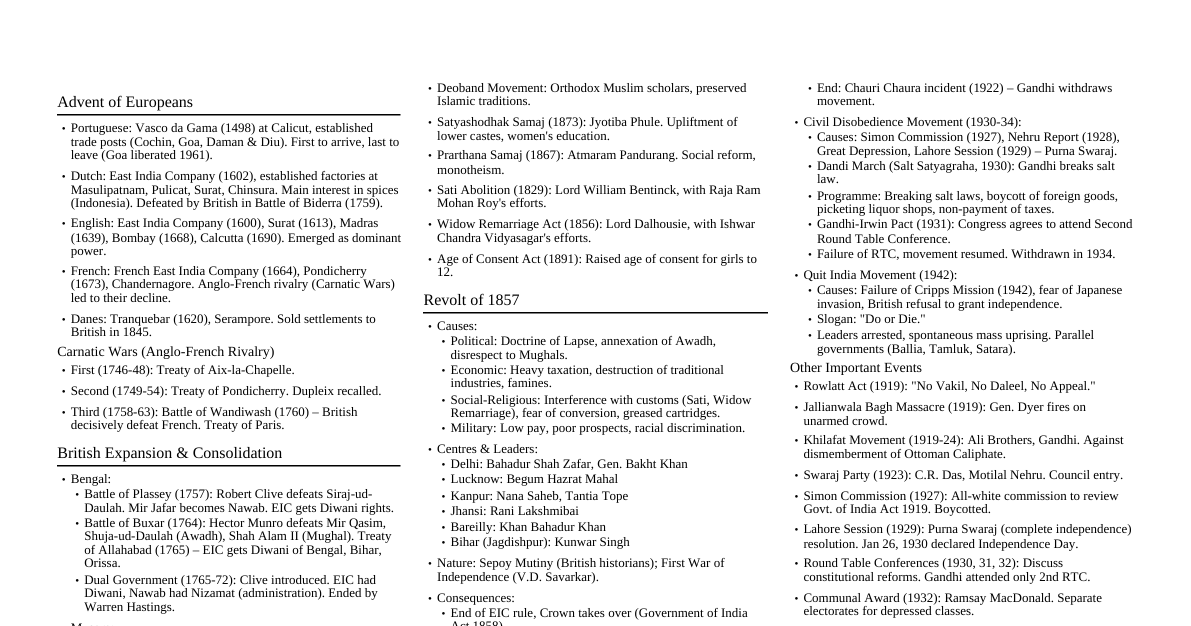
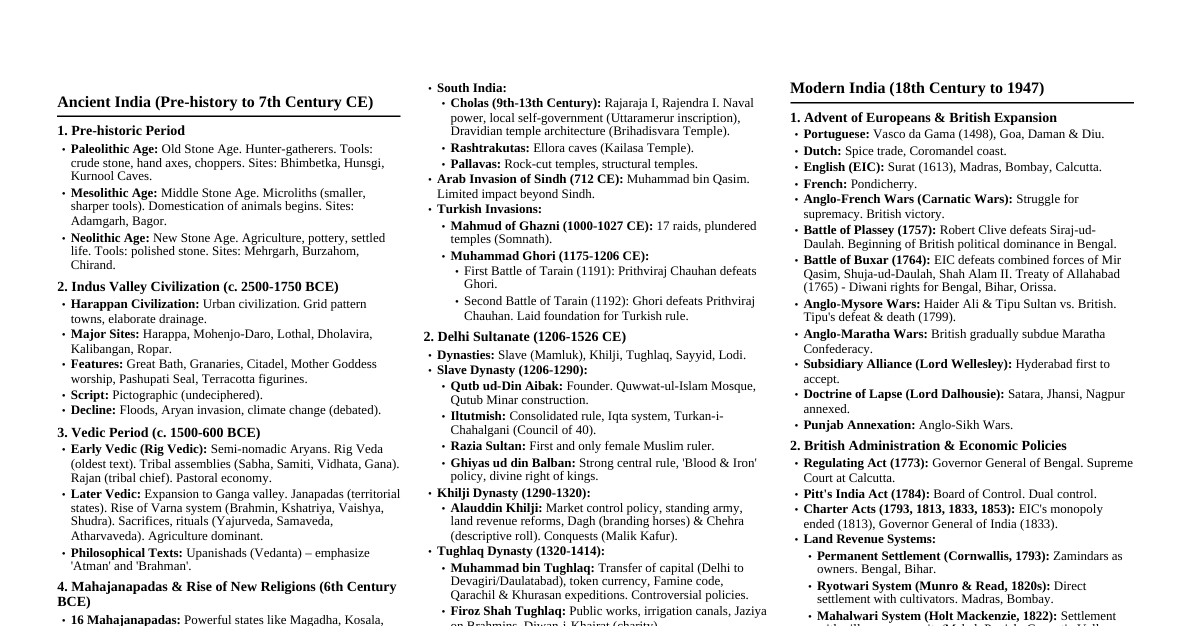
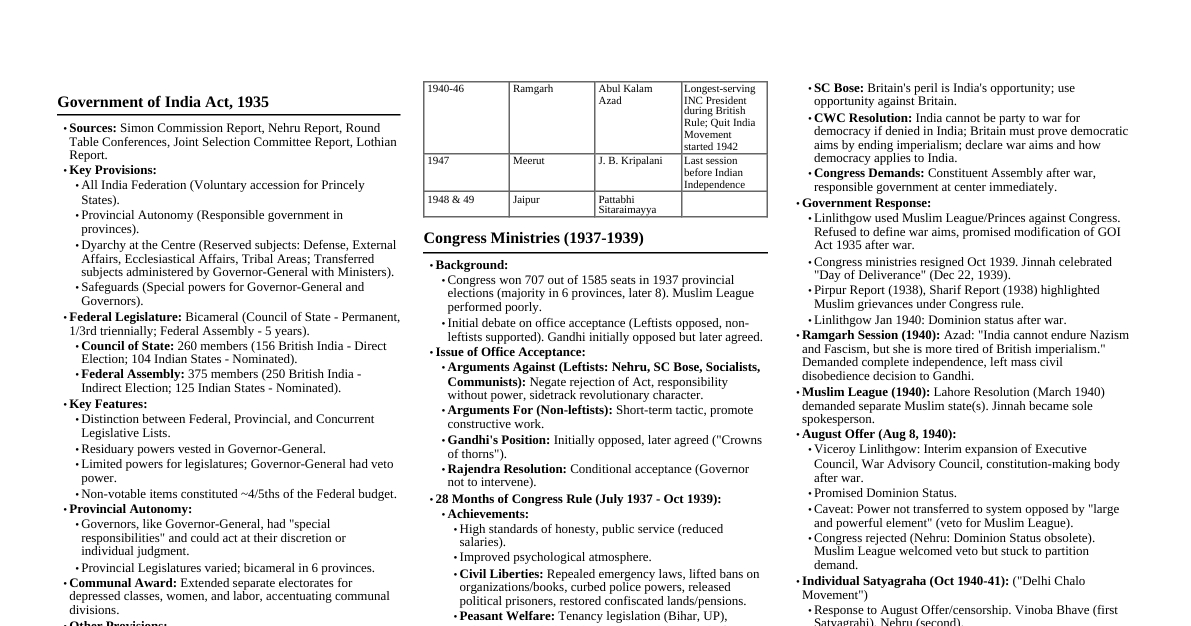
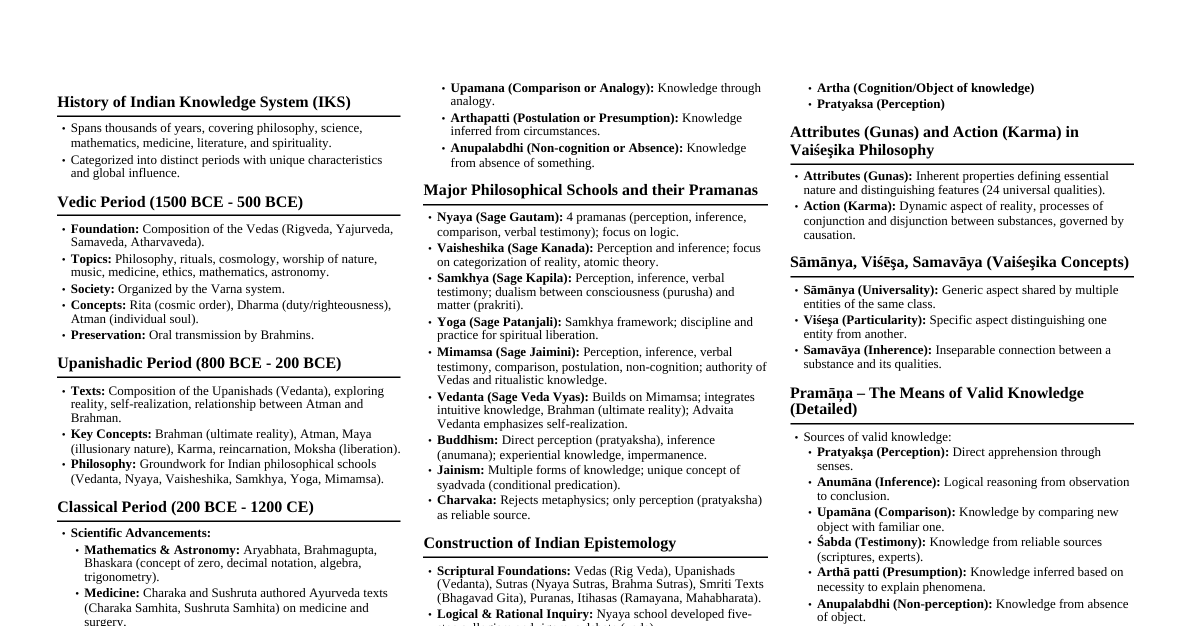
Modern Indian History
Cheatsheet Content
1. European Conquest of India Advent of European Powers European Power Year Place of Arrival Portuguese 1498 Calicut (Kerala) Dutch 1605 Masulipatnam (A.P) English 1608 Surat (Gujarat) Danish 1616 Tranquebar (TN) French 1664 Surat (Gujarat) Portuguese Governors & Policies Vasco da Gama: Arrived 1498 (Calicut), welcomed by Zamorin. Established trading stations. Pedro Alvarez Cabral: First factory at Calicut (1500). Francisco de Almeida (1505-09): First governor, started Blue Water Policy, Cartaze system (naval trade license). Alfonso de Albuquerque (1509-15): Captured Goa (Bijapur), Bhatkal (Vijayanagar). Founder of Portuguese power in India. Encouraged marriage with natives, banned Sati. Nino De Cunha (1529-38): Shifted capital Cochin to Goa (1530). Conquered Diu and Bassein. Expanded presence to eastern coast. Decline: Rise of Marathas, Ottoman empire, English & Dutch power, corruption, diversion to Brazil. Significance: Introduced European era, cannons on ships, European warfare, new crops (pineapple, cashew, potato, tobacco, chillies, tomato), printing press. Dutch Factories: Masulipatnam (1605), Pulicat (1610), Surat (1616), Nagapatnam (1658), Cochin (1663). Decline: Lost to English in Anglo-Dutch rivalry (Battle of Bedara), focused on Malaysia/Indonesia. English East India Company (EIC) 1600: Elizabeth I charter for 15 years trade monopoly. 1608: William Hawkins at Jahangir's court (failed due to Portuguese). 1613: EIC Surat Factory established. 1615: Sir Thomas Roe at Jahangir's court, obtained two Farman. 1632: Golden Farman from Sultan of Golconda. 1639: Madras with Fort St. George (replaced Masulipatnam as East Coast HQ). 1662: Charles II received Bombay as dowry. 1700: Fort William established in Calcutta. 1717: Magna Carta Farman by Farrukhshiyar for duty-free trade in Bengal, Gujarat, Hyderabad. Danish 1616: Founded. Settlements in Tranquebar & Serampur. Promoters of Christianity. Lost to English. French 1664: Foundation of French EIC by Colbert. Settlements: Surat (1667), Masulipatnam (1669), Chandernagore (1673). Dupleix: Governor of Chandernagore (1730), then French territory in India (1741). Seized Chennai (1746). Recalled after loss to Robert Clive (1754). Pondicherry: Francois Martin received land grant (1673), became Pondicherry (1674). Carnatic Wars (English vs French) 1st War (1740-48): Originated from Austrian War of Succession. Battle of St. Thome. Treaty of Aix-la-Chapelle (Madras restored to English). 2nd War (1749-54): Regional dynastic disputes. Loss of French power in South India. Treaty of Pondicherry. 3rd War (1758-63): Seven Years' War in Europe. French captured English forts. Battle of Wandiwash (English routed French under Arthur de Lally). Treaty of Paris. Reasons for French Failure: Government-controlled EIC (vs. private English EIC), weaker navy, less strategic regional bases, territory gains focus (vs. trade gains), weaker leadership. British Advent through Wars Battle of Swally (1612): Vs Portuguese. English victory. Battle of Plassey (1757): Vs Siraj Ud Daula (Bengal). English victory. Revenue of Bengal financed EIC trade. Battle of Bedara (1759): Vs Dutch + Mir Zafar (Bengal). English victory. Battle of Buxar (1764): Vs Mir Qasim (Awadh) + Shuja-ud-daulah + Shah Alam II (Mughal). English victory. Treaty of Allahabad (1765). Dual Government Policy. 1st Anglo-Mysore War (1767-69): Vs Mysore (Haidar Ali). Inconclusive. Treaty of Madras. 1st Anglo-Maratha War (1775-82): Vs Maratha. Origin in cotton trade disputes. Treaty of Salbai. 2nd Anglo-Mysore War (1780-84): Vs Mysore. Death of Haidar Ali. Treaty of Mangalore. 3rd Anglo-Mysore War (1790-92): English + Nizam + Maratha Vs Mysore (Tipu Sultan). English victory (Cornwallis). Treaty of Seringapatam. 4th Anglo-Mysore War (1799): English + Nizam + Maratha Vs Mysore (Tipu Sultan killed). Wodeyar dynasty reinstated. Subsidiary alliance imposed. 2nd Anglo-Maratha War (1803-05): Vs Maratha. English victory. Subsidiary alliance imposed. Treaty of Bassein. 3rd Anglo-Maratha War (1817-19): Maratha confederacy decimated. Peshwa sent to Kanpur. 1st Burma War (1824-26): Vs Burmese. English victory. Treaty of Yandaboo. Sindh War (1839): Vs Sindh (for Subsidiary Alliance). Merged with India (1843). 1st Anglo-Afghan War (1839-42): English victory. 1st Anglo-Sikh War (1845-46): English victory. Treaties of Lahore & Bhairowal. 2nd Anglo-Sikh War (1848-49): Sikh lost. Territories merged into Indian empire. 2nd Burma War (1852): Annexation of Lower Burma (Pegu). 2nd Anglo-Afghan War (1870-80): Treaty of Gandamak. 3rd Burma War (1885): Annexation of Upper Burma. Anglo-Tibetan (1904): Treaty of Lhasa. Transfer of Chumbi valley. 2. India on the Eve of British Conquest Decline of Mughals Aurangzeb's Reign (1658-1707): Decline began after this. Immediate Reasons: Misguided policies, Deccan problem, succession wars, weak rulers. Later Reasons: Neglect of North-west border, invasions (Nadir Shah, Ahmad Shah Abdali), shift of allegiance of Zamindars, rise of Jats & Sikhs, Maratha taxation ('Sardeshmukhi', 'Chowth'), no scientific/technological advancements, poor economic management, deterioration of army, religious policy. Later Mughals Bahadur Shah I (1707-12): Abolished Jiziya, released Sahu, recognized Raja Ajit Singh. Jahandar Shah (1712-13): Mughal advisors gained power. Farrukhsiyar (1713-19): Came to power with Sayyid brothers. Banda Bahadur executed. Mohammad Shah (1719-48): Known as Rangeela. Sayyid brothers killed. Bengal (Murshid Quli Khan), Awadh (Saadat Khan), Hyderabad (Asaf Jah) became independent. Nadir Shah attacked (1739). Ahmed Shah (1748-54): Fourteenth Mughal Emperor. Administrative weaknesses. Alamgir II (1754-59): Emperor during Battle of Plassey. Faced Abdali's attacks. Shah Alam II (1759-1806): Panipat 3rd (1761), Buxar (1764), Allahabad Treaty. Captured by English after 2nd Anglo-Maratha war. Akbar II (1806-37): Gave 'Raja' title to Rammohan Roy. Bahadur Shah II Zafar (1837-57): Head during 1857 revolt. Deported to Burma. Regional States Awadh, Bengal, Hyderabad: Did not challenge Mughal authority, virtually independent with hereditary positions. Mysore, Kerala, Rajputs: Completely independent, rose due to collapsing Mughal power. Maratha, Sikh, Jats: New states as rebels against Mughal empire. Important Regional Powers Hyderabad: Founder Nizam-ul-Mulk (Kilich Khan). Defeated Mubariz Khan (1724). Awadh: Founder Saadat Khan. Expelled from Mughal court. Bengal: Founder Murshid Quli Khan. Alivardi Khan became independent. Mysore: Founder Wodeyars. Rulers: Wodeyars, Haidar Ali, Tipu Sultan. Kerala: Founded by Martanda Varma. Defeated Dutch in Battle of Colacher. Jats: Founded by Churaman & Badan Singh. Declined after Suraj Mal's death (1763). Sikh: Founder Guru Gobind Singh. Banda Bahadur. Ranjit Singh controlled Misls, conquered Lahore (1799), Amritsar (1802). Treaty of Amritsar (1838). Marathas: Founder Veer Chhatrapati Shivaji Maharaj. Defeated in Panipat 3rd. Rohilkhand/Farrukhabad: Founded by Mohammad Khan Bangesh. Why Regional Powers Could Not Dominate? Mughal connection (maintained ties). Local politics, weak finance/administration/military. Constant conflicts, Jagirdari crisis. Backward agriculture, high taxes. Self-sufficient trade, exports > imports. Indian Economy & Society (18th Century) Imports: Pearls, silk, wool, dates, coffee, gold, tea, sugar, ivory, drugs. Exports: Cotton textiles, raw silk, indigo, saltpetre, opium, rice, wheat, spices. Major Industry Centres: Cotton (Surat, Varanasi, Lucknow, etc.), Shipbuilding (Maharashtra, Andhra, Bengal). Education: Traditional, no technological advancements. Pathshalas (Hindus), Maktabs (Muslims). Society: Broad cultural unity, divided by caste/religion/tribe/language. Patriarchal. Women: Upper class at home, lower class worked. Widow remarriage promoted by some rulers. Slavery: Widespread, Europeans increased it. Art & Architecture Bara Imambada: Lucknow (1784) by Asaf-ud-Daula. Jaipur: Established by Sawai Jai Singh (1727). Astronomical observatories. Literature: Urdu (Sittar Poetry), Tamil, Risalo (Sindhi by Abdul Latif). British Policies Subsidiary Alliance: Framed by Lord Wellesley (1798-1805). Indian states gave up armed forces, funded British, lost territory on default, gave up foreign relations, British residents in courts. Doctrine of Lapse: Framed by Lord Dalhousie (1848-56). Annexation of princely state if ruler had no legal male heir. Adopted son inherited personal property only. Kittur (1824) acquired by this. Cause of 1857 revolt. Why Maratha remained limited? Division of power, unsustainable revenue, failed to adopt European style, technological backwardness. Reforms by Tipu & Hyder Ali: State commercial corporation, rocket, army on European lines, arm factory. Why British Succeeded: Superior arms/military/strategy, regular salary, civil discipline, strong financial backup, good leaders. 3. Socio-Religious Movements Background & Objectives British Rule: Encouraged modern changes. Issues in Indian Society: Idolatry, superstitions, Sati, polygamy, child marriage, caste problems, opposition to Western culture. Ideological Basis: Newly emerging middle class, intellectual criteria. Objectives: Alternative cultural-ideological system, regeneration of traditional institutions. Streams: Reformist (Brahmo Samaj, Prarthana Samaj, Aligarh Movement), Revivalist (Arya Samaj, Deoband Movement). Changes in Position of Women Abolition of Sati: Regulation of 1829 by William Bentinck. Preventing Female Infanticide: Act passed in 1870 (compulsory birth registration). Widow Remarriage: Hindu Widows' Remarriage Act of 1856. Controlling Child Marriage: Native Marriage Act (Civil Marriage Act), 1872. Education of Women: Christian missionaries (Calcutta Female Juvenile Society 1819), J.E.D. Bethune (Bethune School 1849), Charles Wood's Dispatch (1854), Lady Dufferin (Hospitals 1885), Ishwar Chandra Vidyasagar (schools in Bengal), D.K. Karve (Indian Women University 1916), Lady Hardinge (Medical College 1916). Mitigating Caste-based Discrimination British rule did not inherently favor caste system. Social reform movements targeted discrimination. National movement inspired by liberty/equality. Education & awakening among lower castes. Constitution made equality imperative. Reformist - Organizations - Important Notes Jyotiba Phule, Savitribai Phule: Satyashodhak Samaj (caste movements, education for lower castes/females). Savitribai first female teacher. Bhimrao Ambedkar: All India Scheduled Castes Federation, All India Depressed Classes Association, Bahishkrit-Hitakarini-Sabha (1924). Mahad Satyagraha (1927). GOI Act 1935. E.V. Ramaswamy Naicker: Self-Respect Movement. Sri Narayana Guru, Kerala: One religion, one caste, one God. Temple entry for lower castes. Raja Rammohan Roy (1772-1833): Atmiya Sabha (1814), Brahmo Samaj (1828), Calcutta Unitarian Society. Anti-Sati struggle. Hindu College (1817), Vedanta College (1825). Supported revolutions. Writings: Gift to Monotheists, Precepts of Jesus. Condemned: prejudice against going abroad, purdah, child marriage, polygamy, casteism, untouchability. Promoted: widow remarriage, monotheism, Vedanta. Debendranath Tagore (1817-1905): Tatvabodhini Sabha (1839), Adi-Brahmo Samajh (1866). Propagated Roy's ideas. Keshab Chandra Sen (1838-1884): Joined Brahmo Samaj (1858), Brahmo Samaj of India (1866). Spread Samaj outside Bengal. Ananda Mohan Bose, Shibchandra Deb, Umesh Chandra Datta: Sadharan Brahmo Samaj. Atmaram Pandurang: Prarthana Samaj (1867, Bombay). Associated with M.G. Ranade, R.G. Bhandarkar, N.G. Chandavarkar, Dhondo Keshav Karve, Vishnu Shastri. Focused on social reforms, not religious. D.K. Karve: Widow Remarriage Movement, Widow Home Association. Henry Vivian Derozio (1809-31): Young Bengal Movement (1820s). Society for the Acquisition of General Knowledge. Taught at Hindu College. Propagated: rationality, questioning authority, love, liberty, equality, freedom, women's rights, protection of peasants, better treatment for Indian labor abroad. Ishwar Chandra Vidyasagar: Widow remarriage movement. Book: BAHUBIVAH (against polygamy). Principal of Sanskrit College (opened to non-brahmins), introduced Western thought. Balshastri Jambhekar: Darpan (1832), Digdarshan (1840). Pioneer of social reform through journalism in Bombay. Dadoba Pandurang, Mehtaji Durgaram: Paramahansa Mandali (1849, Maharashtra). Reformed caste, Hindu religion/society. Advocated widow remarriage, education. Jyotiba Phule (Mali) (1827-90): Satyashodhak Samaj (1873). Books: Sarvajanik Satyadharma, Gulamgiri. Aimed at abolition of caste system. Gopalhari Deshmukh (1823-92): Wrote for Prabhakar (pen name Lokahitawadi). Started Hitechh. Said: "If religion does not sanction social reform, then change religion." Gopal Ganesh Agarkar (1856-95): First editor of Kesari. Started Sudharak. Co-founder of New English School, Deccan Education Society, Fergusson College. Gopal Krishna Gokhale (1866-1915): Servants of India Society (1905). Liberal leader of INC. Hitavada (newspaper). Narayan Malhar Joshi: Social Service League (Bombay), All India Trade Union Congress (1920). Narendranath Datta (1862-1902)/ Swami Vivekananda: Ramakrishna Mission (1897). Preacher of neo-Hinduism. Speech at Parliament of Religions (Chicago 1893). Advocated service to all beings. Behramji M. Malabari (1853-1912) & Diwan Dayara Gidumal: Seva-Sadan (1908). Malabari edited Indian Spectator. Efforts led to Age of Consent Act. Shiv Narayan Agnihotri: Dev-Samaj (1887, Lahore). Emphasized eternity of soul, supremacy of guru. Book: Deva Shastra. Tulsi Ram (Shiv Dayal Saheb): Radhaswami Movement (1861). Spiritual attainment without renunciation. No belief in temples/shrines. Sree Narayana Guru Swamy (1856-1928): Sree Narayana Guru Dharma Paripalana (SNDP) Movement. Awakening among Ezhavas (Kerala). Aruvippuram Movement (1888), Aruvippuram Kshetra Yoga (1889). Vokkaliga Sangha: Mysore (1905). Organized for community progress. C.N. Mudaliar, T.M. Nair, P. Tyagaraja: Justice Party Movement (Madras 1917). Demanded separate representation for lower castes. Periyar transformed it to Dravidar Kazhagam. M.G. Ranade & Raghunath Rao: Indian Social Conference (Madras 1887). Social reform cell of INC. Launched 'Pledge Movement' against child marriage. Reformist vs Revivalist Reformists Revivalists Embrace modernity and progressive values Advocate for a return to traditional values Support social reforms and progressive movements Emphasize preserving traditional social structures Promote modern education and scientific temper Stress on traditional knowledge and wisdom Advocate for women's empowerment and equality Prioritize traditional gender roles and values Seek reinterpretation of religious texts and rituals Promote adherence to religious texts and rituals Advocate for democratic reforms and secularism Emphasize religious and cultural identity Support market-oriented economic reforms Favor protectionism and localized economic models Embrace diversity and promote a pluralistic society Emphasize a homogeneous national identity Embrace technological advancements and innovation Exercise caution and skepticism towards technology Encourage individuality and artistic freedom Promote traditional cultural expressions Examples: Raja Ram Mohan Roy, Jawaharlal Nehru Examples: Swami Dayananda Saraswati, Vinayak Damodar Savarkar Major Movements & Notes Ramakrishna Mission: Founder Ramakrishna Paramhansa. Objectives: Spreading Vedanta, philanthropic work. Arya Samaj: Founder Dayananda Saraswati (1875, Bombay). HQ: Lahore. Books: SatyarthPrakash. Principles: Vedas are source of truth, no idol worship/reincarnations/pilgrimages/child marriage/polygamy. Yes to Havan/Yagyas/female education. Call: Go back to Vedas. Outcomes: Self-respect/confidence for Hindus, undermined white superiority, Shuddhi movement. Vaikom Satyagraha: Founders Sri Narayana Guru, N. Kumaran Asan, T.K. Madhavan, K.P. Kesava, K. Kelappan. Objective: Temple entry for Untouchables. Gandhi's presence (1931). Result: Temples opened in Travancore (1936), Madras (1938). Islamic Reformers Wahabi Movement: Founder Abdul Wahab (Arab) + Shah Walliullah. Movement: Return to true Islam, reject Western ideas. India = Land of Kafirs. Carried by Shah Abdul Aziz, Syed Ahmed Barelvi. Outcome: Feelings against British & Punjabi Sikhs. Titu Mir Movement: Founder Mir Nithar Ali (Titu Mir). Principles: Sharia law, Wahabism. Activity: Narkelberia Uprising (1831) against Hindu landlords. Fara-idi Movement (1818): Founder Haji-Sharia-tullah (Eastern Bengal). Eradication of un-Islamic practices. Later terrorism against Hindu zamindars. Ahmadia Movement (1889): Founder Mirza Ghulam Ahmad. Principles: Modernism yes, Jehad no, Reforms yes, Liberal Education yes. Believed Messiah came in Mirza Ghulam Ahmad. Aligarh Movement: Founder Sir Syed Ahmad Khan. Reformist. Yes to women empowerment, Hindu-Muslim brotherhood. No to purdah, polygamy, piri/mundri, Congress. Centre of Muslim revival. Deoband School (Darul-uloom): Founders Mohammad Qasim Nanotavi, Rashid Ahmed Gangohi. Revivalist. Quran teachings + Jihad against foreign rulers. Supported INC, issued fatwa against Sir Syed Khan. Other Reform Movements Parsi Movement: Founders Furdonji Naoroji, Dadabhai Naoroji, K.R. Cama, S.S. Bengalee. Rahnumai Mazdayasnan Sabha (1851). Activities: Jagat Mitra Journal, Rast-Goftar Newspaper. Revival of Parsi rituals, women upliftment, removal of purdah, raised marriage age, education. Sikh/Gurudwara Reform Movement: Singh Sabhas (1870s). Gained momentum in 1920s. Objective: Take Gurudwaras from Mahant's control. Activities: Khalsa College (1892). Successful in 1925 (management to Shiromani committee). Theosophical Movement: Founders Madame Blavatsky, Colonel Olcott (America). Popularized by Annie Besant (1893). In India (1886, Adyar, Madras). Influenced by Indian doctrine of Karma. Focused on cultural, secular, social outlook. Activity: Central Hindu College (Benaras) by Annie Besant. Women Participation & Organizations Tara Bai Shinde: "Stree Purush ki Tulna" (against patriarchy/caste). Begam Rokaya Hussain: "Sultana's dream" (Muslim women emancipation). Pandita Ramabai: Mahila Arya Samaj, Mukti Mission, Sharda Sadan, Widow home. Margret Cousin: All India Women Conference, 'Roshni' journal. Meera Bai: National Council for Women. Dorothy Jinarajadasa: Theosophical movement, voting rights for women. Annie Besant: Women India Association (with Margret Cousin). Saraladevi: Bharat Stree Mahamandal. Swarnakumari: D/o Devendranath Tagore, 'Bharati' Journal. Arya Mahila Samaj (1882): By Ramabai Saraswati. Ladies Social Conference (1904): By Ramabai Ranade (Bombay). Bharat Stree Mahamandal (1910): By Sarala Devi (Allahabad). National Council of Women in India (1925): By Meherbai Tara. All India Women’s Conference (AIWC) (1927): By Margaret Cousins, Maharani Chimnabai Gaekwad, Rani Sahiba of Sangli, Sarojini Naidu, Kamala Devi Chattopadhyay, Lady Dorab Tata. 4. India before 1857 Civil Uprisings Causative Factors: Revenue policies, destruction of Indian industry. Major Causes: Rapid changes under Company rule, zamindars/poligars seeking revenge, decline of Indian handicraft industries, religious preachers instigating rebellion. Sanyasi Revolt (1763-1800): Manju Shah. Eastern Indian sanyasis against British oppression. Revolt in Midnapore & Dhalbhum (1766-74): Against new land revenue system. Revolt of Moamarias (1769-99): Low-caste peasants challenged Ahom kings in Assam. Revolt of Raja of Vizianagaram (1794): Against British. Civil Rebellion in Awadh (1799): Wazir Ali Khan killed British resident. Poligars' Revolt (1795-1805): South India. Kattabomman Nayakan. Diwan Velu Thampi's Revolt (1808-09): Travancore. Against harsh EIC conditions. Paika Rebellion (1817): Odisha. Rent-free land tenures. Wahabi Movement: Syed Ahmed of Rai Bareilly. Return to pure Islam. Kuka Movement: Bhagat Jawahar Mal (1840, Punjab). Religious purification, then political. Peasant Movements Indigo Revolt (1859-60): Forced indigo cultivation. Digambar Biswas, Bishnu Biswas (Nadia). Supported by intellectuals. Successful. First Satyagraha. Pabna Movement: Occupancy Act of 1859. Zamindars increased rent. Peasants formed Agrarian League. Ended with 1885 Bengal Tenancy Act. Deccan Riots of 1875: Deccan famine. Against Gujarati moneylenders. Ryots boycotted. Armed rebellion under Vasudev Balwant Phadke. Ended with Deccan Peasants Relief Act. Kisan Sabha Movement: Post 1857. Taluqdars unhappy. Supported by Home Rule activists. Kisan Sabha in UP. Leaders: Gauri Shankar Mishra, Indra Nayan Dwivedi, Baba Ramchandra. Eka Movement: End of 1921 (Northern UP). Peasants disobeyed British. Leader: Madari Pasi. Mappila Revolt: 1836-56 (South Malabar). Against Hindu landlords. Poligars: 1790s (Malabar). Land revenue system. Bardoli Satyagrah: 1926 (land revenue increased). Leader: Sardar Vallabhbhai Patel. Main Force: Peasants. Objectives: Against economic exploitation. Targets: Moneylenders, foreign planters, zamindars. Not against colonialism. AIKS (All-India Kisan Congress/Sabha): Founded 1936 (Lucknow) by Swami Sahjanand Saraswati (president), N.G. Ranga (general secretary). Influenced Congress manifesto for 1937 elections. Tribal Movements Triggers: Land revenue policy, forest laws (1840), prohibition of shifting cultivation, new taxes, banning sacrificial customs, new administrations, religious policies, disturbance in indigenous culture. Chauhars (1769): West Bengal. First to revolt. Khasi (1828): Assam. Leader: Tiruth-singh. Why: Revenue policy, army presence. Kol Uprising (1832): Chota Nagpur. Leader: Buddho Bhagat. Why: British expansion. Khond Uprising (1846-48): Odisha. Leader: Chakra Besai. Why: Lord Hardinge I banned sacrifice. Santhal (1854): Rajmahal Hills, Bihar. Leaders: Siddhu + Kanhu. Why: Land revenue policy. Kachangas (1882): Assam. Leader: Shambhu Das. Why: British revenue policy. Munda (1899): Bihar. Leader: Birsa Munda. Why: Against Christian activities. New cult: Singbonga. Sons of soil movement: Ul-gullan. Koya (1922): Godavari, AP. Leader: Alluri Sitaraman Raju. Why: Forest laws. Against Muthadars. Called Rampa rebellion. Naikdas (1858): Gujarat. Leaders: Roop Singh + Jaria Bagatha. Why: Expansion policy. Bhil (1913): Leader: Govind Guru. Why: Revenue policy. Chenchu (1922): Nallamala Hills, AP. Leader: K. Hanumanthu. Why: Forest laws. Tebhaga Movement (1946-47): Bengal. Peasant uprising demanding reduction of share of harvest to one-third. Telangana Movement (1946-51): Andhra Pradesh. Peasant & communist-led armed struggle against feudal landlords & Nizam's government. 5. The Revolt of 1857 Causes Economic Causes: Heavy taxation, loss of patronage for artisans, destruction of traditional industries, forfeiture of zamindar privileges. Political Causes: British interference in socio-religious affairs, Doctrine of Lapse, Subsidiary Alliance, absentee sovereignty, denial of rights to Mughal rulers. Administrative Causes: Widespread corruption. Socioreligious Causes: Racial arrogance, Christian missionaries, British reforms (Sati abolition, widow remarriage, women's education), Religious Disabilities Act (1856). Immediate Causes: Rumors of bone dust in flour, greased Enfield rifle cartridges. Influence of Outside Events: British losses in First Afghan War, Punjab Wars, Crimean Wars, Santhal Rebellion. Chronology of Revolt May 10, 1857: Revolt begins in Meerut (sepoys refuse new cartridges), march to Delhi. May 11, 1857: Sepoys capture Delhi, declare Bahadur Shah Zafar II as leader. May 30, 1857: Siege of Delhi begins. June 1857: Rebellion spreads to Lucknow, Kanpur, Jhansi, Allahabad, Agra. June 8, 1857: Siege of Lucknow begins (Begum Hazrat Mahal, Nana Sahib). June 27, 1857: Massacre at Cawnpore (Kanpur) by Nana Sahib. July 1857: British under General John Nicholson capture Delhi. Rani Lakshmibai leads resistance in Jhansi. September 1857: Siege of Lucknow lifted. March 1858: British recapture Kanpur. June 1858: Rani Lakshmibai dies fighting in Battle of Gwalior. July 8, 1858: Tantia Tope captured. July 1858: British declare revolt officially over. October 1858: Kunwar Singh continues guerrilla warfare in Bihar. November 1858: British capture Faizabad. Government of India Act 1858 (transfer to British Crown). March 1859: British capture Jhansi. April 1859: Rani Padmini of Kittoor captured. June 1859: British capture Gwalior. July 8, 1859: Tantia Tope executed. April 1860: Government of India Act 1858 passed. 1876: Queen Victoria proclaimed Empress of India. 1947: India achieves independence. List of Important Locations Meerut: Revolt began May 10, 1857. Delhi: Captured May 11, 1857. Bahadur Shah II proclaimed leader. Kanpur: Massacre at Bibighar (July 1857). Lucknow: British residency besieged for over 140 days. Jhansi: Rani Lakshmibai led defense. Gwalior: Captured by British June 1858. Awadh (Oudh): Annexation in 1856 a significant cause. Barrackpore: Mangal Pandey rebelled March 29, 1857. Allahabad: Center of rebel activities. Bihar: Prolonged guerrilla warfare by Kunwar Singh. Leaders and Locations Leader Location Mangal Pandey Barrackpore, West Bengal Rani Lakshmibai Jhansi, Uttar Pradesh Bahadur Shah II Delhi Kunwar Singh Bihar Nana Sahib Kanpur, Uttar Pradesh Tantia Tope Central India (Narmada region) Bakht Khan Delhi, Awadh (Oudh) Khan Bahadur Khan Rohilkhand region Begum Hazrat Mahal Awadh (Oudh) Azimullah Khan Lucknow, Uttar Pradesh Maulvi Ahmadullah Shah Faizabad, Uttar Pradesh Birjis Qadir Lucknow, Uttar Pradesh Bakshi Jagabandhu Odisha (Orissa) Ahmadullah Shah Faizabad, Uttar Pradesh Why Revolt Failed Limited territorial & social base: Concentrated in North India. All classes did not join: Zamindars, merchants, moneylenders, educated Indians, many princes supported British. Poor Arms & Equipment: European soldiers had latest weaponry. Uncoordinated & Poorly Organized: Lack of central leadership. Dependence on Mughals: Centripetal tendency around Mughal. Consequences of Revolt Company rule abolished: Crown took over administration. Expansion & annexation ended: British expansion halted. Army reorganized: "Division and counterpoise" policy. Racial hatred increased: Between ruled and ruling classes. White mutiny: Resentment among company forces due to allowance cancellation. Act of 1858: Administration transferred from EIC to Crown. Assurance to native ruling chiefs: Territories never annexed (Allahabad Proclamation). Protection of landlords & zamindars: Policies implemented. Concept of martial race: Gained significance in army recruitment. Views on Revolt V.D. Savarkar: First war of Indian independence. Tara Chand: War of Nation's Independence. R.C. Majumdar: Neither first, nor national, nor war of independence. Surender Nath Sen: Began as fight for religion, transformed into war of independence. 6. Beginning of Modern Nationalism in India Factors Understanding of Contradictions: Colonial rule caused economic backwardness. Political, Administrative, Economic: Professional civil service, unified judiciary, modern infrastructure (unintentionally aided unity). Western Thought & Education: Liberal ideas, English language fostered nationalism. Role of Press & Literature: Disseminated ideas, critiqued government. Rediscovery of India's Past: European theories challenging racial superiority instilled self-respect. Socio-Religious Reform Movements: Unifying role, contributed to nationalism. Middle Class Intelligentsia: Provided leadership to INC. Impact of Contemporary World Movements: Liberation movements inspired Indian leaders. Reactionary Policies & Racial Arrogance: Discriminatory policies (ICS age limit, Delhi Durbar, repressive acts) fueled resentment. Political Associations before INC Banglabhasha Prakashika Sabha (1836): Raja Rammohan Roy's association. Zamindari Association (1838): Safeguard landlords' interests (Bengal). First political organization. Bengal British India Society (1843): George Thompson, Dwarkanath Tagore. Welfare of all classes. British Indian Association (1851): Radhakanta Deb (president), Debendranath Tagore (gen sec). Exclusively Indian. Demands in Charter Act of 1853. East India Association (1866): Dadabhai Naoroji (London). Discussed Indian matters, representation to government. The Indian League (1875): Sisir Kumar Ghosh. Stimulated nationalism, political education. The Indian Association of Calcutta / The Indian National Association (1876): Surendranath Banerjee, Ananda Mohan Bose. Promoted political, intellectual, material advancement. Merged with INC (1886). The Poona Sarvajanik Sabha (1867): Ganesh Vasudeo Joshi, Mahadev Govind Ranade. Mediating body, popularized peasants' legal rights. Petitioned House of Commons for Indian representation. The Bombay Presidency Association (1885): Pherozeshah Mehta, K.T. Telang, Badruddin Tyabji. Response to Lytton's policies, Ilbert Bill controversy. The Madras Mahajan Sabha (1884): M. Veeraraghavachariar, G. Subramania Iyer, P. Ananda Charlu. Forerunner of INC. Activities before Congress 1878-79: Indianization of government service. 1878: Opposition against Lytton's Afghan adventure, Arms Act, Vernacular Press Act. Advocacy for volunteer corps. Opposition against plantation labor/Inland Emigration Act. 1883: Support for Ilbert Bill. 1885: Campaign in Britain to vote for pro-India party. 1906: Agitation against ICS age limit reduction. Ilbert Bill and Controversy (1883) Proposal: Lord Ripon, Sir Courtenay Peregrine Ilbert. Abolish racial discrimination in judicial system. Indian judges to try Europeans. Existing Discrimination: Indian judges could not try Europeans. Controversy: Strong opposition from European British community. Feared superiority undermined. Racial bias. Protest: Mass protests, public meetings. English women argued Bengali women were "ignorant". Bengali women responded with academic qualifications. Compromise: "Ilbert-Sonnerat Amendment" - Indian judges jurisdiction over Europeans only if latter consented. Passage (1884): Limited practical implementation. Legacy: Highlighted racial divisions, catalyst for nationalist movement. Indian National Congress (INC) Founded: 1885 by A.O. Hume (retired English Civil servant). First Session: December 1885, Bombay. Presided by W.C. Bonnerjee, 72 delegates. Aims: Friendly relations among nationalist workers, national unity, formulate popular demands, train/organize public opinion. 7. Moderate Phase 1885-1905 Moderate Leaders Dadabhai Naoroji: First Indian to British Parliament. "Grand Old Man of India". Proponent of Drain Theory ("Poverty & Un-British Rule in India"). Gopal Krishna Gokhale: Social/political reformer. Advocated rights/education reforms. Pherozeshah Mehta: Lawyer/politician. Bombay Presidency Association. Surendranath Banerjee: Founding member INC. Constitutional reforms. Ananda Mohan Bose: Founder Indian National Association. Civil liberties/representation. Madan Mohan Malaviya: Educationist, founder BHU. Hindu-Muslim unity. R.C. Dutt: Retired ICS. "The Economic History of India". Dinshaw Wacha: Social reformer/political leader. Women's rights. S. Subramania Iyer: Journalist/politician. Press freedom. Firozeshah M. Mehta: Lawyer/social reformer. Bombay politics. Justice M.G. Ranade: Taught modern industrial development. Economic Theory & Views Drain Theory: Dadabhai Naoroji. British exploited India economically. Critique of Railways: Gopal Krishna Gokhale. Neglected other sectors, economic disparities. Deindustrialization: Naoroji, R.C. Dutt. British policies led to decline of Indian industries. Operation Methods: Prayers, representation, persuasion. Achievements of Moderates Critiqued British economic policies, exposed wealth drainage. Indian Councils Act, 1892 (increased legislative councils, non-officials). Beginning of nationalist feeling. Propagated human rights, democracy, liberty, equality. Social reforms (Gokhale, Ranade opposed child marriage/forced widowhood). Failures of Moderates Individual struggle, not mass participation. Loyal towards British (not complete independence). Western influence in political model. No struggle for constitution/methodological path. Prime issue "Un-British rule", not British presence. Un-British Rule Moderate leaders criticized British policies inconsistent with British traditions/ideals. Oppressive, exploitative, detrimental policies (land revenue, economic exploitation, racial discrimination, denial of rights). Aimed to appeal to British fairness, hoping for reforms. 8. Era of Militant Nationalism Why Militant Phase Took Over? Famines (1896, 1900): Killed millions. Bubonic Plague: Spread in Deccan. British Policies: Stopped social/cultural progression, suppressed education/modernity. Indian Councils Act (1892): Unsatisfactory. Trials of Nationalists: Natu brothers, Tilak charged with sedition. 1904: Official Secrets Act (reduced press freedom), Indian Universities Act (increased government control). Emergence of New Leaders: Tilak, Aurobindo, Bipin Chandra Pal. Education: Rising unemployment, blame on British for underdevelopment. Myths of English Superiority Busted: Japan's progress, Italy's defeat by Ethiopia, Boer wars, Russia's defeat by Japan. India-focused leaders: Swami Vivekananda, Dayananda Saraswati, Bankim Chandra Chatterjee (revitalization of Indian identity/culture). Failures of Moderates: Petitions, prayers, protests ineffective. Curzon: Refused idea of India as a Nation, invited nationalist wrath. Militant Thoughts: Hatred for alien rule, goal of Swaraj, direct action, mass effect, personal sacrifice. Propagated by Raj Narain Bose, A.K. Dutta, Aurobindo Ghosh, Bipin Chandra Pal, Vishnu Shastri Chiplunkar, Bal Gangadhar Tilak, Lala Lajpat Rai. Bengal Partition of 1905 Announced: July 20, 1905 by Lord Curzon. Implemented Oct 16, 1905. Purpose: Weaken growing national movement in Bengal. Divide & Rule (Hindu-Muslim bridge). Details: Bengal, Bihar, Orissa (80M pop). Assam separate since 1874. East Bengal & Assam (capital Dhaka). West Bengal, Bihar, Orissa (capital Calcutta). INC Reaction: Condemned as 'Divide and Rule'. Launched "Swadeshi Movement". Swadeshi Movement of 1905 Anti-Partition Campaign (1903-05): By Moderates (Surendranath Banerjea, K.K. Mitra, Prithwish Chandra Ray). Actions: Pamphlets, petitions, public meetings, memoranda. Newspapers: Hit-vaadi, Sanjivani, Bangali. Objective: Pressurize government. Songs: Vande Mataram, Amar Sonar Bangla (Tagore). Launch: Benaras session of Congress (1905). President: Gopal Krishna Gokhale. Activities: National Movement came to streets. Objective: Pressurize English economy (indigenous industries), assert nationalistic sentiments, national education, cultural revival. 1906 Calcutta Session: Dadabhai Naoroji president. Goal of 'Swaraj' adopted. Leaders: Poona/Bombay (Bal Gangadhar Tilak), Punjab (Lala Lajpat Rai, Ajit Singh), Delhi (Syed Haidar Raza), Madras (Chidambaram Pillai). Boycotts: Foreign goods. Samitis: Volunteers (Ashwini Kumar Dutta's Swadeshi Bandhab Samiti in Barisal, V.O. Chidambaram Pillai's Swadeshi Sangam in Tirunveli). Self-reliance: Economic regeneration of villages (Rabindranath Tagore's Atma Shakti). Festivals: Ganpati, Shivaji (Tilak). Education: Aurobindo Ghosh (Bengal National College), Tagore (Shantiniketan), National Council of Education (1906), Bengal Institute of Technology. Swadeshi Enterprises: Textile mills, soap/match factories, banks, insurance. V.O. Chidambaram Pillai (Swadeshi Steam Navigation Company). Art: Subramanyan Bharati (Swadesha Geetham), Bengali nationalism music, Abanindranath Tagore (Indian Art), Indian Society of Oriental Art (1907). Mass Participation: Students, women, labor. Muslims: Nawab Salimullah of Decca supported partition. Upper/middle class Muslims did not participate. Differences between Extremists and Moderates Category Extremists Moderates Approach to Ideology Advocated for complete independence through radical means, including armed resistance. Promoted non-violent civil disobedience and emphasized gradual reforms while aiming for self-rule within the British Empire. Communication Style Used fiery speeches and strong rhetoric to mobilize mass support, often invoking nationalist sentiments and challenging British authority. Emphasized persuasive communication, moral appeals, and peaceful dialogue, aiming to win over the hearts and minds of both Indians and the British. Decision-Making Favored more assertive and unilateral decision-making, focusing on achieving immediate goals. Emphasized inclusivity and consensus-building, seeking to involve a wider range of leaders and communities in decision-making processes. Engagement with Opposing Groups Maintained a confrontational approach towards the British and often rejected any form of cooperation or engagement. Encouraged dialogue, negotiations, and constructive engagement with the British, aiming to find common ground and work towards a peaceful solution. Beliefs Rejected Providential mission theory and any political connections with English govt. Believed in England's providential mission in India and that political connections with Britain to be in India's social, political, and cultural interests. Loyalty Loyal to India. Loyal to British crown. Transition of Swadeshi Movement Why it Ended: Government repression, Surat split (1907), lack of organization. Transformation: To revolutionary extremism. Youth frustrated. Quote: "They gave us back the pride of our manhood" - Hirendranath Banerjee on revolutionary activity. What led to Surat Split of 1907 1905 Benaras Session (G.K. Gokhale): Extremists wanted movement to spread outside Bengal and include all associations; Moderates wanted it limited to Bengal. 1906 Calcutta Session (Dadabhai Naoroji): Extremists wanted Tilak/Lajpat Rai as president. Congress adopted Swaraj, swadeshi, boycott, national education resolutions. Moderates wanted Naoroji, thought extremists' agitation dangerous. 1906: Aga Khan led Muslim elites to Lord Minto, demanded separate electorate (Shimla Deputation). 1907 Surat Session: Extremists wanted Nagpur (Tilak/Lala as president). Moderates wanted Surat (Rashbehari Bose as president). Split occurred. Partition of Bengal Cancelled (1911) When & By Whom: Dec 12, 1911 by Lord Hardinge in Delhi Durbar. Response to Swadeshi riots. Muslims: Unhappy. Capital shifted Calcutta to Delhi to placate. Final Results: Assam, Bihar, Orissa became separate provinces. Morley-Minto Reforms of 1909 Who: John Morley (Secretary of State), Lord Minto (Viceroy, "Father of Communal Electorate"). Year: 1909. Muslims: Separate electorate for Muslims for provincial councils. First time seats reserved on basis of religion. Elections: First time introduced in India. Changes: Legislative council members increased (16 to 60 central). Elected Indians debated budget, tabled resolutions. Indian Appointment: One Indian in Viceroy's executive council (Satyendra Sinha, 1909). Problem: House not binding on Government. Hindu-Muslim division. British Legislative Councils Introduction: Platform for discussion, legislation. Central Legislative Council (Imperial Legislative Council): Appointed members. Provincial Legislative Councils: Introduced by Indian Councils Act of 1861. Predominantly nominated. Powers: Discuss, propose legislation, scrutinize budget. Final decision with Governor-General/Governor. Composition: Nominated, elected (specific interests), ex-officio members. Limited Franchise: Based on property, education, taxes. Evolution: Indian Councils Act of 1861, 1892, 1909, 1919, 1935. 9. The Early Revolutionaries of India and World War I Revolutionary Terrorism Main Ideas: Assassinations of British officials, remove traitors/informants, Swadeshi loots for funds, military coups, strike terror. Early Phase: No violent mass movements, individual heroism. Inspired by Russia, Ireland. 1879: Vasudev Balwant Phadke (Maharashtra). Ramosi Peasant Force. 1890: Tilak (Maharashtra). Propagated militant nationalism via Kesari, Maharatta; Shivaji, Ganapati festivals. 1897: Chapekar brothers (Damodar, Balkrishna). Murdered Plague Commissioner Rand, Lt. Ayerst (Poona). 1899: Savarkar brothers. Mitra Mela (secret society), merged with Abhinav Bharat. Bomb manufacturing (Nasik, Poona, Bombay). 1902: Jnanendra Nath Basu, Promotha Mitter, Jatindra Nath Banerjee, Barindra Kumar Ghosh (Midnapore, West Bengal). Anushilan Samiti. 1906: Barindra Kumar Ghosh, Bhupendranath Dutta (Kolkata). Started 'Yugantar' weekly. Advocated force. 1907: Yugantar group (Bengal). Attempted to kill Sir Fuller/Andrew Fraser. 1908: Khudiram Bose, Prafulla Chaki (Muzaffarpur, Bihar). Attempted to kill Kingsford, killed two British women. Bose executed, Chaki committed suicide. 1908: Aurobindo Ghosh, Barindra Ghosh (Bengal). Alipore Conspiracy Case. Aurobindo acquitted. 1909: Anant Lakshaman, Pulin Das (Nasik). Killed AMT Jackson (Collector of Nasik). 1912: Rashbehari Bose, Sachin Sanyal, Basant Kumar Biswas, Amir Chand, Avadh Behari (Delhi). Bomb attack on Viceroy Hardinge. Yugantar Party Origin: Western Anushilan Samiti (1902, Calcutta) by Pramatha Nath Mitra, Barin Ghosh. Transition: Faction favoring militant approach formed Jugantar (1906). Leaders: Barin Ghosh, Jatindranath Mukherjee (Bagha Jatin), Bhupendranath Dutta. Activities: During WWI, arranged German arms (Zimmerman Plan). Plan to organize guerrilla force, mutiny. Failed. "We shall die to awaken the nation" - Bagha Jatin. Revolutionary Newspapers Year Newspaper/Magazine Released By Place of Release 1878 Indu Prakash Girish Chandra Ghosh Calcutta, Bengal 1881 Kesari Lokmanya Tilak Pune, Maharashtra 1892 Yugantar Barindra Kumar Ghosh, Bhupendranath Dutta Calcutta, Bengal 1898 Sandhya Jugantar Party Calcutta, Bengal 1901 Vande Mataram Aurobindo Ghosh Calcutta, Bengal 1902 Bande Mataram Barindra Kumar Ghosh, Bhupendranath Dutta Calcutta, Bengal 1906 Jugantar Barindra Kumar Ghosh, Jatindranath Mukherjee, Bhupendranath Dutta Calcutta, Bengal 1906 Hindustan Ghadar Ghadar Party San Francisco, California (USA) 1910 Kal Savarkar Brothers Nasik, Maharashtra 1911 Karmayogi Bal Gangadhar Tilak Pune, Maharashtra 1912 Mukti Jatindranath Mukherjee (Bagha Jatin) Calcutta, Bengal 1913 Abhinav Bharat Vinayak Damodar Savarkar London, England Punjab Agitations Lala Lajpat Rai: 'Punjabi' motto (Self-help). Ajit Singh: Organised 'Anjuman-i-Mohisban-i-Watan' (Lahore), journal Bharat Mata. Urdu Poets: Aga Haidar, Syed Haider Raza, Bhai Parmanand, Lalchand 'Falak'. 1907: Deportation of Lala + Ajit. Ban on meetings. Rashbehari Bose: Ghadr revolution. Escaped to Japan (1915). Ghadr Movement Origin: 1913. Founders: Lala Hardayal, Sohan Singh Bakhna (Pres.). Location: San Francisco, USA. Objective: Overthrow British rule, establish independent democratic country. Activities: Established Ghadar Party, published "Ghadar" newspaper, mobilized Indian immigrants, advocated armed revolution, collected funds/arms, sent activists to India. Planned Ghadar Conspiracy of 1915. 'Swadesh Sevak Home' (Vancouver), 'United India House' (Seattle). Komagata Maru Incident (1914): Ship with Sikh/Punjabi Muslim passengers denied entry into Canada. Conflict in Calcutta. Inflamed Ghadr leaders. Defence of India Act (1915): Used by British to counter Ghadr. Berlin Committee for Indian Independence (1915): Virendranath Chattopadhyay, Bhupendranath Dutta, Lala Hardayal (with German support - Zimmerman Plan). Mission to Kabul: Raja Mahendra Pratap Singh, Barkatullah, Obaidullah Sindhi (provisional Indian government). Revolutionaries Abroad Shyamji Krishna Varma: Indian Home Rule Society (London 1905). "The Indian Sociologist". Madam Bhikaji Cama: Hoisted first Indian flag (Stuttgart, Germany 1907). Virendranath Chattopadhyay (Chatto): Germany/Russia. Anti-British propaganda. Vinayak Damodar Savarkar: Fled to London (1906). Abhinav Bharat Society. Lala Hardayal: Co-founder Ghadar Party. "Pan-Pacific Association". Tarak Nath Das: Activist/scholar (USA). Madanlal Dhingra: Assassinated Curzon-Wylie (1909). WW-I (1914-1919) and India Context: Britain allied with France, Russia, USA, Italy, Japan vs Germany, Austria-Hungary, Turkey. Imperialist war. India's Participation: Indians recruited. INC supported war for concessions. Montagu Declaration (1917): Promised eventual self-governance. Rowlatt Act & Jallianwala Bagh: Fueled anti-British sentiments. Khilafat Movement: Emergence for Ottoman Caliphate. Political Impact: Punjabi soldiers' return made Punjab revolutionary epicenter. Montagu-Chelmsford Reforms failed. Social Impact: Increased 1911-21. Respect for war participants. Deprived India of essential services. Economic Impact: Sharp increase in demand for Indian goods. Inflation. Industrial prices doubled. Rising military demand for jute. Huge drain on Indian economy. Cotton, Steel benefitted. Boosted Indian capitalism. Home Rule League Why: Extremists started. Nationalists believed popular pressure needed. Moderates disillusioned. Civilians felt wartime miseries. Tilak (released 1914) ready for leadership. Anne Besant active. Objective: Self-rule or Swaraj. Working: Political education, public meetings, conferences, classes, propaganda, funds, social work, local government. Branches: Tilak's League (April 1916): Maharashtra (excl. Bombay), Karnataka, Central Provinces, Berar. Six branches. Demands: Swaraj, linguistic states, vernacular education. Anne Besant's League (Sept 1916, Madras): Rest of India (incl. Bombay). 200 branches. George Arundale (organizing secretary). Other Leaders: Motilal Nehru, Jawaharlal Nehru, Bhulabhai Desai, Chitra-ranjan Das, Madan Mohan Malaviya, Mohammad Ali Jinnah, Tej Bahadur Sapru, Lala Lajpat Rai. Muslims/Non-brahmins: Did not join (feared Hindu majority rule). Response: Severe repression. Annie Besant, B.P. Wadia, George Arundale arrested (June 1917). Sir S. Subramaniya Aiyar renounced knighthood. Tilak advocated passive resistance. Decline: No effective organization, communal riots (1917-18). Montagu-Chelmsford reforms promised home rule. Tilak went abroad (Sept 1918). 1916 Lucknow Pact Extremists readmitted to Congress. Congress accepted League position on separate electorates. Unity between Muslim League and Congress. Key Points: Adequate Muslim representation. Reconciled Congress factions. Joint demands: self-government, increased Indian participation, religious freedom, minority rights. Devolution of powers to provinces. Muslim League Changes Stance (1916) WW-I Deceit: Britain did not help Turkey. Bengal Partition: Unhappy with annulment. Aligarh University: British refusal to set up university with affiliation powers. Younger Members: Maulana Azad ('Al Hilal'), Mohammad Ali ('Comrade'). Muslim League + Congress Joint Demands Congress agreed to League's demand for separate electorate. Muslims granted fixed proportion of seats. Joint demands: self-government, representative assemblies, reforms in viceroy's council, secretary of state paid by British treasury. Montagu Statement (August 20, 1917) British intention to introduce reforms, gradually increase self-governance, prepare India for responsible government. Greater Indian participation. Representative institutions at central/provincial levels. Importance of communal harmony. Dyarchy system proposed (transferred/reserved subjects). 10. The Rise of Gandhi Life in Brief Birth: Oct 2, 1869, Porbandar, Gujarat. Education: Law in London. South Africa (1893-1914): Fought racial discrimination. Developed nonviolence/civil disobedience. Indian National Congress: Joined 1915, advocated Indian rights. Noncooperation Movement: 1920. Boycott British institutions. Salt March (Dandi March): 1930. Civil disobedience against salt monopoly. Round Table Conferences: 1930-32. Represented Indian interests. Quit India Movement: 1942. Immediate end to British rule. Africa Period Influenced by: Satya, Ahinsa, Non-co-operation, Ruskin Bond, Leo Tolstoy, Thoreau. Why moved: Failed lawyer in India, moved to Natal (client Dada Abdullah). Phase 1 (1894-1906): Moderate (petition, prayer). Natal Indian Congress. Indian Opinion Newspaper. Supported Boer/Zulu wars. Phase II (1906-14): Civil disobedience. Satyagraha against Registration Certificates (1906). Passive Resistance Association. Campaign against migration restrictions. Tolstoy Farm (house Satyagrahis). Poll tax campaign. Invalidation of Indian Marriages. 1915: Lord Harding awarded Kesar-e-Hind medal (returned during Khilafat). Authors and Gandhi Author Impact on Gandhi Leo Tolstoy Philosophy of nonviolent resistance and moral principles. Henry David Thoreau "Civil Disobedience" inspired satyagraha, individual conscience. John Ruskin "Unto This Last" shaped economic understanding, simple life, fair distribution. Bhagavad Gita Shaped spiritual beliefs, guided moral/ethical principles, duty, nonattachment. Rabindranath Tagore Writings/poetry resonated, humanism, unity, truth. Deep intellectual/spiritual connection. Ralph Waldo Emerson Transcendentalist ideas influenced self-reliance, individualism, inner conscience. Harishchandra Moral exemplar for unwavering commitment to truth. Henry Salt "A Plea for Vegetarianism" inspired vegetarianism. Gandhi's Publications Publication Description Year Hind Swaraj or Indian Home Rule Gandhi's vision of self-rule and nonviolent resistance. 1909 Young India Weekly journal covering social, political, economic issues, advocating nonviolence. 1919-1931 Navajivan Gujarati weekly newspaper. 1919-1956 Harijan Weekly newspaper dedicated to untouchability and marginalized communities. 1933-1948 Indian Opinion Newspaper established by Gandhi in South Africa. 1903-1915 Satyagraha in South Africa Documenting Gandhi's experiences and nonviolent resistance methods. 1906-1914 Constructive Programme Gandhi's approach to social, economic, and political reforms. 1941-1945 The Story of My Experiments with Truth Gandhi's autobiography, chronicling his life and philosophy. 1925 Key to Health Gandhi's writings on health, hygiene, natural remedies. 1948 Ashram Observances in Action Gandhi's writings on ashram life, rules, discipline. 1945 Gandhi in India (1917-1919) Why came: South African experiences, INC invitation (G.K. Gokhale), strong leadership, Swadeshi movement, homeland. 1915-16: Journeyed through India. 1917: Champaran (First Civil Disobedience). 1918: Ahmedabad Mill Strike (1st hunger strike), Kheda Satyagraha (1st non-cooperation). 1919: Rowlatt Act strikes (1st All India mass strikes). Civil Disobedience vs Non-Cooperation Civil Disobedience Non-Cooperation Deliberate and open refusal to obey unjust laws or orders. Refusal to cooperate with the British government and institutions. Challenge and undermine unjust laws and authorities. Assert Indian independence and boycott British institutions. Active resistance through breaking or violating laws. Passive resistance by withdrawing cooperation. Protests, demonstrations, non-payment of taxes. Boycott of British goods, educational institutions, and titles. Open to all individuals willing to face legal consequences. Open to the general public and encouraged mass participation. Targeted specific laws or policies. Aimed at overall withdrawal of cooperation. Disrupted administration, increased public awareness. Economic strain on British institutions, loss of legitimacy. Examples: Salt March, Salt Satyagraha, Dandi March. Examples: Khilafat Movement, boycott of British cloth and institutions. Predominantly during 1930s and 1940s. Initiated in 1920, gained momentum until early 1922. CHAMPARAN SATYAGRAHA (1917) Context: Rajkumar Shukla invited Gandhi for indigo planters' issues. Problem: Peasants forced to grow indigo (3/20th land) under Tinkathia System. European planters demanded high rents/illegal dues. Involvement: Gandhi investigated, member of committee. Leaders: Rajendra Prasad, Mazhar-ul-Haq, Mahadeo Desai, Narhari Parekh, J.B. Kripalani. Outcome: Tinkathia system abolished, 25% compensation. AHMEDABAD MILL STRIKE (1918) Issue: Dispute over discontinuation of plague bonus. Worker's Demand: 50% wage increase. Gandhi's Demand: 35% wage hike, fast unto death. Social Worker: Anusuya Sarabhai invited Gandhi. KHEDA SATYAGRAH (1918) Issue: Crop failure in Kheda (Gujarat). Farmer's Demand: Remission if yield Government's Response: Refused, ordered property seizure. Leaders: Sardar Vallabhbhai Patel, Narhari Parekh, Shankarlal Parikh, Mohanlal Pandya. ROWLATT ACT MASS STRIKES (1919) Act Description: Anarchical and Revolutionary Crimes Act. Provision: Imprisonment without trial for two years. Gandhi's Response: Mass protest, Satyagraha Sabha, youth engagement. Protest Form: Hartal, fasting, prayer, civil disobedience. Jallianwala Kaand (1919) Date: April 13, 1919. Location: Jallianwala Bagh, Amritsar. Perpetrators: British Indian Army troops. Commander: Brig-Gen Reginald Dyer. Action: Firing into crowd. Cause of Gathering: Peaceful protest against arrest/deportation of Satya Pal, Saifuddin Kitchlew. Tagore's Reaction: Refused knighthood. Why Gandhi was a huge success? Situation created by World War: New war taxation, forced recruitment, food scarcity, price rise, crop failure. Failures of moderates/extremists. Gandhi's success in Africa, myths: Supernatural powers, healing wounds, overcoming government might. Factors for popularity: Simple attire, colloquial Hindi, Ramrajya allegory, lack of precise Swarajya definition, success in initial movements. Hunter Commission (1919) Formation Date: Oct 14, 1919. Purpose: Investigate Jallianwala Bagh. Indian Members: Sir Chimanlal Harilal Setalvad, Pandit Jagat Narayan, Sardar Sahibzada Sultan Ahmad Khan. Findings: Lack of notice to disperse, length of firing, Dyer's motive condemned. Penal Action: None. Montagu Chelmsford Reforms of 1919 Executive: Dyarchy at provincial level (Reserved/Transferred lists). Executive councilors + popular ministers. Governor held ultimate authority. Legislative Council: Ministers responsible to legislature. Governor could take over transferred subjects. Provincial legislatures expanded (70% elected). Communal/class electorates consolidated. Women got vote. Legislative councils initiated legislation, but governor's assent/veto/ordinance needed. Central Government: No responsible government at All-India level. Governor-general chief executive. Two lists (central/provincial). Three Indians in Viceroy's executive council. Governor-general retained control over reserved subjects. Bicameral arrangement at central level. Congress Reaction: Special session Aug 1918 (Hasan Imam). Reforms "disappointing", "unsatisfactory". Demanded effective self-government. 11. Non-Cooperation and Khilafat Movements Causes of Non-Cooperation movement (1919-22) Post WW-I resentment: Indians expected autonomy, got unsatisfactory 1919 Act and repressive Rowlatt Act. Home Rule Movement: Set stage. INC united (extremists/moderates), Lucknow Pact (Muslim League/Congress solidarity). Economic issues from WW-I: Inflation, fall in agricultural prices, resentment. Rowlatt Act & Jallianwala Bagh: Broke faith in British justice. Khilafat Movement Origin: Turkey (German ally) defeated in WWI. Ottoman caliphate proposed to be dissolved. Indian Muslims launched movement to protect caliphate. 1919: Khilafat committee formed (Ali brothers, Maulana, Ajmal Khan). Gandhi headed All India Khilafat Committee. All-India Khilafat Conference (Delhi, Nov 1919) decided to withdraw cooperation. 1920: Muslim League supported Congress. All-party conference (Allahabad, June 1920) approved boycott program. Khilafat Committee launched non-cooperation Aug 31, 1920. Congress special session (Calcutta, Sept 1920). INC & Gandhi: Congress supported Gandhi's plan. Gandhi declared: "If they do not want to do justice, it will be the bounden duty of every Indian to destroy the Empire." Gandhi + Tilak's support: Viewed as opportunity for Hindu-Muslim unity, bringing Muslim masses into national movement. Features & Analysis of Non-cooperation movement Nature: Peaceful and non-violent. Turkey: Treaty of Sèvres (1920) ceded Ottoman territory. Activities: Resign from government jobs, withdraw children from schools, boycott foreign goods/elections, not serve in British army. INC demanded Swarajya. Significance: Decisive step, INC ready to forego constitutional means. Regional trends: Bengal (against Union board taxes), Andhra (no tax campaign), Kerala (Moplah resentment against Hindu landlords), Punjab (Akali movement), Assam (tea plantation labor strike). Gandhi: Assured Swaraj in a year. Tilak Swarajya Fund (over crore rupees subscribed). 1920 Nagpur Session: NCM endorsed. Swaraj through peaceful/legitimate means. Congress working committee (15 members). Provincial committees on linguistic basis. Membership open to all (age 21+, 4 annas). People's response: Led by middle class, business support (Swadeshi), massive participation of peasants, students, women. Communal unity at zenith. Muslim participation not as high as 1920-22. Last phase: Gandhi under pressure to launch CDM. Threatened CDM Feb 1922 if political prisoners not released. Chauri Chaura (1922): Police beaten, violent mob set fire to police station, killing 22 policemen. Gandhi called off movement. 1922: Gandhi arrested, sentenced to 6 years. Results of Movement Not successful in achieving Swaraj. Mass movement, lakhs participated peacefully. Indian merchants/mill owners profited from boycott. Khadi promoted. Established Gandhi as mass leader. Post 1922: Swarajists vs No-Changers Swarajists No-Changers Advocated for Swaraj (Self-rule) within the British Empire. Demanded complete and immediate independence. Supported achieving independence through constitutional means within the British framework. Opposed cooperation with the British authorities. Led by leaders like Motilal Nehru and C.R. Das. Led by leaders like Vallabhbhai Patel and Bipin Chandra Pal. Participated in legislative councils and used them as a platform to advocate for Indian interests. Boycotted legislative councils and official government positions. Believed in working within the system to achieve gradual reforms. Believed in non-cooperation and direct action against British rule. Did not actively participate in the Non-Cooperation Movement. Participated in the Non-Cooperation Movement and the Civil Disobedience Movement. Parliamentary work would enthuse masses and keep morale up. Council entry would lead to political corruption and loss of revolutionary zeal. Had a more moderate and compromising approach. Had a more radical and assertive approach towards independence. 1925-1930: Swarajists divided into responsivists (Lala Lajpat Raj, Madan Mohan Malaviya, Kelkar) and non-responsivists. Responsivists advocated cooperation, holding office, protecting Hindu interests. Finally: Walked out in 1930 due to Lahore Congress session resolution and beginning of Civil Disobedience movement. 12. The Later Revolutionaries Reasons for activities between 1922-1930 Sudden withdrawal of Non-cooperation movement, questioning non-violence. New communist groups (Marxism, socialism). Inspired by Russian Revolution (1917) and young Soviet state. Influence of articles on self-sacrifice (Atmashakti, Sarathi, Bijoli). HSRA (Hindustan Socialist Republican Association) Founded: 1924 in Kanpur by Ram Prasad Bismil, Jogesh Chandra Chatterjee, Sachin Sanyal. Objective: Overthrow British government, establish Federal Republic of United States of India. Bhagat Singh Born 1907, Punjab. Father/uncles members of Ghadar Party. Disillusioned with Gandhi's non-violence after NCM withdrawal. Founded Naujawan Bharat Sabha (March 1926). Joined Hindustan Republican Association. Vision: Classless society, against caste/class discrimination, plural/inclusive India, critical/independent thinking, universal brotherhood. "The struggle in India would continue so long as a handful of exploiters go on exploiting the labour of the common people for their own ends." Wrote "Why I am an Atheist", criticized religious beliefs. Saunder's murder case (Lahore Conspiracy case) + Assembly Case Simon Commission (1928): All British members, no Indian representation. Seen as insult. Boycotted. Lajpat Rai's Protest March (Oct 30, 1928, Lahore): Peaceful protest. Police lathi charge. Lala Lajpat Rai sustained injuries, died Nov 17, 1928. John P. Saunders' Shooting: Bhagat Singh, Shivaram Rajguru, Sukhdev Thapar, Chandrashekhar Azad avenged Lala Lajpat Rai's death. Mistaken identity, shot Saunders (Assistant Superintendent). Assembly Bombing (April 1929): Bhagat Singh, Batukeshwar Dutt exploded non-lethal bomb in Central Legislative Assembly (Delhi) against repressive laws. Courted arrest. Sentencing & Execution: Bhagat Singh, Rajguru, Sukhdev sentenced to death (Lahore conspiracy case). Hanged March 23, 1931 (Shaheed Diwas). Chandra-Shekhar 'Azad' Reorganised Hindustan Republican Association to HSRA. Aggressive after NCM suspension (1922). Involved in Kakori Train Robbery (1925), attempt to blow up Viceroy's train (1926), shooting of Saunders (1928). Died at Alfred Park, Allahabad. Shot himself to avoid capture. Bhagvati Charan Vohra wrote "Philosophy of Bomb" on his instance. Revolutionary Activities Timeline Area of Activity Association Description Punjab, United Provinces, Bihar (1924) Hindustan Republic Association (HRA) Founded Oct 1924 in Kanpur. Founders: Ramprasad Bismil, Jogesh Chandra Chatterjee, Sachin Sanyal. Aimed for armed rebellion to establish federal republic. Kakori, Lucknow, 1925 Kakori Robbery Incident HRA members looted official railway cash. Bismil, Ashfaqullah Khan, Roshan Singh, Rajendra Lahiri hanged. Feroz Shah Kotla Regrouping of HRA into HSRA Under Chandra Shekhar Azad. Participants: Bhagat Singh, Sukhdev, Bhagwati Charan Vohra. Adopted socialism. Lahore, December 1928 Saunders Murder, by HSRA Revolutionaries Saunders responsible for lathi charge leading to Lala Lajpat Rai's death. Shot by Bhagat Singh, Azad, Rajguru. Delhi, 8th April 1929 Bomb in the Central Legislative Assembly To protest Public Safety Bill, Trade Disputes Bill. Bombs harmless. Objective: get arrested, use trial for propaganda. Chittagong, Bengal (April 1930) Chittagong Armoury Raid by Indian Republican Army (IRA) Led by Surya Sen. Occupy armouries, seize arms. Hoisted national flag, proclaimed provisional government. Later arrested. Alipore Conspiracy Case (1908) Attempt to kill Magistrate Kingsford (Muzaffarpur, Bihar). Bomb missed. Accused: Sri Aurobindo Ghosh, Barin Ghosh, Anushilan Samiti members. Aurobindo acquitted due to lack of evidence. Surya Sen Indian revolutionary, led 1930 Chittagong armoury raid. Hoisted Indian National Flag, escaped. Pritilata Waddedar (revolutionary group under Sen) led 1932 attack on Pahartali European Club, died by cyanide. Kalpana Datta (member of armed independence movement). Shanti Ghosh, Suniti Chanderi (school girls) shot district magistrate. 13. Civil Disobedience Movement What led to Civil Disobedience Movement? Simon Commission (1928): Seven British MP's (Sir John Simon). Report on India's constitutional progress. Opposed by Indians (no Indian members). Seen as racist. Congress: Opposed. Muslim League: Faction under Jinnah (Calcutta 1927) opposed. Faction under Muhammad Shafi (Lahore 1927) supported. Unionists from Punjab: Supported. B.R. Ambedkar: Memorandum on rights/safeguards for depressed classes. Argued for universal adult franchise. Simon Commission Report: Proposed abolition of dyarchy, representative government in provinces. Rejected parliamentary responsibility at centre. Governor-general to appoint cabinet. Recommended retaining separate communal electorates. Accepted federalism (not near future). Consultative Council of Greater India. Indian army Indianized, British forces retained. Nehru Report (Motilal Nehru) (1928): Answer to Lord Birkenhead's challenge. Committee members: Tej Bahadur Sapru, Subhash Bose, M.S. Aney, Mangal Singh, Ali Imam, Shuab Qureshi, G.R. Pradhan. Nehru Report Demands: Dominion status. Joint electorates with reserved seats for Muslims (centre, minority provinces). Linguistic provinces. 19 fundamental rights (women's rights, unions, universal adult suffrage). Responsible government (centre, provinces). Protection of Muslim interests. State dissociation from religion. Jawaharlal Nehru, Subash Bose: Rejected Congress goal, set up Independence for India League. Muslim League vs Nehru Report: Jinnah's 4 proposals (1927): Joint electorate, 1/3rd representation for Muslims (central legislative), 3 Muslim majority provinces, representation in Punjab/Bengal proportionate to population. Madras Session of Congress (1927): J.L. Nehru got resolution passed for complete independence as goal. Calcutta Session of Congress (1928): Nehru Report approved. Younger leaders (J.L. Nehru, Subhash Bose, Satya Murthy) dissatisfied with dominion status. Government given one year to accept, otherwise complete independence & CDM. Jinnah’s Fourteen Points (1929): Federal constitution (residual powers to provinces), provincial autonomy, no constitutional amendment without state concurrence, adequate representation, 1/3rd representation (central legislative, cabinet), separate electorates, no bills without 3/4th minority consideration, territorial distribution not to affect Muslim majority, full religious freedom, protection of Muslim rights. Lord Irwin's Declaration (Deepavali Declaration) (1929) Restated dominion status goal. No timeframe. Promised RTC after Simon Commission Report. Delhi Manifesto (Nov 2, 1929) Signed by prominent Congress leaders (except Subhash Bose). Demands: RTC to formulate dominion status constitution. Congress majority representation at conference. General amnesty for political prisoners. Viceroy Irwin rejected demands. Lahore Congress and Purna Swaraj (1929) Jawaharlal Nehru nominated president (due to Gandhi's backing). Purna Swaraj Resolution: Complete independence for India. No dominion status. Civil Disobedience Movement: New phase of non-cooperation, civil disobedience as resistance. Non-violent. Non-payment of Taxes: Endorsed. Boycott of British Goods: Called for. National Flag & Independence Day: Tricolor flag adopted. Jan 26, 1930 observed as Independence Day. Civil Liberties: Commitment to safeguarding. Independence as Congress Goal: Primary/ultimate goal through peaceful means. Dec 31, 1929: Nehru hoisted tri-color flag on River Ravi. The Origin of Satyagraha: Gandhi's Eleven Demands (Ultimatum Jan 31, 1930) Prohibition of Intoxicants and Liquor. Change in Rupee-Sterling Ratio. Reduction of Land Revenue. Abolition of Salt Tax. Reduction in Military and Civil Expenditure. Imposition of Custom Duty on Foreign Cloth. Acceptance of Postal Reservation Bill. Abolition of CID Department. Release of Political Prisoners. Issuance of Arms Licenses. Commutation of Death Sentences (for Chittagong Armoury Raid prisoners). Civil Disobedience (Salt Satyagraha) Dandi March (March 12 - April 6, 1930): Gandhi + 78 members from Sabarmati Ashram, 240 miles to Dandi. Violated salt law by collecting salt. Why Salt: Small but psychologically important income for poor. Lacked divisive element. Affected all Indians. Linked to loyalty/nationalism. Further Directions: Civil disobedience of salt law, picketing liquor/cloth shops, non-payment of tax, boycott court, resign from government service. Gandhi's Arrest: May 4, 1930. Announced raid on Dharasana Salt Works. Other Events: Non-payment of revenue (Ryotwari areas), No-chowkidari-tax (Zamindari areas), violation of forest laws (Central Provinces). Participation: Huge numbers of women, students, merchants, traders, tribals, workers, peasants. Muslim participation lower than 1920-22. Regional Satyagraha Place Satyagraha Organizer Tamil Nadu March from Thiruchinapalli to Vedaranniyam C. Rajagopalachari Malabar Salt marches Kelappan Andhra Satyagraha Sibirams Orissa Satyagraha in Balasore, Cuttack Gopal Bandhu Chaudhuri Bihar Non-chowkidari tax resistance N/A Peshawar Powerful march Khan Abdul Ghaffar Khan (Khudai Khidmatgars, Red Shirts) Sholapur Campaign and Satyagraha Sarojini Naidu Karnataka, Maharashtra, Central Provinces Defiance of forest laws N/A Manipur and Nagaland Resistance against British Rani Gaidinliu Gandhi-Irwin Pact (1931) July 1930: Lord Irwin suggested Round Table Conference. August 1930: Motilal, Jawaharlal Nehru met Gandhi in Yeravada Jail. Nehrus & Gandhi Demands: Right of secession from Britain. Complete national government (defence, finance). Independent tribunal for Britain's financial claims. Feb 14, 1931: Pact signed (Delhi Pact). Congress on equal footing. Irwin agreed: Immediate release of prisoners, remission of fines, return of land, right to make salt. Irwin turned down: Public inquiry into police excesses. Commutation of Bhagat Singh's death sentence. Gandhi agreed: Suspend CDM. Participate in next RTC. Karachi Session (1931) President: Sardar Vallabhbhai Patel. Admiration for Martyrs: Expressed admiration for Bhagat Singh, Sukhdev, Rajguru. Endorsement of Gandhi-Irwin Pact. Reiteration of Purna Swaraj. Fundamental Rights Resolution: Rights for Indian people. National Economic Programme Resolution: Economic freedom for masses. 3 RTC (Round Table Conferences) Conference Participants Important Facts 1st Round Table Conference (Nov 1930-Jan 1931) British representatives, Muslim League (Jinnah, Aga Khan), Indian states, British India representatives (Ambedkar, Sapru). All India Federation accepted. Responsible Government at provinces. Internal sovereignty of princely states. INC did not participate. 2nd Round Table Conference (Sept-Dec 1931) Mahatma Gandhi (INC representative), Sarojini Naidu (women), Ramsay MacDonald (British PM), participants from 1st RTC. Gandhi claimed Congress alone represented political India. Opposed separate electorates for untouchables and Muslims. 3rd Round Table Conference (Nov-Dec 1932) Labour Party and Conservative Party, Dr. B.R. Ambedkar. Decisions reflected in GOI Act 1935. INC refused to attend. Jinnah did not participate. Communal Award (1932) Announced: British PM Ramsay MacDonald, Aug 16, 1932. Background: Indian Franchise Committee (Lothian Committee). Purpose: Separate electorates and reserved seats for minorities (Muslims, Europeans, Sikhs, Indian Christians, Anglo-Indians, depressed classes). Seats: 78 reserved seats for depressed classes. Gandhi's View: Attack on Indian unity, divisive politics. Poona Pact of 1932 Agreement Reached: During Gandhi's indefinite fast (Sept 20, 1932). Purpose: Addressed Gandhi's demands, ended fast. Negotiations: Madan Mohan Malviya, Congress representatives. Seats for Depressed Classes: Increased from 71 to 147 (provincial), 18% (Central Legislature). Political Implications: Demonstrated effectiveness of nonviolent protests. Agreement Details: Abandoned separate electorates for depressed classes, allocated more reserved seats. Signatories: B.R. Ambedkar (depressed classes), Madan Mohan Malviya (Upper Caste Hindus). Government Acceptance: British government accepted as amendment to Communal Award. Second phase of Civil Disobedience Movement Resumed after RTC failure. Viceroy Willingdon refused to meet Gandhi. Jan 4, 1932: Gandhi arrested. Repressive ordinances, 'Civil Martial Law'. Congress organizations banned. Repression on women. Press gagged. April 1934: Gandhi withdrew CDM (no tempo, masses unprepared). After Civil Disobedience phase (1933-) Gandhi: Emphasized constructive work (village crafts, people's power). Revival of Constitutional Methods: Participation in 1934 Central Legislative Assembly elections. Leaders: Dr. M.A. Ansari, Asaf Ali, Satyamurthy, Bhula bhai Desai, B.C. Roy, Vallabhbhai Patel, Rajendra Prasad, Rajagopalachari. Left: Critical of both, favored continuation of mass movement (economic crisis, masses ready). Nehru attacked "winning freedom through stages". Congress avoided division. Those willing to contest elections allowed. Congress Ministries formed in Bombay, Madras, Central Provinces, Orissa, United Provinces, Bihar, NWFP, Assam. Work under Congress Ministries: Ease civil liberties, lift press restrictions, release political prisoners, lift ban on organizations. Land reforms, debt relief, social welfare (Harijans, temple entry, education), khadi, indigenous enterprises. National Planning Committee (1938, Subhash Chandra Bose). Education, public health, sanitation, prisons reforms. Worker conditions improved. Failures: K.M. Munshi used CID against communists/leftists. Agrarian reforms failed (less power/financial resources). Agricultural laborers didn't benefit. Ministries used Section 144, arrested leaders. 14. Provincial Election and Congress's Rule Provincial Elections (1936-37) Mandated by GOI Act 1935. Held in 11 provinces. Results (Feb 1937): Congress in 7 provinces (Bombay, Madras, Central Provinces, United Provinces, NWFP, Bihar, Orissa). Largest party in Bengal. Muslim League failed to form government anywhere. Resignation (Oct/Nov 1939): Congress ministries resigned in protest against Viceroy Lord Linlithgow declaring India belligerent in WWII without consultation. Government of India Act of 1935 Enacted: August 1935. Nature: Act of Parliament of UK. Purpose: Introduce constitutional reforms. Framework: Federal structure with autonomous provinces. Bicameral Legislature: Federal Legislature (Council of States - Upper, Federal Assembly - Lower). Provinces: Increased from 11 to 14. Provincial Autonomy: Greater autonomy, responsible government. Provincial Governors: Retained special powers ("Governor's Reserve"). Federal Structure: All-India Federation, separate legislative lists (centre/provinces). Separate Electorates: Continued for Muslims, Sikhs, other minorities. Franchise: Limited, communal. Federal Court: Established (highest court of appeal). Abolition of Dyarchy: In provinces. Governor-General's Role: Constitutional head. Princely States: Not applied to them. Communal Representation: Reserved seats for Muslims, Sikhs, Indian Christians, Anglo-Indians. Maintained for depressed classes. Achievements of Congress Rule Civil Liberty: Emergency laws repealed. Press restrictions lifted. Political prisoners released. Agrarian Reforms: Land reforms, debt relief, forest grazing fee, arrears of rent. Benefits mainly to statutory/occupancy tenants. Social Welfare: Harijans welfare (temple entry, education). Khadi/indigenous enterprises encouraged. National Planning Committee (1938, Subhash Chandra Bose). Education, public health, sanitation, prisons reforms. Labour: Efforts for good relations between labor/capital. Wage increases. Consequences of Congress Rule Weakened myth that Indians unfit to rule. People perceived future independent India. Confirmed need for Indian self-government for social transformation. Movement used state power without co-option. Ministries failed in Agrarian Reforms (lack of power/funds). Gandhi advised holding offices lightly. 15. The Second World War and India Haripura Session of 1938 President: Subhash Chandra Bose. Resolutions: Complete Independence. Economic Policy (self-reliance, indigenous industries). Social Justice (upliftment of oppressed). Boycott of Foreign Goods (Swadeshi). Youth and Students involvement. Formation of National Planning Committee (Jawaharlal Nehru). Fundamental Rights. Congress Working Committee reconstituted. Mass Contact Campaign. Laid groundwork for Quit India Movement. Tripuri Crisis (1939) 1939 Elections: Subhash Chandra Bose vs Dr. Pattabhi Sitaramayya (supported by Gandhi). Bose won (1580 vs 1377). Challenges: Congress Working Committee dominated by Gandhi followers. March 1939 (Tripuri): Bose accused working committee of compromising with British on federation. Committee resigned. Bose's Proposal: Six-month ultimatum to British for independence, then civil disobedience. Gandhi's Disagreement: Congress/masses not ready. Communal discord. Resolution asked Bose to nominate CWC according to Gandhi's wishes. Bose refused. Bose's Resignation: April 1939. Rajendra Prasad became president. Forward Bloc: May 1939. Bose and followers formed new party within Congress. Subhas Chandra Bose (1897-1945) Indian nationalist, defiance of British authority. "Netaji". Born into wealth, Anglo-centric education. Left ICS exam for nationalism. Joined nationalist movement (Gandhi, INC) 1921. Followed Nehru to lead socialist group within Congress. Congress president 1938. Re-elected 1939, differences with Gandhi/Congress leaders. Resigned, ousted from party. Germany (April 1941): Received equivocal sympathy. Free India Centre, 3,000-strong Free India Legion (from POWs). Southeast Asia (May 1943): Submarine to Japanese-held Sumatra. Revamped INA (Indian National Army) with Japanese support. Provisional Government of Free India: Declared on Andaman & Nicobar Islands. Nominally presided by Bose. INA's Military Effort: Short-lived. British Indian Army reversed Japanese attack. INA surrendered. Death: Aug 18, 1945, plane crash in Japanese Taiwan. Subhas Chandra Bose Life & Activities Birth: Jan 23, 1897, Cuttack. Joining INC: 1921 (influenced by Chittaranjan Das). Non-Cooperation Movement: Actively participated. Imprisonment: Jailed several times. Differences with Gandhi: Disagreed with non-violence, called for militant methods. Formation of Forward Bloc: 1939. Escape: From India 1941, reached Germany, then Japan. Formation of Azad Hind Fauj (INA): With Japanese assistance 1942. INA's Role: Military campaign in Southeast Asia. Azad Hind Government: Set up in Singapore, proclaimed independence 1943. 'Dilli Chalo' Call: From Singapore July 1943. Broadcasts: Used radio for support. Gandhi vs Bose: Ideological Differences Aspect Gandhi Bose Approach to Goal Firm believer of Ahimsa to gain any goal. Believed that violent resistance alone could oust the imperial power from India. Means and Ends For him, means were as important as ends. Bose had his eye on the result. Only the end was important to him. Concept of Governance Propagated the concept of Ramarajya/Self-governance. He was a supporter of democracy. Military Gandhiji was against the military and its actions. He was attracted towards military discipline. Economic Ideology Dismissed Capitalism and Western Socialism. Brought in Sarvodaya and Trusteeship. Bose was in favor of Industrialization and modernization. Attracted by Socialism. Religion Man of religion, steadfast view on religion. Believed in Upanishadic teachings. For total non-discrimination on religion. Secularist. Social Structure Goals: eradication of untouchability & maintaining varna distinctions. Propagated an egalitarian, casteless, and classless society. Education Free, compulsory education (7-14 yrs). Nai Talim (freedom from ignorance). Emphasized vocational training. For higher education, especially technical and scientific fields. World War II (1939-45) Start: Sept 1, 1939 (Germany invaded Poland). Axis Powers: Germany, Italy, Japan. Allied Powers: US, UK, Soviet Union, China. Key Events: Blitzkrieg, Battle of Britain, Operation Barbarossa (Germany invaded USSR), Pearl Harbor (Japan attacked US), Pacific Theater battles, Holocaust, D-Day, Atomic Bombs (Hiroshima, Nagasaki). End: Sept 2, 1945 (Japan's surrender). Role of India in WW-II Support: Indian government declared support for Allies. Indian Army: Substantial manpower (over 2 million soldiers). Burma Campaign: Indian Army crucial against Japanese. Indian National Army (INA): Formed by Indian POWs, led by Subhas Chandra Bose (with Japanese support). Political Struggles: India's support conditional on post-war independence. British failed, intensified freedom struggle. Nationalists' Response towards WW-II Sept 3, 1939: Government of India declared support without consulting Indians. Congress Offer (conditional): Constituent assembly after war. Responsible government at Centre immediately. Viceroy Linlithgow rejected offer. Opinions on Indian Support: Gandhi: Advocates unconditional support to Allies. Total dislike of fascist ideology. Unwilling to embarrass British. Bose: Believed it not ideal time to support either side. War by imperialists. Ideal time for CDM. Nehru: Supported Allies war efforts but without active Indian participation until India free. Justice on side of Britain, France, Poland. Acknowledged Britain/France as imperialist. Advocated no Indian participation until India free. Supported by sociologists like Acharya Narendra Dev, Jayaprakash Narayan. Government's Attitude and Congress Response Govt. Response: Negative. Used Muslims/Princes against INC. Govt.'s Hidden Agenda: "Take advantage of the war to regain lost ground from the Congress." Provoke confrontation, use draconian powers. Defence of India Ordinance: May 1940. Crippling pre-emptive strikes on Congress. Civil liberties restricted. Congress' Reaction: Congress/Gandhi responded sharply. Asked Congress ministry to resign (Oct 1939 CWC). Day of Deliverance: League celebrated Congress ministry resignation. Mass Struggle: Gandhi/supporters not in favor of immediate mass struggle. Advocated toning up Congress, political work, negotiations. Pakistan Resolution (March 1940) Muslim League passed resolution for "grouping of geographically contiguous areas where Muslims are in majority (North-West, East) into independent states." Constituent units autonomous, sovereign. Adequate safeguards for Muslims in minority. The August Offer (1940) Morley-Minto Reforms (1909): Legislative process representation. August Declaration (1917): Montagu, Chelmsford. Self-government demand during WWI. Origin of August Offer: Congress offered help to British in WWII if interim government formed. British rejected. Provisions: Dominion status for India. Viceroy's Executive Council expanded (majority Indians). Constituent Assembly after war (mainly Indians). Defence, minority rights, treaties, All India services under British control. No future constitution without minorities' consent. Rejection: J.L. Nehru, M. Gandhi rejected (dissatisfied with Dominion status). Muslim League content with veto assurance. Significance: First time British explicitly accepted Dominion status, Constituent Assembly. July 1941: Viceroy's Executive Council enlarged (majority Indians). British retained control over defence, finance, home affairs. National Defense Council (advisory). Individual Satyagraha (1940) Aims: Demonstrate nationalist patience, express non-interest in war, provide opportunity for government to accept demands. Satyagrahis demanded freedom of speech against war. "Delhi Chalo Movement". First Satyagrahi: Vinoba Bhave. Second: Jawaharlal Nehru. Third: Acharya Brahma Datt. Successor to Gandhi: Jawaharlal Nehru (reflected pluralist, inclusive idea of India). Cripps Mission of 1942 March 1942: Mission (Stafford Cripps) to seek Indian support for war. Reasons: Threat of Japanese invasion, Allied pressure. Indian nationalists agreed if substantial power transferred immediately, complete independence after war. Main Clauses: Dominion status (option to opt out). Constituent assembly after war (partly elected, partly nominated by princes). Any province could have separate constitution. Treaty between new body/British government (transfer of power, minority rights). Defence in British hands. Governor-general's powers intact. Proposals differed from past: Constitution solely in Indian hands. Concrete plan for constituent assembly. Option for province to have separate constitution (groundwork for partition). Reasons for Failure: Congress objected to dominion status, right to secede, governor-general supremacy, no immediate transfer of power. Nehru/Maulana Azad dissatisfied. Muslim League objected to single Indian Union, dissatisfied with assembly machinery, Pakistan not explicitly offered. Churchill, Amery, Linlithgow undermined efforts. Gandhi: "A post-dated cheque". Quit India Movement of 1942 Reasons: Failure of Cripps Mission (British attitude unchanged). Popular discontent (rising prices, shortage of rice/salt). News of British reverses in SE Asia. Leadership wanted to condition masses for Japanese invasion. July 1942: CWC met at Wardha, Quit India Resolution adopted. Ratified at Gowalia Tank, Bombay. Resolutions: Immediate end to British rule. Free India to defend against Fascism/imperialism. Provisional Government after withdrawal. Sanction civil disobedience. Gandhi's Instructions: Government servants: Declare allegiance to Congress. Soldiers: Do not leave army, but do not fire on compatriots. Students: Leave studies if confident. Peasants: Pay mutually agreed rent to anti-government zamindars, otherwise don't pay. Quit India Movement Details Public on Rampage: Attacked symbols of authority, hoisted national flags. Blown up bridges, removed railway tracks, cut telegraph lines. Intense in eastern UP, Bihar. Student Participation: Strikes, distributed illegal news sheets, couriers for underground networks. Worker Participation: Strikes in Ahmedabad, Bombay, Jamshedpur. Underground Activity: Socialists, Forward Bloc, Gandhi ashramites, revolutionary nationalists. Personalities: Ram Manohar Lohia, Jayaprakash Narayan, Aruna Asaf Ali, Usha Mehta (started underground radio), Biju Patnaik, Chhotubhai Puranik, Achyut Patwardhan, Sucheta Kripalani, R.P. Goenka. Parallel Governments: Ballia (Chittu Pandey). Tamluk (Midnapore) - Jatiya Sarkar. Satara - "Prati Sarkar" (Y.B. Chavan, Nana Patil). Mass Participation: Youth, women, workers, peasants (no anti-zamindar violence). Government officials (lower-level). Muslims (sheltered activists, no communal clashes). Opposition: Communists (supported British war after Nazi attack on Russia). Muslim League (feared minority oppression). Hindu Mahasabha (boycotted). Princely states (low-key response). Government Repression: Severe. Lathi-charged, tear-gassed, fired upon. Feb 1943: Gandhi started fast against violence. Impact of Fast: Raised public morale. Heightened anti-British feeling. Opportunity for political activity. Exposed government's high-handedness. Three executive council members resigned. Pakistan Day observed. C.R Formula (1944) C. Rajagopalachari (Rajaji): Politician, freedom fighter, Gandhi's associate. Premier of Madras, Governor of West Bengal, last Governor-General of India. CR Plan: For Congress-League cooperation. Resolve issues, especially Pakistan demand. Main Points: Muslim League endorse Congress demand for complete independence. League cooperate in forming provisional government at Centre. Plebiscite for Muslim majority areas to decide on separate state. Joint agreement in case of partition (defence, commerce, communication). Jinnah's Demands: Congress accept Two-Nation Theory. Only Muslims vote in plebiscite. Plan failed. Failure of Desai-Liaqat Pact (1945) Bhulabhai Desai (Congress) and Liaquat Ali Khan (Muslim League) talks for future coalition government. Draft Proposal: Interim government at centre. Equal number of Congress/League nominees in central legislature. 20% reserved seats for minorities. Liaquat gave up demand for separate Muslim state for parity. Not formally endorsed by Congress or League. Failure of Shimla Conference (Wavell Plan) (1945) Lord Wavell (Viceroy 1943). Plan for India's future government. Proposals: Viceroy's Executive Council all Indian (except Viceroy, C-in-C). Muslims 6/14 members (more than share). Viceroy/Governor-General veto power. Foreign affairs to Indian member. Defence by British general. Conference to get party lists for Council. Shimla Conference (June 1945): 21 political leaders (Gandhi, Jinnah). Failed due to Congress/League differences. Jinnah insisted only League members represent Muslims. Failure made partition inevitable. New Labour government (Britain) sent Cabinet Mission. Indian National Army under Subhash Chandra + Rasbehari Bose Subhash Chandra Bose: Resigned ICS (1921) to join freedom struggle. Political guru Chittaranjan Das. Mayor of Calcutta (1923). Haripura session president (1938). Formed Forward Bloc (1939). Anti-Compromise Conference (March 1940, Ramgarh): Forward Bloc + Kisan Sabha. Resolution: world-wide struggle April 6. Resist exploitation of Indian resources. House arrest & Escape: Arrested for protesting Holwell monument. Escaped "to supplement from outside the struggle going on at home." Origin & First Phase of INA: Mohan Singh created army of retreating soldiers/POWs (from Japanese). 40,000 men by end of 1942. INA to act only on INC invitation. Differences over INA role. Mohan Singh imprisoned by Japanese. Second Phase under S. Bose: June 1943: Bose reached Tokyo, met Japanese PM, secured permission for INA. Rashbehari Bose: Fled to Japan 1915. Naturalized citizen. Created Indian Independence League (IIL) 1942. Transferred control of IIL/INA to Subhash (July 1943). Oct 21, 1943: Subhash Bose formed Provisional Government for Free India (Singapore). "Give me blood, I will give you freedom." Declared war on Britain/US. Recognized by Axis. Women's regiment: Rani Jhansi Regiment. Nov 6, 1943: Andaman/Nicobar given to INA, renamed Shahid Dweep, Swaraj Dweep. INA HQ shifted to Rangoon (Jan 1944). "Chalo Delhi!" war cry. July 6, 1944: Subhas Bose addressed Gandhi as 'Father of the Nation'. INA crossed Burma border (March 18, 1944), advanced to Kohima/Imphal. April 14: Colonel Malik hoisted INA flag at Moirang, Manipur. INA met same fate as Japanese. Brigades withdrew. 16. The British Farewell and India's Division 1945-1947 (Last 2 years) National Upsurge: Tortuous Negotiations & Communal Violence: Negotiations between British, Congress, Muslim League. Led to freedom & partition. Sporadic & Militant Mass Action: Localized, militant actions by workers, peasants. Influenced by INA Release Movement, Royal Indian Navy (RIN) revolt. INA Trials Sept 1945 (Bombay): Congress session adopted strong resolution supporting INA. Congress leaders (Bhulabhai Desai, Tej Bahadur Sapru, Kailash Nath Katju, Jawaharlal Nehru, Asaf Ali) organized defense of INA prisoners. INA Relief and Enquiry Committee distributed aid, helped employment. Trials highly charged, "Edge of volcano." British planned trials for hundreds. First trial (Red Fort, Nov 1945): Premkumar Sehgal (Hindu), Shah Nawaz Khan (Muslim), Gurbaksh Singh Dhillon (Sikh). INA Day (Nov 12), INA Week (Nov 5-11). Congress and Muslim League Election Results (1946) Congress: 91% non-Muslim votes, 57/102 seats in Central Assembly. Majority in most provinces (except Bengal, Sindh, Punjab). Won NWFP, Assam. Muslim League: 86.6% Muslim votes, all 30 reserved seats in Central Assembly. Majority in Bengal, Sindh. Dominant party among Muslims. Failure of Cabinet Mission plan (1946) Initiative: British government (Clement Attlee) 1946. Address political deadlock, transfer power. Members: Three-member cabinet (Pethick-Lawrence - Sec of State). Objective: Bring Congress/Muslim League together, facilitate united peaceful transfer of power. Recommendation: Interim government with Congress, League, other parties. Viceroy's Executive Council expanded (Indian members, except Viceroy/C-in-C). Challenges/Opposition: Congress reservations (grouping of provinces, centralized government). Muslim League demanded separate state. Negotiations reached impasse. Recommendations of Cabinet Mission Division: Subcontinent into 3 groups of provinces (A, B, C) based on linguistic/religious affinities. Rejection of Pakistan: Rejected full-fledged separate Muslim-majority state. Provincial Autonomy: Full autonomy, residual powers. Common Center: Defence, communications, external affairs. Three-Tier System: Executive/legislature at province, section, union level. Princely States: No longer under British paramountcy. Free to enter arrangements with successor governments. Option for Opting Out: Local provincial governments could opt out of group if majority voted. The Communal Holocaust by Muslims Nehru (Early Summers 1946): No constituent assembly "bound" by prearranged formula. Jinnah: Read Nehru's remarks as "complete repudiation." Convened League's Working Committee, withdrew agreement to federation scheme. Called "Muslim Nation" to launch "direct action." Direct Action Day (Aug 16, 1946): Calcutta. Mass protest, strikes for Pakistan. Started as peaceful, turned into bloody communal riots. Thousands died. Intensified communal hatred. Clement Atlee's Statement (Feb 20, 1947) June 30, 1948: Deadline for transfer of power. British relinquish power to central government or provincial governments (if constituent assembly not representative). British powers/obligations to princely states lapse, not transferred to successor government. Mountbatten to replace Wavell as Viceroy. Contained hints of partition, Balkanization. Reversion of Cripps Offer. Date fixed to prevent constitutional crisis, show British sincerity. INC fine with transfer to more than one Centre. Muslim League launched civil disobedience in Punjab to overthrow coalition government. April 1947: INC ready for partition if Bengal/Punjab divided fairly. British in hurry to vacate India. Mountbatten's Plan (June 3, 1947) Punjab/Bengal Legislative Assemblies to vote for partition (two groups, Hindu/Muslim). If simple majority of either group voted for partition, provinces partitioned. Two dominions, two constituent assemblies. Sindh to make own decision. Referendums in NWFP, Sylhet district (Bengal). Independence for princely states ruled out (join India or Pakistan). Independence for Bengal ruled out. Accession of Hyderabad to Pakistan ruled out. Freedom Aug 15, 1947. Boundary commission if partition. Ensure peaceful/quick transfer of power. Congress to assume authority to check explosive situation. Continuity in bureaucracy/army. Freedom-with-partition widely accepted. League's demand conceded. Congress' position on unity considered to make Pakistan as small as possible. Mountbatten's formula: divide India, retain maximum unity. Reasons why Congress accepted Dominion Status Britain: Dominion status offered chance to keep India in Commonwealth. Economic strength, defence potential, trade/investment value. Britain wanted Congress agreement to dominion status, escape responsibility for communal situation. Bengal/Punjab decided for partition: East Bengal/West Punjab to Pakistan. West Bengal/East Punjab to India. Sylhet referendum: Incorporated into East Bengal. NWFP referendum: Decided for Pakistan. Baluchistan/Sindh similar. Indian Independence Act, 1947 July 5, 1947: British Parliament passed Act (based on Mountbatten Plan). Provisions (Implemented Aug 15, 1947): Creation of two independent dominions: India, Pakistan. Each dominion had governor-general. Constituent assembly of each dominion exercised legislative powers. Existing Central Legislative Assembly, Council of States automatically dissolved. Until new constitution, both dominions acted according to GOI Act 1935. M.A. Jinnah first Governor-General of Pakistan. Mountbatten first Governor-General of India. Integration of States Nehru's leadership: All India State People’s Conference (Udaipur 1945, Gwalior April 1947). Nehru declared states refusing to join CA hostile. July 1947: Vallabhbhai Patel (States Department). Skillfully incorporated states (incentives/threats). Phase-I (By Aug 15, 1947): All states except Kashmir, Hyderabad, Junagarh signed instrument of accession (central authority over defence, external affairs, communication). Princes agreed easily (surrendered what they never had, no change in internal structure). Phase-II: Challenging process of 'integration' (states with provinces, new units like Kathiawar Union, Rajasthan). Internal constitutional changes in states retaining old boundaries. Accomplished within a year. Bait: Generous privy purse. Some princes made governors/Raj-Pramukhs. Rapid political unification after independence was Patel’s greatest achievement. 17. British Impact on Indian Systems Development of Civil Services East India Company Period: Civil service for commercial affairs, then administration. Warren Hastings separated functions. Directors made appointments by nominations until 1853. Abolition of Nomination System (1853): Parliament abolished. Competitive exams open to all British subjects. Cornwallis' & Wellesley's Role: Cornwallis organized civil services, raised salary, enforced rules against private trade/bribes, promotions by seniority. Wellesley set up Fort William College (training new recruits). East India College (Haileybury, England) for 2 years training. Thomas Munro's Reforms (1830): Concentrated powers to District Collector (Madras, then All India). Charter Act of 1833: Civil service opened to Indians (ineffective implementation). Subordinate Civil Service: William Bentinck introduced. Montford Reforms (1919): Simultaneous examination. First exam 1922 (Allahabad). Central Public Service Commission redesigned to All India Service. 1/3rd recruitments in India (raised annually). Lee Commission (1924): Secretary of state recruit. 50:50 parity (Europeans/Indians) in 15 years. Public Service Commission immediately. Government of India Act, 1935: Federal Public Service Commission, Provincial Public Service Commission. Evolution of Police Services Mughal Rule: Faujdars (law/order), Amils (revenue). Dual Rule (Bengal/Orissa): Zamindars for law/order. Warren Hastings: Reinstated faujdars (1771). Faujdari thanas (1775). Cornwallis: Modernized police (1791). Thanas, darogas. Mayo (1808): Superintendents of Police (SP) for each district. Bentinck (1828-35): SPs abolished, responsibilities to district collectors/magistrates. Police Commission (1860): Civil constabulary, Inspectors General (provincial heads), SPs (district heads). Indian Police Act of 1861: Guidelines for police setup. Police Commission (1902): Criminal Investigation Department (CID) in provinces, central intelligence bureau. Evolution of Military Pre-1857: Queen's Army (serving troops), Company's Troops (Indian/European soldiers, British officers). Post-1857: Army rearrangement to prevent revolts. Used for defending Indian territory, expanding British territories. Ratio European to Indian soldiers increased. Indians discriminated. Indian Sandhurst Committee (1926): 50% Indianized officer cadre by 1952. Ideology of "martial races" and "non-martial races." Evolution of Judiciary Mughal/Ancient periods: Lacked proper system. Hindu litigations by caste elders/headmen/zamindars. Muslims by town/village heads. Mayor's Court: Only trace of judiciary. Highest EIC courts until Supreme Court of Judicature (Fort William 1774). Warren Hastings (1772-85): District diwani adalats (collectors, Hindu/Muslim law). Appeals to sadar diwani adalats. District fazdari adalats (Indian officers, quazis/muftis). Supreme Court (Calcutta, Regulating Act 1773) for British subjects. Cornwallis (1786-93): Abolished diwan faujdari adalats, replaced with circuit courts (Calcutta, Deccan, Murshidabad, Patna, European judges). Sardar-Nizamat adalat shifted to Calcutta (Governor-General). District diwan adalats to zila courts. Cornwallis' Code: Separation of revenue/justice. European subjects under court jurisdiction. Government officials answerable. William Bentinck (1828-33): Circuit courts abolished, functions to collectors. Sadar diwani adalat, sardar nizamat adalat (Allahabad). Law Commission (1835, Macaulay): Codify Indian laws. Civil Procedure (1859), Criminal Procedure (1861), Indian Penal Code. Later Developments: 1860: Indian judges not allowed to try Europeans. 1865: Supreme Court/sadar adalats merged into 3 high courts (Calcutta, Bombay, Madras). GOI Act 1935: Federal Court (1937). Evolution of Administration Lessons from 1857: Alienation of masses had consequences. Importance of local values, involving Indians. Industrialization: Global spread. US, Japan new competitors. British exerted power globally. Act for Better Government of India (1858): Transferred power from EIC to Crown. Secretary of State for India: Established to oversee administration. Ultimate power with British Parliament. Indian Council Act of 1861: Restored legislative power to councils. Provincial Government Financial decentralization. Services (police, jails, education, medical) entrusted to provinces. 1877 (Lord Lytton): Other subjects to provinces. 1882: Revenue divided into general, provincial, shared. Evolution of Local Governance Factors: Financial difficulties, civic amenities advancements, nationalist pressure, curb politicization, utilize local taxes. Evolution: 1864, 1868: Local bodies nominated by district collectors. Mayo's Resolution of 1870: Importance of local interest, supervision, funds for education/sanitation/medical relief/public works. Ripon Resolution of 1882: Local self-government. District Boards, Local Boards (tahsil/taluk boards) in rural areas (non-official majority). Municipal powers expanded (partly elected/nominated). Non-official chairpersons. Government retained right to suspend. Royal Commission on Decentralization (1908): Empower village panchayats (judicial jurisdiction, income). Sub-district boards. Municipalities for primary education. Under Dyarchy (GOI Act 1919): Local self-government transferred subject. Simon Commission (1930) highlighted lack of progress. GOI Act 1935: Provincial autonomy. Taxation demarcation. Restrictions on local self-government powers. 18. Economic Impact on India Economic Decline: India's contribution to world economy declined from 23% to 3% due to colonial economy. Deindustrialization: Charter Act of 1813. Cheap machine-made products. One-sided free trade policy (favored British). Indian patrons embraced Western tastes. Decline of urban centers, ruralization, loss of craftsmanship. India became net importer. Impoverishment of Peasantry: Permanent Settlement (maximize revenue, issues for peasants). Transferability of land (insecurity). Zamindars resorted to evictions. Peasants sought moneylenders (exorbitant interest). Emergence of Intermediaries: New zamindars (Bengal) engaged in land grabbing, sub-letting. Absentee landlordism. Stagnation & Deterioration of Agriculture: Cultivators lacked means/incentive to invest. Little funds for agricultural development. Sub-letting, difficulties in modern technology. Famine & Poverty: Not just food shortages, but widespread poverty. 2.8 crore deaths in famines (1850-1900). Commercialization of Indian Agriculture: Shifted to specialized crops for markets (not local consumption). Money economy encouraged commercial activities. Unified national market. Railways, roads facilitated trade. British finance capital. Consequences of Commercialization: Forced upon peasants. Susceptible to international market fluctuations (e.g., cotton prices 1860s, Deccan riots 1870s). Destruction of Industry & Late Development of Modern Industry: British exploited raw materials, hindered Indian industrialization. India dependent on British manufactured goods. Industrial development delayed, India remained agrarian. Indian Industry Destruction: Textile: Heavy taxation, raw materials purchased low, export to Europe. Shipbuilding: Restriction on Indian-built ships. Steel: Difficult criteria for factories, restricted to higher-quality for British, high import duties on lower-quality. Indian Traders/Moneylenders: Crucial in facilitating business, distributing British goods, exporting raw materials. Modern Industries (post 1850s): First cotton textile mill (Bombay 1853, Cowasjee Nanabhoy). First jute mill (Rishra, Bengal 1855). Sugar, cement in 20th century. Faced challenges: credit problems, no tariff protection, unequal competition. Lopsided development. Economic Drain Early intellectuals believed British rule would modernize India. Dadabhai Naoroji proposed 'drain of wealth' (1867). India's wealth drained to Britain for political reasons, no adequate economic returns. Components: Salaries/pensions of civil/military officials, interest on loans, profits on foreign investments, payments for shipping/banking/insurance, stores purchased in Britain. Impacted development. Proponents of Economic Nationalism Proponent Ideas/Published Material Dada Bhai Naoroji Book: "Poverty and Unbritish Rule in India." Papers: English Debt to India, The Wants and Means of India (1870), On the Commerce of India (1871). Gopal Krishna Gokhale Critical of public expenditure/warfare. Not in favor of high land revenue/surplus budgets. Assisted Ranade (Sarvajanik Sabha journal). Views in "The Hitavad". Criticized free trade. M.G. Ranade Historical context in economy. Opposed universal principles, emphasized relativism. Importance of economic education. State presence in economic activities. Identified agriculture's predominance, industrial backwardness, lack of credit. Believed India inherited poverty. Book: "Essays on Indian Economics" (1900). G. Subramaiya Ayer Wrote about economic aspects of British rule. Book: "Some Economic Aspects of British Rule in India." GV Joshi, Surendranath Banerjee, D.E Wacha, Bholanath Chandra, RC Dutt Other economic thinkers. Consequences of Drain: Loss of wealth/capital for industrialization/jobs. Deindustrialization. Railways development (imported components, favored British). Biased trade policy (one-way free trade, destroyed handicrafts, taxes burdened poor). Stages of Colonialization in India (R. Palme Dutt - Marxist Historian) Phase 1: Mercantile Phase (1757-1813) Objective: Monopoly in trade, exploit Indian states. Eliminate rivals. Reforms: Few administrative/social changes. Military organization/technology changes. Wealth supported Industrial Revolution. Phase 2: Industrial Phase (1813-1860) Objective: India as source of raw materials, market for finished goods. Pressure: Industrial capitalists critical of EIC monopoly. Charter Act of 1813. Reforms: Radical administrative/socio-economic changes. Permanent Settlement, Ryotwari. Changes in criminal law, contracts. Modern education (transformed society/culture). Phase 3: Financial Phase (1860-1947) Objective: Promote/protect foreign investment (strengthen British control). Investment in tea/coffee/indigo plantations, trade, transport, mining, industries. Rationale Shift: No more training Indians for self-government. British rule as permanent "trusteeship" ("White Man's burden"). Revenue Laws of the British Permanent Settlement Ryotwari Mahalwari Introduced by Lord Cornwallis in Bengal in 1793 Thomas Munro and Charles Reed in 1820. Lands seized from Mysore, later in Bombay. Holt Mackenzie in 1822, reviewed under Lord William Bentinck in 1833. Modified Permanent Settlement in Gangetic Valley, NW Provinces, Central India, Punjab. Proprietorship Zamindars became owners of all land. Peasants were the proprietors. Settlement with the village instead of individual peasants or zamindars. Tenancy Peasants became rent-paying tenants, subject to eviction. Peasants were proprietors and not tenants. Local lambardar collected revenue from village peasants. Revenue Fixation Fixed arbitrarily and remained constant. Not permanently fixed, revised every 20-30 years. Modified version of Permanent Settlement. Area of Implementation Bengal Lands seized from Mysore and later in Bombay. Gangetic Valley, North-West Provinces, parts of Central India, and the Punjab. 19. A Chronology of British Policies Divide and Rule: Princes vs states' people, region vs region, caste vs caste, Hindus vs Muslims. Resulted in Partition of Pakistan. Hostility Towards Educated Indians: Analyzed British rule. Laws to moderate education (Indians in blood but British in all other aspects). Indian Universities Act 1904. Attitude Towards the Zamindars: Needed alliances with reactionary sections. Restoration of lands, protection of interests. Many acted as breakwater to nationalism. Attitude Towards Social Reforms: Sided with Orthodox sections. Divided society (reformers vs orthodox). Underdeveloped Social Services: Funds for army/civil administration. Facilities for elite/urban areas. Poverty in rural areas. Labour Legislations: Rise of Indian textile industry challenged European. British increased minimum age for child labor, decreased women's working hours. Not applicable to British-owned plantations. Restrictions on Freedom of the Press: Vernacular/local presses spread nationalism. British laws suppressed press. Invited nationalist wrath, leaders found innovative ways. British Policies Flowchart 1772-1813: Orientalist Approach Reasons: Company focused on trade/revenue, avoided socio-religious interference (prevent reactions, engaged in wars). Legitimized rule by linking to common past. Objective: India as big market, transformation/modernization needed for selling British products. Influence of Rationalism, Humanism, Liberalism. Missionaries considered Indian culture inferior. Initiatives: Connections between Sanskrit, Greek, Latin. Calcutta Madrasa (1781), Asiatic Society of Bengal (1784), Sanskrit College Banaras (1794). Charter Act 1813 opened trade. Consequences: Little opposition despite conquests/hardships. 1813-1857: Anglicist Approach Reasons: Industrial/intellectual revolution in Europe. Missionaries considered Indian culture inferior. Objective: India as big market, transformation/modernization. Initiatives: Prohibition of sati, abolition of slavery, Widow remarriage act, new education policies. Charter Act 1813 allowed Christian missionaries, Lex Loci act 1840. Consequences: Turmoil due to sudden socio-cultural changes, culminating in 1857 Revolt. Social reform movements thwarted. 1857 Onwards: Anglicist Approach (Modified) Reasons: British realized interfering in socio-religious matters led to strong reactions (1857 Revolt). Objective: Facilitate/elongate rule. Maintain divided, underdeveloped, uneducated society. Initiatives: No significant actions against orthodox activities (pampered/promoted). Religion-based division of constituencies (1930s). Consequences: Thwarted social reform movements further impacted national freedom movement. 20. Constitutional developments before Independence Constitutional Acts Flowchart Regulating Act 1773 Description: First parliamentary ratification of EIC power. Reasons: EIC financial crisis, corruption, Robert Clive's dual administration. Provisions: Centralized administration. Directors corresponded with British government. Bengal administration by Governor-General + 4-member council. Warren Hastings as Governor General. Supreme Court at Calcutta (British subjects). G-G controlled Bombay/Madras councils. Amendments (1781): Restricted Supreme Court jurisdiction to Calcutta. Government servants immune. Pitt's India Act 1784 Description: Dual control (British government/company). Final authority with government. EIC subordinate department. Provisions: Board of Control (civil, military, revenue). Court of Directors (trading). G-G veto power. Madras/Bombay subordinates. Strengthened government control. The Charter Act of 1793 Description: Renew EIC trade monopoly for 20 years. Changed operations/revenue. Provisions: EIC trade monopoly extended. Expenses from Indian revenues (£500,000 annually to British government). G-G could override council. EIC issued trade licenses (opium to China). Revenue administration separated from judiciary (Maal Adalats disappeared). The Charter Act of 1813 Provisions: EIC charter renewed for 20 years. Defined constitutional position of British Indian territories. EIC trade monopoly ended (except tea/China). Regulations by Madras/Bombay/Calcutta councils laid before British Parliament. Christian missionaries could preach. The Charter Act of 1833 Provisions: EIC exclusive administrative body. End of trade link with China. Legalized British colonization. G-G of Bengal re-designated as G-G of India (Lord William Bentinck first GGI). Bengal, Madras, Bombay under G-G control. G-G council expanded to 4 members (4th limited power). Law member added (codification of laws). Indians access to public employment (no discrimination). Abolition of slavery. Company continued possession of territories. Law Member became full-time member (right to vote). End of patronage system. The Charter Act of 1853 Provisions: Company continued possession (unless Parliament decided otherwise). Law member full-time, with vote. Ended patronage for civil service. Court of Directors strength reduced to 18 (6 nominated by British Crown). G-G of Bengal separated from GGI. Indian Legislative Council established. Government of India Act 1858 Shift: Company rule to Crown rule. Designation: G-G to Viceroy. Secretary of State: Established in British Parliament (oversee Indian affairs). Supported by India Council. First Viceroy: Lord Canning. Indian Council Act, 1861 Dissolution Power: Sec of State could dissolve G-G council acts. Legislative Powers: Restored to Madras/Bombay G-G in Council. G-G Council Changes: Significant. Nominated Indians: Lord Canning nominated Indians to Council. Portfolio System: Introduced (foundations of cabinet government). Indian Councils Act, 1892 Context: INC formed 1885, demanded legislative council reform. Non-Official Members: Increased (5/24 Indians in 1894). Budget Questions: Right to ask (no supplementary). Legislative Councils: Empowered to create/repeal laws (with G-G permission). Indian Council Act 1909 (Morley-Minto Reforms) Purpose: Introduce representative/popular element. Council Members: Central Legislative Council increased (16 to 60). Indirect Elections. Elected Members Rights: Discuss budget, move resolutions, ask supplementary questions. First Indian Member: Satyendranath P Sinha (Viceroy's Executive Council). G-G Veto Power. Separate Electorates: For Muslims. Government of India Act 1919 (Montagu-Chelmsford Reforms) Purpose: Increase Indian participation, gradually introduce responsible government. Dyarchy: Provincial level (Reserved/Transferred categories). Bicameral System: Central Legislative Council replaced. Communal Representation: Extended (Sikhs, Christians, Anglo-Indians, Muslims). Indian Representation: 3/6 members in Viceroy's Council. Budget Voting: 25% votable, 75% non-votable. Public Service Commission: Established for first time. Simon Commission (1927) Appointment: 7-member statutory commission (Sir John Simon), two years early. Purpose: Report on India's condition under new constitution. Response: All political parties boycotted (all British members). Report (1930): Abolition of dyarchy, responsible government in provinces, federation (British India/princely states), communal electorates continued. 'White Paper on Constitutional Reforms': Detailed proposed changes. Government of India Act 1935 Establishment: All-India Federation (Governor's Provinces, Chief Commissioners' Provinces, Indian states). Division of Powers: Federal, provincial, concurrent lists. Viceroy's Residual Power. Provincial Autonomy: Abolished dyarchy at provincial level. Governor head of executive. Dyarchy at the Center: Retained. Federal public service commission, federal court, central bank. Indian Independence Act, 1947 Date of Passing: July 5, 1947. Implementation: Aug 15, 1947. Creation: Two independent dominions (India, Pakistan). Governor-General: Each dominion had one. Constituent Assembly: Exercised legislative powers. Dissolution: Existing Central Legislative Assembly, Council of States. Independence Dates: Pakistan Aug 14, 1947. India Aug 15, 1947. Governor-General of India: Lord Mountbatten (until June 1948). First Governor-General of Pakistan: M.A. Jinnah. 21. Development of Education Early Initiatives Asiatic Society of Bengal (1784): Foster oriental studies. James Prinsep deciphered Kharosthi, Brahmi scripts. Calcutta Madrasa (1781, Warren Hastings): Study Muslim law. Sanskrit College Banaras (1791, Jonathan Duncan): Study Hindu law/philosophy. Fort William College (1800, Wellesley): Training EIC civil servants (languages, customs). Purpose of Madrasa/Sanskrit College: Qualified Indians for law administration in Company's court. Charter Act 1813: Sanctioned one lakh rupees for encouraging learned Indians, promoting modern sciences. Set up three Sanskrit colleges (Calcutta, Delhi, Agra). Educational Approach (Anglicists vs Orientalists) Educational Approach Language of Instruction Curriculum Focus Anglicists English Emphasis on modern studies and Western sciences and literature. Orientalists Vernacular (Indian languages) Emphasis on traditional Indian learning and preparation for Indian jobs. Development of Vernacular Education 1835, 1836, 1838: William Adam's reports on defects in vernacular education (Bengal, Bihar). 1843-53: James Jonathan's experimented (NW Provinces) by establishing model schools. 1853: Lord Dalhousie favored vernacular education. 1854 Wood's Despatch: Improvement of standards, government supervision, normal schools for teachers. 1854-71: Vernacular schools increased five-fold. 1882 Hunter Commission: Recommendations for extension/improvement. 1904 Education Policy: Special emphasis, increased grants. 1937: Encouragement from Congress ministries. Acts related to Education Lord Macaulay’s Minute (1835): Recommendation: Government resources for Western sciences/literature through English. "Indian learning inferior." British wanted "Indian in blood... but English in tastes." Action: Few English schools/colleges, neglected mass education. "Downward filtration Theory." Wood’s Dispatch (1854) ("Magna Carta of English Education"): Recommendation: Government responsibility for mass education. Vernacular (primary), Anglo-Vernacular High Schools, affiliated colleges/universities (Calcutta, Bombay, Madras). Stress on female/vocational education, teacher training. Reason: English education/downward filtration failed. Need vernacular. Action: Education in government institutions became secular. Grants-in-aid for private enterprise. 1857: Universities at Calcutta, Bombay, Madras. Agriculture Institute (Pusa), Engineering Institute (Roorkee). Rapid Westernization. Hunter Education Commission (1882-83): Recommendation: Primary education extension/improvement, vernacular medium. Transfer control to district/municipal boards. Two divisions in Secondary Education (literary/vocational). Female education. Reason: Earlier schemes neglected primary/secondary education. Provinces had limited resources. Action: Rapid growth of secondary/collegiate education. Punjab University (1882), Allahabad University (1887). Saddler University Commission (1917-19): Recommendation: School course 12 years. Less rigidity in university regulations. University as centralized, unitary residential-teaching autonomous body. Female, applied scientific/technological education, teacher training. Reason: Improvement of secondary education needed for university. Study Calcutta University. Action: 1916-21: Seven new universities (Mysore, Patna, Benaras, Aligarh, Dacca, Lucknow, Osmania). Indian Universities Act, 1904: Context: Raleigh Commission (1902) report on Indian Universities. Provisions: Universities to focus on study/research. Government nominated fellows (reduced numbers). Power to veto/amend/pass regulations. Stricter conditions for college affiliations. 5 lakh/annum for 5 years for quality improvement. Consequences: Private education institutes boomed, quality deteriorated. Institutions produced political revolutionaries. Nationalists outraged. Government Resolution on Education Policy (1913): Policy: Remove illiteracy. Provincial governments provide free elementary education for poor/backward. Action: Promotion of elementary education, compulsory primary education (Baroda). Hartog Committee (1929): Recommendation: Emphasis on primary education (not compulsory). Deserving students for high school/college, others to vocational. Restrict admissions for university standards. Reason: Increased schools/colleges led to deterioration. Sergeant Plan of Education (1944): Provisions: 3-6 yrs (pre-primary), 6-11 (free, universal, compulsory elementary), 11-17 (high school for selected), 3 yrs university after higher secondary. Technical, commercial, arts education. Abolition of intermediate course. Liquidate adult illiteracy in 20 yrs. Teacher training, physical education, handicapped education. Objective: Same education level as England in 40 years. Problem: No methodology for implementation. Ideal of England's achievements might not suit India. Development of Technical Education 1847: Engineering College at Roorkee. 1856: Calcutta College of Engineering. 1858: Overseers’ School at Poona to Poona College of Engineering (affiliated to Bombay University). Late 1850s: Guindy College of Engineering (affiliated to Madras University). 1835: Medical college in Calcutta. Late 19th Century: Agriculture College at Pusa (Lord Curzon). 22. Development of Indian Press Acts Enacted by Regulations Censorship of Press Act, 1799: Wartime restrictions, pre-censorship. Anticipated French invasion. Licensing Regulations, 1823: Penal offense to start/use press without license. Targeted Indian language newspapers. Rammohan Roy's Mirat-ul-Akbar ceased. Press Act of 1835 (Metcalfe Act): Repealed 1823 ordinance. Printer/publisher provide premises account. Metcalfe "liberator of Indian press." Licensing Act, 1857: Government reserved right to stop publication (emergency of 1857 revolt). Registration Act, 1867: Registration of printers, publishers, location. Submission of copy to local government. Regulatory. Vernacular Press Act, 1878: District Magistrates search/seize vernacular press publishing against government or promoting antipathy. No appeal. Newspaper (Incitement to Offences) Act, 1908: Magistrates confiscate press property inciting murder/violence. B.G. Tilak charged, sentenced to Mandalay (widespread outrage). Indian Press Act, 1910: Revived worst features of VPA. Required two copies of each issue to local government. Indian Press (Emergency Powers) Act, 1931: Sweeping powers to provincial governments to suppress CDM propaganda. Extended to undermine government authority. Defence of India Rules: Repression of political agitation/public criticism during WWI. 1921: Press Acts of 1908/1910 repealed (recommendations of Tej Bahadur Sapru's Press Committee). Newspapers and Associated Personalities Name of Newspaper Associated Personality The Bengal Gazette or Calcutta General Advertiser (1780) James Augustus Hickey Udant Marthand (1826) Pandit Jugal Kishore Shukla The Bengalee Surendranath Banarjee Voice of India Dadabhai Naoroji Hindu & Swadesa-mitran G. Subramanya Aiyar Indian Mirror N. N. Sen Amrit Bazar Patrika Gosh Brothers Kesari (Marathi) B. G. Tilak Maratha (English) B. G. Tilak Sudharak Gopal Krishna Gokhale Hindustan & Advocate G. P. Verma Modern Ramananda Chaterjee Brahminical Magazine Raja Rammohan Roy Sambad Kaumudi Raja Rammohan Roy Mirat Ul Akbari Raja Rammohan Roy Harijan, Young India Mahatma Gandhi Tatva Bhodini Patrika Maharshi Devendranath Tagore Samachar Darpan Serampore Missionary Bangadarshana Bankim Chandra Chaterjee Tribune Dayalsingh Majeetia Indian Sociologist Shyamji Krishnavarma 23. Some Major Personalities Personality Contributions and Publications Books and Other Publications Bal Gangadhar Tilak (1856-1920) Founded Poona New English School (1890). Associated with Deccan Educational Society, Fergusson College. Started akharas, lathi clubs, Anti-cow-killing societies. Celebrated Shivaji/Ganapati festivals. Leading role in extremist party. "Swaraj is my birthright." Opposed British social reform intervention. Home Rule League (Poona 1916). "The Arctic Home of the Vedas," "Gita Rahasya," "The Maharatta" (English), "Kesari" (Marathi). Lala Lajpat Rai (1865-1928) Associated with D.A.V College. "Sher-ai-Punjab." Involved in Swaraj Party. Entered central legislature as Swarajist. Cooperated with Madan Mohan Malaviya (Hindu Sangathan Movement). Edited "The Panjabee," "The Bande Matram," "The English Weekly," "The People." Bipan Chandra Pal (1858-1932) "Father of Revolutionary thoughts." Part of Lal-Bal-Pal trio. Chief exponent of Swadeshi, Boycott, National Movement. "Indian Nationalism," "Nationality and Empire," "Swaraj and the present situation," "The Basis of social reform," "The Soul of India." Worked for Bengal Public opinion, The Tribune, New India. Sri Aurobindo Ghosh (1872-1950) Philosopher, yogi, guru, nationalist. Participated in formulating Swaraj, Swadeshi, Boycott, National education (1906 Congress). Arrested Alipore Bomb case (1908). Later turned to spirituality. Started philosophical magazine "Arya." "The Life Divine," "The Synthesis of Yoga," "Essays on the Gita," "The Secret of the Veda." Karmayogin (English), Dharma (Bengali). Annie Besant (1847-1933) Socialist, theosophist, women's rights activist, writer. President of Theosophical Society (1907). Launched Home Rule League (India). Started Central Hindu School (Benares). Associated with Malaviya (BHU 1917). First woman president of INC. M.N. Roy Indian revolutionary, radical activist, political activist, philosopher, humanist. Founded Communist Party of India (Tashkent). Instrumental in Radical Democratic Party (1940). Developed Radical Humanism. "Beyond Communism," "Poverty or Plenty," "India's Message," "A Political Biography," "The Historical Role of Islam," "Science and Philosophy," "Radical Humanist," "Reason, Romanticism and Revolution." 24. Indian National Congress Sessions Year Location Facts 1885 Bombay 1st Session. President: W.C. Bonnerjee. Formation of INC. 1886 Calcutta President: Dadabhai Naoroji. 1887 Madras President: Syed Badruddin Tyabji (first Muslim President). 1888 Allahabad President: George Yule (first English President). 1896 Calcutta President: Rahimtullah Sayani. National Song 'Vande Mataram' sung for first time by Rabindranath Tagore. 1899 Lucknow President: Romesh Chandra Dutt. Demand for permanent fixation of Land revenue. 1901 Calcutta President: Dinshaw E. Wacha. First time Gandhiji appeared on Congress platform. 1905 Benaras President: Gopal Krishna Gokhale. Formal proclamation of Swadeshi movement. 1906 Calcutta President: Dadabhai Naoroji. Adopted resolutions on: Swaraj, Boycott Movement, Swadeshi & National Education. 1907 Surat President: Rash Bihari Ghosh. Split in Congress (Moderates & Extremists). Adjournment. 1910 Allahabad President: Sir William Wedderburn. M.A. Jinnah decried separate electorate system (1909 Act). 1911 Calcutta President: B.N. Dhar. First time recital of Jan-Gan-Man. 1915 Bombay President: Sir S.P. Sinha. Congress Constitution altered to admit extremist delegates. 1916 Lucknow President: A.C. Majumdar. Unity between Moderates and Extremists. Lucknow Pact (Congress & Muslim League). 1917 Calcutta President: Annie Besant (First Woman President). 1918 Bombay President: Syed Hasan Imam. Session to deliberate Montagu–Chelmsford Reforms Scheme. 1919 Amritsar President: Motilal Nehru. Congress supported Khilafat Movement. 1920 Calcutta Special Session. President: Lala Lajpat Rai. Mahatma Gandhi moved Non-cooperation resolution. 1920 Nagpur President: C. Vijayaraghavachariar. Reconstitution of Working Committees on Linguistic basis. M.A. Jinnah left INC. 1922 Gaya President: C.R. Das. C.R. Das and others broke away. Formation of Swaraj Party. 1924 Belgaum President: M.K. Gandhi (Only Session presided over by Mahatma Gandhi). 1925 Kanpur President: Sarojini Naidu (First Indian Woman President). 1927 Madras President: Dr. M.A. Ansari. Resolution against Indian troops in China/Iran/Mesopotamia. Resolution against Simon Commission boycott. Adoption of resolution on Purna Swaraj. 1928 Calcutta President: Motilal Nehru. Formation of All India Youth Congress. 1929 Lahore President: Jawahar Lal Nehru. Resolution on ‘Poorna Swaraj.’ Civil Disobedience movement to be launched. Jan 26 observed as ‘Independence Day’. 1931 Karachi President: Vallabhbhai Patel. Resolutions on Fundamental Rights and National Economic Programme. Endorsement of Gandhi-Irwin pact. Gandhi nominated to represent INC in Second Round Table Conference. 1934 Bombay President: Rajendra Prasad. Amendment in Constitution of Congress. 1936 Lucknow President: Jawahar Lal Nehru. Push towards socialist ideas. 1937 Faizpur President: Jawahar Lal Nehru. First Session in a village. 1938 Haripura President: Subhas Chandra Bose. National Planning Committee set up under Jawahar Lal Nehru. 1939 Tripuri President: Rajendra Prasad. Subhas Chandra Bose re-elected but resigned. Rajendra Prasad appointed. Subhash Chandra Bose formed Forward Bloc. 1940 Ramgarh President: Abul Kalam Azad. Civil Disobedience movement to be launched at appropriate time. 1941-1945 N/A No Congress session due to Quit India movement, RIN Mutiny, INA trials, constitutional negotiations (Cripps Mission, Wavell Plan, Cabinet Mission). 1946 Meerut President: J.B. Kripalani. Last session before independence. J.B. Kriplani was president at independence. 25. Governor Generals and Viceroys Governor-General & Viceroys Events During Regime Warren Hastings (1772-1785) Regulating Act of 1773. Pitt’s India Act of 1784. Rohilla War of 1774. First Maratha War (1775-82) & Treaty of Salbai (1782). Second Mysore War (1780-84). Lord Cornwallis (1786-1793) Third Mysore War (1790-92) & Treaty of Seringapatam (1792). Cornwallis Code (1793). Permanent Settlement of Bengal (1793). Lord Wellesley (1798-1805) Introduction of Subsidiary Alliance System (1798). Fourth Mysore War (1799). Second Maratha War (1803-05). Lord Minto I (1807-1813) Treaty of Amritsar with Ranjit Singh (1809). Lord Hastings (1813-1823) Anglo-Nepal War (1814-16) & Treaty of Sagauli (1816). Third Maratha War (1817-19) & dissolution of Maratha Confederacy. Establishment of Ryotwari System (1820). Lord Amherst (1823-1828) First Burmese War (1824-1826). Lord William Bentinck (1828-1835) Abolition of Sati System (1829). Charter Act of 1833. Lord Auckland (1836-1842) First Afghan War (1838-42). Lord Hardinge I (1844-1848) First Anglo-Sikh War (1845-46) & Treaty of Lahore (1846). Social reforms (abolition of female infanticide). Lord Dalhousie (1848-1856) Second Anglo-Sikh War (1848-49). Annexation of Lower Burma (1852). Introduction of Doctrine of Lapse. Wood’s Despatch (1854). First railway line (Bombay-Thane 1853). Establishment of PWD. Lord Canning (1856-1862) Revolt of 1857. Establishment of three universities (Calcutta, Madras, Bombay 1857). Abolition of EIC & transfer of control to Crown (GOI Act 1858). Indian Councils Act of 1861. Lord John Lawrence (1864-1869) Bhutan War (1865). Establishment of High Courts (Calcutta, Bombay, Madras 1865). Lord Lytton (1876-1880) Vernacular Press Act (1878). Arms Act (1878). Second Afghan War (1878-80). Queen Victoria assumed title of ‘Kaiser-i-Hind’. Lord Ripon (1880-1884) Repeal of Vernacular Press Act (1882). First Factory Act (1881). Government resolution on local self-government (1882). Ilbert Bill controversy (1883-84). Hunter Commission on education (1882). Lord Dufferin (1884-1888) Third Burmese War (1885-86). Establishment of Indian National Congress (1885). Lord Lansdowne (1888-1894) Factory Act (1891). Indian Councils Act (1892). Setting up of Durand Commission (1893). Lord Curzon (1899-1905) Appointment of Police Commission (1902). Appointment of Universities Commission (1902). Indian Universities Act (1904). Partition of Bengal (1905). Lord Minto II (1905-1910) Swadeshi Movements (1905-11). Surat Split of Congress (1907). Establishment of Muslim League (1906). Morley-Minto Reforms (1909). Lord Hardinge II (1910-1916) Annulment of Partition of Bengal (1911). Transfer of capital from Calcutta to Delhi (1911). Establishment of Hindu Mahasabha (1915). Lord Chelmsford (1916-1921) Lucknow pact (1916). Champaran Satyagraha (1917). Montagu’s August Declaration (1917). Government of India Act (1919). Rowlatt Act (1919). Jallianwalla Bagh massacre (1919). Launch of Non-Cooperation and Khilafat Movements. Lord Reading (1921-1926) Chauri Chaura incident (1922). Withdrawal of Non-Cooperation Movement (1922). Establishment of Swaraj Party (1922). Kakori train robbery (1925). Lord Irwin (1926-1931) Simon Commission to India (1927). Harcourt Butler Indian States Commission (1927). Nehru Report (1928). Deepavali Declaration (1929). Lahore session of Congress (Purna Swaraj Resolution) 1929. Dandi March & Civil Disobedience Movement (1930). First Round Table Conference (1930). Gandhi-Irwin Pact (1931). Lord Willingdon (1931-1936) Communal Award (1932). Second & Third Round Table Conference (1932). Poona Pact (1932). Government of India Act of 1935. Lord Linlithgow (1936-1944) Resignation of Congress ministries after WWII outbreak (1939). Tripuri Crisis & formation of Forward Bloc (1939). Lahore Resolution of Muslim League (1940). ‘August Offer’ (1940). Formation of Indian National Army (1941). Cripps Mission (1942). Quit India Movement (1942). Lord Wavell (1944-1947) C. Rajagopalachari’s CR Formula (1944). Wavell Plan and Simla Conference (1942). Cabinet Mission (1946). Direct Action Day (1946). Announcement of end of British rule by Clement Attlee (1947). Lord Mountbatten (1947-1948) June Third Plan (1947). Redcliff commission (1947). India’s Independence (15 August 1947). Chakravarti Rajagopalachari (1948-1950) Last Governor-General of India.