Banking System Evolution
Cheatsheet Content
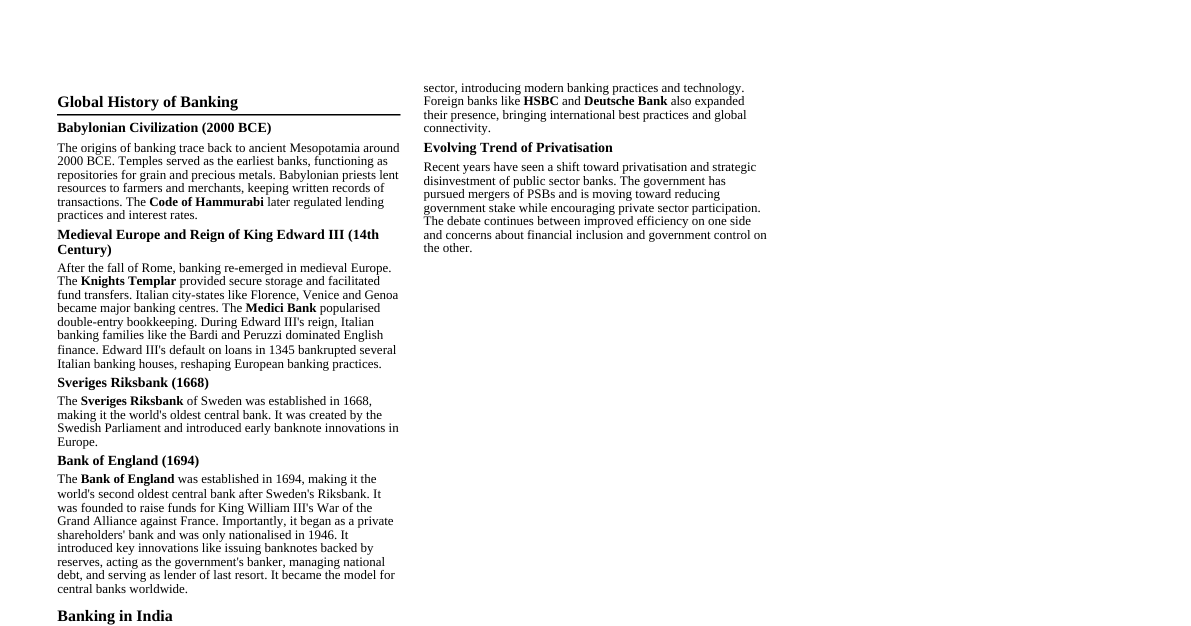
### Ancient Roots of Banking The concept of banking can be traced back to ancient civilizations. - **Babylonian Civilization (2000 BCE):** Early forms of banking emerged in ancient Mesopotamia. Temples and palaces served as safe places for storing valuables like grain, cattle, and precious metals. Priests and scribes managed these deposits and offered loans, charging interest. This period saw rudimentary practices of deposit-taking and lending, laying the groundwork for future financial systems. ### Medieval & Early Modern Banking - **Reign of King Edward III (14th Century):** During this era in England, goldsmiths began to play a crucial role. They had strong vaults and offered to keep people's gold and silver for safekeeping, issuing receipts. These receipts eventually became transferable notes, a precursor to banknotes. Goldsmiths also started lending out a portion of the deposits, marking the beginning of fractional reserve banking. - **Bank of England (1694):** Established to raise funds for King William III's war against France, the Bank of England is one of the world's oldest central banks. Its formation was a pivotal moment, as it introduced the concept of a national bank responsible for issuing currency, managing government debt, and regulating commercial banks. This institution significantly influenced the development of central banking globally. ### Indian Context: Early Banking India has a rich history of indigenous banking practices long before the arrival of modern institutions. - **Kautilya's Arthashastra (circa 3rd-4th Century BCE):** This ancient Indian treatise on statecraft, economic policy, and military strategy provides detailed accounts of commercial activities, including money lending, bills of exchange (Hundis), and deposit-taking. It describes a sophisticated financial system with regulations for interest rates and debt recovery, indicating the presence of organized financial intermediaries. ### Presidency Banks During the British colonial period, modern banking began to take shape in India. - **Establishment:** The first modern banks were the Presidency Banks: - **Bank of Calcutta (1806):** Renamed Bank of Bengal in 1809. - **Bank of Bombay (1840).** - **Bank of Madras (1843).** - **Role:** These banks were established by the East India Company and initially served as semi-government banks, issuing paper currency until the Paper Currency Act of 1861. They played a crucial role in financing British trade and economic activities in India. - **Imperial Bank of India (1921):** The three Presidency Banks were amalgamated to form the Imperial Bank of India, which acted as a quasi-central bank until the establishment of the Reserve Bank of India. ### Reserve Bank of India (RBI) - **Establishment (1934-35):** The Reserve Bank of India was established based on the recommendations of the Hilton Young Commission (also known as the Royal Commission on Indian Currency and Finance) through the RBI Act of 1934. It commenced operations on April 1, 1935. - **Role:** As India's central bank, RBI is responsible for: - Issuing and regulating the supply of currency. - Maintaining monetary stability. - Acting as a banker to the government. - Regulating and supervising the banking sector. - Managing foreign exchange. ### Banking Regulation Act (1949) - **Purpose:** Enacted shortly after independence, this act provided a comprehensive legal framework for the regulation of banking companies in India. - **Key Provisions:** It granted the RBI extensive powers to regulate, supervise, and license banks, ensuring financial stability and protecting depositors' interests. This act was crucial in shaping the modern Indian banking sector. ### Establishment of Small Scale Agri-Banks - **Post-Independence Focus:** After independence, there was a strong emphasis on rural development and financial inclusion for the agricultural sector. - **Cooperative Banks & Regional Rural Banks (RRBs):** To cater to the credit needs of farmers and rural entrepreneurs, various cooperative banks and eventually Regional Rural Banks (RRBs) were established. These institutions were designed to provide credit and banking facilities at the grassroots level, addressing the specific requirements of the agricultural and rural non-farm sectors. ### Bank Nationalisation - **Brief Overview:** In 1969, the Indian government nationalized 14 major commercial banks, followed by 6 more in 1980. - **Objectives:** The primary goals were to: - Promote social welfare and economic development. - Ensure credit flow to priority sectors like agriculture and small industries. - Reduce regional disparities in banking services. - Achieve greater financial inclusion. ### Liberalisation (1990s and 2000s) - **Economic Reforms of 1991:** India embarked on a path of economic liberalization, dismantling many state controls and opening up its economy. This significantly impacted the banking sector. - **Impact on Banking:** - **Entry of Private Banks:** New private sector banks were allowed to be established, introducing competition and modern banking practices. - **Entry of Foreign Banks:** Foreign banks were permitted to expand their operations in India, bringing international best practices and technology. - **Deregulation:** Interest rates were gradually deregulated, and banks gained more operational autonomy. - **Technology Adoption:** Increased focus on technology for better customer service and efficiency. ### Evolution of Private & Foreign Banks - **Post-Liberalisation Growth:** Post-1991, private sector banks like ICICI Bank, HDFC Bank, Axis Bank, etc., emerged as strong players, offering innovative products and superior customer service, pushing public sector banks to modernize. - **Increased Presence:** Foreign banks like Citibank, Standard Chartered, HSBC, etc., expanded their networks and introduced global banking standards, particularly in corporate and investment banking. - **Technological Advancements:** These banks often led the adoption of digital banking, ATMs, and online services, transforming the customer experience. ### Evolving Trend of Privatisation - **Continued Reforms:** While nationalization was a key policy in the past, recent years have seen a renewed debate and gradual movement towards privatization of some public sector banks. - **Rationale:** The arguments for privatization often include: - Improving efficiency and profitability. - Reducing the government's fiscal burden. - Enhancing competition within the banking sector. - Attracting capital for growth and modernization. - **Future Outlook:** This trend indicates a shift in government policy towards a more market-oriented banking system, aiming for a robust and competitive financial landscape in India.