Indian Agricultural Reforms
Cheatsheet Content
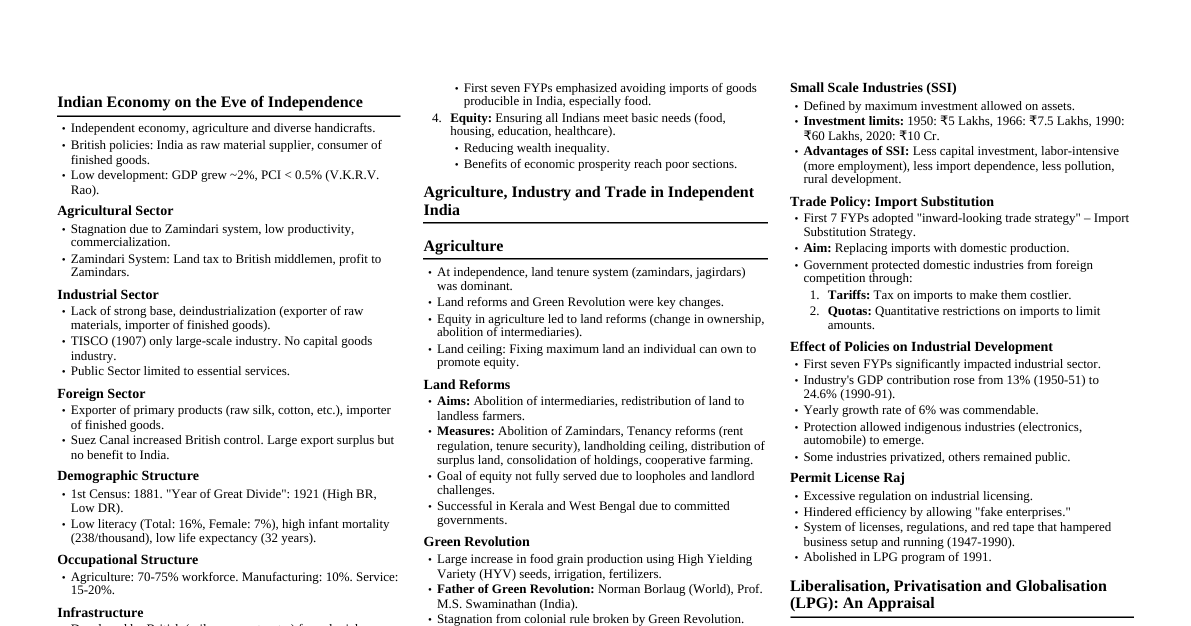
### Introduction to Indian Agricultural Reforms Agriculture has been a cornerstone of India for millennia. However, sustained land use without corresponding technological and institutional advancements has hindered its growth. A significant portion of Indian farmers still rely on monsoon and natural fertility, posing a challenge for a growing population that depends on agriculture for over 60% of its livelihood. This necessity has driven the push for both technical and institutional reforms. ### Institutional Reforms Institutional reforms have been crucial for addressing historical inequalities and improving agricultural productivity. #### Key Areas of Institutional Reforms: - **Land Reform:** A primary focus of the First Five Year Plan, aiming to address land fragmentation due to inheritance rights and promote consolidation of holdings. - **Collectivisation & Consolidation of Holdings:** Efforts to pool land and consolidate fragmented plots for more efficient farming. - **Cooperation:** Promoting cooperative societies among farmers. - **Abolition of Zamindari:** Eliminating the exploitative landlord system. - **Implementation Challenges:** Despite laws being enacted, the implementation of land reforms was often lacking or lukewarm. ### Technological Reforms The Indian government introduced significant technological interventions to modernize agriculture. #### Key Technological Initiatives: - **Green Revolution (1960s-1970s):** Utilized package technology (high-yielding varieties, fertilizers, irrigation) to boost agricultural output. - **White Revolution (Operation Flood):** Focused on enhancing milk production and dairy farming. - **Concentration of Development:** While successful, these revolutions often led to concentrated development in specific areas. - **Comprehensive Land Development Programme (1980s-1990s):** A broader initiative combining both institutional and technical aspects for integrated land development. ### Modern Initiatives and Support Systems Contemporary reforms focus on risk mitigation, credit access, and information dissemination. #### Modern Reforms: - **Crop Insurance:** Provision for crop insurance against natural disasters like drought, flood, cyclone, fire, and disease. - **Grameen Banks & Cooperatives:** Establishment of Grameen banks and cooperative societies to provide accessible loans at lower interest rates. - **Kisan Credit Card (KCC):** A scheme providing farmers with easy access to credit. - **Personal Accident Insurance Scheme (PAIS):** Another government scheme benefiting farmers. - **Weather Bulletins & Agricultural Programmes:** Dissemination of crucial information via radio and television. - **Minimum Support Price (MSP):** Government announced MSP, remunerative, and procurement prices for important crops to protect farmers from exploitation by speculators and middlemen. *Fig. 4.15: Modern technological equipments used in agriculture* ### Bhoodan - Gramdan Movement - **Origin:** Initiated by Vinoba Bhave, Mahatma Gandhi's spiritual heir, as a "Blood-less Revolution." - **Concept:** Bhave undertook a 'padyatra' (foot march) to persuade landowners to voluntarily donate land to landless farmers. - **Impact:** Many zamindars and villages donated land, leading to the distribution of land to the landless. This act was known as 'Bhoodan' (land-gift) and 'Gramdan' (village-gift). - **Limitations:** While significant, large landowners often chose not to participate due to fear of land ceiling acts.