Class 10 Life Processes
Cheatsheet Content
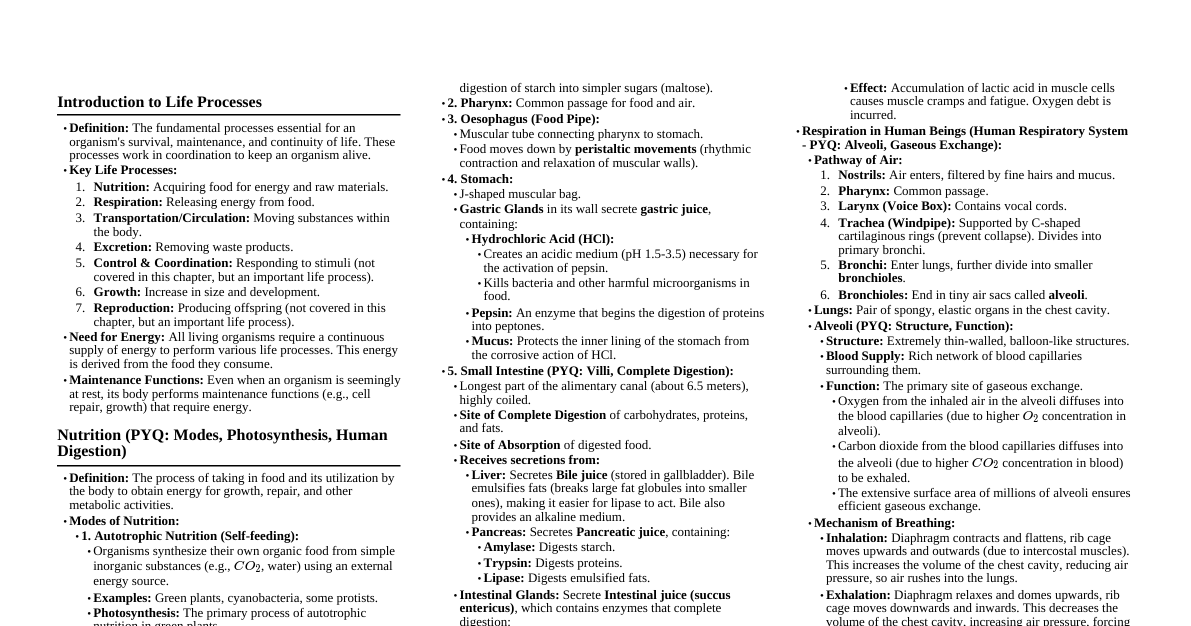
### Introduction to Life Processes Life processes are the basic essential functions performed by living organisms to maintain their life on Earth. These include nutrition, respiration, transportation, and excretion. All living things, whether unicellular or multicellular, perform these processes to survive. - **Why are they essential?** To maintain body structure, repair damaged parts, obtain energy, and respond to the environment. - **Unicellular vs. Multicellular:** - Unicellular organisms (e.g., Amoeba) perform all life processes within a single cell. Diffusion is sufficient for exchange. - Multicellular organisms (e.g., Humans) have specialized tissues and organs for different functions, requiring complex systems. ### Nutrition: Obtaining Food Nutrition is the process of taking in food and converting it into energy and other vital nutrients required for life. #### Modes of Nutrition 1. **Autotrophic Nutrition:** Organisms synthesize their own food using simple inorganic substances. - **Photoautotrophs:** Use light energy (e.g., plants, algae, cyanobacteria). - **Chemoautotrophs:** Use chemical energy from inorganic reactions (e.g., some bacteria). 2. **Heterotrophic Nutrition:** Organisms depend on other organisms for food. - **Holozoic Nutrition:** Ingestion, digestion, absorption, assimilation, and egestion of solid or liquid food. (e.g., animals). - **Saprophytic Nutrition:** Organisms obtain nutrients from dead and decaying organic matter. (e.g., fungi, some bacteria). - **Parasitic Nutrition:** Organisms derive nutrition from another living organism (host) without killing it immediately. (e.g., Cuscuta, ticks, tapeworms). #### Photosynthesis (Autotrophic Nutrition in Plants) The process by which green plants and some other organisms use sunlight to synthesize nutrients from carbon dioxide and water. - **Equation:** $$6CO_2 + 6H_2O \xrightarrow{\text{Sunlight, Chlorophyll}} C_6H_{12}O_6 + 6O_2$$ - **Site:** Chloroplasts, specifically in the thylakoid membranes (light reactions) and stroma (dark reactions/Calvin Cycle). - **Main Events:** 1. Absorption of light energy by chlorophyll. 2. Conversion of light energy to chemical energy and splitting of water molecules into hydrogen and oxygen (photolysis). 3. Reduction of carbon dioxide to carbohydrates. - **Raw Materials:** - **Carbon Dioxide:** Enters through stomata. - **Water:** Absorbed by roots from the soil. - **Sunlight:** Energy source. - **Chlorophyll:** Pigment that traps sunlight. - **Stomata:** Tiny pores on the surface of leaves. - **Functions:** Exchange of gases ($CO_2$ and $O_2$), transpiration (loss of water vapor). - **Opening/Closing:** Regulated by guard cells. When guard cells take in water, they swell and open the stomata; when they lose water, they shrink and close the stomata. #### Nutrition in Animals (Holozoic) ##### Nutrition in Amoeba - **Process:** Phagocytosis. 1. **Ingestion:** Amoeba extends pseudopodia to engulf food. 2. **Digestion:** Food is trapped in a food vacuole; digestive enzymes break down food. 3. **Absorption:** Digested food diffuses into the cytoplasm. 4. **Assimilation:** Absorbed food is used for energy and growth. 5. **Egestion:** Undigested food is expelled from the body. ##### Nutrition in Humans (Human Digestive System) A complex system involving an alimentary canal and associated digestive glands. - **Alimentary Canal:** A long tube extending from the mouth to the anus. 1. **Mouth:** - **Ingestion:** Intake of food. - **Mastication:** Chewing food by teeth. - **Saliva:** Secreted by salivary glands; contains salivary amylase (ptyalin) which starts carbohydrate digestion (starch to maltose). - **Tongue:** Mixes food with saliva, helps in swallowing. 2. **Pharynx:** Common passage for food and air. 3. **Oesophagus (Food Pipe):** Connects pharynx to stomach. Food moves by peristalsis (rhythmic contraction and relaxation of muscles). 4. **Stomach:** J-shaped organ. - **Gastric Glands:** Secrete gastric juice containing: - **Hydrochloric Acid (HCl):** Kills bacteria, provides acidic medium for pepsin, denatures proteins. - **Pepsin:** Enzyme that digests proteins into peptones. - **Mucus:** Protects stomach lining from HCl. - Food stays for 3-4 hours, mixed into chyme. 5. **Small Intestine:** Longest part (approx. 6.5 m); site of complete digestion and absorption. - **Regions:** Duodenum, Jejunum, Ileum. - **Receives secretions from:** - **Liver:** Produces bile (stored in gallbladder). Bile emulsifies fats (breaks large fat globules into smaller ones), making them accessible for lipase. - **Pancreas:** Secretes pancreatic juice containing: - **Amylase:** Digests carbohydrates (starch to maltose). - **Trypsin:** Digests proteins (peptones to amino acids). - **Lipase:** Digests fats (emulsified fats to fatty acids and glycerol). - **Intestinal Glands:** Secrete intestinal juice containing enzymes for final digestion: - **Maltase:** Maltose to glucose. - **Sucrase:** Sucrose to glucose and fructose. - **Lactase:** Lactose to glucose and galactose. - **Peptidases:** Peptides to amino acids. - **Absorption:** Inner lining has villi (finger-like projections) which increase surface area for absorption. Digested food absorbed into blood capillaries and lacteals. 6. **Large Intestine:** Wider and shorter than small intestine (approx. 1.5 m). - **Functions:** Absorbs excess water from undigested food, forms faeces. - **Regions:** Caecum, Colon, Rectum. 7. **Anus:** Egestion of faeces. ### Respiration: Releasing Energy Respiration is the process of releasing energy from food. It involves the intake of oxygen, breakdown of food (glucose), and release of carbon dioxide, water, and energy (ATP). #### Types of Respiration 1. **Aerobic Respiration:** Occurs in the presence of oxygen. - **Equation:** $$C_6H_{12}O_6 + 6O_2 \xrightarrow{\text{Mitochondria}} 6CO_2 + 6H_2O + \text{Energy (38 ATP)}$$ - **Steps:** - **Glycolysis:** Glucose (6C) is broken down into Pyruvate (3C) in the cytoplasm. (Common to both aerobic and anaerobic). - **Krebs Cycle (Citric Acid Cycle):** Pyruvate enters mitochondria, converted to Acetyl-CoA, then completely oxidized to $CO_2$ and $H_2O$. - **Electron Transport Chain:** Most ATP is generated here. - **Efficiency:** Highly efficient, produces a large amount of energy. 2. **Anaerobic Respiration:** Occurs in the absence of oxygen. - **In Yeast (Fermentation):** $$C_6H_{12}O_6 \xrightarrow{\text{Cytoplasm}} \text{Pyruvate} \xrightarrow{\text{Absence of } O_2} \text{Ethanol} + CO_2 + \text{Energy (2 ATP)}$$ - **In Muscle Cells (during strenuous exercise):** $$C_6H_{12}O_6 \xrightarrow{\text{Cytoplasm}} \text{Pyruvate} \xrightarrow{\text{Absence of } O_2} \text{Lactic Acid} + \text{Energy (2 ATP)}$$ - Lactic acid accumulation causes muscle cramps. - **Efficiency:** Much less efficient, produces a small amount of energy. #### Respiration in Plants - **Mechanism:** Plants exchange gases through stomata (leaves), lenticels (stems), and general surface of roots. - **Direction of Diffusion:** Depends on environmental conditions and plant's requirement. - During the day: $CO_2$ released during respiration is used for photosynthesis. $O_2$ is released. - During the night: Photosynthesis doesn't occur. $CO_2$ is released and $O_2$ is taken in. #### Respiration in Animals ##### Aquatic Animals - **Gills:** Specialized organs for gaseous exchange. - **Mechanism:** Gills have a large surface area and are richly supplied with blood vessels. They take in oxygen dissolved in water. - **Breathing Rate:** Faster than terrestrial animals due to lower concentration of dissolved oxygen in water. (e.g., Fish). ##### Terrestrial Animals - **Lungs:** Specialized organs in mammals, birds, reptiles. - **Skin:** Earthworms. - **Tracheal System:** Insects. - **Mechanism:** Direct contact with atmospheric oxygen. ##### Human Respiratory System - **Pathway of Air:** 1. **Nostrils:** Air enters, filtered by fine hairs and mucus. 2. **Pharynx:** Common passage. 3. **Larynx (Voice Box):** Produces sound. 4. **Trachea (Windpipe):** Supported by C-shaped cartilaginous rings to prevent collapse. 5. **Bronchi:** Trachea divides into two bronchi, entering each lung. 6. **Bronchioles:** Bronchi further divide into smaller tubes. 7. **Alveoli (Air Sacs):** End of bronchioles, thin-walled, balloon-like structures. - **Function:** Primary site of gaseous exchange. Have a rich blood supply and large surface area. - $O_2$ diffuses into blood, $CO_2$ diffuses from blood into alveoli. - **Mechanism of Breathing:** - **Inhalation:** Diaphragm contracts and flattens, intercostal muscles contract, lifting ribs and sternum. Chest cavity volume increases, pressure decreases, air rushes in. - **Exhalation:** Diaphragm relaxes and moves up, intercostal muscles relax, ribs and sternum move down. Chest cavity volume decreases, pressure increases, air is forced out. - **Residual Volume:** Volume of air remaining in the lungs after a forceful exhalation. Ensures sufficient time for gas exchange. ### Transportation: Moving Substances Transportation is the process by which absorbed food, oxygen, hormones, and waste products are carried from one part of the body to another. #### Transportation in Plants - **Vascular Tissues:** 1. **Xylem:** Transports water and minerals from roots to other parts of the plant. - **Components:** Tracheids, vessels, xylem parenchyma, xylem fibres. - **Mechanism:** - **Root Pressure:** Roots actively absorb ions, creating a water potential gradient, causing water to move into the root xylem. - **Transpiration Pull:** Evaporation of water from the leaves (transpiration) creates a suction force (pull) that draws water upwards through the xylem. This is the major driving force. 2. **Phloem:** Transports food (sugars/sucrose) from leaves (site of photosynthesis) to other parts of the plant (storage organs, growing regions). - **Components:** Sieve tubes, companion cells, phloem parenchyma, phloem fibres. - **Mechanism (Translocation):** - Food (sucrose) is actively loaded into sieve tubes at the source (leaves). - Water follows by osmosis, increasing pressure in sieve tubes. - This pressure drives the sap to areas of lower pressure (sink), where food is utilized or stored. #### Transportation in Humans (Human Circulatory System) A closed, double circulatory system involving blood, blood vessels, and the heart. ##### Blood - **Components:** - **Plasma:** Liquid matrix (55% of blood volume); transports water, proteins, hormones, digested food, waste products. - **Red Blood Cells (RBCs/Erythrocytes):** Biconcave, anucleated (in mammals); contain hemoglobin for oxygen transport. - **White Blood Cells (WBCs/Leukocytes):** Part of the immune system, fight infections. - **Platelets:** Cell fragments involved in blood clotting. ##### Blood Vessels 1. **Arteries:** Carry oxygenated blood away from the heart to various body parts (except pulmonary artery, which carries deoxygenated blood to lungs). Thick, elastic walls, high pressure. 2. **Veins:** Carry deoxygenated blood from various body parts back to the heart (except pulmonary vein, which carries oxygenated blood from lungs to heart). Thin walls, valves to prevent backflow of blood, low pressure. 3. **Capillaries:** Microscopic, thin-walled vessels connecting arteries and veins. Site of exchange of nutrients, gases, and waste products between blood and tissues. ##### Heart A muscular, four-chambered organ that pumps blood throughout the body. - **Chambers:** - **Right Atrium:** Receives deoxygenated blood from the body. - **Right Ventricle:** Pumps deoxygenated blood to the lungs. - **Left Atrium:** Receives oxygenated blood from the lungs. - **Left Ventricle:** Pumps oxygenated blood to the rest of the body (strongest chamber). - **Valves:** Prevent backflow of blood (e.g., tricuspid, bicuspid/mitral, pulmonary, aortic valves). - **Septum:** Muscular wall that separates the right and left sides, preventing mixing of oxygenated and deoxygenated blood. ##### Double Circulation Blood passes through the heart twice in one complete cycle. 1. **Pulmonary Circulation:** Heart $\rightarrow$ Lungs $\rightarrow$ Heart (for oxygenation). 2. **Systemic Circulation:** Heart $\rightarrow$ Body $\rightarrow$ Heart (to deliver oxygen and nutrients). ##### Blood Pressure - **Systolic Pressure:** Pressure during ventricular contraction (approx. 120 mmHg). - **Diastolic Pressure:** Pressure during ventricular relaxation (approx. 80 mmHg). - **Sphygmomanometer:** Instrument used to measure blood pressure. - **Hypertension (High Blood Pressure):** Can lead to heart disease and damage to vital organs. ##### Lymphatic System - **Lymph:** A colorless fluid, similar to plasma but without large proteins. - **Lymph Vessels:** Collect lymph from tissue spaces. - **Lymph Nodes:** Filter lymph, contain lymphocytes (WBCs) that fight infection. - **Functions:** - Returns tissue fluid to the blood. - Transports digested fats from the small intestine. - Part of the immune system. ### Excretion: Removing Waste Excretion is the biological process of removing harmful metabolic waste products from the body. #### Excretion in Plants - **Gaseous Wastes:** $O_2$ (during photosynthesis) and $CO_2$ (during respiration) are removed through stomata and lenticels. - **Water:** Removed by transpiration. - **Solid/Liquid Wastes:** Stored in cellular vacuoles, in leaves that fall off, or as resins, gums, latex in old xylem. Some wastes are excreted into the soil around the roots. #### Excretion in Humans (Human Excretory System) The main excretory system in humans consists of a pair of kidneys, a pair of ureters, a urinary bladder, and a urethra. ##### Kidneys - **Location:** Abdomen, one on either side of the backbone. - **Function:** Filter blood to remove nitrogenous waste products (urea, uric acid, creatinine), excess salts, and water. - **Nephrons:** Functional units of the kidney (approx. 1 million per kidney). Each nephron consists of: 1. **Glomerulus:** A tuft of capillaries where initial filtration of blood occurs. 2. **Bowman's Capsule:** Cup-shaped structure enclosing the glomerulus. 3. **Renal Tubule:** Long, convoluted tubule divided into PCT, Loop of Henle, DCT, and collecting duct. ##### Urine Formation in Nephron 1. **Glomerular Filtration:** Blood enters the glomerulus under high pressure. Water, salts, glucose, amino acids, urea, etc., are filtered out into Bowman's capsule, forming the glomerular filtrate. Blood cells and large proteins are retained. 2. **Tubular Reabsorption:** As the filtrate flows through the renal tubule: - **Proximal Convoluted Tubule (PCT):** Most of the useful substances (glucose, amino acids, much of the water and salts) are selectively reabsorbed into the blood capillaries surrounding the tubule. - **Loop of Henle:** Involved in concentrating the urine; reabsorbs water and salt. - **Distal Convoluted Tubule (DCT):** Further selective reabsorption of water and salts. 3. **Tubular Secretion:** Certain waste products (e.g., some ions, drugs) are actively secreted from the blood into the filtrate in the DCT and collecting duct. ##### Remaining Components - **Ureters:** Tubes that carry urine from the kidneys to the urinary bladder. - **Urinary Bladder:** Muscular sac that stores urine until it is expelled. - **Urethra:** Tube that carries urine from the bladder out of the body. - **Micturition:** The process of urination, controlled by the nervous system. ##### Artificial Kidney (Dialysis) - **Purpose:** Used when kidneys fail. - **Process:** Blood from the patient's artery is passed through a dialyzing unit (artificial kidney). The unit contains a semi-permeable membrane that allows waste products to diffuse into a dialyzing fluid (which has the same composition as normal blood plasma, except for nitrogenous wastes). The cleaned blood is then returned to the patient's vein. - **Frequency:** Typically 3-4 hours, several times a week. ### Control and Coordination (Brief Overview) While not directly part of "Life Processes" as defined in some curricula, it's crucial for maintaining homeostasis. - **Nervous System:** Transmits electrical impulses for quick responses. - Brain, spinal cord, nerves. - Reflex actions (e.g., withdrawing hand from hot object). - **Endocrine System:** Secretes hormones for slower, long-lasting responses. - Glands (e.g., pituitary, thyroid, pancreas, adrenal). - Growth, metabolism, reproduction. - **In Plants:** Only chemical control (hormones like auxins, gibberellins, cytokinins, abscisic acid, ethylene) governs growth, development, and responses to stimuli (tropisms). ### Summary of Interconnectedness All these life processes are interconnected and essential for the survival and proper functioning of an organism. - Nutrition provides the raw materials and energy. - Respiration releases that energy for cellular activities. - Transportation distributes nutrients, gases, and hormones, and collects waste. - Excretion removes harmful waste products, maintaining internal balance. - Control and coordination ensure all these systems work together harmoniously.