Life Processes Class 10
Cheatsheet Content
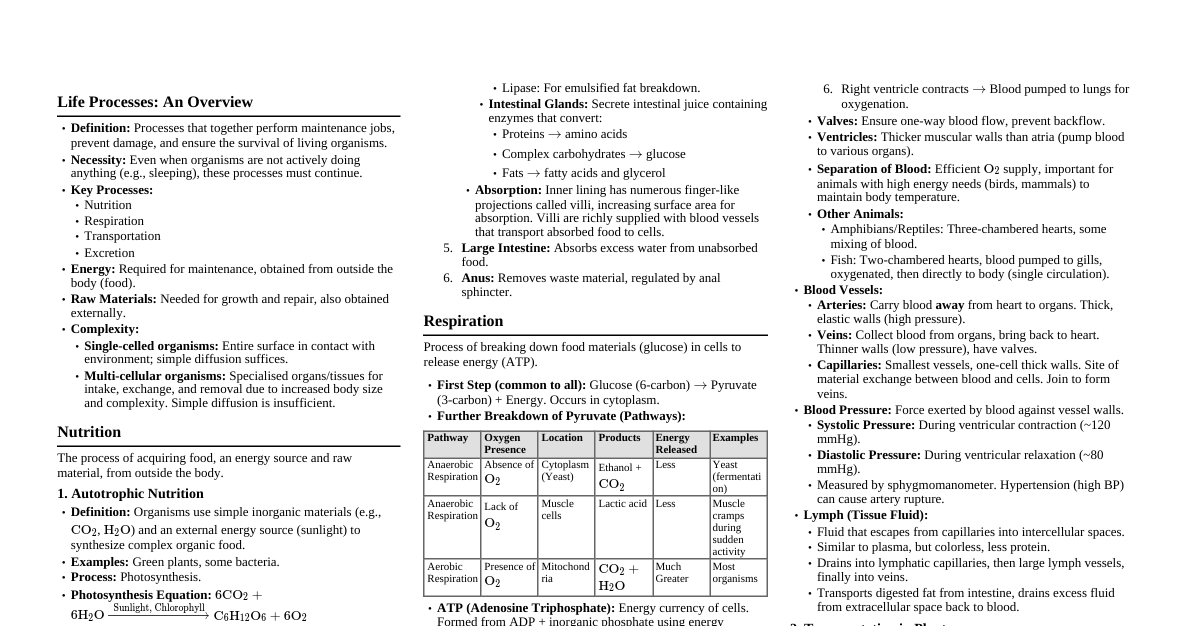
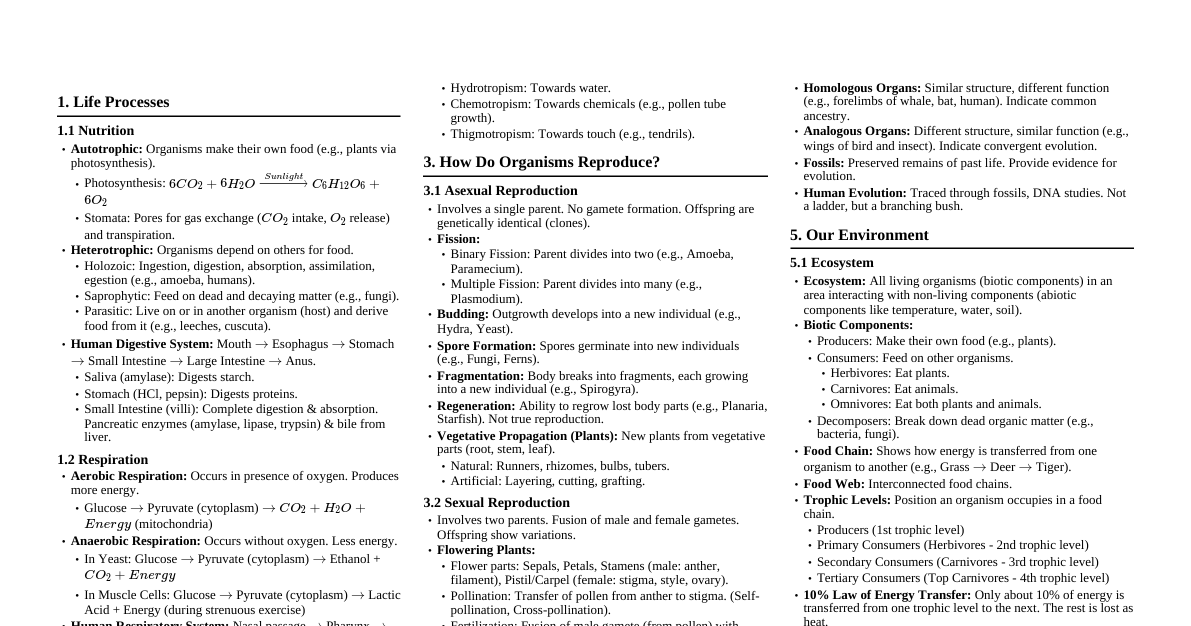
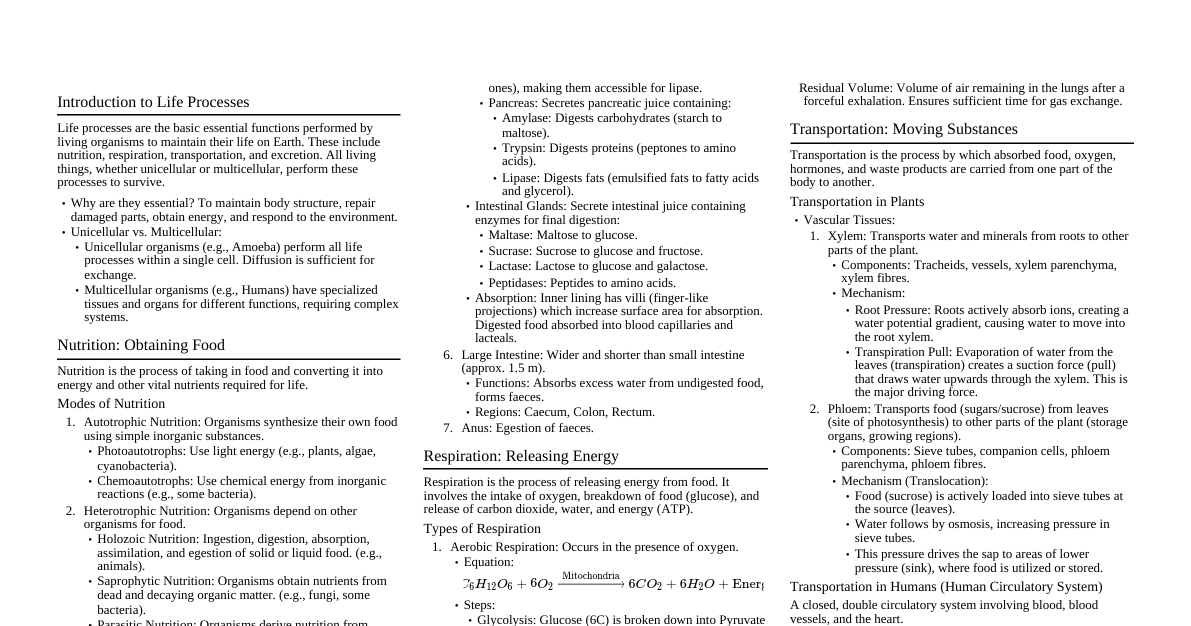
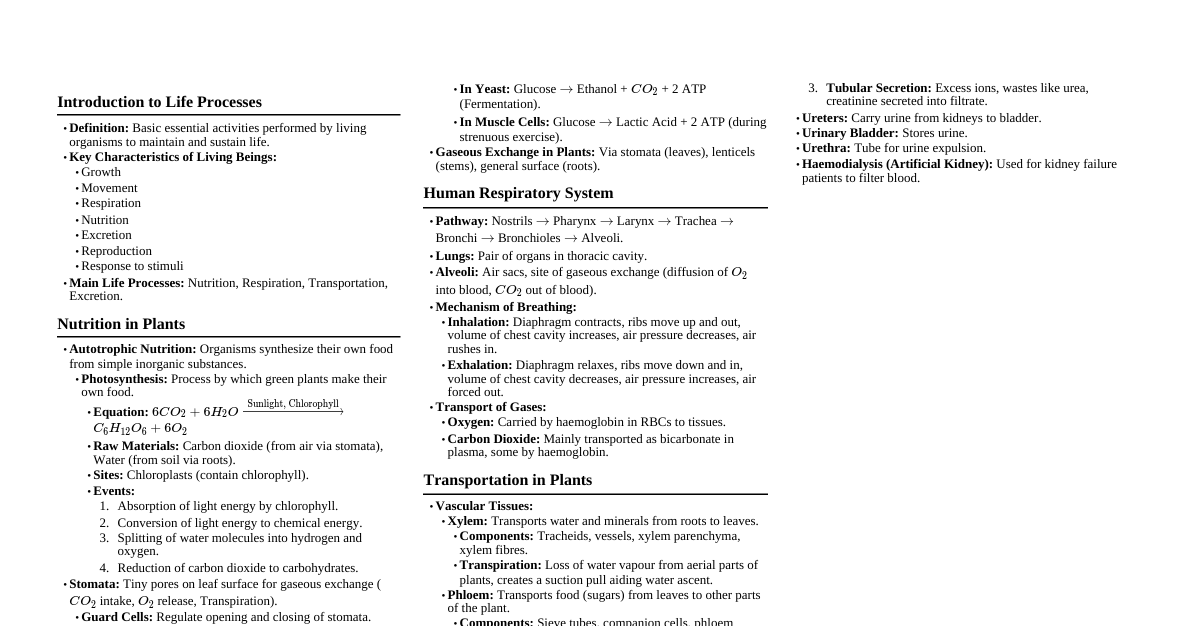
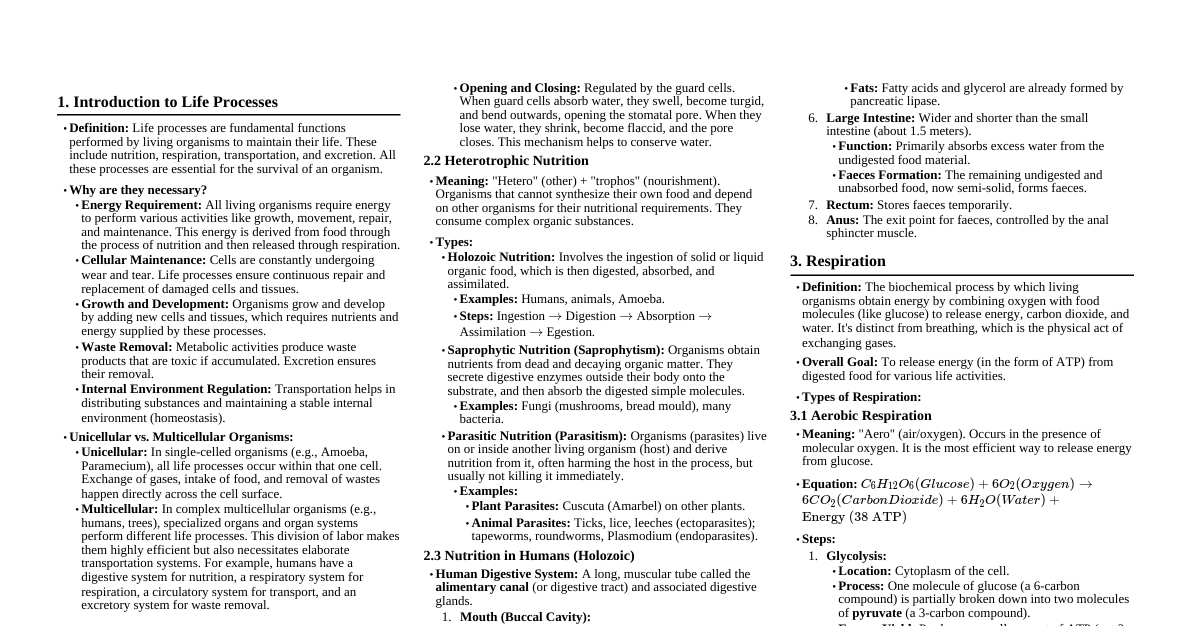
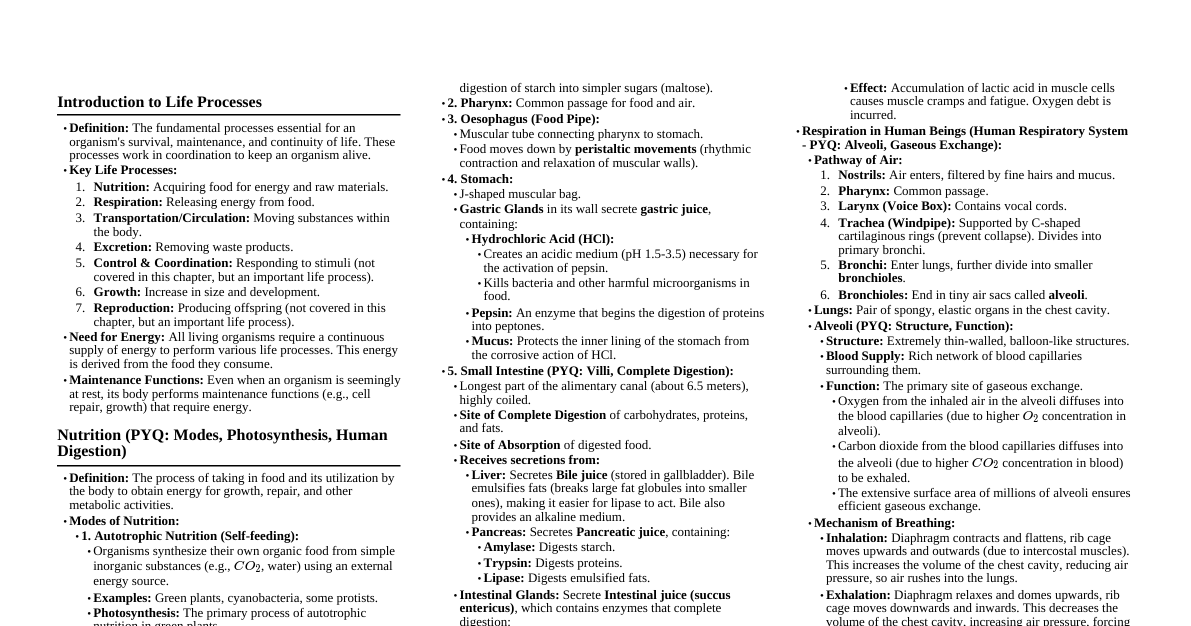
1. Introduction to Life Processes Definition: The basic fundamental functions performed by living organisms to maintain their life on Earth and prevent body damage and breakdown. Necessity: Even when organisms are seemingly doing nothing, the maintenance job goes on. Key Processes: Nutrition, Respiration, Transportation, Excretion. These are essential for survival. 2. Nutrition 2.1 Autotrophic Nutrition Definition: Organisms (autotrophs) synthesize their own food from simple inorganic substances like carbon dioxide and water. Examples: Green plants, some bacteria. Photosynthesis: The process by which autotrophs take in substances from outside and convert them into stored forms of energy. Raw Materials: $CO_2$ (from air via stomata), $H_2O$ (from soil via roots), Sunlight (energy source), Chlorophyll (pigment). Equation: $6CO_2 + 6H_2O \xrightarrow{\text{Sunlight, Chlorophyll}} C_6H_{12}O_6 + 6O_2 + \text{Energy (ATP, NADPH)}$ Main Events: Absorption of light energy by chlorophyll. Conversion of light energy to chemical energy. Splitting of water molecules into hydrogen and oxygen. Reduction of carbon dioxide to carbohydrates (glucose). Site: Chloroplasts (contain chlorophyll). Factors Affecting: Light intensity, $CO_2$ concentration, temperature, water availability. Stomata: Tiny pores present on the surface of leaves. Functions: Massive amounts of gaseous exchange ($CO_2$ intake, $O_2$ release) takes place. Large amount of water loss through transpiration (evaporation of water from leaves). Regulation: Guard cells surround the stomata. Swelling of guard cells due to water intake opens stomatal pore; shrinking closes it. 2.2 Heterotrophic Nutrition Definition: Organisms (heterotrophs) depend on other organisms for their food, as they cannot synthesize their own. Types: Holozoic Nutrition: Organisms take in complex organic food material and digest it internally. Steps: Ingestion, Digestion, Absorption, Assimilation, Egestion. Examples: Humans, Amoeba. Saprophytic Nutrition: Organisms obtain nutrients from dead and decaying organic matter. Mechanism: Digest food outside their body and then absorb it. Examples: Fungi (bread mould, yeast, mushrooms), some bacteria. Parasitic Nutrition: Organisms (parasites) derive nutrition from another living organism (host) without killing it. Examples: Cuscuta (amarbel), ticks, lice, leeches, tapeworms. 2.3 Nutrition in Amoeba (Holozoic) Uses pseudopodia (false feet) to engulf food particles. Food is ingested into a food vacuole. Digestive enzymes break down complex substances into simpler ones within the food vacuole. Digested food diffuses into the cytoplasm. Undigested food is expelled from the body. 2.4 Nutrition in Humans Alimentary Canal: A long tube extending from the mouth to the anus. Associated Glands: Salivary glands, Liver, Pancreas. Mouth: Food is chewed (mechanical digestion). Saliva (secreted by salivary glands) contains salivary amylase (ptyalin) which breaks down starch into simpler sugars (maltose). Pharynx: Common passage for food and air. Esophagus (Food Pipe): Carries food from mouth to stomach. Peristaltic movements: Rhythmic contraction and relaxation of muscles to push food along the alimentary canal. Stomach: Muscular organ, mixes food with digestive juices. Gastric Glands secrete: Hydrochloric Acid (HCl): Makes medium acidic, kills bacteria, activates pepsinogen to pepsin. Pepsin: Enzyme for protein digestion (breaks proteins into peptones). Mucus: Protects the inner lining of the stomach from the action of HCl. Small Intestine: Longest part of the alimentary canal (about 6.5 m in adults). Site of complete digestion of carbohydrates, proteins, and fats. Receives secretions from Liver and Pancreas. Liver: Secretes Bile juice. Bile Function: Emulsifies large fat globules into smaller ones (increases surface area for enzyme action) and makes the medium alkaline for pancreatic enzymes. Pancreas: Secretes Pancreatic juice. Pancreatic Amylase: Continues starch digestion. Trypsin: Digests proteins. Lipase: Digests emulsified fats. Intestinal Wall: Secretes Intestinal juice. Carbohydrates (complex) $\to$ Glucose. Proteins $\to$ Amino Acids. Fats $\to$ Fatty Acids and Glycerol. Absorption: Inner lining has millions of finger-like projections called villi . Villi increase the surface area for absorption of digested food. Richly supplied with blood vessels that absorb digested food and transport it to every cell of the body. Large Intestine: Absorbs excess water from the undigested food. Stores undigested waste material. Anus: Undigested food is expelled from the body through the anus. The exit is regulated by the anal sphincter muscle. 3. Respiration Definition: The process of acquiring oxygen from outside the body and using it in the process of breakdown of food sources for cellular needs, to release energy. Cellular Respiration: Breakdown of glucose (food) to release energy (ATP). Stages: Glycolysis: Glucose (6-carbon molecule) $\xrightarrow{\text{Cytoplasm}}$ Pyruvate (3-carbon molecule) + Energy. (Common to both aerobic and anaerobic). Fate of Pyruvate depends on the presence or absence of oxygen. 3.1 Types of Respiration Aerobic Respiration: Occurs in the presence of oxygen. Pathway: Glucose $\xrightarrow{\text{Cytoplasm}}$ Pyruvate $\xrightarrow{\text{Mitochondria, O2}}$ $CO_2 + H_2O + \text{Large amount of Energy (38 ATP)}$. Most efficient way to release energy. Anaerobic Respiration: Occurs in the absence of oxygen. In Yeast (Fermentation): Glucose $\xrightarrow{\text{Cytoplasm}}$ Pyruvate $\xrightarrow{\text{Absence of O2}}$ Ethanol + $CO_2$ + $\text{Less Energy (2 ATP)}$. In Muscle Cells (during strenuous exercise/oxygen deficit): Glucose $\xrightarrow{\text{Cytoplasm}}$ Pyruvate $\xrightarrow{\text{Absence of O2}}$ Lactic Acid + $\text{Less Energy (2 ATP)}$. Accumulation of lactic acid causes muscle cramps. 3.2 Respiration in Humans (Respiratory System) Pathway: Air enters through nostrils $\to$ Pharynx $\to$ Larynx $\to$ Trachea (windpipe, supported by C-shaped cartilaginous rings to prevent collapse) $\to$ Bronchi (into lungs) $\to$ Bronchioles $\to$ Alveoli (air sacs). Lungs: Primary respiratory organs. Contain millions of alveoli. Alveoli: Balloon-like structures providing a large surface area for gaseous exchange. Walls are one-cell thick and richly supplied with blood capillaries. Exchange: $O_2$ from alveolar air diffuses into blood, $CO_2$ from blood diffuses into alveolar air. Mechanism of Breathing: Inhalation: Diaphragm contracts and flattens, ribs move up and out (due to intercostal muscles). Volume of chest cavity increases, air pressure decreases, so air rushes into lungs. Exhalation: Diaphragm relaxes and domes upwards, ribs move down and inwards. Volume of chest cavity decreases, air pressure increases, so air is forced out of lungs. Transport of Gases: Oxygen: Mostly transported by hemoglobin pigment present in Red Blood Cells (RBCs). Carbon Dioxide: More soluble in water, so mostly transported in dissolved form in blood plasma as bicarbonate, some by hemoglobin. 3.3 Respiration in Aquatic Organisms Take oxygen dissolved in water. Gills: Specialized organs with large surface area for oxygen absorption. Breathing rate is much faster than terrestrial organisms due to lower oxygen content in water. 3.4 Respiration in Plants Occurs through stomata (leaves), lenticels (stems), and general surface of roots. Each plant part can independently respire. Energy released is used for various plant activities. 4. Transportation 4.1 Transportation in Humans (Circulatory System) Components: Heart, Blood, Blood Vessels (Arteries, Veins, Capillaries). Heart: A muscular organ, size of a clenched fist, acts as a pump. Chambers: Four chambers - two upper atria (receivers), two lower ventricles (pumps). Septum: Wall separating right and left sides, prevents mixing of oxygenated and deoxygenated blood. Blood Flow: Deoxygenated blood from body $\to$ Right Atrium $\to$ Right Ventricle $\to$ Lungs (for oxygenation via Pulmonary Artery). Oxygenated blood from Lungs $\to$ Left Atrium $\to$ Left Ventricle $\to$ Body (via Aorta). Valves: Present between atria and ventricles, and at the exit of ventricles, to prevent backflow of blood. Double Circulation: Blood passes through the heart twice in one complete cycle (once to lungs, once to body). This ensures efficient supply of oxygen to the body. Systole: Contraction phase; Diastole: Relaxation phase. Blood: A fluid connective tissue. Plasma: Fluid matrix, transports food, oxygen, $CO_2$, nitrogenous wastes, hormones. Red Blood Cells (RBCs) / Erythrocytes: Contain hemoglobin (red pigment), transport oxygen. White Blood Cells (WBCs) / Leukocytes: Fight infection and disease, part of immune system. Platelets: Help in blood clotting at the site of injury. Blood Vessels: Arteries: Carry oxygenated blood away from the heart to various organs (exception: pulmonary artery carries deoxygenated blood to lungs). Thick, elastic walls to withstand high pressure. No valves. Veins: Carry deoxygenated blood from various organs back to the heart (exception: pulmonary vein carries oxygenated blood from lungs to heart). Thinner walls, contain valves to prevent backflow of blood against gravity. Blood pressure is lower. Capillaries: Extremely thin (one-cell thick) and narrow vessels. Form network between arteries and veins. Site of exchange of materials (gases, nutrients, wastes) between blood and body cells. Lymphatic System: Lymph (Tissue Fluid): A colorless fluid similar to plasma, but without most proteins. Formed when some plasma, proteins, and blood cells escape into intercellular spaces from capillaries. Functions: Carries digested and absorbed fat from the intestine. Drains excess fluid from extracellular spaces back into the blood. Part of the immune system (lymph nodes filter lymph). Blood Pressure: The force that blood exerts against the wall of a vessel. Systolic Pressure: Pressure during ventricular contraction (e.g., 120 mm Hg). Diastolic Pressure: Pressure during ventricular relaxation (e.g., 80 mm Hg). Measured by a sphygmomanometer. Hypertension (High Blood Pressure): Can lead to rupture of artery and internal bleeding. 4.2 Transportation in Plants Vascular Tissue: Xylem and Phloem. Xylem: Transports water and dissolved minerals from roots to all aerial parts of the plant. Mechanism: Root Pressure: Ions are actively taken up by root cells, creating a water potential gradient, causing water to enter by osmosis. This pushes water up the stem to some extent. Transpiration Pull: Major driving force. Evaporation of water from the leaves (transpiration) creates a suction pull that draws water up from the roots. Water moves as a continuous column due to cohesion (water-water attraction) and adhesion (water-xylem wall attraction). Phloem: Transports soluble products of photosynthesis (sugars, e.g., sucrose) from leaves (source) to other parts of the plant (sink) where they are needed or stored. Translocation: The process of transport of food. Mechanism: Food (sucrose) is actively transported into phloem sieve tubes. This requires ATP energy. Water moves into the phloem by osmosis, increasing pressure. High pressure causes sap to move to areas of lower pressure (e.g., roots, fruits, growing tips). 5. Excretion Definition: The biological process of removal of harmful metabolic waste products from the body. 5.1 Excretion in Humans (Excretory System) Components: A pair of kidneys, a pair of ureters, a urinary bladder, and a urethra. Kidneys: Bean-shaped organs located in the abdomen, on either side of the backbone. Function: Filter blood, remove nitrogenous waste (urea, uric acid), excess salts, and water to form urine. Nephron: The basic functional and filtering unit of the kidney. Each kidney has millions of nephrons. Structure of a Nephron: Bowman's Capsule: Cup-shaped structure at the beginning, containing a cluster of capillaries called Glomerulus . Renal Tubule: Long, convoluted tube extending from Bowman's capsule. Mechanism of Urine Formation: Glomerular Filtration: Blood entering the glomerulus is filtered. Water, salts, glucose, amino acids, and nitrogenous wastes (like urea) pass into Bowman's capsule to form glomerular filtrate. Large molecules (proteins, blood cells) do not filter. Tubular Reabsorption: As the filtrate flows through the renal tubule, useful substances like all glucose, most amino acids, much of the salt, and a major amount of water are selectively reabsorbed back into the blood capillaries surrounding the tubule. Tubular Secretion: Some waste ions, hydrogen ions, potassium ions, and drugs are actively secreted from the blood into the filtrate in the tubule. The fluid remaining in the tubule is urine. Ureters: Tubes that carry urine from the kidneys to the urinary bladder. Urinary Bladder: A muscular sac that stores urine until it is released. Its expansion is controlled by nerves. Urethra: A tube that carries urine from the bladder out of the body. The opening is guarded by a sphincter muscle. Artificial Kidney (Dialysis): A device used to remove nitrogenous waste products from the blood through an artificial kidney in case of kidney failure. It is similar to the function of a normal kidney but is less efficient. 5.2 Excretion in Plants Plants have different strategies as they do not have a specialized excretory system. Gaseous Wastes: Oxygen (product of photosynthesis) and carbon dioxide (product of respiration) are removed through stomata in leaves and lenticels in stems. Excess Water: Removed by transpiration (evaporation from leaves). Solid/Liquid Wastes: Stored in cellular vacuoles (e.g., as crystals). Stored as gums and resins, especially in old xylem. Excreted into the soil around them. Removed by shedding leaves, bark, or fruits.