Class 10 Maths Essentials (CISCE)
Cheatsheet Content
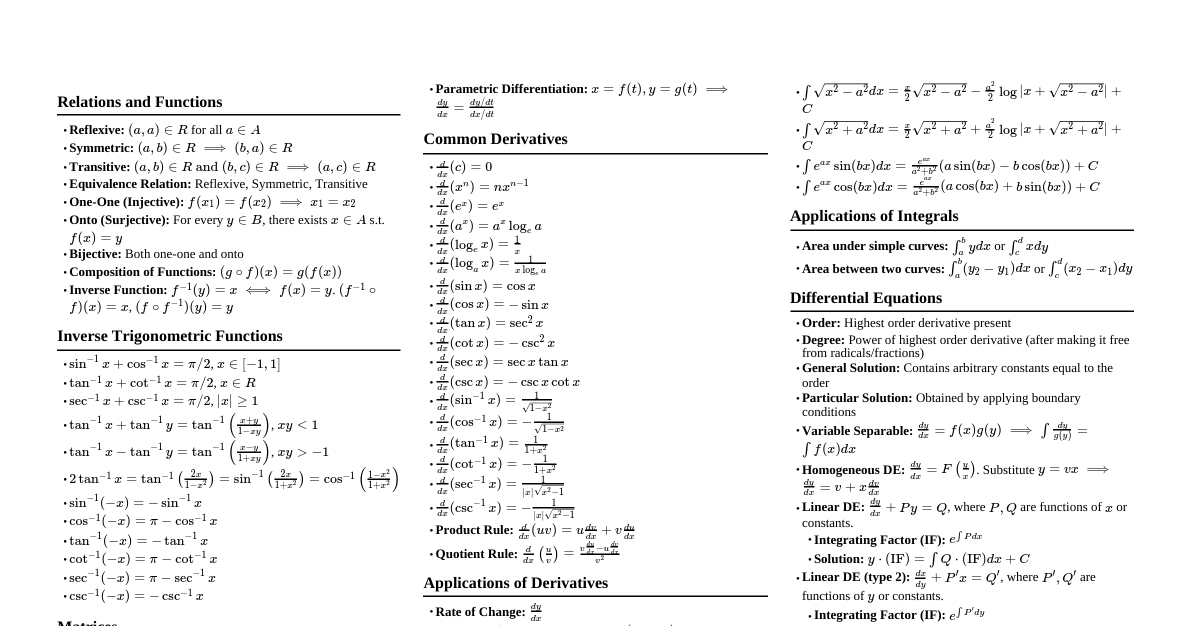
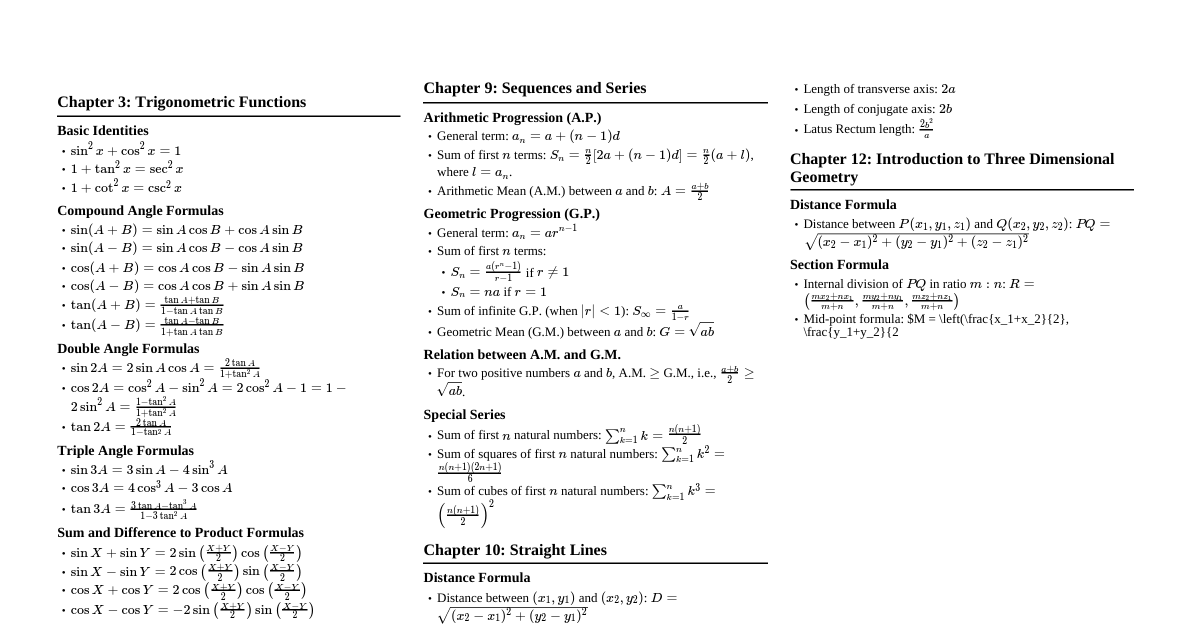
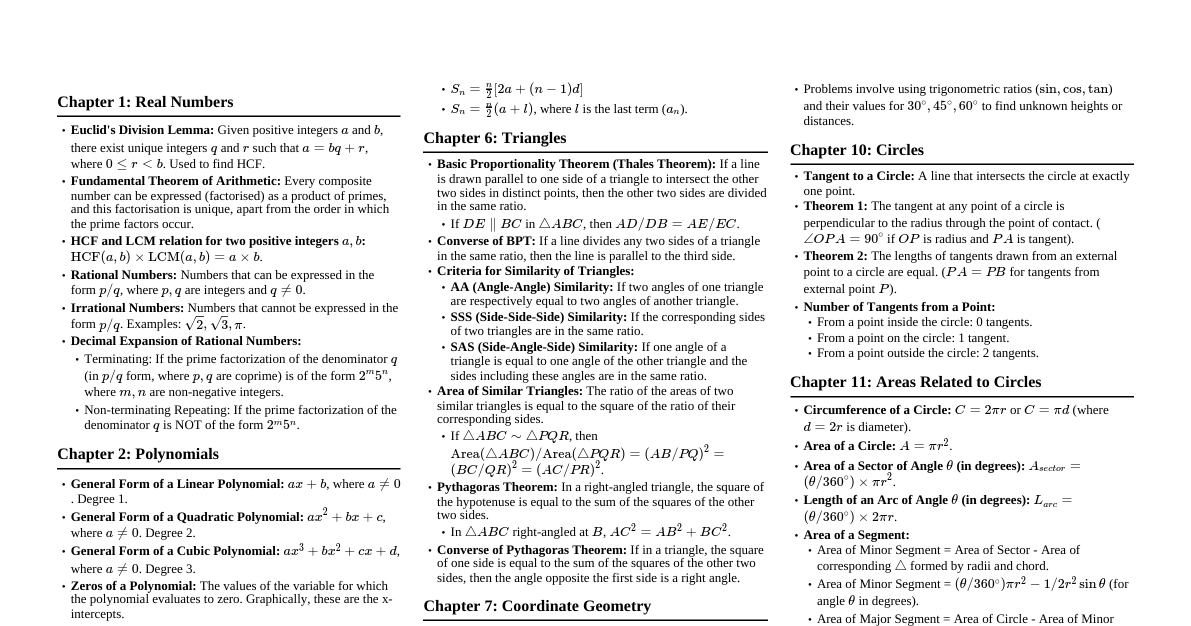
1. Commercial Mathematics 1.1. Goods and Services Tax (GST) Selling Price (SP): Price at which goods are sold. Cost Price (CP): Price at which goods are bought. GST Amount: Rate of GST $\times$ Taxable Value. Taxable Value: SP (for seller), CP (for buyer). Invoice Price: Taxable Value + GST Amount. Input GST: GST paid by a dealer on purchases. Output GST: GST collected by a dealer on sales. GST Payable: Output GST - Input GST (if positive). 1.2. Banking (Recurring Deposit Accounts) Monthly Installment: $P$ Number of Months: $n$ Rate of Interest: $r\%$ per annum Interest (I): $P \times \frac{n(n+1)}{2 \times 12} \times \frac{r}{100}$ Maturity Value (MV): $(P \times n) + I$ 1.3. Shares and Dividends Face Value (FV): Value printed on the share. Market Value (MV): Price at which share is bought/sold in market. Number of Shares: $\frac{\text{Total Investment}}{\text{MV per share}}$ Dividend: Rate of Dividend $\times$ FV $\times$ Number of Shares. Return %: $\frac{\text{Annual Income (Dividend)}}{\text{Total Investment}} \times 100$ 2. Algebra 2.1. Linear Inequations Solving inequalities is similar to equations, but with a key difference: Multiplying/dividing by a negative number reverses the inequality sign. Representation on Number Line: Open circle for $ $. Closed circle for $\le$ or $\ge$. 2.2. Quadratic Equations Standard Form: $ax^2 + bx + c = 0$, where $a \ne 0$. Quadratic Formula: $x = \frac{-b \pm \sqrt{b^2 - 4ac}}{2a}$ Discriminant ($\Delta$ or $D$): $D = b^2 - 4ac$ If $D > 0$: Two distinct real roots. If $D = 0$: Two equal real roots. If $D Sum of Roots ($\alpha + \beta$): $-\frac{b}{a}$ Product of Roots ($\alpha \beta$): $\frac{c}{a}$ 2.3. Ratio and Proportion Continued Proportion: If $a, b, c$ are in continued proportion, then $\frac{a}{b} = \frac{b}{c} \implies b^2 = ac$. Componendo: If $\frac{a}{b} = \frac{c}{d}$, then $\frac{a+b}{b} = \frac{c+d}{d}$. Dividendo: If $\frac{a}{b} = \frac{c}{d}$, then $\frac{a-b}{b} = \frac{c-d}{d}$. Componendo and Dividendo: If $\frac{a}{b} = \frac{c}{d}$, then $\frac{a+b}{a-b} = \frac{c+d}{c-d}$. Alternendo: If $\frac{a}{b} = \frac{c}{d}$, then $\frac{a}{c} = \frac{b}{d}$. Invertendo: If $\frac{a}{b} = \frac{c}{d}$, then $\frac{b}{a} = \frac{d}{c}$. 2.4. Factorization of Polynomials Factor Theorem: If $(x-a)$ is a factor of $P(x)$, then $P(a)=0$. Remainder Theorem: If $P(x)$ is divided by $(x-a)$, the remainder is $P(a)$. 2.5. Matrices Order of Matrix: $m \times n$ (rows $\times$ columns). Addition/Subtraction: Only possible if matrices have the same order. Add/subtract corresponding elements. Scalar Multiplication: Multiply each element by the scalar. Matrix Multiplication: $A_{m \times n} \times B_{n \times p}$ results in $(AB)_{m \times p}$. Number of columns in A must equal number of rows in B. Identity Matrix ($I$): Square matrix with 1s on diagonal, 0s elsewhere. $AI = IA = A$. Null Matrix ($O$): All elements are zero. $A+O = A$. 2.6. Arithmetic Progression (AP) General Form: $a, a+d, a+2d, \dots$ $n$-th term ($a_n$): $a_n = a + (n-1)d$ Sum of $n$ terms ($S_n$): $S_n = \frac{n}{2}[2a + (n-1)d]$ or $S_n = \frac{n}{2}(a + a_n)$ 3. Coordinate Geometry Distance Formula: Between $(x_1, y_1)$ and $(x_2, y_2)$ is $\sqrt{(x_2-x_1)^2 + (y_2-y_1)^2}$. Section Formula: Point $(x, y)$ dividing line segment joining $(x_1, y_1)$ and $(x_2, y_2)$ in ratio $m:n$: $x = \frac{mx_2 + nx_1}{m+n}$ $y = \frac{my_2 + ny_1}{m+n}$ Mid-point Formula: $\left(\frac{x_1+x_2}{2}, \frac{y_1+y_2}{2}\right)$ Centroid of Triangle: For vertices $(x_1, y_1), (x_2, y_2), (x_3, y_3)$: $\left(\frac{x_1+x_2+x_3}{3}, \frac{y_1+y_2+y_3}{3}\right)$ Equation of a Line: Slope-intercept form: $y = mx + c$ (where $m$ is slope, $c$ is y-intercept). Point-slope form: $y - y_1 = m(x - x_1)$. Two-point form: $y - y_1 = \frac{y_2 - y_1}{x_2 - x_1}(x - x_1)$. General form: $Ax + By + C = 0$. Slope $m = -\frac{A}{B}$. Parallel Lines: $m_1 = m_2$. Perpendicular Lines: $m_1 m_2 = -1$. 4. Geometry 4.1. Similarity Conditions for Similarity of Triangles: AAA/AA: All corresponding angles are equal. SSS: All corresponding sides are in proportion. SAS: Two sides are in proportion and the included angle is equal. Area Ratio: If $\triangle ABC \sim \triangle PQR$, then $\frac{\text{Area}(\triangle ABC)}{\text{Area}(\triangle PQR)} = \left(\frac{AB}{PQ}\right)^2 = \left(\frac{BC}{QR}\right)^2 = \left(\frac{AC}{PR}\right)^2$. 4.2. Circles Tangent Properties: Radius is perpendicular to the tangent at the point of contact. Lengths of tangents drawn from an external point to a circle are equal. Angle Properties: Angle in a semicircle is $90^\circ$. Angles subtended by an arc at the center is double the angle subtended by it at any point on the remaining part of the circle. Angles in the same segment are equal. Opposite angles of a cyclic quadrilateral sum to $180^\circ$. Exterior angle of a cyclic quadrilateral is equal to the interior opposite angle. Chord Properties: Perpendicular from center to a chord bisects the chord. Equal chords are equidistant from the center. 4.3. Loci Locus of points equidistant from two fixed points: Perpendicular bisector of the line segment joining the points. Locus of points equidistant from two intersecting lines: Bisectors of the angles between the lines. 5. Mensuration Cylinder: Volume: $\pi r^2 h$ Curved Surface Area (CSA): $2 \pi r h$ Total Surface Area (TSA): $2 \pi r (h + r)$ Cone: Volume: $\frac{1}{3} \pi r^2 h$ CSA: $\pi r l$ (where $l = \sqrt{r^2 + h^2}$ is slant height) TSA: $\pi r (l + r)$ Sphere: Volume: $\frac{4}{3} \pi r^3$ Surface Area: $4 \pi r^2$ Hemisphere: Volume: $\frac{2}{3} \pi r^3$ CSA: $2 \pi r^2$ TSA: $3 \pi r^2$ Cuboid: Volume: $lwh$ TSA: $2(lw + wh + hl)$ 6. Trigonometry Basic Ratios: $\sin \theta = \frac{\text{Opposite}}{\text{Hypotenuse}}$ $\cos \theta = \frac{\text{Adjacent}}{\text{Hypotenuse}}$ $\tan \theta = \frac{\text{Opposite}}{\text{Adjacent}} = \frac{\sin \theta}{\cos \theta}$ $\csc \theta = \frac{1}{\sin \theta}$ $\sec \theta = \frac{1}{\cos \theta}$ $\cot \theta = \frac{1}{\tan \theta}$ Standard Angles: $\theta$ $0^\circ$ $30^\circ$ $45^\circ$ $60^\circ$ $90^\circ$ $\sin \theta$ $0$ $\frac{1}{2}$ $\frac{1}{\sqrt{2}}$ $\frac{\sqrt{3}}{2}$ $1$ $\cos \theta$ $1$ $\frac{\sqrt{3}}{2}$ $\frac{1}{\sqrt{2}}$ $\frac{1}{2}$ $0$ $\tan \theta$ $0$ $\frac{1}{\sqrt{3}}$ $1$ $\sqrt{3}$ Undefined Identities: $\sin^2 \theta + \cos^2 \theta = 1$ $1 + \tan^2 \theta = \sec^2 \theta$ $1 + \cot^2 \theta = \csc^2 \theta$ Complementary Angles: $\sin (90^\circ - \theta) = \cos \theta$ $\cos (90^\circ - \theta) = \sin \theta$ $\tan (90^\circ - \theta) = \cot \theta$ Heights and Distances: Applications using angles of elevation and depression. Drawing accurate diagrams is crucial. 7. Statistics Mean: Direct Method: $\bar{x} = \frac{\sum f_i x_i}{\sum f_i}$ Assumed Mean Method: $\bar{x} = A + \frac{\sum f_i d_i}{\sum f_i}$, where $d_i = x_i - A$. Step Deviation Method: $\bar{x} = A + \left(\frac{\sum f_i u_i}{\sum f_i}\right) \times h$, where $u_i = \frac{x_i - A}{h}$. Median: For ungrouped data, arrange in ascending order. If $n$ is odd, median is $\left(\frac{n+1}{2}\right)^{th}$ term. If $n$ is even, median is average of $\left(\frac{n}{2}\right)^{th}$ and $\left(\frac{n}{2}+1\right)^{th}$ terms. For grouped data: Median $= L + \left(\frac{\frac{N}{2} - cf}{f}\right) \times h$, where $L$ is lower boundary of median class, $N = \sum f_i$, $cf$ is cumulative frequency of class preceding median class, $f$ is frequency of median class, $h$ is class size. Mode: The value that appears most frequently. For grouped data: Mode $= L + \left(\frac{f_1 - f_0}{2f_1 - f_0 - f_2}\right) \times h$, where $L$ is lower boundary of modal class, $f_1$ is frequency of modal class, $f_0$ is frequency of class preceding modal class, $f_2$ is frequency of class succeeding modal class, $h$ is class size. Ogive: Cumulative frequency curve. Less than ogive: Plots upper class boundaries vs. less than cumulative frequency. More than ogive: Plots lower class boundaries vs. more than cumulative frequency. Median can be found from the intersection of less than and more than ogives, or by finding $N/2$ on the y-axis of a single ogive and projecting to x-axis. 8. Probability Probability of an Event E ($P(E)$): $P(E) = \frac{\text{Number of favorable outcomes}}{\text{Total number of possible outcomes}}$ Range of Probability: $0 \le P(E) \le 1$. Sum of Probabilities: $P(E) + P(\text{not } E) = 1$. Keywords: Coin Toss: Head/Tail (2 outcomes per coin). Dice Roll: 1, 2, 3, 4, 5, 6 (6 outcomes per die). Cards: 52 cards, 4 suits (Hearts, Diamonds, Clubs, Spades), 13 cards per suit. Face cards: J, Q, K (3 per suit, total 12). Red cards: Hearts and Diamonds (26 total). Black cards: Clubs and Spades (26 total).