Life Processes (Biology)
Cheatsheet Content
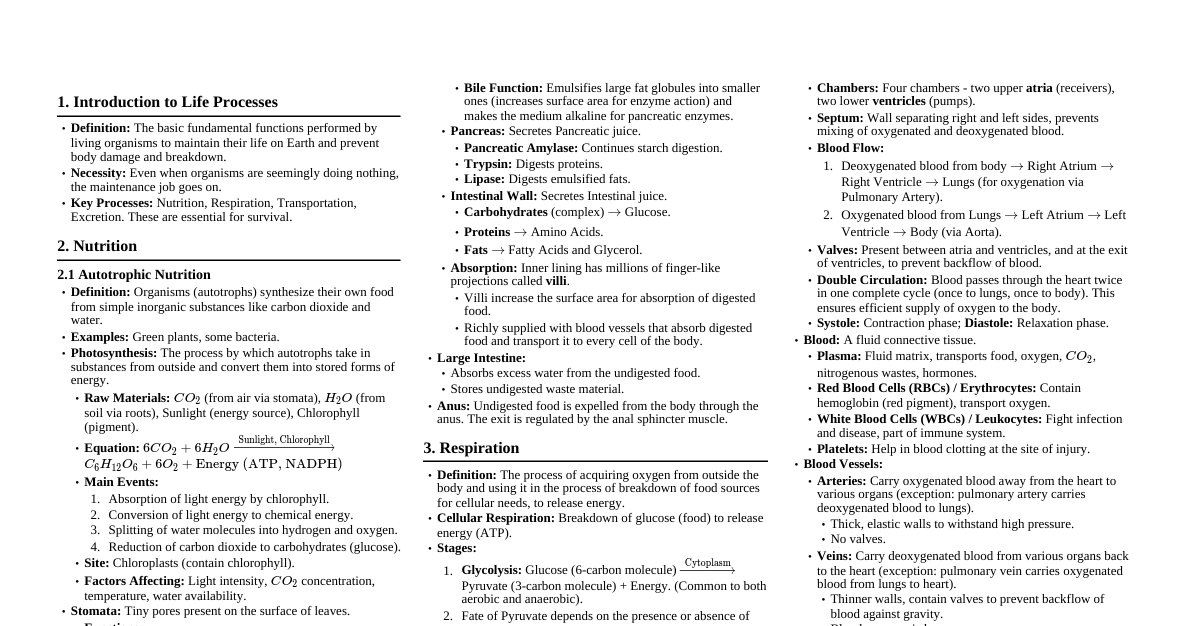
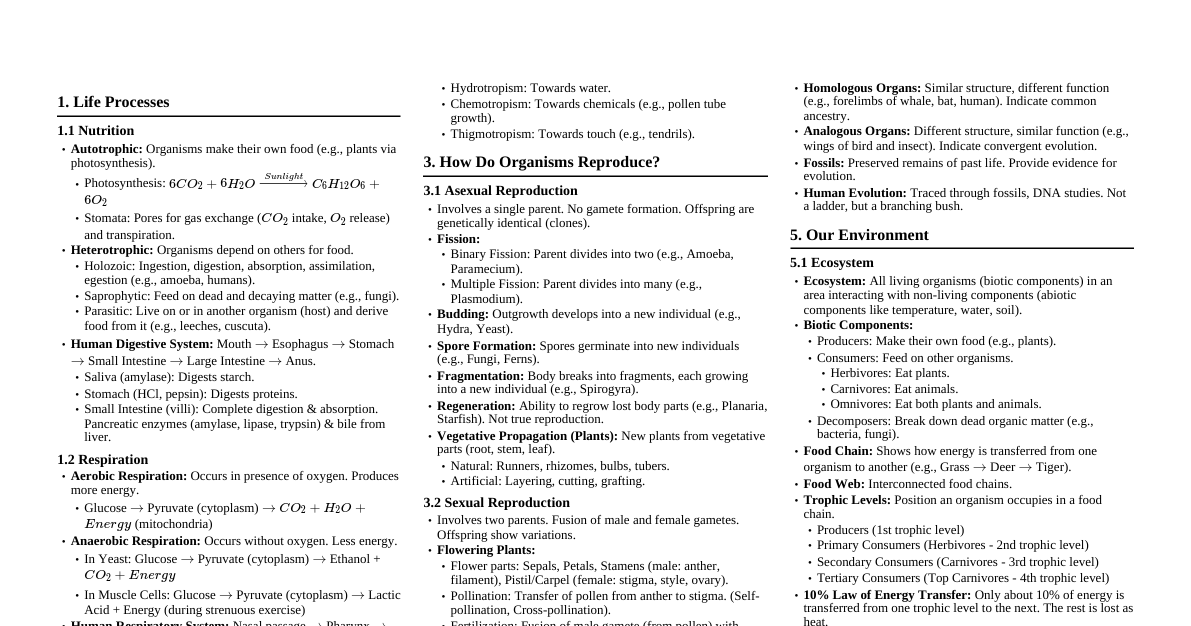
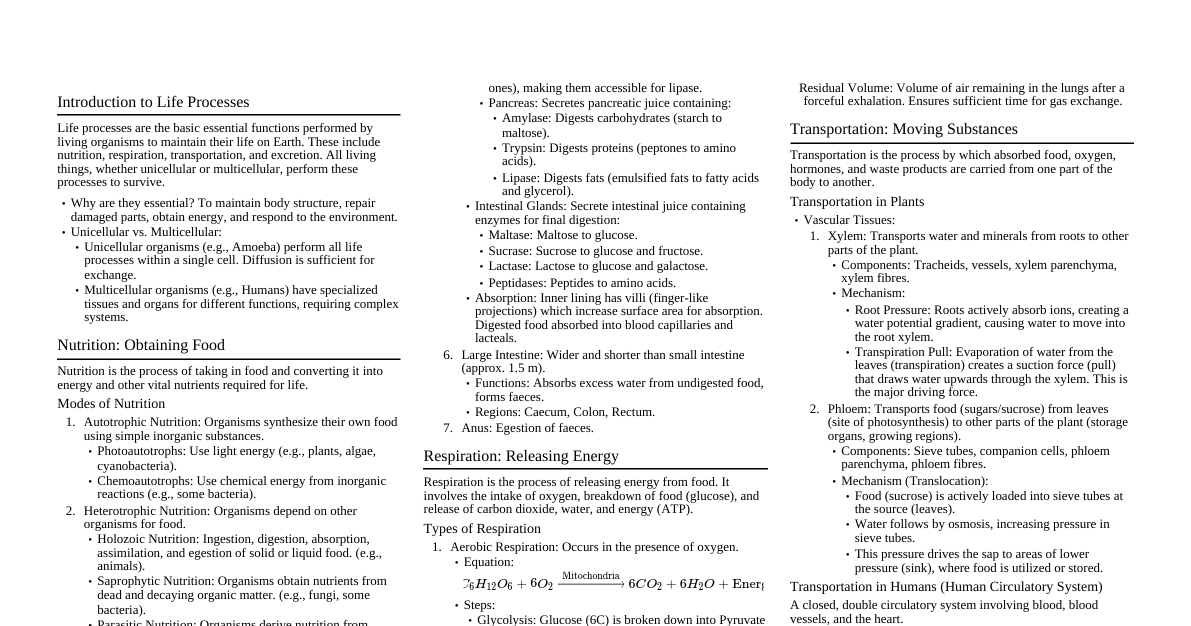
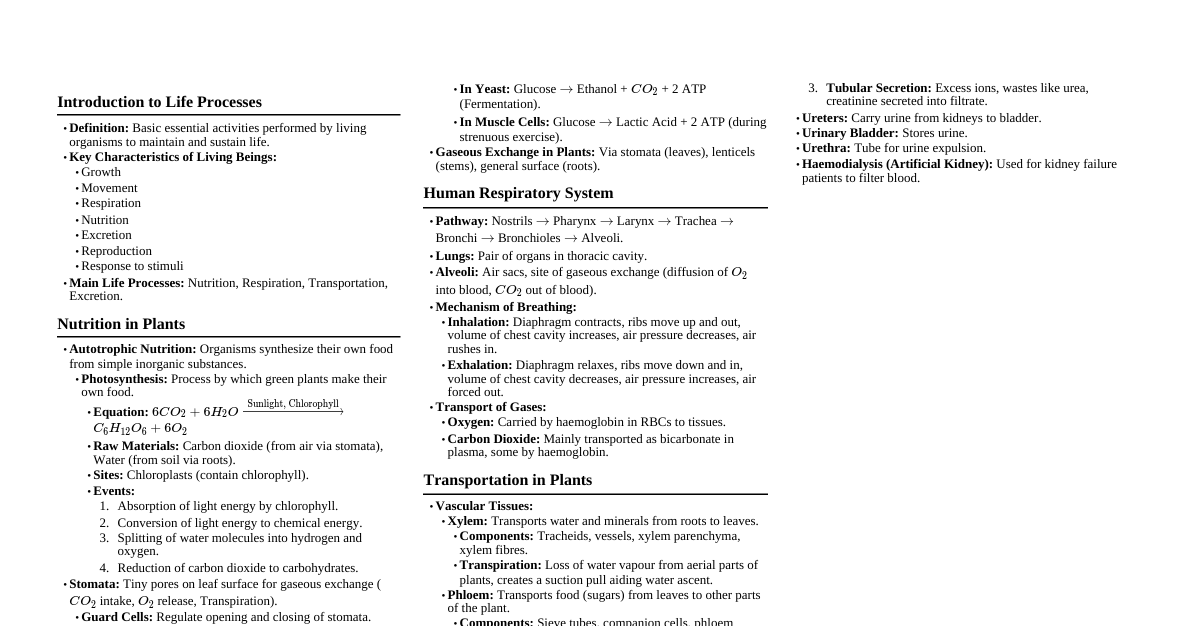
Life Processes: An Overview Definition: Processes that together perform maintenance jobs, prevent damage, and ensure the survival of living organisms. Necessity: Even when organisms are not actively doing anything (e.g., sleeping), these processes must continue. Key Processes: Nutrition Respiration Transportation Excretion Energy: Required for maintenance, obtained from outside the body (food). Raw Materials: Needed for growth and repair, also obtained externally. Complexity: Single-celled organisms: Entire surface in contact with environment; simple diffusion suffices. Multi-cellular organisms: Specialised organs/tissues for intake, exchange, and removal due to increased body size and complexity. Simple diffusion is insufficient. Nutrition The process of acquiring food, an energy source and raw material, from outside the body. 1. Autotrophic Nutrition Definition: Organisms use simple inorganic materials (e.g., $\text{CO}_2$, $\text{H}_2\text{O}$) and an external energy source (sunlight) to synthesize complex organic food. Examples: Green plants, some bacteria. Process: Photosynthesis. Photosynthesis Equation: $6\text{CO}_2 + 6\text{H}_2\text{O} \xrightarrow{\text{Sunlight, Chlorophyll}} \text{C}_6\text{H}_{12}\text{O}_6 + 6\text{O}_2$ Events during Photosynthesis: Absorption of light energy by chlorophyll. Conversion of light energy to chemical energy; splitting of water into hydrogen and oxygen. Reduction of carbon dioxide to carbohydrates. Raw Materials for Photosynthesis: Carbon Dioxide ($\text{CO}_2$): Taken in through stomata (tiny pores on leaf surface). Guard cells regulate stomatal opening/closing. Water ($\text{H}_2\text{O}$): Absorbed from soil by roots. Chlorophyll: Green pigment in chloroplasts, essential for absorbing light. Sunlight: Energy source. Other Materials: Nitrogen, phosphorus, iron, magnesium from soil (e.g., Nitrogen for protein synthesis). Storage: Carbohydrates not immediately used are stored as starch in plants, glycogen in animals. 2. Heterotrophic Nutrition Definition: Organisms obtain complex food materials prepared by other organisms. Dependence: Directly or indirectly depend on autotrophs. Examples: Animals, fungi. Strategies: Saprophytic: Break down food outside body, then absorb (e.g., bread moulds, yeast, mushrooms). Holozoic: Take in whole material and break it down inside (e.g., amoeba, humans). Parasitic: Derive nutrition from host without killing it (e.g., cuscuta, ticks, lice, tapeworms). 3. Nutrition in Amoeba (Holozoic) Uses temporary finger-like extensions (pseudopodia) to engulf food particle, forming a food-vacuole. Complex substances broken down into simpler ones inside food-vacuole, then diffuse into cytoplasm. Undigested material moved to surface and expelled. 4. Nutrition in Human Beings (Holozoic) Alimentary Canal: Long tube from mouth to anus, with specialized parts. Digestion Process: Mouth: Teeth: Crush food (mechanical digestion). Saliva: Secreted by salivary glands, wets food. Contains salivary amylase (enzyme) to break down starch into simple sugars (chemical digestion). Tongue: Mixes food with saliva. Oesophagus (Food-pipe): Food moves by peristaltic movements (rhythmic contractions of muscular walls). Stomach: Expands to hold food. Muscular walls mix food with digestive juices. Gastric glands secrete: Hydrochloric acid ($\text{HCl}$): Creates acidic medium for pepsin, kills bacteria. Pepsin: Protein-digesting enzyme. Mucus: Protects stomach lining from acid. Exit of food regulated by sphincter muscle. Small Intestine: Longest part, extensively coiled. Site of complete digestion and absorption. Receives secretions from: Liver: Secretes bile juice. Bile makes food alkaline (for pancreatic enzymes) and emulsifies fats (breaks large globules into smaller ones). Pancreas: Secretes pancreatic juice containing enzymes: Trypsin: For protein digestion. Lipase: For emulsified fat breakdown. Intestinal Glands: Secrete intestinal juice containing enzymes that convert: Proteins $\to$ amino acids Complex carbohydrates $\to$ glucose Fats $\to$ fatty acids and glycerol Absorption: Inner lining has numerous finger-like projections called villi, increasing surface area for absorption. Villi are richly supplied with blood vessels that transport absorbed food to cells. Large Intestine: Absorbs excess water from unabsorbed food. Anus: Removes waste material, regulated by anal sphincter. Respiration Process of breaking down food materials (glucose) in cells to release energy (ATP). First Step (common to all): Glucose (6-carbon) $\to$ Pyruvate (3-carbon) + Energy. Occurs in cytoplasm. Further Breakdown of Pyruvate (Pathways): Pathway Oxygen Presence Location Products Energy Released Examples Anaerobic Respiration Absence of $\text{O}_2$ Cytoplasm (Yeast) Ethanol + $\text{CO}_2$ Less Yeast (fermentation) Anaerobic Respiration Lack of $\text{O}_2$ Muscle cells Lactic acid Less Muscle cramps during sudden activity Aerobic Respiration Presence of $\text{O}_2$ Mitochondria $\text{CO}_2 + \text{H}_2\text{O}$ Much Greater Most organisms ATP (Adenosine Triphosphate): Energy currency of cells. Formed from ADP + inorganic phosphate using energy released during respiration. Used for muscle contraction, protein synthesis, nerve impulses, etc. Gas Exchange in Plants: Stomata: For $\text{CO}_2$ and $\text{O}_2$ exchange. Inter-cellular spaces: Ensure all cells are in contact with air. Diffusion: Direction depends on environmental conditions. Night: $\text{CO}_2$ elimination (from respiration) is major. Day: $\text{CO}_2$ used for photosynthesis; $\text{O}_2$ release is major. Gas Exchange in Animals: Aquatic Organisms: Use dissolved oxygen in water (low amount). Faster breathing rate than terrestrial organisms. Fish: Water taken through mouth, forced over gills; dissolved $\text{O}_2$ absorbed by blood. Terrestrial Organisms: Use atmospheric oxygen. Specialized organs (e.g., lungs) with large surface area, fine/delicate membranes, internal location, and passages for air movement. Human Respiratory System: Air enters through nostrils (filtered by hairs, moistened by mucus). Passes through throat and into lungs. Rings of cartilage in throat prevent collapse of air-passage. Within lungs, passage divides into smaller tubes ending in alveoli (balloon-like structures). Alveoli: Provide surface for gas exchange. Walls have extensive network of blood vessels. Breathing in: Ribs lift, diaphragm flattens, chest cavity enlarges, air sucked into expanded alveoli. $\text{CO}_2$ from blood (from body) released into alveoli. $\text{O}_2$ from alveolar air taken up by blood for transport to cells. Residual volume of air in lungs ensures sufficient time for gas exchange. Respiratory Pigment: Haemoglobin (in red blood corpuscles) has high affinity for oxygen, transports $\text{O}_2$. $\text{CO}_2$ is more soluble in water, mostly transported in dissolved form in blood. Transportation Movement of substances within the body. 1. Transportation in Human Beings (Circulatory System) Components: Heart, blood, blood vessels. Blood: Fluid connective tissue. Plasma: Fluid medium, transports food, $\text{CO}_2$, nitrogenous wastes, salts (dissolved form). Red Blood Corpuscles (RBCs): Carry oxygen (due to haemoglobin). Platelets: Circulate and plug leaks in vessels by clotting blood at injury sites. Heart: Muscular pumping organ, size of a fist. Chambers: Four chambers (two atria, two ventricles) to prevent mixing of oxygenated and deoxygenated blood. Double Circulation: Blood passes through the heart twice in one complete cycle. Pathway: Oxygen-rich blood from lungs $\to$ Left atrium (relaxes). Left atrium contracts $\to$ Left ventricle (relaxes). Left ventricle contracts $\to$ Blood pumped to body. Deoxygenated blood from body $\to$ Right atrium (relaxes). Right atrium contracts $\to$ Right ventricle (dilates). Right ventricle contracts $\to$ Blood pumped to lungs for oxygenation. Valves: Ensure one-way blood flow, prevent backflow. Ventricles: Thicker muscular walls than atria (pump blood to various organs). Separation of Blood: Efficient $\text{O}_2$ supply, important for animals with high energy needs (birds, mammals) to maintain body temperature. Other Animals: Amphibians/Reptiles: Three-chambered hearts, some mixing of blood. Fish: Two-chambered hearts, blood pumped to gills, oxygenated, then directly to body (single circulation). Blood Vessels: Arteries: Carry blood away from heart to organs. Thick, elastic walls (high pressure). Veins: Collect blood from organs, bring back to heart. Thinner walls (low pressure), have valves. Capillaries: Smallest vessels, one-cell thick walls. Site of material exchange between blood and cells. Join to form veins. Blood Pressure: Force exerted by blood against vessel walls. Systolic Pressure: During ventricular contraction (~120 mmHg). Diastolic Pressure: During ventricular relaxation (~80 mmHg). Measured by sphygmomanometer. Hypertension (high BP) can cause artery rupture. Lymph (Tissue Fluid): Fluid that escapes from capillaries into intercellular spaces. Similar to plasma, but colorless, less protein. Drains into lymphatic capillaries, then large lymph vessels, finally into veins. Transports digested fat from intestine, drains excess fluid from extracellular space back to blood. 2. Transportation in Plants Distance: Diffusion insufficient for large plants; requires proper transport system. Energy Needs: Low (plants don't move, large proportion of dead cells). Transport Systems: Two independently organized conducting tubes. Xylem: Transports water and minerals from roots upwards. Vessels and tracheids form continuous water-conducting channels. Root cells actively take up ions, causing water to move into root by osmosis, creating a water column pushed upwards. Transpiration: Loss of water vapor from aerial parts (leaves) through stomata. Creates a suction pull, major driving force for water movement during the day. Also helps in temperature regulation. Phloem: Transports products of photosynthesis (food, amino acids, other substances) from leaves to other parts (storage organs, growing organs). Process called Translocation . Occurs in sieve tubes with companion cells, in both upward and downward directions. Requires energy (ATP) to transfer sucrose into phloem, increasing osmotic pressure and causing water to move in, which drives material movement to areas of lower pressure. Excretion Biological process involved in the removal of harmful metabolic wastes from the body. 1. Excretion in Human Beings Excretory System: Pair of kidneys, pair of ureters, urinary bladder, urethra. Kidneys: Located in abdomen (one on each side of backbone). Purpose: Filter out waste products (nitrogenous wastes like urea, uric acid) from blood. Nephrons: Basic filtration units in kidneys. Each kidney has millions. Structure: Cluster of thin-walled blood capillaries (glomerulus) associated with a cup-shaped Bowman's capsule. Function: Filtration: Blood filtered in glomerulus; initial filtrate (glucose, amino acids, salts, water, wastes) collects in Bowman's capsule. Selective Re-absorption: As filtrate flows along the tubule, useful substances (glucose, amino acids, major amount of water) are re-absorbed. Amount of water re-absorbed depends on body's water level and amount of dissolved waste. Ureters: Tubes carrying urine from kidneys to urinary bladder. Urinary Bladder: Stores urine until release. Muscular, under nervous control (allows voluntary urination). Urethra: Tube through which urine is released. Artificial Kidney (Hemodialysis): Used in kidney failure to remove nitrogenous wastes from blood by diffusion across a semi-permeable membrane into a dialyzing fluid. (No re-absorption occurs). 2. Excretion in Plants Different strategies than animals due to different metabolic processes and structure. Gaseous Wastes: Oxygen ($\text{O}_2$): Waste product of photosynthesis, released via stomata. Carbon Dioxide ($\text{CO}_2$): Released during respiration via stomata. Excess Water: Removed by transpiration. Other Wastes: Stored in cellular vacuoles. Stored in leaves that eventually fall off. Stored as resins and gums (especially in old xylem). Excreted into the soil around them.