Class 12 Organic Reactions (NCERT)
Cheatsheet Content
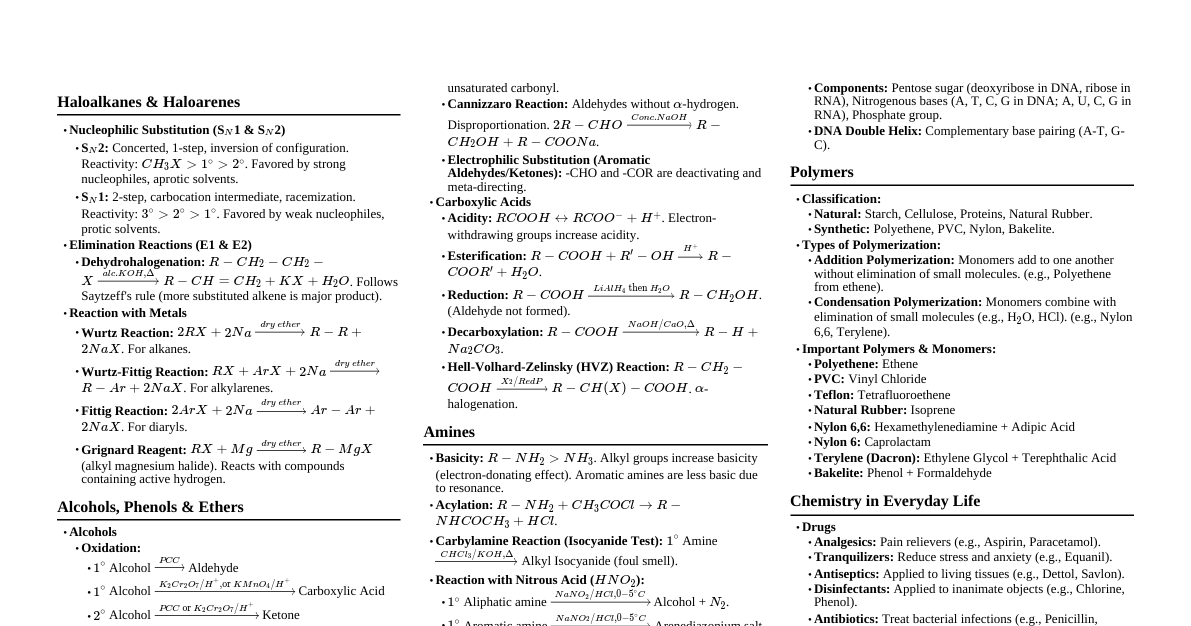
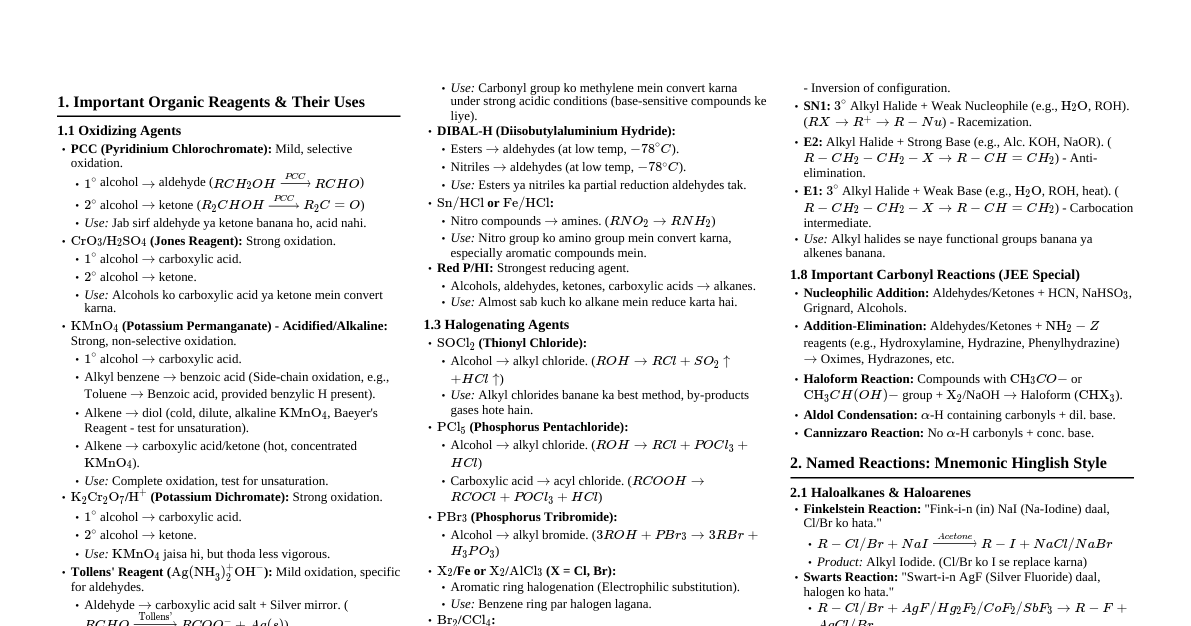
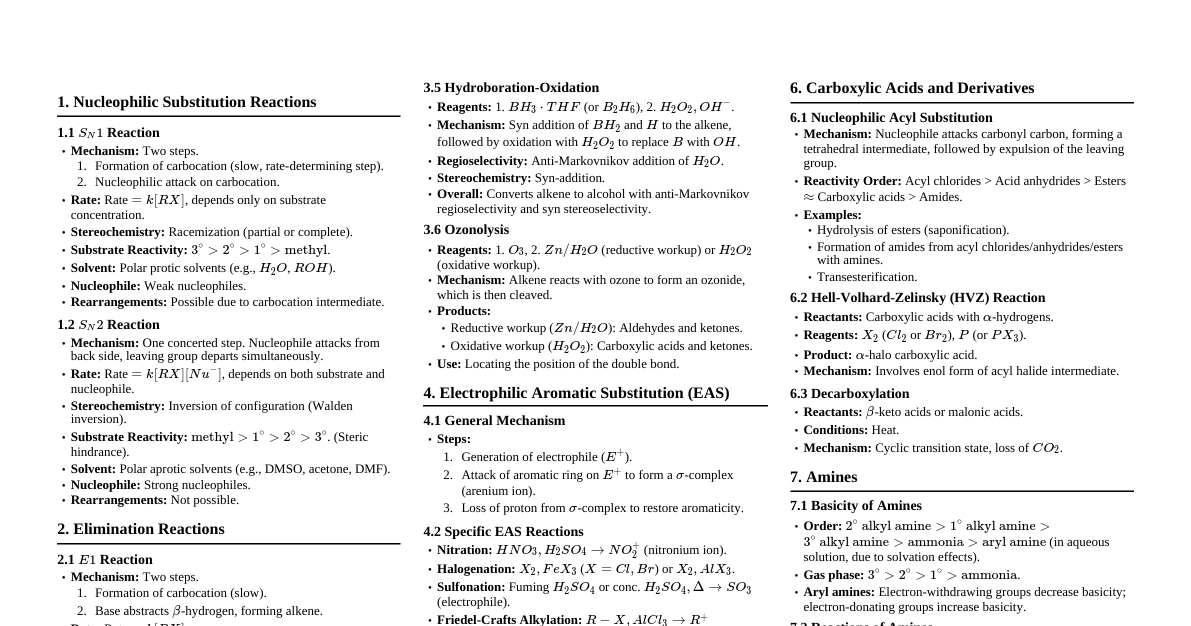
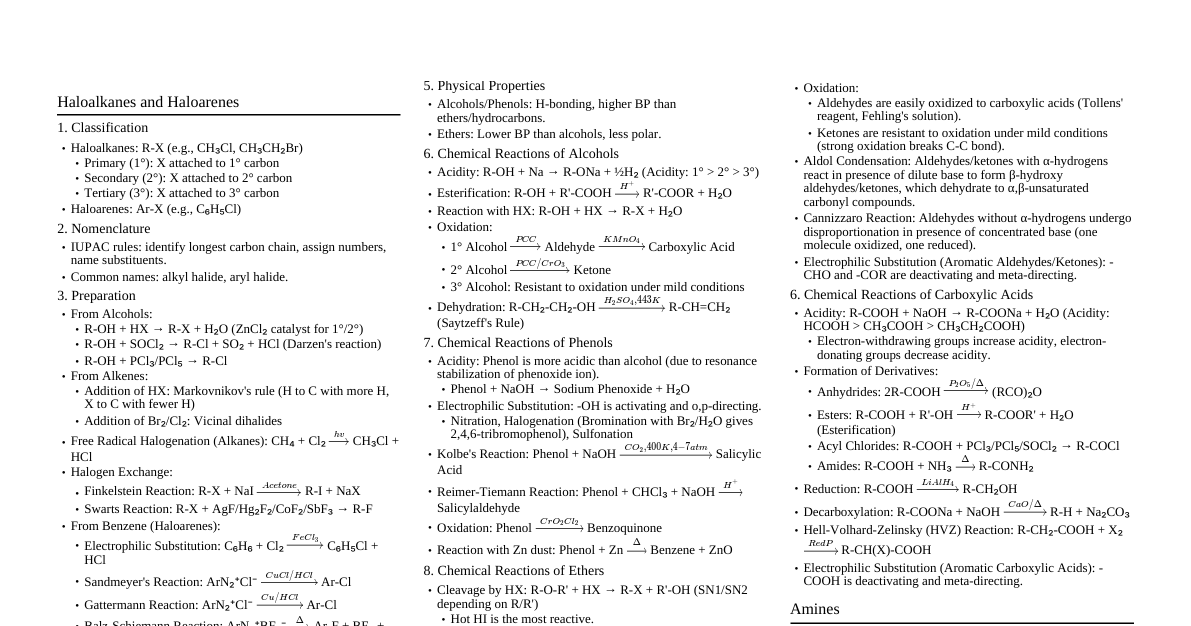
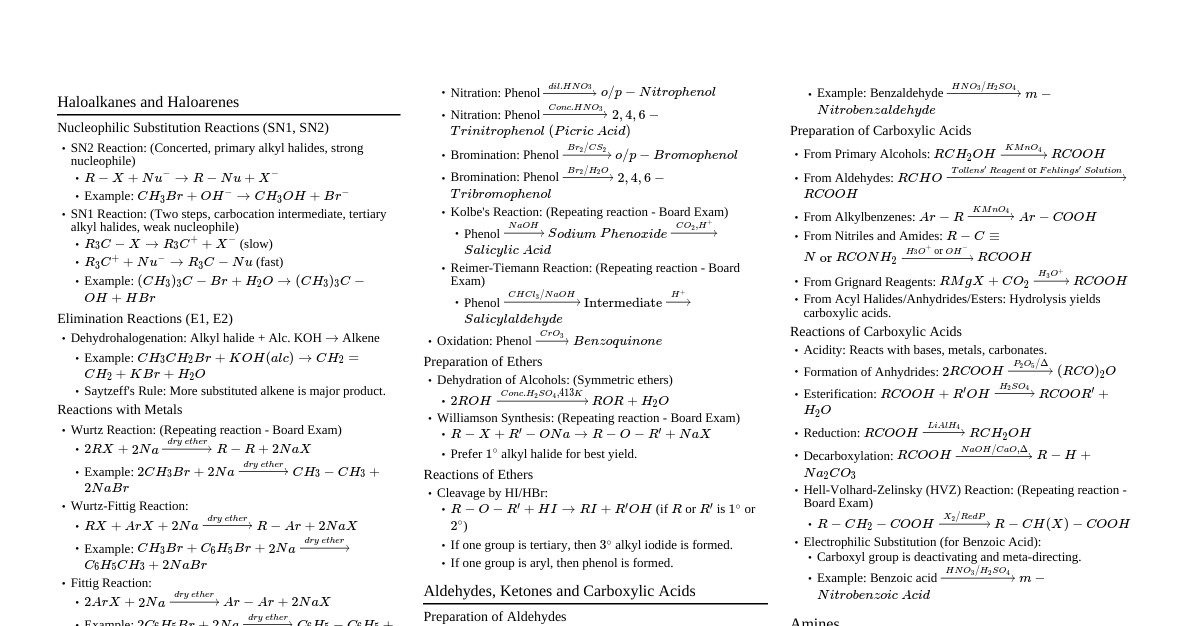
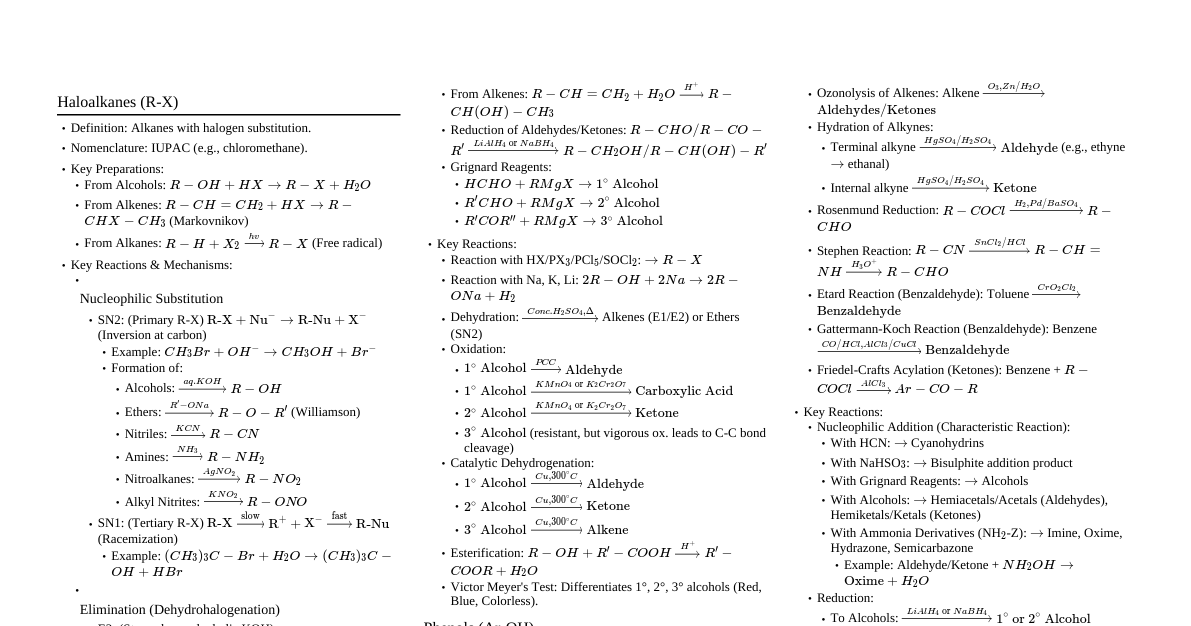
1. Haloalkanes and Haloarenes 1.1 Preparation of Haloalkanes From Alcohols: $\text{ROH} + \text{HCl} \xrightarrow{\text{ZnCl}_2} \text{RCl} + \text{H}_2\text{O}$ (Lucas Test) $\text{ROH} + \text{HBr} \rightarrow \text{RBr} + \text{H}_2\text{O}$ $3\text{ROH} + \text{PCl}_3 \rightarrow 3\text{RCl} + \text{H}_3\text{PO}_3$ $\text{ROH} + \text{PCl}_5 \rightarrow \text{RCl} + \text{POCl}_3 + \text{HCl}$ $\text{ROH} + \text{SOCl}_2 \xrightarrow{\text{Pyridine}} \text{RCl} + \text{SO}_2 + \text{HCl}$ (Darzen's process) From Alkenes (Electrophilic Addition): $\text{CH}_2=\text{CH}_2 + \text{HBr} \rightarrow \text{CH}_3\text{CH}_2\text{Br}$ $\text{CH}_3\text{CH}=\text{CH}_2 + \text{HBr} \rightarrow \text{CH}_3\text{CH(Br)}\text{CH}_3$ (Markovnikov's Rule) $\text{CH}_3\text{CH}=\text{CH}_2 + \text{HBr} \xrightarrow{\text{Peroxide}} \text{CH}_3\text{CH}_2\text{CH}_2\text{Br}$ (Anti-Markovnikov's Rule) Halogenation of Alkanes (Free Radical): $\text{CH}_4 + \text{Cl}_2 \xrightarrow{h\nu} \text{CH}_3\text{Cl} + \text{HCl}$ Halogen Exchange: Finkelstein Reaction: $\text{R-X} + \text{NaI} \xrightarrow{\text{Acetone}} \text{R-I} + \text{NaX}$ Swarts Reaction: $\text{R-Br} + \text{AgF} \rightarrow \text{R-F} + \text{AgBr}$ (or $\text{Hg}_2\text{F}_2, \text{CoF}_2, \text{SbF}_3$) 1.2 Preparation of Haloarenes From Benzene (Electrophilic Substitution): $\text{C}_6\text{H}_6 + \text{Cl}_2 \xrightarrow{\text{FeCl}_3} \text{C}_6\text{H}_5\text{Cl} + \text{HCl}$ From Diazonium Salts: Sandmeyer Reaction: $\text{ArN}_2^+\text{Cl}^- \xrightarrow{\text{CuCl/HCl}} \text{ArCl} + \text{N}_2$ Gattermann Reaction: $\text{ArN}_2^+\text{Cl}^- \xrightarrow{\text{Cu/HCl}} \text{ArCl} + \text{N}_2$ $\text{ArN}_2^+\text{Cl}^- \xrightarrow{\text{KI}} \text{ArI} + \text{N}_2 + \text{KCl}$ 1.3 Reactions of Haloalkanes Nucleophilic Substitution Reactions ($\text{S}_{\text{N}}1, \text{S}_{\text{N}}2$): With aq. KOH/NaOH: $\text{R-X} + \text{KOH(aq)} \rightarrow \text{R-OH} + \text{KX}$ With NaOR': $\text{R-X} + \text{NaOR'} \rightarrow \text{R-O-R'} + \text{NaX}$ (Williamson Synthesis) With KCN/NaCN: $\text{R-X} + \text{KCN} \rightarrow \text{R-CN} + \text{KX}$ (alkyl cyanides) With AgCN: $\text{R-X} + \text{AgCN} \rightarrow \text{R-NC} + \text{AgX}$ (alkyl isocyanides) With $\text{KNO}_2$: $\text{R-X} + \text{KNO}_2 \rightarrow \text{R-ONO} + \text{KX}$ (alkyl nitrites) With $\text{AgNO}_2$: $\text{R-X} + \text{AgNO}_2 \rightarrow \text{R-NO}_2 + \text{AgX}$ (nitroalkanes) With $\text{NH}_3$: $\text{R-X} + \text{NH}_3 \rightarrow \text{RNH}_2 + \text{HX}$ (ammonolysis) With $\text{LiAlH}_4$: $\text{R-X} \xrightarrow{\text{LiAlH}_4} \text{R-H}$ (reduction) Elimination Reactions ($\text{E}1, \text{E}2$): Dehydrohalogenation: $\text{R-CH}_2\text{CH}_2\text{X} \xrightarrow{\text{alc. KOH}} \text{R-CH}=\text{CH}_2 + \text{HX}$ (Saytzeff's Rule) Reaction with Metals: Wurtz Reaction: $2\text{R-X} + 2\text{Na} \xrightarrow{\text{Dry Ether}} \text{R-R} + 2\text{NaX}$ Grignard Reagent: $\text{R-X} + \text{Mg} \xrightarrow{\text{Dry Ether}} \text{R-Mg-X}$ 1.4 Reactions of Haloarenes Nucleophilic Substitution: (Difficult due to resonance, $\text{sp}^2$ hybrid C-X bond) Dow's Process: $\text{Chlorobenzene} \xrightarrow{\text{NaOH, 623K, 300atm}} \text{Phenol}$ Electrophilic Substitution: (Ortho/Para directing) Halogenation: $\text{Chlorobenzene} + \text{Cl}_2 \xrightarrow{\text{FeCl}_3} \text{o-/p-Dichlorobenzene}$ Nitration: $\text{Chlorobenzene} + \text{HNO}_3/\text{H}_2\text{SO}_4 \rightarrow \text{o-/p-Nitrochlorobenzene}$ Sulphonation: $\text{Chlorobenzene} + \text{H}_2\text{SO}_4 \rightarrow \text{o-/p-Chlorobenzenesulphonic acid}$ Friedel-Crafts Alkylation: $\text{Chlorobenzene} + \text{CH}_3\text{Cl} \xrightarrow{\text{Anhy. AlCl}_3} \text{o-/p-Chlorotoluene}$ Friedel-Crafts Acylation: $\text{Chlorobenzene} + \text{CH}_3\text{COCl} \xrightarrow{\text{Anhy. AlCl}_3} \text{o-/p-Chloroacetophenone}$ Reaction with Metals: Wurtz-Fittig Reaction: $\text{Ar-X} + \text{R-X} + 2\text{Na} \xrightarrow{\text{Dry Ether}} \text{Ar-R} + 2\text{NaX}$ Fittig Reaction: $2\text{Ar-X} + 2\text{Na} \xrightarrow{\text{Dry Ether}} \text{Ar-Ar} + 2\text{NaX}$ 2. Alcohols, Phenols and Ethers 2.1 Preparation of Alcohols From Alkenes: Acid Catalysed Hydration: $\text{R-CH=CH}_2 + \text{H}_2\text{O} \xrightarrow{\text{H}^+} \text{R-CH(OH)-CH}_3$ (Markovnikov) Hydroboration-Oxidation: $\text{R-CH=CH}_2 \xrightarrow{(\text{i}) \text{BH}_3, \text{THF} (\text{ii}) \text{H}_2\text{O}_2, \text{OH}^-} \text{R-CH}_2\text{CH}_2\text{OH}$ (Anti-Markovnikov) From Carbonyl Compounds (Reduction): Aldehydes: $\text{RCHO} \xrightarrow{\text{LiAlH}_4 \text{ or } \text{NaBH}_4} \text{RCH}_2\text{OH}$ (Primary alcohol) Ketones: $\text{RCOR'} \xrightarrow{\text{LiAlH}_4 \text{ or } \text{NaBH}_4} \text{RCH(OH)R'}$ (Secondary alcohol) Carboxylic Acids: $\text{RCOOH} \xrightarrow{\text{LiAlH}_4} \text{RCH}_2\text{OH}$ Esters: $\text{RCOOR'} \xrightarrow{\text{LiAlH}_4} \text{RCH}_2\text{OH} + \text{R'OH}$ From Grignard Reagents: $\text{HCHO} + \text{RMgX} \rightarrow \text{RCH}_2\text{OMgX} \xrightarrow{\text{H}_3\text{O}^+} \text{RCH}_2\text{OH}$ (Primary alcohol) $\text{R'CHO} + \text{RMgX} \rightarrow \text{RR'CHOMgX} \xrightarrow{\text{H}_3\text{O}^+} \text{RR'CHOH}$ (Secondary alcohol) $\text{R'COR''} + \text{RMgX} \rightarrow \text{RR'R''COMgX} \xrightarrow{\text{H}_3\text{O}^+} \text{RR'R''COH}$ (Tertiary alcohol) 2.2 Preparation of Phenols From Haloarenes (Dow's Process): $\text{Chlorobenzene} \xrightarrow{\text{NaOH, 623K, 300atm}} \text{Phenol}$ From Benzene Sulphonic Acid: $\text{C}_6\text{H}_5\text{SO}_3\text{H} \xrightarrow{(\text{i}) \text{NaOH} (\text{ii}) \text{H}^+} \text{C}_6\text{H}_5\text{OH}$ From Diazonium Salts: $\text{ArN}_2^+\text{Cl}^- + \text{H}_2\text{O} \xrightarrow{\text{Warm}} \text{ArOH} + \text{N}_2 + \text{HCl}$ From Cumene: $\text{Cumene} \xrightarrow{(\text{i}) \text{O}_2 (\text{ii}) \text{H}^+} \text{Phenol} + \text{Acetone}$ 2.3 Reactions of Alcohols Acidity: $\text{ROH} + \text{Na} \rightarrow \text{RONa} + 1/2 \text{H}_2$ Esterification: $\text{ROH} + \text{R'COOH} \xrightarrow{\text{Conc. H}_2\text{SO}_4} \text{R'COOR} + \text{H}_2\text{O}$ Dehydration: $\text{R-CH}_2\text{CH}_2\text{OH} \xrightarrow{\text{Conc. H}_2\text{SO}_4, 443K} \text{R-CH=CH}_2 + \text{H}_2\text{O}$ Oxidation: Primary alcohol: $\text{RCH}_2\text{OH} \xrightarrow{\text{PCC}} \text{RCHO}$ (aldehyde) Primary alcohol: $\text{RCH}_2\text{OH} \xrightarrow{\text{CrO}_3 \text{ or } \text{KMnO}_4} \text{RCOOH}$ (carboxylic acid) Secondary alcohol: $\text{RCH(OH)R'} \xrightarrow{\text{CrO}_3} \text{RCOR'}$ (ketone) Tertiary alcohol: No oxidation under mild conditions. Reaction with HX: $\text{ROH} + \text{HX} \rightarrow \text{RX} + \text{H}_2\text{O}$ Reaction with $\text{PCl}_3, \text{PCl}_5, \text{SOCl}_2$: (See Haloalkanes preparation) 2.4 Reactions of Phenols Acidity: $\text{Phenol} + \text{NaOH} \rightarrow \text{Sodium Phenoxide} + \text{H}_2\text{O}$ Electrophilic Substitution: (Ortho/Para directing, activating) Nitration: $\text{Phenol} \xrightarrow{\text{Dil. HNO}_3} \text{o-/p-Nitrophenol}$ Nitration: $\text{Phenol} \xrightarrow{\text{Conc. HNO}_3/\text{H}_2\text{SO}_4} \text{Picric acid (2,4,6-trinitrophenol)}$ Bromination: $\text{Phenol} \xrightarrow{\text{Br}_2/\text{CS}_2} \text{o-/p-Bromophenol}$ Bromination: $\text{Phenol} \xrightarrow{\text{Br}_2/\text{H}_2\text{O}} \text{2,4,6-Tribromophenol}$ Kolbe's Reaction: $\text{Sodium Phenoxide} \xrightarrow{(\text{i}) \text{CO}_2, 400K, 4-7 atm (\text{ii}) \text{H}^+} \text{Salicylic acid}$ Reimer-Tiemann Reaction: $\text{Phenol} \xrightarrow{(\text{i}) \text{CHCl}_3/\text{NaOH} (\text{ii}) \text{H}^+} \text{Salicylaldehyde}$ Reaction with Zinc Dust: $\text{Phenol} \xrightarrow{\text{Zn dust}} \text{Benzene}$ Oxidation: $\text{Phenol} \xrightarrow{\text{Na}_2\text{Cr}_2\text{O}_7/\text{H}_2\text{SO}_4} \text{Benzoquinone}$ 2.5 Preparation of Ethers From Alcohols (Dehydration): $2\text{ROH} \xrightarrow{\text{Conc. H}_2\text{SO}_4, 413K} \text{R-O-R} + \text{H}_2\text{O}$ (Symmetric ethers) Williamson Synthesis: $\text{R-X} + \text{NaOR'} \rightarrow \text{R-O-R'} + \text{NaX}$ (Symmetric and unsymmetric ethers) 2.6 Reactions of Ethers Cleavage by HX: $\text{R-O-R'} + \text{HX} \rightarrow \text{ROH} + \text{R'X}$ (order of reactivity $\text{HI} > \text{HBr} > \text{HCl}$) Electrophilic Substitution (in aromatic ethers): (Ortho/Para directing, activating) Halogenation: $\text{Methoxybenzene} + \text{Br}_2/\text{CH}_3\text{COOH} \rightarrow \text{o-/p-Bromoanisole}$ Nitration: $\text{Methoxybenzene} + \text{HNO}_3/\text{H}_2\text{SO}_4 \rightarrow \text{o-/p-Nitroanisole}$ Friedel-Crafts Alkylation: $\text{Methoxybenzene} + \text{CH}_3\text{Cl} \xrightarrow{\text{Anhy. AlCl}_3} \text{o-/p-Methylanisole}$ Friedel-Crafts Acylation: $\text{Methoxybenzene} + \text{CH}_3\text{COCl} \xrightarrow{\text{Anhy. AlCl}_3} \text{o-/p-Methoxyacetophenone}$ 3. Aldehydes, Ketones and Carboxylic Acids 3.1 Preparation of Aldehydes and Ketones From Alcohols (Oxidation): Primary alcohol: $\text{RCH}_2\text{OH} \xrightarrow{\text{PCC}} \text{RCHO}$ Secondary alcohol: $\text{RCH(OH)R'} \xrightarrow{\text{CrO}_3} \text{RCOR'}$ From Alkenes (Ozonolysis): $\text{R-CH=CH-R'} \xrightarrow{(\text{i}) \text{O}_3 (\text{ii}) \text{Zn/H}_2\text{O}} \text{RCHO} + \text{R'CHO}$ or Ketones if substituted From Alkynes (Hydration): $\text{HC}\equiv\text{CH} \xrightarrow{\text{H}_2\text{SO}_4/\text{HgSO}_4} \text{CH}_3\text{CHO}$ From Acyl Chlorides: Rosenmund Reduction: $\text{RCOCl} + \text{H}_2 \xrightarrow{\text{Pd-BaSO}_4} \text{RCHO}$ $\text{RCOCl} \xrightarrow{(\text{i}) \text{R}'_2\text{Cd} (\text{ii}) \text{H}_2\text{O}} \text{RCOR'}$ (Ketones) From Nitriles: Stephen Reaction: $\text{RCN} \xrightarrow{(\text{i}) \text{SnCl}_2/\text{HCl} (\text{ii}) \text{H}_3\text{O}^+} \text{RCHO}$ $\text{RCN} \xrightarrow{(\text{i}) \text{DIBAL-H} (\text{ii}) \text{H}_2\text{O}} \text{RCHO}$ $\text{R'MgX} + \text{RCN} \xrightarrow{(\text{i}) \text{Ether} (\text{ii}) \text{H}_3\text{O}^+} \text{RCOR'}$ (Ketones) 3.2 Preparation of Aldehydes (Specific) Etard Reaction: $\text{Toluene} \xrightarrow{(\text{i}) \text{CrO}_2\text{Cl}_2/\text{CS}_2 (\text{ii}) \text{H}_3\text{O}^+} \text{Benzaldehyde}$ Gattermann-Koch Reaction: $\text{Benzene} + \text{CO} + \text{HCl} \xrightarrow{\text{Anhy. AlCl}_3/\text{CuCl}} \text{Benzaldehyde}$ From Toluene (Chromyl Chloride or Acetate): $\text{Toluene} \xrightarrow{\text{CrO}_3/\text{(CH}_3\text{CO)}_2\text{O}} \text{Benzaldehyde}$ 3.3 Preparation of Ketones (Specific) From Benzene (Friedel-Crafts Acylation): $\text{Benzene} + \text{RCOCl} \xrightarrow{\text{Anhy. AlCl}_3} \text{RCOR}$ (Ketone) From Nitriles: (See above) 3.4 Reactions of Aldehydes and Ketones Nucleophilic Addition Reactions: Addition of HCN: $\text{C=O} + \text{HCN} \rightarrow \text{Cyanohydrin}$ Addition of $\text{NaHSO}_3$: $\text{C=O} + \text{NaHSO}_3 \rightarrow \text{Bisulphite Addition Product}$ Addition of Grignard Reagents: (See Alcohol preparation) Addition of Alcohols: $\text{RCHO} + \text{R'OH} \xrightarrow{\text{HCl(gas)}} \text{Hemiacetal} \rightarrow \text{Acetal}$ Addition of Ammonia Derivatives: $\text{C=O} + \text{H}_2\text{N-Z} \rightarrow \text{C=N-Z} + \text{H}_2\text{O}$ (Imine, Oxime, Hydrazone, Semicarbazone etc.) Reduction: To Alcohols: $\text{C=O} \xrightarrow{\text{LiAlH}_4 \text{ or } \text{NaBH}_4} \text{CH-OH}$ To Hydrocarbons: Clemmensen Reduction: $\text{C=O} \xrightarrow{\text{Zn-Hg/Conc. HCl}} \text{CH}_2$ Wolff-Kishner Reduction: $\text{C=O} \xrightarrow{(\text{i}) \text{NH}_2\text{NH}_2 (\text{ii}) \text{KOH/Ethylene Glycol, Heat}} \text{CH}_2$ Oxidation: Aldehydes: $\text{RCHO} \xrightarrow{\text{KMnO}_4 \text{ or } \text{K}_2\text{Cr}_2\text{O}_7 \text{ or } \text{HNO}_3} \text{RCOOH}$ Ketones: Oxidize under vigorous conditions (strong oxidising agents and high temp), C-C bond cleavage. Tollens' Test: $\text{RCHO} + 2[\text{Ag(NH}_3\text{)}_2]^+\text{OH}^- \rightarrow \text{RCOO}^- + 2\text{Ag} + 4\text{NH}_3 + \text{H}_2\text{O}$ (Silver mirror) Fehling's Test: $\text{RCHO} + 2\text{Cu}^{2+} + 5\text{OH}^- \rightarrow \text{RCOO}^- + \text{Cu}_2\text{O} \downarrow + 3\text{H}_2\text{O}$ (Red ppt) Reactions due to $\alpha$-hydrogen: Aldol Condensation: Aldehydes/ketones with $\alpha$-H, in presence of dil. base, form $\beta$-hydroxy aldehydes/ketones, which dehydrate to $\alpha, \beta$-unsaturated carbonyl compounds. Cross Aldol Condensation: Between two different aldehydes/ketones. Haloform Reaction: $\text{CH}_3\text{CO-R} \xrightarrow{\text{NaOH/X}_2} \text{CHX}_3 + \text{RCOONa}$ ($\text{R}$ can be H, alkyl, aryl) Other Reactions: Cannizzaro Reaction: Aldehydes without $\alpha$-H, in presence of conc. base, undergo disproportionation. $2\text{HCHO} \xrightarrow{\text{Conc. NaOH}} \text{CH}_3\text{OH} + \text{HCOONa}$ Electrophilic Substitution (Aromatic Aldehydes/Ketones): Meta directing. 3.5 Preparation of Carboxylic Acids From Primary Alcohols/Aldehydes (Oxidation): $\text{RCH}_2\text{OH} \text{ or } \text{RCHO} \xrightarrow{\text{KMnO}_4 \text{ or } \text{K}_2\text{Cr}_2\text{O}_7 \text{ or } \text{CrO}_3} \text{RCOOH}$ From Alkylbenzenes: $\text{Ar-R} \xrightarrow{\text{KMnO}_4/\text{KOH, Heat}} \text{Ar-COOK} \xrightarrow{\text{H}^+} \text{Ar-COOH}$ From Nitriles and Amides: $\text{RCN} \xrightarrow{\text{H}_3\text{O}^+} \text{RCONH}_2 \xrightarrow{\text{H}_3\text{O}^+} \text{RCOOH}$ From Grignard Reagents: $\text{RMgX} + \text{CO}_2 \xrightarrow{(\text{i}) \text{Dry Ether} (\text{ii}) \text{H}_3\text{O}^+} \text{RCOOH}$ From Acyl Halides/Anhydrides/Esters: All hydrolyse to carboxylic acids. 3.6 Reactions of Carboxylic Acids Acidity: $\text{RCOOH} + \text{Na} \rightarrow \text{RCOONa} + 1/2 \text{H}_2$ Formation of Anhydride: $2\text{RCOOH} \xrightarrow{\text{P}_2\text{O}_5, \text{Heat}} \text{(RCO)}_2\text{O} + \text{H}_2\text{O}$ Esterification: $\text{RCOOH} + \text{R'OH} \xrightarrow{\text{H}^+} \text{RCOOR'} + \text{H}_2\text{O}$ Formation of Acyl Chloride: $\text{RCOOH} + \text{PCl}_5 \rightarrow \text{RCOCl} + \text{POCl}_3 + \text{HCl}$ (also with $\text{PCl}_3, \text{SOCl}_2$) Formation of Amide: $\text{RCOOH} + \text{NH}_3 \rightarrow \text{RCOONH}_4 \xrightarrow{\text{Heat}} \text{RCONH}_2 + \text{H}_2\text{O}$ Reduction: $\text{RCOOH} \xrightarrow{\text{LiAlH}_4} \text{RCH}_2\text{OH}$ Decarboxylation: $\text{RCOONa} + \text{NaOH} \xrightarrow{\text{CaO, Heat}} \text{RH} + \text{Na}_2\text{CO}_3$ Hell-Volhard-Zelinsky (HVZ) Reaction: $\text{R-CH}_2\text{COOH} \xrightarrow{(\text{i}) \text{X}_2/\text{Red P} (\text{ii}) \text{H}_2\text{O}} \text{R-CH(X)COOH}$ ($\alpha$-halo carboxylic acid) Electrophilic Substitution (Aromatic Carboxylic Acids): Meta directing. 4. Amines 4.1 Preparation of Amines Reduction of Nitro Compounds: $\text{R-NO}_2 \xrightarrow{\text{Sn/HCl} \text{ or } \text{Fe/HCl} \text{ or } \text{H}_2/\text{Pd}} \text{R-NH}_2$ Ammonolysis of Alkyl Halides: $\text{R-X} + \text{NH}_3 \rightarrow \text{RNH}_2 + \text{HX}$ (can form $2^o, 3^o$ amines and quaternary salts) Reduction of Nitriles: $\text{RCN} \xrightarrow{\text{LiAlH}_4 \text{ or } \text{H}_2/\text{Ni}} \text{RCH}_2\text{NH}_2$ Reduction of Amides: $\text{RCONH}_2 \xrightarrow{\text{LiAlH}_4} \text{RCH}_2\text{NH}_2$ Gabriel Phthalimide Synthesis: Primary amines only. $\text{Phthalimide} \xrightarrow{(\text{i}) \text{KOH} (\text{ii}) \text{R-X} (\text{iii}) \text{NaOH(aq)}} \text{R-NH}_2$ Hoffmann Bromamide Degradation: $\text{RCONH}_2 + \text{Br}_2 + 4\text{NaOH} \rightarrow \text{RNH}_2 + \text{Na}_2\text{CO}_3 + 2\text{NaBr} + 2\text{H}_2\text{O}$ (one carbon less) 4.2 Reactions of Amines Basicity: $\text{RNH}_2 + \text{H}_2\text{O} \rightleftharpoons \text{RNH}_3^+ + \text{OH}^-$ Alkylation: $\text{RNH}_2 + \text{R'X} \rightarrow \text{RR'NH} \rightarrow \text{RR'R''N} \rightarrow \text{Quaternary Salt}$ Acylation: $\text{RNH}_2 + \text{CH}_3\text{COCl} \rightarrow \text{RNHCOCH}_3 + \text{HCl}$ (Amide formation) Carbylamine Reaction (Isocyanide Test): Primary amines only. $\text{RNH}_2 + \text{CHCl}_3 + 3\text{KOH(alc)} \rightarrow \text{RNC} + 3\text{KCl} + 3\text{H}_2\text{O}$ (Foul smelling isocyanide) Reaction with Nitrous Acid ($\text{HNO}_2$): Primary aliphatic amine: $\text{RNH}_2 + \text{HNO}_2 \rightarrow \text{ROH} + \text{N}_2 + \text{H}_2\text{O}$ Primary aromatic amine: $\text{ArNH}_2 + \text{HNO}_2 \xrightarrow{0-5^\circ\text{C}} \text{ArN}_2^+\text{Cl}^-$ (Diazotisation) Secondary amine: Forms N-nitrosoamine (yellow oily liquid) Tertiary amine: Forms N-nitrosodialkylamine (yellow oily liquid) Hinsberg's Test: Reaction with Benzenesulphonyl chloride ($\text{C}_6\text{H}_5\text{SO}_2\text{Cl}$) Primary amine: Forms N-alkylbenzenesulphonamide (soluble in $\text{KOH}$) Secondary amine: Forms N,N-dialkylbenzenesulphonamide (insoluble in $\text{KOH}$) Tertiary amine: No reaction with reagent. Electrophilic Substitution (Aromatic Amines): (Ortho/Para directing, strongly activating) Bromination: $\text{Aniline} \xrightarrow{\text{Br}_2/\text{H}_2\text{O}} \text{2,4,6-Tribromoaniline}$ (To avoid tri-substitution, first acetylate to reduce activation) Nitration: $\text{Aniline} \xrightarrow{\text{Conc. HNO}_3/\text{H}_2\text{SO}_4} \text{p-Nitroaniline}$ (also m- and o-) Sulphonation: $\text{Aniline} \xrightarrow{\text{Conc. H}_2\text{SO}_4} \text{Anilinium Hydrogen Sulphate} \xrightarrow{\text{Heat}} \text{Sulphanilic Acid}$ 4.3 Reactions of Diazonium Salts Replacement by Halogens/CN: (See Haloarenes preparation - Sandmeyer, Gattermann) Replacement by I: $\text{ArN}_2^+\text{Cl}^- \xrightarrow{\text{KI}} \text{ArI} + \text{N}_2 + \text{KCl}$ Replacement by F: $\text{ArN}_2^+\text{Cl}^- \xrightarrow{(\text{i}) \text{HBF}_4 (\text{ii}) \text{Heat}} \text{ArF} + \text{N}_2 + \text{BF}_3$ (Balz-Schiemann Reaction) Replacement by H: $\text{ArN}_2^+\text{Cl}^- \xrightarrow{\text{H}_3\text{PO}_2/\text{H}_2\text{O}} \text{ArH} + \text{N}_2 + \text{H}_3\text{PO}_3 + \text{HCl}$ Replacement by OH: $\text{ArN}_2^+\text{Cl}^- \xrightarrow{\text{Warm H}_2\text{O}} \text{ArOH} + \text{N}_2 + \text{HCl}$ Replacement by $\text{NO}_2$: $\text{ArN}_2^+\text{Cl}^- \xrightarrow{\text{NaNO}_2/\text{Cu}} \text{ArNO}_2 + \text{N}_2 + \text{CuCl}$ Coupling Reactions: With Phenol: $\text{ArN}_2^+\text{Cl}^- + \text{Phenol} \xrightarrow{\text{NaOH}} \text{p-Hydroxyazobenzene}$ (Orange dye) With Aniline: $\text{ArN}_2^+\text{Cl}^- + \text{Aniline} \xrightarrow{\text{H}^+} \text{p-Aminoazobenzene}$ (Yellow dye) 5. Biomolecules (Reactions of Glucose) Reaction with HI/Red P: $\text{Glucose} \xrightarrow{\text{HI/Red P, Heat}} \text{n-Hexane}$ (Suggests straight chain) Reaction with Hydroxylamine: Forms Oxime ($\text{C=NOH}$) (Suggests carbonyl group) Reaction with HCN: Forms Cyanohydrin (Suggests carbonyl group) Reaction with Bromine Water: $\text{Glucose} \xrightarrow{\text{Br}_2/\text{H}_2\text{O}} \text{Gluconic acid}$ (Suggests aldehyde group) Reaction with Nitric Acid: $\text{Glucose} \xrightarrow{\text{HNO}_3} \text{Saccharic acid}$ (Oxidizes aldehyde and primary alcohol) Acetylation: $\text{Glucose} \xrightarrow{\text{(CH}_3\text{CO)}_2\text{O}} \text{Glucose Pentaacetate}$ (Suggests five -OH groups) Fehling's Test/Tollens' Test: Positive (Reducing sugar, presence of free aldehyde group)