Class 12 Organic Chemistry Cheatsheet
Cheatsheet Content
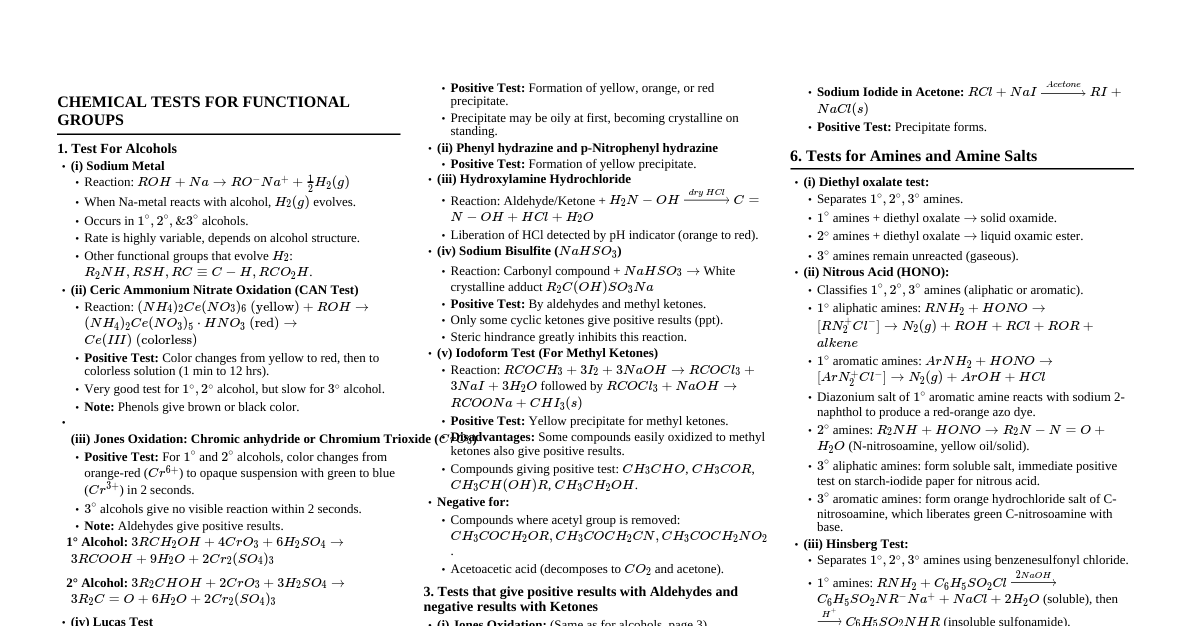
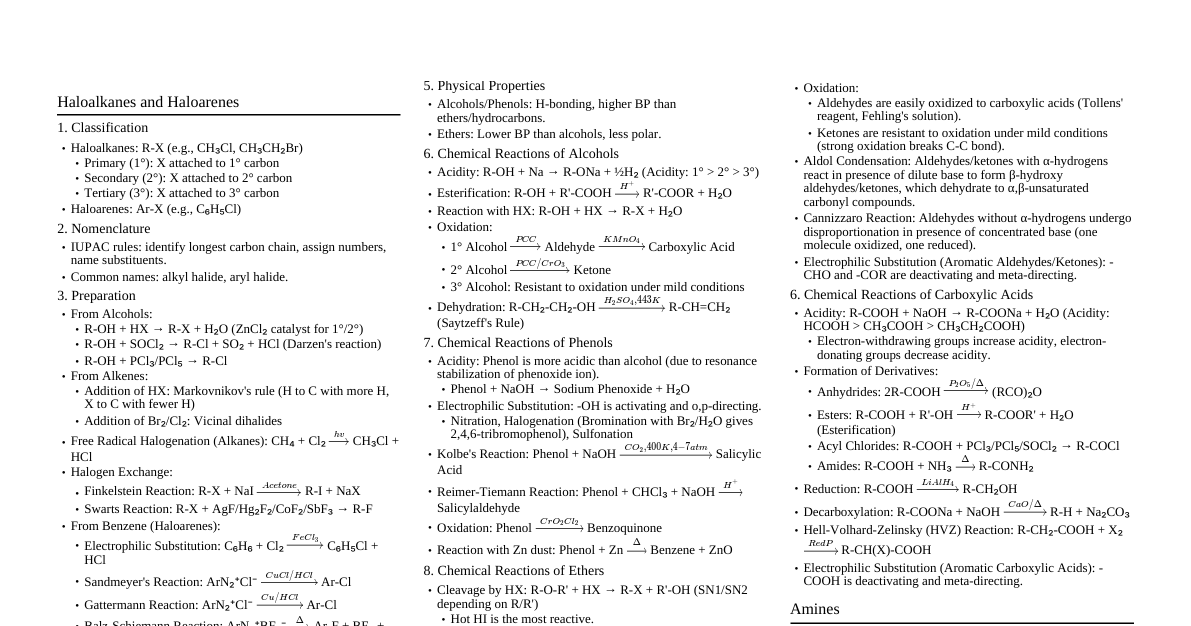
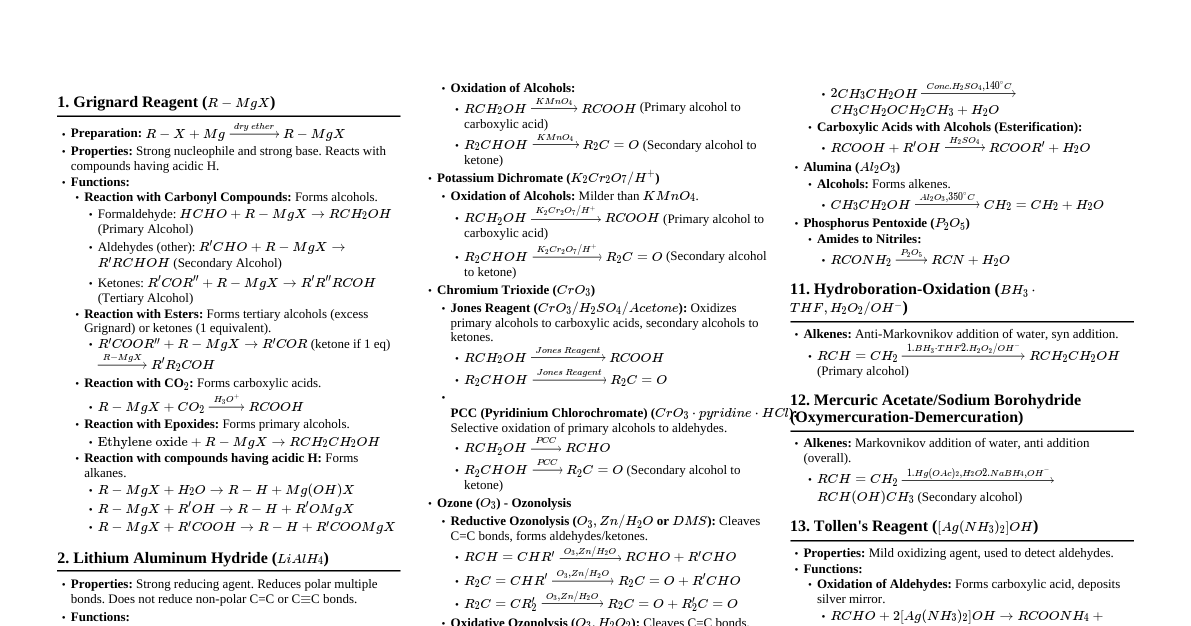
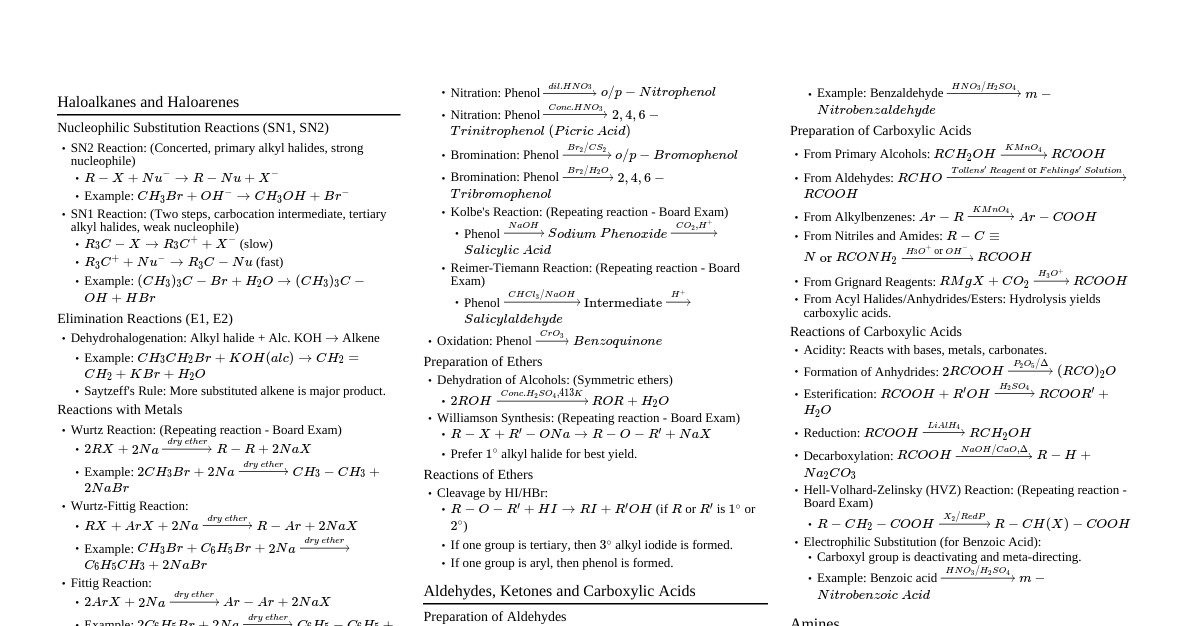
1. Important Organic Reagents & Their Uses 1.1 Oxidizing Agents PCC (Pyridinium Chlorochromate): Mild, selective oxidation. $1^\circ$ alcohol $\rightarrow$ aldehyde ($RCH_2OH \xrightarrow{PCC} RCHO$) $2^\circ$ alcohol $\rightarrow$ ketone ($R_2CHOH \xrightarrow{PCC} R_2C=O$) Use: Jab sirf aldehyde ya ketone banana ho, acid nahi. $\text{CrO}_3$/$\text{H}_2\text{SO}_4$ (Jones Reagent): Strong oxidation. $1^\circ$ alcohol $\rightarrow$ carboxylic acid. $2^\circ$ alcohol $\rightarrow$ ketone. Use: Alcohols ko carboxylic acid ya ketone mein convert karna. $\text{KMnO}_4$ (Potassium Permanganate) - Acidified/Alkaline: Strong, non-selective oxidation. $1^\circ$ alcohol $\rightarrow$ carboxylic acid. Alkyl benzene $\rightarrow$ benzoic acid (Side-chain oxidation, e.g., Toluene $\rightarrow$ Benzoic acid, provided benzylic H present). Alkene $\rightarrow$ diol (cold, dilute, alkaline $\text{KMnO}_4$, Baeyer's Reagent - test for unsaturation). Alkene $\rightarrow$ carboxylic acid/ketone (hot, concentrated $\text{KMnO}_4$). Use: Complete oxidation, test for unsaturation. $\text{K}_2\text{Cr}_2\text{O}_7$/$\text{H}^+$ (Potassium Dichromate): Strong oxidation. $1^\circ$ alcohol $\rightarrow$ carboxylic acid. $2^\circ$ alcohol $\rightarrow$ ketone. Use: $\text{KMnO}_4$ jaisa hi, but thoda less vigorous. Tollens' Reagent ($\text{Ag(NH}_3)_2^+ \text{OH}^-$): Mild oxidation, specific for aldehydes. Aldehyde $\rightarrow$ carboxylic acid salt + Silver mirror. ($RCHO \xrightarrow{\text{Tollens'}} RCOO^- + Ag(s)$) Use: Aldehydes (both aliphatic and aromatic) ko ketones se distinguish karna. Fehling's Solution (Cupric ions in alkaline medium): Mild oxidation, specific for aliphatic aldehydes. Aldehyde $\rightarrow$ carboxylic acid salt + Red ppt of $\text{Cu}_2\text{O}$. ($RCHO \xrightarrow{\text{Fehling's}} RCOO^- + \text{Cu}_2\text{O}(s)$) Use: Aliphatic aldehydes ko ketones aur aromatic aldehydes se distinguish karna. $\text{Br}_2$/$\text{H}_2\text{O}$ (Bromine water): Mild oxidation. Aldehyde $\rightarrow$ carboxylic acid. Use: Aldehydes ko detect karna (brown color to colorless). $\text{O}_3$/$\text{Zn/H}_2\text{O}$ or $\text{O}_3$/$\text{H}_2\text{O}_2$ (Ozonolysis): Alkene/Alkyne cleavage to form carbonyl compounds. Reductive workup ($\text{Zn/H}_2\text{O}$): Aldehydes/ketones. Oxidative workup ($\text{H}_2\text{O}_2$): Carboxylic acids. Use: Alkene/alkyne ki position pata karna, ya smaller carbonyl compounds banana. $\text{HIO}_4$ (Periodic Acid): Cleaves vicinal diols (1,2-diols) to give aldehydes/ketones. Use: 1,2-diols ka oxidative cleavage. 1.2 Reducing Agents $\text{LiAlH}_4$ (Lithium Aluminium Hydride): Strong, non-selective reduction. Aldehyde $\rightarrow$ $1^\circ$ alcohol. Ketone $\rightarrow$ $2^\circ$ alcohol. Carboxylic acid $\rightarrow$ $1^\circ$ alcohol. Esters $\rightarrow$ $1^\circ$ alcohol. Amides $\rightarrow$ amines. Nitriles $\rightarrow$ $1^\circ$ amines. Nitro compounds $\rightarrow$ amines. Use: Sabse strong reducing agent, almost saare carbonyl aur nitrile groups ko reduce karta hai. Water ke saath react karta hai. $\text{NaBH}_4$ (Sodium Borohydride): Mild, selective reduction. Aldehyde $\rightarrow$ $1^\circ$ alcohol. Ketone $\rightarrow$ $2^\circ$ alcohol. Use: Sirf aldehydes aur ketones ko reduce karta hai, carboxylic acid, ester, nitrile ko chhod deta hai. Water ke saath safe hai. $\text{H}_2$/Pd, Pt, or Ni (Catalytic Hydrogenation): Alkene $\rightarrow$ alkane. Alkyne $\rightarrow$ alkene/alkane. Aldehyde $\rightarrow$ $1^\circ$ alcohol. Ketone $\rightarrow$ $2^\circ$ alcohol. Nitrile $\rightarrow$ amine. Nitro compounds $\rightarrow$ amine. Use: Double/triple bonds aur carbonyl groups ko reduce karna. Wolf-Kishner Reduction ($\text{NH}_2\text{NH}_2$/KOH/ethylene glycol, heat): Carbonyl ($\text{C=O}$) $\rightarrow$ methylene ($\text{CH}_2$). (Aldehyde/Ketone to Alkane) Use: Carbonyl group ko methylene mein convert karna under strong basic conditions (acid-sensitive compounds ke liye). Clemmensen Reduction ($\text{Zn-Hg}$/Conc. HCl): Carbonyl ($\text{C=O}$) $\rightarrow$ methylene ($\text{CH}_2$). (Aldehyde/Ketone to Alkane) Use: Carbonyl group ko methylene mein convert karna under strong acidic conditions (base-sensitive compounds ke liye). DIBAL-H (Diisobutylaluminium Hydride): Esters $\rightarrow$ aldehydes (at low temp, $-78^\circ C$). Nitriles $\rightarrow$ aldehydes (at low temp, $-78^\circ C$). Use: Esters ya nitriles ka partial reduction aldehydes tak. $\text{Sn/HCl}$ or $\text{Fe/HCl}$: Nitro compounds $\rightarrow$ amines. ($RNO_2 \rightarrow RNH_2$) Use: Nitro group ko amino group mein convert karna, especially aromatic compounds mein. Red P/HI: Strongest reducing agent. Alcohols, aldehydes, ketones, carboxylic acids $\rightarrow$ alkanes. Use: Almost sab kuch ko alkane mein reduce karta hai. 1.3 Halogenating Agents $\text{SOCl}_2$ (Thionyl Chloride): Alcohol $\rightarrow$ alkyl chloride. ($ROH \rightarrow RCl + SO_2 \uparrow + HCl \uparrow$) Use: Alkyl chlorides banane ka best method, by-products gases hote hain. $\text{PCl}_5$ (Phosphorus Pentachloride): Alcohol $\rightarrow$ alkyl chloride. ($ROH \rightarrow RCl + POCl_3 + HCl$) Carboxylic acid $\rightarrow$ acyl chloride. ($RCOOH \rightarrow RCOCl + POCl_3 + HCl$) $\text{PBr}_3$ (Phosphorus Tribromide): Alcohol $\rightarrow$ alkyl bromide. ($3ROH + PBr_3 \rightarrow 3RBr + H_3PO_3$) $\text{X}_2$/Fe or $\text{X}_2$/$\text{AlCl}_3$ (X = Cl, Br): Aromatic ring halogenation (Electrophilic substitution). Use: Benzene ring par halogen lagana. $\text{Br}_2$/$\text{CCl}_4$: Alkene/Alkyne $\rightarrow$ vicinal dihalide/tetrahalide (addition reaction). Use: Unsaturation test (brown color disappears). NBS (N-Bromosuccinimide): Allylic/Benzylic bromination. Use: Allylic ya benzylic position par Br lagana, double bond intact rehta hai. $\text{HX}$ (Hydrogen Halides): Alcohol $\rightarrow$ Alkyl Halide ($ROH \xrightarrow{HX} RX + H_2O$). Reactivity: HI > HBr > HCl. For alcohols: $3^\circ > 2^\circ > 1^\circ$. Alkene $\rightarrow$ Alkyl Halide (Markovnikov's rule). Alkene $\rightarrow$ Alkyl Halide (Anti-Markovnikov with peroxides for HBr only). Use: Alcohols ya alkenes se alkyl halides banana. 1.4 Dehydrating Agents & Elimination Reactions Conc. $\text{H}_2\text{SO}_4$/Heat: Alcohol $\rightarrow$ alkene (E1/E2 elimination, Saytzeff's rule). Alcohol $\rightarrow$ ether (at $140^\circ C$, intermolecular dehydration). Carboxylic acid + Alcohol $\rightarrow$ Ester (Esterification). Use: Water nikal kar C=C bonds, ethers, ya esters banana. $\text{Al}_2\text{O}_3$/Heat: Alcohol $\rightarrow$ alkene. $\text{P}_2\text{O}_5$: Amides $\rightarrow$ nitriles. ($RCONH_2 \xrightarrow{\text{P}_2\text{O}_5} RCN$) Alc. KOH: Alkyl halide $\rightarrow$ alkene (Dehydrohalogenation, Saytzeff's rule). Use: Alkyl halides se alkene banana. 1.5 Grignard Reagents ($\text{RMgX}$) Formation: Alkyl/Aryl halide + Mg in dry ether. ($RX + Mg \xrightarrow{dry \ ether} RMgX$) Reactions: Adds R group to carbonyl carbon, followed by hydrolysis. Formaldehyde $\rightarrow$ $1^\circ$ alcohol. Aldehydes (other than formaldehyde) $\rightarrow$ $2^\circ$ alcohol. Ketones $\rightarrow$ $3^\circ$ alcohol. $\text{CO}_2 \rightarrow$ carboxylic acid (after hydrolysis). Epoxides $\rightarrow$ alcohol. Use: Carbon chain extend karna, alcohols banana. Highly reactive, reacts with any acidic H (e.g., from water, alcohol, amine). 1.6 Electrophilic Aromatic Substitution (EAS) Halogenation: $\text{X}_2$/Fe or $\text{AlX}_3$. ($Ar-H \rightarrow Ar-X$) Nitration: Conc. $\text{HNO}_3$ + Conc. $\text{H}_2\text{SO}_4$. ($Ar-H \rightarrow Ar-NO_2$) Sulfonation: Conc. $\text{H}_2\text{SO}_4$ or Fuming $\text{H}_2\text{SO}_4$. ($Ar-H \rightarrow Ar-SO_3H$) Friedel-Crafts Alkylation: Alkyl halide + $\text{AlCl}_3$. ($Ar-H \rightarrow Ar-R$) - Rearrangement possible, polyalkylation. Friedel-Crafts Acylation: Acyl halide/Anhydride + $\text{AlCl}_3$. ($Ar-H \rightarrow Ar-COR$) - No rearrangement, prevents polyacylation. Use: Benzene ring par naye groups lagana. 1.7 Nucleophilic Substitution (SN1/SN2) & Elimination (E1/E2) SN2: $1^\circ$ Alkyl Halide + Strong Nucleophile (e.g., NaCN, KCN, KOH (aq), NaOR). ($RX + Nu^- \rightarrow R-Nu + X^-$) - Inversion of configuration. SN1: $3^\circ$ Alkyl Halide + Weak Nucleophile (e.g., $\text{H}_2\text{O}$, ROH). ($RX \rightarrow R^+ \rightarrow R-Nu$) - Racemization. E2: Alkyl Halide + Strong Base (e.g., Alc. KOH, NaOR). ($R-CH_2-CH_2-X \rightarrow R-CH=CH_2$) - Anti-elimination. E1: $3^\circ$ Alkyl Halide + Weak Base (e.g., $\text{H}_2\text{O}$, ROH, heat). ($R-CH_2-CH_2-X \rightarrow R-CH=CH_2$) - Carbocation intermediate. Use: Alkyl halides se naye functional groups banana ya alkenes banana. 1.8 Important Carbonyl Reactions (JEE Special) Nucleophilic Addition: Aldehydes/Ketones + HCN, NaHSO$_3$, Grignard, Alcohols. Addition-Elimination: Aldehydes/Ketones + $\text{NH}_2-Z$ reagents (e.g., Hydroxylamine, Hydrazine, Phenylhydrazine) $\rightarrow$ Oximes, Hydrazones, etc. Haloform Reaction: Compounds with $\text{CH}_3CO-$ or $\text{CH}_3CH(OH)-$ group + $\text{X}_2$/NaOH $\rightarrow$ Haloform ($\text{CHX}_3$). Aldol Condensation: $\alpha$-H containing carbonyls + dil. base. Cannizzaro Reaction: No $\alpha$-H carbonyls + conc. base. 2. Named Reactions: Mnemonic Hinglish Style 2.1 Haloalkanes & Haloarenes Finkelstein Reaction: "Fink-i-n (in) NaI (Na-Iodine) daal, Cl/Br ko hata." $R-Cl/Br + NaI \xrightarrow{Acetone} R-I + NaCl/NaBr$ Product: Alkyl Iodide. (Cl/Br ko I se replace karna) Swarts Reaction: "Swart-i-n AgF (Silver Fluoride) daal, halogen ko hata." $R-Cl/Br + AgF/Hg_2F_2/CoF_2/SbF_3 \rightarrow R-F + AgCl/Br$ Product: Alkyl Fluoride. (Cl/Br ko F se replace karna) Wurtz Reaction: "Wurtz bhai, 2 alkyl halide (RX) aur Na (Sodium) pakad, alkane banade." $2RX + 2Na \xrightarrow{Dry \ Ether} R-R + 2NaX$ Product: Symmetrical Alkane (even number of carbons). Wurtz-Fittig Reaction: "Wurtz-Fittig ne ek aryl (ArX) aur ek alkyl (RX) halide liya, Na (Sodium) daala, aur alkylbenzene banaya." $ArX + RX + 2Na \xrightarrow{Dry \ Ether} Ar-R + 2NaX$ Product: Alkylbenzene. Fittig Reaction: "Fittig ne 2 aryl halide (ArX) liye, Na (Sodium) daala, aur bi-aryl banaya." $2ArX + 2Na \xrightarrow{Dry \ Ether} Ar-Ar + 2NaX$ Product: Bi-aryl (e.g., Biphenyl). Sandmeyer Reaction: "Sand-bhaiya ne diazonium salt (ArN$_2^+$Cl$^-$) ko Cu$_2$X$_2$/HX (Copper halide/acid) diya, $N_2$ nikal gaya, Aryl halide ban gaya." $ArN_2^+Cl^- \xrightarrow{Cu_2Cl_2/HCl \ or \ Cu_2Br_2/HBr} ArCl \ or \ ArBr + N_2$ Product: Aryl Chloride/Bromide. Gattermann Reaction: "Gattermann, Sandmeyer ka chhota bhai, Cu powder/HX (Copper powder/acid) se bhi $N_2$ nikal ke Aryl halide banata hai." $ArN_2^+Cl^- \xrightarrow{Cu/HCl \ or \ Cu/HBr} ArCl \ or \ ArBr + N_2$ Product: Aryl Chloride/Bromide. (Lower yield than Sandmeyer). Balz-Schiemann Reaction: "Balz-Schiemann ne diazonium salt (ArN$_2^+$Cl$^-$) ko $\text{HBF}_4$ (Fluoroboric acid) diya, $N_2$ nikal gaya, Aryl fluoride ban gaya." $ArN_2^+Cl^- \xrightarrow{HBF_4, \Delta} ArF + N_2 + BF_3$ Product: Aryl Fluoride. 2.2 Alcohols, Phenols & Ethers Reimer-Tiemann Reaction: "Reimer-Tiemann ne Phenol ko $\text{CHCl}_3$/NaOH (Chloroform/base) diya, aur ortho-hydroxy benzaldehyde (Salicylaldehyde) banaya." Phenol $\xrightarrow{1. \ CHCl_3/NaOH \ 2. \ H^+} $ Salicylaldehyde (o-hydroxybenzaldehyde) Product: Salicylaldehyde. Kolbe's Reaction (Kolbe-Schmidt): "Kolbe ne Phenol ko $\text{CO}_2$/NaOH (Carbon dioxide/base) diya, Salicylic acid banaya." Phenol $\xrightarrow{1. \ CO_2, \ NaOH, \ 400K, \ 4-7 \ atm \ 2. \ H^+} $ Salicylic acid (o-hydroxybenzoic acid) Product: Salicylic acid. Williamson Ether Synthesis: "Williamson ne alkyl halide (RX) aur sodium alkoxide ($R'ONa$) ko milaya, ether ($R-O-R'$) banaya." $R-X + R'-ONa \rightarrow R-O-R' + NaX$ Product: Ether. (Best for $1^\circ$ alkyl halides to avoid elimination). Hydroboration-Oxidation Reaction: "Boron (BH$_3$) ko alkene par lagao anti-Markovnikov style, phir $\text{H}_2\text{O}_2$/NaOH se oxidize karo, alcohol paao." $RCH=CH_2 \xrightarrow{1. \ BH_3/THF \ 2. \ H_2O_2/NaOH} RCH_2CH_2OH$ Product: Anti-Markovnikov primary alcohol. 2.3 Aldehydes, Ketones & Carboxylic Acids Rosenmund Reduction: "Rosenmund ne Acyl chloride (RCOCl) ko $\text{H}_2$/Pd-BaSO$_4$ (Hydrogen/poisoned Palladium) diya, aldehyde (RCHO) banaya, acid nahi." $RCOCl + H_2 \xrightarrow{Pd-BaSO_4} RCHO + HCl$ Product: Aldehyde. Stephen Reaction: "Stephen ne Nitrile (RCN) ko $\text{SnCl}_2$/HCl (Stannous chloride/acid) diya, usko imine mein badla, phir hydrolysis karke aldehyde (RCHO) banaya." $R-CN + SnCl_2/HCl \rightarrow R-CH=NH \xrightarrow{H_3O^+} RCHO$ Product: Aldehyde. Etard Reaction: "Etard ne Toluene (methylbenzene) ko $\text{CrO}_2\text{Cl}_2$ (Chromyl chloride) diya, brown complex banaya, hydrolysis karke benzaldehyde (aromatic aldehyde) banaya." Toluene $\xrightarrow{CrO_2Cl_2 \ (CS_2) \ then \ H_3O^+} $ Benzaldehyde Product: Benzaldehyde. Gattermann-Koch Reaction: "Gattermann-Koch ne Benzene ko CO/HCl/$\text{AlCl}_3$ (Carbon monoxide/acid/Lewis acid) diya, benzaldehyde banaya." Benzene $\xrightarrow{CO/HCl/AlCl_3/CuCl} $ Benzaldehyde Product: Benzaldehyde. Clemmensen Reduction: "Clemmensen ne Carbonyl (ketone/aldehyde) ko $\text{Zn-Hg}$/Conc. HCl (Zinc Amalgam/acid) diya, usko alkane ($\text{CH}_2$) mein badal diya, 'C=O' gaayab." $R_2C=O \xrightarrow{Zn-Hg/Conc. HCl} R_2CH_2$ Product: Alkane. Wolf-Kishner Reduction: "Wolf-Kishner ne Carbonyl (ketone/aldehyde) ko $\text{NH}_2\text{NH}_2$/KOH (Hydrazine/strong base) diya, usko alkane ($\text{CH}_2$) mein badal diya, 'C=O' gaayab." $R_2C=O \xrightarrow{NH_2NH_2, \ KOH/Ethylene \ Glycol, \ heat} R_2CH_2$ Product: Alkane. Aldol Condensation: "Aldol, $\alpha$-H wale aldehyde/ketone ka dost. Dilute base (NaOH) ki presence mein do same/different molecule judkar $\beta$-hydroxy carbonyl banate hain, phir heat karo toh $\alpha,\beta$-unsaturated carbonyl." $2RCH_2CHO \xrightarrow{dil. \ NaOH} RCH_2CH(OH)CH(R)CHO \xrightarrow{heat} RCH_2CH=C(R)CHO$ Product: $\beta$-hydroxy aldehyde/ketone or $\alpha,\beta$-unsaturated aldehyde/ketone. Cross Aldol Condensation: "Jab do alag alag $\alpha$-H wale aldehyde/ketone react karte hain, toh 4 products ban sakte hain." Use: More complex Aldol products. Cannizzaro Reaction: "Cannizzaro, jiske paas $\alpha$-H nahi, uske liye. Concentrated base (NaOH) ki presence mein disproportionation karke ek ko alcohol, doosre ko carboxylic acid salt banata hai." $2HCHO \xrightarrow{conc. \ NaOH} CH_3OH + HCOONa$ Product: Alcohol and Carboxylic acid salt. Hell-Volhard-Zelinsky (HVZ) Reaction: "HVZ, carboxylic acid ke $\alpha$-carbon par halogen lagata hai. $\text{Cl}_2/\text{P}$ ya $\text{Br}_2/\text{P}$ daalo, $\alpha$-halo carboxylic acid paao." $RCH_2COOH \xrightarrow{X_2/Red \ P \ then \ H_2O} RCH(X)COOH$ Product: $\alpha$-halo carboxylic acid. Perkin Reaction: "Perkin ne aromatic aldehyde, acetic anhydride aur sodium acetate ko milaya, unsaturated aromatic acid banaya." $ArCHO + (CH_3CO)_2O \xrightarrow{CH_3COONa, \Delta} ArCH=CHCOOH$ Product: $\alpha,\beta$-unsaturated aromatic acid. 2.4 Amines Hofmann Bromamide Degradation: "Hofmann ne Amide (RCONH$_2$) ko $\text{Br}_2$/KOH (Bromine/base) diya, 'CO' group ko 'gayab' kar diya, ek carbon kam wala Amine ($RNH_2$) banaya." $RCONH_2 + Br_2 + 4KOH \rightarrow RNH_2 + K_2CO_3 + 2KBr + 2H_2O$ Product: $1^\circ$ Amine with one less carbon atom. Carbylamine Reaction (Isocyanide Test): "Carbylamine, $1^\circ$ amine ki pehchan. $\text{CHCl}_3$/KOH (Chloroform/base) daalo, badboo wala isocyanide (foul smelling) banega." $RNH_2 + CHCl_3 + 3KOH \xrightarrow{heat} RNC + 3KCl + 3H_2O$ Product: Isocyanide (Foul smelling). (Only $1^\circ$ amines show this test, $2^\circ$ and $3^\circ$ don't). Gabriel Phthalimide Synthesis: "Gabriel ne $1^\circ$ amine banane ka shortcut diya. Phthalimide ko KOH se treat karo, phir alkyl halide (RX) se, finally hydrolysis ya hydrazinolysis (NH$_2$NH$_2$) se $1^\circ$ amine ($RNH_2$) milega." Phthalimide $\xrightarrow{1. \ KOH \ 2. \ RX \ 3. \ NaOH/H_2O \ or \ NH_2NH_2} RNH_2$ Product: $1^\circ$ Alkyl Amine. (Aromatic amines cannot be prepared). Coupling Reaction: "Coupling, diazonium salt (ArN$_2^+$Cl$^-$) aur phenol/aniline ko milata hai. Orange/yellow dye banti hai." $ArN_2^+Cl^- + Phenol/Aniline \rightarrow Azo \ Dye$ Product: Azo Dye (colored compound). Hinsberg's Test: "Hinsberg, amines ko differentiate karta hai. Benzene sulfonyl chloride ($C_6H_5SO_2Cl$) se react karao." $1^\circ$ amine: Gives sulfonamide, soluble in KOH. $2^\circ$ amine: Gives sulfonamide, insoluble in KOH. $3^\circ$ amine: No reaction with Hinsberg's reagent. 3. Important General Reactions & Conversions 3.1 Preparation of Alkyl Halides From Alcohols: $ROH + HX \rightarrow RX + H_2O$ (Lucas reagent for $3^\circ, 2^\circ$) $ROH + SOCl_2 \rightarrow RCl + SO_2 + HCl$ $ROH + PCl_5 \rightarrow RCl + POCl_3 + HCl$ $3ROH + PBr_3 \rightarrow 3RBr + H_3PO_3$ From Alkenes: $RCH=CH_2 + HX \rightarrow RCHXCH_3$ (Markovnikov) $RCH=CH_2 + HBr \xrightarrow{Peroxide} RCH_2CH_2Br$ (Anti-Markovnikov) $RCH=CH_2 + X_2 \rightarrow RCHXCH_2X$ (Vicinal dihalide) From Alkanes: Free radical halogenation ($CH_4 + Cl_2 \xrightarrow{hv} CH_3Cl + HCl$). 3.2 Preparation of Alcohols From Alkyl Halides: $RX + KOH(aq) \rightarrow ROH + KX$ (SN reaction). From Alkenes: $RCH=CH_2 \xrightarrow{H_2SO_4/H_2O} RCH(OH)CH_3$ (Markovnikov) $RCH=CH_2 \xrightarrow{1. \ BH_3/THF \ 2. \ H_2O_2/NaOH} RCH_2CH_2OH$ (Anti-Markovnikov) From Carbonyl Compounds (Reduction): Aldehyde $\xrightarrow{LiAlH_4 \ or \ NaBH_4 \ or \ H_2/Ni} 1^\circ$ Alcohol. Ketone $\xrightarrow{LiAlH_4 \ or \ NaBH_4 \ or \ H_2/Ni} 2^\circ$ Alcohol. From Grignard Reagents: Formaldehyde $\xrightarrow{1. \ RMgX \ 2. \ H_3O^+} 1^\circ$ Alcohol. Aldehyde $\xrightarrow{1. \ RMgX \ 2. \ H_3O^+} 2^\circ$ Alcohol. Ketone $\xrightarrow{1. \ RMgX \ 2. \ H_3O^+} 3^\circ$ Alcohol. 3.3 Preparation of Aldehydes & Ketones From Alcohols (Oxidation): $1^\circ$ Alcohol $\xrightarrow{PCC} $ Aldehyde. $2^\circ$ Alcohol $\xrightarrow{PCC \ or \ CrO_3} $ Ketone. From Nitriles: $RCN \xrightarrow{1. \ DIBAL-H \ 2. \ H_2O} RCHO$ (aldehyde). $RCN \xrightarrow{1. \ RMgX \ 2. \ H_3O^+} R_2C=O$ (ketone) From Acyl Chlorides: $RCOCl \xrightarrow{H_2/Pd-BaSO_4} RCHO$ (Rosenmund). From Esters: $RCOOR' \xrightarrow{1. \ DIBAL-H \ 2. \ H_2O} RCHO$ (aldehyde). From Benzene/Substituted Benzene: Benzene $\xrightarrow{CO/HCl/AlCl_3/CuCl} $ Benzaldehyde (Gattermann-Koch). Toluene $\xrightarrow{CrO_2Cl_2 \ then \ H_3O^+} $ Benzaldehyde (Etard). From Alkenes (Ozonolysis): Alkene $\xrightarrow{O_3/Zn, H_2O} $ Aldehyde/Ketone. 3.4 Preparation of Carboxylic Acids From $1^\circ$ Alcohols/Aldehydes (Oxidation): $RCH_2OH \xrightarrow{KMnO_4 \ or \ K_2Cr_2O_7} RCOOH$. $RCHO \xrightarrow{KMnO_4 \ or \ K_2Cr_2O_7 \ or \ Tollens'} RCOOH$. From Alkylbenzenes (Oxidation): Alkyl benzene $\xrightarrow{KMnO_4/KOH \ then \ H^+} $ Benzoic acid. From Nitriles/Amides (Hydrolysis): $RCN \xrightarrow{H_3O^+ \ or \ OH^-, \ heat} RCOOH$. $RCONH_2 \xrightarrow{H_3O^+ \ or \ OH^-, \ heat} RCOOH$. From Grignard Reagents: $RMgX \xrightarrow{1. \ CO_2 \ 2. \ H_3O^+} RCOOH$. 3.5 Preparation of Amines From Nitro Compounds (Reduction): $RNO_2 \xrightarrow{Sn/HCl \ or \ Fe/HCl \ or \ H_2/Pd} RNH_2$. From Alkyl Halides: $RX \xrightarrow{NH_3 \ (excess)} RNH_2$ (Ammonolysis, mixture of amines possible). From Nitriles (Reduction): $RCN \xrightarrow{LiAlH_4 \ or \ H_2/Ni} RCH_2NH_2$. From Amides: $RCONH_2 \xrightarrow{Br_2/KOH} RNH_2$ (Hofmann Bromamide Degradation). Gabriel Phthalimide Synthesis: (For $1^\circ$ alkyl amines). 4. Distinguishing Tests for Organic Compounds (JEE Special) 4.1 Aldehydes & Ketones Tollens' Test: Aldehydes (+ve, silver mirror), Ketones (-ve). Fehling's Test: Aliphatic Aldehydes (+ve, red ppt), Ketones/Aromatic Aldehydes (-ve). Schiff's Test: Aldehydes (+ve, pink/magenta color), Ketones (-ve). Iodoform Test ($\text{I}_2$/NaOH): Compounds with $\text{CH}_3CO-$ group (methyl ketones, acetaldehyde) or $\text{CH}_3CH(OH)-$ group (+ve, yellow ppt of iodoform $\text{CHI}_3$). 4.2 Alcohols & Phenols Lucas Test ($\text{ZnCl}_2$/Conc. HCl): $3^\circ$ Alcohol: Immediate turbidity. $2^\circ$ Alcohol: Turbidity in 5-10 minutes. $1^\circ$ Alcohol: No turbidity at room temp. $\text{FeCl}_3$ Test: Phenols (+ve, violet/blue/green coloration), Alcohols (-ve). Bromine Water Test: Phenols (+ve, white ppt of 2,4,6-tribromophenol, decolorizes $\text{Br}_2$ water), Alcohols (-ve). Iodoform Test ($\text{I}_2$/NaOH): Alcohols with $\text{CH}_3CH(OH)-$ group (e.g., Ethanol, $2^\circ$ alcohols with methyl at alpha position) (+ve, yellow ppt of iodoform $\text{CHI}_3$). 4.3 Carboxylic Acids & Phenols $\text{NaHCO}_3$ Test: Carboxylic acids (+ve, brisk effervescence due to $\text{CO}_2$ evolution), Phenols (-ve) (except picric acid). 4.4 Amines ($1^\circ, 2^\circ, 3^\circ$) Hinsberg's Test: (Benzene sulfonyl chloride, $C_6H_5SO_2Cl$) $1^\circ$ amine: Gives sulfonamide, soluble in KOH. $2^\circ$ amine: Gives sulfonamide, insoluble in KOH. $3^\circ$ amine: No reaction with Hinsberg's reagent. Carbylamine Test: (Chloroform + KOH, heat) $1^\circ$ amines (aliphatic & aromatic): (+ve, foul-smelling isocyanide). $2^\circ, 3^\circ$ amines: (-ve). Nitrous Acid Test ($\text{NaNO}_2$/HCl): Distinguishes $1^\circ, 2^\circ, 3^\circ$ aliphatic/aromatic amines based on $N_2$ gas evolution, nitrosoamine formation, or salt formation. 4.5 Alkenes & Alkynes Bromine Water Test: Alkenes & Alkynes (+ve, decolorizes brown $\text{Br}_2$ water). Alkanes (-ve). Baeyer's Test (Cold, Dilute, Alkaline $\text{KMnO}_4$): Alkenes & Alkynes (+ve, decolorizes purple $\text{KMnO}_4$). Alkanes (-ve). Ammoniacal Silver Nitrate (Tollens' Reagent for Alkynes): Terminal Alkynes (+ve, white ppt of silver acetylide). Alkenes, Internal Alkynes (-ve). Ammoniacal Cuprous Chloride: Terminal Alkynes (+ve, red ppt of copper acetylide). Alkenes, Internal Alkynes (-ve).