Integration Class 12
Cheatsheet Content
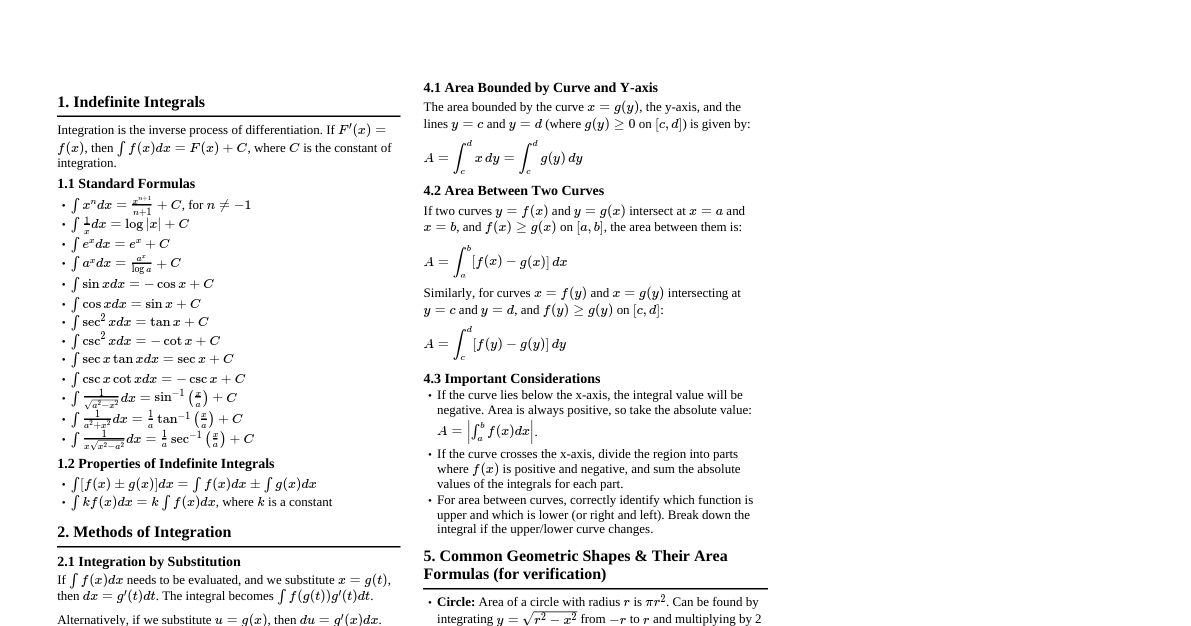
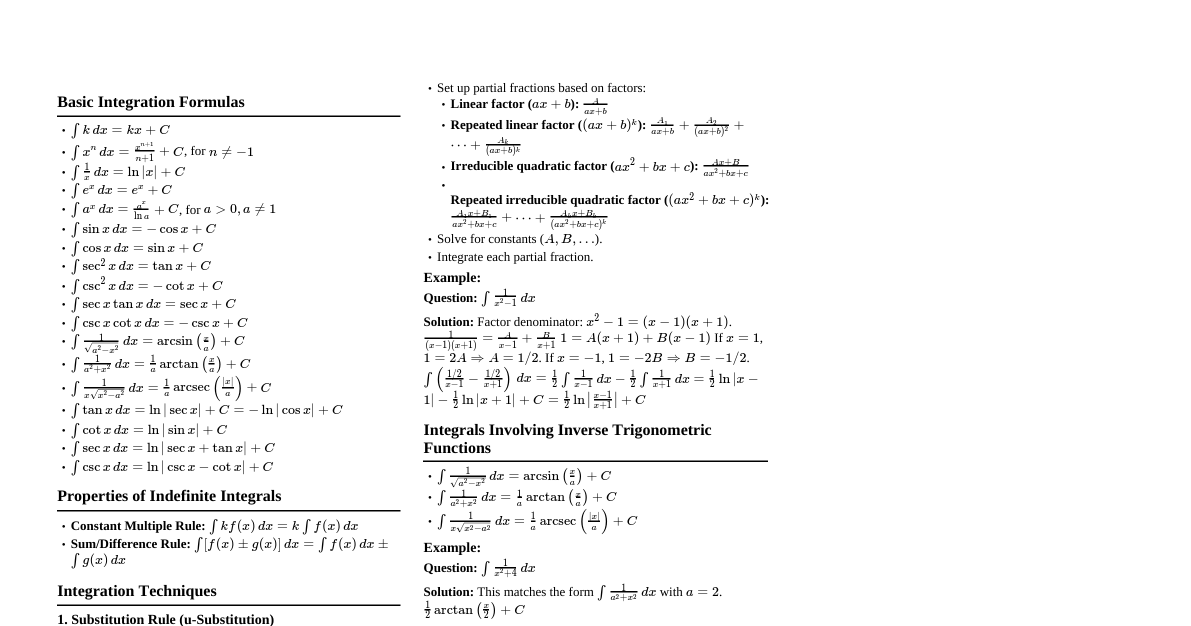
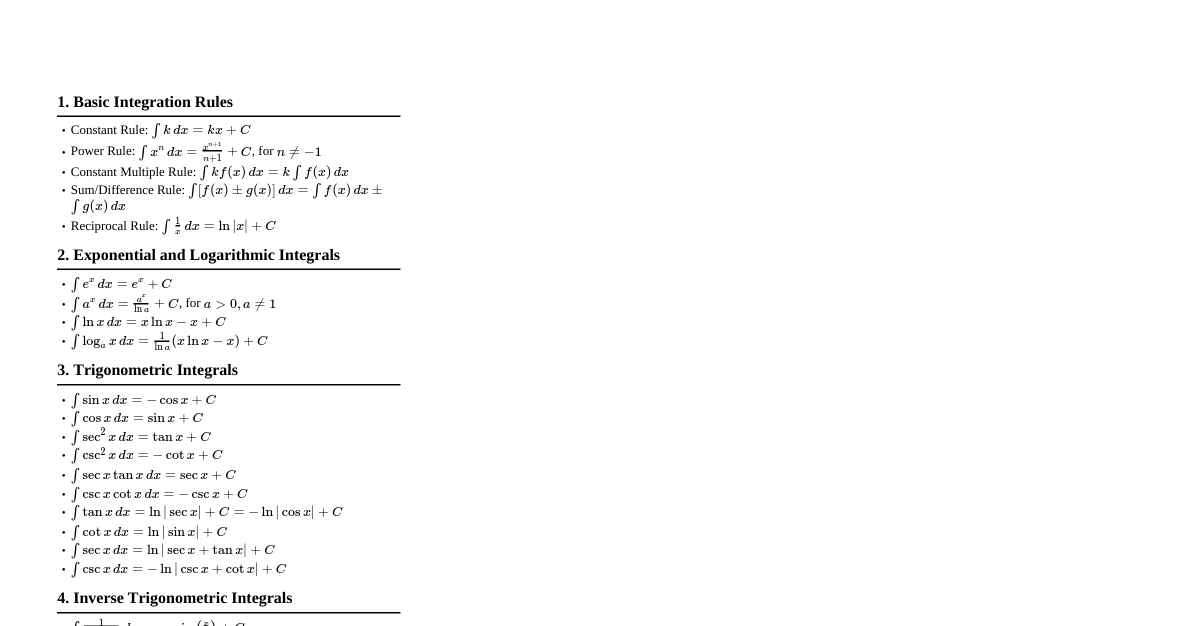
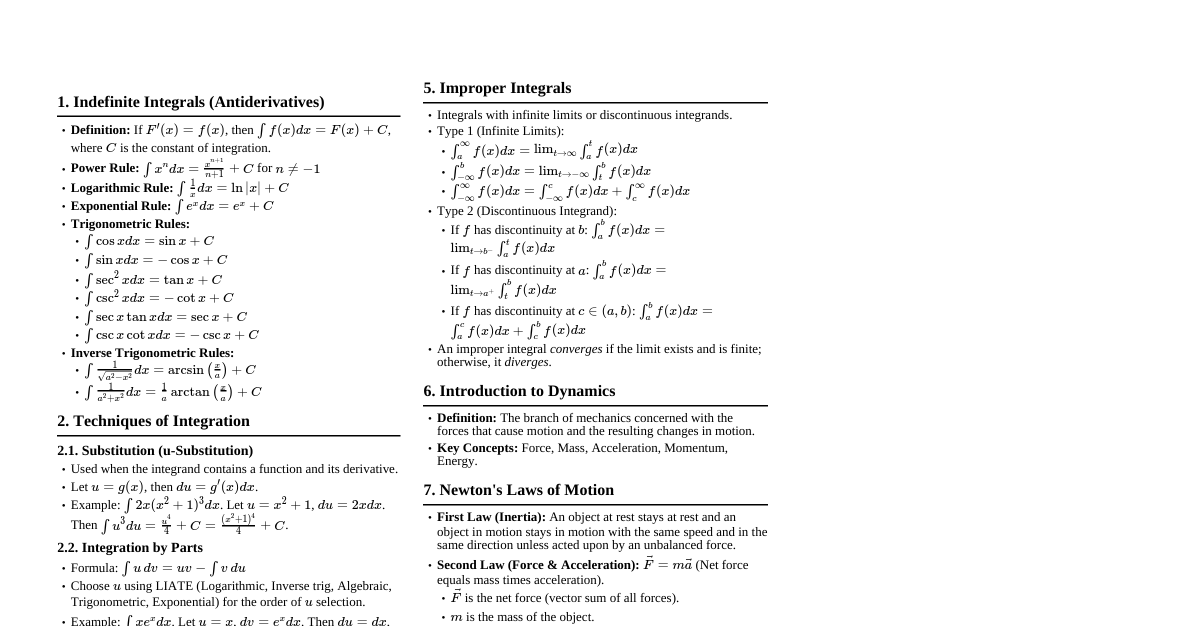
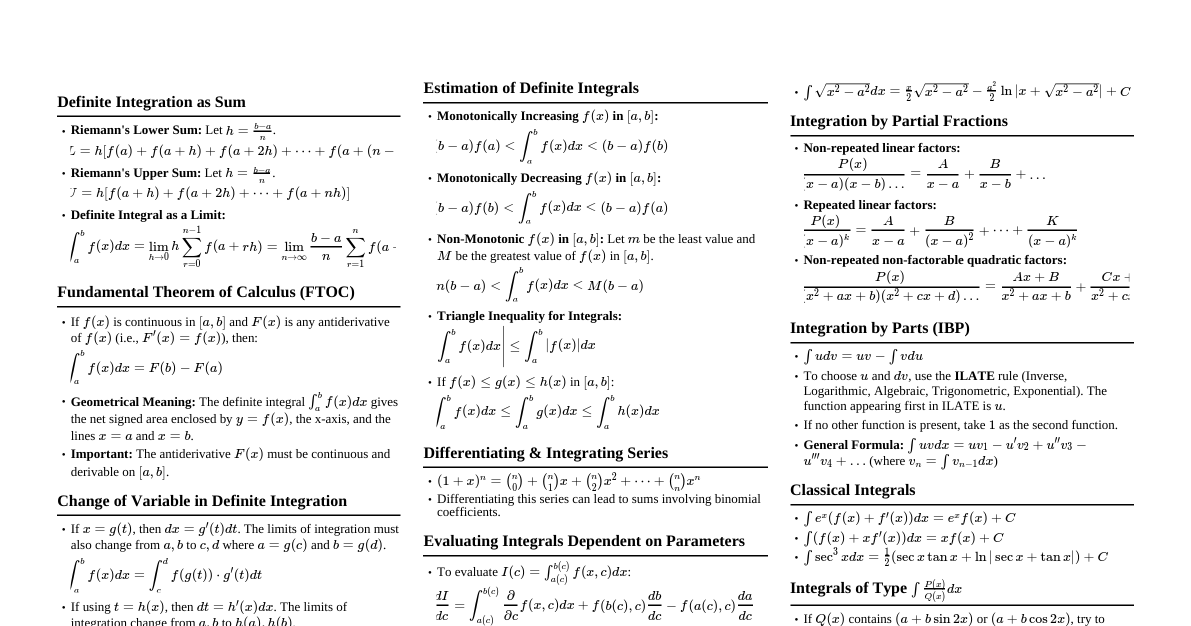
1. Introduction to Integration Definition: Integration is the reverse process of differentiation. It is used to find the area under a curve, volume, etc. Indefinite Integral: $\int f(x) dx = F(x) + C$, where $F'(x) = f(x)$ and $C$ is the constant of integration. Definite Integral: $\int_a^b f(x) dx = F(b) - F(a)$, where $a$ is the lower limit and $b$ is the upper limit. 2. Basic Integration Formulas $\int x^n dx = \frac{x^{n+1}}{n+1} + C$, for $n \neq -1$ $\int \frac{1}{x} dx = \ln|x| + C$ $\int e^x dx = e^x + C$ $\int a^x dx = \frac{a^x}{\ln a} + C$ $\int \sin x dx = -\cos x + C$ $\int \cos x dx = \sin x + C$ $\int \sec^2 x dx = \tan x + C$ $\int \csc^2 x dx = -\cot x + C$ $\int \sec x \tan x dx = \sec x + C$ $\int \csc x \cot x dx = -\csc x + C$ $\int \frac{1}{\sqrt{1-x^2}} dx = \sin^{-1} x + C$ $\int \frac{-1}{\sqrt{1-x^2}} dx = \cos^{-1} x + C$ $\int \frac{1}{1+x^2} dx = \tan^{-1} x + C$ $\int \frac{-1}{1+x^2} dx = \cot^{-1} x + C$ $\int \frac{1}{x\sqrt{x^2-1}} dx = \sec^{-1} x + C$ $\int \frac{-1}{x\sqrt{x^2-1}} dx = \csc^{-1} x + C$ 3. Properties of Indefinite Integral $\int [f(x) \pm g(x)] dx = \int f(x) dx \pm \int g(x) dx$ $\int k f(x) dx = k \int f(x) dx$, where $k$ is a constant. 4. Methods of Integration 4.1. Integration by Substitution If $\int f(g(x)) g'(x) dx$, let $u = g(x)$, then $du = g'(x) dx$. The integral becomes $\int f(u) du$. Example: $\int \sin(2x) dx$. Let $u=2x$, $du=2dx \implies dx = \frac{1}{2}du$. $\int \sin(u) \frac{1}{2} du = -\frac{1}{2}\cos(u) + C = -\frac{1}{2}\cos(2x) + C$. 4.2. Integration by Parts Formula: $\int u dv = uv - \int v du$ Often remembered using the "ILATE" rule for choosing $u$: I nverse trigonometric functions L ogarithmic functions A lgebraic functions T rigonometric functions E xponential functions Example: $\int x \sin x dx$. Let $u=x$, $dv=\sin x dx$. Then $du=dx$, $v=-\cos x$. $\int x \sin x dx = x(-\cos x) - \int (-\cos x) dx = -x \cos x + \sin x + C$. 4.3. Integration by Partial Fractions Used for integrating rational functions $\frac{P(x)}{Q(x)}$, where $P(x)$ and $Q(x)$ are polynomials and the degree of $P(x)$ is less than the degree of $Q(x)$. Decompose $\frac{P(x)}{Q(x)}$ into simpler fractions based on the factors of $Q(x)$. Linear factors: $\frac{px+q}{(x-a)(x-b)} = \frac{A}{x-a} + \frac{B}{x-b}$ Repeated linear factors: $\frac{px+q}{(x-a)^2} = \frac{A}{x-a} + \frac{B}{(x-a)^2}$ Irreducible quadratic factors: $\frac{px^2+qx+r}{(x-a)(x^2+bx+c)} = \frac{A}{x-a} + \frac{Bx+C}{x^2+bx+c}$ 5. Special Integrals $\int \frac{1}{x^2+a^2} dx = \frac{1}{a} \tan^{-1} \frac{x}{a} + C$ $\int \frac{1}{x^2-a^2} dx = \frac{1}{2a} \ln \left| \frac{x-a}{x+a} \right| + C$ $\int \frac{1}{a^2-x^2} dx = \frac{1}{2a} \ln \left| \frac{a+x}{a-x} \right| + C$ $\int \frac{1}{\sqrt{x^2-a^2}} dx = \ln \left| x + \sqrt{x^2-a^2} \right| + C$ $\int \frac{1}{\sqrt{x^2+a^2}} dx = \ln \left| x + \sqrt{x^2+a^2} \right| + C$ $\int \frac{1}{\sqrt{a^2-x^2}} dx = \sin^{-1} \frac{x}{a} + C$ $\int \sqrt{a^2-x^2} dx = \frac{x}{2}\sqrt{a^2-x^2} + \frac{a^2}{2}\sin^{-1}\frac{x}{a} + C$ $\int \sqrt{x^2-a^2} dx = \frac{x}{2}\sqrt{x^2-a^2} - \frac{a^2}{2}\ln\left|x+\sqrt{x^2-a^2}\right| + C$ $\int \sqrt{x^2+a^2} dx = \frac{x}{2}\sqrt{x^2+a^2} + \frac{a^2}{2}\ln\left|x+\sqrt{x^2+a^2}\right| + C$ 6. Definite Integrals 6.1. Fundamental Theorem of Calculus If $F'(x) = f(x)$, then $\int_a^b f(x) dx = F(b) - F(a)$. 6.2. Properties of Definite Integrals $\int_a^b f(x) dx = -\int_b^a f(x) dx$ $\int_a^a f(x) dx = 0$ $\int_a^b f(x) dx = \int_a^c f(x) dx + \int_c^b f(x) dx$ $\int_a^b f(x) dx = \int_a^b f(t) dt$ (Dummy variable property) $\int_0^a f(x) dx = \int_0^a f(a-x) dx$ $\int_a^b f(x) dx = \int_a^b f(a+b-x) dx$ $\int_0^{2a} f(x) dx = \int_0^a f(x) dx + \int_0^a f(2a-x) dx$ If $f(x)$ is an even function ($f(-x)=f(x)$): $\int_{-a}^a f(x) dx = 2 \int_0^a f(x) dx$ If $f(x)$ is an odd function ($f(-x)=-f(x)$): $\int_{-a}^a f(x) dx = 0$ $\int_0^{2a} f(x) dx = 2 \int_0^a f(x) dx$, if $f(2a-x) = f(x)$ $\int_0^{2a} f(x) dx = 0$, if $f(2a-x) = -f(x)$ 7. Application of Integrals 7.1. Area Under Simple Curves Area bounded by $y=f(x)$, x-axis, $x=a$, $x=b$: $A = \int_a^b y dx = \int_a^b f(x) dx$ Area bounded by $x=g(y)$, y-axis, $y=c$, $y=d$: $A = \int_c^d x dy = \int_c^d g(y) dy$ 7.2. Area Between Two Curves If $f(x) \ge g(x)$ on $[a,b]$: $A = \int_a^b [f(x) - g(x)] dx$ If curves intersect, find intersection points to determine limits and split the integral if necessary.