Matrices (RTU Kota)
Cheatsheet Content
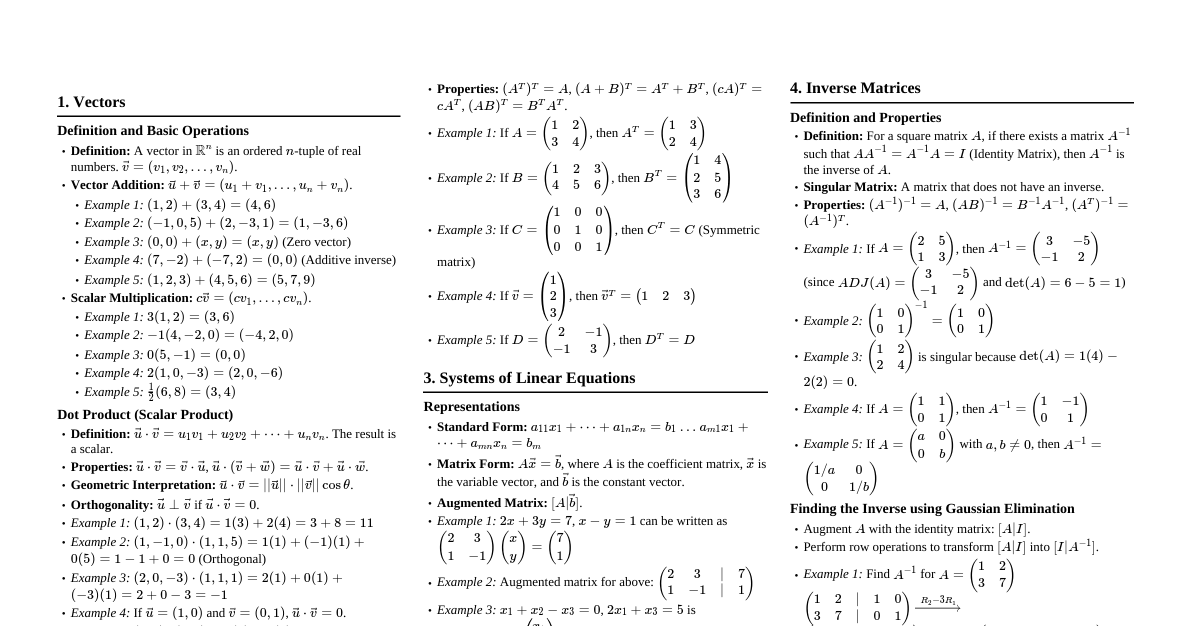
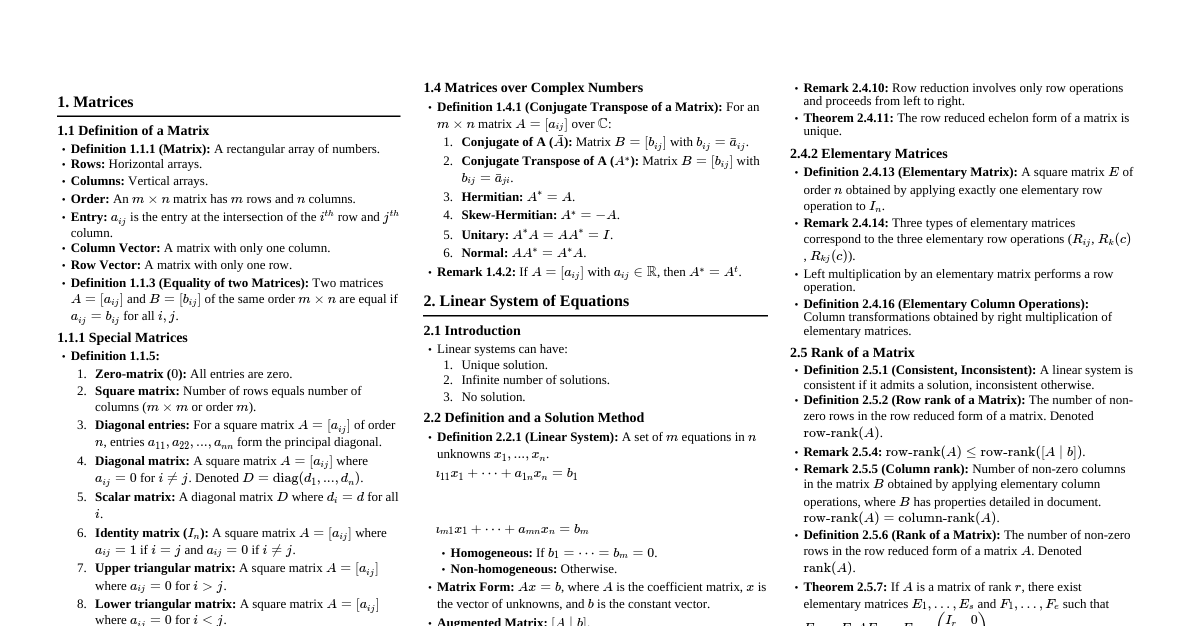
### 1. Introduction to Matrices (मैट्रिक्स का परिचय) - **Definition (परिभाषा):** Numbers या functions का rectangular arrangement rows और columns में. $$ A = \begin{pmatrix} a_{11} & a_{12} & \dots & a_{1n} \\ a_{21} & a_{22} & \dots & a_{2n} \\ \vdots & \vdots & \ddots & \vdots \\ a_{m1} & a_{m2} & \dots & a_{mn} \end{pmatrix} $$ - **Order of Matrix (कोटि):** `m x n` जहाँ `m` rows हैं और `n` columns हैं. - Ex: $A = \begin{pmatrix} 1 & 2 \\ 3 & 4 \\ 5 & 6 \end{pmatrix}$ का order `3 x 2` है. #### Types of Matrices (मैट्रिक्स के प्रकार) - **Row Matrix (पंक्ति मैट्रिक्स):** Only one row. Ex: $\begin{pmatrix} 1 & 2 & 3 \end{pmatrix}$ - **Column Matrix (स्तंभ मैट्रिक्स):** Only one column. Ex: $\begin{pmatrix} 1 \\ 2 \\ 3 \end{pmatrix}$ - **Rectangular Matrix (आयताकार मैट्रिक्स):** Rows ≠ Columns (m ≠ n). Ex: $\begin{pmatrix} 1 & 2 \\ 3 & 4 \\ 5 & 6 \end{pmatrix}$ - **Square Matrix (वर्ग मैट्रिक्स):** Rows = Columns (m = n). Ex: $\begin{pmatrix} 1 & 2 \\ 3 & 4 \end{pmatrix}$ - **Zero Matrix (शून्य मैट्रिक्स) / Null Matrix:** All elements are zero. Denoted by `O`. Ex: $\begin{pmatrix} 0 & 0 \\ 0 & 0 \end{pmatrix}$ - **Diagonal Matrix (विकर्ण मैट्रिक्स):** Square matrix जहाँ non-diagonal elements zero होते हैं ($a_{ij}=0$ for $i \ne j$). Ex: $\begin{pmatrix} 1 & 0 \\ 0 & 4 \end{pmatrix}$ - **Scalar Matrix (अदिश मैट्रिक्स):** Diagonal matrix जहाँ all diagonal elements equal होते हैं. Ex: $\begin{pmatrix} k & 0 \\ 0 & k \end{pmatrix}$ - **Identity Matrix (तत्समक मैट्रिक्स) / Unit Matrix:** Scalar matrix जहाँ diagonal elements 1 होते हैं. Denoted by `I`. Ex: $I_2 = \begin{pmatrix} 1 & 0 \\ 0 & 1 \end{pmatrix}$ - **Upper Triangular Matrix (ऊपरी त्रिभुजीय मैट्रिक्स):** Square matrix जहाँ diagonal के नीचे के सभी elements zero होते हैं ($a_{ij}=0$ for $i > j$). Ex: $\begin{pmatrix} 1 & 2 \\ 0 & 4 \end{pmatrix}$ - **Lower Triangular Matrix (निचली त्रिभुजीय मैट्रिक्स):** Square matrix जहाँ diagonal के ऊपर के सभी elements zero होते हैं ($a_{ij}=0$ for $i ### 2. Algebra of Matrices (मैट्रिक्स का बीजगणित) #### Matrix Addition (मैट्रिक्स योग) - Same order की matrices ही add हो सकती हैं. - Corresponding elements add होते हैं. - Ex: $A = \begin{pmatrix} 1 & 2 \\ 3 & 4 \end{pmatrix}, B = \begin{pmatrix} 5 & 6 \\ 7 & 8 \end{pmatrix} \Rightarrow A+B = \begin{pmatrix} 1+5 & 2+6 \\ 3+7 & 4+8 \end{pmatrix} = \begin{pmatrix} 6 & 8 \\ 10 & 12 \end{pmatrix}$ #### Scalar Multiplication (अदिश गुणन) - Matrix के हर element को scalar से multiply करते हैं. - Ex: $A = \begin{pmatrix} 1 & 2 \\ 3 & 4 \end{pmatrix}, k=2 \Rightarrow kA = \begin{pmatrix} 2 \cdot 1 & 2 \cdot 2 \\ 2 \cdot 3 & 2 \cdot 4 \end{pmatrix} = \begin{pmatrix} 2 & 4 \\ 6 & 8 \end{pmatrix}$ #### Matrix Multiplication (मैट्रिक्स गुणन) - $A_{m \times n} \cdot B_{n \times p}$ possible है, result $C_{m \times p}$ होगा. - $A$ के columns की संख्या $B$ के rows की संख्या के बराबर होनी चाहिए. - $(AB)_{ij} = \sum_{k=1}^{n} A_{ik} B_{kj}$ (row-by-column multiplication). - Ex: $A = \begin{pmatrix} 1 & 2 \\ 3 & 4 \end{pmatrix}, B = \begin{pmatrix} 5 & 6 \\ 7 & 8 \end{pmatrix}$ $AB = \begin{pmatrix} (1 \cdot 5 + 2 \cdot 7) & (1 \cdot 6 + 2 \cdot 8) \\ (3 \cdot 5 + 4 \cdot 7) & (3 \cdot 6 + 4 \cdot 8) \end{pmatrix} = \begin{pmatrix} (5+14) & (6+16) \\ (15+28) & (18+32) \end{pmatrix} = \begin{pmatrix} 19 & 22 \\ 43 & 50 \end{pmatrix}$ #### Properties of Matrix Multiplication (मैट्रिक्स गुणन के गुण) - **Associative (साहचर्य):** $(AB)C = A(BC)$ - **Distributive (वितरण):** $A(B+C) = AB + AC$, $(A+B)C = AC + BC$ - **Identity (तत्समक):** $AI = IA = A$ (जहाँ $I$ identity matrix है) - **Non-commutative (गैर-क्रमविनिमेय):** $AB \ne BA$ in general. (मैट्रिक्स गुणन commutative नहीं होता). - Ex: $A = \begin{pmatrix} 1 & 0 \\ 0 & 0 \end{pmatrix}, B = \begin{pmatrix} 0 & 1 \\ 0 & 0 \end{pmatrix} \Rightarrow AB = \begin{pmatrix} 0 & 1 \\ 0 & 0 \end{pmatrix}, BA = \begin{pmatrix} 0 & 0 \\ 0 & 0 \end{pmatrix}$. So $AB \ne BA$. #### Transpose of Matrix (मैट्रिक्स का परिवर्त) - Rows को columns में और columns को rows में interchange करने से $A^T$ मिलता है. - Ex: $A = \begin{pmatrix} 1 & 2 & 3 \\ 4 & 5 & 6 \end{pmatrix} \Rightarrow A^T = \begin{pmatrix} 1 & 4 \\ 2 & 5 \\ 3 & 6 \end{pmatrix}$ #### Properties of Transpose (परिवर्त के गुण) 1. $(A^T)^T = A$ 2. $(kA)^T = kA^T$ 3. $(A+B)^T = A^T + B^T$ 4. $(AB)^T = B^T A^T$ (Reverse order property) ### 3. Determinant (सारणिक) - Square matrix से associated एक scalar value. Denoted by $|A|$ or $\det(A)$. #### Determinant of 2x2 Matrix - If $A = \begin{pmatrix} a & b \\ c & d \end{pmatrix}$, then $|A| = ad - bc$. - Ex: $A = \begin{pmatrix} 1 & 2 \\ 3 & 4 \end{pmatrix} \Rightarrow |A| = (1 \cdot 4) - (2 \cdot 3) = 4 - 6 = -2$. #### Determinant of 3x3 Matrix - If $A = \begin{pmatrix} a_{11} & a_{12} & a_{13} \\ a_{21} & a_{22} & a_{23} \\ a_{31} & a_{32} & a_{33} \end{pmatrix}$ - $|A| = a_{11}(a_{22}a_{33} - a_{23}a_{32}) - a_{12}(a_{21}a_{33} - a_{23}a_{31}) + a_{13}(a_{21}a_{32} - a_{22}a_{31})$. - This is expansion along the first row. Can expand along any row or column. #### Minor and Cofactor (उपसारणिक और सहखंड) - **Minor ($M_{ij}$):** Element $a_{ij}$ के minor के लिए, $i$-th row और $j$-th column को delete करके determinant calculate करते हैं. - **Cofactor ($C_{ij}$):** $C_{ij} = (-1)^{i+j} M_{ij}$. - Ex: $A = \begin{pmatrix} 1 & 2 & 3 \\ 4 & 5 & 6 \\ 7 & 8 & 9 \end{pmatrix}$ - $M_{11} = \det \begin{pmatrix} 5 & 6 \\ 8 & 9 \end{pmatrix} = 45 - 48 = -3$. - $C_{11} = (-1)^{1+1} M_{11} = 1 \cdot (-3) = -3$. - $M_{12} = \det \begin{pmatrix} 4 & 6 \\ 7 & 9 \end{pmatrix} = 36 - 42 = -6$. - $C_{12} = (-1)^{1+2} M_{12} = -1 \cdot (-6) = 6$. #### Expansion by Cofactors (सहखंडों द्वारा विस्तार) - $|A| = a_{11}C_{11} + a_{12}C_{12} + a_{13}C_{13}$ (First row के along expansion) - Similar for any row or column. #### Properties of Determinants (सारणिक के गुण) 1. If rows and columns are interchanged ($A^T$), determinant remains same: $|A^T| = |A|$. 2. If any two rows (or columns) are interchanged, determinant sign changes. 3. If any two rows (or columns) are identical or proportional, determinant is zero. 4. If each element of a row (or column) is multiplied by a scalar $k$, determinant is multiplied by $k$. - $|kA|_{n \times n} = k^n |A|$. 5. If elements of a row/column are expressed as sum of two terms, determinant can be expressed as sum of two determinants. 6. If elements of any row/column are added/subtracted by $k$ times corresponding elements of another row/column, determinant remains unchanged ($R_i \to R_i + k R_j$). 7. If all elements of a row (or column) are zero, determinant is zero. 8. $|AB| = |A||B|$. ### 4. Adjoint & Inverse (सहखंडज और प्रतिलोम) #### Adjoint of a Matrix (मैट्रिक्स का सहखंडज) - Adjoint of $A$, denoted by $\text{adj}(A)$, is the transpose of the cofactor matrix of $A$. - Let $C$ be the cofactor matrix, then $\text{adj}(A) = C^T$. - Ex: $A = \begin{pmatrix} 1 & 2 \\ 3 & 4 \end{pmatrix}$. - $C_{11} = 4$, $C_{12} = -3$ - $C_{21} = -2$, $C_{22} = 1$ - Cofactor matrix $C = \begin{pmatrix} 4 & -3 \\ -2 & 1 \end{pmatrix}$ - $\text{adj}(A) = C^T = \begin{pmatrix} 4 & -2 \\ -3 & 1 \end{pmatrix}$ #### Inverse Formula (प्रतिलोम का सूत्र) - $A^{-1} = \frac{1}{|A|} \text{adj}(A)$ - **Condition for Inverse:** Inverse तभी exist करता है जब $|A| \ne 0$ (i.e., A is a non-singular matrix). #### Example of finding Inverse (प्रतिलोम ज्ञात करने का उदाहरण) - Find $A^{-1}$ for $A = \begin{pmatrix} 1 & 2 \\ 3 & 4 \end{pmatrix}$ 1. Calculate $|A|$: $|A| = (1 \cdot 4) - (2 \cdot 3) = 4 - 6 = -2$. 2. Since $|A| \ne 0$, inverse exists. 3. Calculate $\text{adj}(A)$: $\text{adj}(A) = \begin{pmatrix} 4 & -2 \\ -3 & 1 \end{pmatrix}$ (from above example) 4. Calculate $A^{-1}$: $A^{-1} = \frac{1}{-2} \begin{pmatrix} 4 & -2 \\ -3 & 1 \end{pmatrix} = \begin{pmatrix} -2 & 1 \\ 3/2 & -1/2 \end{pmatrix}$ ### 5. System of Linear Equations (रेखीय समीकरणों का निकाय) - System: $a_1x + b_1y + c_1z = d_1$ $a_2x + b_2y + c_2z = d_2$ $a_3x + b_3y + c_3z = d_3$ #### Matrix Method (मैट्रिक्स विधि) - Represent as $AX = B$, जहाँ $A = \begin{pmatrix} a_1 & b_1 & c_1 \\ a_2 & b_2 & c_2 \\ a_3 & b_3 & c_3 \end{pmatrix}$, $X = \begin{pmatrix} x \\ y \\ z \end{pmatrix}$, $B = \begin{pmatrix} d_1 \\ d_2 \\ d_3 \end{pmatrix}$. - Solution: $X = A^{-1}B$. - Calculate $A^{-1}$ using the formula $A^{-1} = \frac{1}{|A|} \text{adj}(A)$. #### Cramer's Rule (क्रेमर का नियम) - $x = \frac{|A_x|}{|A|}$, $y = \frac{|A_y|}{|A|}$, $z = \frac{|A_z|}{|A|}$ - $|A|$ is the determinant of the coefficient matrix. - $|A_x|$ is determinant of matrix formed by replacing $A$'s first column with $B$. - $|A_y|$ is determinant of matrix formed by replacing $A$'s second column with $B$. - $|A_z|$ is determinant of matrix formed by replacing $A$'s third column with $B$. #### Consistency Conditions (संगतता की शर्तें) - **Unique Solution (अद्वितीय हल):** If $|A| \ne 0$. System is consistent. - **If $|A| = 0$:** - Calculate $\text{adj}(A)B$. - **Infinite Solutions (अनंत हल):** If $\text{adj}(A)B = O$ (zero matrix). System is consistent. - **No Solution (कोई हल नहीं):** If $\text{adj}(A)B \ne O$. System is inconsistent. ### 6. Rank of a Matrix (मैट्रिक्स की कोटि) - **Definition:** A matrix $A$ का rank $r$ होता है यदि: 1. There is at least one minor of order $r$ which is non-zero. 2. Every minor of order $(r+1)$ or higher is zero. - Denoted by $\rho(A)$. - $\rho(A) \le \min(m, n)$ for an $m \times n$ matrix. #### Echelon Form (सोपानक रूप) - A matrix is in echelon form if: 1. All zero rows, if any, are at the bottom. 2. The first non-zero element (leading entry) in each non-zero row is 1 (called a leading 1). 3. Each leading 1 is to the right of the leading 1 in the row above it. 4. All entries in a column below a leading 1 are zero. - **Finding Rank using Echelon Form:** Number of non-zero rows in the echelon form is the rank. #### Normal Form (सामान्य रूप) - By applying elementary row and column operations, any $m \times n$ matrix $A$ can be reduced to one of the following normal forms: $$ \begin{pmatrix} I_r & O \\ O & O \end{pmatrix}, \begin{pmatrix} I_r & O \end{pmatrix}, \begin{pmatrix} I_r \\ O \end{pmatrix}, I_r $$ where $I_r$ is the identity matrix of order $r$. - **Finding Rank using Normal Form:** The order of the identity matrix $I_r$ is the rank $r$. #### Finding Rank using Elementary Transformations (प्रारंभिक संक्रियाओं द्वारा कोटि ज्ञात करना) - **Elementary Row Operations:** 1. $R_i \leftrightarrow R_j$ (Interchange $i$-th and $j$-th row) 2. $R_i \to kR_i$ (Multiply $i$-th row by non-zero scalar $k$) 3. $R_i \to R_i + kR_j$ (Add $k$ times $j$-th row to $i$-th row) - **Elementary Column Operations:** Similar operations for columns ($C_i \leftrightarrow C_j$, etc.) - Elementary operations matrix के rank को change नहीं करते. - Goal: matrix को echelon form में reduce करना. - **Example:** Find rank of $A = \begin{pmatrix} 1 & 2 & 3 \\ 2 & 3 & 4 \\ 3 & 5 & 7 \end{pmatrix}$ $R_2 \to R_2 - 2R_1$, $R_3 \to R_3 - 3R_1$ $\begin{pmatrix} 1 & 2 & 3 \\ 0 & -1 & -2 \\ 0 & -1 & -2 \end{pmatrix}$ $R_3 \to R_3 - R_2$ $\begin{pmatrix} 1 & 2 & 3 \\ 0 & -1 & -2 \\ 0 & 0 & 0 \end{pmatrix}$ Non-zero rows = 2. So, $\rho(A) = 2$. ### 7. Eigenvalues & Eigenvectors (आइगेन मान और आइगेन सदिश) - For a square matrix $A$, if $A\vec{v} = \lambda\vec{v}$ (where $\vec{v}$ is a non-zero vector), then $\lambda$ is an eigenvalue and $\vec{v}$ is its corresponding eigenvector. #### Characteristic Equation (अभिलाक्षणिक समीकरण) - To find eigenvalues, solve the characteristic equation: $|A - \lambda I| = 0$. - Where $I$ is the identity matrix of the same order as $A$. - $\lambda$ are the eigenvalues. #### Finding Eigenvalues (आइगेन मान ज्ञात करना) - Solve the polynomial equation $|A - \lambda I| = 0$ for $\lambda$. - Ex: $A = \begin{pmatrix} 1 & 2 \\ 3 & 2 \end{pmatrix}$ $A - \lambda I = \begin{pmatrix} 1-\lambda & 2 \\ 3 & 2-\lambda \end{pmatrix}$ $|A - \lambda I| = (1-\lambda)(2-\lambda) - (2 \cdot 3) = 2 - \lambda - 2\lambda + \lambda^2 - 6 = \lambda^2 - 3\lambda - 4 = 0$ $(\lambda-4)(\lambda+1) = 0 \Rightarrow \lambda = 4, -1$. These are the eigenvalues. #### Finding Eigenvectors (आइगेन सदिश ज्ञात करना) - For each eigenvalue $\lambda$, solve $(A - \lambda I)\vec{v} = \vec{0}$ for $\vec{v}$. - Ex: For $A = \begin{pmatrix} 1 & 2 \\ 3 & 2 \end{pmatrix}$ - **For $\lambda = 4$:** $(A - 4I)\vec{v} = \begin{pmatrix} 1-4 & 2 \\ 3 & 2-4 \end{pmatrix} \begin{pmatrix} x \\ y \end{pmatrix} = \begin{pmatrix} -3 & 2 \\ 3 & -2 \end{pmatrix} \begin{pmatrix} x \\ y \end{pmatrix} = \begin{pmatrix} 0 \\ 0 \end{pmatrix}$ $-3x + 2y = 0 \Rightarrow 3x = 2y$. Let $x=2k$, $y=3k$. Eigenvector $\vec{v}_1 = \begin{pmatrix} 2 \\ 3 \end{pmatrix}$ (or any scalar multiple). - **For $\lambda = -1$:** $(A - (-1)I)\vec{v} = \begin{pmatrix} 1+1 & 2 \\ 3 & 2+1 \end{pmatrix} \begin{pmatrix} x \\ y \end{pmatrix} = \begin{pmatrix} 2 & 2 \\ 3 & 3 \end{pmatrix} \begin{pmatrix} x \\ y \end{pmatrix} = \begin{pmatrix} 0 \\ 0 \end{pmatrix}$ $2x + 2y = 0 \Rightarrow x = -y$. Let $x=k$, $y=-k$. Eigenvector $\vec{v}_2 = \begin{pmatrix} 1 \\ -1 \end{pmatrix}$ (or any scalar multiple). #### Cayley-Hamilton Theorem (केली-हैमिल्टन प्रमेय) - **Statement:** Every square matrix satisfies its own characteristic equation. - If characteristic equation is $P(\lambda) = a_n\lambda^n + a_{n-1}\lambda^{n-1} + \dots + a_1\lambda + a_0 = 0$, - Then $P(A) = a_nA^n + a_{n-1}A^{n-1} + \dots + a_1A + a_0I = O$ (zero matrix). - **Use to find Inverse:** - From $a_nA^n + \dots + a_1A + a_0I = O$, multiply by $A^{-1}$. - $a_nA^{n-1} + \dots + a_1I + a_0A^{-1} = O$ - If $a_0 \ne 0$, then $A^{-1} = -\frac{1}{a_0}(a_nA^{n-1} + \dots + a_1I)$. ### 8. Important Properties & Formulas (महत्वपूर्ण गुण और सूत्र) - **Idempotent Matrix:** $A^2 = A$. - **Nilpotent Matrix:** $A^k = O$ for some positive integer $k$. (Smallest $k$ is index of nilpotency). - **Involutory Matrix:** $A^2 = I$. ($A=A^{-1}$) - **Orthogonal Matrix:** $A A^T = A^T A = I$. ($A^{-1} = A^T$) - **Hermitian Matrix:** $A = (A^*)^T$ (conjugate transpose) or $a_{ij} = \overline{a_{ji}}$. (For complex matrices) - **Skew-Hermitian Matrix:** $A = -(A^*)^T$ or $a_{ij} = -\overline{a_{ji}}$. (Diagonal elements are pure imaginary or zero) - **Unitary Matrix:** $A A^* = I$. (For complex matrices) - **Trace of a Matrix (ट्रेस):** Sum of diagonal elements. $\text{Tr}(A) = \sum a_{ii}$. - $\text{Tr}(A) = \sum \text{eigenvalues}$. - $|A| = \prod \text{eigenvalues}$. - **Rank-Nullity Theorem:** For an $m \times n$ matrix $A$, $\rho(A) + \text{nullity}(A) = n$. - Nullity is dimension of null space (number of free variables in $(A|0)$). ### 9. Comparison / Summary Tables (तुलना/सारांश तालिकाएँ) #### Types of Matrices (मैट्रिक्स के प्रकार) | Type (प्रकार) | Condition (शर्त) | Example (उदाहरण) | |----------------------|-------------------------------------------------|-------------------------------------------------| | Symmetric (सममित) | $A^T = A$ | $\begin{pmatrix} 1 & 2 \\ 2 & 3 \end{pmatrix}$ | | Skew-Symmetric (विषम सममित) | $A^T = -A$, diagonal elements are 0 | $\begin{pmatrix} 0 & 2 \\ -2 & 0 \end{pmatrix}$ | | Diagonal (विकर्ण) | $a_{ij}=0$ for $i \ne j$ | $\begin{pmatrix} 1 & 0 \\ 0 & 3 \end{pmatrix}$ | | Scalar (अदिश) | Diagonal, $a_{ii}=k$ | $\begin{pmatrix} 5 & 0 \\ 0 & 5 \end{pmatrix}$ | | Identity (तत्समक) | Diagonal, $a_{ii}=1$ | $\begin{pmatrix} 1 & 0 \\ 0 & 1 \end{pmatrix}$ | | Singular (अव्युत्क्रमणीय) | $|A|=0$ | $\begin{pmatrix} 1 & 2 \\ 2 & 4 \end{pmatrix}$ ($|A|=0$) | | Non-Singular (व्युत्क्रमणीय) | $|A| \ne 0$ | $\begin{pmatrix} 1 & 2 \\ 3 & 4 \end{pmatrix}$ ($|A|=-2$) | | Orthogonal (लंबकोणीय) | $A A^T = I$ | $\frac{1}{\sqrt{2}}\begin{pmatrix} 1 & 1 \\ -1 & 1 \end{pmatrix}$ | #### Consistency Cases for $AX=B$ (संगतता के मामले) | Determinant $|A|$ | $\text{adj}(A)B$ | Solution Type (हल का प्रकार) | Consistency (संगतता) | |-------------------|-------------------|---------------------------------|-----------------------| | $|A| \ne 0$ | N/A | Unique Solution (अद्वितीय हल) | Consistent (संगत) | | $|A| = 0$ | $\ne O$ | No Solution (कोई हल नहीं) | Inconsistent (असंगत) | | $|A| = 0$ | $= O$ | Infinite Solutions (अनंत हल) | Consistent (संगत) | #### Determinant Properties (सारणिक के गुण) | Property (गुण) | Effect on $|A|$ (सारणिक पर प्रभाव) | |---------------------------------------------------|-----------------------------------| | $R_i \leftrightarrow R_j$ (rows swapped) | Sign changes | | $R_i \to kR_i$ (row multiplied by $k$) | $|A| \to k|A|$ | | $R_i \to R_i + kR_j$ (row operation) | No change | | Two rows/columns identical/proportional | $|A|=0$ | | All elements in a row/column are zero | $|A|=0$ | | $|A^T|$ | $=|A|$ | | $|AB|$ | $=|A||B|$ | ### 10. 5 Most Important Exam Questions from Matrix Chapter (मैट्रिक्स अध्याय से 5 सबसे महत्वपूर्ण परीक्षा प्रश्न) 1. **Inverse by Adjoint Method:** Find the inverse of a $3 \times 3$ matrix using $\text{adj}(A)$ and $|A|$. - *Example:* Find $A^{-1}$ for $A = \begin{pmatrix} 1 & 2 & 3 \\ 0 & 1 & 2 \\ 0 & 0 & 1 \end{pmatrix}$. 2. **System of Linear Equations:** Solve a system of 3 linear equations using Matrix Method or Cramer's Rule, and discuss consistency. - *Example:* Solve: $x+y+z=6, x-y+z=2, 2x+y-z=1$. 3. **Rank of a Matrix:** Find the rank of a given matrix using elementary row/column operations (reducing to Echelon or Normal Form). - *Example:* Find the rank of $A = \begin{pmatrix} 1 & 2 & 3 & 0 \\ 2 & 4 & 3 & 2 \\ 3 & 2 & 1 & 3 \\ 6 & 8 & 7 & 5 \end{pmatrix}$. 4. **Eigenvalues & Eigenvectors:** Find all eigenvalues and corresponding eigenvectors for a $2 \times 2$ or $3 \times 3$ matrix. - *Example:* Find eigenvalues and eigenvectors for $A = \begin{pmatrix} 3 & -2 \\ -1 & 2 \end{pmatrix}$. 5. **Cayley-Hamilton Theorem:** State the theorem and verify it for a given matrix. Use it to find $A^{-1}$ or a higher power of $A$. - *Example:* Verify Cayley-Hamilton theorem for $A = \begin{pmatrix} 1 & 2 \\ 3 & 4 \end{pmatrix}$ and use it to find $A^{-1}$.