CBSE Class 12 Maths Viva Cheatsheet
Cheatsheet Content
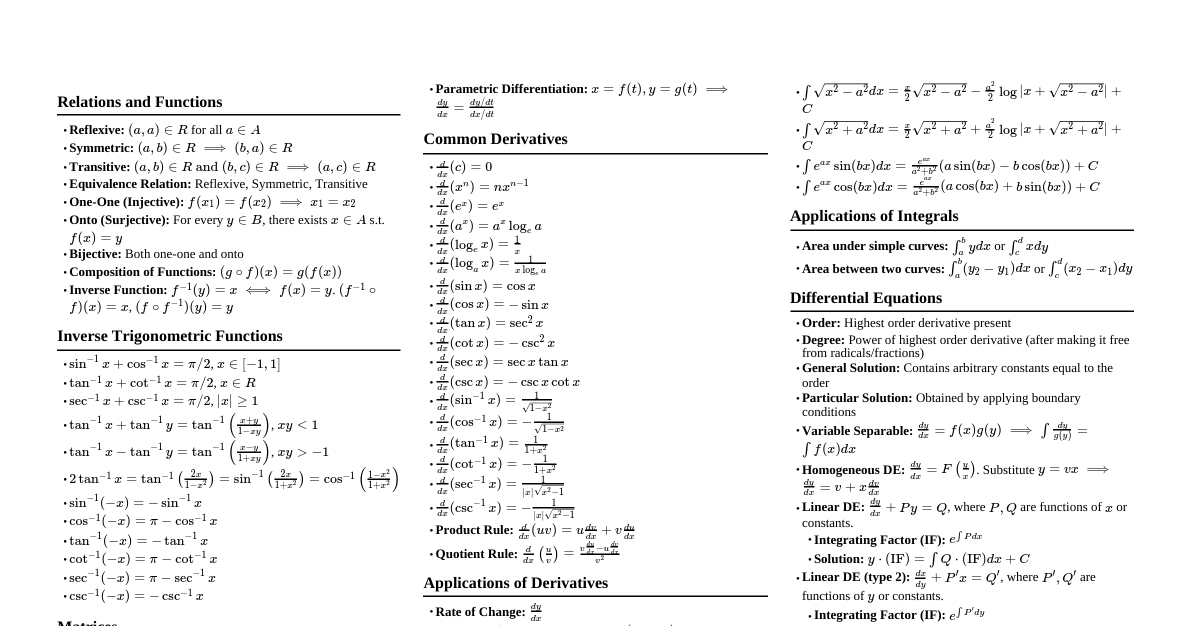
1. Relations and Functions Types of Relations: Reflexive: $(a,a) \in R$ for all $a \in A$ Symmetric: $(a,b) \in R \implies (b,a) \in R$ Transitive: $(a,b) \in R \text{ and } (b,c) \in R \implies (a,c) \in R$ Equivalence Relation: Reflexive, Symmetric, and Transitive Types of Functions: One-one (Injective): $f(x_1) = f(x_2) \implies x_1 = x_2$ Onto (Surjective): For every $y \in B$, there exists $x \in A$ such that $f(x) = y$ Bijective: Both one-one and onto Composition of Functions: $(g \circ f)(x) = g(f(x))$ Inverse of a Function: $f^{-1}(y) = x \iff f(x) = y$. Exists if $f$ is bijective. Viva Questions: What is the difference between a relation and a function? Give an example of a relation that is symmetric but not reflexive. When does $f^{-1}$ exist? If $f(x) = x^2$, is $f^{-1}$ defined for all real numbers? What is the domain and range of $f(x) = \sqrt{x-1}$? 2. Inverse Trigonometric Functions Principal Value Branches: $\sin^{-1}x$: $[-\pi/2, \pi/2]$ $\cos^{-1}x$: $[0, \pi]$ $\tan^{-1}x$: $(-\pi/2, \pi/2)$ $\csc^{-1}x$: $[-\pi/2, \pi/2] - \{0\}$ $\sec^{-1}x$: $[0, \pi] - \{\pi/2\}$ $\cot^{-1}x$: $(0, \pi)$ Properties: $\sin^{-1}(\sin x) = x$ if $x \in [-\pi/2, \pi/2]$ $\sin^{-1}(-x) = -\sin^{-1}x$ $\cos^{-1}(-x) = \pi - \cos^{-1}x$ $\sin^{-1}x + \cos^{-1}x = \pi/2$ $\tan^{-1}x + \cot^{-1}x = \pi/2$ $\sec^{-1}x + \csc^{-1}x = \pi/2$ $\tan^{-1}x + \tan^{-1}y = \tan^{-1}\left(\frac{x+y}{1-xy}\right)$ for $xy $\tan^{-1}x - \tan^{-1}y = \tan^{-1}\left(\frac{x-y}{1+xy}\right)$ for $xy > -1$ $2\tan^{-1}x = \sin^{-1}\left(\frac{2x}{1+x^2}\right) = \cos^{-1}\left(\frac{1-x^2}{1+x^2}\right) = \tan^{-1}\left(\frac{2x}{1-x^2}\right)$ Viva Questions: Why is the range of $\sin^{-1}x$ restricted to $[-\pi/2, \pi/2]$? What is the domain of $\cos^{-1}(2x)$? Evaluate $\sin(\tan^{-1}(1))$. Is $\sin^{-1}(\sin(3\pi/4)) = 3\pi/4$? Explain why or why not. 3. Matrices Order of a Matrix: $m \times n$ (rows $\times$ columns) Types of Matrices: Row, Column, Square, Diagonal, Scalar, Identity, Zero, Symmetric ($A^T=A$), Skew-Symmetric ($A^T=-A$), Invertible ($|A| \neq 0$). Matrix Operations: Addition, Subtraction, Scalar Multiplication, Matrix Multiplication (not commutative: $AB \neq BA$). Properties of Transpose: $(A^T)^T = A$, $(A+B)^T = A^T+B^T$, $(kA)^T = kA^T$, $(AB)^T = B^TA^T$. Elementary Operations: Row/column transformations. Used to find inverse or reduce to echelon form. Invertible Matrix: An $n \times n$ matrix $A$ is invertible if there exists an $n \times n$ matrix $B$ such that $AB=BA=I$. Then $B=A^{-1}$. Theorem: A square matrix $A$ has an inverse if and only if $A$ is non-singular ($|A| \neq 0$). Viva Questions: Can you multiply a $2 \times 3$ matrix by a $3 \times 2$ matrix? What is the order of the resulting matrix? What is an identity matrix? If $A$ is a square matrix, can it be both symmetric and skew-symmetric? What is the significance of $A A^{-1} = I$? What is the difference between a singular and a non-singular matrix? 4. Determinants Determinant of a $2 \times 2$ matrix: $A = \begin{pmatrix} a & b \\ c & d \end{pmatrix} \implies |A| = ad - bc$. Determinant of a $3 \times 3$ matrix: Using cofactor expansion along any row or column. Properties of Determinants: $|A^T| = |A|$ If two rows/columns are identical or proportional, $|A|=0$. If any row/column consists of all zeros, $|A|=0$. If rows/columns are interchanged, determinant changes sign. If a row/column is multiplied by $k$, determinant is multiplied by $k$. If $A$ is $n \times n$, then $|kA| = k^n|A|$. $|AB| = |A||B|$. Operation $R_i \to R_i + k R_j$ (or $C_i \to C_i + k C_j$) does not change the determinant value. Minors and Cofactors: Minor $M_{ij}$: determinant of submatrix by deleting $i$-th row and $j$-th column. Cofactor $A_{ij} = (-1)^{i+j} M_{ij}$. Adjoint of a Matrix: $adj(A) = (A_{ij})^T$. Inverse of a Matrix: $A^{-1} = \frac{1}{|A|} adj(A)$. Exists if $|A| \neq 0$. Theorem: $A \cdot (adj A) = (adj A) \cdot A = |A|I$. Solving System of Linear Equations (Matrix Method $AX=B$): If $|A| \neq 0$: Unique solution $X = A^{-1}B$. (Consistent) If $|A| = 0$: If $(adj A)B \neq O$: No solution. (Inconsistent) If $(adj A)B = O$: Infinitely many solutions. (Consistent, dependent) Area of a Triangle: $\frac{1}{2} | \begin{vmatrix} x_1 & y_1 & 1 \\ x_2 & y_2 & 1 \\ x_3 & y_3 & 1 \end{vmatrix} |$. Collinear points if determinant is 0. Viva Questions: What is the condition for a matrix to be invertible? If two rows of a determinant are identical, what is its value? Why? Explain the difference between a minor and a cofactor. How does a determinant help in checking the consistency of a system of linear equations? What happens to the determinant if you multiply an entire matrix by a scalar $k$? 5. Continuity and Differentiability Continuity: A function $f(x)$ is continuous at $x=a$ if $\lim_{x \to a^-} f(x) = \lim_{x \to a^+} f(x) = f(a)$. Differentiability: A function $f(x)$ is differentiable at $x=a$ if $\lim_{h \to 0} \frac{f(a+h) - f(a)}{h}$ exists. This limit is $f'(a)$. Relation: Differentiability $\implies$ Continuity, but not vice-versa (e.g., $|x|$ at $x=0$). Differentiation Formulas: $\frac{d}{dx}(c) = 0$ $\frac{d}{dx}(x^n) = nx^{n-1}$ $\frac{d}{dx}(\sin x) = \cos x$, $\frac{d}{dx}(\cos x) = -\sin x$ $\frac{d}{dx}(\tan x) = \sec^2 x$, $\frac{d}{dx}(\cot x) = -\csc^2 x$ $\frac{d}{dx}(\sec x) = \sec x \tan x$, $\frac{d}{dx}(\csc x) = -\csc x \cot x$ $\frac{d}{dx}(e^x) = e^x$, $\frac{d}{dx}(a^x) = a^x \log a$ $\frac{d}{dx}(\log_e x) = \frac{1}{x}$, $\frac{d}{dx}(\log_a x) = \frac{1}{x \log_e a}$ $\frac{d}{dx}(\sin^{-1}x) = \frac{1}{\sqrt{1-x^2}}$ $\frac{d}{dx}(\cos^{-1}x) = -\frac{1}{\sqrt{1-x^2}}$ $\frac{d}{dx}(\tan^{-1}x) = \frac{1}{1+x^2}$ Rules of Differentiation: Sum/Difference: $\frac{d}{dx}(u \pm v) = \frac{du}{dx} \pm \frac{dv}{dx}$ Product Rule: $\frac{d}{dx}(uv) = u\frac{dv}{dx} + v\frac{du}{dx}$ Quotient Rule: $\frac{d}{dx}\left(\frac{u}{v}\right) = \frac{v\frac{du}{dx} - u\frac{dv}{dx}}{v^2}$ Chain Rule: $\frac{dy}{dx} = \frac{dy}{du} \cdot \frac{du}{dx}$ Logarithmic Differentiation: Used for functions of the form $[f(x)]^{g(x)}$ or complex products/quotients. Implicit Differentiation: For equations defining $y$ implicitly as a function of $x$. Parametric Differentiation: If $x=f(t), y=g(t)$, then $\frac{dy}{dx} = \frac{dy/dt}{dx/dt}$. Second Order Derivatives: $\frac{d^2y}{dx^2} = \frac{d}{dx}\left(\frac{dy}{dx}\right)$. Mean Value Theorems: Rolle's Theorem: $f$ continuous on $[a,b]$, differentiable on $(a,b)$, $f(a)=f(b) \implies \exists c \in (a,b)$ s.t. $f'(c)=0$. Lagrange's Mean Value Theorem: $f$ continuous on $[a,b]$, differentiable on $(a,b) \implies \exists c \in (a,b)$ s.t. $f'(c) = \frac{f(b)-f(a)}{b-a}$. Viva Questions: Can a function be continuous but not differentiable? Give an example. What is the geometric interpretation of the derivative? State Rolle's Theorem. Why are its conditions important? Differentiate $y = x^x$. How do you differentiate $\sin^{-1}(2x)$? 6. Applications of Derivatives Rate of Change: $\frac{dy}{dx}$ is the instantaneous rate of change of $y$ with respect to $x$. Increasing/Decreasing Functions: $f'(x) > 0 \implies$ strictly increasing on an interval. $f'(x) $f'(x) = 0 \implies$ stationary point. Tangents and Normals: Slope of tangent at $(x_0, y_0)$ is $m_T = \left(\frac{dy}{dx}\right)_{(x_0, y_0)}$. Equation of tangent: $y - y_0 = m_T(x - x_0)$. Slope of normal is $m_N = -1/m_T$ (if $m_T \neq 0$). Equation of normal: $y - y_0 = m_N(x - x_0)$. Maxima and Minima: Critical points: Where $f'(x)=0$ or $f'(x)$ is undefined. First Derivative Test: Change of sign of $f'(x)$ around critical point. Second Derivative Test: If $f'(c)=0$: $f''(c) > 0 \implies$ local minimum at $x=c$. $f''(c) $f''(c) = 0 \implies$ test fails, use first derivative test. Absolute Maxima/Minima: Compare values at local extrema and endpoints of interval. Approximations: $f(x + \Delta x) \approx f(x) + f'(x) \Delta x$. Viva Questions: How do you determine if a function is increasing or decreasing? What is a critical point? Explain the difference between local maxima/minima and absolute maxima/minima. If the slope of the tangent to a curve is 0, what does it mean geometrically? How would you find the dimensions of a rectangle with maximum area inscribed in a circle? 7. Integrals Indefinite Integrals (Antiderivatives): $\int f(x) dx = F(x) + C$, where $F'(x) = f(x)$. Standard Formulas: $\int x^n dx = \frac{x^{n+1}}{n+1} + C$ ($n \neq -1$) $\int \frac{1}{x} dx = \log|x| + C$ $\int \sin x dx = -\cos x + C$, $\int \cos x dx = \sin x + C$ $\int \tan x dx = \log|\sec x| + C = -\log|\cos x| + C$ $\int \cot x dx = \log|\sin x| + C$ $\int \sec x dx = \log|\sec x + \tan x| + C$ $\int \csc x dx = \log|\csc x - \cot x| + C$ $\int e^x dx = e^x + C$, $\int a^x dx = \frac{a^x}{\log a} + C$ $\int \frac{1}{\sqrt{a^2 - x^2}} dx = \sin^{-1}\left(\frac{x}{a}\right) + C$ $\int \frac{1}{a^2 + x^2} dx = \frac{1}{a}\tan^{-1}\left(\frac{x}{a}\right) + C$ $\int \frac{1}{x^2 - a^2} dx = \frac{1}{2a}\log\left|\frac{x-a}{x+a}\right| + C$ $\int \frac{1}{a^2 - x^2} dx = \frac{1}{2a}\log\left|\frac{a+x}{a-x}\right| + C$ $\int \frac{1}{x\sqrt{x^2 - a^2}} dx = \frac{1}{a}\sec^{-1}\left(\frac{x}{a}\right) + C$ $\int \sqrt{a^2 - x^2} dx = \frac{x}{2}\sqrt{a^2 - x^2} + \frac{a^2}{2}\sin^{-1}\left(\frac{x}{a}\right) + C$ $\int \sqrt{x^2 - a^2} dx = \frac{x}{2}\sqrt{x^2 - a^2} - \frac{a^2}{2}\log|x + \sqrt{x^2 - a^2}| + C$ $\int \sqrt{x^2 + a^2} dx = \frac{x}{2}\sqrt{x^2 + a^2} + \frac{a^2}{2}\log|x + \sqrt{x^2 + a^2}| + C$ Methods of Integration: Substitution: $\int f(g(x))g'(x) dx = \int f(t) dt$ (where $t=g(x)$). Integration by Parts: $\int u dv = uv - \int v du$ (LIATE rule for choosing $u$). Partial Fractions: For rational functions $\frac{P(x)}{Q(x)}$. Definite Integrals: $\int_a^b f(x) dx = F(b) - F(a)$ (Fundamental Theorem of Calculus). Properties of Definite Integrals: $\int_a^b f(x) dx = -\int_b^a f(x) dx$ $\int_a^b f(x) dx = \int_a^c f(x) dx + \int_c^b f(x) dx$ $\int_0^a f(x) dx = \int_0^a f(a-x) dx$ $\int_a^b f(x) dx = \int_a^b f(a+b-x) dx$ $\int_0^{2a} f(x) dx = 2\int_0^a f(x) dx$ if $f(2a-x)=f(x)$, and $0$ if $f(2a-x)=-f(x)$. $\int_{-a}^a f(x) dx = 2\int_0^a f(x) dx$ if $f$ is even, $0$ if $f$ is odd. Viva Questions: What is the constant of integration and why is it important in indefinite integrals? Explain the Fundamental Theorem of Calculus. When do you use integration by parts? What is the LIATE rule? Evaluate $\int_0^{\pi/2} \sin x dx$. How would you integrate $\frac{1}{x^2-4}$? 8. Applications of Integrals Area under Simple Curves: Area bounded by $y=f(x)$, x-axis, $x=a$, $x=b$: $\int_a^b |y| dx$. Area bounded by $x=g(y)$, y-axis, $y=c$, $y=d$: $\int_c^d |x| dy$. Area between Two Curves: Area = $\int_a^b |f(x) - g(x)| dx$. Viva Questions: How can integration be used to find the area of a region? What is the difference between $\int f(x) dx$ and $\int_a^b f(x) dx$? When calculating area, why do we sometimes take the absolute value of the integrand or split the integral? How would you find the area enclosed by a parabola and a line? 9. Differential Equations Order: Highest order derivative present. Degree: Power of the highest order derivative (when rational powers are removed). General Solution: Contains arbitrary constants, number of constants equals order. Particular Solution: Obtained from general solution by assigning specific values to constants using initial/boundary conditions. Formation of Differential Equation: Eliminate arbitrary constants from a given equation. Methods of Solving First Order, First Degree DEs: Variable Separable: $\frac{dy}{dx} = f(x)g(y) \implies \int \frac{dy}{g(y)} = \int f(x) dx$. Homogeneous: $\frac{dy}{dx} = F\left(\frac{y}{x}\right)$. Substitute $y=vx$ to convert to variable separable. Linear Differential Equation: $\frac{dy}{dx} + Py = Q$, where $P, Q$ are functions of $x$ (or constants). Integrating Factor (IF): $e^{\int P dx}$. Solution: $y \cdot (\text{IF}) = \int Q \cdot (\text{IF}) dx + C$. Linear in $x$: $\frac{dx}{dy} + P'x = Q'$, where $P', Q'$ are functions of $y$. Solution: $x \cdot (\text{IF}) = \int Q' \cdot (\text{IF}) dy + C$. Viva Questions: What is the order and degree of the differential equation $\frac{d^2y}{dx^2} + (\frac{dy}{dx})^3 = 0$? When do we use an integrating factor? Give an example of a real-world problem that can be modeled by a differential equation. What is the general solution vs. particular solution of a differential equation? How do you check if a differential equation is homogeneous? 10. Vector Algebra Vectors and Scalars: Vector has magnitude and direction, scalar has only magnitude. Types of Vectors: Zero, Unit ($\hat{a} = \frac{\vec{a}}{|\vec{a}|}$), Coinitial, Collinear, Equal, Coplanar. Position Vector: $\vec{r} = x\hat{i} + y\hat{j} + z\hat{k}$. Magnitude $|\vec{r}| = \sqrt{x^2+y^2+z^2}$. Direction Cosines (DC's): $l=\cos\alpha = \frac{x}{|\vec{r}|}$, $m=\cos\beta = \frac{y}{|\vec{r}|}$, $n=\cos\gamma = \frac{z}{|\vec{r}|}$. $l^2+m^2+n^2=1$. Direction Ratios (DR's): Any numbers $a,b,c$ proportional to DC's. $(a=kl, b=km, c=kn)$. Scalar (Dot) Product: $\vec{a} \cdot \vec{b} = |\vec{a}||\vec{b}|\cos\theta = a_1b_1+a_2b_2+a_3b_3$. $\vec{a} \cdot \vec{b} = 0 \iff \vec{a} \perp \vec{b}$ (for non-zero vectors). Projection of $\vec{a}$ on $\vec{b}$: $\frac{\vec{a} \cdot \vec{b}}{|\vec{b}|} = \vec{a} \cdot \hat{b}$. Vector (Cross) Product: $\vec{a} \times \vec{b} = |\vec{a}||\vec{b}|\sin\theta \hat{n}$. Direction by right-hand rule. $\vec{a} \times \vec{b} = \begin{vmatrix} \hat{i} & \hat{j} & \hat{k} \\ a_1 & a_2 & a_3 \\ b_1 & b_2 & b_3 \end{vmatrix}$. Magnitude $|\vec{a} \times \vec{b}|$ = Area of parallelogram with adjacent sides $\vec{a}, \vec{b}$. Area of triangle = $\frac{1}{2}|\vec{a} \times \vec{b}|$. $\vec{a} \times \vec{b} = \vec{0} \iff \vec{a} || \vec{b}$ (for non-zero vectors). Scalar Triple Product: $(\vec{a} \times \vec{b}) \cdot \vec{c} = \begin{vmatrix} a_1 & a_2 & a_3 \\ b_1 & b_2 & b_3 \\ c_1 & c_2 & c_3 \end{vmatrix}$. Volume of parallelepiped = $|(\vec{a} \times \vec{b}) \cdot \vec{c}|$. Volume of tetrahedron = $\frac{1}{6}|(\vec{a} \times \vec{b}) \cdot \vec{c}|$. If $(\vec{a} \times \vec{b}) \cdot \vec{c} = 0$, then $\vec{a}, \vec{b}, \vec{c}$ are coplanar. Viva Questions: What is the difference between a position vector and a displacement vector? When is the dot product of two non-zero vectors zero? When is the cross product of two non-zero vectors zero? What is the physical significance of the cross product? Can a vector have zero magnitude but non-zero direction? How do you check for coplanarity of three vectors? 11. Three Dimensional Geometry Direction Cosines (DC's) and Direction Ratios (DR's): If $a,b,c$ are DR's, then DC's are $\pm \frac{a}{\sqrt{a^2+b^2+c^2}}$, etc. Equation of a Line: Vector form: $\vec{r} = \vec{a} + \lambda \vec{b}$ ($\vec{a}$ is position vector of a point, $\vec{b}$ is direction vector). Cartesian form: $\frac{x-x_1}{a} = \frac{y-y_1}{b} = \frac{z-z_1}{c}$. Line passing through two points $\vec{a}$ and $\vec{b}$: $\vec{r} = \vec{a} + \lambda (\vec{b}-\vec{a})$. Cartesian: $\frac{x-x_1}{x_2-x_1} = \frac{y-y_1}{y_2-y_1} = \frac{z-z_1}{z_2-z_1}$. Angle between Two Lines: $\cos\theta = \left|\frac{\vec{b_1} \cdot \vec{b_2}}{|\vec{b_1}||\vec{b_2}|}\right|$. In Cartesian: $\cos\theta = \left|\frac{a_1a_2+b_1b_2+c_1c_2}{\sqrt{a_1^2+b_1^2+c_1^2}\sqrt{a_2^2+b_2^2+c_2^2}}\right|$. Shortest Distance between Two Skew Lines: Lines: $\vec{r} = \vec{a_1} + \lambda \vec{b_1}$ and $\vec{r} = \vec{a_2} + \mu \vec{b_2}$. $d = \left|\frac{(\vec{a_2}-\vec{a_1}) \cdot (\vec{b_1} \times \vec{b_2})}{|\vec{b_1} \times \vec{b_2}|}\right|$. If lines are parallel: $\vec{b_1} = \vec{b_2} = \vec{b}$. $d = \left|\frac{(\vec{a_2}-\vec{a_1}) \times \vec{b}}{|\vec{b}|}\right|$. Equation of a Plane: Normal form: $\vec{r} \cdot \hat{n} = d$. Cartesian: $lx+my+nz=p$. Equation of a plane perpendicular to a given vector $\vec{n}$ and passing through a given point $\vec{a}$: $(\vec{r}-\vec{a}) \cdot \vec{n} = 0$. Cartesian: $A(x-x_1)+B(y-y_1)+C(z-z_1)=0$. Equation of a plane passing through three non-collinear points. Intercept form: $\frac{x}{a} + \frac{y}{b} + \frac{z}{c} = 1$. Plane passing through the intersection of two planes $P_1: \vec{r} \cdot \vec{n_1} = d_1$ and $P_2: \vec{r} \cdot \vec{n_2} = d_2$: $\vec{r} \cdot (\vec{n_1} + \lambda \vec{n_2}) = d_1 + \lambda d_2$. Angle between Two Planes: $\cos\theta = \left|\frac{\vec{n_1} \cdot \vec{n_2}}{|\vec{n_1}||\vec{n_2}|}\right|$. Angle between a Line and a Plane: $\sin\theta = \left|\frac{\vec{b} \cdot \vec{n}}{|\vec{b}||\vec{n}|}\right|$. Distance of a Point from a Plane: $D = \left|\frac{Ax_1+By_1+Cz_1+D}{\sqrt{A^2+B^2+C^2}}\right|$. Viva Questions: What are direction cosines? How are they related to direction ratios? What is a skew line? How do you find the shortest distance between two skew lines? When are two planes perpendicular? What does the normal vector to a plane represent? How can you check if three points are collinear using 3D geometry? What is the difference between the vector equation and Cartesian equation of a line/plane? 12. Linear Programming Objective Function: The linear function ($Z = ax+by$) to be maximized or minimized. Constraints: Linear inequalities that limit the variables (e.g., $x \ge 0, y \ge 0$, $2x+3y \le 12$). Feasible Region: The common region determined by all constraints. It's always a convex polygon. Feasible Solution: Any point in the feasible region. Optimal Solution: A point in the feasible region that gives the optimal (max/min) value of the objective function. Corner Point Theorem: The optimal solution (if it exists) occurs at a corner point (vertex) of the feasible region. If the feasible region is bounded, both maximum and minimum exist. If the feasible region is unbounded, max/min may or may not exist. If it exists, it must be at a corner point. Types of Problems: Manufacturing, Diet, Transportation. Viva Questions: What is an objective function in LPP? What is a feasible region? Is it always bounded? Explain the corner point theorem. Can an LPP have no feasible solution? Give an example. What is the difference between a feasible solution and an optimal solution? What does it mean for a feasible region to be unbounded? 13. Probability Conditional Probability: $P(A|B) = \frac{P(A \cap B)}{P(B)}$, provided $P(B) > 0$. Multiplication Theorem: $P(A \cap B) = P(A)P(B|A) = P(B)P(A|B)$. Independent Events: $P(A \cap B) = P(A)P(B) \iff A, B$ are independent. If $A, B$ are independent, then $A, B'$ are independent, $A', B$ are independent, $A', B'$ are independent. Mutually Exclusive Events: $A \cap B = \emptyset \implies P(A \cap B) = 0$. (Cannot occur simultaneously). Total Probability Theorem: If $E_1, E_2, ..., E_n$ form a partition of the sample space S, then $P(A) = \sum_{i=1}^n P(A|E_i)P(E_i)$. Bayes' Theorem: $P(E_i|A) = \frac{P(A|E_i)P(E_i)}{\sum_{j=1}^n P(A|E_j)P(E_j)}$. Random Variable and its Probability Distribution: A function that assigns a real number to each outcome of a random experiment. Sum of all probabilities $\sum P(X=x_i) = 1$. Mean (Expectation) of a Random Variable: $E(X) = \sum x_i P(X=x_i)$. Variance of a Random Variable: $Var(X) = E(X^2) - [E(X)]^2$. ($E(X^2) = \sum x_i^2 P(X=x_i)$). Bernoulli Trials: Sequence of independent trials with only two outcomes (success/failure) and constant probability of success. Binomial Distribution: For $n$ Bernoulli trials, probability of $r$ successes is $P(X=r) = {}^n C_r p^r q^{n-r}$, where $p$ is probability of success, $q=1-p$, $n$ is number of trials. Mean: $np$ Variance: $npq$ Viva Questions: What is the difference between mutually exclusive events and independent events? Explain conditional probability with an example. When do you use Bayes' Theorem? What are the conditions for a binomial distribution? If $P(A)=0.5$ and $P(B)=0.4$, and $A$ and $B$ are independent, what is $P(A \cap B)$? What is a probability distribution of a random variable?