Matrices & Determinants (JEE/NCERT)
Cheatsheet Content
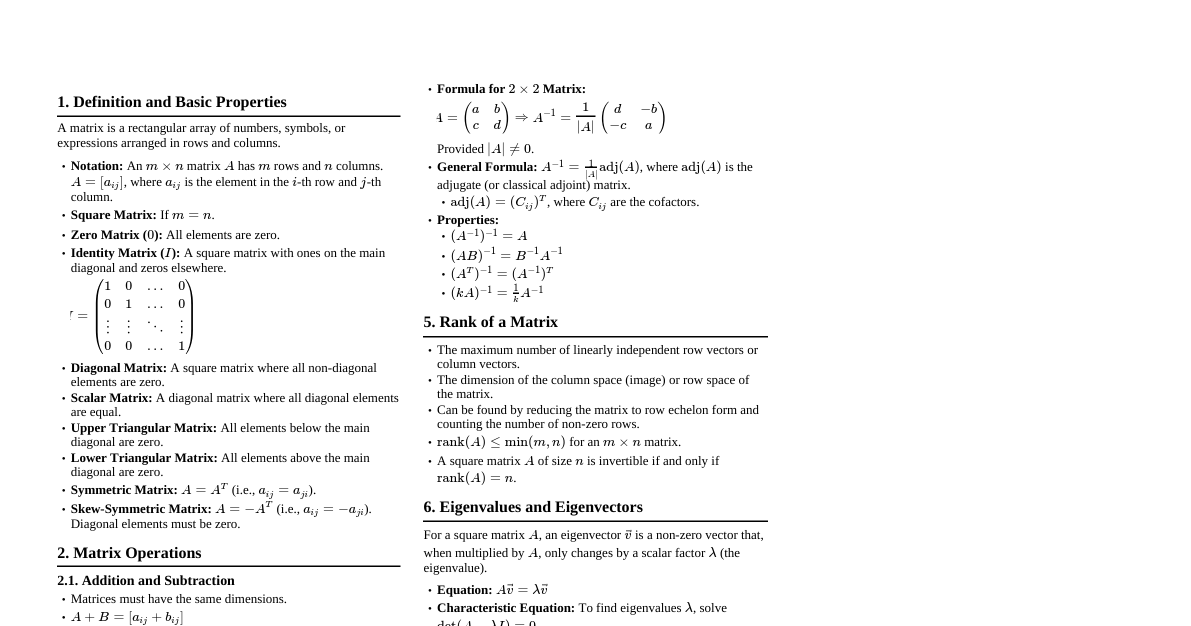
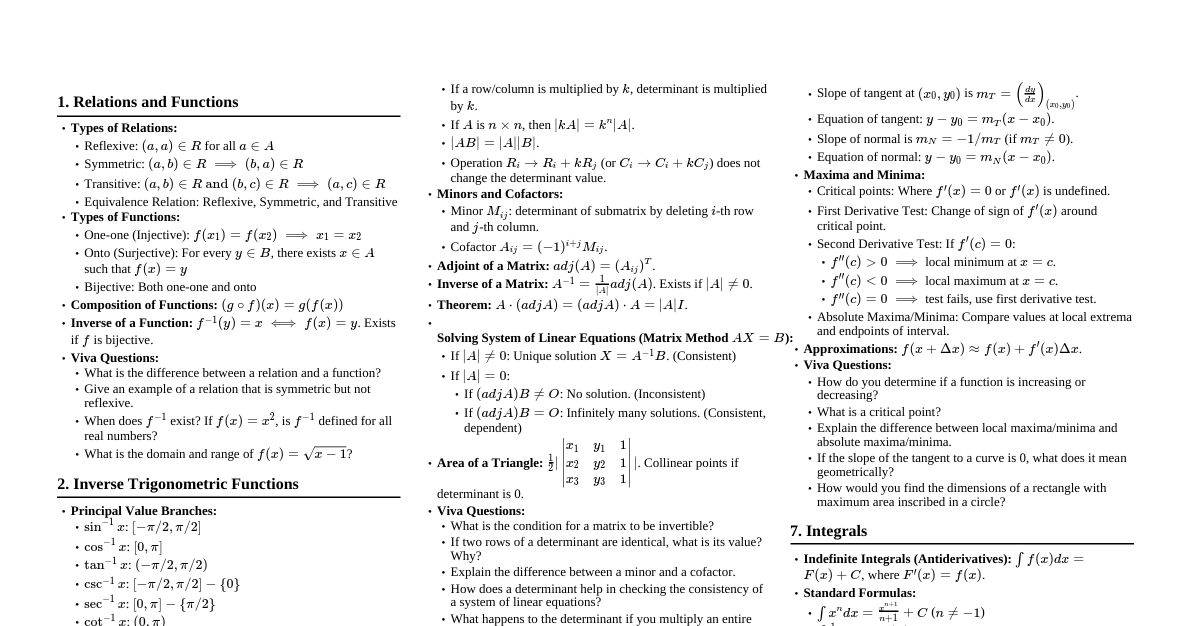
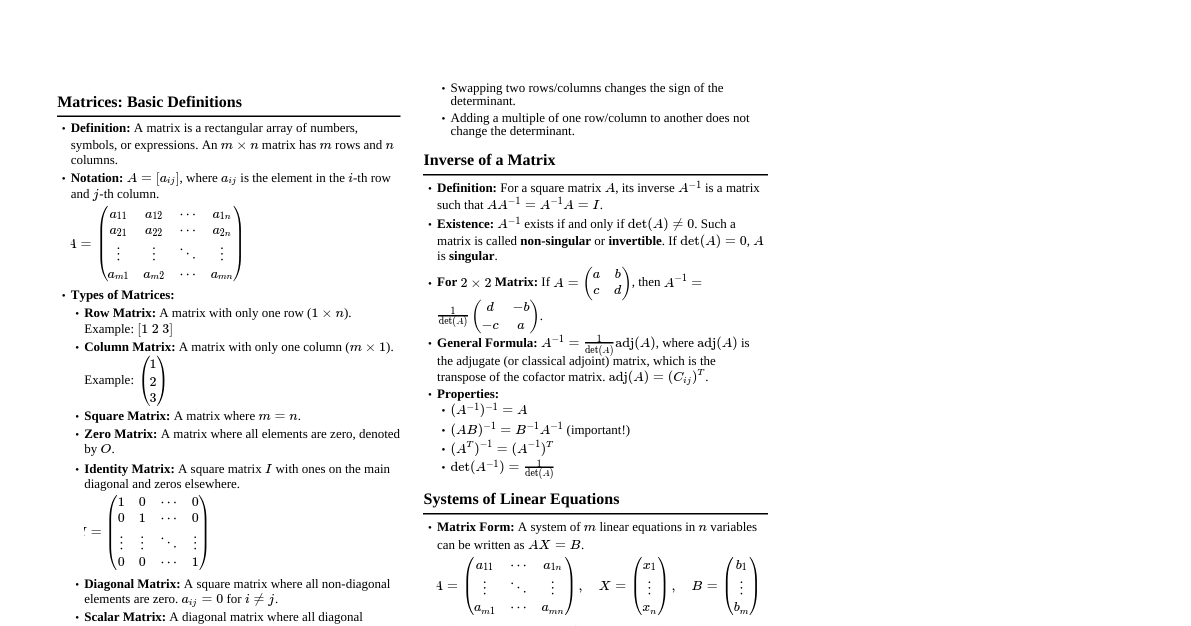
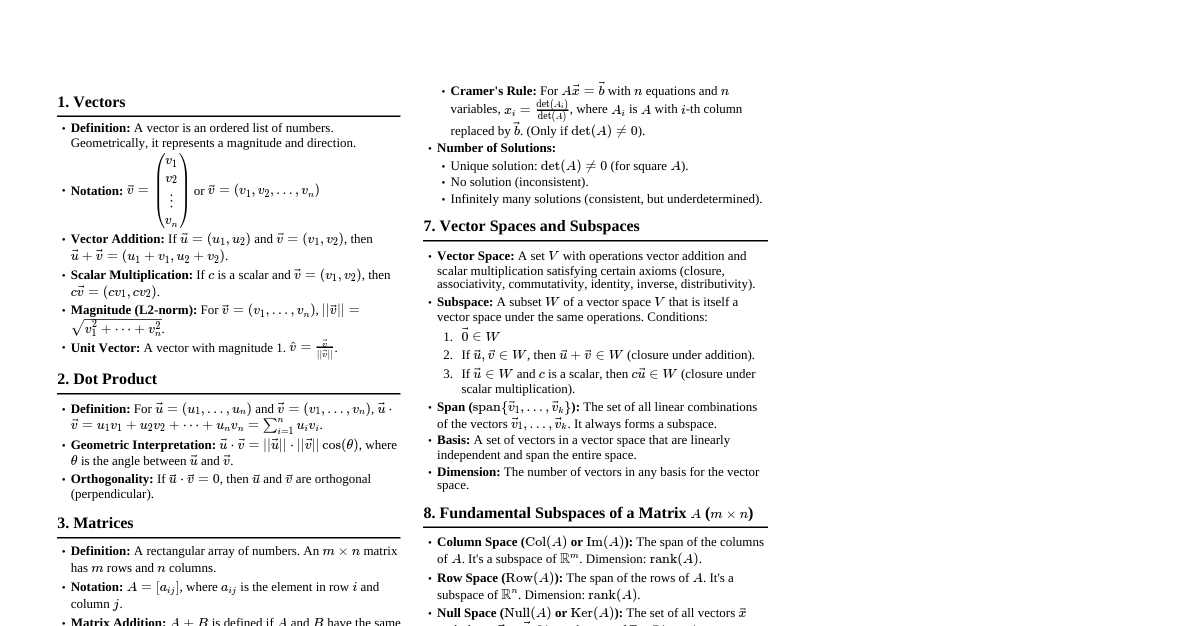
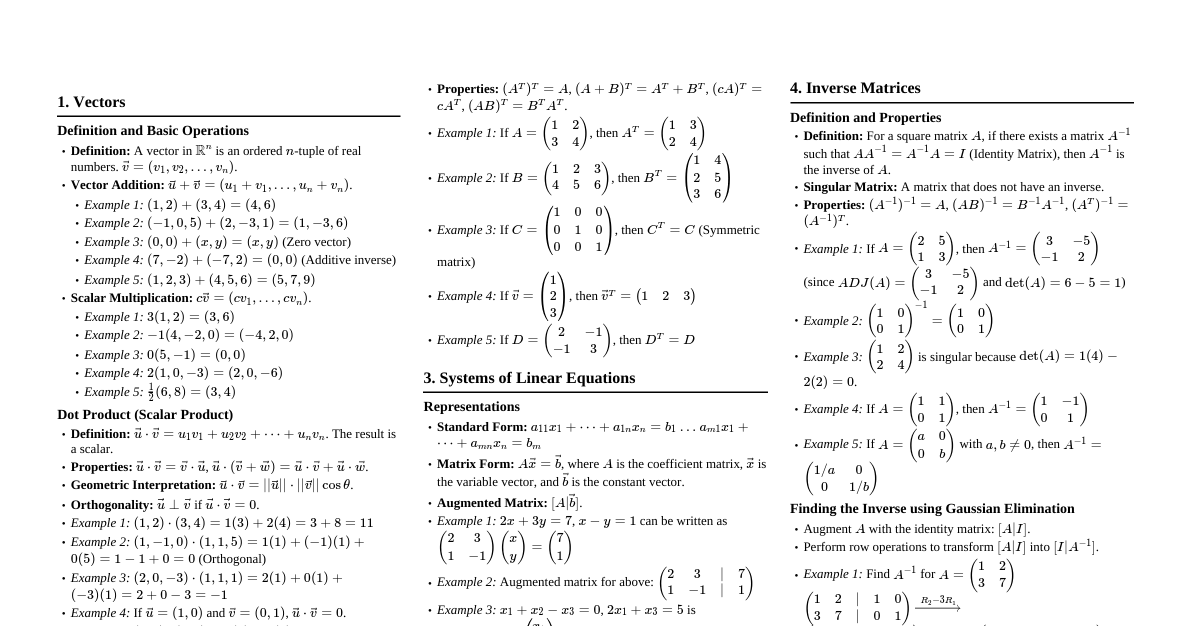
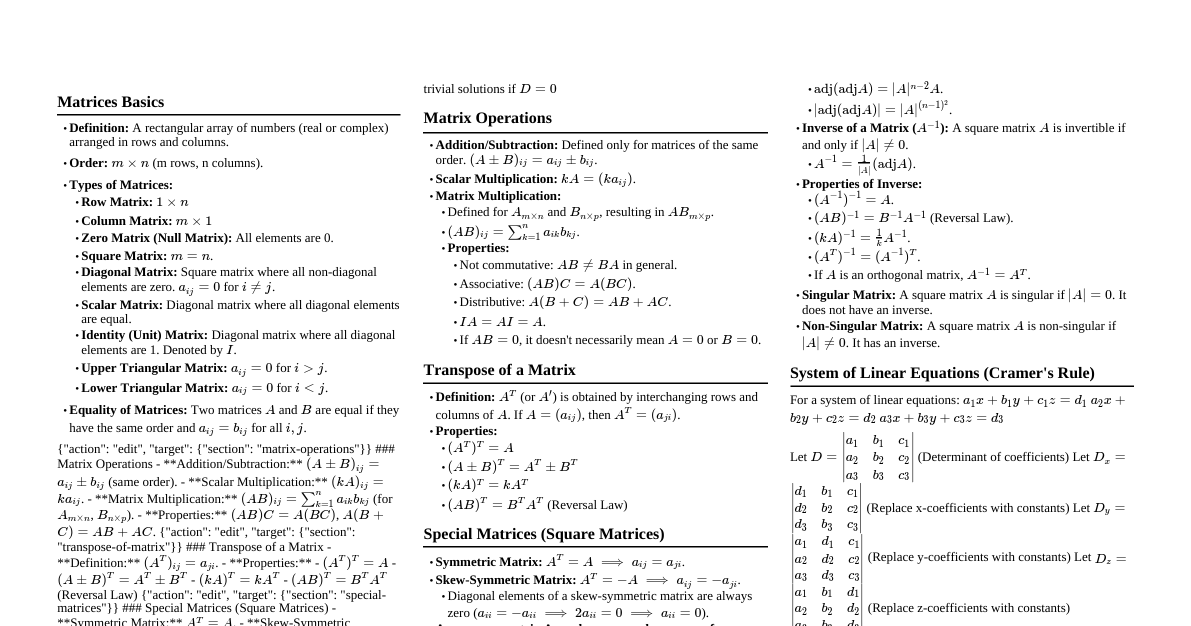
Matrices: Basic Concepts Definition: A matrix is a rectangular array of numbers or functions. $A = [a_{ij}]_{m \times n}$, where $m$ is rows, $n$ is columns. Order of a Matrix: $m \times n$ (read as 'm by n'). Types of Matrices: Column Matrix: $m \times 1$ Row Matrix: $1 \times n$ Square Matrix: $m=n$ Diagonal Matrix: Square matrix where $a_{ij}=0$ for $i \neq j$. Scalar Matrix: Diagonal matrix where $a_{ii}=k$ (constant) for all $i$. Identity Matrix ($I$): Scalar matrix where $a_{ii}=1$ for all $i$. Zero Matrix ($O$): All elements are zero. Upper Triangular Matrix: $a_{ij}=0$ for $i > j$. Lower Triangular Matrix: $a_{ij}=0$ for $i Equality of Matrices: Two matrices $A=[a_{ij}]$ and $B=[b_{ij}]$ are equal if they are of the same order and $a_{ij}=b_{ij}$ for all $i,j$. Matrix Operations Addition/Subtraction: Defined only for matrices of the same order. $[a_{ij}] \pm [b_{ij}] = [a_{ij} \pm b_{ij}]$. Scalar Multiplication: $k[a_{ij}] = [ka_{ij}]$. Matrix Multiplication: $AB$ is defined if columns of $A$ = rows of $B$. If $A = [a_{ij}]_{m \times p}$ and $B = [b_{ij}]_{p \times n}$, then $C = AB = [c_{ij}]_{m \times n}$ where $c_{ij} = \sum_{k=1}^{p} a_{ik}b_{kj}$. Note: $AB \neq BA$ in general. Properties of Matrix Operations: $A+B = B+A$ (Commutative) $(A+B)+C = A+(B+C)$ (Associative) $A+O = O+A = A$ $A+(-A) = O$ $(AB)C = A(BC)$ (Associative) $A(B+C) = AB+AC$ (Distributive) $(A+B)C = AC+BC$ (Distributive) $k(A+B) = kA+kB$ $k(AB) = (kA)B = A(kB)$ $IA = AI = A$ Transpose of a Matrix Definition: $A^T$ (or $A'$) is obtained by interchanging rows and columns of $A$. If $A=[a_{ij}]$, then $A^T=[a_{ji}]$. Properties: $(A^T)^T = A$ $(A+B)^T = A^T+B^T$ $(kA)^T = kA^T$ $(AB)^T = B^T A^T$ (Reversal Law) Symmetric Matrix: $A^T=A$. (e.g., $\begin{pmatrix} 1 & 2 \\ 2 & 3 \end{pmatrix}$) Skew-Symmetric Matrix: $A^T=-A$. All diagonal elements are zero. (e.g., $\begin{pmatrix} 0 & 2 \\ -2 & 0 \end{pmatrix}$) Any square matrix can be expressed as sum of symmetric and skew-symmetric matrix: $A = \frac{1}{2}(A+A^T) + \frac{1}{2}(A-A^T)$. Determinants: Basic Concepts Definition: For a square matrix $A$, its determinant, denoted $|A|$ or $det(A)$, is a scalar value. Determinant of a $1 \times 1$ matrix: If $A=[a]$, then $|A|=a$. Determinant of a $2 \times 2$ matrix: If $A=\begin{pmatrix} a & b \\ c & d \end{pmatrix}$, then $|A|=ad-bc$. Determinant of a $3 \times 3$ matrix (Sarrus Rule): If $A=\begin{pmatrix} a_{11} & a_{12} & a_{13} \\ a_{21} & a_{22} & a_{23} \\ a_{31} & a_{32} & a_{33} \end{pmatrix}$, then $|A| = a_{11}(a_{22}a_{33}-a_{23}a_{32}) - a_{12}(a_{21}a_{33}-a_{23}a_{31}) + a_{13}(a_{21}a_{32}-a_{22}a_{31})$. Minor ($M_{ij}$): Determinant of the submatrix obtained by deleting the $i$-th row and $j$-th column. Cofactor ($A_{ij}$ or $C_{ij}$): $A_{ij} = (-1)^{i+j}M_{ij}$. Expansion of Determinant: $|A| = \sum_{j=1}^{n} a_{ij}A_{ij}$ (along $i$-th row) or $|A| = \sum_{i=1}^{m} a_{ij}A_{ij}$ (along $j$-th column). Properties of Determinants The value of a determinant remains unchanged if its rows and columns are interchanged: $|A^T|=|A|$. If any two rows (or columns) of a determinant are interchanged, the sign of the determinant changes. If any two rows (or columns) of a determinant are identical, then its value is zero. If all elements of a row (or column) are multiplied by a constant $k$, the determinant value is multiplied by $k$. $|kA| = k^n|A|$ for an $n \times n$ matrix. If elements of a row (or column) are expressed as sum of two or more terms, the determinant can be expressed as sum of two or more determinants. If to any row (or column) of a determinant, a multiple of another row (or column) is added, the value of the determinant remains the same. $R_i \rightarrow R_i + kR_j$ (or $C_i \rightarrow C_i + kC_j$). If all elements of a row or column are zero, the determinant is zero. If $A$ is a triangular matrix (upper or lower), $|A|$ is the product of its diagonal elements. $|AB| = |A||B|$. Adjoint and Inverse of a Matrix Adjoint of a Matrix ($adj(A)$): The transpose of the cofactor matrix. If $A = [a_{ij}]$, then $adj(A) = [A_{ji}]$. Property: $A(adj(A)) = (adj(A))A = |A|I$. Singular Matrix: A square matrix $A$ is singular if $|A|=0$. Non-Singular Matrix: A square matrix $A$ is non-singular if $|A| \neq 0$. Inverse of a Matrix ($A^{-1}$): A square matrix $A$ has an inverse if and only if it is non-singular. $A^{-1} = \frac{1}{|A|} adj(A)$. Properties of Inverse: $(A^{-1})^{-1} = A$ $(AB)^{-1} = B^{-1}A^{-1}$ (Reversal Law) $(A^T)^{-1} = (A^{-1})^T$ $|A^{-1}| = \frac{1}{|A|}$ If $A$ is diagonal, $A = diag(a_1, ..., a_n)$, then $A^{-1} = diag(1/a_1, ..., 1/a_n)$. System of Linear Equations Representing a system: $AX=B$, where $A$ is coefficient matrix, $X$ is variable matrix, $B$ is constant matrix. Consistent System: Has one or infinitely many solutions. Inconsistent System: Has no solution. Solution using Matrix Inverse (Cramer's Rule for $n=3$): If $|A| \neq 0$ (non-singular), then $X = A^{-1}B$. Unique solution. System is consistent. If $|A| = 0$ (singular): Calculate $(adj(A))B$. If $(adj(A))B \neq O$ (zero matrix), then no solution. System is inconsistent. If $(adj(A))B = O$, then infinitely many solutions. System is consistent (requires checking consistency by substituting variables). JEE Specific Concepts Orthogonal Matrix: A square matrix $A$ is orthogonal if $A A^T = A^T A = I$. Implies $A^{-1} = A^T$. Idempotent Matrix: A square matrix $A$ is idempotent if $A^2 = A$. Nilpotent Matrix: A square matrix $A$ is nilpotent if $A^k = O$ for some positive integer $k$. The least such $k$ is the index of the nilpotent matrix. Involutory Matrix: A square matrix $A$ is involutory if $A^2 = I$. Implies $A^{-1} = A$. Trace of a Matrix: For a square matrix $A=[a_{ij}]_{n \times n}$, the trace is the sum of its diagonal elements. $tr(A) = \sum_{i=1}^{n} a_{ii}$. $tr(A \pm B) = tr(A) \pm tr(B)$ $tr(kA) = k \cdot tr(A)$ $tr(AB) = tr(BA)$ Rank of a Matrix: The maximum number of linearly independent rows or columns. Also, the order of the largest non-zero minor. Homogeneous System: $AX=O$. If $|A| \neq 0$, unique solution $X=O$ (trivial solution). If $|A| = 0$, infinitely many solutions (non-trivial solutions).