Class 10 Carbon & Its Compounds
Cheatsheet Content
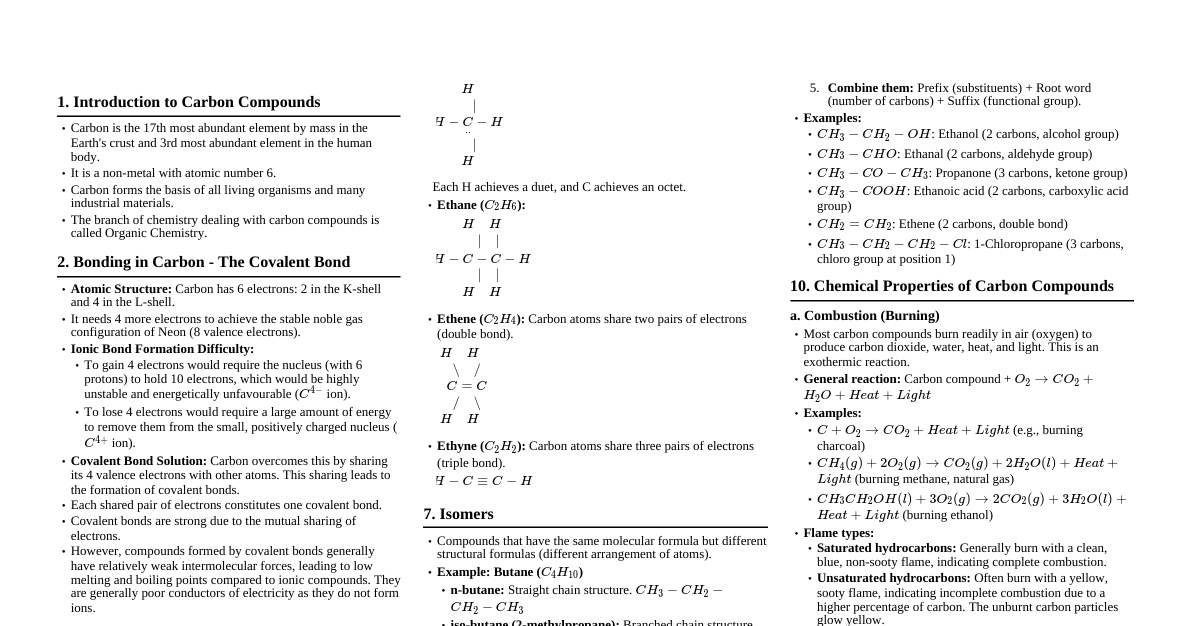
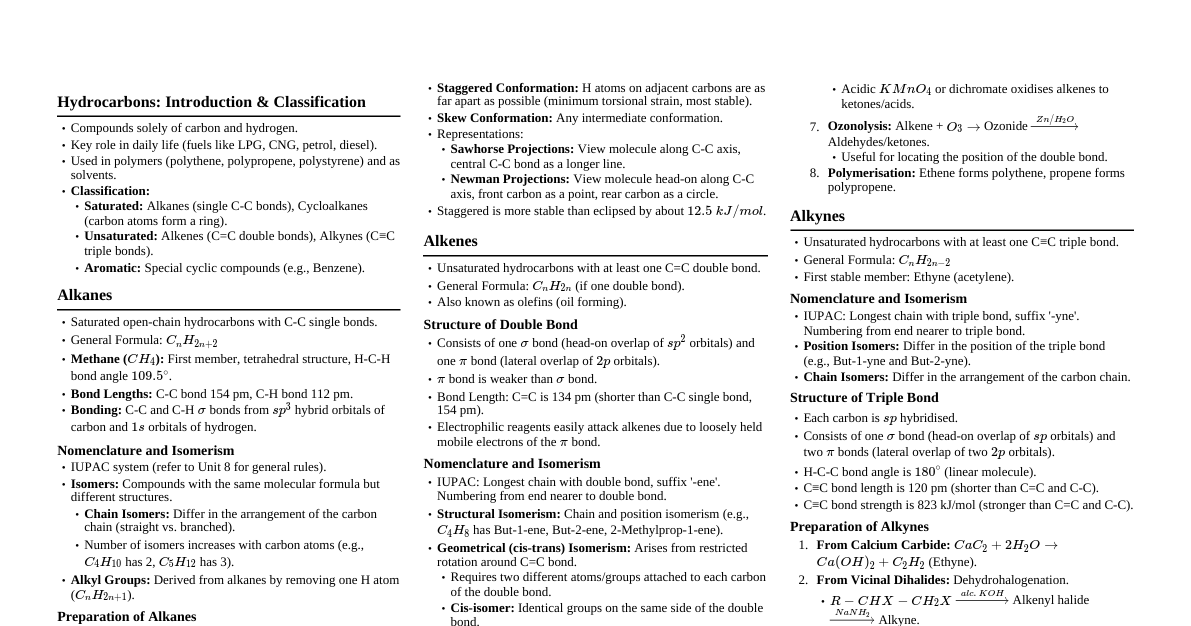
1. Carbon: The Versatile Element Atomic Number: 6 Electronic Configuration: 2, 4 (Valence electrons: 4) Nature of Bond: Forms covalent bonds by sharing electrons. Doesn't form ionic bonds (too much energy to gain/lose 4 electrons). Catenation: Unique ability of carbon atoms to form bonds with other carbon atoms, creating long chains, branched chains, and rings. This leads to a large number of carbon compounds. Tetravalency: Carbon has a valency of 4, meaning it can form four bonds with other atoms (carbon, hydrogen, oxygen, nitrogen, sulfur, chlorine, etc.). 2. Allotropes of Carbon Different structural forms of the same element with different physical properties but similar chemical properties. Diamond: Each C atom bonded to 4 other C atoms in a tetrahedral arrangement. Hardest natural substance, non-conductor of electricity. Used in cutting tools, jewelry. Graphite: Each C atom bonded to 3 other C atoms in a hexagonal planar layer. Layers held by weak forces. Soft, slippery, good conductor of electricity (due to free electrons). Used as lubricant, in pencil leads, electrodes. Fullerenes (e.g., Buckminsterfullerene, $C_{60}$): Spherical molecules resembling a football (20 hexagons, 12 pentagons). Discovery opened new areas in nanotechnology. 3. Hydrocarbons Compounds containing only carbon and hydrogen. Saturated Hydrocarbons (Alkanes): Contain only single bonds between carbon atoms. General formula: $C_nH_{2n+2}$ Examples: Methane ($CH_4$), Ethane ($C_2H_6$), Propane ($C_3H_8$). Less reactive. Unsaturated Hydrocarbons: Contain double or triple bonds between carbon atoms. Alkenes: Contain at least one carbon-carbon double bond. General formula: $C_nH_{2n}$. Examples: Ethene ($C_2H_4$), Propene ($C_3H_6$). Alkynes: Contain at least one carbon-carbon triple bond. General formula: $C_nH_{2n-2}$. Examples: Ethyne ($C_2H_2$), Propyne ($C_3H_4$). More reactive than alkanes. Cyclic Hydrocarbons: Carbon atoms form a ring structure. Cyclohexane ($C_6H_{12}$, saturated) Benzene ($C_6H_6$, unsaturated, aromatic) 4. Functional Groups An atom or group of atoms that largely determines the chemical properties of a carbon compound. Haloalkanes (-X): ($X = F, Cl, Br, I$) Example: Chloromethane ($CH_3Cl$) Alcohols (-OH): (Hydroxyl group) Example: Ethanol ($CH_3CH_2OH$) Aldehydes (-CHO): (Aldehyde group) Example: Ethanal ($CH_3CHO$) Ketones (C=O): (Ketone group, C=O within chain) Example: Propanone ($CH_3COCH_3$) Carboxylic Acids (-COOH): (Carboxyl group) Example: Ethanoic acid ($CH_3COOH$) 5. Homologous Series A series of organic compounds in which all members have the same functional group and similar chemical properties. Successive members differ by a $CH_2$ group. Example: Alkanes ($CH_4, C_2H_6, C_3H_8, ...$), Alcohols ($CH_3OH, C_2H_5OH, C_3H_7OH, ...$) Characteristics: Same general formula. Similar chemical properties. Gradual change in physical properties (e.g., melting point, boiling point increase with molecular mass). Can be prepared by similar methods. 6. Nomenclature of Carbon Compounds (IUPAC) Prefix: Indicates the number of carbon atoms. 1: Meth- 2: Eth- 3: Prop- 4: But- 5: Pent- Suffix: Indicates the type of bond or functional group. -ane (single bond, alkane) -ene (double bond, alkene) -yne (triple bond, alkyne) -ol (alcohol, -OH) -al (aldehyde, -CHO) -one (ketone, C=O) -oic acid (carboxylic acid, -COOH) Halo- (for halogens, e.g., chloro-, bromo-) Examples: $CH_3-CH_3$: Ethane $CH_2=CH_2$: Ethene $CH \equiv CH$: Ethyne $CH_3-OH$: Methanol $CH_3-COOH$: Ethanoic acid $CH_3CH_2Cl$: Chloroethane 7. Isomerism Compounds having the same molecular formula but different structural formulas. Structural Isomers: Differ in the arrangement of atoms. Example: Butane ($C_4H_{10}$) has two isomers: n-Butane ($CH_3-CH_2-CH_2-CH_3$) Isobutane (2-Methylpropane, $CH_3-CH(CH_3)-CH_3$) 8. Chemical Properties of Carbon Compounds a. Combustion Most carbon compounds burn in air (oxygen) to produce carbon dioxide, water, heat, and light. $CH_4 + 2O_2 \rightarrow CO_2 + 2H_2O + Heat + Light$ Saturated hydrocarbons usually burn with a clean blue flame. Unsaturated hydrocarbons burn with a sooty yellow flame (due to incomplete combustion). Incomplete combustion produces carbon monoxide (a poisonous gas). b. Oxidation Alcohols can be oxidized to carboxylic acids in the presence of oxidizing agents. Oxidizing agents: Acidified potassium dichromate ($K_2Cr_2O_7$) or alkaline potassium permanganate ($KMnO_4$). $CH_3CH_2OH \xrightarrow{Alkaline \; KMnO_4 / Acidified \; K_2Cr_2O_7 + Heat} CH_3COOH$ c. Addition Reaction Unsaturated hydrocarbons (alkenes, alkynes) add hydrogen in the presence of catalysts (Ni, Pd) to form saturated hydrocarbons. Used in the hydrogenation of vegetable oils to form vanaspati ghee (solid fat). $CH_2=CH_2 + H_2 \xrightarrow{Ni/Pd} CH_3-CH_3$ d. Substitution Reaction Saturated hydrocarbons (alkanes) are generally unreactive. Under sunlight, chlorine can substitute hydrogen atoms in alkanes. $CH_4 + Cl_2 \xrightarrow{Sunlight} CH_3Cl + HCl$ 9. Important Carbon Compounds a. Ethanol ($CH_3CH_2OH$) Properties: Colourless liquid, pleasant smell, burning taste, miscible with water, volatile, neutral. Uses: Solvent, in medicines (tincture of iodine, cough syrups), alcoholic beverages, fuel. Reactions: With Sodium: $2CH_3CH_2OH + 2Na \rightarrow 2CH_3CH_2ONa + H_2$ (Sodium ethoxide + Hydrogen) Dehydration: Heating with conc. $H_2SO_4$ at 443 K. $CH_3CH_2OH \xrightarrow{Conc. \; H_2SO_4, 443K} CH_2=CH_2 + H_2O$ (Ethene) Denatured Alcohol: Ethanol mixed with poisonous substances (e.g., methanol) to make it unfit for drinking. b. Ethanoic Acid ($CH_3COOH$) Properties: Colourless liquid, sour taste, pungent smell (vinegar), melting point 290 K (freezes in winter, 'glacial acetic acid'), weak acid. Uses: In vinegar (5-8% solution in water), preservative, in making esters. Reactions: Esterification: With ethanol in presence of conc. $H_2SO_4$. $CH_3COOH + CH_3CH_2OH \xrightarrow{Conc. \; H_2SO_4} CH_3COOCH_2CH_3 + H_2O$ (Ethyl ethanoate, an ester) With bases: $CH_3COOH + NaOH \rightarrow CH_3COONa + H_2O$ (Sodium ethanoate) With carbonates/bicarbonates: $2CH_3COOH + Na_2CO_3 \rightarrow 2CH_3COONa + H_2O + CO_2$ 10. Soaps and Detergents Soaps: Sodium or potassium salts of long-chain carboxylic acids. Formula: $RCOONa$ (e.g., Sodium stearate, $C_{17}H_{35}COONa$) Structure: Hydrophilic (water-loving) ionic head ($COO^-$ $Na^+$) Hydrophobic (water-hating) hydrocarbon tail ($R$) Cleaning Action (Micelle Formation): Hydrophobic tails attach to oil/grease. Hydrophilic heads point outwards towards water. Forms a spherical structure called a micelle. Micelles repel each other, preventing aggregation, and are washed away with water. Limitation: Don't work well in hard water (react with $Ca^{2+}, Mg^{2+}$ ions to form insoluble scum). Detergents: Sodium salts of long-chain benzene sulphonic acids or long-chain alkyl hydrogen sulphates. Formula: $R-SO_3Na$ (e.g., Sodium lauryl sulphate) Work effectively even in hard water as they don't form insoluble scum with hard water ions. Often used in shampoos and products for delicate fabrics.