Coordination Compounds Cheatsheet
Cheatsheet Content
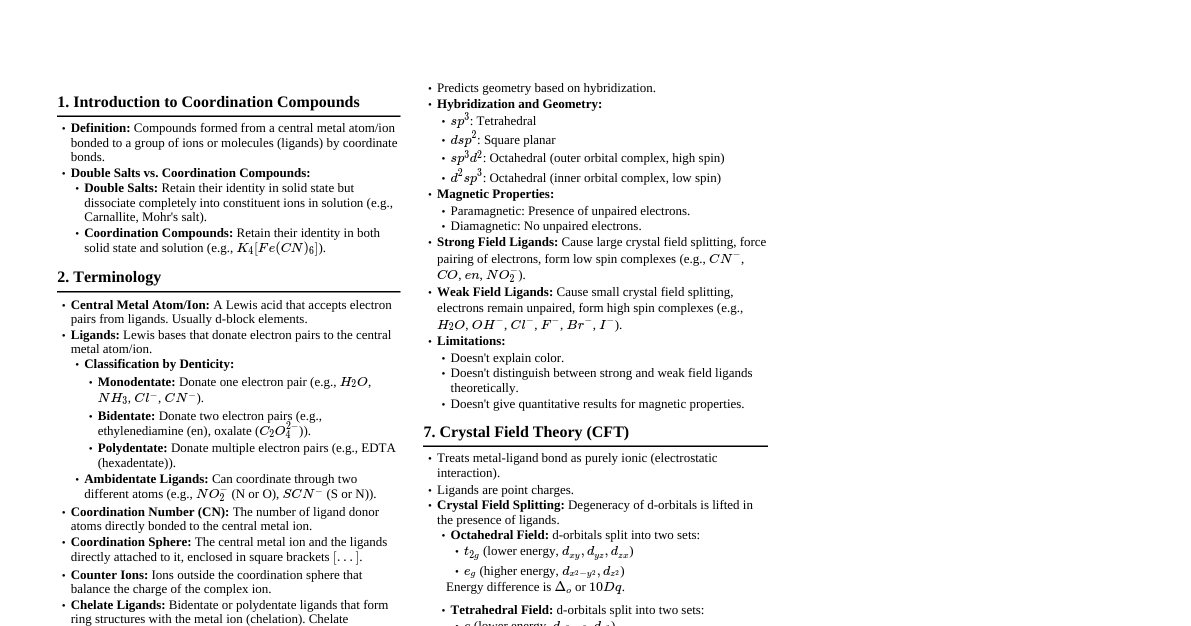
1. Introduction to Coordination Compounds Definition: Compounds formed by the combination of a metal atom/ion (central metal) with a group of anions or neutral molecules (ligands). Coordination Entity: The central metal atom/ion and the ligands attached to it. e.g., $[Co(NH_3)_6]^{3+}$ Central Metal Atom/Ion: Usually a transition metal, acts as a Lewis acid (electron pair acceptor). Ligands: Species (ions or molecules) capable of donating a pair of electrons to the central metal atom/ion. Act as Lewis bases. Coordination Number (CN): The number of ligand donor atoms directly bonded to the central metal ion. Common CNs: 2, 4, 6. Counter Ions: Ions outside the coordination sphere that balance the charge of the complex ion. e.g., in $K_4[Fe(CN)_6]$, $K^+$ are counter ions. 2. Types of Ligands Monodentate: Ligands that bind to the central metal ion through a single donor atom. Examples: $H_2O$ (aqua), $NH_3$ (ammine), $Cl^-$ (chloro), $CN^-$ (cyano), $OH^-$ (hydroxo), $CO$ (carbonyl), $NO$ (nitrosyl). Polydentate (Chelating Ligands): Ligands that bind through two or more donor atoms simultaneously. Bidentate: Two donor atoms. Examples: Ethylenediamine (en, $NH_2CH_2CH_2NH_2$), Oxalate ($C_2O_4^{2-}$), Glycinato (gly). Tridentate: Three donor atoms. Example: Diethylenetriamine (dien). Hexadentate: Six donor atoms. Example: Ethylenediaminetetraacetate (EDTA$^{4-}$). Ambidentate Ligands: Ligands that can bind through two different donor atoms. Examples: $NO_2^-$ (nitro/-O-nitrito), $SCN^-$ (thiocyanato/-isothiocyanato), $CN^-$ (cyano/-isocyano). 3. Nomenclature of Coordination Compounds (IUPAC) Cation is named first, then anion (if present). Ligands are named first (alphabetically), followed by the central metal ion. Ligand names: Anionic ligands end in '-o' (e.g., $Cl^-$: chloro, $OH^-$: hydroxo, $SO_4^{2-}$: sulfato, $CN^-$: cyano). Neutral ligands are named as the molecule (e.g., $NH_3$: ammine, $H_2O$: aqua, $CO$: carbonyl, $NO$: nitrosyl). Prefixes for number of ligands: di-, tri-, tetra-, etc. For polydentate ligands or when ligand name already contains a prefix, use bis-, tris-, tetrakis-. e.g., $bis(ethylenediamine)$ Oxidation state of the central metal ion is indicated by Roman numeral in parentheses after its name. If the complex is an anion, the metal name ends with '-ate' (e.g., ferrate for Fe, cobaltate for Co). If the complex is neutral or cationic, the metal name is unchanged. Examples: $[Co(NH_3)_6]Cl_3$: Hexaamminecobalt(III) chloride $K_4[Fe(CN)_6]$: Potassium hexacyanoferrate(II) $[Ni(CO)_4]$: Tetracarbonylnickel(0) $[Pt(NH_3)_2Cl_2]$: Diamminedichloroplatinum(II) 4. Isomerism in Coordination Compounds A. Structural Isomerism (Constitutional Isomerism) Ionization Isomerism: Isomers that produce different ions in solution, arising from the exchange of an ion in the coordination sphere with an ion outside the coordination sphere. Example: $[Co(NH_3)_5Br]SO_4$ (pentaamminebromocobalt(III) sulfate) and $[Co(NH_3)_5SO_4]Br$ (pentaamminesulfatocobalt(III) bromide). Hydrate Isomerism: A specific type of ionization isomerism where water is involved as a ligand or as solvent molecule. Example: $[Cr(H_2O)_6]Cl_3$ (violet), $[Cr(H_2O)_5Cl]Cl_2 \cdot H_2O$ (blue-green), $[Cr(H_2O)_4Cl_2]Cl \cdot 2H_2O$ (dark green). Linkage Isomerism: Arises when an ambidentate ligand is bonded to the central metal ion through different donor atoms. Example: $[Co(NH_3)_5NO_2]^{2+}$ (nitro, Co-N bond) and $[Co(NH_3)_5ONO]^{2+}$ (nitrito, Co-O bond). Coordination Isomerism: Occurs in compounds containing both cationic and anionic complex ions, due to the interchange of ligands between the two complex entities. Example: $[Co(NH_3)_6][Cr(CN)_6]$ and $[Cr(NH_3)_6][Co(CN)_6]$. B. Stereoisomerism (Space Isomerism) Geometrical Isomerism (cis-trans Isomerism): Arises due to different possible arrangements of ligands around the central metal atom in space. Common in square planar ($MA_2B_2$, $MABCD$) and octahedral ($MA_4B_2$, $MA_3B_3$) complexes. Square Planar ($MA_2B_2$): cis: Identical ligands adjacent ($90^\circ$). trans: Identical ligands opposite ($180^\circ$). Example: $[Pt(NH_3)_2Cl_2]$ (cis-platin, trans-platin). Octahedral ($MA_4B_2$): cis: Two identical ligands at $90^\circ$. trans: Two identical ligands at $180^\circ$. Octahedral ($MA_3B_3$ - facial/meridional): facial (fac): Three identical ligands occupy adjacent positions on an octahedron face. meridional (mer): Three identical ligands occupy positions around the meridian of the octahedron. Optical Isomerism (Enantiomerism): Occurs when a complex and its mirror image are non-superimposable. Such complexes are chiral and rotate plane-polarized light. Common in octahedral complexes, especially those with bidentate ligands (e.g., $[Co(en)_3]^{3+}$). Square planar complexes usually do not show optical isomerism unless they contain asymmetric ligands. 5. Werner's Theory of Coordination Compounds Proposed two types of valencies: Primary Valency (Ionizable Valency): Corresponds to the oxidation state of the central metal ion. Satisfied by anions. Secondary Valency (Non-ionizable Valency): Corresponds to the coordination number of the central metal ion. Satisfied by ligands (anions or neutral molecules). The secondary valencies are directed towards fixed positions in space, giving a definite geometry to the complex. 6. Valence Bond Theory (VBT) Explains bonding in coordination compounds based on hybridization. Assumes the central metal atom/ion provides empty hybrid orbitals to accept electron pairs from ligands. The number of hybrid orbitals equals the coordination number. Hybridization and Geometry: CN = 2: $sp$, Linear CN = 4: $sp^3$, Tetrahedral (outer orbital complex) or $dsp^2$, Square Planar (inner orbital complex) CN = 6: $sp^3d^2$, Octahedral (outer orbital complex) or $d^2sp^3$, Octahedral (inner orbital complex) Magnetic Properties: Paramagnetic: Presence of unpaired electrons. Diamagnetic: All electrons are paired. Magnetic moment, $\mu = \sqrt{n(n+2)}$ BM (Bohr Magnetons), where $n$ is the number of unpaired electrons. Limitations: Does not explain the color of complexes. Does not distinguish between strong and weak field ligands. Does not give quantitative interpretation of magnetic data. Does not predict distortion from regular geometries. 7. Crystal Field Theory (CFT) Treats the metal-ligand bond as purely ionic, arising from electrostatic attraction between the metal ion and the ligands (point charges). Focuses on the effect of ligands on the d-orbitals of the central metal ion. In a free metal ion, the five d-orbitals are degenerate. In the presence of ligands, the d-orbitals split into different energy levels. This splitting is called Crystal Field Splitting. Octahedral Complexes: The five d-orbitals split into two sets: $t_{2g}$ set (lower energy): $d_{xy}, d_{yz}, d_{zx}$ $e_g$ set (higher energy): $d_{x^2-y^2}, d_{z^2}$ Energy difference = $\Delta_o$ (Crystal Field Stabilization Energy for Octahedral). For $t_{2g}$ orbitals, energy is $-0.4\Delta_o$. For $e_g$ orbitals, energy is $+0.6\Delta_o$. Electron Distribution: Depends on $\Delta_o$ and pairing energy (P). Strong field ligands: Large $\Delta_o > P$. Electrons pair up in $t_{2g}$ before occupying $e_g$. (Low spin complexes). Weak field ligands: Small $\Delta_o Tetrahedral Complexes: The five d-orbitals split into two sets: $e$ set (lower energy): $d_{x^2-y^2}, d_{z^2}$ $t_2$ set (higher energy): $d_{xy}, d_{yz}, d_{zx}$ Energy difference = $\Delta_t$. Generally, $\Delta_t = \frac{4}{9}\Delta_o$. Crystal field splitting is smaller than in octahedral complexes. Always high spin complexes (pairing energy usually greater than $\Delta_t$). Square Planar Complexes: Splitting pattern is more complex, typically: $d_{x^2-y^2} \gg d_{xy} > d_{z^2} > d_{xz}, d_{yz}$. Usually strong field ligands and low spin complexes. Spectrochemical Series (Ligand Strength): $I^- Weak field $\leftarrow \text{Increasing Field Strength} \rightarrow$ Strong field Color of Coordination Compounds: Due to d-d transitions (absorption of light in visible region, excitation of electrons from lower energy d-orbitals to higher energy d-orbitals). The observed color is the complementary color of the absorbed light. Limitations: Does not account for the covalent character of bonding. Considers ligands as point charges, not differentiating between bonding abilities of various ligands. Does not explain why some ligands like CO and CN- exert such strong fields. 8. Bonding in Metal Carbonyls Metal carbonyls contain transition metals bonded to carbon monoxide (CO) ligands. Bonding involves both $\sigma$ (ligand to metal) and $\pi$ (metal to ligand) interactions. Synergic Bonding: CO donates a lone pair of electrons from its sigma orbital to the empty orbital of the metal (M $\leftarrow$ CO $\sigma$ bond). The metal then back-donates electrons from its filled d-orbitals to the vacant antibonding $\pi^*$ orbitals of CO (M $\rightarrow$ CO $\pi$ bond). This synergic effect strengthens both the M-C bond and weakens the C-O bond (indicated by increased C-O bond length and decreased C-O stretching frequency in IR). Examples: $[Ni(CO)_4]$ (tetrahedral), $[Fe(CO)_5]$ (trigonal bipyramidal), $[Cr(CO)_6]$ (octahedral). 9. Stability of Coordination Compounds Thermodynamic Stability: Refers to the extent to which a complex will form or dissociate at equilibrium. Stability Constant (Formation Constant, $K_f$ or $\beta$): For a reaction like $M^{n+} + 4L \rightleftharpoons ML_4^{n+}$ $K_f = \frac{[ML_4^{n+}]}{[M^{n+}][L]^4}$ Higher $K_f$ means greater stability. Stepwise Formation Constants ($K_1, K_2, ...$): $M + L \rightleftharpoons ML \quad K_1 = [ML]/([M][L])$ $ML + L \rightleftharpoons ML_2 \quad K_2 = [ML_2]/([ML][L])$ ... Overall stability constant $\beta_n = K_1 \times K_2 \times ... \times K_n$. Factors Affecting Stability: Charge on the metal ion: Higher the charge, greater the stability. Size of the metal ion: Smaller the size, greater the stability. Nature of ligand: Basic ligands form more stable complexes. Chelating ligands form more stable complexes (chelate effect). Kinetic Stability (Lability and Inertness): Refers to the speed at which a complex undergoes ligand exchange reactions. Labile: Complexes that undergo rapid ligand exchange. Inert: Complexes that undergo slow ligand exchange. 10. Applications of Coordination Compounds Biological Systems: Chlorophyll (Mg complex) in photosynthesis. Hemoglobin (Fe complex) for oxygen transport. Vitamin B-12 (Co complex) for various metabolic processes. Analytical Chemistry: Detection and estimation of metal ions (e.g., EDTA for hardness of water). Metallurgy: Extraction of metals (e.g., Ag and Au by cyanide process). Purification of metals (e.g., Mond's process for Ni). Medicine: Cis-platin for cancer treatment. EDTA for treating lead poisoning. Catalysis: Wilkinson's catalyst ($[RhCl(PPh_3)_3]$) for hydrogenation of alkenes.