Carbon and Its Compounds (CHEM)
Cheatsheet Content
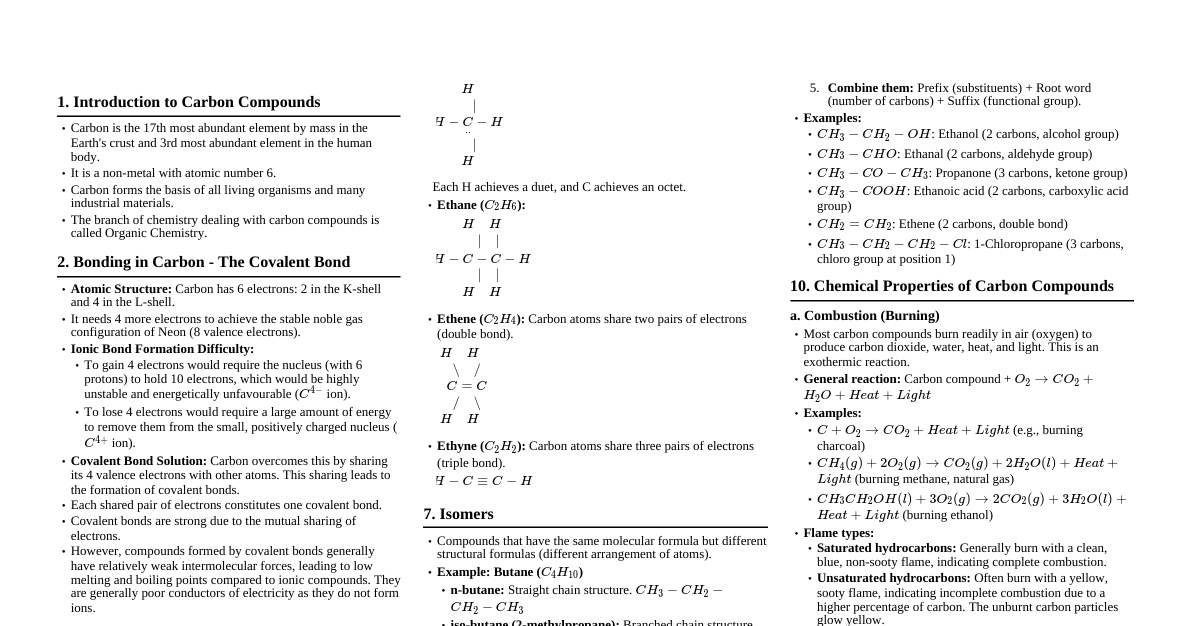
1. Introduction to Carbon: The Backbone of Life Carbon is a unique and fundamental element, serving as the chemical basis for all known life on Earth. Its ability to form a vast array of stable and diverse compounds is unparalleled. Abundance: In Earth's crust: Approximately 0.02% by mass, primarily found in minerals like carbonates (e.g., limestone, marble, dolomite), coal, petroleum, and natural gas. In the atmosphere: Approximately 0.03% carbon dioxide ($CO_2$), a crucial component for photosynthesis and a greenhouse gas. Its central role in organic chemistry makes it indispensable for understanding biological processes and many synthetic materials. 2. The Nature of Bonding in Carbon: Covalent Bonds 2.1 Fundamental Properties and Electron Configuration Carbon compounds exhibit distinctive physical properties: Low melting and boiling points: This indicates relatively weak intermolecular forces between molecules, requiring less energy to overcome them during phase changes. Poor electrical conductivity: This suggests the absence of free ions or delocalized electrons that can carry charge. These properties are characteristic of compounds formed by covalent bonding . Atomic Structure of Carbon: Atomic Number: 6 (meaning 6 protons and 6 electrons). Electronic Configuration: 2 electrons in the first shell, 4 electrons in the outermost (valence) shell. To achieve a stable noble gas configuration (like Neon, with 8 valence electrons), carbon needs to gain or lose 4 electrons. Challenges with Ionic Bonding for Carbon: Gaining 4 electrons: Forming a $C^{4-}$ anion would require the nucleus (with only 6 protons) to hold onto 10 electrons. The strong electrostatic repulsion between these electrons would make this highly unstable and energetically unfavorable. Losing 4 electrons: Forming a $C^{4+}$ cation would require an enormous amount of energy to remove all four valence electrons from the relatively small carbon atom. Solution: Covalent Bonding: Carbon overcomes these energetic hurdles by sharing its valence electrons with other atoms. This sharing allows both participating atoms to achieve a stable octet (or duet in the case of hydrogen) configuration in their outermost shells, leading to the formation of strong covalent bonds . 2.2 Illustrative Examples of Covalent Bond Formation Hydrogen Molecule ($H_2$): Each hydrogen atom has 1 electron and needs 1 more to complete its first shell (duet rule, like Helium). They share one pair of electrons, forming a single covalent bond . Electron dot structure: $H \cdot + \cdot H \rightarrow H:H$ Oxygen Molecule ($O_2$): Each oxygen atom has 6 valence electrons and needs 2 more to complete its octet. They share two pairs of electrons, forming a double covalent bond . Electron dot structure: $:O::O:$ Nitrogen Molecule ($N_2$): Each nitrogen atom has 5 valence electrons and needs 3 more to complete its octet. They share three pairs of electrons, forming a triple covalent bond . Electron dot structure: $:N:::N:$ Methane ($CH_4$): A Carbon Compound Example Carbon has 4 valence electrons; each hydrogen has 1. Carbon shares one of its electrons with each of the four hydrogen atoms, and each hydrogen shares its electron with carbon. This results in the formation of four single covalent bonds , where carbon achieves an octet and each hydrogen achieves a duet. Electron dot structure: H | H:C:H | H Key Characteristics of Covalently Bonded Molecules: Strong Intramolecular Bonds: The covalent bonds within the molecule are very strong, holding the atoms together tightly. Weak Intermolecular Forces: The forces between individual molecules are generally much weaker than ionic or metallic bonds. This accounts for their low melting/boiling points. Poor Electrical Conductivity: Electrons are localized in the shared bonds and are not free to move, hence they do not conduct electricity (with exceptions like graphite). 2.3 Allotropes of Carbon: Different Forms, Same Element Allotropes are different structural forms of the same element, exhibiting different physical properties but identical chemical properties (since they are the same element). Diamond: Structure: Each carbon atom is covalently bonded to four other carbon atoms in a tetrahedral arrangement, forming a giant three-dimensional network structure. Properties: This rigid, extensive bonding makes diamond incredibly hard (the hardest known natural substance) and gives it a high melting point. All valence electrons are involved in bonding, so there are no free electrons, making it a poor conductor of electricity. Graphite: Structure: Each carbon atom is covalently bonded to three other carbon atoms in the same plane, forming hexagonal rings arranged in layers. The layers are held together by weak intermolecular forces. Within each layer, one of the bonds has some double bond character, meaning electrons are delocalized over the sheet. Properties: The weak forces between layers allow them to slide past each other, making graphite soft and slippery (used as a lubricant). The delocalized electrons within the layers allow it to conduct electricity, making it a good conductor. Fullerenes (e.g., Buckminsterfullerene, $C_{60}$): Structure: Carbon atoms are arranged in spherical, ellipsoidal, or tubular forms. For $C_{60}$, 60 carbon atoms are arranged in a closed cage-like structure resembling a football, composed of 12 pentagons and 20 hexagons. Properties: These are discrete molecules rather than giant networks. They exhibit unique properties and have potential applications in nanotechnology and medicine. 3. The Versatile Nature of Carbon: Why So Many Compounds? 3.1 Key Factors Driving Carbon's Diversity Catenation: The Self-Linking Ability Carbon possesses a unique and remarkable ability to form strong covalent bonds with other carbon atoms. This property, known as catenation , allows it to create long chains, branched chains, and closed rings of varying sizes. Carbon-carbon bonds are exceptionally strong and stable, contributing to the stability of these large molecules. Carbon can form single ($C-C$), double ($C=C$), and triple ($C \equiv C$) bonds with other carbon atoms, further increasing the diversity of structures. While other elements like silicon also exhibit catenation, their chains are generally much shorter and less stable due to weaker element-element bonds. Tetravalency: Four Available Bonds With a valency of four, each carbon atom can form covalent bonds with up to four other atoms. This allows it to bond not only with other carbon atoms but also with a wide range of other elements, including hydrogen, oxygen, nitrogen, sulfur, and halogens (chlorine, bromine, iodine). The small size of the carbon atom plays a crucial role; it allows the nucleus to exert a strong attraction on the shared pairs of electrons, resulting in very strong and stable bonds with other atoms. This stability is essential for the complexity of organic molecules. Organic Compounds: The vast majority of carbon compounds (excluding a few simple inorganic ones like carbonates, carbides, and oxides of carbon) are classified as organic compounds and are the subject of organic chemistry. 3.2 Saturated and Unsaturated Carbon Compounds Saturated Compounds: These are carbon compounds where all the carbon-carbon bonds are single bonds . This means each carbon atom is bonded to the maximum possible number of hydrogen atoms (or other atoms), and no more atoms can be added to the molecule. Examples: Alkanes like Methane ($CH_4$), Ethane ($C_2H_6$), Propane ($C_3H_8$). Reactivity: Saturated compounds are generally less reactive due to the strength and stability of their single bonds. Unsaturated Compounds: These are carbon compounds that contain one or more double bonds ($C=C$) or triple bonds ($C \equiv C$) between carbon atoms. These multiple bonds mean the carbon atoms are not bonded to the maximum number of other atoms, and additional atoms can be added across the multiple bond. Examples: Alkenes (contain $C=C$ double bonds), e.g., Ethene ($C_2H_4$). Alkynes (contain $C \equiv C$ triple bonds), e.g., Ethyne ($C_2H_2$). Reactivity: Unsaturated compounds are generally more reactive than saturated compounds because the multiple bonds are sites of higher electron density and can undergo addition reactions. 3.3 Structural Variations: Chains, Branches, and Rings The catenation property allows carbon atoms to arrange themselves in diverse structural forms: Straight chains: Carbon atoms are linked linearly. E.g., Butane ($CH_3-CH_2-CH_2-CH_3$). Branched chains: Carbon atoms form a main chain with side chains (branches) attached. E.g., Isobutane (2-methylpropane). Rings (Cyclic compounds): Carbon atoms form a closed loop. E.g., Cyclohexane ($C_6H_{12}$), Benzene ($C_6H_6$). Structural Isomers: A fascinating consequence of carbon's versatility is isomerism. Structural isomers are compounds that have the exact same molecular formula (same number and type of atoms) but differ in the way these atoms are connected or arranged in space, leading to different structural formulas and often different physical and chemical properties. Example: Butane ($C_4H_{10}$) has two structural isomers: n-butane (a straight chain) and isobutane (a branched chain, also called 2-methylpropane). 3.4 Hydrocarbons: The Simplest Organic Compounds Hydrocarbons are organic compounds composed exclusively of carbon and hydrogen atoms. They form the fundamental building blocks from which more complex organic molecules are derived. Classification of Hydrocarbons: Alkanes: Nature: Saturated hydrocarbons, containing only carbon-carbon single bonds. General Formula: $C_nH_{2n+2}$ (where $n$ is the number of carbon atoms). Examples: Methane ($CH_4$), Ethane ($C_2H_6$), Propane ($C_3H_8$). Alkenes: Nature: Unsaturated hydrocarbons possessing at least one carbon-carbon double bond ($C=C$). General Formula: $C_nH_{2n}$ (for compounds with one double bond). Examples: Ethene ($C_2H_4$), Propene ($C_3H_6$). Alkynes: Nature: Unsaturated hydrocarbons possessing at least one carbon-carbon triple bond ($C \equiv C$). General Formula: $C_nH_{2n-2}$ (for compounds with one triple bond). Examples: Ethyne ($C_2H_2$), Propyne ($C_3H_4$). 3.5 Heteroatoms and Functional Groups: Modifying Hydrocarbons Heteroatom: An atom other than carbon or hydrogen that is present in an organic molecule. Common heteroatoms include oxygen (O), nitrogen (N), sulfur (S), and halogens (F, Cl, Br, I). When a heteroatom replaces one or more hydrogen atoms in a hydrocarbon chain, it significantly alters the compound's properties. Functional Group: A specific atom or a group of atoms (often containing heteroatoms, or specific bonding patterns like double/triple bonds) within a molecule that is responsible for the characteristic chemical reactions and properties of that molecule. The presence of a functional group dictates how a compound will react, largely independent of the length or structure of the hydrocarbon chain it is attached to. Heteroatom(s) Class of Compounds Functional Group Formula Example (3-carbon chain) Cl / Br Haloalkane -Cl, -Br (Prefix: Chloro-, Bromo-) Chloropropane ($CH_3CH_2CH_2Cl$) Oxygen Alcohol -OH (Suffix: -ol) Propanol ($CH_3CH_2CH_2OH$) Aldehyde -CHO (Suffix: -al) Propanal ($CH_3CH_2CHO$) Ketone $C=O$ (Suffix: -one) Propanone ($CH_3COCH_3$) Carboxylic acid -COOH (Suffix: -oic acid) Propanoic acid ($CH_3CH_2COOH$) 3.6 Homologous Series: A Systematic Classification A homologous series is a family of organic compounds in which all members have the same general formula, the same functional group, and similar chemical properties. Each successive member in the series differs from the next by a -$CH_2$- group. Key Characteristics of a Homologous Series: Same General Formula: All members can be represented by a single general formula (e.g., alkanes: $C_nH_{2n+2}$). Gradation in Physical Properties: As the molecular mass increases with each -$CH_2$- unit, there is a regular and predictable change in physical properties such as melting point, boiling point, and density. Typically, these properties increase with increasing molecular size. Similar Chemical Properties: Since all members possess the same functional group, they undergo similar chemical reactions. The reactivity is primarily determined by the functional group. Successive members differ by a -$CH_2$- unit: For example, methane ($CH_4$) and ethane ($C_2H_6$) differ by one -$CH_2$- group; ethane and propane ($C_3H_8$) also differ by one -$CH_2$- group. Examples: Alkanes: Methane ($CH_4$), Ethane ($C_2H_6$), Propane ($C_3H_8$), Butane ($C_4H_{10}$), etc. Alcohols: Methanol ($CH_3OH$), Ethanol ($C_2H_5OH$), Propanol ($C_3H_7OH$), etc. Alkenes: Ethene ($C_2H_4$), Propene ($C_3H_6$), Butene ($C_4H_8$), etc. 3.7 Nomenclature of Carbon Compounds: Naming Rules (IUPAC) Systematic naming of organic compounds follows rules set by the International Union of Pure and Applied Chemistry (IUPAC). The name of a carbon compound is derived based on the number of carbon atoms in the longest continuous chain and the type of functional group present. General Steps for Naming: Identify the parent chain: Determine the longest continuous carbon chain. The number of carbons in this chain gives the root name (e.g., meth- for 1, eth- for 2, prop- for 3, but- for 4, pent- for 5, hex- for 6). Identify the functional group: Determine the main functional group present in the molecule. This will dictate the suffix or prefix. Determine saturation: If only single bonds (alkane), use '-ane'. If a double bond is present (alkene), use '-ene'. If a triple bond is present (alkyne), use '-yne'. Combine root, saturation, and functional group: If the functional group is a suffix (e.g., -ol, -al, -one, -oic acid), replace the final 'e' of the alkane/alkene/alkyne name with the functional group suffix. Example: Propan e + -ol $\rightarrow$ Propanol. Example: Propan e + -one $\rightarrow$ Propanone. Example: Ethan e + -oic acid $\rightarrow$ Ethanoic acid. If the functional group is a prefix (e.g., haloalkanes), add the prefix before the alkane/alkene/alkyne name. Example: Chloro- + propane $\rightarrow$ Chloropropane. Numbering (for longer chains and position of groups): For longer chains or multiple functional groups/substituents, numbers are used to indicate their positions. (More advanced IUPAC rule). Common Functional Group Naming Conventions: Functional Group Prefix (if any) Suffix (if any) Example (3-carbon chain) -Cl (Chloro) Chloro- - Chloropropane -Br (Bromo) Bromo- - Bromopropane -OH (Hydroxyl) Hydroxy- -ol Propanol -CHO (Aldehyde) Formyl- -al Propanal $C=O$ (Ketone) Oxo- -one Propanone -COOH (Carboxyl) Carboxy- -oic acid Propanoic acid $C=C$ (Alkene) - -ene Propene $C \equiv C$ (Alkyne) - -yne Propyne 4. Chemical Properties of Carbon Compounds 4.1 Combustion: Burning of Carbon Compounds Definition: Combustion is a chemical process involving rapid reaction between a substance with an oxidant, usually oxygen, to produce heat and light (and often flame). Carbon and its compounds are excellent fuels because they readily burn in the presence of oxygen, releasing significant amounts of energy. General Reaction: Carbon compound + $O_2 \rightarrow CO_2 + H_2O + \text{Heat} + \text{Light}$ Examples: Pure Carbon: $C(s) + O_2(g) \rightarrow CO_2(g) + \text{Heat and light}$ Methane (Natural Gas): $CH_4(g) + 2O_2(g) \rightarrow CO_2(g) + 2H_2O(g) + \text{Heat and light}$ Ethanol: $CH_3CH_2OH(l) + 3O_2(g) \rightarrow 2CO_2(g) + 3H_2O(g) + \text{Heat and light}$ Nature of Flame: The appearance of the flame during combustion provides clues about the compound and oxygen supply. Saturated Hydrocarbons (e.g., alkanes): Typically burn with a clean, blue, non-sooty flame when there is a sufficient supply of oxygen. This indicates complete combustion. Unsaturated Hydrocarbons (e.g., alkenes, alkynes): Often burn with a yellow, sooty flame, producing black smoke. This is because the higher percentage of carbon in these compounds, relative to hydrogen, makes complete combustion more difficult. Unburnt carbon particles glow yellow and are released as soot. Limited Air Supply: Even saturated hydrocarbons will burn with a yellow, sooty flame if the oxygen supply is insufficient, leading to incomplete combustion and the formation of carbon monoxide (CO) and soot (unburnt carbon). Pollution: Fuels like coal and petroleum contain small amounts of nitrogen and sulfur. Their combustion produces oxides of sulfur ($SO_x$) and nitrogen ($NO_x$), which are major air pollutants and contribute to acid rain. Flame vs. Glowing: A flame is produced when gaseous substances burn, or when volatile substances vaporize and burn. A luminous flame results from the incandescence of tiny, hot, unburnt carbon particles. Solid fuels like coal or charcoal often simply glow red hot as they burn, without producing a visible flame, unless they are heated sufficiently to produce volatile gases. 4.2 Oxidation: Adding Oxygen to Carbon Compounds Definition: Oxidation in organic chemistry often refers to the gain of oxygen atoms or the loss of hydrogen atoms. Carbon compounds, particularly alcohols, can be readily oxidized. Conversion of Alcohols to Carboxylic Acids: This is a common and important oxidation reaction. Oxidizing Agents: Substances that facilitate the oxidation of another substance while themselves being reduced. Common strong oxidizing agents used for this conversion include: Alkaline potassium permanganate ($KMnO_4$) - purple solution. Acidified potassium dichromate ($K_2Cr_2O_7$) - orange solution. These oxidizing agents provide the necessary oxygen atoms. Example: Ethanol is oxidized to ethanoic acid. $CH_3CH_2OH \xrightarrow{\text{Alkaline } KMnO_4 \text{ or acidified } K_2Cr_2O_7 + \text{heat}} CH_3COOH$ (Ethanol) $\rightarrow$ (Ethanoic Acid) The oxidizing agent itself changes color during the reaction (e.g., purple $KMnO_4$ decolors, orange $K_2Cr_2O_7$ turns green), serving as a test for the presence of compounds that can be oxidized. 4.3 Addition Reaction: Saturating Unsaturated Compounds Definition: Addition reactions are characteristic of unsaturated compounds (those with double or triple bonds). In these reactions, atoms or groups of atoms are added across the multiple bond, breaking the pi ($\pi$) bond and forming new single ($\sigma$) bonds, thereby converting an unsaturated compound into a saturated one. Hydrogenation: The most common type of addition reaction, where hydrogen gas ($H_2$) is added across a double or triple bond. Conditions: This reaction typically requires a catalyst (such as finely divided Palladium (Pd), Nickel (Ni), or Platinum (Pt)) and often elevated temperature and pressure. General Reaction: $C=C \text{ (or } C \equiv C) + H_2 \xrightarrow{\text{Ni catalyst, Heat}} C-C$ Example: Ethene (an alkene) reacts with hydrogen to form ethane (an alkane). $CH_2=CH_2 + H_2 \xrightarrow{\text{Ni}} CH_3-CH_3$ Industrial Application: Hydrogenation of Vegetable Oils: Vegetable oils are generally unsaturated fatty acids, containing long carbon chains with several carbon-carbon double bonds. They are typically liquid at room temperature. Animal fats are generally saturated fatty acids, containing mostly carbon-carbon single bonds. They are typically solid at room temperature. The process of hydrogenating vegetable oils involves passing hydrogen gas through the oil in the presence of a nickel catalyst. This converts some of the double bonds to single bonds, making the oil more saturated and solidifying it into vegetable ghee (vanaspati). From a health perspective, unsaturated fatty acids (from vegetable oils) are generally considered healthier than saturated fatty acids (from animal fats), as excessive consumption of saturated fats is linked to cardiovascular diseases. Catalysts: Substances that increase the rate of a chemical reaction without being consumed in the reaction itself. They provide an alternative reaction pathway with a lower activation energy. 4.4 Substitution Reaction: Replacing Atoms in Saturated Compounds Definition: Substitution reactions are characteristic of saturated compounds (like alkanes) where one or more hydrogen atoms are replaced by other atoms or groups of atoms. Reactivity: Saturated hydrocarbons are generally quite unreactive and do not readily undergo reactions with many reagents. However, under specific conditions, they can react. Reaction with Halogens: In the presence of sunlight (or UV light), halogens (like chlorine, $Cl_2$, or bromine, $Br_2$) can react with alkanes. This reaction proceeds via a free radical mechanism, where the energy from sunlight initiates the breaking of the halogen bond. Hydrogen atoms in the alkane are successively replaced by halogen atoms. Example: Methane reacts with chlorine in the presence of sunlight. $CH_4 + Cl_2 \xrightarrow{\text{sunlight}} CH_3Cl + HCl$ (Chloromethane) Further substitution can occur: $CH_3Cl + Cl_2 \xrightarrow{\text{sunlight}} CH_2Cl_2 + HCl$ (Dichloromethane) $CH_2Cl_2 + Cl_2 \xrightarrow{\text{sunlight}} CHCl_3 + HCl$ (Trichloromethane or Chloroform) $CHCl_3 + Cl_2 \xrightarrow{\text{sunlight}} CCl_4 + HCl$ (Tetrachloromethane or Carbon Tetrachloride) Because multiple products can form, substitution reactions can sometimes be less useful for synthesizing a single desired product in high purity, especially with higher homologs of alkanes. 5. Important Carbon Compounds: Ethanol and Ethanoic Acid 5.1 Ethanol ($CH_3CH_2OH$) Common Names: Ethyl alcohol, Grain alcohol. Properties and Uses: Active Ingredient: It is the intoxicating component in all alcoholic beverages (beer, wine, spirits). Excellent Solvent: Due to its ability to dissolve both polar and nonpolar substances, it is widely used as a solvent in industry and in pharmaceutical preparations. Medicinal Applications: Found in tincture of iodine (an antiseptic), many cough syrups, and tonics. It's also used as a disinfectant. Miscibility: Ethanol is completely miscible with water in all proportions, forming a homogeneous solution. Physiological Effects: Consumption of small amounts leads to drunkenness, impaired judgment, and reduced coordination. Ingestion of pure ethanol (absolute alcohol, 100% ethanol) is highly dangerous and can be lethal. Chronic consumption of alcohol causes severe liver damage, nervous system damage, and other health issues. Methanol Poisoning: Methanol ($CH_3OH$) is another alcohol that is highly poisonous. Even small amounts can cause blindness and death. Denatured Alcohol: Industrial ethanol is often denatured to prevent its misuse as a beverage. This involves adding small amounts of poisonous substances (like methanol), pyridine, or dyes to make it unfit for drinking. Fuel: Ethanol is increasingly used as a fuel or fuel additive (e.g., in gasohol) in some countries due to its cleaner burning properties compared to gasoline and its renewable source (fermentation of biomass). Reactions of Ethanol: 1. Reaction with Sodium: Ethanol reacts with active metals like sodium to produce hydrogen gas and sodium ethoxide (a salt). This is a characteristic reaction of alcohols, demonstrating the slightly acidic nature of the hydroxyl group. $2Na(s) + 2CH_3CH_2OH(l) \rightarrow 2CH_3CH_2O^-Na^+(aq) + H_2(g)$ (Sodium) + (Ethanol) $\rightarrow$ (Sodium Ethoxide) + (Hydrogen gas) 2. Dehydration (Elimination Reaction): When ethanol is heated with an excess of concentrated sulphuric acid ($H_2SO_4$) at 443 K (170°C), it undergoes dehydration. A molecule of water is removed from the ethanol molecule, forming ethene (an alkene). Concentrated $H_2SO_4$ acts as a strong dehydrating agent , meaning it removes water from other compounds. $CH_3CH_2OH \xrightarrow{\text{Conc. } H_2SO_4, 443K} CH_2=CH_2 + H_2O$ (Ethanol) $\rightarrow$ (Ethene) + (Water) 5.2 Ethanoic Acid ($CH_3COOH$) Common Names: Acetic acid. Properties and Uses: Carboxylic Acid: It is the second simplest carboxylic acid. Vinegar: A 5-8% solution of ethanoic acid in water is known as vinegar, which is widely used as a food preservative and flavoring agent. Melting Point: Pure ethanoic acid has a melting point of 290 K (17°C). In cold climates, it freezes into an ice-like solid, hence it is often called glacial acetic acid . Acid Strength: Ethanoic acid is a weak acid . Unlike strong mineral acids (e.g., HCl, $H_2SO_4$) which completely dissociate in water, ethanoic acid only partially dissociates, releasing fewer $H^+$ ions. Reactions of Ethanoic Acid: 1. Esterification Reaction: Ethanoic acid reacts with alcohols (like ethanol) in the presence of an acid catalyst (usually concentrated $H_2SO_4$) to form an ester and water. This reaction is reversible. $CH_3COOH(l) + CH_3CH_2OH(l) \xrightarrow{\text{Acid catalyst}} CH_3COOCH_2CH_3(l) + H_2O(l)$ (Ethanoic Acid) + (Ethanol) $\rightleftharpoons$ (Ethyl Ethanoate) + (Water) Esters: These are sweet-smelling substances and are responsible for the characteristic fragrances of fruits and flowers. They are used in perfumes, flavoring agents, and in the production of synthetic fabrics. 2. Saponification: The reverse reaction of esterification, where an ester is hydrolyzed (broken down by water) in the presence of a base (like NaOH) to produce the parent alcohol and the sodium salt of the carboxylic acid. This process is used in the manufacture of soap. $CH_3COOCH_2CH_3 + NaOH \rightarrow CH_3CH_2OH + CH_3COONa$ (Ethyl Ethanoate) + (Sodium Hydroxide) $\rightarrow$ (Ethanol) + (Sodium Ethanoate, a soap) 3. Reaction with a Base: Like other acids, ethanoic acid reacts with bases (metal hydroxides) to form a salt and water (a neutralization reaction). $CH_3COOH + NaOH \rightarrow CH_3COONa + H_2O$ (Ethanoic Acid) + (Sodium Hydroxide) $\rightarrow$ (Sodium Ethanoate) + (Water) 4. Reaction with Carbonates and Hydrogencarbonates: Ethanoic acid reacts with metal carbonates and hydrogencarbonates to produce a salt, carbon dioxide gas, and water. This is a characteristic test for acids. $2CH_3COOH + Na_2CO_3 \rightarrow 2CH_3COONa + H_2O + CO_2$ $CH_3COOH + NaHCO_3 \rightarrow CH_3COONa + H_2O + CO_2$ The evolved carbon dioxide gas can be tested by passing it through limewater (calcium hydroxide solution), which will turn milky due to the formation of insoluble calcium carbonate. 6. Soaps and Detergents: Cleaning Agents 6.1 Soaps: Traditional Cleaning Agents Composition: Soaps are typically the sodium or potassium salts of long-chain carboxylic acids (fatty acids). They are produced by the saponification of fats and oils (esters of long-chain fatty acids) with a strong base like NaOH or KOH. Structure of a Soap Molecule: Each soap molecule has a dual nature: Long Hydrocarbon Chain (Hydrophobic Tail): This part is non-polar and water-repelling. It dissolves in oils and grease. Ionic Part (Hydrophilic Head): This part (e.g., $-COO^-Na^+$) is polar and water-attracting. It dissolves in water. Mechanism of Cleaning Action: When soap is added to water, the hydrophobic tails of the soap molecules orient themselves towards the oily dirt particle, while the hydrophilic heads remain exposed to the water. These molecules cluster together to form a spherical structure called a micelle . The oily dirt is trapped in the center of the micelle, surrounded by the hydrophobic tails. The hydrophilic (ionic) heads of the soap molecules face outwards towards the water, creating a negatively charged surface on the micelle. Due to the repulsion between similarly charged micelles, they remain suspended in the water as a stable emulsion (a colloidal solution) and do not coalesce. When the water is agitated (e.g., by rubbing or washing), the micelles containing the dirt are easily rinsed away with the water, effectively removing the dirt. The "Hard Water" Problem: Hard water contains dissolved salts of calcium ($Ca^{2+}$) and magnesium ($Mg^{2+}$) ions. When soap is used in hard water, the $Ca^{2+}$ and $Mg^{2+}$ ions react with the soap molecules (specifically the carboxylate ions, $-COO^-$) to form an insoluble white precipitate called scum . Reaction: $2RCOO^-Na^+(aq) + Ca^{2+}(aq) \rightarrow (RCOO)_2Ca(s) + 2Na^+(aq)$ This scum adheres to clothes, forms rings in tubs, and clogs pipes. It also reduces the effectiveness of the soap, as a significant amount of soap is wasted in precipitating these ions before it can contribute to cleaning. This necessitates using more soap. 6.2 Detergents: Modern Cleaning Solutions Composition: Detergents are synthetic cleaning agents. They are typically sodium salts of long-chain benzene sulphonic acids or long-chain alkyl hydrogen sulphates. Some detergents are also ammonium salts with chloride or bromide ions. Structure: Like soap, detergent molecules also have a long hydrophobic hydrocarbon chain and a hydrophilic ionic head (e.g., $-SO_3^-Na^+$ or $-N^+(CH_3)_3Br^-$). Advantage over Soaps in Hard Water: The key advantage of detergents is that their ionic heads (sulphate or sulphonate groups) do not form insoluble precipitates (scum) with calcium ($Ca^{2+}$) and magnesium ($Mg^{2+}$) ions present in hard water. Instead, they form soluble salts with these ions, meaning the cleaning action is not hindered, and no scum is formed. This makes detergents effective cleaning agents in both soft and hard water. Applications: Detergents are widely used in laundry products, shampoos, dishwashing liquids, and other household cleaning agents due to their superior performance in hard water and their ability to produce stable foams.