Carbon and Its Compounds
Cheatsheet Content
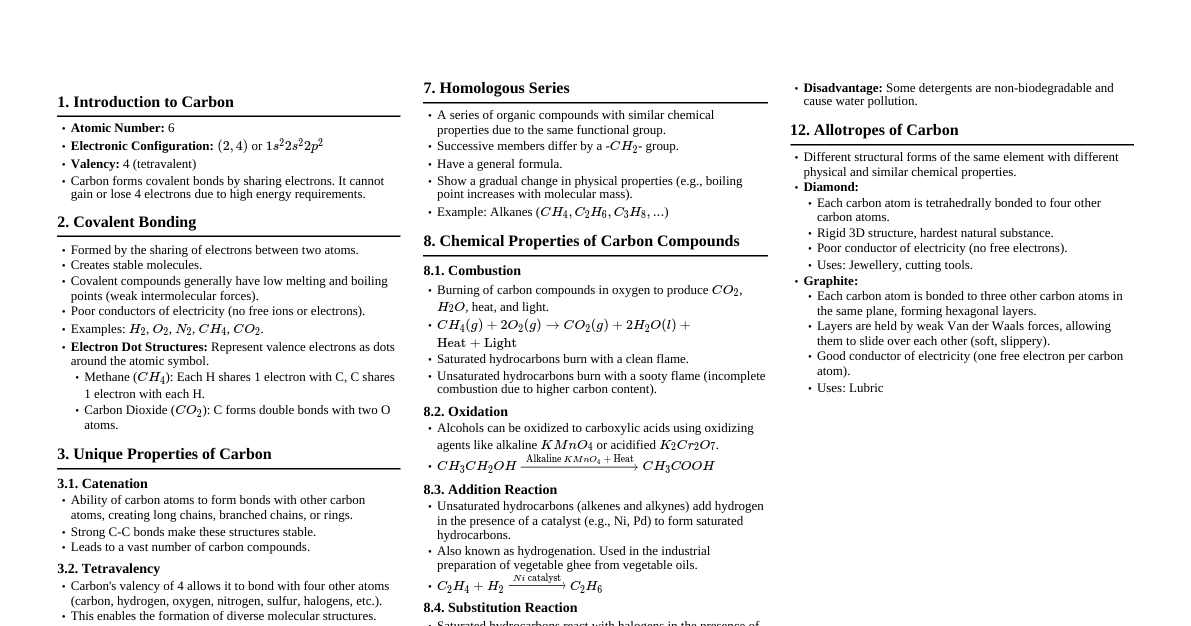
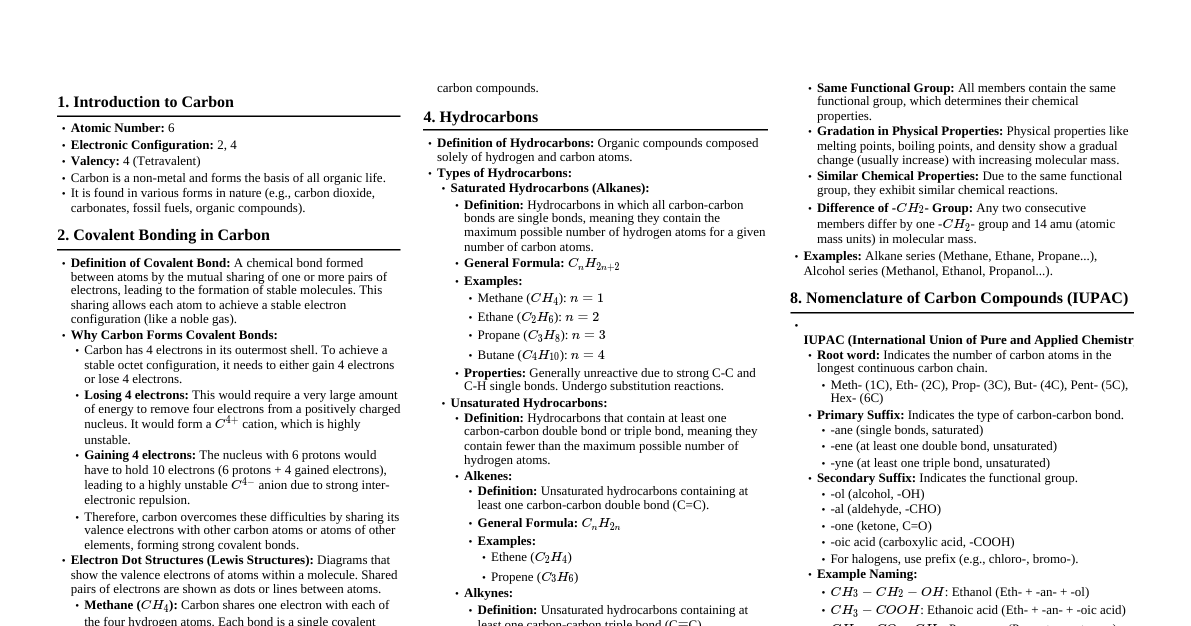
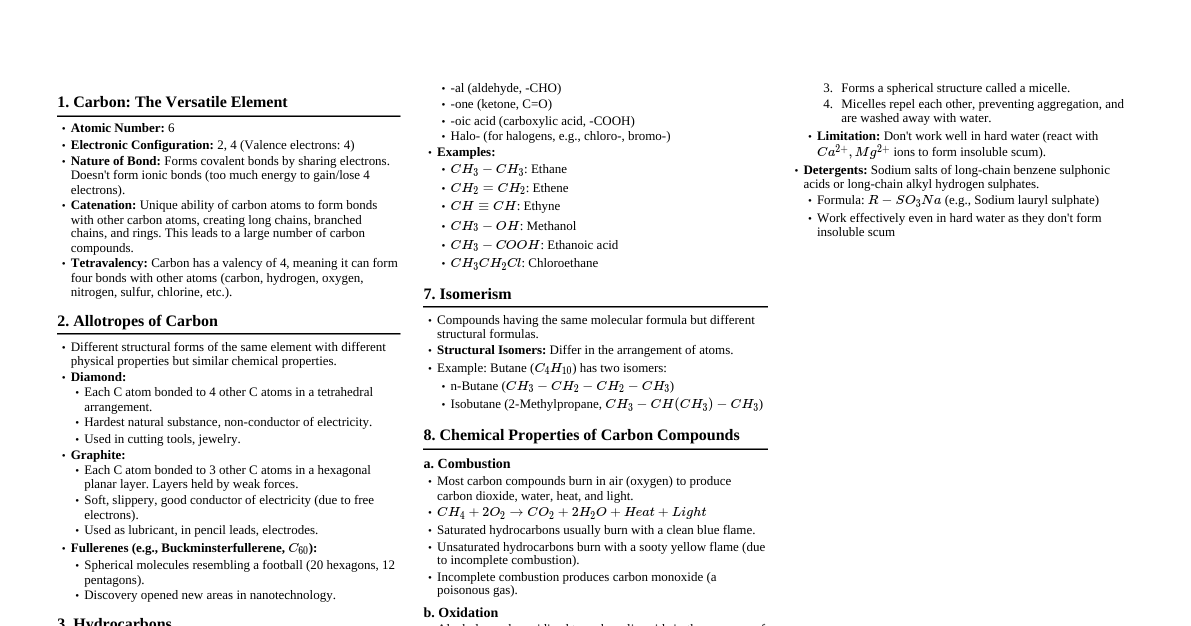
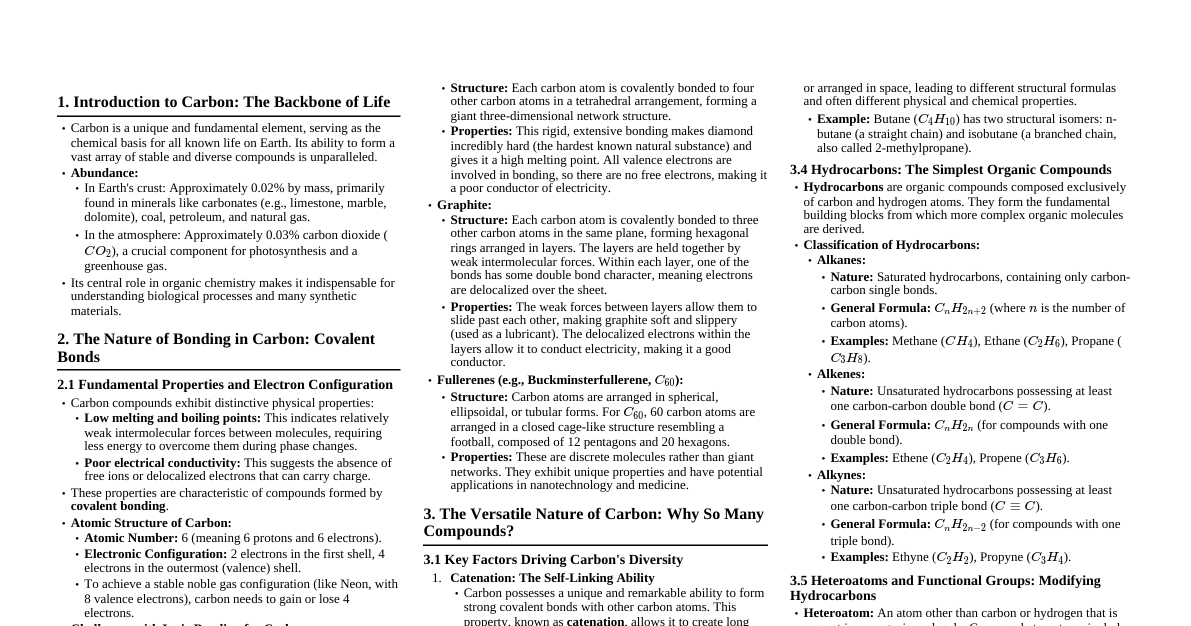
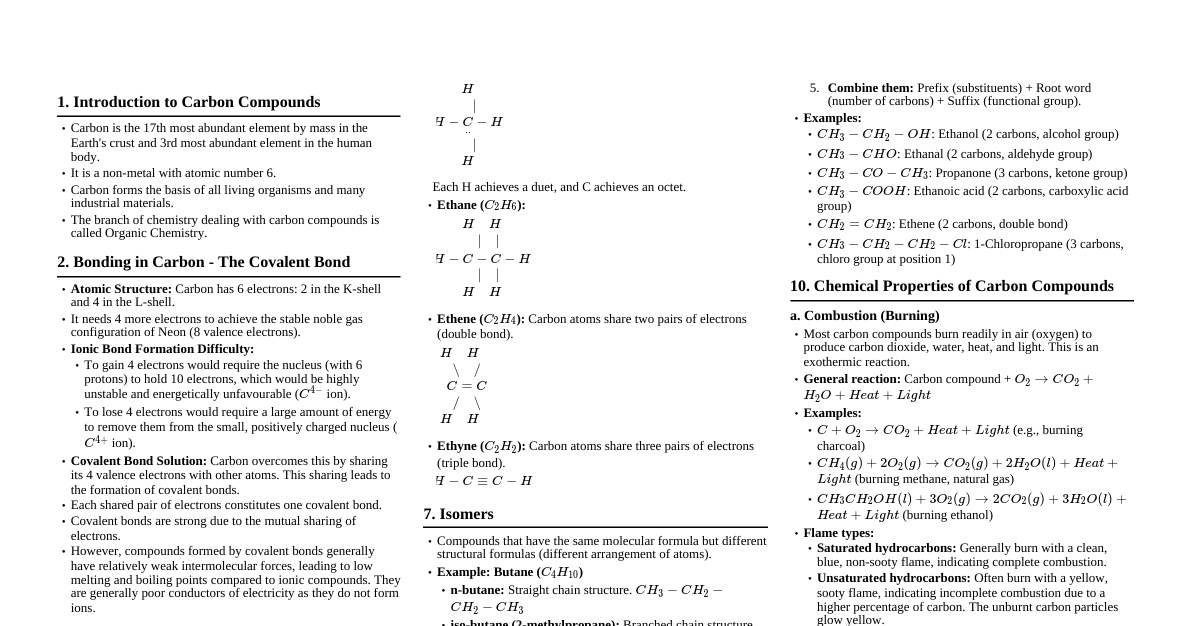
1. Introduction to Carbon Atomic Number: 6 Electronic Configuration: $(2, 4)$ Valency: 4 (Tetravalent) Forms covalent bonds by sharing electrons. 2. Covalent Bonding in Carbon Compounds Bonding occurs by sharing valence electrons between atoms. Forms strong, stable bonds. Examples: Hydrogen molecule ($H_2$): $H-H$ (1 shared pair) Oxygen molecule ($O_2$): $O=O$ (2 shared pairs) Nitrogen molecule ($N_2$): $N \equiv N$ (3 shared pairs) Methane ($CH_4$): Carbon shares 4 electrons with 4 Hydrogen atoms. 3. Unique Nature of Carbon 3.1. Catenation Ability of carbon atoms to form bonds with other carbon atoms, forming long chains, branched chains, or rings. Leads to a large number of carbon compounds. Can form single ($C-C$), double ($C=C$), or triple ($C \equiv C$) bonds. 3.2. Tetravalency Carbon has a valency of 4, allowing it to bond with four other atoms (carbon, hydrogen, oxygen, nitrogen, sulfur, chlorine, etc.). 4. Hydrocarbons Compounds containing only carbon and hydrogen. 4.1. Saturated Hydrocarbons (Alkanes) Contain only single bonds between carbon atoms. General formula: $C_nH_{2n+2}$ Examples: Methane ($CH_4$), Ethane ($C_2H_6$), Propane ($C_3H_8$). Relatively unreactive. 4.2. Unsaturated Hydrocarbons Contain double or triple bonds between carbon atoms. Alkenes: Contain at least one carbon-carbon double bond. General formula: $C_nH_{2n}$ Examples: Ethene ($C_2H_4$), Propene ($C_3H_6$). Alkynes: Contain at least one carbon-carbon triple bond. General formula: $C_nH_{2n-2}$ Examples: Ethyne ($C_2H_2$), Propyne ($C_3H_4$). More reactive than alkanes. 5. Isomerism Compounds with the same molecular formula but different structural formulas. Example: Butane ($C_4H_{10}$) has two isomers: n-butane and isobutane. 6. Functional Groups An atom or group of atoms that determines the chemical properties of a carbon compound. Functional Group Formula Class of Compound Suffix/Prefix Haloalkane $-X$ (X = Cl, Br, I) Alkyl halide Prefix: chloro-, bromo-, iodo- Alcohol $-OH$ Alcohol -ol Aldehyde $-CHO$ Aldehyde -al Ketone $C=O$ (within chain) Ketone -one Carboxylic acid $-COOH$ Carboxylic acid -oic acid Alkene $C=C$ Alkene -ene Alkyne $C \equiv C$ Alkyne -yne 7. Homologous Series A series of compounds in which the same functional group substitutes hydrogen in a carbon chain. Characteristics: Same general formula. Successive members differ by a $-CH_2$ group. Similar chemical properties. Gradual change in physical properties (e.g., boiling point increases with molecular mass). Examples: Alkanes, Alkenes, Alcohols. 8. Chemical Properties of Carbon Compounds 8.1. Combustion Carbon compounds burn in oxygen to produce carbon dioxide, water, heat, and light. Example: $CH_4(g) + 2O_2(g) \rightarrow CO_2(g) + 2H_2O(g) + \text{Heat + Light}$ Saturated hydrocarbons burn with a clean flame. Unsaturated hydrocarbons burn with a sooty flame (due to incomplete combustion). 8.2. Oxidation Alcohols can be oxidized to carboxylic acids using oxidizing agents like alkaline $KMnO_4$ or acidified $K_2Cr_2O_7$. Example: $CH_3CH_2OH \xrightarrow{\text{Alkaline } KMnO_4 \text{ + Heat}} CH_3COOH$ 8.3. Addition Reaction Unsaturated hydrocarbons (alkenes and alkynes) add hydrogen in the presence of a catalyst (e.g., Palladium or Nickel) to form saturated hydrocarbons. Also known as hydrogenation. Used in the industrial preparation of vegetable ghee from vegetable oils. Example: $C_2H_4 + H_2 \xrightarrow{Ni \text{ catalyst}} C_2H_6$ 8.4. Substitution Reaction Saturated hydrocarbons react with halogens in the presence of sunlight. Hydrogen atoms are replaced by halogen atoms. Example: $CH_4 + Cl_2 \xrightarrow{\text{Sunlight}} CH_3Cl + HCl$ 9. Important Carbon Compounds 9.1. Ethanol ($CH_3CH_2OH$) Commonly called alcohol. Used in medicines (tincture iodine, cough syrups) and as a solvent. Consumption of pure ethanol is dangerous. Reactions: With Sodium: $2CH_3CH_2OH + 2Na \rightarrow 2CH_3CH_2ONa + H_2$ (Sodium ethoxide) Dehydration: $CH_3CH_2OH \xrightarrow{\text{Hot conc. } H_2SO_4} CH_2=CH_2 + H_2O$ (Ethene) 9.2. Ethanoic Acid ($CH_3COOH$) Commonly called acetic acid. A 5-8% solution in water is called vinegar. Used as a preservative in pickles. Reactions: Esterification: Reacts with ethanol in the presence of an acid catalyst to form an ester (ethyl ethanoate). $CH_3COOH + CH_3CH_2OH \xrightarrow{\text{Acid}} CH_3COOCH_2CH_3 + H_2O$ Esters are sweet-smelling substances used in perfumes and flavouring agents. With a base (NaOH): $CH_3COOH + NaOH \rightarrow CH_3COONa + H_2O$ With carbonates/bicarbonates: $2CH_3COOH + Na_2CO_3 \rightarrow 2CH_3COONa + H_2O + CO_2$ 10. Soaps and Detergents 10.1. Soaps Sodium or potassium salts of long-chain carboxylic acids. Structure: Hydrophilic (water-loving) head (ionic part) and hydrophobic (water-repelling) tail (long hydrocarbon chain). Cleansing action: The hydrophobic tail attaches to oil/grease (dirt). The hydrophilic head faces outwards in water. Forms spherical structures called micelles, with the dirt in the center. Micelles remain suspended in water and are rinsed away. Drawback: Do not work effectively in hard water (water containing calcium and magnesium salts) because they form insoluble precipitates (scum). 10.2. Detergents Long-chain sodium alkyl sulphonates or sodium alkyl benzene sulphonates. Work effectively in hard water because they do not form insoluble precipitates with calcium and magnesium ions. Generally have a stronger cleansing action than soaps.