Carbon & Its Compounds (Class 10)
Cheatsheet Content
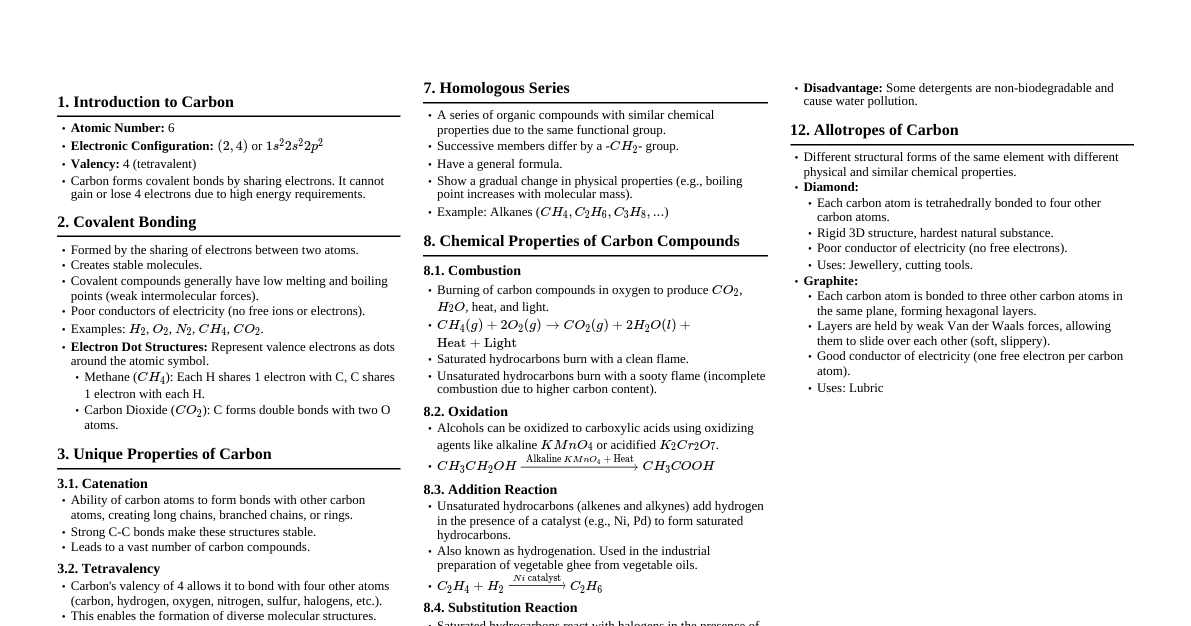
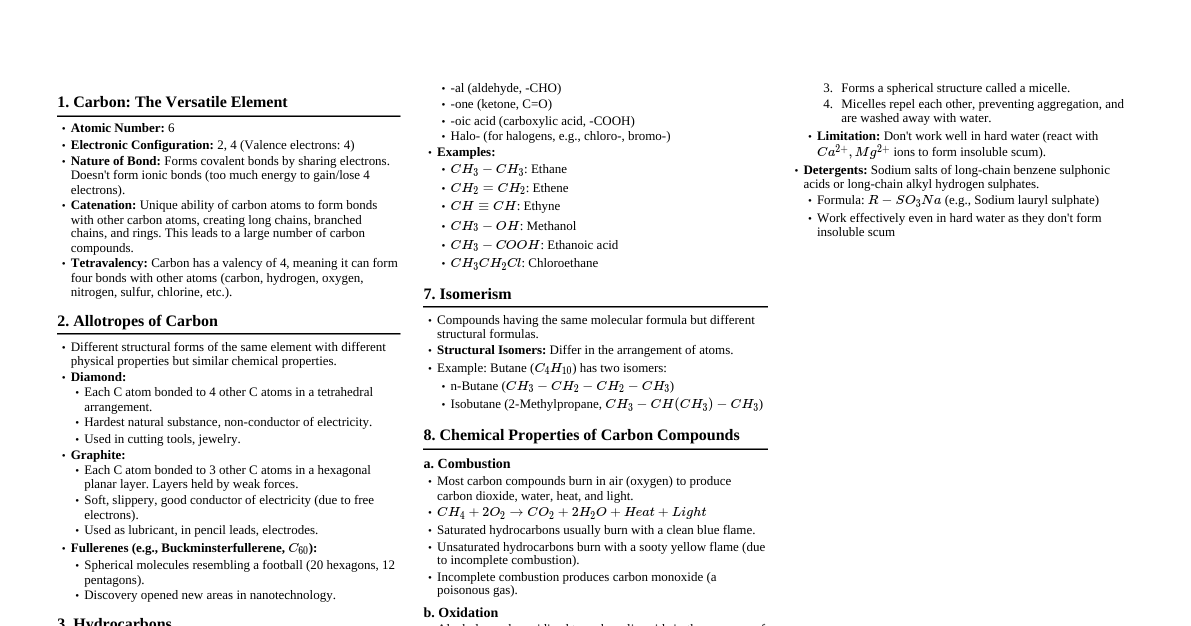
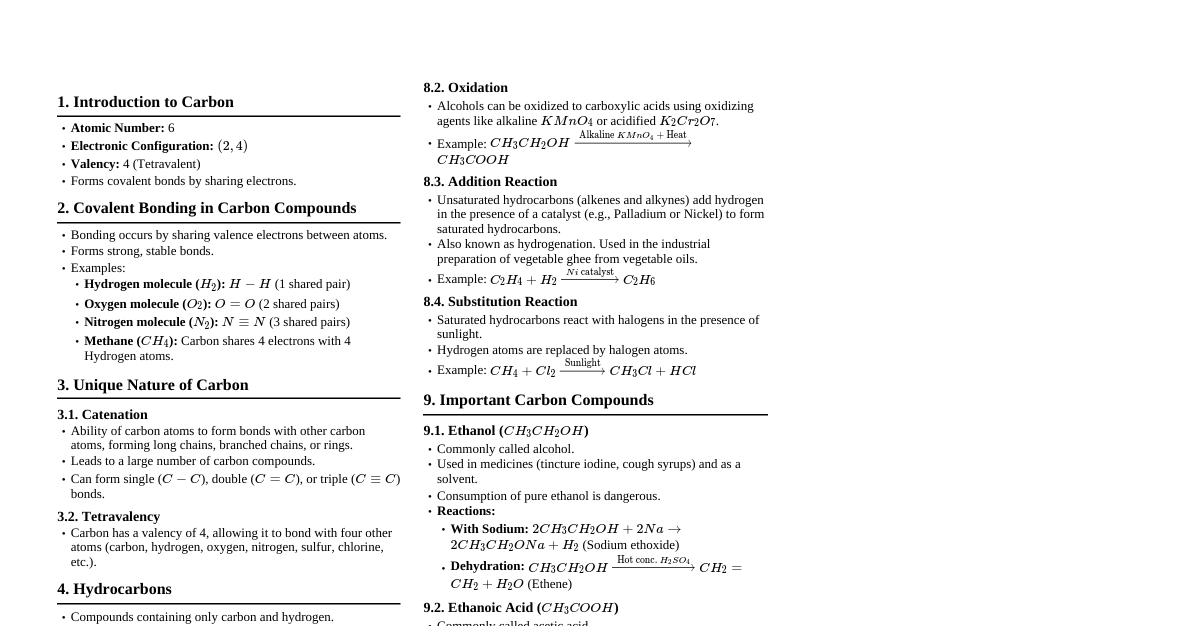
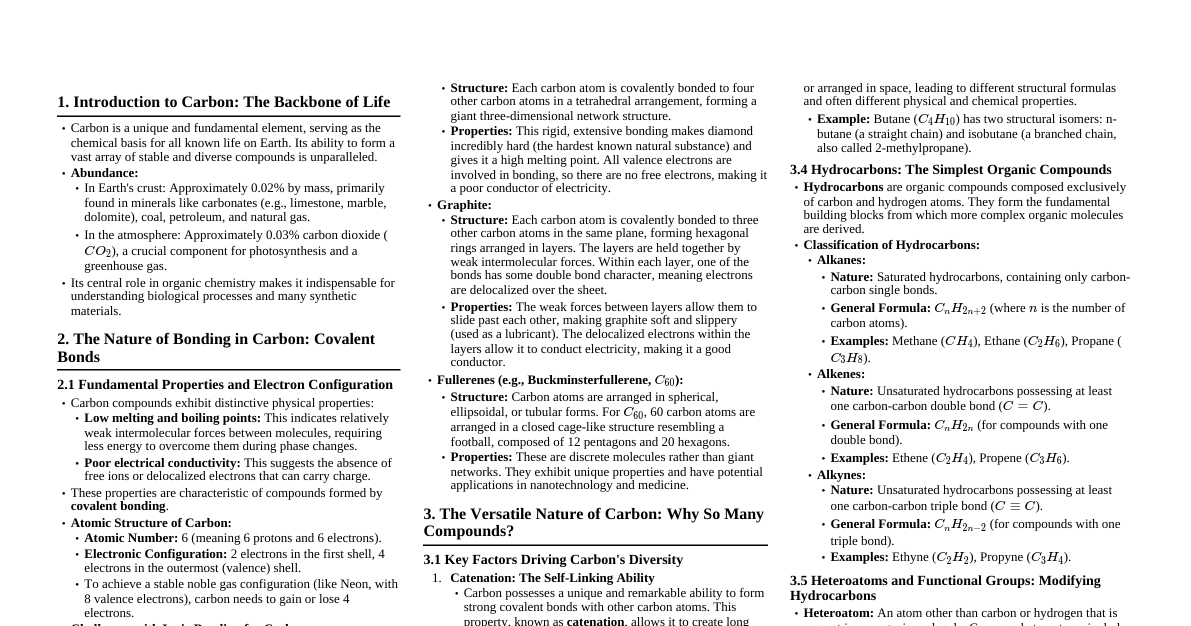
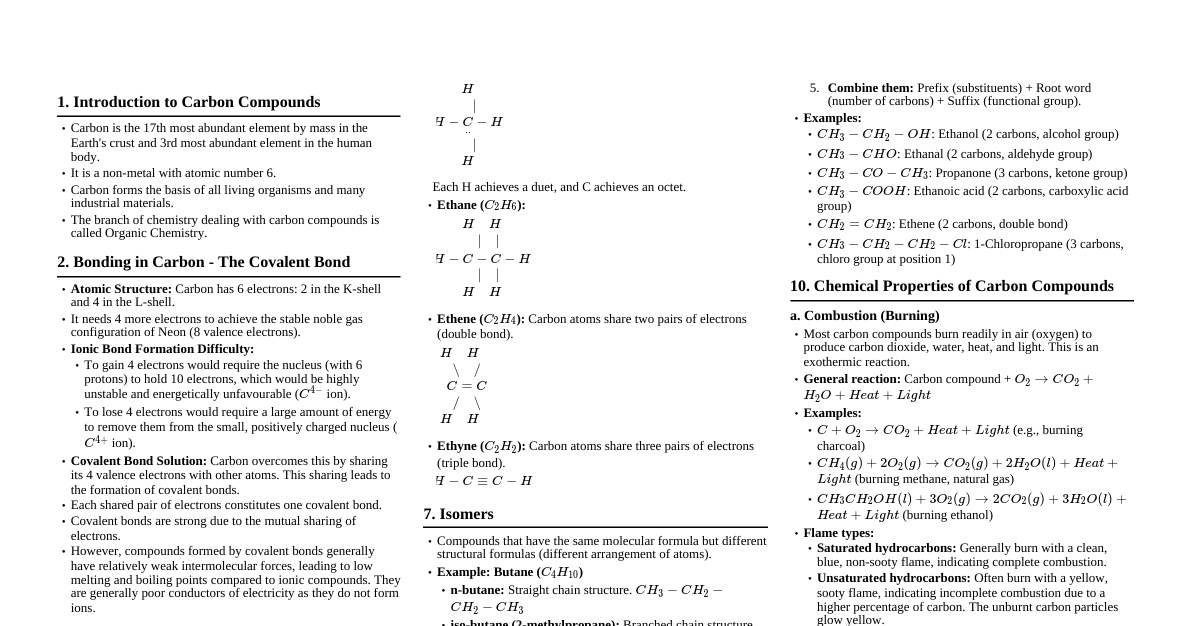
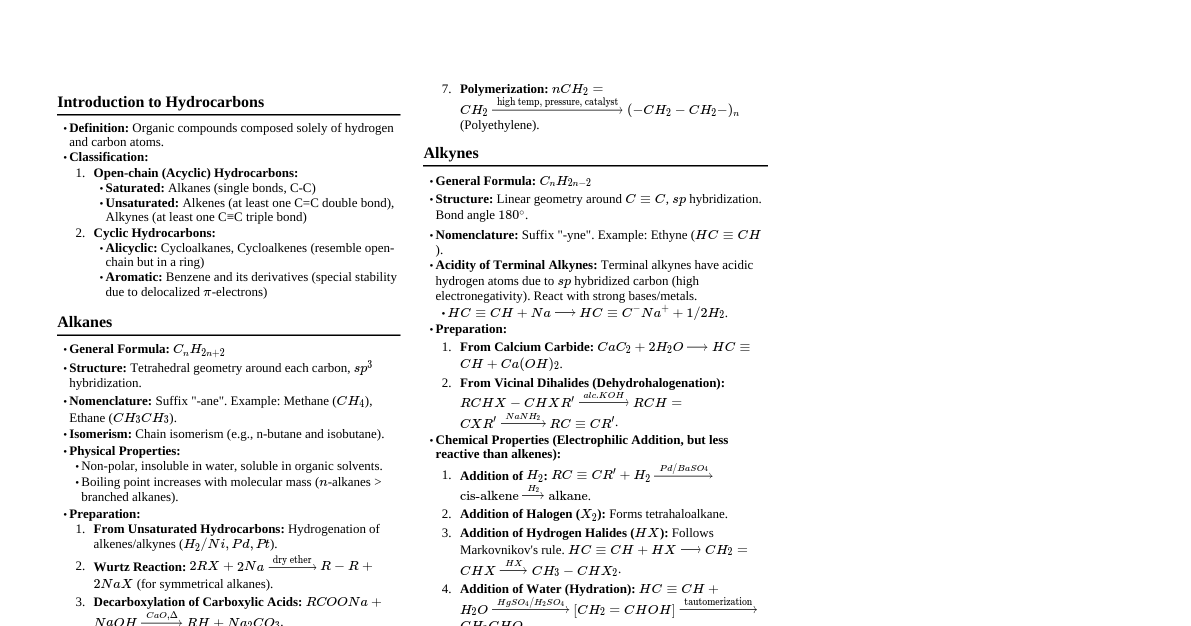
1. Introduction to Carbon Atomic Number: 6 Electronic Configuration: 2, 4 Valency: 4 (Tetravalent) Carbon is a non-metal and forms the basis of all organic life. It is found in various forms in nature (e.g., carbon dioxide, carbonates, fossil fuels, organic compounds). 2. Covalent Bonding in Carbon Definition of Covalent Bond: A chemical bond formed between atoms by the mutual sharing of one or more pairs of electrons, leading to the formation of stable molecules. This sharing allows each atom to achieve a stable electron configuration (like a noble gas). Why Carbon Forms Covalent Bonds: Carbon has 4 electrons in its outermost shell. To achieve a stable octet configuration, it needs to either gain 4 electrons or lose 4 electrons. Losing 4 electrons: This would require a very large amount of energy to remove four electrons from a positively charged nucleus. It would form a $C^{4+}$ cation, which is highly unstable. Gaining 4 electrons: The nucleus with 6 protons would have to hold 10 electrons (6 protons + 4 gained electrons), leading to a highly unstable $C^{4-}$ anion due to strong inter-electronic repulsion. Therefore, carbon overcomes these difficulties by sharing its valence electrons with other carbon atoms or atoms of other elements, forming strong covalent bonds. Electron Dot Structures (Lewis Structures): Diagrams that show the valence electrons of atoms within a molecule. Shared pairs of electrons are shown as dots or lines between atoms. Methane ($CH_4$): Carbon shares one electron with each of the four hydrogen atoms. Each bond is a single covalent bond. $$ H \\ H : \underset{\cdot \cdot}{C} : H \\ H $$ Carbon Dioxide ($CO_2$): Carbon shares two pairs of electrons with each oxygen atom, forming two double covalent bonds. $$ \cdot \cdot \\ : O :: C :: O : \\ \cdot \cdot $$ Water ($H_2O$): Oxygen shares one electron with each hydrogen atom, forming two single covalent bonds. Oxygen also has two lone pairs. Ammonia ($NH_3$): Nitrogen shares one electron with each hydrogen atom, forming three single covalent bonds. Nitrogen has one lone pair. Ethene ($C_2H_4$): Two carbon atoms share two pairs of electrons (a double bond), and each carbon shares one electron with two hydrogen atoms. $$ H \quad H \\ \quad \cdot \cdot \\ H : C :: C : H \\ \quad \cdot \cdot $$ Ethyne ($C_2H_2$): Two carbon atoms share three pairs of electrons (a triple bond), and each carbon shares one electron with one hydrogen atom. $$ H : C ::: C : H $$ Properties of Covalent Compounds: Low Melting and Boiling Points: Molecules are held together by strong covalent bonds, but the intermolecular forces (forces between molecules) are generally weak. Less energy is required to overcome these weak forces, leading to low melting and boiling points. Poor Conductors of Electricity: Covalent compounds do not form ions (charged particles) when dissolved in water or in their molten state. They also do not have free electrons. Therefore, they cannot conduct electricity. Solubility: Generally soluble in organic solvents and insoluble in water, but some polar covalent compounds like ethanol can dissolve in water due to hydrogen bonding. 3. Versatile Nature of Carbon Definition of Catenation: Catenation is the self-linking property of an element, particularly carbon, to form stable chains or rings with other atoms of the same element. Carbon exhibits this property to the maximum extent. Reasons for Strong Catenation in Carbon: Small Size: Carbon atoms are relatively small, allowing for strong and stable C-C bonds. Strong C-C Bonds: The carbon-carbon single bond is very strong, making long chains and rings stable. Tetravalency: Each carbon atom can form four bonds, allowing for extensive linking in various forms. Definition of Tetravalency: The property of an atom, like carbon, to have a valency of four, meaning it can form four chemical bonds with other atoms. Impact of Tetravalency: Due to its tetravalency, carbon can bond with: Other carbon atoms (forming chains, branches, rings) Hydrogen, oxygen, nitrogen, sulfur, halogens, etc. This ability to form bonds with many different elements and with itself in various ways leads to an enormous number of carbon compounds. 4. Hydrocarbons Definition of Hydrocarbons: Organic compounds composed solely of hydrogen and carbon atoms. Types of Hydrocarbons: Saturated Hydrocarbons (Alkanes): Definition: Hydrocarbons in which all carbon-carbon bonds are single bonds, meaning they contain the maximum possible number of hydrogen atoms for a given number of carbon atoms. General Formula: $C_nH_{2n+2}$ Examples: Methane ($CH_4$): $n=1$ Ethane ($C_2H_6$): $n=2$ Propane ($C_3H_8$): $n=3$ Butane ($C_4H_{10}$): $n=4$ Properties: Generally unreactive due to strong C-C and C-H single bonds. Undergo substitution reactions. Unsaturated Hydrocarbons: Definition: Hydrocarbons that contain at least one carbon-carbon double bond or triple bond, meaning they contain fewer than the maximum possible number of hydrogen atoms. Alkenes: Definition: Unsaturated hydrocarbons containing at least one carbon-carbon double bond (C=C). General Formula: $C_nH_{2n}$ Examples: Ethene ($C_2H_4$) Propene ($C_3H_6$) Alkynes: Definition: Unsaturated hydrocarbons containing at least one carbon-carbon triple bond (C$\equiv$C). General Formula: $C_nH_{2n-2}$ Examples: Ethyne ($C_2H_2$) Properties: More reactive than alkanes due to the presence of pi ($\pi$) bonds in double/triple bonds. Undergo addition reactions. 5. Isomers Definition of Isomers: Compounds that have the same molecular formula but different structural formulae (i.e., different arrangement of atoms in space). This difference in structure leads to different physical and chemical properties. Example: Butane ($C_4H_{10}$) n-Butane (straight chain): $CH_3-CH_2-CH_2-CH_3$ Isobutane (2-methylpropane, branched chain): $$ \quad CH_3 \\ CH_3 - CH - CH_3 $$ Example: Pentane ($C_5H_{12}$) n-Pentane Isopentane (2-methylbutane) Neopentane (2,2-dimethylpropane) 6. Functional Groups Definition of Functional Group: An atom or a group of atoms (other than hydrogen) that is bonded to the carbon chain and is primarily responsible for the characteristic chemical properties of the organic compound. Common Functional Groups: Halogen Group (-X, where X = F, Cl, Br, I): Class: Haloalkanes Example: Chloromethane ($CH_3Cl$) Alcohol Group (-OH): Class: Alcohols Example: Ethanol ($CH_3CH_2OH$) Aldehyde Group (-CHO): Class: Aldehydes Example: Ethanal ($CH_3CHO$) Structure: $R-\overset{O}{\parallel}C-H$ Ketone Group (C=O, within a carbon chain): Class: Ketones Example: Propanone ($CH_3COCH_3$) Structure: $R-\overset{O}{\parallel}C-R'$ Carboxylic Acid Group (-COOH): Class: Carboxylic Acids Example: Ethanoic Acid ($CH_3COOH$) Structure: $R-\overset{O}{\parallel}C-OH$ 7. Homologous Series Definition of Homologous Series: A series of organic compounds in which all members have the same general formula, the same functional group, and similar chemical properties. Successive members in the series differ by a -$CH_2$- group. Characteristics of a Homologous Series: Same General Formula: All members can be represented by a common general formula (e.g., alkanes $C_nH_{2n+2}$, alkenes $C_nH_{2n}$). Same Functional Group: All members contain the same functional group, which determines their chemical properties. Gradation in Physical Properties: Physical properties like melting points, boiling points, and density show a gradual change (usually increase) with increasing molecular mass. Similar Chemical Properties: Due to the same functional group, they exhibit similar chemical reactions. Difference of -$CH_2$- Group: Any two consecutive members differ by one -$CH_2$- group and 14 amu (atomic mass units) in molecular mass. Examples: Alkane series (Methane, Ethane, Propane...), Alcohol series (Methanol, Ethanol, Propanol...). 8. Nomenclature of Carbon Compounds (IUPAC) IUPAC (International Union of Pure and Applied Chemistry) Naming Rules: Root word: Indicates the number of carbon atoms in the longest continuous carbon chain. Meth- (1C), Eth- (2C), Prop- (3C), But- (4C), Pent- (5C), Hex- (6C) Primary Suffix: Indicates the type of carbon-carbon bond. -ane (single bonds, saturated) -ene (at least one double bond, unsaturated) -yne (at least one triple bond, unsaturated) Secondary Suffix: Indicates the functional group. -ol (alcohol, -OH) -al (aldehyde, -CHO) -one (ketone, C=O) -oic acid (carboxylic acid, -COOH) For halogens, use prefix (e.g., chloro-, bromo-). Example Naming: $CH_3-CH_2-OH$: Ethanol (Eth- + -an- + -ol) $CH_3-COOH$: Ethanoic acid (Eth- + -an- + -oic acid) $CH_3-CO-CH_3$: Propanone (Prop- + -an- + -one) $CH_2=CH_2$: Ethene (Eth- + -ene) $CH_3-CH_2-CH_2-Cl$: 1-Chloropropane (Chloro + Prop- + -an- + -e) 9. Chemical Properties of Carbon Compounds 1. Combustion: Definition: The process of burning carbon compounds in the presence of oxygen, releasing carbon dioxide, water, heat, and light. Reaction: Carbon compounds (fuels) + $O_2 \rightarrow CO_2 + H_2O + Heat + Light$ Saturated Hydrocarbons: Burn with a clean, non-sooty flame (e.g., LPG, methane). This indicates complete combustion. $CH_4(g) + 2O_2(g) \rightarrow CO_2(g) + 2H_2O(g) + Heat + Light$ Unsaturated Hydrocarbons: Burn with a yellow, sooty flame. This is due to incomplete combustion caused by a high percentage of carbon, which does not burn completely in the available oxygen, forming unburnt carbon particles (soot). $C_2H_4(g) + 3O_2(g) \rightarrow 2CO_2(g) + 2H_2O(g) + Heat + Light$ (If sufficient oxygen is available) If oxygen is limited, soot forms: $C_2H_2(g) + O_2(g) \rightarrow C(s) + CO_2(g) + H_2O(g)$ (Incomplete) Importance: Used as fuels (petrol, diesel, LPG, CNG). 2. Oxidation: Definition: A chemical reaction in which a substance gains oxygen or loses hydrogen. In organic chemistry, it often involves the conversion of alcohols to carboxylic acids. Oxidizing Agents: Substances that cause oxidation. Common oxidizing agents include alkaline potassium permanganate ($Alk. KMnO_4$) and acidified potassium dichromate ($Acid. K_2Cr_2O_7$). Reaction: Oxidation of Ethanol to Ethanoic Acid: $CH_3CH_2OH \xrightarrow{\text{Alk. } KMnO_4 \text{ or Acid. } K_2Cr_2O_7 + Heat} CH_3COOH$ The $KMnO_4$ and $K_2Cr_2O_7$ are strong oxidizing agents that provide oxygen for the conversion. 3. Addition Reaction (Hydrogenation): Definition: A reaction in which an unsaturated hydrocarbon (alkene or alkyne) reacts with another molecule (like hydrogen, halogens, or hydrogen halides) across the double or triple bond to form a single, saturated product. Hydrogenation: The addition of hydrogen to an unsaturated compound in the presence of a catalyst. Catalysts: Nickel (Ni), Palladium (Pd), or Platinum (Pt). These metals provide a surface for the reaction and lower the activation energy. Reaction: $CH_2=CH_2 (Ethene) + H_2 \xrightarrow{Ni \text{ catalyst}} CH_3-CH_3 (Ethane)$ $R-CH=CH-R' + H_2 \xrightarrow{Ni} R-CH_2-CH_2-R'$ Application: Used in the industrial process of converting unsaturated vegetable oils (liquid) into saturated vegetable ghee or vanaspati (solid). Vegetable oils contain double bonds, which are reduced by adding hydrogen. Distinguishing Saturated vs. Unsaturated: Unsaturated compounds decolorize bromine water (reddish-brown to colorless) due to addition reaction, while saturated compounds do not. 4. Substitution Reaction: Definition: A chemical reaction in which an atom or a group of atoms in a molecule is replaced by another atom or group of atoms. Conditions: Saturated hydrocarbons (alkanes) are generally unreactive. They react with halogens (like chlorine) in the presence of sunlight (UV light). Reaction: $CH_4 (Methane) + Cl_2 \xrightarrow{Sunlight} CH_3Cl (Chloromethane) + HCl$ This is a chain reaction where one or more hydrogen atoms can be substituted by chlorine atoms. 10. Important Carbon Compounds 1. Ethanol ($CH_3CH_2OH$) Common Name: Ethyl alcohol. Properties: Colorless liquid with a pleasant smell and a burning taste. Highly soluble in water in all proportions. Neutral to litmus paper. Volatile liquid with a low boiling point ($78^\circ C$). Uses: Used in alcoholic beverages. Excellent solvent for many organic compounds. Used in medicines like tincture iodine, cough syrups, and tonics. Used as a fuel (gasohol, a mixture of petrol and ethanol). Reactions of Ethanol: Reaction with Sodium: $2CH_3CH_2OH + 2Na \rightarrow 2CH_3CH_2ONa (Sodium \text{ ethoxide}) + H_2 \uparrow$ Ethanol reacts with active metals like sodium to produce hydrogen gas. This shows its slightly acidic nature (though weaker than water). Dehydration (Reaction with Hot Concentrated Sulphuric Acid): $CH_3CH_2OH \xrightarrow{Conc. H_2SO_4, 170^\circ C} CH_2=CH_2 (Ethene) + H_2O$ Concentrated sulphuric acid acts as a dehydrating agent, removing a water molecule from ethanol to form ethene. This is an elimination reaction. Denatured Alcohol: Ethanol made unfit for drinking by adding poisonous substances like methanol, pyridine, or dyes. This is done to prevent its misuse and avoid excise duty levied on potable alcohol. Harmful Effects of Consuming Alcohol: Methanol is oxidized to methanal (formaldehyde) in the liver, which reacts rapidly with components of cells, causing protoplasmic coagulation. It also affects the optic nerve, causing blindness. Ethanol consumption depresses the central nervous system, impairs judgment, causes drowsiness, and can lead to liver damage (cirrhosis) and addiction with chronic use. 2. Ethanoic Acid ($CH_3COOH$) Common Name: Acetic acid. Properties: Colorless liquid with a pungent smell (like vinegar) and a sour taste. 5-8% solution of ethanoic acid in water is called vinegar, used as a food preservative. Pure ethanoic acid is called glacial acetic acid because it freezes at $16.6^\circ C$ to form ice-like crystals. It is a weak acid. Reactions of Ethanoic Acid: Esterification Reaction: $CH_3COOH (Ethanoic \text{ acid}) + CH_3CH_2OH (Ethanol) \xrightarrow{Conc. H_2SO_4} CH_3COOCH_2CH_3 (Ethyl \text{ ethanoate}) + H_2O$ Ethanoic acid reacts with ethanol in the presence of an acid catalyst (conc. $H_2SO_4$) to form an ester (ethyl ethanoate) and water. This reaction is reversible. Esters: Sweet-smelling substances used in perfumes, flavoring agents, and artificial essences. Saponification Reaction (Hydrolysis of Ester): $CH_3COOCH_2CH_3 (Ester) + NaOH \rightarrow CH_3COONa (Sodium \text{ ethanoate}) + CH_3CH_2OH (Ethanol)$ When an ester is heated with a strong base (like NaOH), it hydrolyzes to form the alcohol and the sodium salt of the carboxylic acid. This reaction is used in the preparation of soap (saponification). Reaction with Bases: Being an acid, it reacts with bases to form salt and water. $CH_3COOH + NaOH \rightarrow CH_3COONa + H_2O$ Reaction with Carbonates and Bicarbonates: Ethanoic acid reacts with carbonates and bicarbonates to produce carbon dioxide gas with brisk effervescence. $2CH_3COOH + Na_2CO_3 \rightarrow 2CH_3COONa + H_2O + CO_2 \uparrow$ $CH_3COOH + NaHCO_3 \rightarrow CH_3COONa + H_2O + CO_2 \uparrow$ This reaction is used to distinguish ethanoic acid from ethanol, as ethanol does not react with carbonates or bicarbonates. 11. Soaps and Detergents 1. Soaps Definition of Soap: Sodium or potassium salts of long-chain carboxylic acids (fatty acids). Structure of a Soap Molecule: A soap molecule has two distinct parts: Long Hydrocarbon Chain (Non-polar 'Tail'): This part is hydrophobic (water-repelling) and lipophilic (oil-attracting). Ionic Part (-$COO^-Na^+$ or -$COO^-K^+$) (Polar 'Head'): This part is hydrophilic (water-attracting) and lipophobic (oil-repelling). Cleansing Action of Soap: When soap is added to water, the hydrophobic tails orient themselves towards the oil/grease particles, while the hydrophilic heads remain in the water. This forms a spherical structure called a micelle , where the oily dirt is trapped in the center of the micelle, and the ionic heads face outwards into the water. These micelles are negatively charged and repel each other, preventing them from clumping together. The micelles remain suspended in water and are easily rinsed away, carrying the dirt with them. Water Limitation of Soaps: Soaps are ineffective in hard water. Hard Water: Water containing dissolved salts of calcium ($Ca^{2+}$) and magnesium ($Mg^{2+}$). When soap is used in hard water, the $Ca^{2+}$ and $Mg^{2+}$ ions react with the soap to form an insoluble precipitate called scum . $2C_{17}H_{35}COO^-Na^+ (Soap) + Ca^{2+} \rightarrow (C_{17}H_{35}COO^-)_2Ca^{2+} (Scum) \downarrow + 2Na^+$ This scum adheres to the clothes, making washing difficult, and also reduces the cleansing ability of the soap, leading to wastage. 2. Detergents Definition of Detergents: Sodium salts of long-chain benzene sulphonic acids or long-chain alkyl hydrogen sulphates. Advantages of Detergents over Soaps: Detergents work effectively both in soft and hard water. They do not form insoluble scum with calcium and magnesium ions present in hard water. They can also be used in acidic water, where soaps precipitate out. They have stronger cleansing action than soaps. Disadvantages of Detergents: Some detergents are non-biodegradable (especially branched-chain detergents), meaning they are not easily broken down by microorganisms. This can lead to water pollution and foaming in rivers. Modern detergents are often biodegradable (linear-chain detergents).