Geometrical Optics
Cheatsheet Content
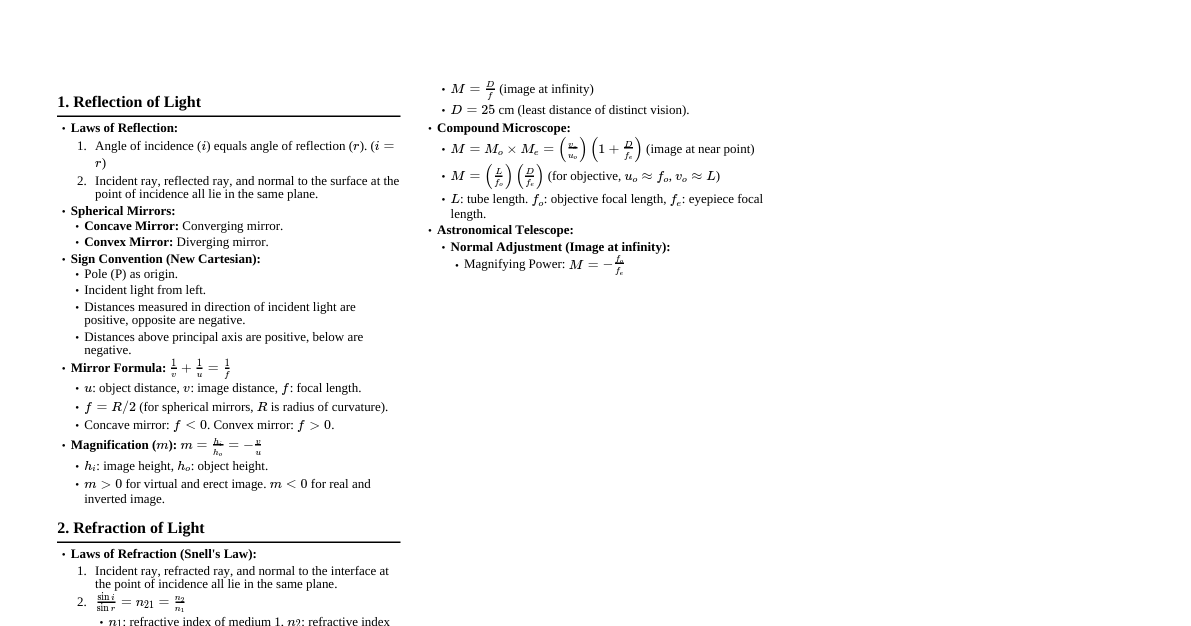
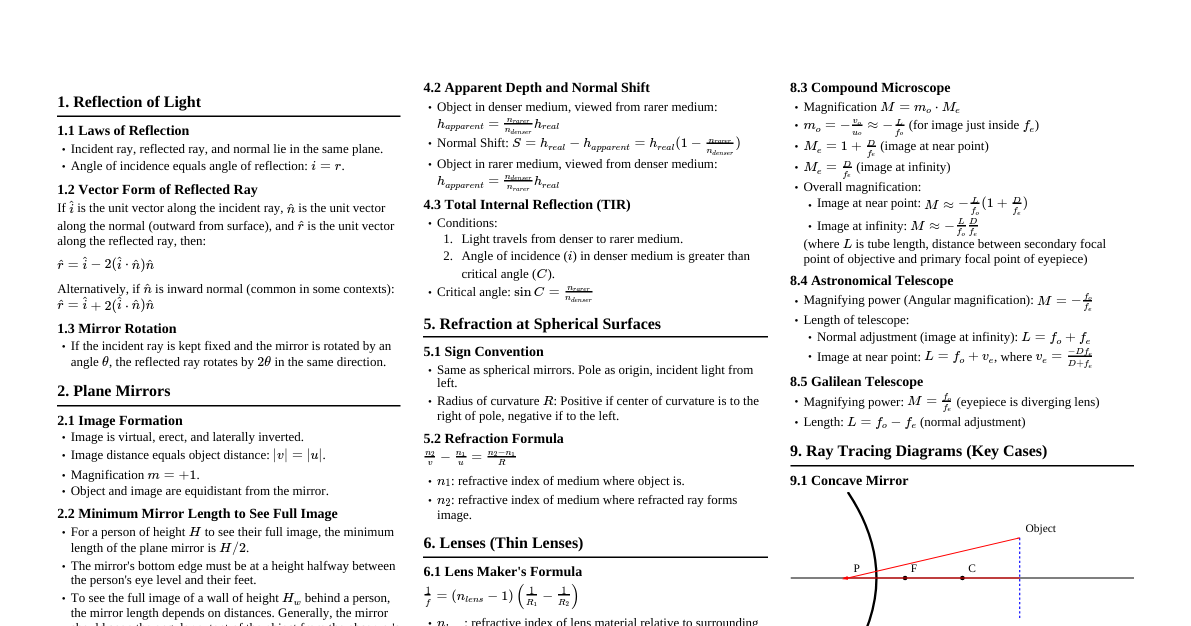
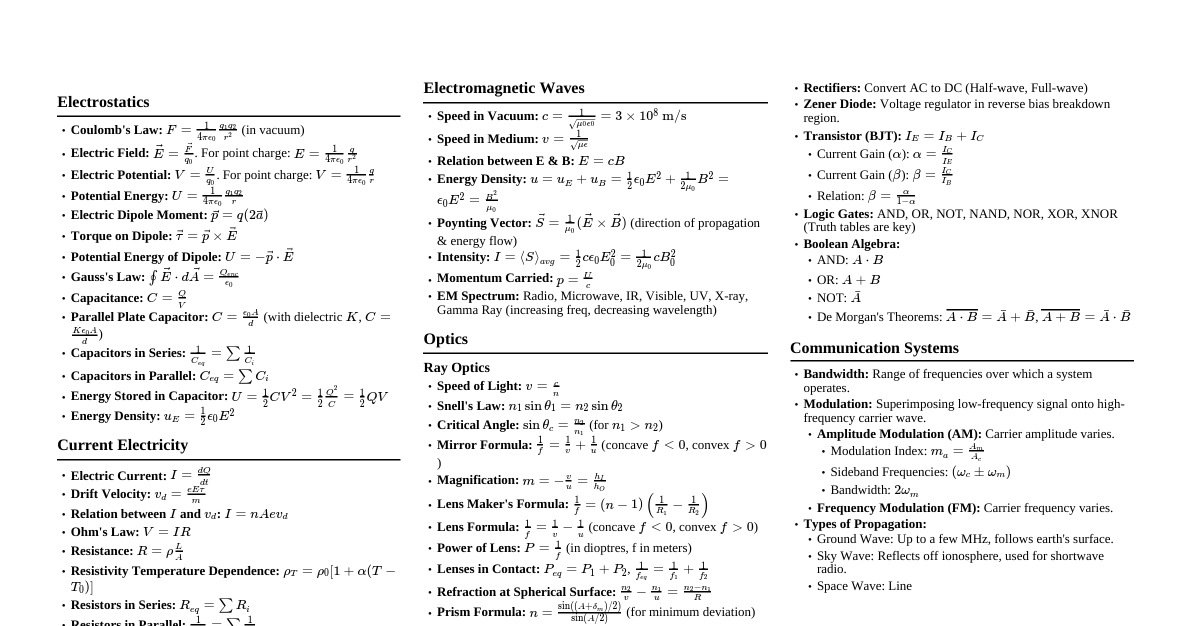
### Reflection from Plane Mirror - **Laws of Reflection:** 1. Angle of incidence ($i$) = Angle of reflection ($r$). 2. Incident ray, reflected ray, and normal lie in the same plane. - **Image Formation:** Virtual, erect, laterally inverted, same size, same distance behind mirror as object in front. - **Velocity of Image:** If object velocity is $\vec{v}_o = v_{ox}\hat{i} + v_{oy}\hat{j}$ and mirror velocity is $\vec{v}_m = v_{mx}\hat{i}$ (along normal to mirror), then image velocity $\vec{v}_i = -(v_{ox} - 2v_{mx})\hat{i} + v_{oy}\hat{j}$. ### Reflection from Spherical Mirror - **Terminology:** Pole (P), Center of Curvature (C), Radius of Curvature (R), Principal Axis, Focus (F), Focal Length (f). - **Sign Convention (Cartesian):** - Pole as origin. - Incident light direction as positive x-axis. - Heights above principal axis positive, below negative. - **Mirror Formula:** $\frac{1}{v} + \frac{1}{u} = \frac{1}{f}$ - $f = R/2$ for concave mirror (real focus, $f 0$). - **Magnification (m):** $m = \frac{h_i}{h_o} = -\frac{v}{u}$ - Real image: $m 0$ (erect). - **Velocity of Image (Spherical Mirror):** - Along principal axis: $v_i = -m^2 v_o$ - Perpendicular to principal axis: $v_{iy} = m v_{oy}$ ### Refraction at Plane Surface - **Snell's Law:** $n_1 \sin i = n_2 \sin r$ - $n_1, n_2$ are refractive indices of medium 1 and 2. - **Apparent Depth:** $h_{apparent} = \frac{h_{real}}{n_{relative}} = h_{real} \frac{n_{observer}}{n_{object}}$ - **Critical Angle ($C$):** $\sin C = \frac{n_{denser}}{n_{rarer}}$ - Total Internal Reflection (TIR) occurs if $i > C$ and light travels from denser to rarer medium. - **Shift due to Glass Slab:** $\text{Shift} = t(1 - \frac{1}{n})$ (where $t$ is thickness of slab). ### Refraction at Spherical Surface - **Formula:** $\frac{n_2}{v} - \frac{n_1}{u} = \frac{n_2 - n_1}{R}$ - $n_1$: refractive index of medium where object is. - $n_2$: refractive index of medium where image is formed. - $R$: radius of curvature (positive for convex, negative for concave towards incident light). - **Magnification:** $m = \frac{h_i}{h_o} = \frac{n_1 v}{n_2 u}$ ### Lenses - **Lens Maker's Formula:** $\frac{1}{f} = (n-1)(\frac{1}{R_1} - \frac{1}{R_2})$ - $n$: refractive index of lens material relative to surrounding. - $R_1$: radius of curvature of first surface. - $R_2$: radius of curvature of second surface. - Sign convention for $R_1, R_2$ depends on surface type (convex/concave towards incident light). - **Thin Lens Formula:** $\frac{1}{v} - \frac{1}{u} = \frac{1}{f}$ - Convex lens: $f > 0$. - Concave lens: $f ### Prism - **Angle of Deviation ($\delta$):** $\delta = (i_1 + i_2) - (A)$ - $A$: Angle of prism. - $i_1$: Angle of incidence. - $i_2$: Angle of emergence. - **Relation between angles:** $A = r_1 + r_2$ - **Minimum Deviation ($\delta_m$):** Occurs when $i_1 = i_2$ and $r_1 = r_2 = A/2$. - $\delta_m = 2i - A$ - $n = \frac{\sin(\frac{A+\delta_m}{2})}{\sin(\frac{A}{2})}$ (for thin prism, $\delta_m = (n-1)A$) - **Dispersion:** Splitting of white light into its constituent colors. - Angular Dispersion: $\theta = \delta_v - \delta_r = (n_v - n_r)A$ - Dispersive Power ($\omega$): $\omega = \frac{\theta}{\delta_y} = \frac{n_v - n_r}{n_y - 1}$ ### Optical Instruments - **Human Eye:** - Least Distance of Distinct Vision (D) = 25 cm. - Near point, Far point. - Defects: Myopia (nearsightedness - concave lens), Hypermetropia (farsightedness - convex lens), Presbyopia, Astigmatism. - **Simple Microscope (Magnifying Glass):** - Angular magnification: $M = \frac{D}{f}$ (image at infinity), $M = 1 + \frac{D}{f}$ (image at D). - **Compound Microscope:** - Magnification: $M = M_o \times M_e = (\frac{v_o}{u_o})(1 + \frac{D}{f_e})$ or $(\frac{L}{f_o})(1 + \frac{D}{f_e})$ (image at D). - $L$: length of tube. - **Astronomical Telescope:** - Magnification: $M = -\frac{f_o}{f_e}$ (image at infinity). - Length: $L = f_o + f_e$. - **Terrestrial Telescope:** Erect image. Additional erecting lens system. - **Galilean Telescope:** Final image is virtual and erect. - $M = \frac{f_o}{|f_e|}$ - Length: $L = f_o - |f_e|$. - **Resolving Power:** - Microscope: $RP = \frac{2n \sin\theta}{\lambda}$ - Telescope: $RP = \frac{D}{1.22\lambda}$