ISC Class 12 Ray Optics
Cheatsheet Content
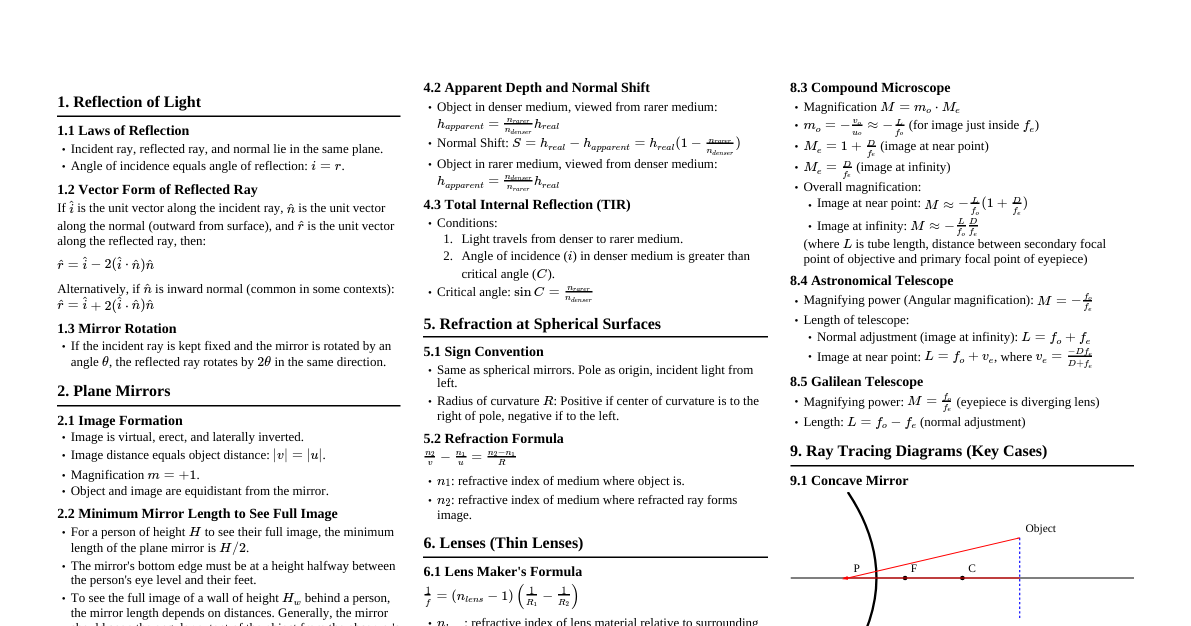
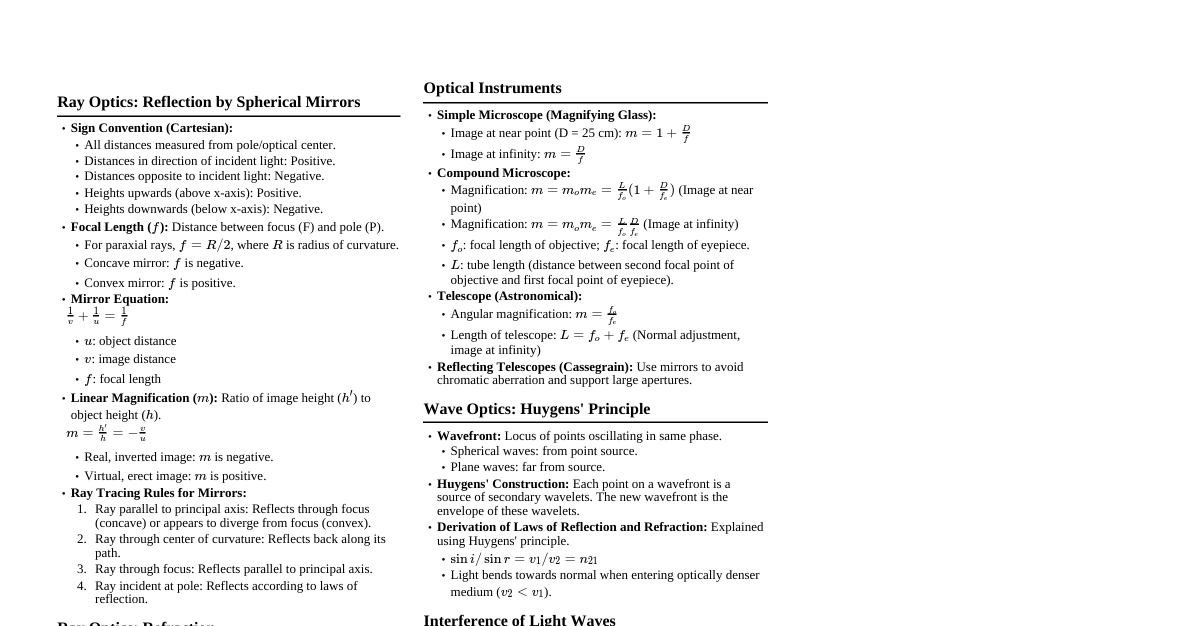
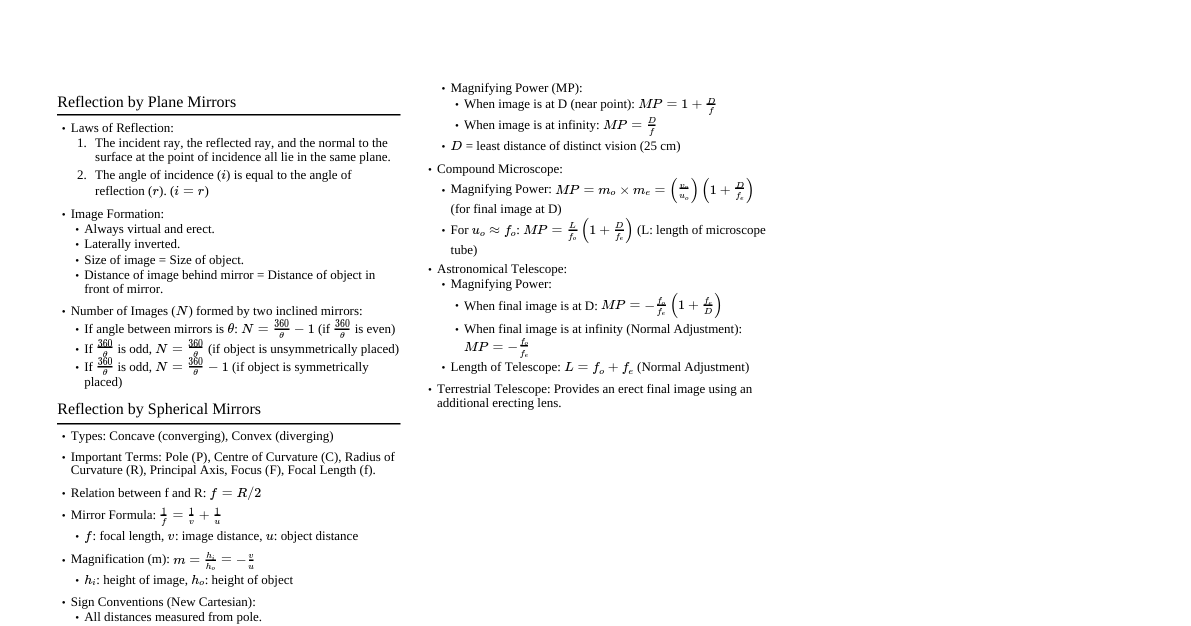
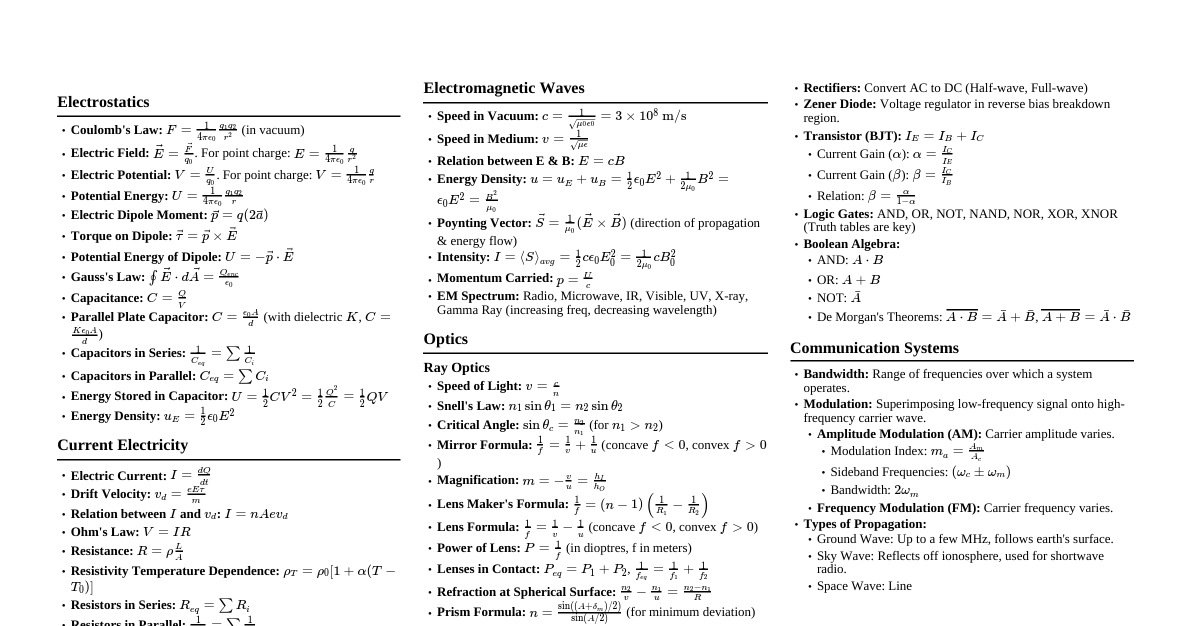
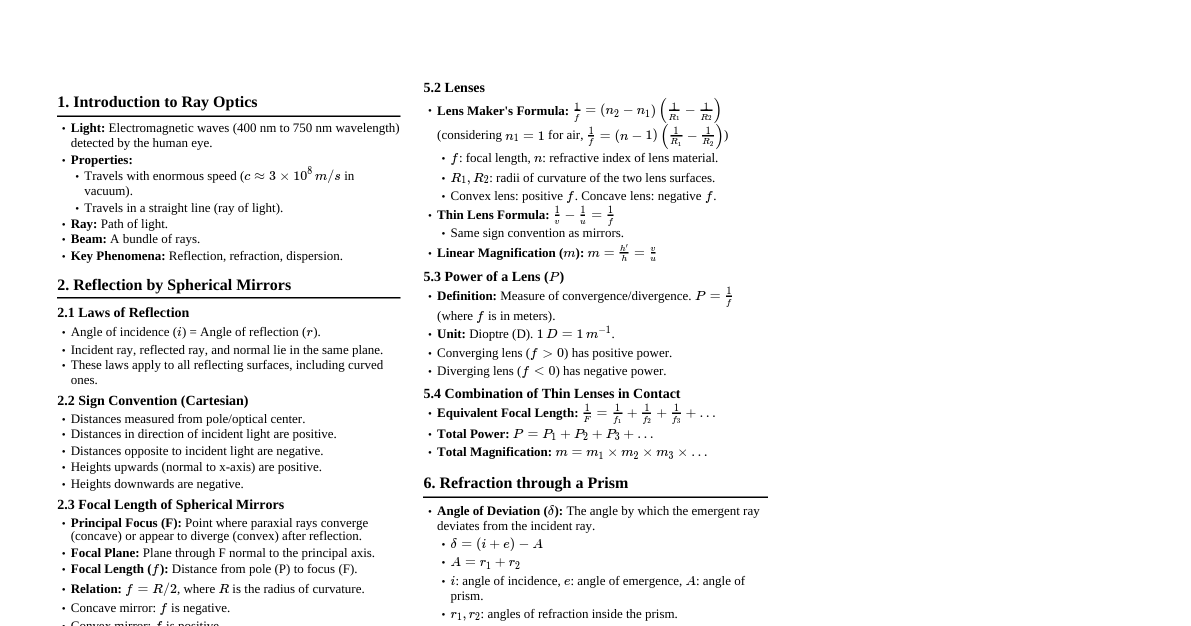
1. Reflection of Light Laws of Reflection: Angle of incidence ($i$) equals angle of reflection ($r$). ($i=r$) Incident ray, reflected ray, and normal to the surface at the point of incidence all lie in the same plane. Spherical Mirrors: Concave Mirror: Converging mirror. Convex Mirror: Diverging mirror. Sign Convention (New Cartesian): Pole (P) as origin. Incident light from left. Distances measured in direction of incident light are positive, opposite are negative. Distances above principal axis are positive, below are negative. Mirror Formula: $\frac{1}{v} + \frac{1}{u} = \frac{1}{f}$ $u$: object distance, $v$: image distance, $f$: focal length. $f = R/2$ (for spherical mirrors, $R$ is radius of curvature). Concave mirror: $f 0$. Magnification ($m$): $m = \frac{h_i}{h_o} = -\frac{v}{u}$ $h_i$: image height, $h_o$: object height. $m > 0$ for virtual and erect image. $m 2. Refraction of Light Laws of Refraction (Snell's Law): Incident ray, refracted ray, and normal to the interface at the point of incidence all lie in the same plane. $\frac{\sin i}{\sin r} = n_{21} = \frac{n_2}{n_1}$ $n_1$: refractive index of medium 1, $n_2$: refractive index of medium 2. $n = c/v$ ($c$: speed of light in vacuum, $v$: speed of light in medium). Total Internal Reflection (TIR): Light travels from denser to rarer medium. Angle of incidence ($i$) > critical angle ($c$). $\sin c = \frac{n_{rarer}}{n_{denser}}$ Apparent Depth: For normal view, $n = \frac{\text{Real Depth}}{\text{Apparent Depth}}$ Refraction through a Glass Slab: Lateral shift, no deviation. Refraction at Spherical Surfaces: $\frac{n_2}{v} - \frac{n_1}{u} = \frac{n_2 - n_1}{R}$ 3. Lenses Lens Maker's Formula: $\frac{1}{f} = (n-1)\left(\frac{1}{R_1} - \frac{1}{R_2}\right)$ $n$: refractive index of lens material relative to surrounding medium. $R_1, R_2$: radii of curvature of the two surfaces. Convex lens: $f > 0$. Concave lens: $f Lens Formula: $\frac{1}{v} - \frac{1}{u} = \frac{1}{f}$ Magnification ($m$): $m = \frac{h_i}{h_o} = \frac{v}{u}$ Power of a Lens ($P$): $P = \frac{1}{f}$ (in dioptres, $f$ in meters). Convex lens: $P > 0$. Concave lens: $P Combination of Thin Lenses in Contact: Equivalent focal length: $\frac{1}{F} = \frac{1}{f_1} + \frac{1}{f_2} + ...$ Equivalent power: $P = P_1 + P_2 + ...$ 4. Refraction through a Prism Ray Path: Incident ray, refracted ray, emergent ray. Angle of Deviation ($\delta$): Angle between incident and emergent ray. Formulae: $i + e = A + \delta$ ($A$: angle of prism, $i$: angle of incidence, $e$: angle of emergence). $r_1 + r_2 = A$ ($r_1, r_2$: angles of refraction inside prism). Minimum Deviation ($\delta_m$): Occurs when $i=e$ and $r_1=r_2=A/2$. $\delta_m = 2i - A$ Refractive index: $n = \frac{\sin((A+\delta_m)/2)}{\sin(A/2)}$ Dispersion: Splitting of white light into its constituent colors. Caused by different refractive indices for different wavelengths ($n_{violet} > n_{red}$). Angular Dispersion: $(\delta_V - \delta_R) = (n_V - n_R)A$ Dispersive Power ($\omega$): $\omega = \frac{n_V - n_R}{n_Y - 1} = \frac{\delta_V - \delta_R}{\delta_Y}$ $n_Y$: refractive index for yellow light (mean deviation). 5. Optical Instruments Human Eye: Near Point: 25 cm (normal vision). Far Point: Infinity. Accommodation: Ability of eye lens to adjust focal length. Defects: Myopia (Nearsightedness): Corrected by concave lens. Hypermetropia (Farsightedness): Corrected by convex lens. Presbyopia: Corrected by bifocal lens. Astigmatism: Corrected by cylindrical lens. Simple Microscope (Magnifying Glass): Angular magnification: $M = 1 + \frac{D}{f}$ (image at near point) $M = \frac{D}{f}$ (image at infinity) $D = 25$ cm (least distance of distinct vision). Compound Microscope: $M = M_o \times M_e = \left(\frac{v_o}{u_o}\right)\left(1 + \frac{D}{f_e}\right)$ (image at near point) $M = \left(\frac{L}{f_o}\right)\left(\frac{D}{f_e}\right)$ (for objective, $u_o \approx f_o$, $v_o \approx L$) $L$: tube length. $f_o$: objective focal length, $f_e$: eyepiece focal length. Astronomical Telescope: Normal Adjustment (Image at infinity): Magnifying Power: $M = -\frac{f_o}{f_e}$ Length of telescope: $L = f_o + f_e$ Image at Near Point: Magnifying Power: $M = -\frac{f_o}{f_e}\left(1 + \frac{f_e}{D}\right)$ Length of telescope: $L = f_o + u_e$ (where $u_e$ is distance of eyepiece from intermediate image, calculated using lens formula for eyepiece). Terrestrial Telescope: Uses an erecting lens between objective and eyepiece. Galilean Telescope: Uses a concave lens as eyepiece.