JEE Physics Class 12 Cheatsheet
Cheatsheet Content
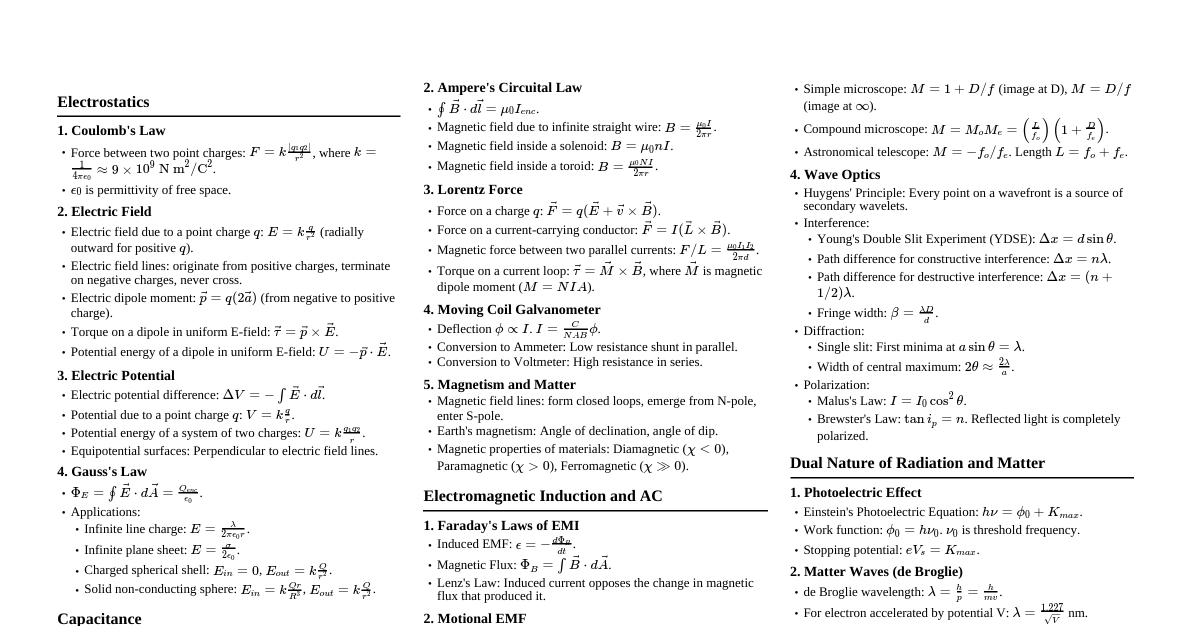
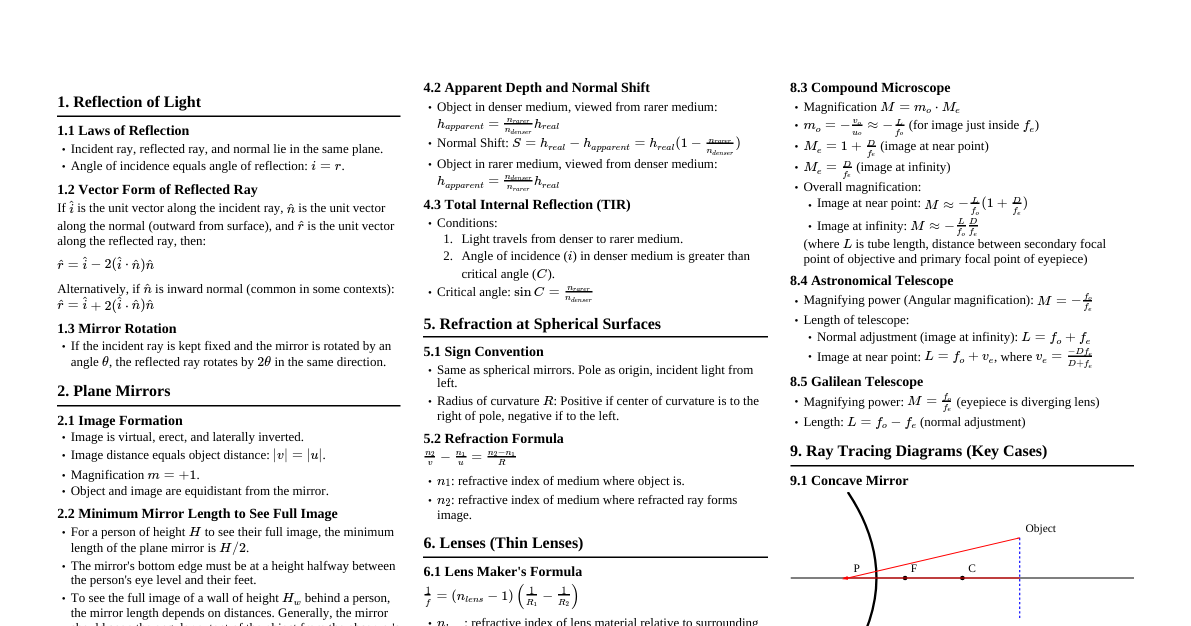
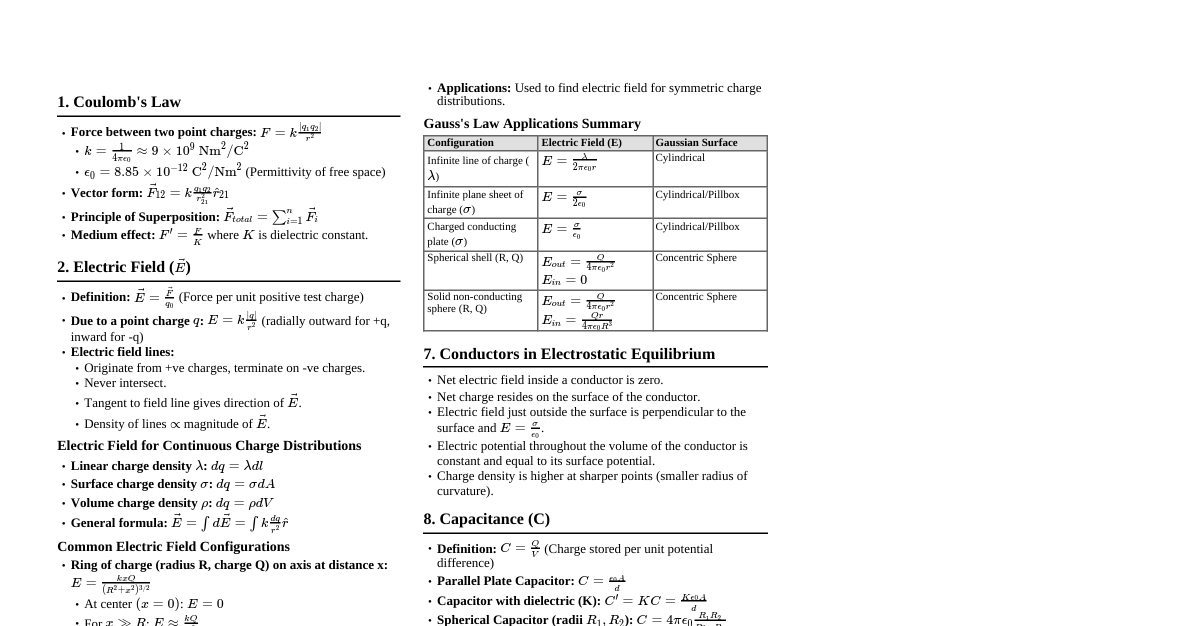
Electrostatics Coulomb's Law: $F = \frac{1}{4\pi\epsilon_0} \frac{q_1 q_2}{r^2}$ (in vacuum) Electric Field: $\vec{E} = \frac{\vec{F}}{q_0}$. For point charge: $E = \frac{1}{4\pi\epsilon_0} \frac{q}{r^2}$ Electric Potential: $V = \frac{U}{q_0}$. For point charge: $V = \frac{1}{4\pi\epsilon_0} \frac{q}{r}$ Potential Energy: $U = \frac{1}{4\pi\epsilon_0} \frac{q_1 q_2}{r}$ Electric Dipole Moment: $\vec{p} = q(2\vec{a})$ Torque on Dipole: $\vec{\tau} = \vec{p} \times \vec{E}$ Potential Energy of Dipole: $U = -\vec{p} \cdot \vec{E}$ Gauss's Law: $\oint \vec{E} \cdot d\vec{A} = \frac{Q_{enc}}{\epsilon_0}$ Capacitance: $C = \frac{Q}{V}$ Parallel Plate Capacitor: $C = \frac{\epsilon_0 A}{d}$ (with dielectric $K$, $C = \frac{K\epsilon_0 A}{d}$) Capacitors in Series: $\frac{1}{C_{eq}} = \sum \frac{1}{C_i}$ Capacitors in Parallel: $C_{eq} = \sum C_i$ Energy Stored in Capacitor: $U = \frac{1}{2}CV^2 = \frac{1}{2}\frac{Q^2}{C} = \frac{1}{2}QV$ Energy Density: $u_E = \frac{1}{2}\epsilon_0 E^2$ Current Electricity Electric Current: $I = \frac{dQ}{dt}$ Drift Velocity: $v_d = \frac{eE\tau}{m}$ Relation between $I$ and $v_d$: $I = nAev_d$ Ohm's Law: $V = IR$ Resistance: $R = \rho \frac{L}{A}$ Resistivity Temperature Dependence: $\rho_T = \rho_0[1 + \alpha(T - T_0)]$ Resistors in Series: $R_{eq} = \sum R_i$ Resistors in Parallel: $\frac{1}{R_{eq}} = \sum \frac{1}{R_i}$ Kirchhoff's Junction Rule: $\sum I_{in} = \sum I_{out}$ Kirchhoff's Loop Rule: $\sum \Delta V = 0$ Electric Power: $P = VI = I^2R = \frac{V^2}{R}$ Cells in Series/Parallel: Series: $E_{eq} = \sum E_i$, $r_{eq} = \sum r_i$ Parallel: $\frac{1}{r_{eq}} = \sum \frac{1}{r_i}$, $\frac{E_{eq}}{r_{eq}} = \sum \frac{E_i}{r_i}$ Wheatstone Bridge: Balanced if $\frac{R_1}{R_2} = \frac{R_3}{R_4}$ Meter Bridge: $\frac{R}{S} = \frac{l}{100-l}$ Potentiometer: $\frac{E_1}{E_2} = \frac{l_1}{l_2}$ (comparison of EMFs) Magnetic Effects of Current & Magnetism Biot-Savart Law: $d\vec{B} = \frac{\mu_0}{4\pi} \frac{I d\vec{l} \times \vec{r}}{r^3}$ Magnetic Field (Straight Wire): $B = \frac{\mu_0 I}{2\pi r}$ Magnetic Field (Circular Loop Center): $B = \frac{\mu_0 I}{2R}$ Magnetic Field (Solenoid): $B = \mu_0 n I$ Ampere's Circuital Law: $\oint \vec{B} \cdot d\vec{l} = \mu_0 I_{enc}$ Lorentz Force: $\vec{F} = q(\vec{E} + \vec{v} \times \vec{B})$ Magnetic Force on Current Carrying Wire: $\vec{F} = I(\vec{l} \times \vec{B})$ Torque on Current Loop: $\vec{\tau} = \vec{M} \times \vec{B}$, where $\vec{M} = NI\vec{A}$ Moving Coil Galvanometer: $I \propto \theta$ Conversion to Ammeter: Shunt resistance $S = \frac{I_g G}{I - I_g}$ Conversion to Voltmeter: Series resistance $R = \frac{V}{I_g} - G$ Earth's Magnetic Field: $B_H = B_E \cos\delta$, $B_V = B_E \sin\delta$, $\tan\delta = \frac{B_V}{B_H}$ Magnetic Permeability: $\mu_r = \frac{\mu}{\mu_0} = 1 + \chi$ Diamagnetism: $\chi Paramagnetism: $\chi > 0$ (small, positive) Ferromagnetism: $\chi \gg 0$ (very large, positive) Electromagnetic Induction & AC Magnetic Flux: $\Phi_B = \int \vec{B} \cdot d\vec{A} = BA \cos\theta$ Faraday's Law: $\mathcal{E} = -\frac{d\Phi_B}{dt}$ Motional EMF: $\mathcal{E} = (Blv)$ (for conductor moving perpendicular to B) Self Inductance: $\Phi_B = LI$, $\mathcal{E} = -L\frac{dI}{dt}$ Energy Stored in Inductor: $U = \frac{1}{2}LI^2$ Mutual Inductance: $\Phi_{21} = MI_1$, $\mathcal{E}_2 = -M\frac{dI_1}{dt}$ Energy Density: $u_B = \frac{1}{2\mu_0} B^2$ AC Voltage/Current: $V = V_0 \sin(\omega t + \phi)$, $I = I_0 \sin(\omega t)$ RMS Values: $V_{rms} = \frac{V_0}{\sqrt{2}}$, $I_{rms} = \frac{I_0}{\sqrt{2}}$ Inductive Reactance: $X_L = \omega L = 2\pi f L$ Capacitive Reactance: $X_C = \frac{1}{\omega C} = \frac{1}{2\pi f C}$ Impedance (LCR Series): $Z = \sqrt{R^2 + (X_L - X_C)^2}$ Phase Angle: $\tan\phi = \frac{X_L - X_C}{R}$ Power in AC Circuit: $P = V_{rms}I_{rms} \cos\phi$ ($\cos\phi$ is power factor) Resonance Frequency: $\omega_0 = \frac{1}{\sqrt{LC}}$, $f_0 = \frac{1}{2\pi\sqrt{LC}}$ Quality Factor: $Q = \frac{\omega_0 L}{R} = \frac{1}{R}\sqrt{\frac{L}{C}}$ Transformer: $\frac{V_s}{V_p} = \frac{N_s}{N_p} = \frac{I_p}{I_s}$ (for ideal transformer) Electromagnetic Waves Speed in Vacuum: $c = \frac{1}{\sqrt{\mu_0\epsilon_0}} = 3 \times 10^8 \text{ m/s}$ Speed in Medium: $v = \frac{1}{\sqrt{\mu\epsilon}}$ Relation between E & B: $E = cB$ Energy Density: $u = u_E + u_B = \frac{1}{2}\epsilon_0 E^2 + \frac{1}{2\mu_0} B^2 = \epsilon_0 E^2 = \frac{B^2}{\mu_0}$ Poynting Vector: $\vec{S} = \frac{1}{\mu_0}(\vec{E} \times \vec{B})$ (direction of propagation & energy flow) Intensity: $I = \langle S \rangle_{avg} = \frac{1}{2}c\epsilon_0 E_0^2 = \frac{1}{2\mu_0}c B_0^2$ Momentum Carried: $p = \frac{U}{c}$ EM Spectrum: Radio, Microwave, IR, Visible, UV, X-ray, Gamma Ray (increasing freq, decreasing wavelength) Optics Ray Optics Speed of Light: $v = \frac{c}{n}$ Snell's Law: $n_1 \sin\theta_1 = n_2 \sin\theta_2$ Critical Angle: $\sin\theta_c = \frac{n_2}{n_1}$ (for $n_1 > n_2$) Mirror Formula: $\frac{1}{f} = \frac{1}{v} + \frac{1}{u}$ (concave $f 0$) Magnification: $m = -\frac{v}{u} = \frac{h_I}{h_O}$ Lens Maker's Formula: $\frac{1}{f} = (n-1)\left(\frac{1}{R_1} - \frac{1}{R_2}\right)$ Lens Formula: $\frac{1}{f} = \frac{1}{v} - \frac{1}{u}$ (concave $f 0$) Power of Lens: $P = \frac{1}{f}$ (in dioptres, f in meters) Lenses in Contact: $P_{eq} = P_1 + P_2$, $\frac{1}{f_{eq}} = \frac{1}{f_1} + \frac{1}{f_2}$ Refraction at Spherical Surface: $\frac{n_2}{v} - \frac{n_1}{u} = \frac{n_2 - n_1}{R}$ Prism Formula: $n = \frac{\sin((A+\delta_m)/2)}{\sin(A/2)}$ (for minimum deviation) Wave Optics Wavefront: Locus of points with same phase Huygens' Principle: Every point on a wavefront is a source of secondary wavelets. Young's Double Slit Experiment (YDSE): Path Difference: $\Delta x = d \sin\theta = \frac{yd}{D}$ Bright Fringes (Max): $\Delta x = n\lambda$, $y_n = \frac{n\lambda D}{d}$ Dark Fringes (Min): $\Delta x = (n + \frac{1}{2})\lambda$, $y_n = \frac{(n + \frac{1}{2})\lambda D}{d}$ Fringe Width: $\beta = \frac{\lambda D}{d}$ Intensity in YDSE: $I = 4I_0 \cos^2(\frac{\phi}{2})$, where $\phi = \frac{2\pi}{\lambda}\Delta x$ Single Slit Diffraction: Minima: $a \sin\theta = n\lambda$ Angular Width of Central Max: $2\theta = \frac{2\lambda}{a}$ Resolving Power: Microscope: $RP = \frac{2n \sin\theta}{\lambda}$ Telescope: $RP = \frac{D}{1.22\lambda}$ Polarization: Malus' Law: $I = I_0 \cos^2\theta$ Brewster's Law: $\tan i_p = n$ Modern Physics Dual Nature of Radiation & Matter Photon Energy: $E = h\nu = \frac{hc}{\lambda}$ Photon Momentum: $p = \frac{h}{\lambda} = \frac{E}{c}$ Photoelectric Effect: $K_{max} = h\nu - \phi_0$, where $\phi_0$ is work function. Stopping Potential: $eV_0 = K_{max}$ Threshold Frequency: $h\nu_0 = \phi_0$ de Broglie Wavelength: $\lambda = \frac{h}{p} = \frac{h}{mv}$ de Broglie (for accelerated electron): $\lambda = \frac{h}{\sqrt{2meV}}$ Atoms & Nuclei Bohr's Model: Radius: $r_n = \frac{n^2 h^2 \epsilon_0}{\pi m e^2 Z} = 0.529 \frac{n^2}{Z} \mathring{A}$ Energy: $E_n = -\frac{me^4}{8\epsilon_0^2 h^2} \frac{Z^2}{n^2} = -13.6 \frac{Z^2}{n^2} \text{ eV}$ Frequency of emitted photon: $h\nu = E_f - E_i$ Rydberg Formula: $\frac{1}{\lambda} = RZ^2 \left(\frac{1}{n_1^2} - \frac{1}{n_2^2}\right)$ ($R = 1.097 \times 10^7 \text{ m}^{-1}$) Mass Defect: $\Delta m = (Zm_p + (A-Z)m_n) - M_{nucleus}$ Binding Energy: $E_b = \Delta m c^2$ Radioactive Decay Law: $N = N_0 e^{-\lambda t}$ Half-life: $T_{1/2} = \frac{\ln 2}{\lambda} = \frac{0.693}{\lambda}$ Mean Life: $\tau = \frac{1}{\lambda}$ Activity: $A = -\frac{dN}{dt} = \lambda N$ Nuclear Reactions: Conservation of mass number and charge number. Electronic Devices Energy Bands: Conductor, Semiconductor, Insulator Intrinsic Semiconductor: $n_e = n_h = n_i$ Extrinsic Semiconductor: N-type: $n_e \gg n_h$ (doped with pentavalent impurities) P-type: $n_h \gg n_e$ (doped with trivalent impurities) Diode (p-n junction): Forward Bias: Low resistance, current flows Reverse Bias: High resistance, negligible current Rectifiers: Convert AC to DC (Half-wave, Full-wave) Zener Diode: Voltage regulator in reverse bias breakdown region. Transistor (BJT): $I_E = I_B + I_C$ Current Gain ($\alpha$): $\alpha = \frac{I_C}{I_E}$ Current Gain ($\beta$): $\beta = \frac{I_C}{I_B}$ Relation: $\beta = \frac{\alpha}{1-\alpha}$ Logic Gates: AND, OR, NOT, NAND, NOR, XOR, XNOR (Truth tables are key) Boolean Algebra: AND: $A \cdot B$ OR: $A + B$ NOT: $\bar{A}$ De Morgan's Theorems: $\overline{A \cdot B} = \bar{A} + \bar{B}$, $\overline{A + B} = \bar{A} \cdot \bar{B}$ Communication Systems Bandwidth: Range of frequencies over which a system operates. Modulation: Superimposing low-frequency signal onto high-frequency carrier wave. Amplitude Modulation (AM): Carrier amplitude varies. Modulation Index: $m_a = \frac{A_m}{A_c}$ Sideband Frequencies: $(\omega_c \pm \omega_m)$ Bandwidth: $2\omega_m$ Frequency Modulation (FM): Carrier frequency varies. Types of Propagation: Ground Wave: Up to a few MHz, follows earth's surface. Sky Wave: Reflects off ionosphere, used for shortwave radio. Space Wave: Line-of-sight, used for TV, satellite communication, radar. Range of Space Wave: $d = \sqrt{2Rh_T} + \sqrt{2Rh_R}$ Transducer: Converts one form of energy to another. Repeater: Amplifies and re-transmits signals.