Laser and Fibre Optics
Cheatsheet Content
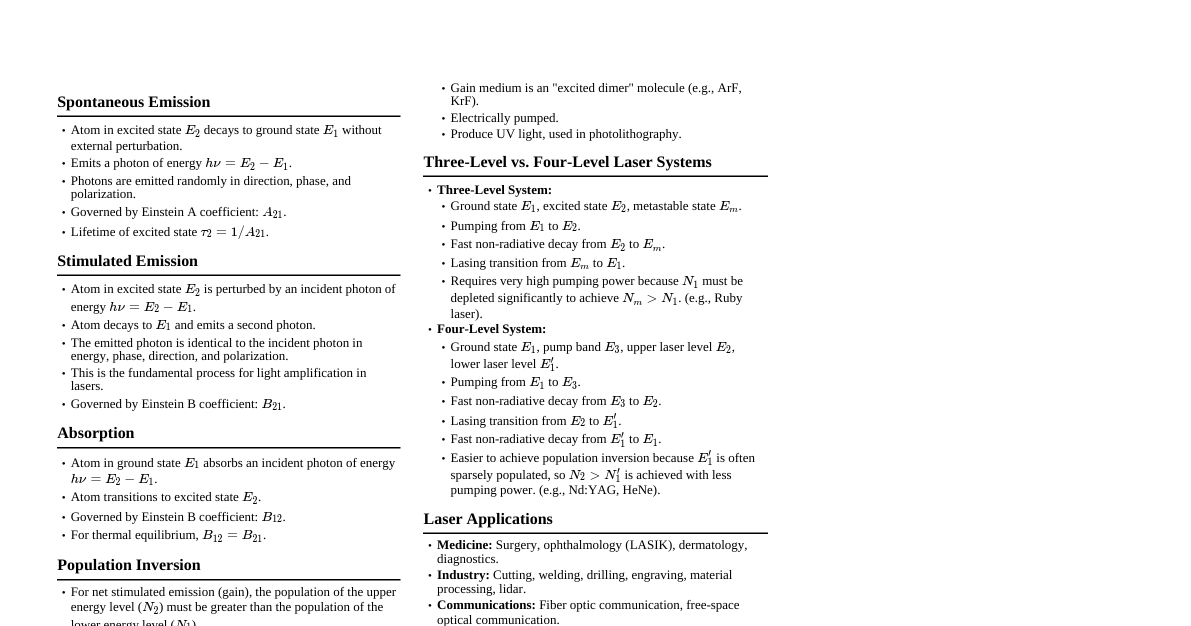
1. Introduction to Lasers LASER: Light Amplification by Stimulated Emission of Radiation. Key Characteristics: Monochromatic: Emits light of a single wavelength (or a very narrow range). Coherent: Photons are in phase both spatially and temporally. Directional: Light is emitted in a narrow, highly parallel beam. High Intensity: Concentrated power in a small area. 2. Einstein Coefficients and Their Relations Describes the rates of absorption, spontaneous emission, and stimulated emission. Absorption ($B_{12}$): Atom absorbs a photon and moves to a higher energy state. Rate of absorption: $R_{12} = N_1 B_{12} u(\nu)$ Spontaneous Emission ($A_{21}$): Atom in a higher energy state randomly emits a photon and drops to a lower state. Rate of spontaneous emission: $R_{21,sp} = N_2 A_{21}$ Stimulated Emission ($B_{21}$): Incident photon causes an excited atom to emit an identical photon and drop to a lower state. This is the basis of laser action. Rate of stimulated emission: $R_{21,st} = N_2 B_{21} u(\nu)$ Relations: $B_{12} = B_{21}$ (for non-degenerate energy levels) $A_{21} = \frac{8 \pi h \nu^3}{c^3} B_{21}$ 3. Metastable State An excited energy state of an atom with a relatively long lifetime (typically $10^{-3}$ to $10^{-6}$ seconds) compared to normal excited states ($10^{-8}$ seconds). Crucial for achieving population inversion, as atoms can accumulate in this state. 4. Population Inversion A non-equilibrium condition where the number of atoms in a higher energy state ($N_2$) is greater than the number of atoms in a lower energy state ($N_1$). $N_2 > N_1$ Essential for net stimulated emission to dominate over absorption, leading to light amplification. 5. Pumping The process of supplying energy to the laser medium to achieve population inversion. Optical Pumping: Using strong light sources (e.g., flash lamps, other lasers). Electrical Pumping: Using an electric discharge in a gas. Chemical Pumping: Energy released from chemical reactions. Direct Conversion: In semiconductor lasers, electron-hole recombination. 6. Lasing Action (Principle of Laser) Pumping: Atoms are excited to higher energy levels. Metastable State: Atoms rapidly decay to a metastable state, where they accumulate. Population Inversion: Accumulation in the metastable state leads to more atoms in the excited state than in the ground state. Spontaneous Emission: A few atoms spontaneously emit photons. Stimulated Emission: These spontaneously emitted photons trigger other excited atoms to emit identical photons, leading to a cascade effect. Amplification: Photons bounce between mirrors in an optical resonator, stimulating more emission and amplifying the light. Output: A small portion of the amplified light is allowed to exit through a partially reflective mirror as the laser beam. 7. Types of Lasers 7.1. Ruby Laser (Solid-State Laser) Active Medium: Chromium ions ($Cr^{3+}$) doped in Aluminum Oxide ($Al_2O_3$) crystal. Pumping: Optical pumping using a xenon flash lamp. Energy Levels: Three-level system. Ground state ($E_1$) $\rightarrow$ Broad absorption band ($E_3$) $\rightarrow$ Metastable state ($E_2$) $\rightarrow$ Ground state ($E_1$). Wavelength: 694.3 nm (red light). Output: Pulsed. Applications: Holography, range finding, tattoo removal. 7.2. He-Ne Laser (Gas Laser) Active Medium: Mixture of Helium (He) and Neon (Ne) gases in a ratio of 10:1. Pumping: Electrical discharge. Energy Levels: Four-level system. He atoms are excited by electron collision to metastable states. Excited He atoms transfer energy to Ne atoms via collision, exciting Ne to its metastable states. Lasing occurs between Ne energy levels. Wavelength: 632.8 nm (red light). Output: Continuous Wave (CW). Applications: Barcode scanners, alignment, holography, optical disk readers. 7.3. CO$_2$ Laser (Gas Laser) Active Medium: Mixture of CO$_2$, N$_2$, and He gases. Pumping: Electrical discharge. Energy Levels: Vibrational-rotational transitions of CO$_2$ molecules. Nitrogen aids in exciting CO$_2$, Helium helps depopulate lower laser levels. Wavelength: Primarily 10.6 $\mu$m (far-infrared). Output: High power, CW or pulsed. Applications: Industrial cutting, welding, drilling, surgery. 7.4. Semiconductor Diode Laser Active Medium: A p-n junction diode made from semiconductor materials (e.g., GaAs, AlGaAs). Pumping: Electrical injection (forward biasing the p-n junction). Lasing Mechanism: Electron-hole recombination across the bandgap emits photons. Population inversion is achieved by high injection of carriers into the active region. Wavelength: Varies with material composition (e.g., 780 nm to 850 nm for CD/DVD, 405 nm for Blu-ray). Output: Compact, efficient, can be CW or pulsed. Applications: Optical fiber communication, CD/DVD/Blu-ray players, laser pointers, barcode scanners, medical devices. 8. Laser Applications Bar Code Scanner: He-Ne or diode lasers read bar codes by detecting reflected light patterns. LIDAR for Autonomous Vehicles: (Light Detection and Ranging) Emits laser pulses and measures the time of flight for reflections to create detailed 3D maps of the surroundings. Crucial for obstacle detection, navigation, and mapping in self-driving cars. Medical: Surgery, vision correction (LASIK), dermatology. Industrial: Cutting, welding, drilling, engraving. Communication: Fiber optic communication systems. Scientific: Spectroscopy, interferometry, research. 9. Introduction to Fibre Optics Optical Fibre: A thin, flexible, transparent fiber made of glass (silica) or plastic, used to transmit light over long distances. Principle: Based on Total Internal Reflection (TIR). 10. Total Internal Reflection (TIR) Occurs when light travels from a denser medium (higher refractive index, $n_1$) to a rarer medium (lower refractive index, $n_2$) at an angle of incidence greater than the critical angle ($\theta_c$). Condition for TIR: Light travels from denser to rarer medium ($n_1 > n_2$). Angle of incidence ($\theta_i$) > Critical angle ($\theta_c$). Critical Angle: $\theta_c = \arcsin\left(\frac{n_2}{n_1}\right)$ 11. Construction of Optical Fibre Core: The central part, typically made of high-purity glass or plastic, with a higher refractive index ($n_1$). This is where light propagates. Cladding: Surrounds the core, made of a material with a slightly lower refractive index ($n_2 Buffer Coating (Protective Jacket): A plastic layer that protects the core and cladding from moisture and physical damage. 12. Acceptance Angle ($\theta_a$) and Numerical Aperture (NA) Acceptance Angle: The maximum angle at which light can enter the fiber from the outside and still be guided by TIR. $\sin \theta_a = \sqrt{n_1^2 - n_2^2}$ (assuming air outside the fiber, $n_{air}=1$) Numerical Aperture (NA): A measure of the light-gathering ability of the fiber and its ability to guide light. It is defined as the sine of the acceptance angle. $NA = \sin \theta_a = \sqrt{n_1^2 - n_2^2}$ Higher NA means the fiber can collect more light and has a larger acceptance cone. 13. Classification of Optical Fibres 13.1. Based on Refractive Index Profile Step-Index Fibre: Core has a uniform refractive index. Cladding has a uniform but lower refractive index. Abrupt change in refractive index at the core-cladding interface. Graded-Index (GRIN) Fibre: Refractive index of the core gradually decreases from the center towards the cladding. Light rays follow helical paths, and different modes travel at different speeds but arrive at the end almost simultaneously, reducing modal dispersion. 13.2. Based on Mode of Propagation Single-Mode Fibre (SMF): Very small core diameter (8-10 $\mu$m). Allows only one mode of light to propagate. Eliminates modal dispersion, suitable for long-distance, high-bandwidth applications. Requires precise coupling. Multi-Mode Fibre (MMF): Larger core diameter (50-100 $\mu$m). Allows multiple modes of light to propagate. Can be step-index or graded-index. Suffer from modal dispersion (different modes arrive at different times). Suitable for shorter distances and lower bandwidth. 14. Losses in Optical Fibre Attenuation: Reduction in light signal power as it travels through the fiber. Measured in dB/km. Absorption Loss: Intrinsic absorption by fiber material (e.g., UV absorption by electrons, IR absorption by molecular vibrations). Extrinsic absorption due to impurities (e.g., OH-ions, transition metal ions). Scattering Loss: Rayleigh Scattering: Caused by microscopic density fluctuations (smaller than wavelength) frozen into the fiber during manufacturing. Dominant loss mechanism, inversely proportional to $\lambda^4$. Mie Scattering: Caused by larger imperfections (e.g., bubbles, impurities) comparable to or larger than the wavelength. Dispersion: Spreading of light pulses as they travel through the fiber, leading to signal distortion and limiting bandwidth. Modal Dispersion: Different modes of light travel different path lengths and arrive at different times (significant in MMF). Eliminated in SMF. Chromatic Dispersion: Different wavelengths (even within a single mode) travel at different speeds due to refractive index being wavelength-dependent. Material Dispersion: Due to wavelength dependence of refractive index. Waveguide Dispersion: Due to light propagating differently in core and cladding based on wavelength. Polarization Mode Dispersion (PMD): Different polarization components of light travel at different speeds. Bending Losses: Macrobending: Losses due to large-radius bends. Microbending: Losses due to microscopic fluctuations in the fiber geometry. 15. Applications of Optical Fibre Communication Systems: Transmitting data (internet, telephone, TV) over long distances with high bandwidth and low loss. Immune to electromagnetic interference. Sensor for Structural Health Monitoring: Optical fibers can be embedded in structures (bridges, buildings, aircraft) to detect changes in strain, temperature, pressure, and vibration. Changes in these parameters alter the light transmission characteristics (e.g., phase, intensity, wavelength shift), which are then measured. Provides real-time, distributed monitoring of structural integrity. Medical: Endoscopes, surgical lasers, diagnostic tools. Illumination: Decorative lighting, medical lighting. Data Storage: Optical data links within data centers.