Ray Optics - JEE Cheatsheet
Cheatsheet Content
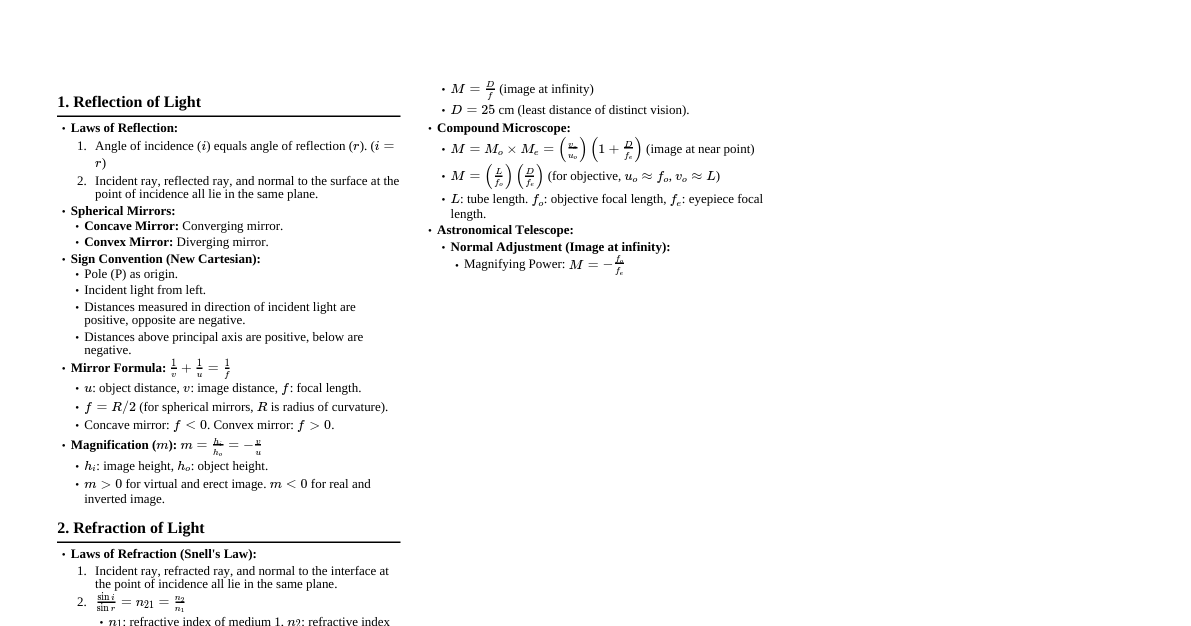
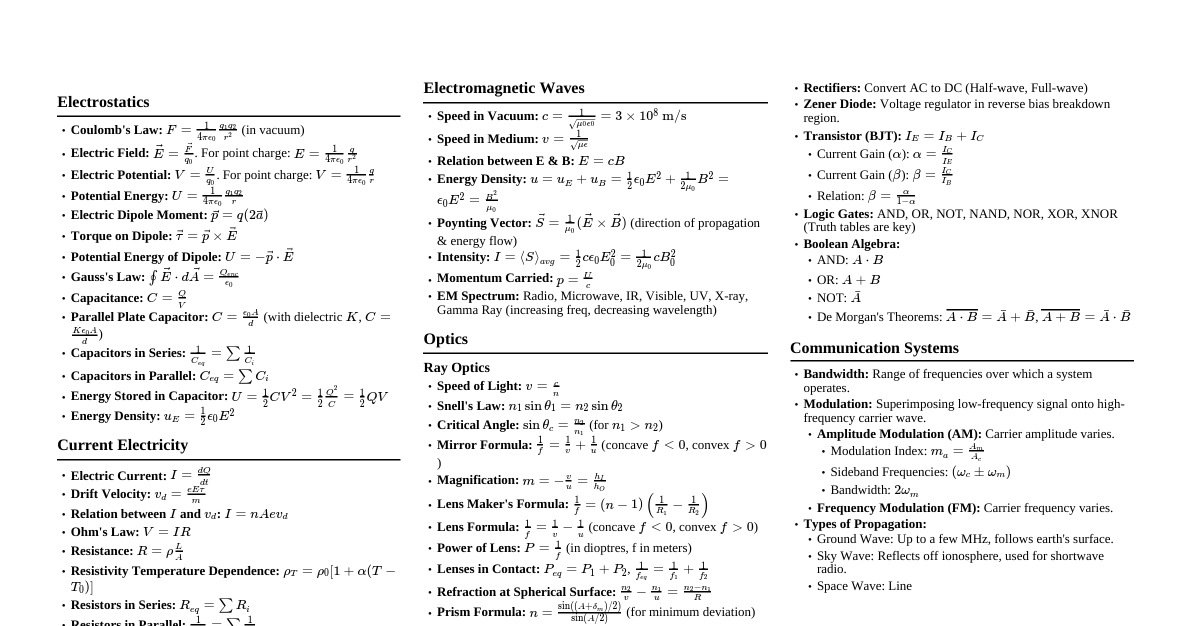
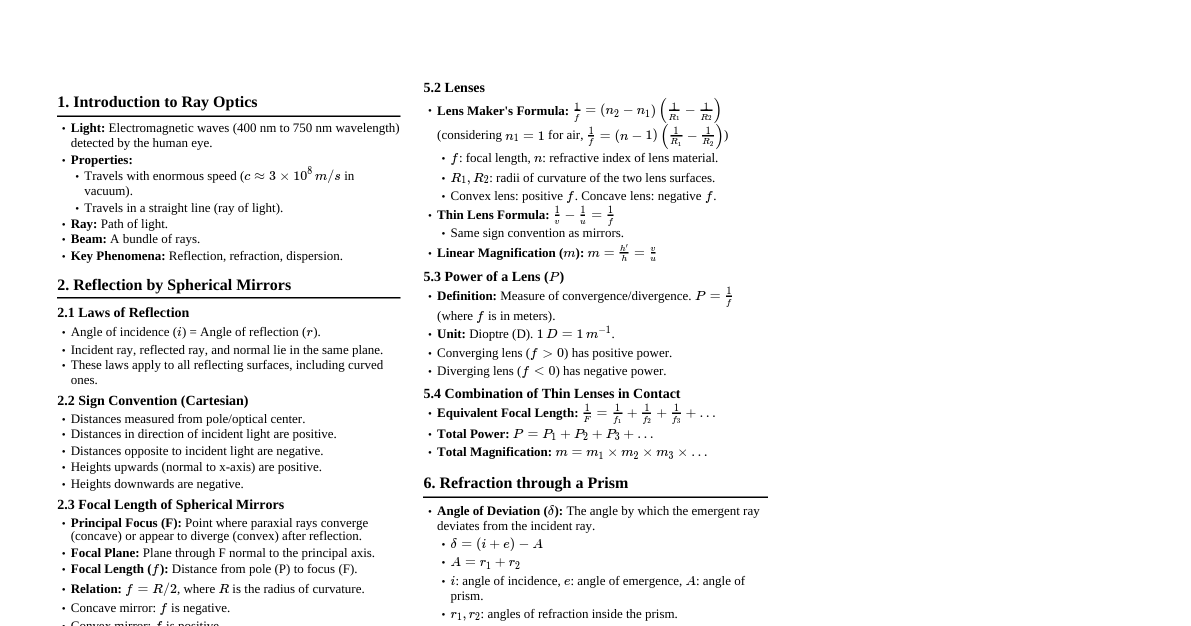
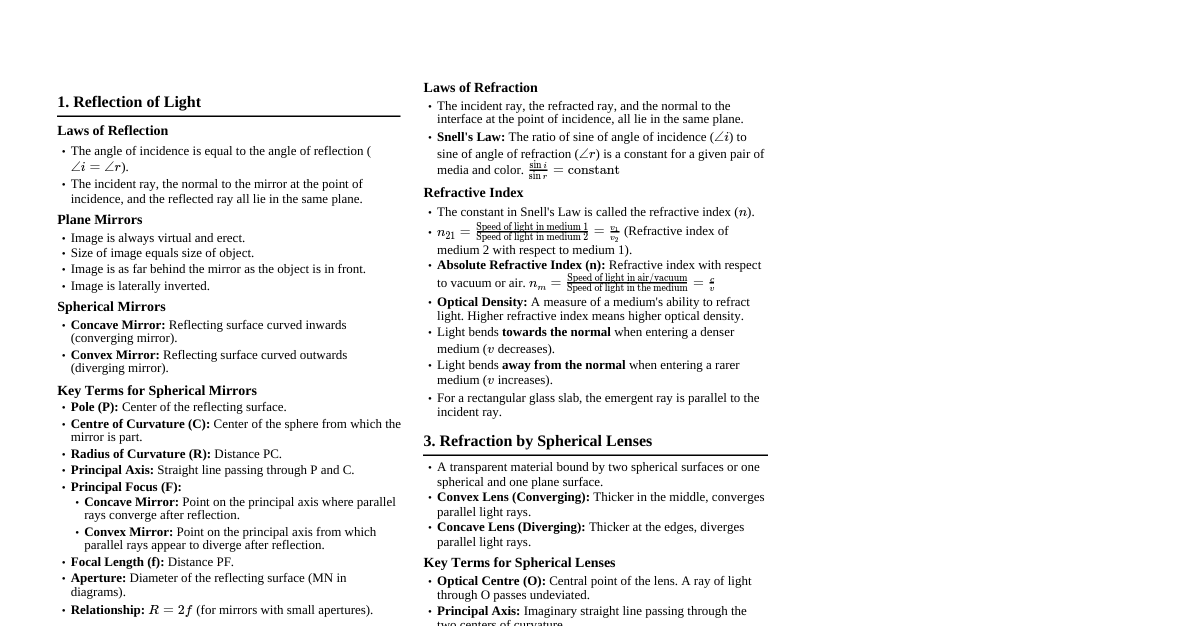
1. Reflection of Light 1.1 Laws of Reflection Incident ray, reflected ray, and normal lie in the same plane. Angle of incidence equals angle of reflection: $i = r$. 1.2 Vector Form of Reflected Ray If $\hat{i}$ is the unit vector along the incident ray, $\hat{n}$ is the unit vector along the normal (outward from surface), and $\hat{r}$ is the unit vector along the reflected ray, then: $\hat{r} = \hat{i} - 2(\hat{i} \cdot \hat{n})\hat{n}$ Alternatively, if $\hat{n}$ is inward normal (common in some contexts): $\hat{r} = \hat{i} + 2(\hat{i} \cdot \hat{n})\hat{n}$ 1.3 Mirror Rotation If the incident ray is kept fixed and the mirror is rotated by an angle $\theta$, the reflected ray rotates by $2\theta$ in the same direction. 2. Plane Mirrors 2.1 Image Formation Image is virtual, erect, and laterally inverted. Image distance equals object distance: $|v| = |u|$. Magnification $m = +1$. Object and image are equidistant from the mirror. 2.2 Minimum Mirror Length to See Full Image For a person of height $H$ to see their full image, the minimum length of the plane mirror is $H/2$. The mirror's bottom edge must be at a height halfway between the person's eye level and their feet. To see the full image of a wall of height $H_w$ behind a person, the mirror length depends on distances. Generally, the mirror should span the angular extent of the object from the observer's eye. 2.3 Velocity of Image Let $\vec{v}_o$ be object velocity, $\vec{v}_i$ be image velocity, $\vec{v}_m$ be mirror velocity. Along the normal to the mirror (x-axis if mirror is in y-z plane): $v_{ix} = 2v_{mx} - v_{ox}$ Parallel to the mirror (y-z plane): $v_{iy} = v_{oy}$ and $v_{iz} = v_{oz}$ 3. Spherical Mirrors (Concave & Convex) 3.1 Sign Convention (New Cartesian Convention) Origin: Pole (P) of the mirror. Principal Axis: X-axis. Incident light travels from left to right (usually). Distances measured in the direction of incident light are positive. Distances measured opposite to the direction of incident light are negative. Heights above the principal axis are positive, below are negative. Focal length $f$: Concave mirror $f 0$. Radius of curvature $R$: Concave mirror $R 0$. 3.2 Mirror Formula $\frac{1}{v} + \frac{1}{u} = \frac{1}{f}$ where $u$ = object distance, $v$ = image distance, $f$ = focal length. Relationship between $f$ and $R$: $f = R/2$. 3.3 Magnification (Lateral/Transverse) $m = \frac{h_i}{h_o} = -\frac{v}{u}$ $h_i$ = height of image, $h_o$ = height of object. $m > 0$: image is erect (virtual). $m $|m| > 1$: magnified image. $|m| $|m| = 1$: same size image. 3.4 Longitudinal Magnification $m_L = -\frac{dv}{du} = -(\frac{v}{u})^2 = -m^2$ For small object length along principal axis. 3.5 Velocity of Image in Spherical Mirrors Along principal axis: $v_{ix} = -(\frac{v}{u})^2 v_{ox}$ (This is $m_L \cdot v_{ox}$) Perpendicular to principal axis: $v_{iy} = (\frac{v}{u}) v_{oy} = m \cdot v_{oy}$ If mirror is moving: $v_{ix} = -(\frac{v}{u})^2 v_{ox} + (1 + (\frac{v}{u})^2) v_{mx}$ (For x-component along principal axis) 4. Refraction of Light 4.1 Snell's Law $n_1 \sin i = n_2 \sin r$ $n_1$: refractive index of medium 1 (where incident ray is). $n_2$: refractive index of medium 2 (where refracted ray is). $i$: angle of incidence. $r$: angle of refraction. Also, $\frac{\sin i}{\sin r} = \frac{v_1}{v_2} = \frac{\lambda_1}{\lambda_2}$ (where $v$ is speed, $\lambda$ is wavelength) Absolute refractive index $n = c/v$ (where $c$ is speed of light in vacuum). 4.2 Apparent Depth and Normal Shift Object in denser medium, viewed from rarer medium: $h_{apparent} = \frac{n_{rarer}}{n_{denser}} h_{real}$ Normal Shift: $S = h_{real} - h_{apparent} = h_{real} (1 - \frac{n_{rarer}}{n_{denser}})$ Object in rarer medium, viewed from denser medium: $h_{apparent} = \frac{n_{denser}}{n_{rarer}} h_{real}$ 4.3 Total Internal Reflection (TIR) Conditions: Light travels from denser to rarer medium. Angle of incidence ($i$) in denser medium is greater than critical angle ($C$). Critical angle: $\sin C = \frac{n_{rarer}}{n_{denser}}$ 5. Refraction at Spherical Surfaces 5.1 Sign Convention Same as spherical mirrors. Pole as origin, incident light from left. Radius of curvature $R$: Positive if center of curvature is to the right of pole, negative if to the left. 5.2 Refraction Formula $\frac{n_2}{v} - \frac{n_1}{u} = \frac{n_2 - n_1}{R}$ $n_1$: refractive index of medium where object is. $n_2$: refractive index of medium where refracted ray forms image. 6. Lenses (Thin Lenses) 6.1 Lens Maker's Formula $\frac{1}{f} = (n_{lens} - 1) \left( \frac{1}{R_1} - \frac{1}{R_2} \right)$ $n_{lens}$: refractive index of lens material relative to surrounding medium. $R_1$: radius of curvature of first surface. $R_2$: radius of curvature of second surface. Sign convention for $R_1, R_2$: Positive if center of curvature is on the side of emergent ray (convex for incident side, concave for emergent side). Converging lens ($f > 0$), Diverging lens ($f 6.2 Thin Lens Formula $\frac{1}{v} - \frac{1}{u} = \frac{1}{f}$ Sign convention same as spherical mirrors. Optical centre as origin. 6.3 Magnification (Lateral/Transverse) $m = \frac{h_i}{h_o} = \frac{v}{u}$ Same interpretation as mirror magnification regarding erect/inverted, magnified/diminished. 6.4 Power of a Lens $P = \frac{1}{f}$ (in dioptres, if $f$ is in meters) Converging lens: $P > 0$. Diverging lens: $P 6.5 Combination of Thin Lenses If lenses are in contact: $\frac{1}{f_{eq}} = \frac{1}{f_1} + \frac{1}{f_2} + \dots$ $P_{eq} = P_1 + P_2 + \dots$ If two thin lenses are separated by a distance $d$: $\frac{1}{f_{eq}} = \frac{1}{f_1} + \frac{1}{f_2} - \frac{d}{f_1 f_2}$ $P_{eq} = P_1 + P_2 - d P_1 P_2$ 7. Prism 7.1 Deviation by a Prism $A = r_1 + r_2$ (Angle of Prism) $\delta = (i_1 - r_1) + (i_2 - r_2) = i_1 + i_2 - A$ (Angle of Deviation) 7.2 Minimum Deviation Occurs when $i_1 = i_2$ and $r_1 = r_2 = A/2$. At minimum deviation: $n = \frac{\sin((A + \delta_m)/2)}{\sin(A/2)}$ 7.3 Dispersion (Angular Dispersion) $\theta = \delta_v - \delta_r$ (Deviation for violet - Deviation for red) $\theta = (n_v - n_r)A$ (For thin prism) 7.4 Dispersive Power $\omega = \frac{\theta}{\delta_y} = \frac{n_v - n_r}{n_y - 1}$ $\delta_y$: deviation for yellow (mean) light. $n_y$: refractive index for yellow light $\approx (n_v+n_r)/2$. 8. Optical Instruments 8.1 Human Eye Near point: 25 cm (normal eye). Far point: Infinity (normal eye). 8.2 Simple Microscope (Magnifying Glass) Angular magnification $M$: Image at near point (25 cm): $M = 1 + \frac{D}{f}$ Image at infinity: $M = \frac{D}{f}$ (where $D = 25$ cm) 8.3 Compound Microscope Magnification $M = m_o \cdot M_e$ $m_o = -\frac{v_o}{u_o} \approx -\frac{L}{f_o}$ (for image just inside $f_e$) $M_e = 1 + \frac{D}{f_e}$ (image at near point) $M_e = \frac{D}{f_e}$ (image at infinity) Overall magnification: Image at near point: $M \approx -\frac{L}{f_o} (1 + \frac{D}{f_e})$ Image at infinity: $M \approx -\frac{L}{f_o} \frac{D}{f_e}$ (where $L$ is tube length, distance between secondary focal point of objective and primary focal point of eyepiece) 8.4 Astronomical Telescope Magnifying power (Angular magnification): $M = -\frac{f_o}{f_e}$ Length of telescope: Normal adjustment (image at infinity): $L = f_o + f_e$ Image at near point: $L = f_o + v_e$, where $v_e = \frac{-D f_e}{D + f_e}$ 8.5 Galilean Telescope Magnifying power: $M = \frac{f_o}{f_e}$ (eyepiece is diverging lens) Length: $L = f_o - f_e$ (normal adjustment) 9. Ray Tracing Diagrams (Key Cases) 9.1 Concave Mirror P F C Object Ray parallel to principal axis passes through F after reflection. Ray passing through F becomes parallel to principal axis after reflection. Ray passing through C retraces its path after reflection. Ray incident at P reflects symmetrically about principal axis. 9.2 Convex Lens O F1 F2 Object Ray parallel to principal axis passes through F2 after refraction. Ray passing through F1 becomes parallel to principal axis after refraction. Ray passing through optical center (O) goes undeviated.