Wave Optics (JEE Level)
Cheatsheet Content
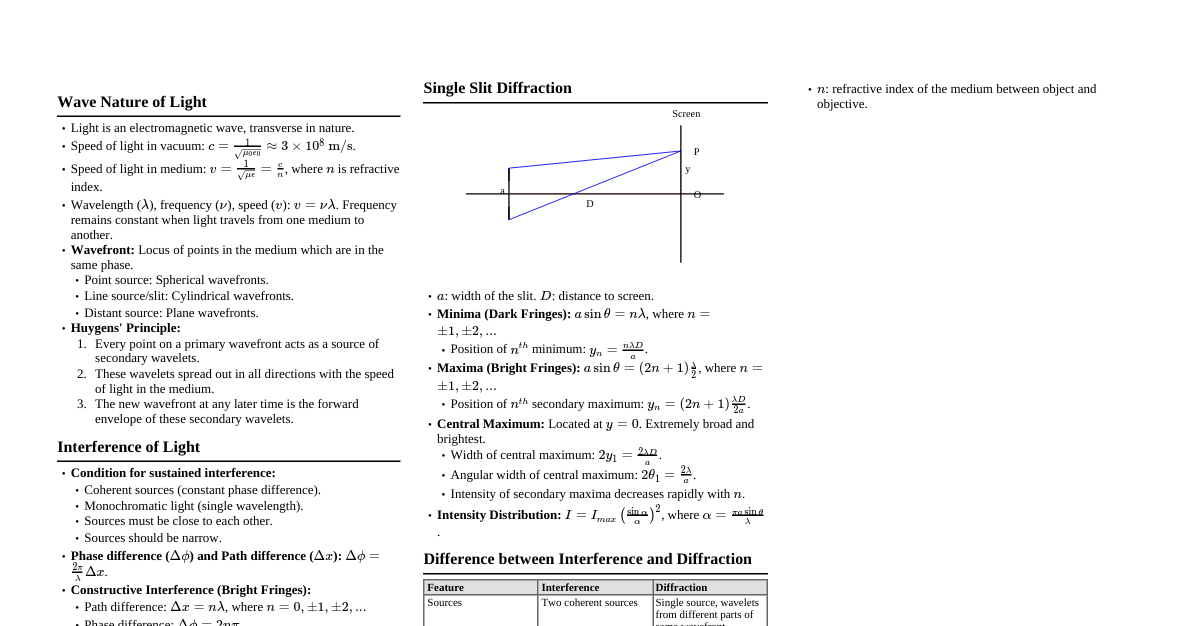
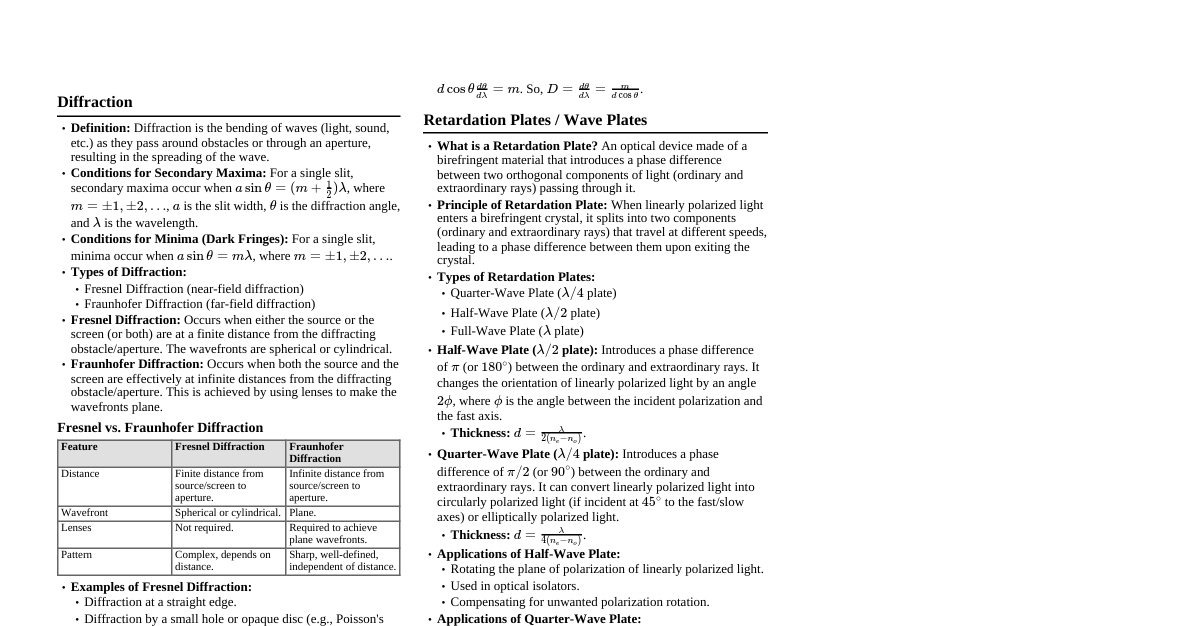
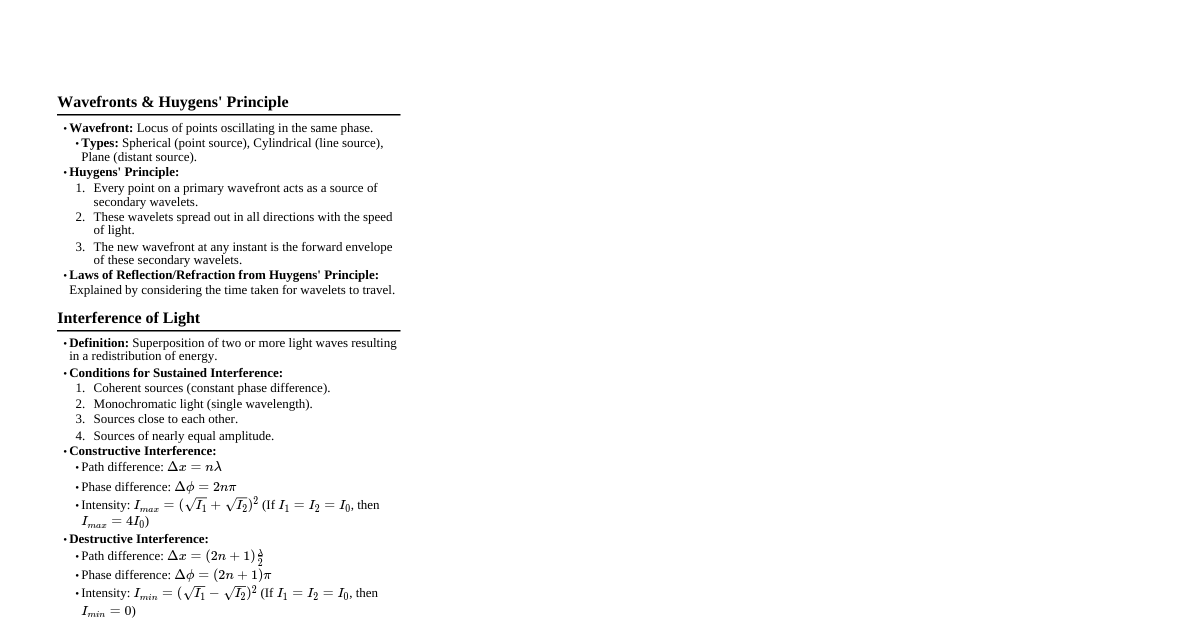
1. Introduction to Waves and Light Wavefront: Locus of all points oscillating in the same phase. Point source: Spherical wavefront Linear source: Cylindrical wavefront Distant source: Plane wavefront Huygens' Principle: Every point on a wavefront acts as a source of secondary wavelets. The new wavefront is the envelope of these wavelets. Superposition Principle: When two or more waves overlap, the resultant displacement at any point is the vector sum of the individual displacements due to each wave. 2. Interference of Light Coherent Sources: Sources that emit light waves of the same frequency, constant phase difference, and same direction of propagation. Constructive Interference: Occurs when waves meet in phase, resulting in maximum intensity. Path difference $\Delta x = n\lambda$ Phase difference $\Delta \phi = 2n\pi$ Destructive Interference: Occurs when waves meet out of phase ($180^\circ$), resulting in minimum intensity. Path difference $\Delta x = (2n+1)\frac{\lambda}{2}$ Phase difference $\Delta \phi = (2n+1)\pi$ Intensity Distribution: For two waves with amplitudes $A_1, A_2$ and phase difference $\phi$: $I = I_1 + I_2 + 2\sqrt{I_1 I_2} \cos\phi$ If $A_1 = A_2 = A_0$, then $I = 4I_0 \cos^2(\frac{\phi}{2})$ Conditions for Sustained Interference: Coherent sources (most crucial) Monochromatic light Sources close to each other Sources of nearly equal amplitude 3. Young's Double Slit Experiment (YDSE) - Detailed Setup: Two narrow slits $S_1, S_2$ separated by a distance $d$, illuminated by a monochromatic source. A screen is placed at a large distance $D$ from the slits. S S1 S2 Screen D d y Path Difference ($\Delta x$): For a point P on the screen at a distance $y$ from the central axis: $\Delta x = S_2P - S_1P$ Using geometry and binomial approximation $(1+x)^n \approx 1+nx$ for small $x$: $S_1P = \sqrt{D^2 + (y - d/2)^2} \approx D + \frac{(y - d/2)^2}{2D}$ $S_2P = \sqrt{D^2 + (y + d/2)^2} \approx D + \frac{(y + d/2)^2}{2D}$ $\Delta x = \frac{(y + d/2)^2 - (y - d/2)^2}{2D} = \frac{4y(d/2)}{2D} = \frac{yd}{D}$ This approximation is valid when $D \gg d$ and $D \gg y$. Alternatively, using angles: $\Delta x = d \sin\theta$. For small $\theta$, $\sin\theta \approx \tan\theta \approx \frac{y}{D}$, so $\Delta x = \frac{yd}{D}$. Condition for Bright Fringes (Constructive Interference): Occurs when $\Delta x = n\lambda$ (where $n = 0, \pm 1, \pm 2, ...$) $\frac{yd}{D} = n\lambda \implies y_n = \frac{n\lambda D}{d}$ For $n=0$, $y_0 = 0$ (Central Bright Fringe) For $n=\pm 1$, $y_{\pm 1} = \pm \frac{\lambda D}{d}$ (First Bright Fringes) Condition for Dark Fringes (Destructive Interference): Occurs when $\Delta x = (2n+1)\frac{\lambda}{2}$ (where $n = 0, \pm 1, \pm 2, ...$) $\frac{yd}{D} = (2n+1)\frac{\lambda}{2} \implies y_n = (2n+1)\frac{\lambda D}{2d}$ For $n=0$, $y_0 = \frac{\lambda D}{2d}$ (First Dark Fringe) For $n=1$, $y_1 = \frac{3\lambda D}{2d}$ (Second Dark Fringe) Fringe Width ($\beta$): The distance between the centers of two consecutive bright fringes or two consecutive dark fringes. $\beta = y_{n+1} - y_n = \frac{(n+1)\lambda D}{d} - \frac{n\lambda D}{d} = \frac{\lambda D}{d}$ All bright and dark fringes have the same width in YDSE. Angular Fringe Width ($\theta$): The angular separation between consecutive fringes. $\theta = \frac{\beta}{D} = \frac{\lambda}{d}$ Intensity Distribution: The intensity at a point $P$ is $I = I_0 \cos^2(\frac{\phi}{2})$, where $\phi = \frac{2\pi}{\lambda}\Delta x = \frac{2\pi}{\lambda}\frac{yd}{D}$. $I = I_0 \cos^2(\frac{\pi yd}{\lambda D})$ Maximum Intensity ($I_{max} = I_0$) at bright fringes, Minimum Intensity ($I_{min} = 0$) at dark fringes. Effect of Thin Transparent Sheet: If a thin sheet of thickness $t$ and refractive index $\mu$ is placed in the path of one of the beams (say, from $S_1$): The optical path length for $S_1$ changes from $S_1P$ to $S_1P - t + \mu t = S_1P + (\mu-1)t$. The new path difference: $\Delta x' = S_2P - (S_1P + (\mu-1)t) = \Delta x - (\mu-1)t = \frac{yd}{D} - (\mu-1)t$. For the central bright fringe ($n=0$), $\Delta x' = 0 \implies \frac{y_{shift}d}{D} - (\mu-1)t = 0$. So, the shift of the central bright fringe is $\Delta y = y_{shift} = \frac{D}{d}(\mu-1)t$. The entire fringe pattern shifts towards the slit in front of which the sheet is placed. 4. Diffraction of Light Definition: Bending of light waves around obstacles or through small apertures. Fraunhofer Diffraction (Single Slit): Condition for minima: $a \sin\theta = n\lambda$ ($n = \pm 1, \pm 2, ...$) where $a$ is slit width, $\theta$ is angle from center. Condition for maxima: $a \sin\theta = (2n+1)\frac{\lambda}{2}$ ($n = \pm 1, \pm 2, ...$) (approximate for secondary maxima) Central maximum is twice as wide as secondary maxima. Intensity of secondary maxima decreases rapidly. Width of central maximum: $2\theta_1 = \frac{2\lambda}{a}$ (angular), $2y_1 = \frac{2\lambda D}{a}$ (linear) Difference between Interference and Diffraction: Feature Interference Diffraction Sources Two coherent sources Single wavefront Fringe Width Usually equal Central maximum widest, others decrease Intensity All bright fringes same intensity Intensity decreases rapidly from center Minima Perfectly dark (if amplitudes equal) Not perfectly dark 5. Polarization of Light Unpolarized Light: Vibrations of electric field vectors occur in all possible directions perpendicular to propagation. Polarized Light: Vibrations are confined to a single plane. Plane polarized (linear polarized) Circularly polarized Elliptically polarized Methods of Polarization: Reflection (Brewster's Law) Refraction (Double Refraction) Scattering Selective Absorption (Dichroism - e.g., Polaroid) Polaroid: A sheet that transmits light with electric field vibrations parallel to its transmission axis and absorbs others. Malus's Law: When plane-polarized light of intensity $I_0$ passes through an analyzer, the transmitted intensity $I$ is given by $I = I_0 \cos^2\theta$, where $\theta$ is the angle between the transmission axes of the polarizer and analyzer. Brewster's Law (Polarization by Reflection): When unpolarized light is incident on an interface at Brewster's angle ($i_p$), the reflected light is completely plane-polarized perpendicular to the plane of incidence. $n = \tan i_p$ At $i_p$, reflected and refracted rays are perpendicular to each other. Double Refraction (Birefringence): Certain crystals (e.g., calcite, quartz) split an unpolarized incident ray into two refracted rays: Ordinary ray (O-ray): Obeys Snell's law, vibrates perpendicular to principal section. Extraordinary ray (E-ray): Does not obey Snell's law, vibrates in the principal section. 6. Important Formulas Phase Difference ($\Delta\phi$) and Path Difference ($\Delta x$): $\Delta\phi = \frac{2\pi}{\lambda} \Delta x$ Resultant Intensity (Interference): $I = I_1 + I_2 + 2\sqrt{I_1 I_2} \cos\phi$ If $I_1 = I_2 = I_{initial}$, then $I = 4I_{initial} \cos^2(\frac{\phi}{2})$ Maximum Intensity: $I_{max} = (\sqrt{I_1} + \sqrt{I_2})^2$ Minimum Intensity: $I_{min} = (\sqrt{I_1} - \sqrt{I_2})^2$ Ratio of Max to Min Intensity: $\frac{I_{max}}{I_{min}} = (\frac{\sqrt{I_1} + \sqrt{I_2}}{\sqrt{I_1} - \sqrt{I_2}})^2 = (\frac{A_1 + A_2}{A_1 - A_2})^2$ YDSE Path Difference: $\Delta x = \frac{yd}{D}$ (for small angles) YDSE Bright Fringes (Maxima) Position: $y_n = \frac{n\lambda D}{d}$ ($n = 0, \pm 1, \pm 2, ...$) YDSE Dark Fringes (Minima) Position: $y_n = (2n+1)\frac{\lambda D}{2d}$ ($n = 0, \pm 1, \pm 2, ...$) YDSE Fringe Width: $\beta = \frac{\lambda D}{d}$ YDSE Angular Fringe Width: $\theta = \frac{\lambda}{d}$ Shift of Fringes due to Thin Film in YDSE: $\Delta y = \frac{D}{d}(\mu-1)t$ Single Slit Diffraction Minima: $a \sin\theta = n\lambda$ ($n = \pm 1, \pm 2, ...$) Single Slit Diffraction Secondary Maxima (approx): $a \sin\theta = (2n+1)\frac{\lambda}{2}$ ($n = \pm 1, \pm 2, ...$) Linear Width of Central Maximum (Single Slit): $W = \frac{2\lambda D}{a}$ Angular Width of Central Maximum (Single Slit): $2\theta = \frac{2\lambda}{a}$ Malus's Law (Polarization): $I = I_0 \cos^2\theta$ Brewster's Law: $n = \tan i_p$