Wave Optics (JEE Mains)
Cheatsheet Content
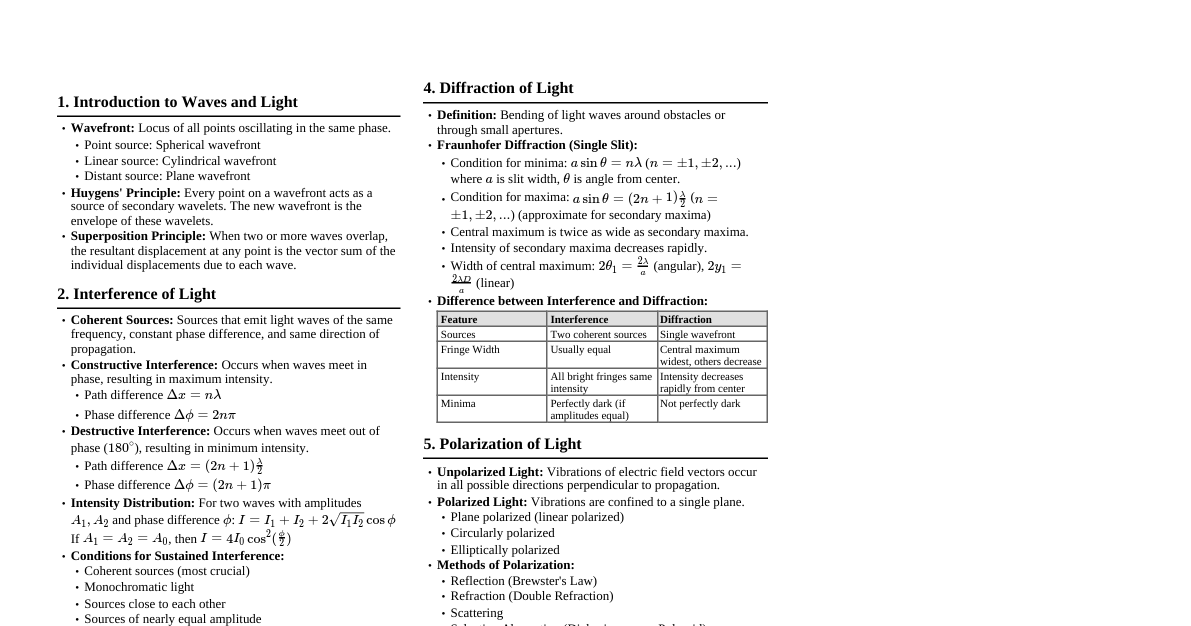
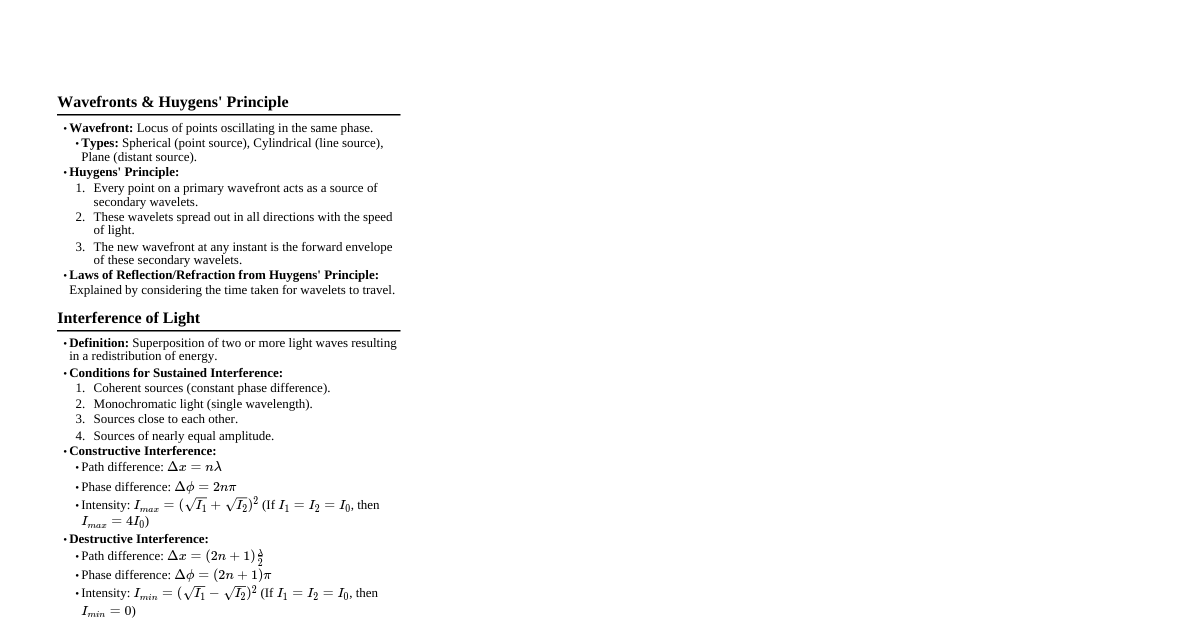
Wave Nature of Light Light is an electromagnetic wave, transverse in nature. Speed of light in vacuum: $c = \frac{1}{\sqrt{\mu_0 \epsilon_0}} \approx 3 \times 10^8 \text{ m/s}$. Speed of light in medium: $v = \frac{1}{\sqrt{\mu \epsilon}} = \frac{c}{n}$, where $n$ is refractive index. Wavelength ($\lambda$), frequency ($\nu$), speed ($v$): $v = \nu \lambda$. Frequency remains constant when light travels from one medium to another. Wavefront: Locus of points in the medium which are in the same phase. Point source: Spherical wavefronts. Line source/slit: Cylindrical wavefronts. Distant source: Plane wavefronts. Huygens' Principle: Every point on a primary wavefront acts as a source of secondary wavelets. These wavelets spread out in all directions with the speed of light in the medium. The new wavefront at any later time is the forward envelope of these secondary wavelets. Interference of Light Condition for sustained interference: Coherent sources (constant phase difference). Monochromatic light (single wavelength). Sources must be close to each other. Sources should be narrow. Phase difference ($\Delta \phi$) and Path difference ($\Delta x$): $\Delta \phi = \frac{2\pi}{\lambda} \Delta x$. Constructive Interference (Bright Fringes): Path difference: $\Delta x = n\lambda$, where $n = 0, \pm 1, \pm 2, ...$ Phase difference: $\Delta \phi = 2n\pi$. Resultant intensity: $I_{max} = (\sqrt{I_1} + \sqrt{I_2})^2$. If $I_1 = I_2 = I_0$, then $I_{max} = 4I_0$. Destructive Interference (Dark Fringes): Path difference: $\Delta x = (2n-1)\frac{\lambda}{2}$ or $(2n+1)\frac{\lambda}{2}$, where $n = \pm 1, \pm 2, ...$ (or $n=0, \pm 1, \pm 2, ...$ for $(2n+1)\frac{\lambda}{2}$). Phase difference: $\Delta \phi = (2n-1)\pi$. Resultant intensity: $I_{min} = (\sqrt{I_1} - \sqrt{I_2})^2$. If $I_1 = I_2 = I_0$, then $I_{min} = 0$. Young's Double Slit Experiment (YDSE) S1 S2 Screen D P O y d $d$: distance between slits. $D$: distance between slits and screen. Path difference: $\Delta x = \frac{yd}{D}$. (for small angles) Position of Bright Fringes: $y_n = \frac{n\lambda D}{d}$ ($n=0, \pm 1, \pm 2, ...$) Central maximum ($n=0$): $y_0 = 0$. Position of Dark Fringes: $y_n = (2n-1)\frac{\lambda D}{2d}$ or $(2n+1)\frac{\lambda D}{2d}$ ($n = \pm 1, \pm 2, ...$ or $n=0, \pm 1, \pm 2, ...$). Fringe Width ($\beta$): Distance between two consecutive bright or dark fringes. $\beta = \frac{\lambda D}{d}$. Angular Fringe Width ($\theta$): $\theta = \frac{\beta}{D} = \frac{\lambda}{d}$. Intensity Distribution: $I = I_0 \cos^2\left(\frac{\phi}{2}\right) = 4I_{max} \cos^2\left(\frac{\pi y d}{\lambda D}\right)$. Effect of Medium: If the apparatus is immersed in a medium of refractive index $n'$, then $\lambda' = \frac{\lambda}{n'}$, so $\beta' = \frac{\beta}{n'}$. Shift of Fringes by Thin Film: If a thin transparent sheet of thickness $t$ and refractive index $\mu$ is placed in front of one slit, the central fringe shifts. Optical path difference introduced by film: $(\mu-1)t$. Shift in central maximum: $y_{shift} = \frac{D}{d}(\mu-1)t$. Shift is towards the slit covered by the film. Diffraction of Light Bending of light waves around obstacles or spreading of light waves when passing through a small aperture/slit. Fresnel Diffraction: Source/screen are at finite distance. Fraunhofer Diffraction: Source/screen are effectively at infinite distance (requires lenses). Condition: Aperture size $a$ is comparable to wavelength $\lambda$. Single Slit Diffraction a Screen D y P O $a$: width of the slit. $D$: distance to screen. Minima (Dark Fringes): $a \sin\theta = n\lambda$, where $n = \pm 1, \pm 2, ...$ Position of $n^{th}$ minimum: $y_n = \frac{n\lambda D}{a}$. Maxima (Bright Fringes): $a \sin\theta = (2n+1)\frac{\lambda}{2}$, where $n = \pm 1, \pm 2, ...$ Position of $n^{th}$ secondary maximum: $y_n = (2n+1)\frac{\lambda D}{2a}$. Central Maximum: Located at $y=0$. Extremely broad and brightest. Width of central maximum: $2y_1 = \frac{2\lambda D}{a}$. Angular width of central maximum: $2\theta_1 = \frac{2\lambda}{a}$. Intensity of secondary maxima decreases rapidly with $n$. Intensity Distribution: $I = I_{max} \left(\frac{\sin\alpha}{\alpha}\right)^2$, where $\alpha = \frac{\pi a \sin\theta}{\lambda}$. Difference between Interference and Diffraction Feature Interference Diffraction Sources Two coherent sources Single source, wavelets from different parts of same wavefront Fringes Equal width, equal intensity (if $I_1=I_2$) Unequal width (central max is widest), decreasing intensity Minima Perfectly dark (zero intensity) Not perfectly dark (some intensity) Number Many bright fringes Few bright fringes (intensity decreases rapidly) Polarization of Light Phenomenon of restricting the vibrations of a transverse wave into a single plane. Only transverse waves can be polarized (e.g., light waves). Longitudinal waves (e.g., sound waves) cannot. Unpolarized Light: Vibrations in all possible planes perpendicular to the direction of propagation. Plane Polarized Light: Vibrations confined to a single plane. Polarizer: Device that produces plane-polarized light from unpolarized light. Analyzer: Device used to detect and analyze polarized light. Methods of Polarization By Reflection (Brewster's Law): When unpolarized light is incident at Brewster's angle ($i_p$) on the interface of two media, the reflected light is completely plane polarized. The reflected and refracted rays are perpendicular to each other ($i_p + r = 90^\circ$). Brewster's Law: $\tan i_p = n$, where $n$ is the refractive index of the second medium with respect to the first. The reflected light is polarized perpendicular to the plane of incidence. The refracted light is partially polarized. By Refraction: Using a pile of plates. By Double Refraction (Birefringence): Using crystals like calcite, quartz. By Scattering: Scattered light observed perpendicular to the incident sunlight is partially polarized. (e.g., blue sky). By Selective Absorption (Dichroism): Using polaroids (e.g., Polaroid sheets). Malus's Law When plane polarized light of intensity $I_0$ passes through an analyzer, the intensity of the transmitted light $I$ is given by: $I = I_0 \cos^2\theta$. $\theta$: angle between the transmission axis of the polarizer and the analyzer. If unpolarized light passes through a polarizer, the transmitted intensity is $I_0/2$. Resolving Power Ability of an optical instrument to distinguish between two closely spaced objects or images. Rayleigh's Criterion: Two point objects are just resolvable when the center of the diffraction pattern of one coincides with the first minimum of the diffraction pattern of the other. Resolving Power of Telescope: $RP = \frac{1}{\Delta\theta} = \frac{D}{1.22\lambda}$ $\Delta\theta$: minimum resolvable angle. $D$: diameter of the objective lens. Higher $D$ and lower $\lambda$ lead to higher resolving power. Resolving Power of Microscope: $RP = \frac{1}{d} = \frac{2n\sin\theta}{1.22\lambda}$ $d$: minimum resolvable distance. $n$: refractive index of the medium between object and objective. $\theta$: half-angle of the cone of light from the object. $n\sin\theta$: numerical aperture (NA). Higher NA and lower $\lambda$ lead to higher resolving power.