Wave Motion & Sound
Cheatsheet Content
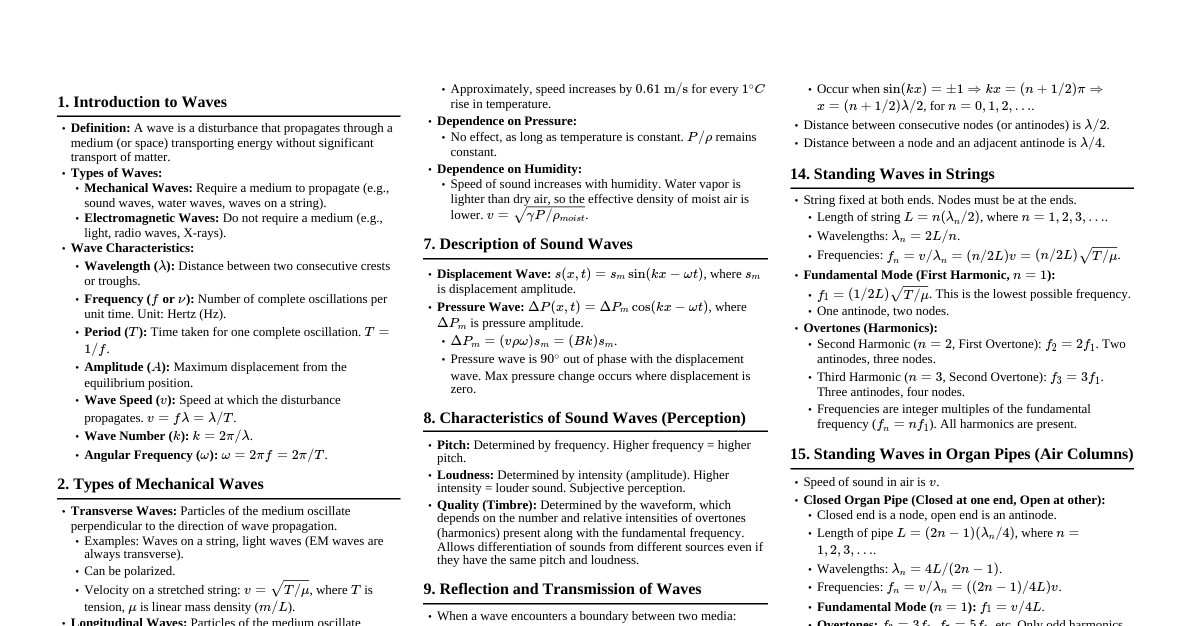
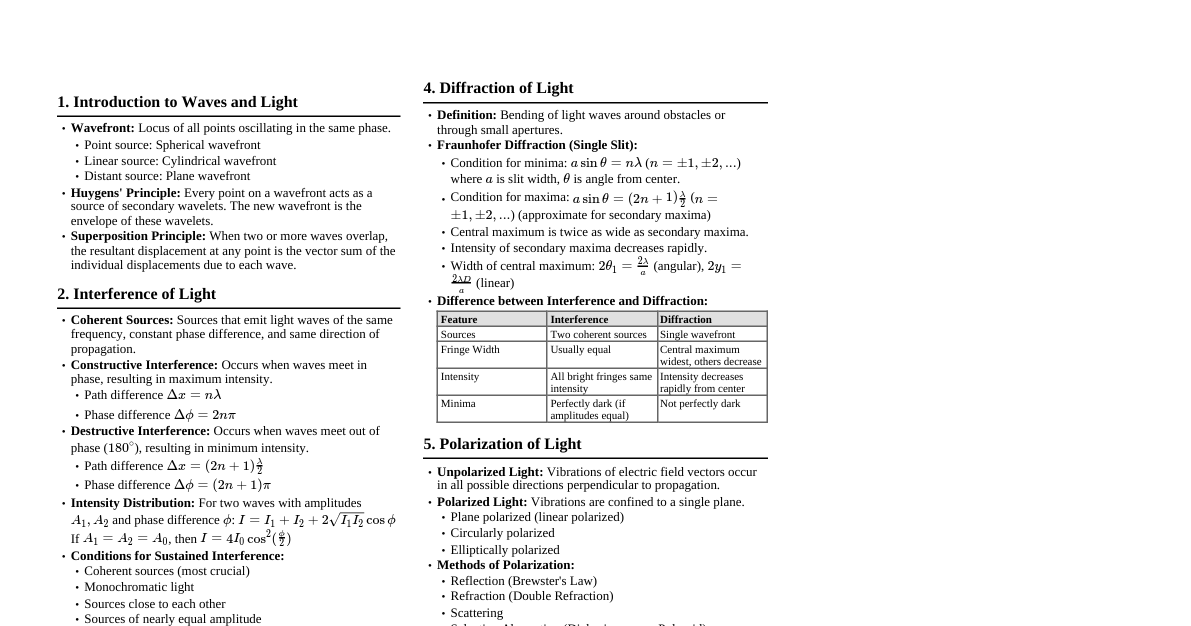
### Introduction to Waves - **Definition:** A disturbance that propagates through a medium, transferring energy without transferring matter. - **Types of Waves:** - **Transverse Waves:** Oscillations perpendicular to wave propagation (e.g., light waves, waves on a string). - **Longitudinal Waves:** Oscillations parallel to wave propagation (e.g., sound waves). - **Key Wave Properties:** - **Amplitude (A):** Maximum displacement from equilibrium. - **Wavelength ($\lambda$):** Distance between two consecutive identical points on a wave. - **Frequency (f):** Number of oscillations per unit time (Hz). - **Period (T):** Time for one complete oscillation ($T = 1/f$). - **Wave Speed (v):** $v = \lambda f$. - **Angular Frequency ($\omega$):** $\omega = 2\pi f$. - **Wave Number (k):** $k = 2\pi / \lambda$. - **Wave Equation (1D):** $y(x,t) = A \sin(kx - \omega t + \phi)$ where $\phi$ is the phase constant. ### Wave Superposition - **Principle of Superposition:** When two or more waves overlap, the resultant displacement at any point is the vector sum of the displacements due to individual waves. - **Interference:** - **Constructive Interference:** Waves combine to produce a larger amplitude (when crests meet crests or troughs meet troughs). - **Destructive Interference:** Waves combine to produce a smaller or zero amplitude (when crests meet troughs). - **Standing Waves:** Formed when two waves of the same frequency, amplitude, and wavelength traveling in opposite directions interfere. - **Nodes:** Points of zero displacement. - **Antinodes:** Points of maximum displacement. - **Fixed Ends:** Always nodes. - **Free Ends:** Always antinodes. ### Waves on a String - **Wave Speed:** $v = \sqrt{\frac{T}{\mu}}$ - $T$: Tension in the string (N) - $\mu$: Linear mass density (mass per unit length, kg/m) - **Standing Waves on a String (Fixed at both ends):** - Wavelengths: $\lambda_n = \frac{2L}{n}$ ($n = 1, 2, 3, ...$) - Frequencies: $f_n = \frac{nv}{2L} = n f_1$ - $f_1 = \frac{v}{2L}$: Fundamental frequency (first harmonic) - $f_n$: $n$-th harmonic (or $n$-th overtone if $n > 1$) ### Sound Waves - **Nature:** Longitudinal waves, requiring a medium for propagation. - **Speed of Sound (v):** - **General:** $v = \sqrt{\frac{B}{\rho}}$ - $B$: Bulk modulus of the medium (Pa) - $\rho$: Density of the medium (kg/m$^3$) - **In Air (approx):** $v \approx (331 + 0.6 T_C)$ m/s, where $T_C$ is temperature in Celsius. - **Intensity (I):** Power transmitted per unit area ($I = P/A$, W/m$^2$). - For a point source: $I = \frac{P}{4\pi r^2}$ - **Sound Intensity Level ($\beta$):** Measured in decibels (dB). - $\beta = 10 \log_{10} \left( \frac{I}{I_0} \right)$ - $I_0 = 10^{-12}$ W/m$^2$ (threshold of hearing). - **Pitch:** Determined by frequency (higher frequency = higher pitch). - **Loudness:** Subjective perception related to intensity. - **Timbre (Quality):** Determined by the presence and relative intensity of overtones. ### Doppler Effect - **Definition:** Apparent change in frequency (and wavelength) of a wave due to the relative motion between the source and the observer. - **Formula:** $f' = f \left( \frac{v \pm v_O}{v \mp v_S} \right)$ - $f'$: Observed frequency - $f$: Source frequency - $v$: Speed of sound in the medium - $v_O$: Speed of the observer - $v_S$: Speed of the source - **Use + for $v_O$ if observer moves towards source.** - **Use - for $v_O$ if observer moves away from source.** - **Use - for $v_S$ if source moves towards observer.** - **Use + for $v_S$ if source moves away from observer.** - **Mnemonic:** "Towards" = higher frequency (numerator adds, denominator subtracts). "Away" = lower frequency (numerator subtracts, denominator adds). ### Sound Interference - **Path Difference ($\Delta L$):** Difference in distance traveled by two sound waves from different sources to a common point. - **Constructive Interference:** Occurs when $\Delta L = n\lambda$ ($n = 0, 1, 2, ...$) - Phase difference: $\Delta \phi = 2\pi n$ - **Destructive Interference:** Occurs when $\Delta L = (n + \frac{1}{2})\lambda$ ($n = 0, 1, 2, ...$) - Phase difference: $\Delta \phi = (2n + 1)\pi$ - **Beats:** Periodic variations in loudness when two sound waves of slightly different frequencies interfere. - **Beat Frequency:** $f_{beat} = |f_1 - f_2|$ ### Standing Waves in Pipes - **Open at both ends:** - Wavelengths: $\lambda_n = \frac{2L}{n}$ ($n = 1, 2, 3, ...$) - Frequencies: $f_n = \frac{nv}{2L} = n f_1$ - All harmonics are present. - **Closed at one end:** - Wavelengths: $\lambda_n = \frac{4L}{n}$ ($n = 1, 3, 5, ...$ only odd harmonics) - Frequencies: $f_n = \frac{nv}{4L} = n f_1$ - Only odd harmonics are present. ### Shock Waves - **Definition:** Formed when a source of sound moves faster than the speed of sound in the medium (supersonic speed). - **Mach Number (M):** $M = \frac{v_S}{v}$ - $v_S$: Speed of the source - $v$: Speed of sound - **Mach Cone Angle ($\theta$):** $\sin\theta = \frac{v}{v_S} = \frac{1}{M}$