Rotational Motion (JEE)
Cheatsheet Content
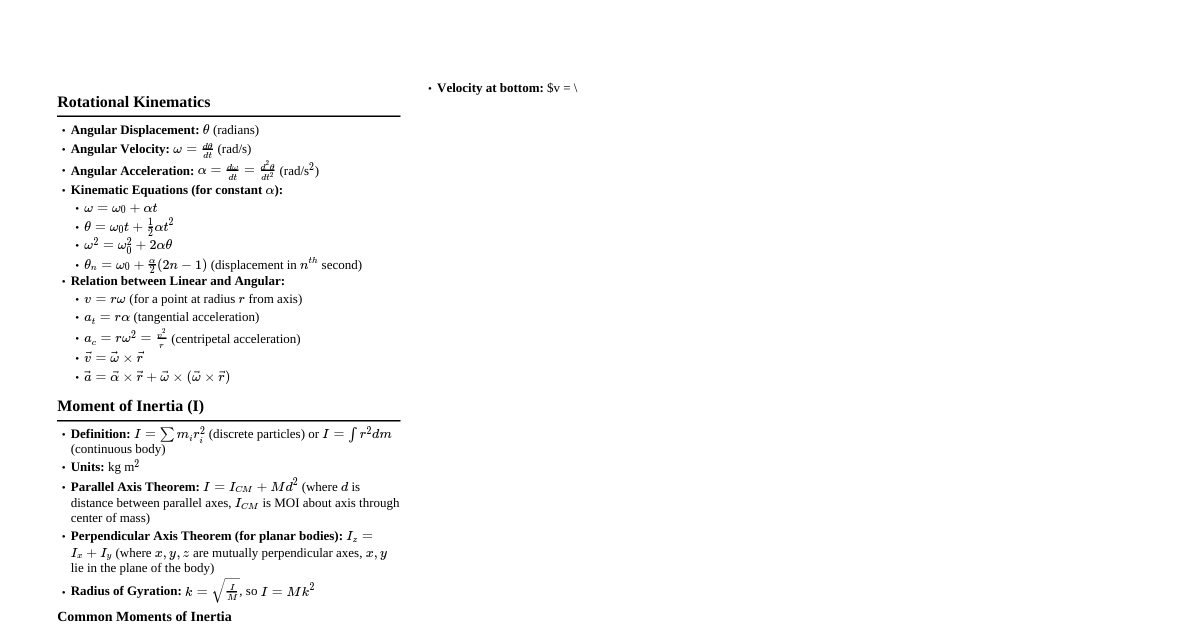
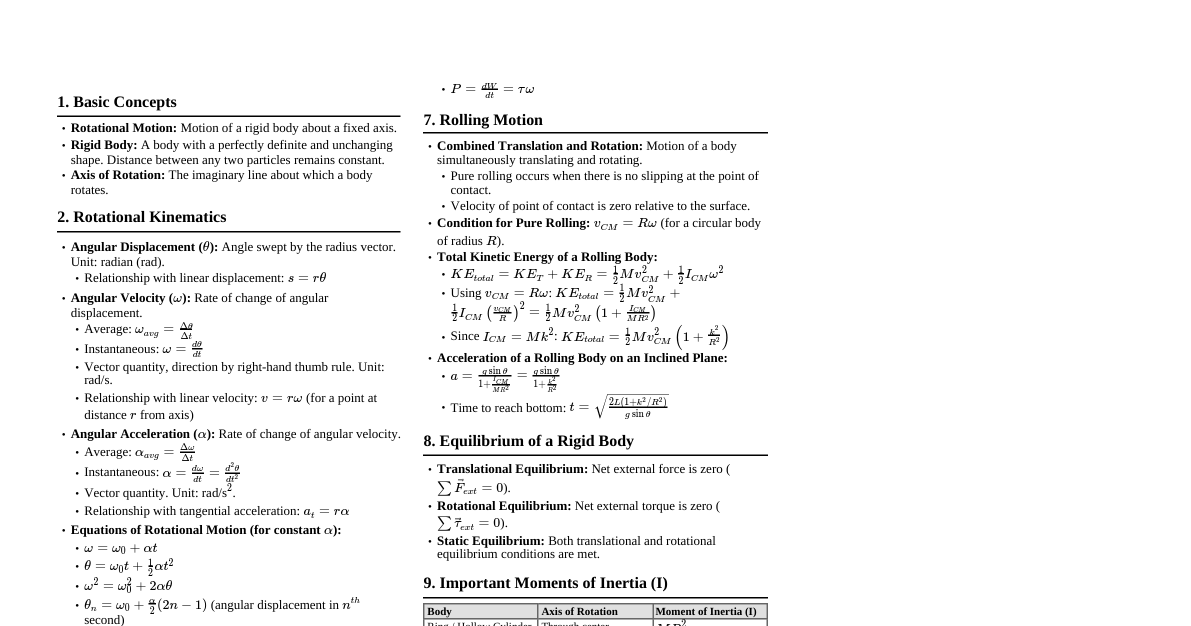
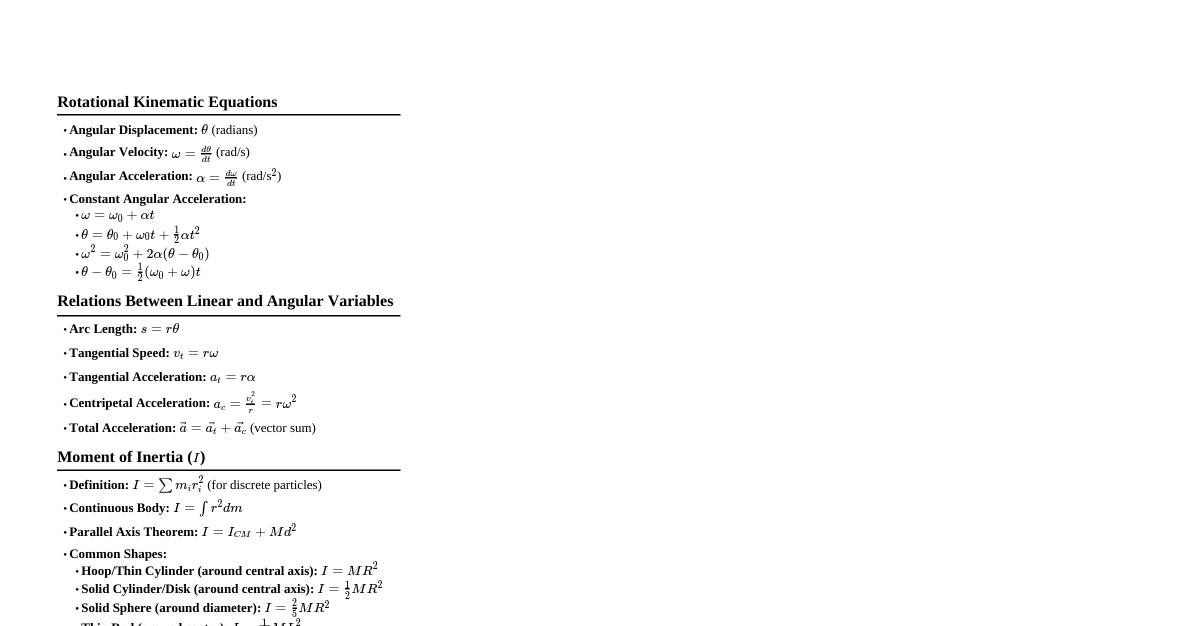
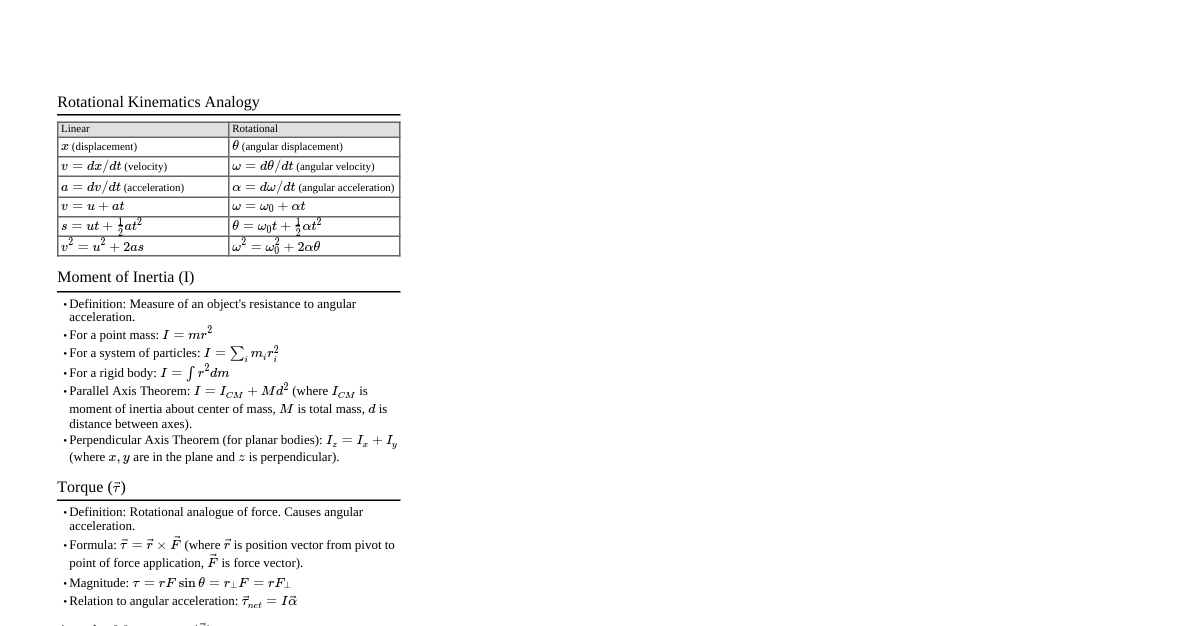
1. Rotational Kinematics Angular Displacement: $\theta$ (radians) Angular Velocity: $\omega = \frac{d\theta}{dt}$ (rad/s) Angular Acceleration: $\alpha = \frac{d\omega}{dt} = \frac{d^2\theta}{dt^2}$ (rad/s$^2$) Kinematic Equations (Constant $\alpha$): $\omega = \omega_0 + \alpha t$ $\theta = \omega_0 t + \frac{1}{2}\alpha t^2$ $\omega^2 = \omega_0^2 + 2\alpha\theta$ $\theta = \frac{\omega_0 + \omega}{2} t$ Relation between Linear and Angular: $s = r\theta$ $v = r\omega$ (for a point at distance $r$ from axis) $a_t = r\alpha$ (tangential acceleration) $a_c = \frac{v^2}{r} = r\omega^2$ (centripetal acceleration) $a_{net} = \sqrt{a_t^2 + a_c^2}$ 2. Moment of Inertia ($I$) Definition: Measure of rotational inertia. For discrete particles: $I = \sum m_i r_i^2$ For continuous body: $I = \int r^2 dm$ Parallel Axis Theorem: $I = I_{CM} + Md^2$ (where $I_{CM}$ is moment of inertia about COM, $M$ is total mass, $d$ is distance between parallel axes). Perpendicular Axis Theorem (for planar bodies): $I_z = I_x + I_y$ (where $x, y, z$ are mutually perpendicular axes, and $x, y$ lie in the plane of the body). Common Moments of Inertia: Body Axis Moment of Inertia Ring/Hollow Cylinder Through CM, $\perp$ plane $MR^2$ Solid Cylinder/Disc Through CM, $\perp$ plane $\frac{1}{2}MR^2$ Thin Rod Through CM, $\perp$ rod $\frac{1}{12}ML^2$ Thin Rod Through end, $\perp$ rod $\frac{1}{3}ML^2$ Solid Sphere Through CM $\frac{2}{5}MR^2$ Hollow Sphere Through CM $\frac{2}{3}MR^2$ 3. Torque ($\tau$) Definition: Rotational analogue of force. $\tau = \vec{r} \times \vec{F}$ Magnitude: $\tau = rF\sin\theta = r_{\perp}F = rF_{\perp}$ Units: N-m Relation to Angular Acceleration: $\tau_{net} = I\alpha$ 4. Angular Momentum ($\vec{L}$) For a particle: $\vec{L} = \vec{r} \times \vec{p} = \vec{r} \times (m\vec{v})$ For a rigid body: $\vec{L} = I\vec{\omega}$ (for rotation about an axis of symmetry) Units: kg m$^2$/s or J-s Newton's Second Law for Rotation: $\vec{\tau}_{net} = \frac{d\vec{L}}{dt}$ Conservation of Angular Momentum: If $\vec{\tau}_{net, ext} = 0$, then $\vec{L}_{total}$ is conserved. $I_1\omega_1 = I_2\omega_2$. 5. Rotational Kinetic Energy ($K_{rot}$) Definition: $K_{rot} = \frac{1}{2}I\omega^2$ Work Done by Torque: $W = \int \tau d\theta$ Power: $P = \tau\omega$ 6. Combined Translation and Rotation Total Kinetic Energy: $K_{total} = K_{trans} + K_{rot} = \frac{1}{2}Mv_{CM}^2 + \frac{1}{2}I_{CM}\omega^2$ (for pure rolling). Pure Rolling Condition: $v_{CM} = R\omega$ and $a_{CM} = R\alpha$ (no slipping at the point of contact). Point of Contact: For pure rolling, the instantaneous velocity of the point of contact with the ground is zero. Friction in Rolling: Pure rolling on horizontal surface: Static friction acts, but does no work. Rolling down an incline: Static friction acts up the incline to cause rolling. $a_{CM} = \frac{g\sin\theta}{1 + I_{CM}/MR^2}$ $f_s = \frac{Mg\sin\theta}{1 + MR^2/I_{CM}}$ 7. Angular Impulse Definition: $J_\theta = \int \tau dt = \Delta L$ Angular impulse equals change in angular momentum. 8. Equilibrium of Rigid Bodies Translational Equilibrium: $\sum \vec{F}_{ext} = 0$ Rotational Equilibrium: $\sum \vec{\tau}_{ext} = 0$ (about any point) 9. Important Concepts & Tips Pseudo force in rotating frame: Centrifugal force $m\omega^2 r$ (outward). Gyroscopic Motion: Precession of a spinning top or gyroscope. Torque causes change in direction of angular momentum. Rolling without slipping on an inclined plane: Acceleration: $a = \frac{g \sin\theta}{1 + k^2/R^2}$ where $I_{CM} = Mk^2$. Final velocity after rolling down height $h$: $v = \sqrt{\frac{2gh}{1 + k^2/R^2}}$. Key skill: Choosing the correct axis for calculating torque and moment of inertia. Often, the axis of rotation or a point where unknown forces pass is a good choice. Conservation of Energy: Often useful for problems involving rolling, where $K_{total} + U = \text{constant}$ if only conservative forces and static friction (doing no work) are involved.