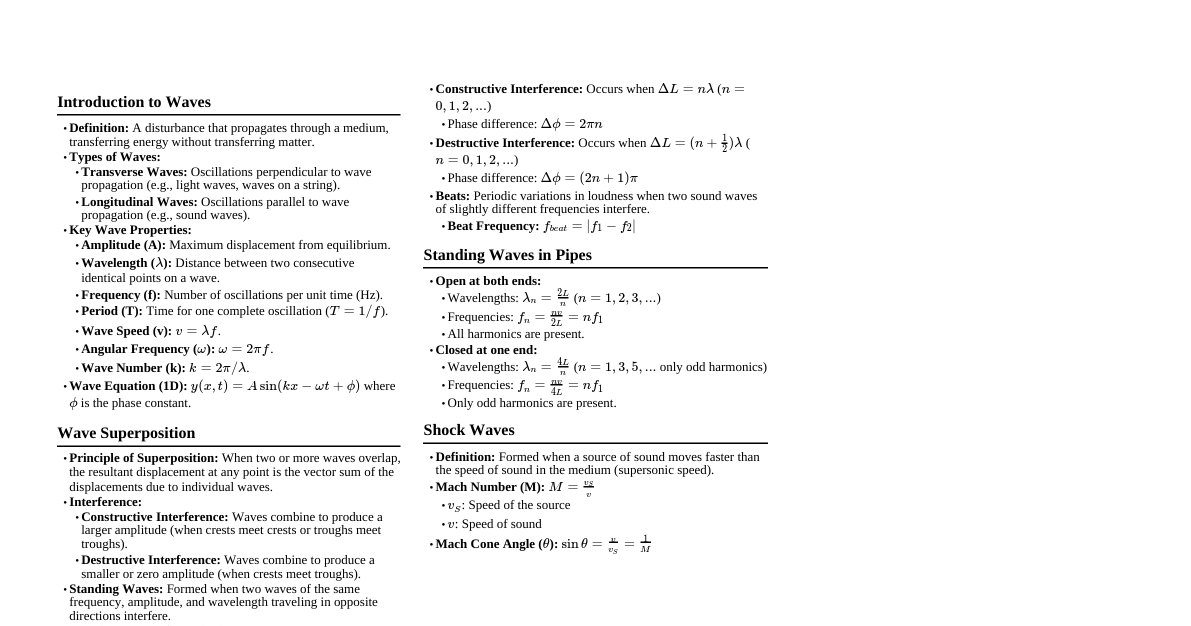
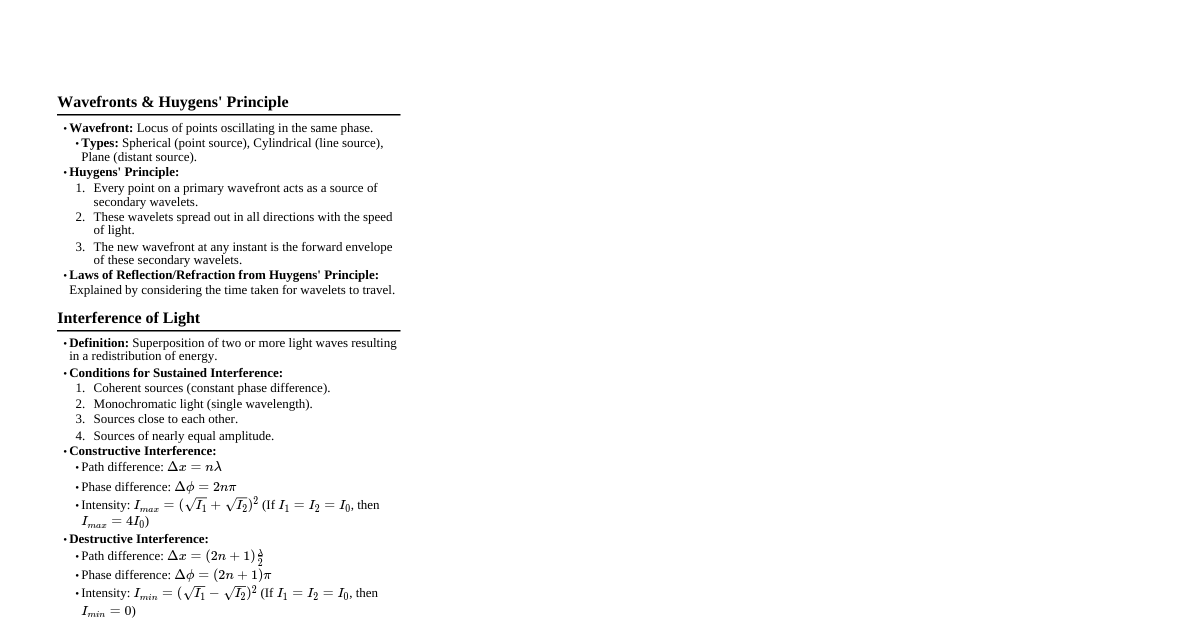
Wave Motion (Class 11 WBCHSE)
Cheatsheet Content
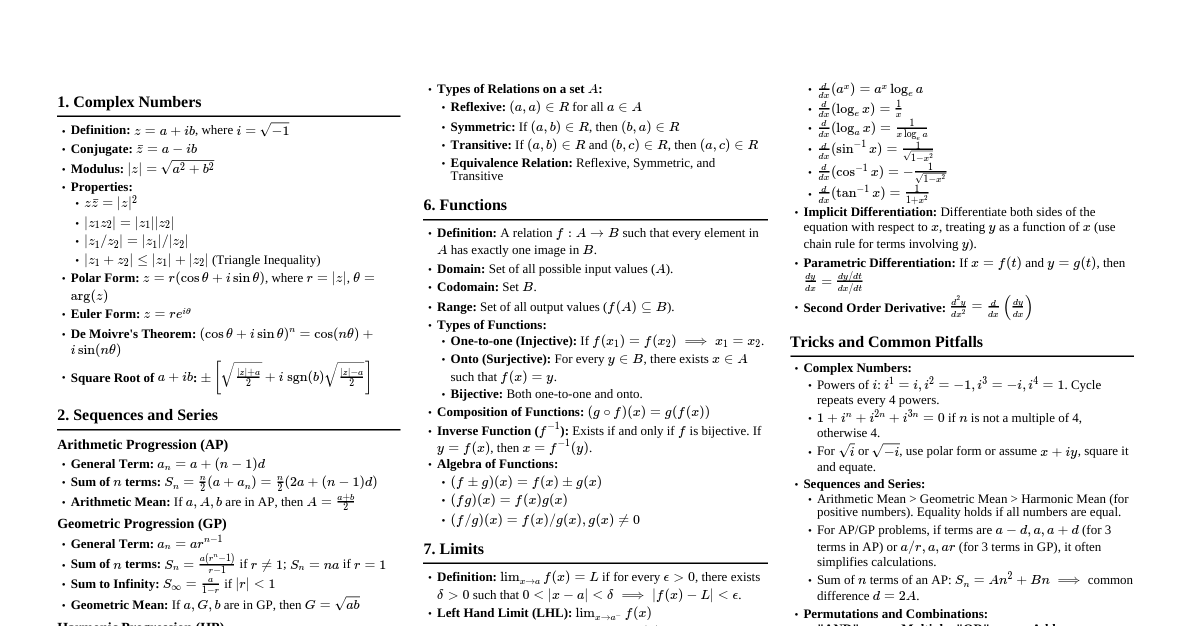
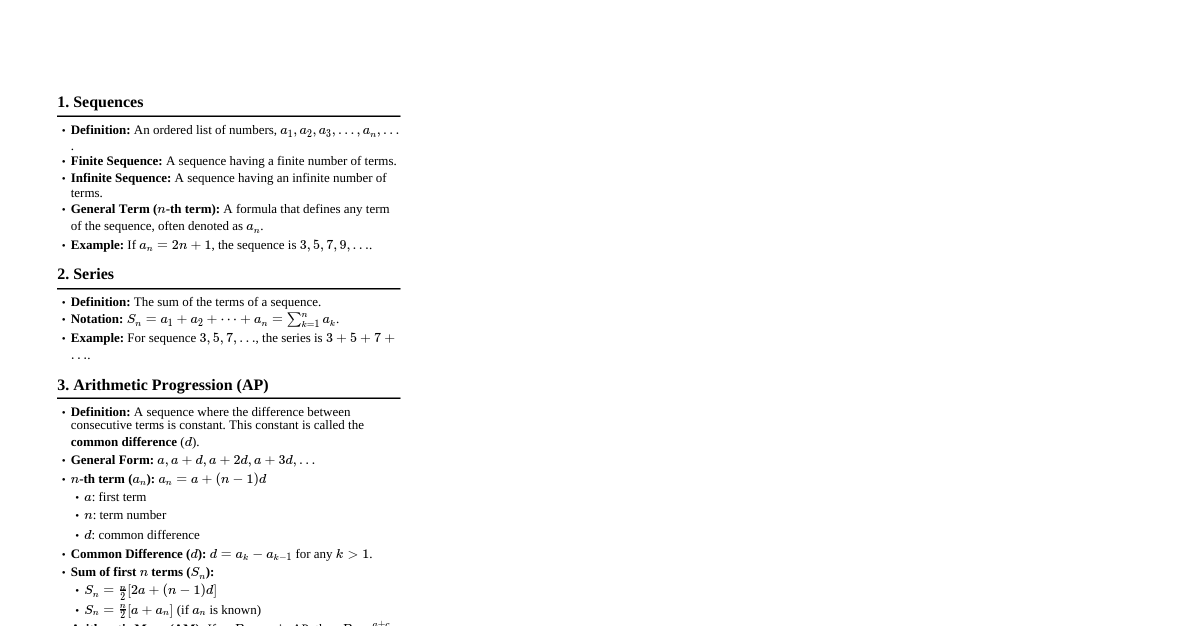
1. Sequences and Series: Basic Definitions Sequence: An ordered list of numbers (or terms) following a specific pattern. Denoted as $a_1, a_2, a_3, \dots, a_n, \dots$. Series: The sum of the terms of a sequence. Denoted as $S_n = a_1 + a_2 + \dots + a_n = \sum_{k=1}^{n} a_k$. Finite Sequence/Series: Has a definite number of terms. Infinite Sequence/Series: Has an unlimited number of terms. General Term ($a_n$ or $T_n$): A formula that defines any term of the sequence based on its position $n$. Recurrence Relation: Defines a term of a sequence based on one or more preceding terms (e.g., Fibonacci sequence). 2. Arithmetic Progression (AP) Definition: A sequence where the difference between consecutive terms is constant. This constant is called the common difference ($d$). $a_n - a_{n-1} = d$ for all $n > 1$ General Term ($n$-th term): $a_n = a + (n-1)d$ Where $a$ is the first term. Sum of the First $n$ Terms ($S_n$): $S_n = \frac{n}{2}[2a + (n-1)d]$ $S_n = \frac{n}{2}(a + a_n)$ Properties of AP: If $a, b, c$ are in AP, then $2b = a+c$. ($b$ is the arithmetic mean of $a$ and $c$). If each term of an AP is added, subtracted, multiplied, or divided by a non-zero constant, the resulting sequence is also an AP. The sum of terms equidistant from the beginning and end is constant and equal to $a_1 + a_n$. Arithmetic Mean (AM): For two numbers $a$ and $b$, the AM is $\frac{a+b}{2}$. For $n$ numbers $x_1, x_2, \dots, x_n$, the AM is $\frac{x_1 + x_2 + \dots + x_n}{n}$. Insertion of $n$ Arithmetic Means between $a$ and $b$: If $A_1, A_2, \dots, A_n$ are $n$ AMs between $a$ and $b$, then $a, A_1, \dots, A_n, b$ form an AP with $(n+2)$ terms. The common difference $d = \frac{b-a}{n+1}$. And $A_k = a + kd$ for $k=1, \dots, n$. Sum of $n$ AMs: $\sum_{k=1}^{n} A_k = n \left(\frac{a+b}{2}\right)$. 3. Geometric Progression (GP) Definition: A sequence where the ratio between consecutive terms is constant. This constant is called the common ratio ($r$). $\frac{a_n}{a_{n-1}} = r$ for all $n > 1$ General Term ($n$-th term): $a_n = ar^{n-1}$ Where $a$ is the first term. Sum of the First $n$ Terms ($S_n$): If $r \neq 1$: $S_n = \frac{a(r^n - 1)}{r - 1}$ or $S_n = \frac{a(1 - r^n)}{1 - r}$ If $r = 1$: $S_n = na$ Sum of an Infinite GP ($S_\infty$): If $|r| $S_\infty = \frac{a}{1 - r}$ If $|r| \ge 1$, the sum diverges (does not exist). Properties of GP: If $a, b, c$ are in GP, then $b^2 = ac$. ($b$ is the geometric mean of $a$ and $c$). If each term of a GP is multiplied or divided by a non-zero constant, the resulting sequence is also a GP. If $a_1, a_2, \dots, a_n$ is a GP, then $\log a_1, \log a_2, \dots, \log a_n$ is an AP. The product of terms equidistant from the beginning and end is constant and equal to $a_1 a_n$. Geometric Mean (GM): For two positive numbers $a$ and $b$, the GM is $\sqrt{ab}$. For $n$ positive numbers $x_1, x_2, \dots, x_n$, the GM is $\sqrt[n]{x_1 x_2 \dots x_n}$. Insertion of $n$ Geometric Means between $a$ and $b$: If $G_1, G_2, \dots, G_n$ are $n$ GMs between $a$ and $b$, then $a, G_1, \dots, G_n, b$ form a GP with $(n+2)$ terms. The common ratio $r = \left(\frac{b}{a}\right)^{\frac{1}{n+1}}$. And $G_k = ar^k$ for $k=1, \dots, n$. Product of $n$ GMs: $\prod_{k=1}^{n} G_k = (\sqrt{ab})^n$. 4. Harmonic Progression (HP) Definition: A sequence of non-zero numbers whose reciprocals are in Arithmetic Progression (AP). If $a_1, a_2, \dots, a_n$ are in HP, then $\frac{1}{a_1}, \frac{1}{a_2}, \dots, \frac{1}{a_n}$ are in AP. General Term ($n$-th term): To find $a_n$ for an HP, first find the $n$-th term of the corresponding AP: $\frac{1}{a_n} = \frac{1}{a} + (n-1)d$ where $\frac{1}{a}$ is the first term of the AP, and $d$ is its common difference. Sum of $n$ terms of an HP: There is no general formula for the sum of an HP. You typically work with the reciprocal AP. Properties of HP: If $a, b, c$ are in HP, then $\frac{1}{b} = \frac{1}{2}\left(\frac{1}{a} + \frac{1}{c}\right)$, which implies $b = \frac{2ac}{a+c}$. ($b$ is the harmonic mean of $a$ and $c$). Harmonic Mean (HM): For two numbers $a$ and $b$, the HM is $\frac{2ab}{a+b}$. For $n$ numbers $x_1, x_2, \dots, x_n$, the HM is $\frac{n}{\frac{1}{x_1} + \frac{1}{x_2} + \dots + \frac{1}{x_n}}$. 5. Relationship between AM, GM, and HM For any two positive numbers $a$ and $b$: $AM \ge GM \ge HM$ Equality holds if and only if $a=b$. For two positive numbers $a$ and $b$: $GM^2 = AM \times HM$ 6. Arithmetico-Geometric Progression (AGP) Definition: A series where each term is the product of corresponding terms of an AP and a GP. $a, (a+d)r, (a+2d)r^2, \dots, [a+(n-1)d]r^{n-1}, \dots$ Sum of $n$ terms ($S_n$): $S_n = \frac{a}{1-r} + \frac{dr(1-r^{n-1})}{(1-r)^2} - \frac{[a+(n-1)d]r^n}{1-r}$ (for $r \neq 1$) Sum to infinity ($S_\infty$): If $|r| $S_\infty = \frac{a}{1-r} + \frac{dr}{(1-r)^2}$ 7. Special Series (Sums of Powers of Natural Numbers) Sum of the first $n$ natural numbers: $\sum_{k=1}^{n} k = 1 + 2 + 3 + \dots + n = \frac{n(n+1)}{2}$ Sum of the squares of the first $n$ natural numbers: $\sum_{k=1}^{n} k^2 = 1^2 + 2^2 + 3^2 + \dots + n^2 = \frac{n(n+1)(2n+1)}{6}$ Sum of the cubes of the first $n$ natural numbers: $\sum_{k=1}^{n} k^3 = 1^3 + 2^3 + 3^3 + \dots + n^3 = \left(\frac{n(n+1)}{2}\right)^2 = (\sum_{k=1}^{n} k)^2$ 8. Method of Differences (for finding $n$-th term and sum) If the differences of consecutive terms ($a_2-a_1, a_3-a_2, \dots$) are in AP or GP, we can find the general term. If the first differences are in AP, the general term $a_n$ is a quadratic in $n$ ($An^2+Bn+C$). If the first differences are in GP, $a_n = A r^{n-1} + B$. If the second differences are constant, $a_n$ is a quadratic in $n$. To find $S_n$: $S_n = \sum_{k=1}^{n} a_k$ Sometimes, writing out the terms and finding a pattern for cancellation (telescoping series) can work. 9. Sigma Notation ($\sum$) Definition: A concise way to represent the sum of a sequence. $\sum_{k=m}^{n} a_k = a_m + a_{m+1} + \dots + a_n$ Properties: $\sum_{k=1}^{n} c a_k = c \sum_{k=1}^{n} a_k$ (where $c$ is a constant) $\sum_{k=1}^{n} (a_k \pm b_k) = \sum_{k=1}^{n} a_k \pm \sum_{k=1}^{n} b_k$ $\sum_{k=1}^{n} c = nc$ (where $c$ is a constant) 10. Important Tips & Tricks Choosing terms in AP/GP: For 3 terms in AP: $a-d, a, a+d$ (sum is $3a$) For 4 terms in AP: $a-3d, a-d, a+d, a+3d$ (sum is $4a$, common difference $2d$) For 3 terms in GP: $a/r, a, ar$ (product is $a^3$) For 4 terms in GP: $a/r^3, a/r, ar, ar^3$ (product is $a^4$, common ratio $r^2$) Relationship between $S_n$ and $a_n$: $a_n = S_n - S_{n-1}$ (for $n > 1$) $a_1 = S_1$ Always try to identify the type of sequence first (AP, GP, HP, or none of these). For complex series, try to find the general term $a_n$ first, then apply summation techniques.