Sound - Question Paper
Cheatsheet Content
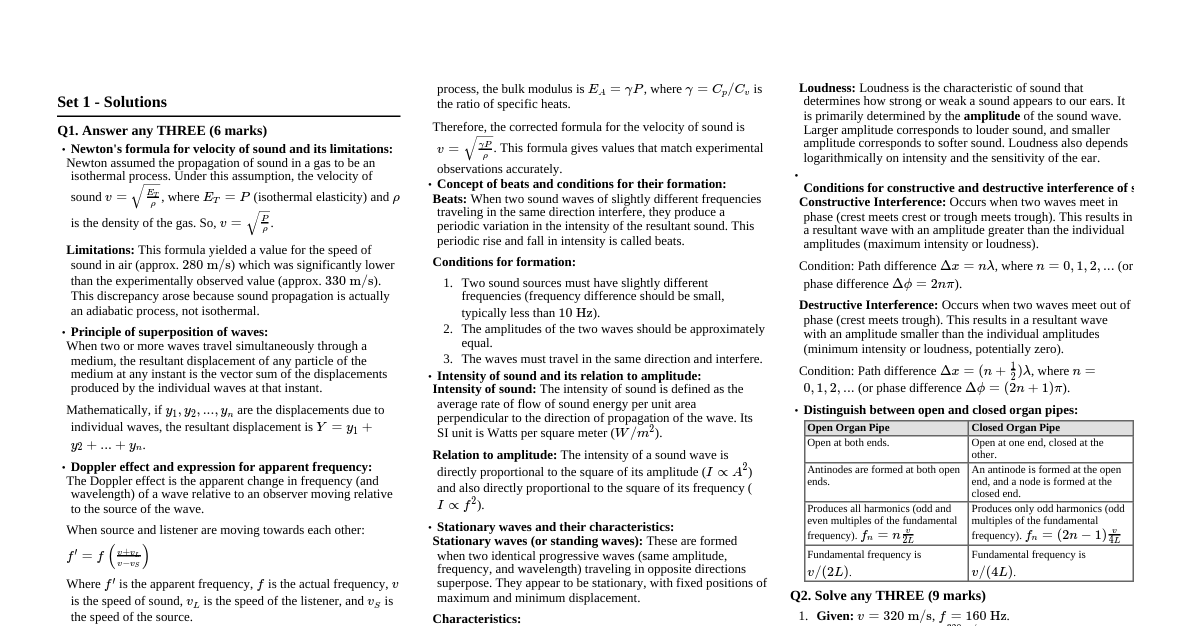
Set 1 Q1. Answer any THREE (6 marks) Explain Newton's formula for velocity of sound and state its limitations. (2 marks) State and explain the principle of superposition of waves. (2 marks) What is Doppler effect? State the expression for apparent frequency when source and listener are moving towards each other. (2 marks) Distinguish between transverse waves and longitudinal waves (any two points). (2 marks) Q2. Solve any THREE (9 marks) A tuning fork produces sound waves of wavelength $2.5 \text{ m}$ in air. If the speed of sound in air is $340 \text{ m/s}$, calculate the frequency of the tuning fork and its time period. (3 marks) A man standing between two parallel cliffs fires a gun and hears two echoes after $4 \text{ seconds}$ and $6 \text{ seconds}$ respectively. If the distance between the cliffs is $1700 \text{ m}$, calculate the speed of sound in air. (3 marks) A police siren emits sound of frequency $500 \text{ Hz}$. If the police car moves towards a stationary observer at a speed of $20 \text{ m/s}$, calculate the apparent frequency heard by the observer. (Speed of sound in air = $340 \text{ m/s}$) (3 marks) At what temperature will the speed of sound in air be $1.5$ times its speed at $0^\circ\text{C}$? (Speed of sound at $0^\circ\text{C} = 332 \text{ m/s}$) (3 marks) Set 2 Q1. Answer any THREE (6 marks) Derive Newton's formula for the velocity of sound in a gas and explain why Laplace's correction was necessary. (2 marks) Explain the concept of beats and state the conditions for their formation. (2 marks) Define intensity of sound. How does it relate to the amplitude of the wave? (2 marks) What are stationary waves? List two characteristics of stationary waves. (2 marks) Q2. Solve any THREE (9 marks) A sound wave has a frequency of $2 \text{ kHz}$ and a wavelength of $35 \text{ cm}$. How long will it take to travel $1.5 \text{ km}$? (3 marks) A reverberation time of a concert hall is $2.5 \text{ s}$. If the volume of the hall is $1500 \text{ m}^3$, calculate the total absorption of sound in Sabins. (3 marks) An observer is moving away from a stationary source of sound with a velocity of $10 \text{ m/s}$. If the source emits sound of frequency $600 \text{ Hz}$ and the speed of sound in air is $330 \text{ m/s}$, what is the apparent frequency heard by the observer? (3 marks) The speed of sound in air at $20^\circ\text{C}$ is $343 \text{ m/s}$. Calculate the speed of sound in air at $40^\circ\text{C}$. (3 marks) Set 3 Q1. Answer any THREE (6 marks) Describe the phenomenon of resonance with an example. (2 marks) Explain the terms 'pitch' and 'loudness' of sound. How are they related to wave properties? (2 marks) State the conditions for constructive and destructive interference of sound waves. (2 marks) Distinguish between open and closed organ pipes (any two points). (2 marks) Q2. Solve any THREE (9 marks) A wave has a speed of $320 \text{ m/s}$ and a frequency of $160 \text{ Hz}$. Calculate its wavelength and period. (3 marks) A source of sound produces $100$ beats in $5 \text{ s}$ when sounded with a tuning fork of frequency $256 \text{ Hz}$. What are the possible frequencies of the source? (3 marks) A train approaching a railway platform with a speed of $30 \text{ m/s}$ sounds a whistle of frequency $400 \text{ Hz}$. What is the frequency heard by a stationary observer on the platform? (Speed of sound in air = $340 \text{ m/s}$) (3 marks) If the temperature of air is increased by $1^\circ\text{C}$, what is the approximate percentage increase in the speed of sound in air? (3 marks) Set 4 Q1. Answer any THREE (6 marks) Explain how sound waves are produced and propagated through a medium. (2 marks) What is an echo? State the conditions necessary for hearing a distinct echo. (2 marks) Differentiate between musical sound and noise. (2 marks) Explain why sound travels faster in solids than in gases. (2 marks) Q2. Solve any THREE (9 marks) A sound wave travels from air into water. If its frequency in air is $500 \text{ Hz}$ and the speed of sound in air is $340 \text{ m/s}$ and in water is $1480 \text{ m/s}$, what will be its frequency and wavelength in water? (3 marks) Two sound sources have frequencies $256 \text{ Hz}$ and $260 \text{ Hz}$. How many beats per second will be produced when they are sounded together? (3 marks) A listener is moving towards a stationary source of sound with a speed of $15 \text{ m/s}$. The source emits sound of frequency $440 \text{ Hz}$. If the speed of sound in air is $330 \text{ m/s}$, what is the apparent frequency heard by the listener? (3 marks) The speed of sound in a gas is $300 \text{ m/s}$ at $27^\circ\text{C}$. What will be its speed at $127^\circ\text{C}$? (3 marks) Set 5 Q1. Answer any THREE (6 marks) Explain the phenomenon of reflection of sound waves. State the laws of reflection. (2 marks) What is reverberation? How can it be reduced in an auditorium? (2 marks) Define amplitude and wavelength of a sound wave. (2 marks) Give two applications of ultrasound. (2 marks) Q2. Solve any THREE (9 marks) A sound source produces $20$ waves in $0.4 \text{ s}$. If the wavelength of the wave is $1.7 \text{ m}$, calculate the frequency and speed of the wave. (3 marks) A closed organ pipe $80 \text{ cm}$ long is vibrating in its first overtone. Calculate the frequency of the note. (Speed of sound in air = $330 \text{ m/s}$) (3 marks) A source of sound is moving away from a stationary listener with a speed of $v_s$. The apparent frequency heard by the listener is half the actual frequency. Find $v_s$ in terms of the speed of sound $v$. (3 marks) Compare the speed of sound in hydrogen and oxygen at the same temperature. (Ratio of molecular weights H:O is $1:16$, $\gamma$ for H is $1.41$, $\gamma$ for O is $1.40$) (3 marks) Set 6 Q1. Answer any THREE (6 marks) Explain the factors affecting the speed of sound in a gas. (2 marks) What is intensity level of sound? Define decibel. (2 marks) Explain why astronauts cannot hear each other on the moon. (2 marks) Differentiate between node and antinode in a stationary wave. (2 marks) Q2. Solve any THREE (9 marks) A person claps his hands near a cliff and hears the echo after $2 \text{ s}$. If the speed of sound in air is $340 \text{ m/s}$, how far is the cliff from the person? (3 marks) An open organ pipe is $50 \text{ cm}$ long. Calculate the frequency of its fundamental note. (Speed of sound in air = $340 \text{ m/s}$) (3 marks) A car blowing a horn of frequency $1000 \text{ Hz}$ is moving towards a wall with a speed of $10 \text{ m/s}$. Find the frequency of the reflected sound heard by the driver. (Speed of sound in air = $330 \text{ m/s}$) (3 marks) If the pressure of a gas is doubled at constant temperature, what happens to the speed of sound in it? Justify your answer. (3 marks)