Wave Motion Cheatsheet
Cheatsheet Content
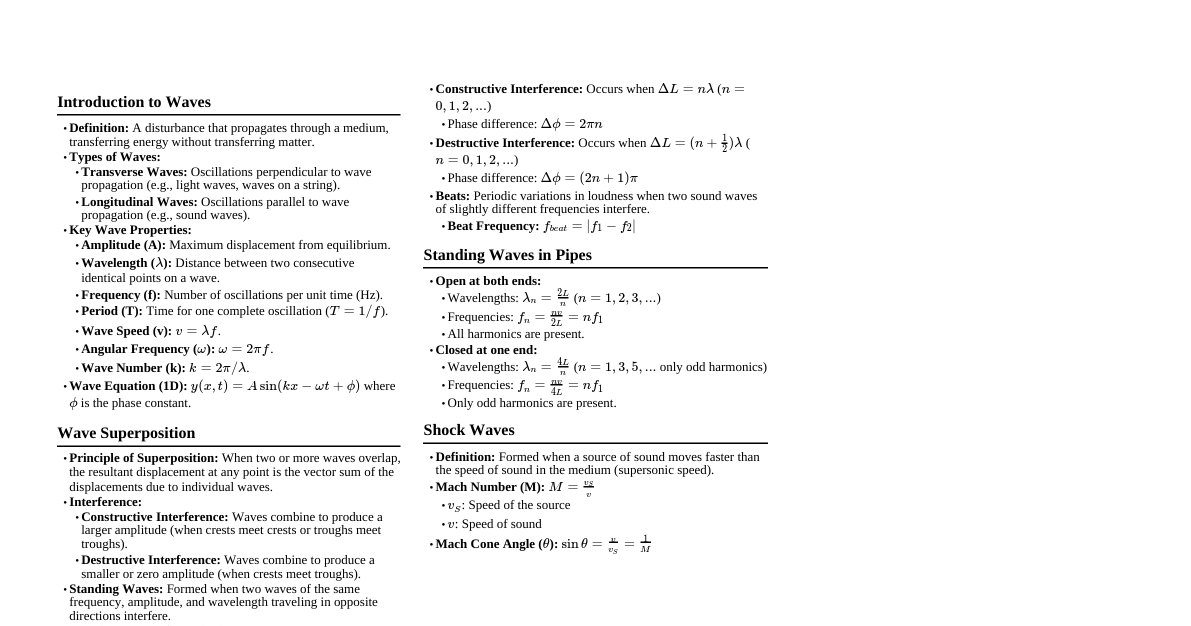
1. Introduction to Waves Definition: A wave is a disturbance that propagates through a medium (or space) transporting energy without significant transport of matter. Types of Waves: Mechanical Waves: Require a medium to propagate (e.g., sound waves, water waves, waves on a string). Electromagnetic Waves: Do not require a medium (e.g., light, radio waves, X-rays). Wave Characteristics: Wavelength ($\lambda$): Distance between two consecutive crests or troughs. Frequency ($f$ or $\nu$): Number of complete oscillations per unit time. Unit: Hertz (Hz). Period ($T$): Time taken for one complete oscillation. $T = 1/f$. Amplitude ($A$): Maximum displacement from the equilibrium position. Wave Speed ($v$): Speed at which the disturbance propagates. $v = f\lambda = \lambda/T$. Wave Number ($k$): $k = 2\pi/\lambda$. Angular Frequency ($\omega$): $\omega = 2\pi f = 2\pi/T$. 2. Types of Mechanical Waves Transverse Waves: Particles of the medium oscillate perpendicular to the direction of wave propagation. Examples: Waves on a string, light waves (EM waves are always transverse). Can be polarized. Velocity on a stretched string: $v = \sqrt{T/\mu}$, where $T$ is tension, $\mu$ is linear mass density ($m/L$). Longitudinal Waves: Particles of the medium oscillate parallel to the direction of wave propagation. Examples: Sound waves, P-waves in earthquakes. Consist of compressions (regions of high density/pressure) and rarefactions (regions of low density/pressure). Cannot be polarized. 3. Equation of Plane Progressive Wave General form: $y(x,t) = A \sin(kx - \omega t + \phi)$ or $y(x,t) = A \sin(\omega t - kx + \phi)$ $y(x,t)$: displacement of a particle at position $x$ and time $t$. $A$: amplitude. $k = 2\pi/\lambda$: angular wave number. $\omega = 2\pi f$: angular frequency. $\phi$: initial phase constant. For wave propagating in $-x$ direction: $y(x,t) = A \sin(kx + \omega t + \phi)$. Alternative forms: $y(x,t) = A \sin\left[2\pi\left(\frac{x}{\lambda} - \frac{t}{T}\right) + \phi\right]$ $y(x,t) = A \sin\left[\frac{2\pi}{\lambda}(x - vt) + \phi\right]$ 4. Intensity of Waves Intensity ($I$): Average power transmitted per unit area perpendicular to the direction of wave propagation. $I = P_{avg}/Area$. Unit: $W/m^2$. For a spherical wave, $I \propto 1/r^2$. Intensity is proportional to the square of the amplitude and the square of the frequency: $I \propto A^2 f^2$. For a plane progressive wave: $I = \frac{1}{2} \rho v \omega^2 A^2$, where $\rho$ is the density of the medium. Sound Intensity Level ($\beta$): Measured in decibels (dB). $\beta = 10 \log_{10}(I/I_0)$, where $I_0 = 10^{-12} W/m^2$ (threshold of hearing). 5. Sound Waves Nature: Longitudinal mechanical waves. Classification by Frequency: Audible Waves: $20 Hz - 20,000 Hz$. Infrasonic Waves: $f Ultrasonic Waves: $f > 20,000 Hz$ (e.g., medical imaging, bat echolocation). Speed of Sound in a Medium: $v = \sqrt{B/\rho}$, where $B$ is the bulk modulus and $\rho$ is the density of the medium. For solids: $v = \sqrt{Y/\rho}$, where $Y$ is Young's modulus. For liquids: $v = \sqrt{K/\rho}$, where $K$ is bulk modulus. 6. Speed of Sound in Gases Newton's Formula: Assumed isothermal process. $v_{Newton} = \sqrt{P/\rho}$. Predicted speed was lower than experimental values. Laplace Correction: Assumed adiabatic process. $v_{Laplace} = \sqrt{\gamma P/\rho}$. $\gamma = C_p/C_v$ (ratio of specific heats). This formula matches experimental values well. Dependence on Temperature: $v \propto \sqrt{T}$ (absolute temperature in Kelvin). $v_t = v_0 \sqrt{(T_0 + t)/T_0} \approx v_0 (1 + t/(2T_0))$ Approximately, speed increases by $0.61 \text{ m/s}$ for every $1^\circ C$ rise in temperature. Dependence on Pressure: No effect, as long as temperature is constant. $P/\rho$ remains constant. Dependence on Humidity: Speed of sound increases with humidity. Water vapor is lighter than dry air, so the effective density of moist air is lower. $v = \sqrt{\gamma P/\rho_{moist}}$. 7. Description of Sound Waves Displacement Wave: $s(x,t) = s_m \sin(kx - \omega t)$, where $s_m$ is displacement amplitude. Pressure Wave: $\Delta P(x,t) = \Delta P_m \cos(kx - \omega t)$, where $\Delta P_m$ is pressure amplitude. $\Delta P_m = (v\rho\omega)s_m = (B k)s_m$. Pressure wave is $90^\circ$ out of phase with the displacement wave. Max pressure change occurs where displacement is zero. 8. Characteristics of Sound Waves (Perception) Pitch: Determined by frequency. Higher frequency = higher pitch. Loudness: Determined by intensity (amplitude). Higher intensity = louder sound. Subjective perception. Quality (Timbre): Determined by the waveform, which depends on the number and relative intensities of overtones (harmonics) present along with the fundamental frequency. Allows differentiation of sounds from different sources even if they have the same pitch and loudness. 9. Reflection and Transmission of Waves When a wave encounters a boundary between two media: Reflection: Part of the wave bounces back. Transmission (Refraction): Part of the wave passes into the new medium. Reflection from a Denser Medium (Fixed End): Reflected wave is inverted (phase change of $\pi$ or $180^\circ$). Amplitude of reflected wave is usually smaller. Reflection from a Rarer Medium (Free End): Reflected wave is not inverted (no phase change). Echo: Reflected sound wave. For a distinct echo, minimum distance to obstacle is about $17.2$ m (assuming $v_{sound} = 344 \text{ m/s}$, minimum time for distinct echo is $0.1$ s). 10. Principle of Superposition When two or more waves overlap, the resultant displacement at any point and time is the algebraic sum of the displacements due to individual waves. $y_{net}(x,t) = y_1(x,t) + y_2(x,t) + \dots$ 11. Interference of Waves The phenomenon of two or more waves overlapping to form a resultant wave of greater, lower, or same amplitude. Consider two waves: $y_1 = A_1 \sin(kx - \omega t)$ and $y_2 = A_2 \sin(kx - \omega t + \phi)$. Resultant amplitude: $A = \sqrt{A_1^2 + A_2^2 + 2A_1 A_2 \cos\phi}$. Resultant intensity: $I = I_1 + I_2 + 2\sqrt{I_1 I_2} \cos\phi$. Constructive Interference: Occurs when waves are in phase ($\phi = 2n\pi$, $n=0,1,2,\dots$). Path difference $\Delta x = n\lambda$. Resultant amplitude $A = A_1 + A_2$. Resultant intensity $I = (\sqrt{I_1} + \sqrt{I_2})^2$. Destructive Interference: Occurs when waves are $180^\circ$ out of phase ($\phi = (2n+1)\pi$, $n=0,1,2,\dots$). Path difference $\Delta x = (n + 1/2)\lambda$. Resultant amplitude $A = |A_1 - A_2|$. Resultant intensity $I = (\sqrt{I_1} - \sqrt{I_2})^2$. 12. Beats When two sound waves of slightly different frequencies ($f_1$ and $f_2$) travel in the same direction, a periodic variation in intensity (loudness) is heard. Beat Frequency ($f_{beat}$): The number of beats heard per second. $f_{beat} = |f_1 - f_2|$. The resultant wave has a frequency $f_{avg} = (f_1+f_2)/2$ and an amplitude that varies with frequency $f_{beat}/2$. 13. Stationary Waves (Standing Waves) Formed when two identical progressive waves (same amplitude, frequency, wavelength) travel in opposite directions and superpose. Equation: $y(x,t) = [2A \sin(kx)] \cos(\omega t)$. The amplitude $A_{standing} = 2A \sin(kx)$ is position-dependent. Nodes: Points where particles are permanently at rest (amplitude is zero). Occur when $\sin(kx) = 0 \Rightarrow kx = n\pi \Rightarrow x = n\lambda/2$, for $n=0,1,2,\dots$. Antinodes: Points where particles oscillate with maximum amplitude ($2A$). Occur when $\sin(kx) = \pm 1 \Rightarrow kx = (n + 1/2)\pi \Rightarrow x = (n + 1/2)\lambda/2$, for $n=0,1,2,\dots$. Distance between consecutive nodes (or antinodes) is $\lambda/2$. Distance between a node and an adjacent antinode is $\lambda/4$. 14. Standing Waves in Strings String fixed at both ends. Nodes must be at the ends. Length of string $L = n(\lambda_n/2)$, where $n=1,2,3,\dots$. Wavelengths: $\lambda_n = 2L/n$. Frequencies: $f_n = v/\lambda_n = (n/2L)v = (n/2L)\sqrt{T/\mu}$. Fundamental Mode (First Harmonic, $n=1$): $f_1 = (1/2L)\sqrt{T/\mu}$. This is the lowest possible frequency. One antinode, two nodes. Overtones (Harmonics): Second Harmonic ($n=2$, First Overtone): $f_2 = 2f_1$. Two antinodes, three nodes. Third Harmonic ($n=3$, Second Overtone): $f_3 = 3f_1$. Three antinodes, four nodes. Frequencies are integer multiples of the fundamental frequency ($f_n = n f_1$). All harmonics are present. 15. Standing Waves in Organ Pipes (Air Columns) Speed of sound in air is $v$. Closed Organ Pipe (Closed at one end, Open at other): Closed end is a node, open end is an antinode. Length of pipe $L = (2n-1)(\lambda_n/4)$, where $n=1,2,3,\dots$. Wavelengths: $\lambda_n = 4L/(2n-1)$. Frequencies: $f_n = v/\lambda_n = ((2n-1)/4L)v$. Fundamental Mode ($n=1$): $f_1 = v/4L$. Overtones: $f_3 = 3f_1$, $f_5 = 5f_1$, etc. Only odd harmonics are present. Open Organ Pipe (Open at both ends): Both ends are antinodes. Length of pipe $L = n(\lambda_n/2)$, where $n=1,2,3,\dots$. Wavelengths: $\lambda_n = 2L/n$. Frequencies: $f_n = v/\lambda_n = (n/2L)v$. Fundamental Mode ($n=1$): $f_1 = v/2L$. Overtones: $f_2 = 2f_1$, $f_3 = 3f_1$, etc. All harmonics are present. End Correction: For open ends, the antinode is slightly outside the pipe. Effective length $L_{eff} = L + e$, where $e \approx 0.6r$ (r = radius of pipe). 16. Resonance Tube Used to determine the speed of sound in air using a tuning fork. A tube of variable length (usually by changing water level) with one end closed by water and the other open to air. Behaves like a closed organ pipe. First Resonance: Occurs when $L_1 + e = \lambda/4$. Second Resonance: Occurs when $L_2 + e = 3\lambda/4$. Subtracting the two: $(L_2 + e) - (L_1 + e) = 3\lambda/4 - \lambda/4 \Rightarrow L_2 - L_1 = \lambda/2$. From this, $\lambda = 2(L_2 - L_1)$. Speed of sound $v = f\lambda = 2f(L_2 - L_1)$. End correction $e = (L_2 - 3L_1)/2$.