Waves and Sound Questions
Cheatsheet Content
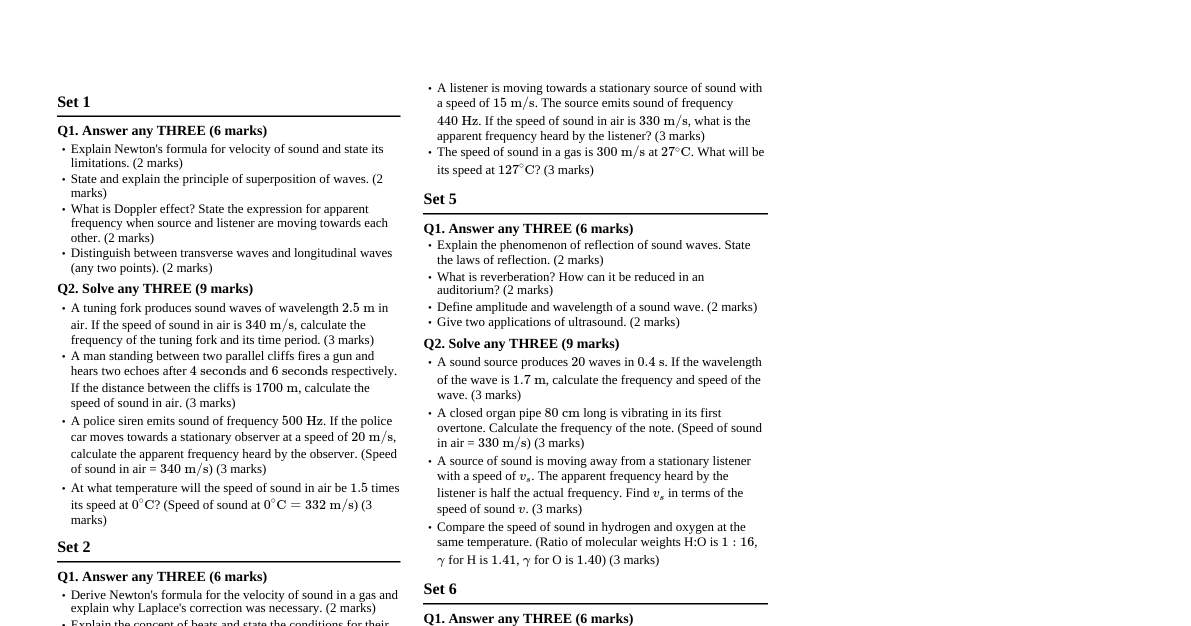
Set 1 - Solutions Q1. Answer any THREE (6 marks) Newton's formula for velocity of sound and its limitations: Newton assumed the propagation of sound in a gas to be an isothermal process. Under this assumption, the velocity of sound $v = \sqrt{\frac{E_T}{\rho}}$, where $E_T = P$ (isothermal elasticity) and $\rho$ is the density of the gas. So, $v = \sqrt{\frac{P}{\rho}}$. Limitations: This formula yielded a value for the speed of sound in air (approx. $280 \text{ m/s}$) which was significantly lower than the experimentally observed value (approx. $330 \text{ m/s}$). This discrepancy arose because sound propagation is actually an adiabatic process, not isothermal. Principle of superposition of waves: When two or more waves travel simultaneously through a medium, the resultant displacement of any particle of the medium at any instant is the vector sum of the displacements produced by the individual waves at that instant. Mathematically, if $y_1, y_2, ..., y_n$ are the displacements due to individual waves, the resultant displacement is $Y = y_1 + y_2 + ... + y_n$. Doppler effect and expression for apparent frequency: The Doppler effect is the apparent change in frequency (and wavelength) of a wave relative to an observer moving relative to the source of the wave. When source and listener are moving towards each other: $f' = f \left( \frac{v + v_L}{v - v_S} \right)$ Where $f'$ is the apparent frequency, $f$ is the actual frequency, $v$ is the speed of sound, $v_L$ is the speed of the listener, and $v_S$ is the speed of the source. Distinguish between transverse waves and longitudinal waves: Transverse Waves Longitudinal Waves Particles of the medium oscillate perpendicular to the direction of wave propagation. Particles of the medium oscillate parallel to the direction of wave propagation. Form crests and troughs. Form compressions and rarefactions. Can be polarized. Cannot be polarized. Example: Light waves, waves on a string. Example: Sound waves in air, waves in a spring. Q2. Solve any THREE (9 marks) Given: $\lambda = 2.5 \text{ m}$, $v = 340 \text{ m/s}$. Formula: $v = f\lambda$ and $T = \frac{1}{f}$. Frequency: $f = \frac{v}{\lambda} = \frac{340 \text{ m/s}}{2.5 \text{ m}} = 136 \text{ Hz}$. Time period: $T = \frac{1}{f} = \frac{1}{136 \text{ Hz}} \approx 0.00735 \text{ s}$. Given: $t_1 = 4 \text{ s}$, $t_2 = 6 \text{ s}$, $D = 1700 \text{ m}$. Let $d_1$ and $d_2$ be the distances to the cliffs from the man. $D = d_1 + d_2 = 1700 \text{ m}$. For the first echo: $2d_1 = v t_1 \Rightarrow 2d_1 = v \times 4 \Rightarrow d_1 = 2v$. For the second echo: $2d_2 = v t_2 \Rightarrow 2d_2 = v \times 6 \Rightarrow d_2 = 3v$. Substituting into the distance equation: $2v + 3v = 1700 \Rightarrow 5v = 1700$. Speed of sound: $v = \frac{1700}{5} = 340 \text{ m/s}$. Given: $f = 500 \text{ Hz}$, $v_S = 20 \text{ m/s}$, $v_L = 0 \text{ m/s}$ (stationary observer), $v = 340 \text{ m/s}$. Formula (source moving towards stationary listener): $f' = f \left( \frac{v}{v - v_S} \right)$. Apparent frequency: $f' = 500 \text{ Hz} \left( \frac{340 \text{ m/s}}{340 \text{ m/s} - 20 \text{ m/s}} \right) = 500 \text{ Hz} \left( \frac{340}{320} \right) = 500 \times 1.0625 = 531.25 \text{ Hz}$. Given: $v_0 = 332 \text{ m/s}$ at $T_0 = 0^\circ\text{C} = 273 \text{ K}$. We want $v_T = 1.5 v_0$. Formula: $v \propto \sqrt{T}$ (where $T$ is absolute temperature). $\frac{v_T}{v_0} = \sqrt{\frac{T}{T_0}} \Rightarrow 1.5 = \sqrt{\frac{T}{273 \text{ K}}}$. Squaring both sides: $(1.5)^2 = \frac{T}{273} \Rightarrow 2.25 = \frac{T}{273}$. $T = 2.25 \times 273 = 614.25 \text{ K}$. Converting to Celsius: $T_C = 614.25 - 273 = 341.25^\circ\text{C}$. Set 2 - Solutions Q1. Answer any THREE (6 marks) Derivation of Newton's formula for the velocity of sound in a gas and Laplace's correction: Newton's Formula: Newton assumed that when sound travels through a gas, the compressions and rarefactions occur slowly enough for the temperature to remain constant (isothermal process). The bulk modulus for an isothermal process is $E_T = P$. So, the velocity of sound $v = \sqrt{\frac{E_T}{\rho}} = \sqrt{\frac{P}{\rho}}$. Laplace's Correction: Laplace pointed out that compressions and rarefactions in a sound wave occur rapidly, so there is insufficient time for heat exchange with the surroundings. Thus, the process is adiabatic, not isothermal. For an adiabatic process, the bulk modulus is $E_A = \gamma P$, where $\gamma = C_p/C_v$ is the ratio of specific heats. Therefore, the corrected formula for the velocity of sound is $v = \sqrt{\frac{\gamma P}{\rho}}$. This formula gives values that match experimental observations accurately. Concept of beats and conditions for their formation: Beats: When two sound waves of slightly different frequencies traveling in the same direction interfere, they produce a periodic variation in the intensity of the resultant sound. This periodic rise and fall in intensity is called beats. Conditions for formation: Two sound sources must have slightly different frequencies (frequency difference should be small, typically less than $10 \text{ Hz}$). The amplitudes of the two waves should be approximately equal. The waves must travel in the same direction and interfere. Intensity of sound and its relation to amplitude: Intensity of sound: The intensity of sound is defined as the average rate of flow of sound energy per unit area perpendicular to the direction of propagation of the wave. Its SI unit is Watts per square meter ($W/m^2$). Relation to amplitude: The intensity of a sound wave is directly proportional to the square of its amplitude ($I \propto A^2$) and also directly proportional to the square of its frequency ($I \propto f^2$). Stationary waves and their characteristics: Stationary waves (or standing waves): These are formed when two identical progressive waves (same amplitude, frequency, and wavelength) traveling in opposite directions superpose. They appear to be stationary, with fixed positions of maximum and minimum displacement. Characteristics: There are points of zero displacement called nodes , and points of maximum displacement called antinodes . Energy is not transferred from one region to another; it remains localized between nodes. All particles between two consecutive nodes vibrate in phase. The amplitude of vibration varies from zero at nodes to maximum at antinodes. Q2. Solve any THREE (9 marks) Given: $f = 2 \text{ kHz} = 2000 \text{ Hz}$, $\lambda = 35 \text{ cm} = 0.35 \text{ m}$. Distance $d = 1.5 \text{ km} = 1500 \text{ m}$. Speed of sound: $v = f\lambda = 2000 \text{ Hz} \times 0.35 \text{ m} = 700 \text{ m/s}$. Time taken: $t = \frac{d}{v} = \frac{1500 \text{ m}}{700 \text{ m/s}} \approx 2.14 \text{ s}$. Given: Reverberation time $T_R = 2.5 \text{ s}$, Volume $V = 1500 \text{ m}^3$. Sabine's formula for reverberation time: $T_R = \frac{0.161 V}{A}$, where $A$ is the total absorption in Sabins. Total absorption: $A = \frac{0.161 V}{T_R} = \frac{0.161 \times 1500 \text{ m}^3}{2.5 \text{ s}} = \frac{241.5}{2.5} = 96.6 \text{ Sabins}$. Given: $v_L = 10 \text{ m/s}$ (moving away), $f = 600 \text{ Hz}$, $v_S = 0 \text{ m/s}$ (stationary source), $v = 330 \text{ m/s}$. Formula (listener moving away from stationary source): $f' = f \left( \frac{v - v_L}{v} \right)$. Apparent frequency: $f' = 600 \text{ Hz} \left( \frac{330 \text{ m/s} - 10 \text{ m/s}}{330 \text{ m/s}} \right) = 600 \text{ Hz} \left( \frac{320}{330} \right) = 600 \times 0.9697 \approx 581.82 \text{ Hz}$. Given: $v_1 = 343 \text{ m/s}$ at $T_1 = 20^\circ\text{C} = 20 + 273 = 293 \text{ K}$. We need to find $v_2$ at $T_2 = 40^\circ\text{C} = 40 + 273 = 313 \text{ K}$. Formula: $\frac{v_2}{v_1} = \sqrt{\frac{T_2}{T_1}}$. $v_2 = v_1 \sqrt{\frac{T_2}{T_1}} = 343 \text{ m/s} \sqrt{\frac{313 \text{ K}}{293 \text{ K}}} = 343 \times \sqrt{1.0682} = 343 \times 1.0335 \approx 354.45 \text{ m/s}$. Set 3 - Solutions Q1. Answer any THREE (6 marks) Phenomenon of resonance with an example: Resonance: Resonance is a phenomenon that occurs when an oscillating system (or an object) is subjected to an external force whose frequency is equal or very close to the natural frequency of the system. This results in a significant increase in the amplitude of oscillations. Example: Pushing a swing. If you push a swing at its natural frequency (the frequency at which it naturally swings back and forth), its amplitude of oscillation will increase significantly. If you push it at a different frequency, the amplitude will not increase as much. Another example: A tuning fork vibrating at its natural frequency can cause another identical tuning fork nearby to vibrate (sympathetic vibration). Pitch and loudness of sound, and their relation to wave properties: Pitch: Pitch is the characteristic of sound that allows us to classify a sound as "high" or "low". It is primarily determined by the frequency of the sound wave. Higher frequency corresponds to higher pitch, and lower frequency corresponds to lower pitch. Loudness: Loudness is the characteristic of sound that determines how strong or weak a sound appears to our ears. It is primarily determined by the amplitude of the sound wave. Larger amplitude corresponds to louder sound, and smaller amplitude corresponds to softer sound. Loudness also depends logarithmically on intensity and the sensitivity of the ear. Conditions for constructive and destructive interference of sound waves: Constructive Interference: Occurs when two waves meet in phase (crest meets crest or trough meets trough). This results in a resultant wave with an amplitude greater than the individual amplitudes (maximum intensity or loudness). Condition: Path difference $\Delta x = n\lambda$, where $n = 0, 1, 2, ...$ (or phase difference $\Delta\phi = 2n\pi$). Destructive Interference: Occurs when two waves meet out of phase (crest meets trough). This results in a resultant wave with an amplitude smaller than the individual amplitudes (minimum intensity or loudness, potentially zero). Condition: Path difference $\Delta x = (n + \frac{1}{2})\lambda$, where $n = 0, 1, 2, ...$ (or phase difference $\Delta\phi = (2n+1)\pi$). Distinguish between open and closed organ pipes: Open Organ Pipe Closed Organ Pipe Open at both ends. Open at one end, closed at the other. Antinodes are formed at both open ends. An antinode is formed at the open end, and a node is formed at the closed end. Produces all harmonics (odd and even multiples of the fundamental frequency). $f_n = n \frac{v}{2L}$ Produces only odd harmonics (odd multiples of the fundamental frequency). $f_n = (2n-1) \frac{v}{4L}$ Fundamental frequency is $v/(2L)$. Fundamental frequency is $v/(4L)$. Q2. Solve any THREE (9 marks) Given: $v = 320 \text{ m/s}$, $f = 160 \text{ Hz}$. Wavelength: $\lambda = \frac{v}{f} = \frac{320 \text{ m/s}}{160 \text{ Hz}} = 2 \text{ m}$. Period: $T = \frac{1}{f} = \frac{1}{160 \text{ Hz}} = 0.00625 \text{ s}$. Given: Number of beats = $100$ in $5 \text{ s}$. Beat frequency $f_b = \frac{100}{5} = 20 \text{ Hz}$. Frequency of tuning fork $f_{tf} = 256 \text{ Hz}$. The beat frequency is the absolute difference between the two frequencies: $f_b = |f_s - f_{tf}|$. So, $20 = |f_s - 256|$. Possible frequencies of the source $f_s = 256 \pm 20 \text{ Hz}$. Possible frequencies: $f_s = 256 + 20 = 276 \text{ Hz}$ or $f_s = 256 - 20 = 236 \text{ Hz}$. Given: $v_S = 30 \text{ m/s}$ (source approaching), $f = 400 \text{ Hz}$, $v_L = 0 \text{ m/s}$ (stationary observer), $v = 340 \text{ m/s}$. Formula (source approaching stationary listener): $f' = f \left( \frac{v}{v - v_S} \right)$. Apparent frequency: $f' = 400 \text{ Hz} \left( \frac{340 \text{ m/s}}{340 \text{ m/s} - 30 \text{ m/s}} \right) = 400 \text{ Hz} \left( \frac{340}{310} \right) = 400 \times 1.0967 \approx 438.71 \text{ Hz}$. Speed of sound in air: $v \propto \sqrt{T}$ (absolute temperature). The speed of sound in air increases by approximately $0.61 \text{ m/s}$ for every $1^\circ\text{C}$ rise in temperature. Let's consider $v_0$ at $0^\circ\text{C}$ (approx $331 \text{ m/s}$). At $1^\circ\text{C}$, $v_1 \approx 331 + 0.61 = 331.61 \text{ m/s}$. Percentage increase $= \frac{v_1 - v_0}{v_0} \times 100\% = \frac{0.61}{331} \times 100\% \approx 0.184\%$. Alternatively, using $T$: $v_T = v_0 \sqrt{\frac{T}{T_0}}$. Let $T_0 = 273 \text{ K}$ ($0^\circ\text{C}$). Let $T_1 = 274 \text{ K}$ ($1^\circ\text{C}$). $\frac{v_1}{v_0} = \sqrt{\frac{274}{273}} \approx \sqrt{1.00366} \approx 1.00183$. Percentage increase $= (1.00183 - 1) \times 100\% = 0.00183 \times 100\% = 0.183\%$. Approximate percentage increase: $\approx 0.18\%$.