Organic Chemistry JEE
Cheatsheet Content
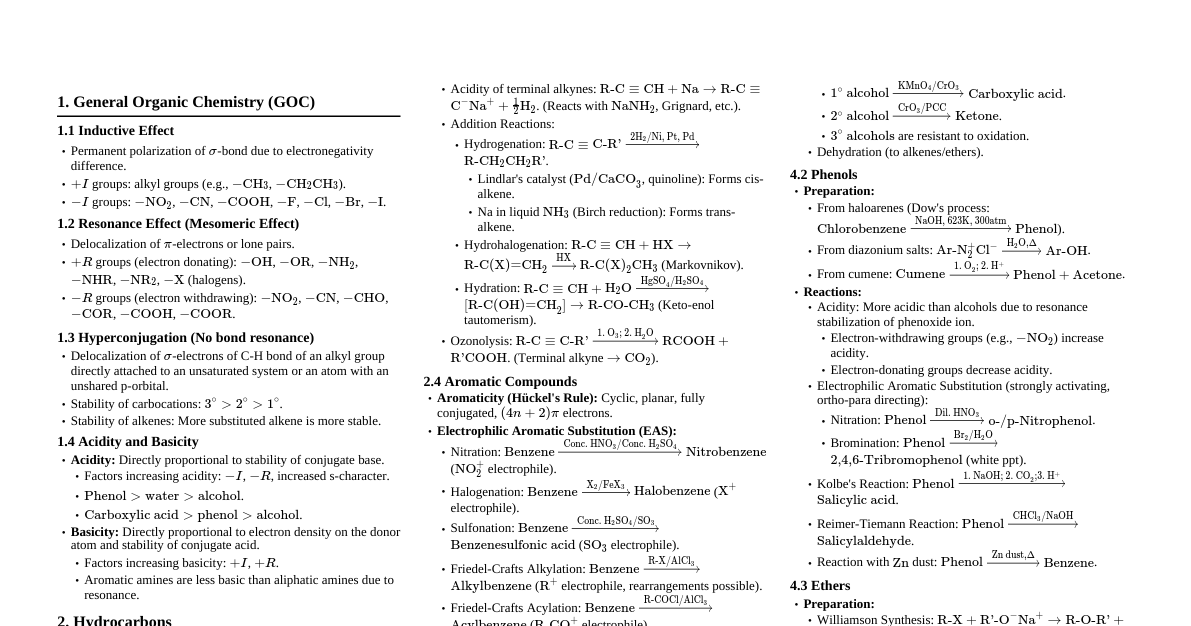
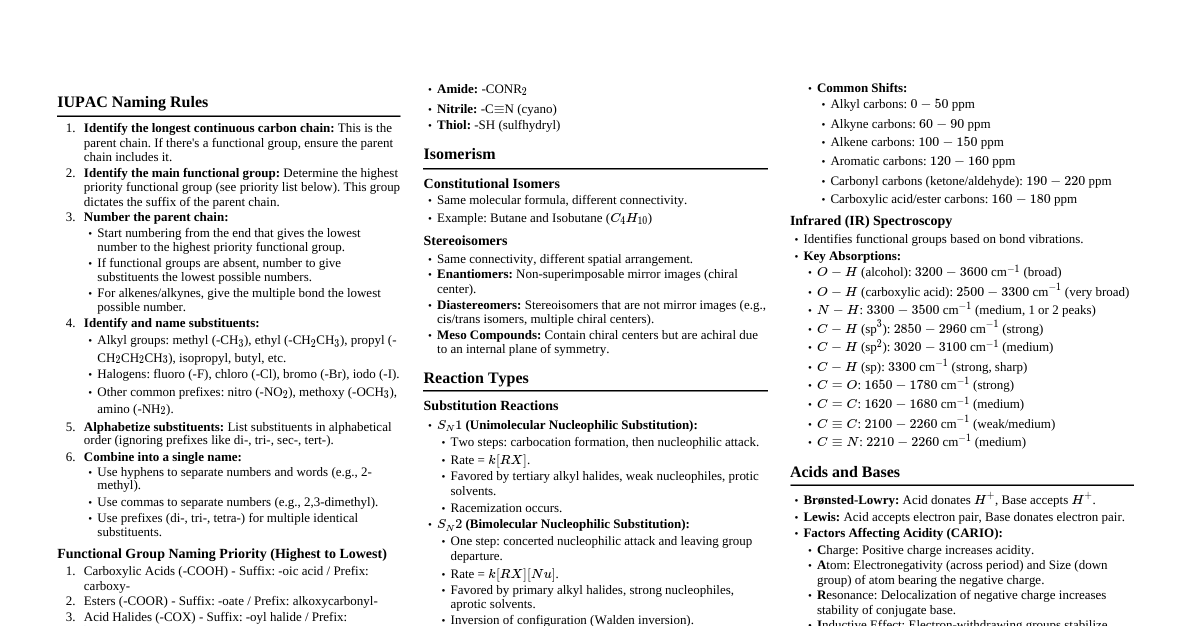
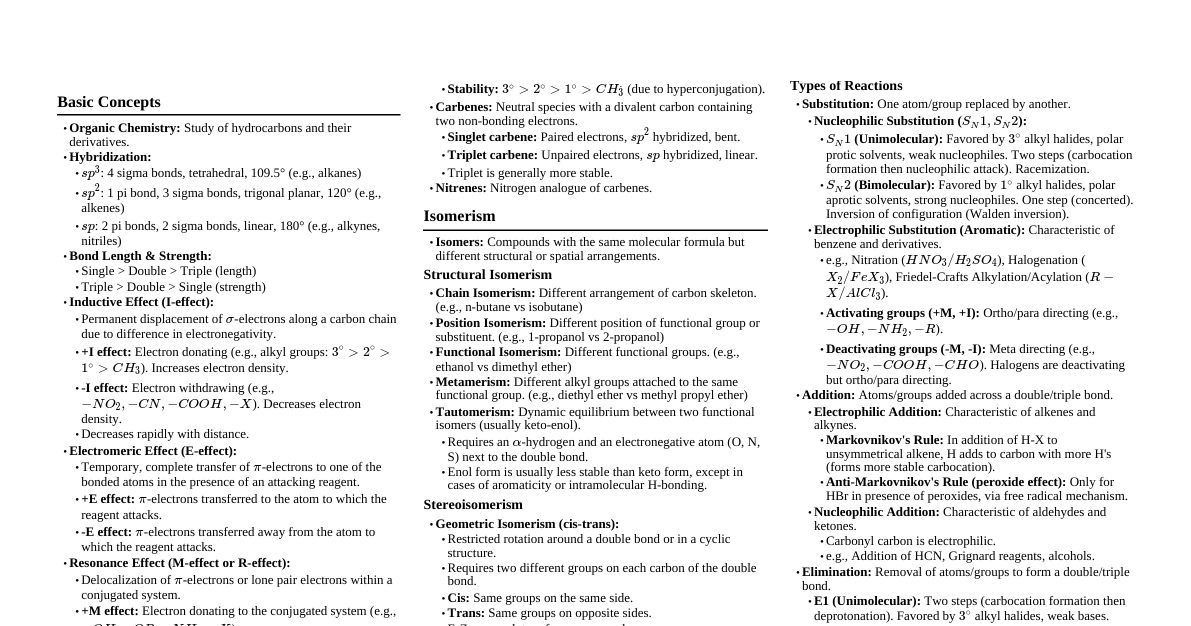
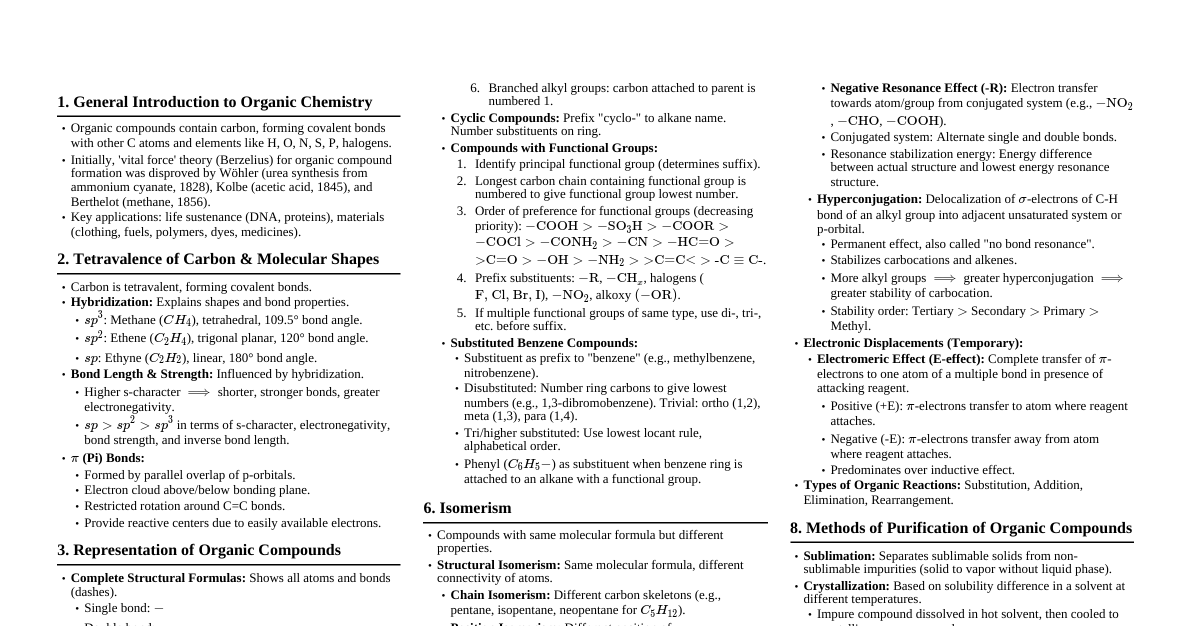
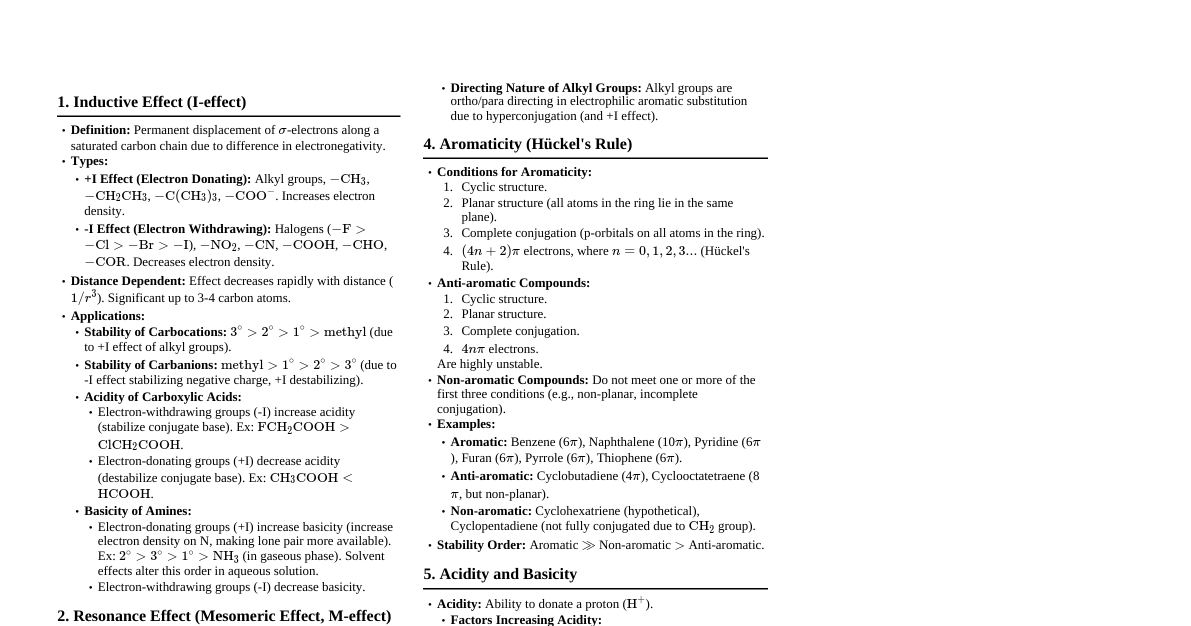
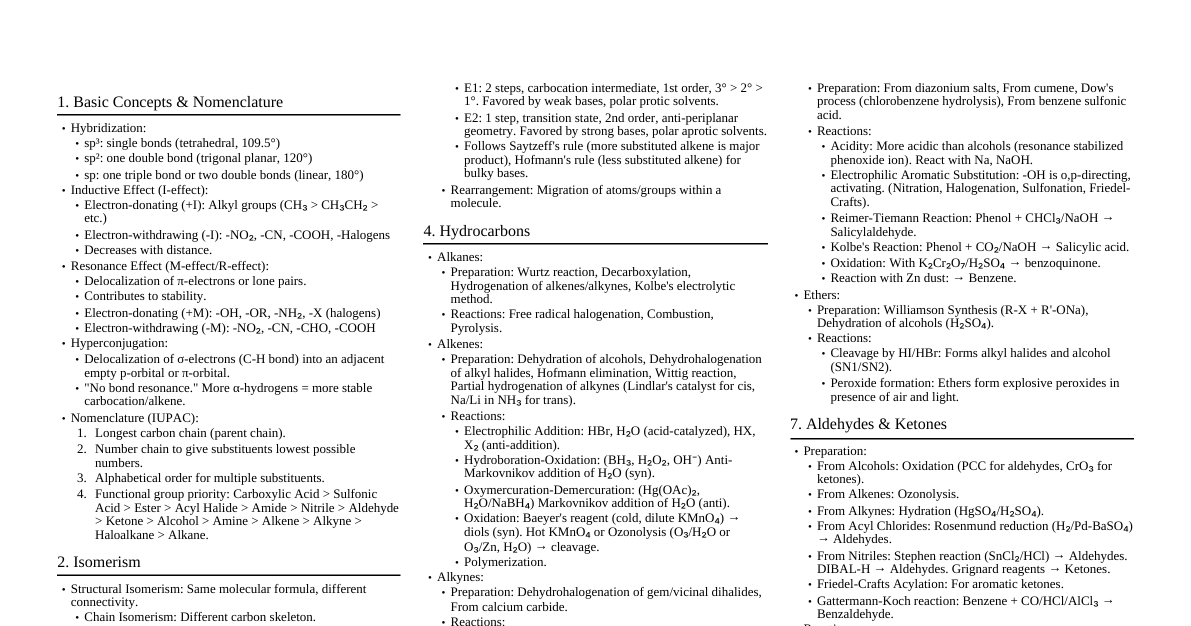
1. General Organic Chemistry (GOC) 1.1 Hybridization and Geometry $sp^3$: Tetrahedral, $109.5^\circ$ (e.g., alkanes) $sp^2$: Trigonal planar, $120^\circ$ (e.g., alkenes, carbonyls) $sp$: Linear, $180^\circ$ (e.g., alkynes, nitriles) 1.2 Inductive Effect (I-effect) Electron-donating (+I): Alkyl groups (e.g., $-\text{CH}_3 > -\text{CH}_2\text{CH}_3$) Electron-withdrawing (-I): $-\text{NO}_2 > -\text{CN} > -\text{F} > -\text{Cl} > -\text{Br} > -\text{I} > -\text{OH} > -\text{OR} > -\text{COOH} > -\text{CONH}_2 > -\text{NH}_2 > -\text{C}_6\text{H}_5$ Propagates through sigma bonds, decreases rapidly with distance. 1.3 Resonance Effect (M-effect) / Mesomeric Effect Electron-donating (+M): Groups with lone pairs (e.g., $-\text{OH}, -\text{OR}, -\text{NH}_2, -\text{Cl}$) Electron-withdrawing (-M): Groups with $\pi$ bonds conjugated to a positive center or an electronegative atom (e.g., $-\text{NO}_2, -\text{CHO}, -\text{COOH}, -\text{CN}$) Operates through $\pi$ bonds/conjugation, more powerful than I-effect. 1.4 Hyperconjugation (No bond resonance) Stabilization due to interaction of $\sigma$ electrons (C-H bond) with adjacent empty p-orbital (carbocation) or $\pi$-orbital (alkene, alkyl radical). Stability order of carbocations/radicals: $3^\circ > 2^\circ > 1^\circ > \text{methyl}$ Stability of alkenes: More $\alpha$-hydrogens, more stable. 1.5 Acidity and Basicity Acidity: Directly proportional to stability of conjugate base. Factors increasing acidity: -I, -M effects; greater s-character of C (e.g., alkyne > alkene > alkane) Order: $\text{RCOOH} > \text{H}_2\text{CO}_3 > \text{PhOH} > \text{H}_2\text{O} > \text{ROH} > \text{alkynes} > \text{alkenes} > \text{alkanes}$ Basicity: Directly proportional to electron density on donor atom and availability of lone pair. Factors increasing basicity: +I, +M effects. Factors decreasing basicity: -I, -M effects; delocalization of lone pair (e.g., anilines are less basic than aliphatic amines). Order $\text{NH}_3, \text{RNH}_2$: Gas phase $3^\circ > 2^\circ > 1^\circ > \text{NH}_3$; Aqueous phase $2^\circ > 3^\circ > 1^\circ > \text{NH}_3$ (or $2^\circ > 1^\circ > 3^\circ > \text{NH}_3$ for smaller R groups like $\text{CH}_3$) due to solvation effects. 1.6 Isomerism Structural Isomers: Chain, Position, Functional, Metamerism, Tautomerism. Stereoisomers: Geometrical (cis-trans): Restricted rotation around C=C (or C=N, cycloalkanes). Requires two different groups on each C of the double bond. E/Z nomenclature for complex cases. Optical: Chiral center (asymmetric carbon), non-superimposable mirror images (enantiomers). Specific rotation: $[\alpha] = \frac{\alpha}{l \times c}$ Racemic mixture: Equimolar mixture of enantiomers, optically inactive. Meso compounds: Chiral centers present but optically inactive due to internal plane of symmetry. 2. Hydrocarbons 2.1 Alkanes Preparation: Wurtz reaction ($2\text{RX} + 2\text{Na} \to \text{R-R} + 2\text{NaX}$), Decarboxylation ($RCOONa + NaOH/CaO \to RH + Na_2CO_3$), Hydrogenation of alkenes/alkynes, Kolbe's electrolytic method. Reactions: Free radical halogenation (reactivity: $3^\circ > 2^\circ > 1^\circ$), Combustion, Pyrolysis. 2.2 Alkenes Preparation: Dehydration of alcohols ($\text{H}_2\text{SO}_4$, heat), Dehydrohalogenation of alkyl halides (alcoholic KOH, Saytzeff's rule), Partial hydrogenation of alkynes (Lindlar's catalyst - cis, Na/liq. $\text{NH}_3$ - trans). Reactions: Electrophilic addition: $\text{HBr}$ (Markovnikov's rule), $\text{HBr}$ in presence of peroxide (anti-Markovnikov's), $\text{Br}_2/\text{CCl}_4$ (anti-addition), $\text{H}_2\text{O}/\text{H}^+$ (Markovnikov's). Oxidation: Baeyer's reagent ($\text{cold dil. alkaline KMnO}_4$) - diol formation (syn), Hot $\text{KMnO}_4$ / $\text{O}_3$ - cleavage. Polymerization. 2.3 Alkynes Preparation: Dehydrohalogenation of vicinal/geminal dihalides, From calcium carbide ($\text{CaC}_2 + 2\text{H}_2\text{O} \to \text{C}_2\text{H}_2 + \text{Ca(OH)}_2$). Reactions: Acidic nature of terminal alkynes: React with $\text{Na}, \text{NaNH}_2$, ammoniacal $\text{AgNO}_3$ (Tollens' reagent), ammoniacal $\text{CuCl}$ to form acetylides. Electrophilic addition: $\text{HBr}, \text{Br}_2, \text{H}_2\text{O}/\text{H}^+$ (Markovnikov's, forms ketones/aldehydes). Polymerization: Linear (e.g., acetylene to polyacetylene), Cyclic (e.g., acetylene to benzene at red hot Fe tube). 2.4 Aromatic Compounds (Benzene) Aromaticity (Hückel's Rule): Planar, cyclic, fully conjugated, $(4n+2)\pi$ electrons. Electrophilic Aromatic Substitution (EAS): Nitration: $\text{HNO}_3/\text{H}_2\text{SO}_4 \to -\text{NO}_2$ Halogenation: $\text{X}_2/\text{FeX}_3 \to -\text{X}$ Sulfonation: $\text{conc. H}_2\text{SO}_4/\text{SO}_3 \to -\text{SO}_3\text{H}$ Friedel-Crafts Alkylation: $\text{R-X}/\text{AlCl}_3 \to -\text{R}$ (carbocation rearrangement possible) Friedel-Crafts Acylation: $\text{RCOCl}/\text{AlCl}_3 \to -\text{COR}$ Directing Groups: Ortho-para directors (+M/+I): $-\text{NH}_2, -\text{OH}, -\text{OR}, -\text{R}, -\text{X}$ (halogens are deactivating but o,p-directing) Meta directors (-M/-I): $-\text{NO}_2, -\text{CN}, -\text{CHO}, -\text{COOH}, -\text{SO}_3\text{H}$ 3. Halogen Derivatives 3.1 Alkyl Halides (R-X) Preparation: From alcohols ($\text{HX}, \text{SOCl}_2, \text{PCl}_3/\text{PCl}_5$), Alkanes (free radical), Alkenes ($\text{HX}, \text{X}_2$). Reactions: Nucleophilic Substitution ($\text{S}_{\text{N}}1, \text{S}_{\text{N}}2$): $\text{S}_{\text{N}}1$: $3^\circ > 2^\circ > 1^\circ$, proceeds via carbocation (racemization), polar protic solvents. $\text{S}_{\text{N}}2$: $1^\circ > 2^\circ > 3^\circ$, concerted mechanism (inversion of configuration), polar aprotic solvents. Elimination (E1, E2): E1: $3^\circ > 2^\circ > 1^\circ$, via carbocation, polar protic solvents, weak base. E2: $3^\circ > 2^\circ > 1^\circ$, concerted, strong base, Saytzeff's rule (major product is more substituted alkene). Reaction with metals: Grignard reagent ($\text{RMgX}$), Wurtz reaction. 3.2 Aryl Halides (Ar-X) Less reactive towards nucleophilic substitution due to resonance stabilization of C-X bond and $sp^2$ hybridized carbon. Reactions: Nucleophilic substitution under harsh conditions (e.g., Dow's process for chlorobenzene to phenol). Electrophilic substitution (halogens are deactivating but o,p-directing). 4. Alcohols, Phenols, Ethers 4.1 Alcohols (R-OH) Preparation: From alkyl halides ($\text{aq. KOH}$), Carbonyl compounds (reduction with $\text{LiAlH}_4, \text{NaBH}_4$), Grignard reagents. Reactions: Acidic nature: React with $\text{Na}$. Acidity: $\text{H}_2\text{O} > \text{ROH}$ (due to +I effect of R). Esterification ($\text{RCOOH} + \text{R'OH} \rightleftharpoons \text{RCOOR'} + \text{H}_2\text{O}$). Dehydration to alkenes ($\text{conc. H}_2\text{SO}_4$, heat) or ethers ($\text{conc. H}_2\text{SO}_4$, lower temp.). Oxidation: $1^\circ \text{alcohol} \to \text{aldehyde} \to \text{carboxylic acid}$; $2^\circ \text{alcohol} \to \text{ketone}$; $3^\circ \text{alcohol}$ generally not oxidized under mild conditions. Lucas Test: $\text{HCl}/\text{ZnCl}_2$ (anhydrous). $3^\circ \text{alcohol}$ (immediate turbidity), $2^\circ \text{alcohol}$ (turbidity in 5-10 min), $1^\circ \text{alcohol}$ (no turbidity at RT). 4.2 Phenols (Ar-OH) Preparation: Dow's process, Cumene process, From diazonium salts. Reactions: More acidic than alcohols (resonance stabilization of phenoxide ion). Less acidic than carboxylic acids. Electrophilic substitution (strong o,p-director): Nitration, Halogenation, Sulfonation, Kolbe's reaction, Reimer-Tiemann reaction. Oxidation: Air oxidation to quinones. Reaction with $\text{FeCl}_3$: Violet coloration (characteristic test). 4.3 Ethers (R-O-R') Preparation: Williamson synthesis ($\text{RONa} + \text{R'X} \to \text{ROR'} + \text{NaX}$). Best for $1^\circ$ alkyl halides. Reactions: Cleavage with $\text{HI}$ (hot, concentrated): $\text{R-O-R'} + \text{HI} \to \text{ROH} + \text{R'I}$. If one R is $3^\circ$, then $3^\circ$ R forms iodide. Peroxide formation: Ethers react with $\text{O}_2$ in presence of light to form explosive peroxides. 5. Aldehydes, Ketones, Carboxylic Acids 5.1 Aldehydes (R-CHO) & Ketones (R-CO-R') Preparation: Aldehydes: Oxidation of $1^\circ$ alcohols (PCC, $\text{CrO}_3$), Ozonolysis of alkenes, Rosenmund reduction ($\text{RCOCl} + \text{H}_2/\text{Pd-BaSO}_4$), Stephen reduction ($\text{RCN} + \text{SnCl}_2/\text{HCl}$), DIBAL-H. Ketones: Oxidation of $2^\circ$ alcohols, Ozonolysis of alkenes, Friedel-Crafts acylation, From nitriles + Grignard reagent. Reactions (Nucleophilic Addition): React with $\text{HCN}$ (cyanohydrin), $\text{NaHSO}_3$ (bisulfite adduct), Grignard reagents, alcohols (hemiacetal/acetal, hemiketal/ketal), ammonia derivatives ($\text{NH}_2\text{OH}, \text{N}_2\text{H}_4$, etc.). Reduction: To alcohols ($\text{LiAlH}_4, \text{NaBH}_4$). To alkanes (Clemmensen reduction: $\text{Zn-Hg/HCl}$; Wolff-Kishner reduction: $\text{N}_2\text{H}_4/\text{KOH}$ in ethylene glycol). Aldol Condensation: Aldehydes/ketones with $\alpha$-hydrogens in presence of dilute base. Forms $\beta$-hydroxy carbonyl, which dehydrates to $\alpha,\beta$-unsaturated carbonyl. Cannizzaro Reaction: Aldehydes with NO $\alpha$-hydrogens in presence of conc. base. Disproportionation: one molecule oxidized to carboxylic acid salt, another reduced to alcohol. Haloform Reaction: Methyl ketones ($\text{CH}_3\text{CO-}$ group) react with $\text{X}_2/\text{NaOH}$ to give haloform ($\text{CHX}_3$) and carboxylate. Tests: Tollens' reagent ($\text{Ag(NH}_3)_2^+$ - silver mirror, for aldehydes), Fehling's solution (red ppt. of $\text{Cu}_2\text{O}$, for aldehydes). 5.2 Carboxylic Acids (R-COOH) Preparation: Oxidation of $1^\circ$ alcohols/aldehydes, From Grignard reagents ($\text{RMgX} + \text{CO}_2 \to \text{RCOOMgX} \to \text{RCOOH}$), Hydrolysis of nitriles/esters. Reactions: Acidic nature: Stronger acids than phenols and alcohols. Acidity order depends on -I/-M effects. Esterification ($\text{RCOOH} + \text{R'OH} \rightleftharpoons \text{RCOOR'} + \text{H}_2\text{O}$). Formation of acid derivatives: Acid chlorides ($\text{SOCl}_2, \text{PCl}_5$), Anhydrides ($\text{P}_2\text{O}_5$), Amides ($\text{NH}_3$, heat). Reduction to $1^\circ$ alcohols ($\text{LiAlH}_4$). Hell-Volhard-Zelinsky (HVZ) reaction: Carboxylic acids with $\alpha$-hydrogen react with $\text{X}_2/\text{Red P}$ to form $\alpha$-halo carboxylic acids. 6. Nitrogen Containing Compounds 6.1 Amines (R-NH$_2$, R$_2$NH, R$_3$N) Preparation: Reduction of nitro compounds ($\text{Sn/HCl}, \text{Fe/HCl}, \text{H}_2/\text{Pd}$), Reduction of nitriles/amides, Gabriel phthalimide synthesis (for $1^\circ$ amines), Hofmann bromamide degradation (decrease carbon by one). Reactions: Basic nature: Amines are basic due to lone pair on nitrogen. Basicity: Alkyl amines > $\text{NH}_3$ > Aryl amines. Acylation: React with acid chlorides/anhydrides to form amides. Carbylamine reaction (Isocyanide test): $1^\circ$ amines + $\text{CHCl}_3 + \text{KOH}$ (alcoholic) $\to$ foul-smelling isocyanide. Reaction with Nitrous Acid ($\text{HNO}_2$): $1^\circ \text{aliphatic amine} \to \text{diazonium salt} \to \text{alcohol} + \text{N}_2$ (gas). $1^\circ \text{aromatic amine} \to \text{arenediazonium salt}$ (stable at $0-5^\circ\text{C}$). $2^\circ \text{amines} \to \text{N}$-nitrosoamines (yellow oily liquid). $3^\circ \text{amines} \to \text{no reaction}$ (aliphatic) / forms para-nitroso derivative (aromatic). Hinsberg's test: Distinguishes $1^\circ, 2^\circ, 3^\circ$ amines using benzenesulphonyl chloride. 6.2 Diazonium Salts ($\text{Ar-N}_2^+ \text{X}^-$) Preparation: From $1^\circ$ aromatic amines + $\text{NaNO}_2/\text{HCl}$ at $0-5^\circ\text{C}$. Reactions: Replacement reactions: $\text{N}_2$ is a good leaving group. Can be replaced by $\text{Cl}, \text{Br}, \text{I}, \text{CN}, \text{OH}, \text{H}$ (Sandmeyer, Gattermann reactions). Coupling reactions: React with phenols or anilines to form azo dyes (e.g., orange dye). 7. Biomolecules 7.1 Carbohydrates Monosaccharides: Glucose, Fructose. Glucose: Aldohexose, forms cyclic hemiacetal (pyranose), mutarotation. Fructose: Ketohexose, forms cyclic hemiketal (furanose). Reducing sugars: Contain free aldehyde/ketone group or can isomerize (e.g., glucose, fructose, maltose, lactose). Reduce Tollens' and Fehling's reagents. Disaccharides: Sucrose (non-reducing), Maltose (reducing), Lactose (reducing). Polysaccharides: Starch, Cellulose, Glycogen. 7.2 Proteins Amino acids: Building blocks, contain $-\text{NH}_2$ and $-\text{COOH}$ groups. Zwitterionic form. Peptide bond: $-\text{CONH}-$. Structure: Primary, Secondary ($\alpha$-helix, $\beta$-pleated sheet), Tertiary, Quaternary. Denaturation: Loss of biological activity due to change in 3D structure. 7.3 Vitamins Fat-soluble: A, D, E, K. Water-soluble: B complex, C. 7.4 Nucleic Acids DNA, RNA. Nucleotide: Base + Sugar + Phosphate. Bases: Adenine (A), Guanine (G), Cytosine (C), Thymine (T - in DNA), Uracil (U - in RNA). DNA: Double helix, A-T, G-C pairing. 8. Polymers Classification: Natural/Synthetic, Addition/Condensation, Thermoplastic/Thermosetting. Addition Polymers: Polyethylene, Polypropylene, PVC, Teflon, Polyacrylonitrile (PAN), Buna-S, Buna-N. Condensation Polymers: Nylon (Nylon 6,6; Nylon 6), Polyesters (Dacron/Terylene), Bakelite, Melamine-formaldehyde resin. Copolymerization: Formation of polymer from two or more different monomers (e.g., Buna-S). Biodegradable Polymers: PHBV, Nylon 2-Nylon 6. 9. Chemistry in Everyday Life Drugs: Antacids, Antihistamines, Tranquilizers, Analgesics, Antiseptics, Disinfectants, Antibiotics. Food Additives: Artificial sweeteners, Food preservatives, Antioxidants. Cleansing Agents: Soaps, Detergents (anionic, cationic, non-ionic).