JEE Advanced Organic Chemistry
Cheatsheet Content
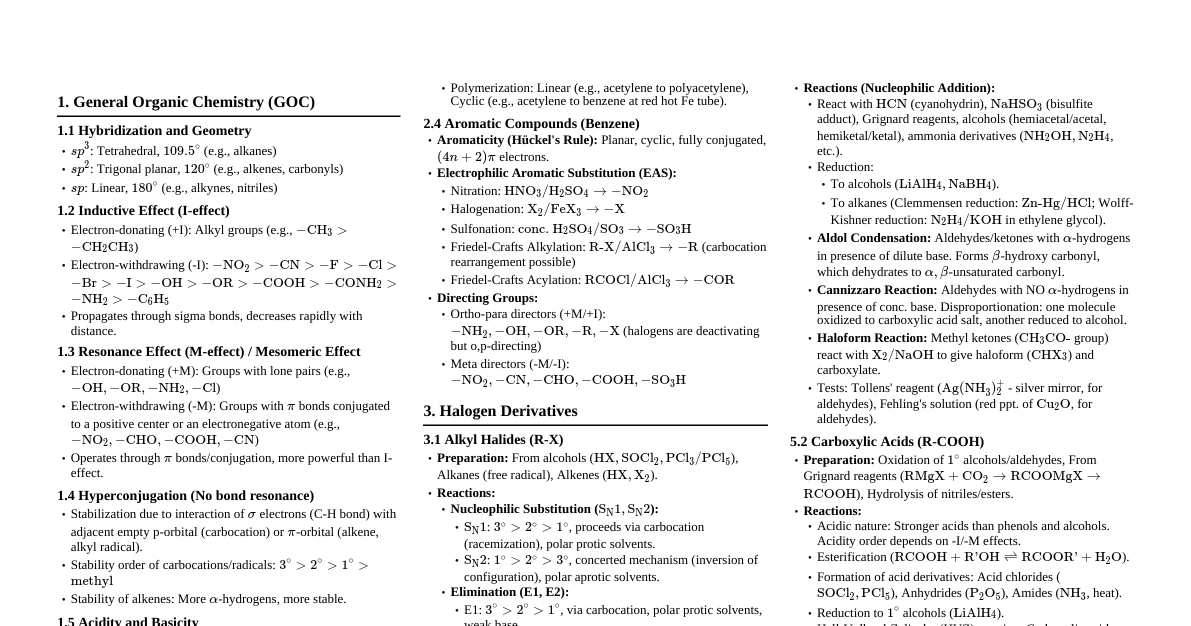
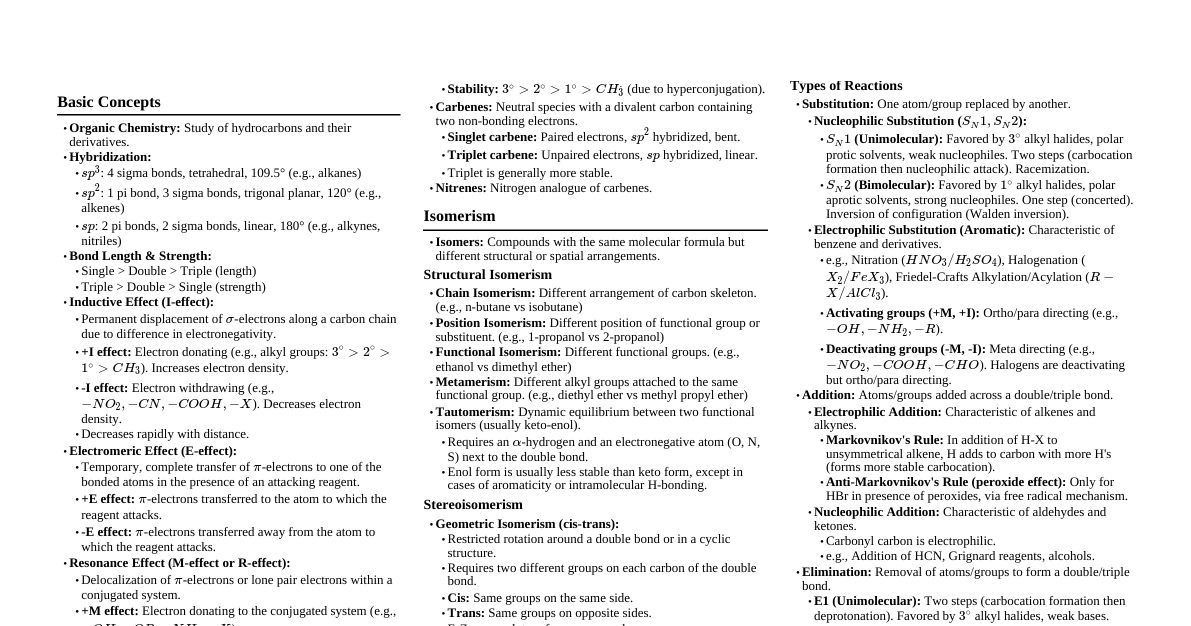
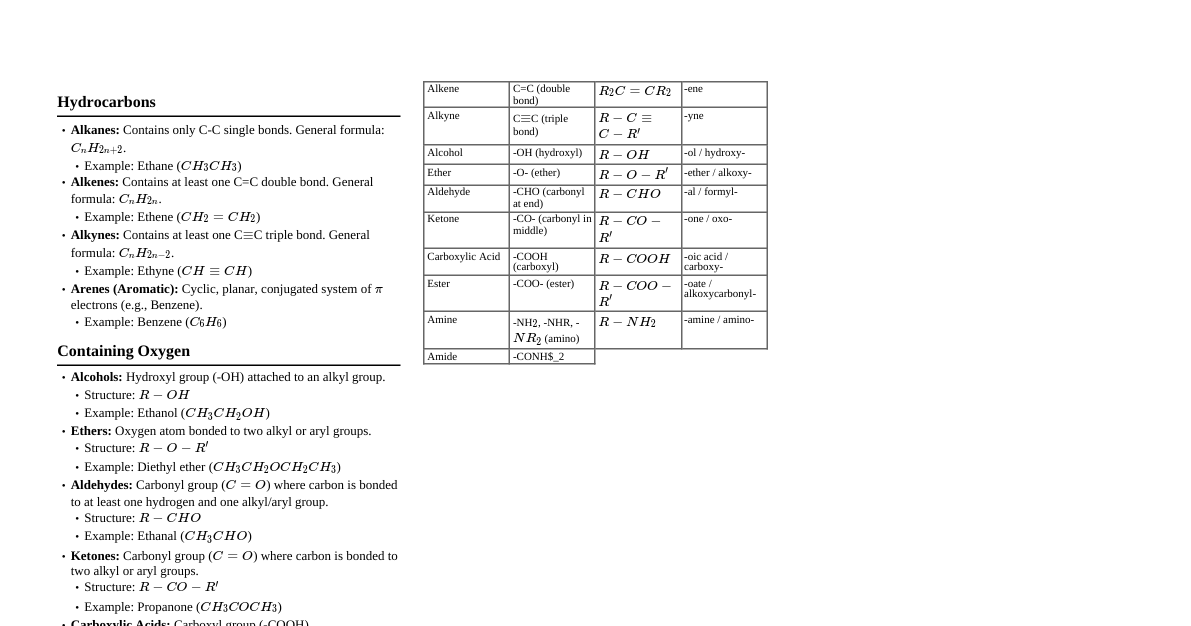
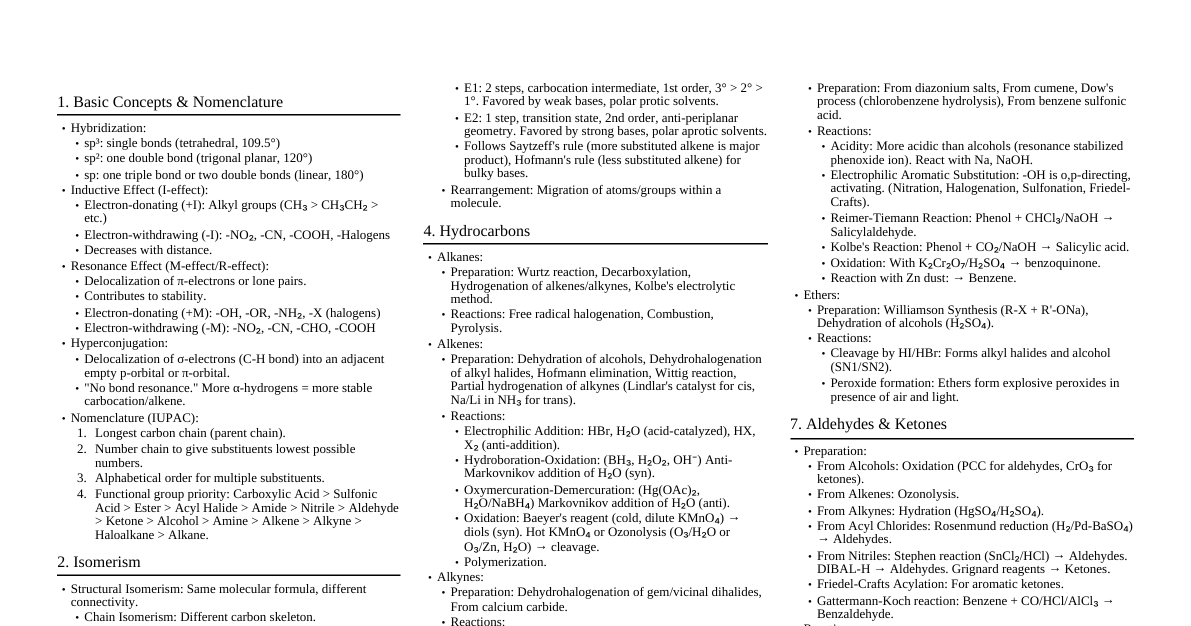
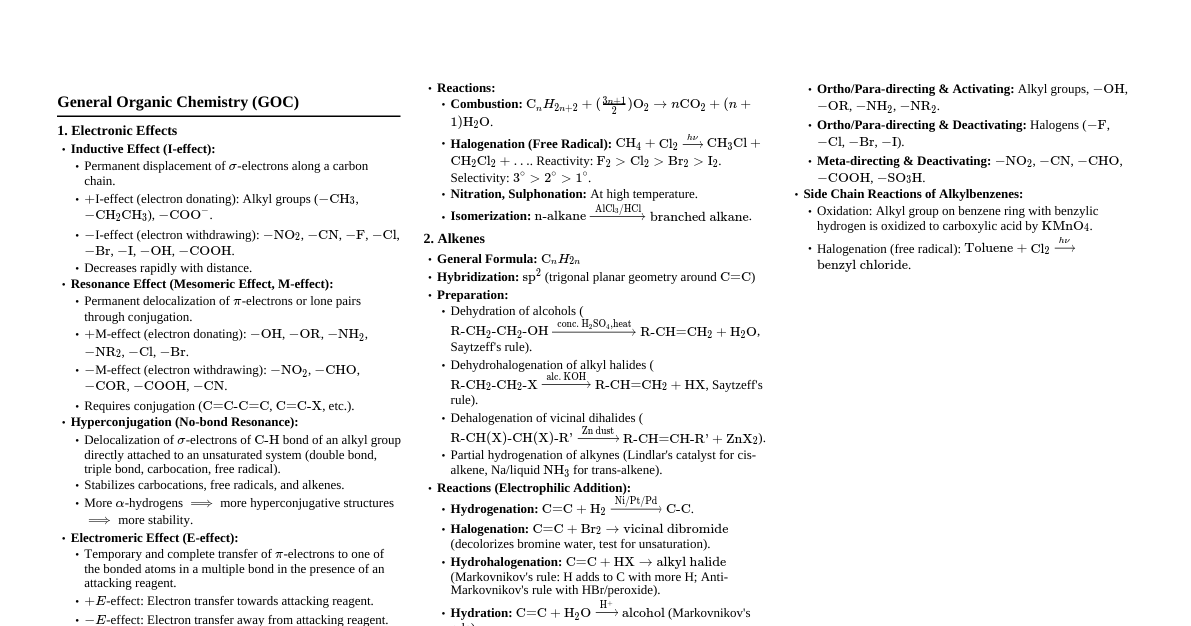
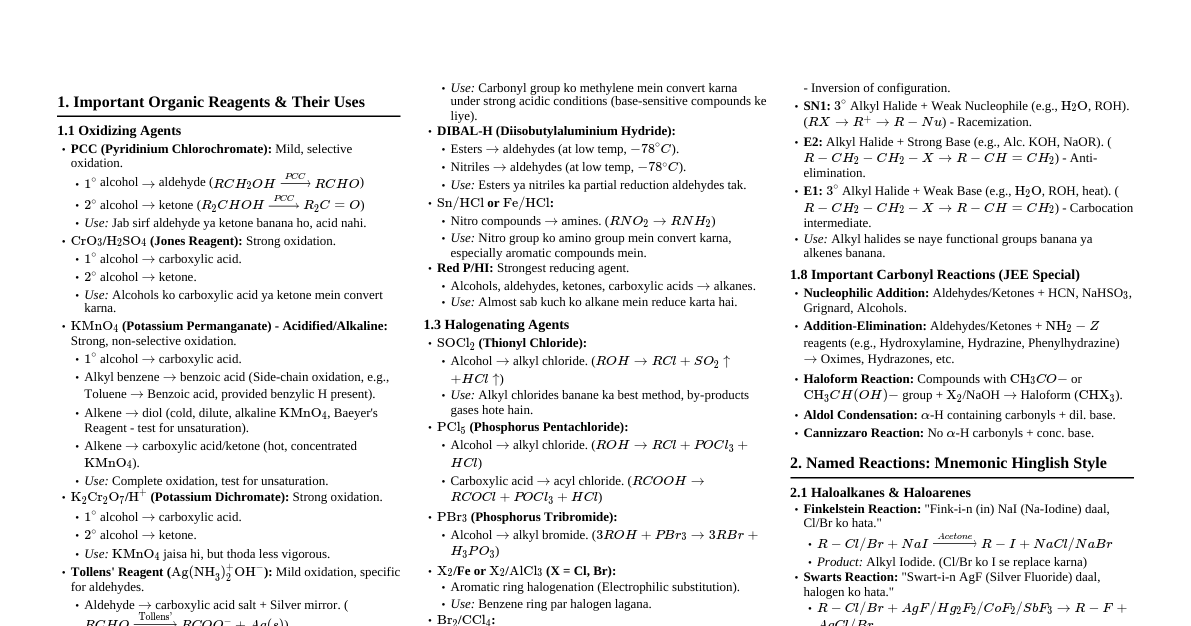
1. General Organic Chemistry (GOC) 1.1 Inductive Effect Permanent polarization of $\sigma$-bond due to electronegativity difference. $+I$ groups: alkyl groups (e.g., $-\text{CH}_3$, $-\text{CH}_2\text{CH}_3$). $-I$ groups: $-\text{NO}_2$, $-\text{CN}$, $-\text{COOH}$, $-\text{F}$, $-\text{Cl}$, $-\text{Br}$, $-\text{I}$. 1.2 Resonance Effect (Mesomeric Effect) Delocalization of $\pi$-electrons or lone pairs. $+R$ groups (electron donating): $-\text{OH}$, $-\text{OR}$, $-\text{NH}_2$, $-\text{NHR}$, $-\text{NR}_2$, $-\text{X}$ (halogens). $-R$ groups (electron withdrawing): $-\text{NO}_2$, $-\text{CN}$, $-\text{CHO}$, $-\text{COR}$, $-\text{COOH}$, $-\text{COOR}$. 1.3 Hyperconjugation (No bond resonance) Delocalization of $\sigma$-electrons of C-H bond of an alkyl group directly attached to an unsaturated system or an atom with an unshared p-orbital. Stability of carbocations: $3^\circ > 2^\circ > 1^\circ$. Stability of alkenes: More substituted alkene is more stable. 1.4 Acidity and Basicity Acidity: Directly proportional to stability of conjugate base. Factors increasing acidity: $-I$, $-R$, increased s-character. $\text{Phenol} > \text{water} > \text{alcohol}$. $\text{Carboxylic acid} > \text{phenol} > \text{alcohol}$. Basicity: Directly proportional to electron density on the donor atom and stability of conjugate acid. Factors increasing basicity: $+I$, $+R$. Aromatic amines are less basic than aliphatic amines due to resonance. 2. Hydrocarbons 2.1 Alkanes Preparation: Wurtz Reaction: $2\text{RX} + 2\text{Na} \xrightarrow{\text{Dry Ether}} \text{R-R} + 2\text{NaX}$. (Cannot be used for odd number C-atoms easily). Kolbe's Electrolysis: $2\text{RCOO}^- \text{Na}^+ \xrightarrow{\text{Electrolysis}} \text{R-R} + 2\text{CO}_2 + 2\text{NaOH} + \text{H}_2$. Hydrogenation of alkenes/alkynes: $\text{R-CH=CH}_2 + \text{H}_2 \xrightarrow{\text{Ni/Pt/Pd}} \text{R-CH}_2\text{CH}_3$. Reduction of alkyl halides: $\text{RX} \xrightarrow{\text{Zn/HCl or LiAlH}_4} \text{RH}$. Reactions: Free Radical Halogenation: $\text{CH}_4 + \text{Cl}_2 \xrightarrow{h\nu} \text{CH}_3\text{Cl} + \text{HCl}$. (Reactivity: $3^\circ > 2^\circ > 1^\circ$). Combustion: $\text{C}_n\text{H}_{2n+2} + (\frac{3n+1}{2})\text{O}_2 \to n\text{CO}_2 + (n+1)\text{H}_2\text{O}$. 2.2 Alkenes Preparation: Dehydrohalogenation of alkyl halides: $\text{R-CH}_2\text{CH}_2\text{X} \xrightarrow{\text{Alc. KOH}} \text{R-CH=CH}_2$. (Saytzeff's rule: more substituted alkene is major). Acid-catalyzed dehydration of alcohols: $\text{R-CH}_2\text{CH}_2\text{OH} \xrightarrow{\text{Conc. H}_2\text{SO}_4, \Delta} \text{R-CH=CH}_2$. (Rearrangements possible). Dehalogenation of vicinal dihalides: $\text{R-CH(X)CH}_2\text{X} \xrightarrow{\text{Zn dust}} \text{R-CH=CH}_2$. Reactions: Electrophilic Addition: (Markovnikov's rule: H adds to $\text{C}$ with more $\text{H}$'s). $\text{HBr/HCl}$: $\text{R-CH=CH}_2 + \text{HBr} \to \text{R-CH(Br)CH}_3$. $\text{HBr/Peroxide}$ (Anti-Markovnikov): $\text{R-CH=CH}_2 + \text{HBr} \xrightarrow{\text{Peroxide}} \text{R-CH}_2\text{CH}_2\text{Br}$. Hydration: $\text{R-CH=CH}_2 + \text{H}_2\text{O} \xrightarrow{\text{H}_2\text{SO}_4} \text{R-CH(OH)CH}_3$. Halogenation: $\text{R-CH=CH}_2 + \text{Br}_2 \xrightarrow{\text{CCl}_4} \text{R-CH(Br)CH}_2\text{Br}$ (anti-addition). Hydroboration-Oxidation: $\text{R-CH=CH}_2 \xrightarrow{\text{1. BH}_3 \text{ in THF; 2. H}_2\text{O}_2, \text{OH}^-} \text{R-CH}_2\text{CH}_2\text{OH}$ (anti-Markovnikov, syn-addition). Oxidation: Baeyer's Reagent ($\text{cold, dilute, alkaline KMnO}_4$): Forms vicinal diols (syn-addition). Hot $\text{KMnO}_4$: Cleavage of double bond, forms carboxylic acids/ketones. Ozonolysis: Reductive: $\text{R-CH=CH-R'} \xrightarrow{\text{1. O}_3\text{; 2. Zn/H}_2\text{O}} \text{RCHO} + \text{R'CHO}$. Oxidative: $\text{R-CH=CH-R'} \xrightarrow{\text{1. O}_3\text{; 2. H}_2\text{O}_2} \text{RCOOH} + \text{R'COOH}$. 2.3 Alkynes Preparation: Dehydrohalogenation of geminal/vicinal dihalides: $\text{R-CH(X)CH}_2\text{X} \xrightarrow{\text{Alc. KOH}} \text{R-C}\equiv\text{CH}$. From calcium carbide: $\text{CaC}_2 + 2\text{H}_2\text{O} \to \text{HC}\equiv\text{CH} + \text{Ca(OH)}_2$. Reactions: Acidity of terminal alkynes: $\text{R-C}\equiv\text{CH} + \text{Na} \to \text{R-C}\equiv\text{C}^-\text{Na}^+ + \frac{1}{2}\text{H}_2$. (Reacts with $\text{NaNH}_2$, Grignard, etc.). Addition Reactions: Hydrogenation: $\text{R-C}\equiv\text{C-R'} \xrightarrow{\text{2H}_2/\text{Ni, Pt, Pd}} \text{R-CH}_2\text{CH}_2\text{R'}$. Lindlar's catalyst ($\text{Pd/CaCO}_3$, quinoline): Forms cis-alkene. Na in liquid $\text{NH}_3$ (Birch reduction): Forms trans-alkene. Hydrohalogenation: $\text{R-C}\equiv\text{CH} + \text{HX} \to \text{R-C(X)=CH}_2 \xrightarrow{\text{HX}} \text{R-C(X)}_2\text{CH}_3$ (Markovnikov). Hydration: $\text{R-C}\equiv\text{CH} + \text{H}_2\text{O} \xrightarrow{\text{HgSO}_4/\text{H}_2\text{SO}_4} [\text{R-C(OH)=CH}_2] \to \text{R-CO-CH}_3$ (Keto-enol tautomerism). Ozonolysis: $\text{R-C}\equiv\text{C-R'} \xrightarrow{\text{1. O}_3\text{; 2. H}_2\text{O}} \text{RCOOH} + \text{R'COOH}$. (Terminal alkyne $\to \text{CO}_2$). 2.4 Aromatic Compounds Aromaticity (Hückel's Rule): Cyclic, planar, fully conjugated, $(4n+2)\pi$ electrons. Electrophilic Aromatic Substitution (EAS): Nitration: $\text{Benzene} \xrightarrow{\text{Conc. HNO}_3/\text{Conc. H}_2\text{SO}_4} \text{Nitrobenzene}$ ($\text{NO}_2^+$ electrophile). Halogenation: $\text{Benzene} \xrightarrow{\text{X}_2/\text{FeX}_3} \text{Halobenzene}$ ($\text{X}^+$ electrophile). Sulfonation: $\text{Benzene} \xrightarrow{\text{Conc. H}_2\text{SO}_4/\text{SO}_3} \text{Benzenesulfonic acid}$ ($\text{SO}_3$ electrophile). Friedel-Crafts Alkylation: $\text{Benzene} \xrightarrow{\text{R-X}/\text{AlCl}_3} \text{Alkylbenzene}$ ($\text{R}^+$ electrophile, rearrangements possible). Friedel-Crafts Acylation: $\text{Benzene} \xrightarrow{\text{R-COCl}/\text{AlCl}_3} \text{Acylbenzene}$ ($\text{R-CO}^+$ electrophile). Directing Groups: Ortho-para directing, activating: $-\text{OH}$, $-\text{OR}$, $-\text{NH}_2$, $-\text{NHR}$, $-\text{NR}_2$, $-\text{CH}_3$, $-\text{R}$. Ortho-para directing, deactivating: $-\text{X}$ (halogens). Meta directing, deactivating: $-\text{NO}_2$, $-\text{CN}$, $-\text{CHO}$, $-\text{COR}$, $-\text{COOH}$, $-\text{COOR}$, $-\text{SO}_3\text{H}$. Side Chain Oxidation: Alkylbenzenes $\xrightarrow{\text{KMnO}_4/\text{H}^+, \Delta} \text{Benzoic acid}$ (requires at least one benzylic H). 3. Alkyl Halides and Aryl Halides 3.1 Alkyl Halides Preparation: From alcohols: $\text{R-OH} \xrightarrow{\text{HX/ZnCl}_2 \text{ (Lucas reagent)}} \text{R-X}$, $\text{R-OH} \xrightarrow{\text{PCl}_5/\text{PCl}_3/\text{SOCl}_2} \text{R-X}$. From alkanes (free radical halogenation). From alkenes (addition of HX). Reactions: Nucleophilic Substitution ($\text{S}_{\text{N}}1$, $\text{S}_{\text{N}}2$): $\text{S}_{\text{N}}1$: $3^\circ > 2^\circ > 1^\circ$. Racemization. Carbocation intermediate. $\text{S}_{\text{N}}2$: $1^\circ > 2^\circ > 3^\circ$. Inversion of configuration (Walden inversion). Concerted mechanism. Elimination (E1, E2): E1: $3^\circ > 2^\circ > 1^\circ$. Carbocation intermediate. Saytzeff product. E2: $3^\circ > 2^\circ > 1^\circ$. Concerted. Anti-periplanar geometry required. Saytzeff product. Reaction with metals: $\text{R-X} + \text{Mg} \xrightarrow{\text{Dry Ether}} \text{RMgX}$ (Grignard reagent). Wurtz Reaction. 3.2 Aryl Halides Less reactive towards nucleophilic substitution due to $sp^2$ hybridized carbon and resonance stabilization. Can undergo Nucleophilic Aromatic Substitution under harsh conditions (high T, P) or with strong electron-withdrawing groups (e.g., $-\text{NO}_2$) ortho/para to halogen. Preparation: Halogenation of benzene (EAS). 4. Alcohols, Phenols, Ethers 4.1 Alcohols Preparation: From alkyl halides (aq. KOH). From alkenes (hydration, hydroboration-oxidation). Reduction of aldehydes/ketones: $\text{RCHO}/\text{RCOR'} \xrightarrow{\text{LiAlH}_4/\text{NaBH}_4} \text{RCH}_2\text{OH}/\text{RCH(OH)R'}$. Grignard reaction: $\text{HCHO} + \text{RMgX} \to 1^\circ \text{ alcohol}$. $\text{R'CHO} + \text{RMgX} \to 2^\circ \text{ alcohol}$. $\text{R'COR''} + \text{RMgX} \to 3^\circ \text{ alcohol}$. Reactions: Acidity: $\text{MeOH} > 1^\circ > 2^\circ > 3^\circ$. (Electron-donating groups decrease acidity). Esterification: $\text{R-OH} + \text{R'-COOH} \xrightarrow{\text{H}^+} \text{R'-COOR} + \text{H}_2\text{O}$. Oxidation: $1^\circ \text{ alcohol} \xrightarrow{\text{PCC}} \text{Aldehyde}$. $1^\circ \text{ alcohol} \xrightarrow{\text{KMnO}_4/\text{CrO}_3} \text{Carboxylic acid}$. $2^\circ \text{ alcohol} \xrightarrow{\text{CrO}_3/\text{PCC}} \text{Ketone}$. $3^\circ \text{ alcohols}$ are resistant to oxidation. Dehydration (to alkenes/ethers). 4.2 Phenols Preparation: From haloarenes (Dow's process: $\text{Chlorobenzene} \xrightarrow{\text{NaOH, 623K, 300atm}} \text{Phenol}$). From diazonium salts: $\text{Ar-N}_2^+\text{Cl}^- \xrightarrow{\text{H}_2\text{O}, \Delta} \text{Ar-OH}$. From cumene: $\text{Cumene} \xrightarrow{\text{1. O}_2\text{; 2. H}^+} \text{Phenol} + \text{Acetone}$. Reactions: Acidity: More acidic than alcohols due to resonance stabilization of phenoxide ion. Electron-withdrawing groups (e.g., $-\text{NO}_2$) increase acidity. Electron-donating groups decrease acidity. Electrophilic Aromatic Substitution (strongly activating, ortho-para directing): Nitration: $\text{Phenol} \xrightarrow{\text{Dil. HNO}_3} \text{o-/p-Nitrophenol}$. Bromination: $\text{Phenol} \xrightarrow{\text{Br}_2/\text{H}_2\text{O}} \text{2,4,6-Tribromophenol}$ (white ppt). Kolbe's Reaction: $\text{Phenol} \xrightarrow{\text{1. NaOH; 2. CO}_2; \text{3. H}^+} \text{Salicylic acid}$. Reimer-Tiemann Reaction: $\text{Phenol} \xrightarrow{\text{CHCl}_3/\text{NaOH}} \text{Salicylaldehyde}$. Reaction with $\text{Zn}$ dust: $\text{Phenol} \xrightarrow{\text{Zn dust}, \Delta} \text{Benzene}$. 4.3 Ethers Preparation: Williamson Synthesis: $\text{R-X} + \text{R'-O}^-\text{Na}^+ \to \text{R-O-R'} + \text{NaX}$. (Best for $1^\circ$ alkyl halides). Dehydration of alcohols: $2\text{R-OH} \xrightarrow{\text{Conc. H}_2\text{SO}_4, 140^\circ\text{C}} \text{R-O-R}$. (Symmetric ethers, $1^\circ$ alcohols). Reactions: Cleavage with $\text{HI/HBr}$: $\text{R-O-R'} + \text{HI} \to \text{R-OH} + \text{R'-I}$. (If one R is $3^\circ$, then $3^\circ$ R forms iodide). Peroxide formation: Ethers form explosive peroxides on exposure to air. 5. Aldehydes and Ketones 5.1 Preparation Oxidation of alcohols. Ozonolysis of alkenes. From nitriles: $\text{R-CN} \xrightarrow{\text{1. DIBAL-H; 2. H}_2\text{O}} \text{RCHO}$ (Stephen reaction: $\text{R-CN} \xrightarrow{\text{SnCl}_2/\text{HCl}} \text{RCHO}$). Friedel-Crafts acylation (for ketones). Etard reaction: $\text{Toluene} \xrightarrow{\text{CrO}_2\text{Cl}_2} \text{Benzaldehyde}$. Gattermann-Koch reaction: $\text{Benzene} \xrightarrow{\text{CO/HCl, Anhyd. AlCl}_3/\text{CuCl}} \text{Benzaldehyde}$. 5.2 Reactions Nucleophilic Addition: (Aldehydes are more reactive than ketones). Addition of $\text{HCN}$: $\text{RCHO} \to \text{Cyanohydrin}$. Addition of $\text{NaHSO}_3$: Bisulfite adduct. Addition of Grignard reagent (forms alcohols). Addition of alcohol: $\text{RCHO} + \text{R'OH} \xrightarrow{\text{H}^+} \text{Hemiacetal} \xrightarrow{\text{R'OH}} \text{Acetal}$. Addition of ammonia derivatives ($\text{NH}_2\text{Z}$): Forms imines, oximes, hydrazones, 2,4-DNP derivatives. Reduction: To alcohols ($\text{LiAlH}_4$, $\text{NaBH}_4$). Clemmensen Reduction: $\text{RCHO}/\text{RCOR'} \xrightarrow{\text{Zn-Hg/Conc. HCl}} \text{RCH}_3/\text{RCH}_2\text{R'}$. Wolff-Kishner Reduction: $\text{RCHO}/\text{RCOR'} \xrightarrow{\text{NH}_2\text{NH}_2/\text{KOH, Glycol, Heat}} \text{RCH}_3/\text{RCH}_2\text{R'}$. Oxidation: Aldehydes oxidize to carboxylic acids easily. Ketones are resistant. Tollens' Reagent ($\text{Ag(NH}_3)_2^+$): Aldehyde $\to$ Carboxylate + Ag mirror. Fehling's Solution ($\text{Cu}^{2+}$): Aldehyde $\to$ Carboxylate + $\text{Cu}_2\text{O}$ red ppt. Haloform Reaction: $\text{CH}_3\text{CO-}$ group or $\text{CH}_3\text{CH(OH)-}$ group $\xrightarrow{\text{X}_2/\text{NaOH}} \text{CHX}_3$ (haloform) + $\text{RCOO}^-\text{Na}^+$. Reactions involving $\alpha$-Hydrogen: Aldol Condensation: Aldehydes/ketones with $\alpha$-H $\xrightarrow{\text{Dil. NaOH}} \beta$-hydroxy aldehyde/ketone $\xrightarrow{\Delta} \alpha,\beta$-unsaturated aldehyde/ketone. Cross Aldol Condensation: Between two different aldehydes/ketones. Cannizzaro Reaction: Aldehydes without $\alpha$-H ($\text{HCHO, PhCHO}$) $\xrightarrow{\text{Conc. NaOH}} \text{Alcohol} + \text{Carboxylate}$. Perkin Reaction: Aromatic aldehyde + acetic anhydride + $\text{CH}_3\text{COONa} \to \alpha,\beta$-unsaturated acid. 6. Carboxylic Acids and Derivatives 6.1 Carboxylic Acids Preparation: Oxidation of $1^\circ$ alcohols/aldehydes. From nitriles: $\text{R-CN} \xrightarrow{\text{H}_3\text{O}^+/\Delta} \text{RCOOH}$. Grignard reagent with $\text{CO}_2$: $\text{RMgX} + \text{CO}_2 \to \text{RCOOMgX} \xrightarrow{\text{H}_3\text{O}^+} \text{RCOOH}$. Hydrolysis of esters/amides/acid halides/anhydrides. Reactions: Acidity: Stronger than phenols/alcohols. Electron-withdrawing groups increase acidity. Formation of derivatives: $\text{Acid chloride}$: $\text{RCOOH} \xrightarrow{\text{SOCl}_2/\text{PCl}_5/\text{PCl}_3} \text{RCOCl}$. $\text{Anhydride}$: $2\text{RCOOH} \xrightarrow{\text{P}_2\text{O}_5/\Delta} \text{(RCO)}_2\text{O}$. $\text{Ester}$: $\text{RCOOH} + \text{R'OH} \xrightarrow{\text{H}^+} \text{RCOOR'}$. $\text{Amide}$: $\text{RCOOH} \xrightarrow{\text{NH}_3/\Delta} \text{RCOONH}_4 \xrightarrow{\Delta} \text{RCONH}_2$. Reduction: $\text{RCOOH} \xrightarrow{\text{LiAlH}_4} \text{RCH}_2\text{OH}$. Hell-Volhard-Zelinsky (HVZ) Reaction: $\text{R-CH}_2\text{COOH} \xrightarrow{\text{X}_2/\text{Red P}} \text{R-CH(X)COOH}$. 6.2 Acid Derivatives Reactivity towards Nucleophilic Acyl Substitution: $\text{Acid Chloride} > \text{Anhydride} > \text{Ester} > \text{Amide}$. Esters: Hydrolysis (acid/base catalyzed). Transesterification. Claisen Condensation: Esters with $\alpha$-H $\xrightarrow{\text{NaOEt}} \beta$-keto ester. Amides: Hydrolysis to carboxylic acid. Hofmann Bromamide Degradation: $\text{RCONH}_2 \xrightarrow{\text{Br}_2/\text{NaOH}} \text{RNH}_2$ (one C less). 7. Amines 7.1 Preparation Reduction of nitro compounds: $\text{R-NO}_2 \xrightarrow{\text{Sn/HCl or Fe/HCl or H}_2/\text{Pd}} \text{R-NH}_2$. Reduction of nitriles: $\text{R-CN} \xrightarrow{\text{LiAlH}_4} \text{RCH}_2\text{NH}_2$. Reduction of amides: $\text{RCONH}_2 \xrightarrow{\text{LiAlH}_4} \text{RCH}_2\text{NH}_2$. Gabriel Phthalimide Synthesis: For $1^\circ$ amines only. $\text{Phthalimide} \xrightarrow{\text{KOH}} \text{Potassium phthalimide} \xrightarrow{\text{R-X}} \text{N-alkyl phthalimide} \xrightarrow{\text{H}_2\text{O}/\text{H}^+ \text{ or N}_2\text{H}_4} \text{RNH}_2$. Hofmann Bromamide Degradation. Ammonolysis of alkyl halides: $\text{R-X} \xrightarrow{\text{NH}_3} \text{RNH}_2 \xrightarrow{\text{R-X}} \text{R}_2\text{NH} \xrightarrow{\text{R-X}} \text{R}_3\text{N} \xrightarrow{\text{R-X}} \text{R}_4\text{N}^+\text{X}^-$. 7.2 Reactions Basicity: Aliphatic amines are more basic than $\text{NH}_3$. Aromatic amines are less basic than $\text{NH}_3$ due to resonance. Gas phase: $3^\circ > 2^\circ > 1^\circ > \text{NH}_3$. Aqueous phase: $2^\circ > 1^\circ > 3^\circ > \text{NH}_3$ (for $\text{CH}_3$ groups); $2^\circ > 3^\circ > 1^\circ > \text{NH}_3$ (for $\text{C}_2\text{H}_5$ groups). Acylation: $\text{RNH}_2 + \text{R'-COCl} \to \text{RNHCOR'}$. Carbylamine Reaction: $1^\circ \text{ amine} \xrightarrow{\text{CHCl}_3/\text{KOH}} \text{Isocyanide (foul smell)}$. Reaction with Nitrous Acid ($\text{NaNO}_2/\text{HCl}$): $1^\circ \text{ Aliphatic amine} \to \text{Diazonium salt} \to \text{Alcohol} + \text{N}_2$. $1^\circ \text{ Aromatic amine} \to \text{Diazonium salt}$ (stable below $5^\circ\text{C}$). $2^\circ \text{ Amine} \to \text{N-nitrosoamine}$ (yellow oily liquid). $3^\circ \text{ Amine} \to \text{No reaction}$ (aliphatic); $\text{p-nitrosoaniline}$ (aromatic). Hinsberg Test: Distinction of $1^\circ, 2^\circ, 3^\circ$ amines using benzenesulfonyl chloride. $1^\circ \text{ amine}$: Forms sulfonamide soluble in $\text{KOH}$. $2^\circ \text{ amine}$: Forms sulfonamide insoluble in $\text{KOH}$. $3^\circ \text{ amine}$: No reaction. 7.3 Diazonium Salts (Aromatic) Preparation: Aniline $\xrightarrow{\text{NaNO}_2/\text{HCl}, 0-5^\circ\text{C}} \text{Benzene diazonium chloride}$. Reactions: Sandmeyer Reaction: $\text{Ar-N}_2^+\text{Cl}^- \xrightarrow{\text{CuX/HX}} \text{Ar-X}$. ($\text{CuCN/KCN} \to \text{Ar-CN}$). Gattermann Reaction: $\text{Ar-N}_2^+\text{Cl}^- \xrightarrow{\text{Cu powder/HX}} \text{Ar-X}$. Replacement by Iodine: $\text{Ar-N}_2^+\text{Cl}^- \xrightarrow{\text{KI}} \text{Ar-I}$. Replacement by Fluorine (Balz-Schiemann): $\text{Ar-N}_2^+\text{Cl}^- \xrightarrow{\text{HBF}_4} \text{Ar-F}$. Replacement by H: $\text{Ar-N}_2^+\text{Cl}^- \xrightarrow{\text{H}_3\text{PO}_2 \text{ or EtOH}} \text{Ar-H}$. Coupling Reactions: $\text{Ar-N}_2^+\text{Cl}^- \xrightarrow{\text{Phenol/Aniline}} \text{Azo dyes}$. 8. Biomolecules (Brief Overview) 8.1 Carbohydrates Monosaccharides (glucose, fructose), Disaccharides (sucrose, lactose, maltose), Polysaccharides (starch, cellulose, glycogen). Reducing sugars: All monosaccharides, maltose, lactose (contain free aldehyde/ketone group or hemiacetal form). Sucrose is non-reducing. Tests: Fehling's, Tollens', Benedict's. 8.2 Amino Acids and Proteins Amino acids: Amphoteric, zwitterionic form. Peptide bond formation. Proteins: Primary, secondary, tertiary, quaternary structures. Denaturation. 8.3 DNA and RNA Nucleotides (sugar, base, phosphate). Bases: A, T, C, G (DNA); A, U, C, G (RNA). Double helix structure of DNA. 9. Polymers Addition polymerization: Polyethylene, polypropylene, PVC, Teflon. Condensation polymerization: Nylon 6,6, Nylon 6, Dacron, Bakelite. Natural rubber, synthetic rubber (Buna-S, Buna-N). 10. Chemistry in Everyday Life Drugs: Analgesics, antipyretics, antibiotics, antiseptics, disinfectants. Food additives: Preservatives, artificial sweeteners, antioxidants. Soaps and detergents.