GOC for JEE Mains
Cheatsheet Content
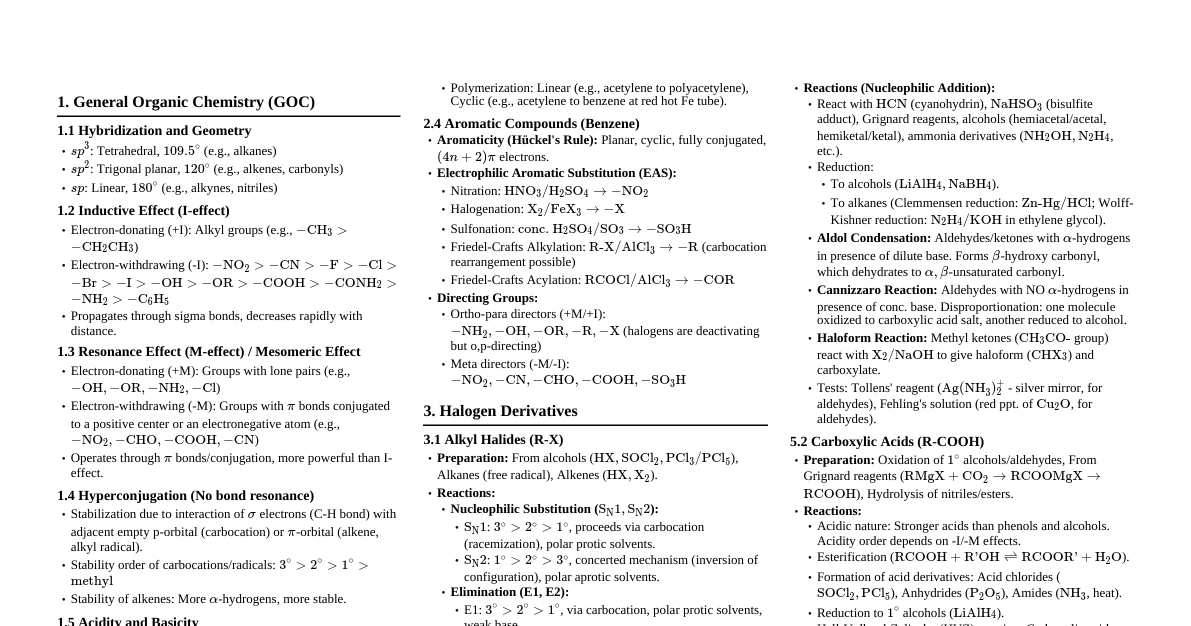
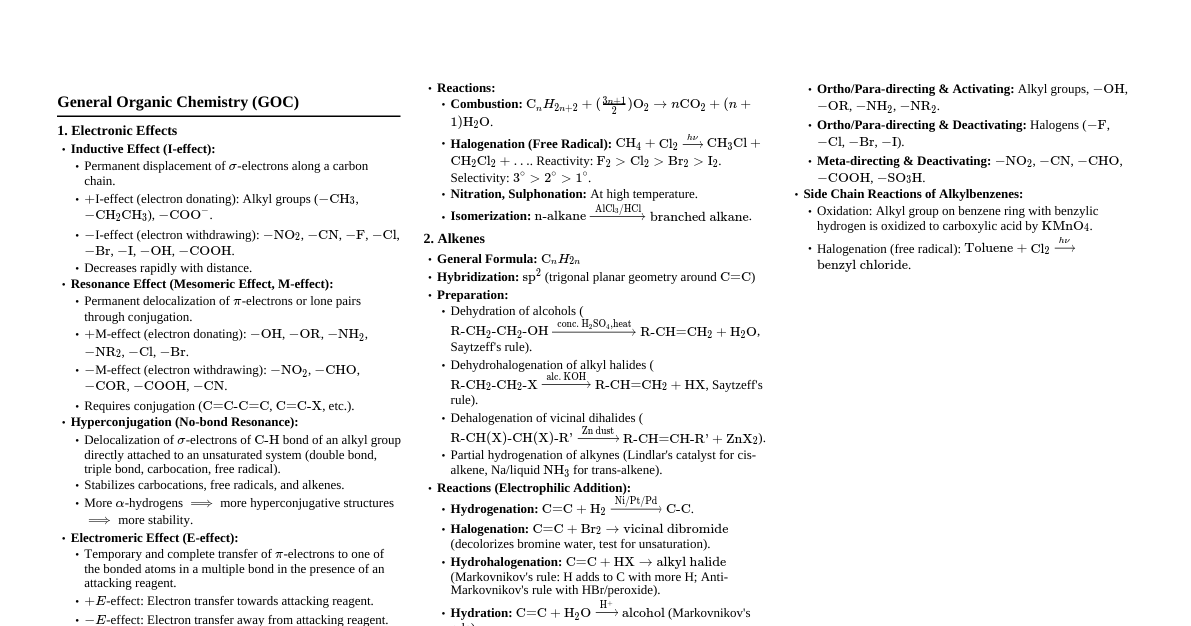
1. Inductive Effect (I-effect) Definition: Permanent displacement of $\sigma$-electrons along a saturated carbon chain due to difference in electronegativity. Types: +I Effect (Electron Donating): Alkyl groups, $-\text{CH}_3$, $-\text{CH}_2\text{CH}_3$, $-\text{C}(\text{CH}_3)_3$, $-\text{COO}^-$. Increases electron density. -I Effect (Electron Withdrawing): Halogens ($-\text{F} > -\text{Cl} > -\text{Br} > -\text{I}$), $-\text{NO}_2$, $-\text{CN}$, $-\text{COOH}$, $-\text{CHO}$, $-\text{COR}$. Decreases electron density. Distance Dependent: Effect decreases rapidly with distance ($1/r^3$). Significant up to 3-4 carbon atoms. Applications: Stability of Carbocations: $3^\circ > 2^\circ > 1^\circ > \text{methyl}$ (due to +I effect of alkyl groups). Stability of Carbanions: $\text{methyl} > 1^\circ > 2^\circ > 3^\circ$ (due to -I effect stabilizing negative charge, +I destabilizing). Acidity of Carboxylic Acids: Electron-withdrawing groups (-I) increase acidity (stabilize conjugate base). Ex: $\text{FCH}_2\text{COOH} > \text{ClCH}_2\text{COOH}$. Electron-donating groups (+I) decrease acidity (destabilize conjugate base). Ex: $\text{CH}_3\text{COOH} Basicity of Amines: Electron-donating groups (+I) increase basicity (increase electron density on N, making lone pair more available). Ex: $2^\circ > 3^\circ > 1^\circ > \text{NH}_3$ (in gaseous phase). Solvent effects alter this order in aqueous solution. Electron-withdrawing groups (-I) decrease basicity. 2. Resonance Effect (Mesomeric Effect, M-effect) Definition: Delocalization of $\pi$-electrons or lone pair of electrons in a conjugated system. Involves movement of electrons, not atoms. Conditions: Presence of conjugation (alternating single and double bonds, or a double bond adjacent to a lone pair/empty orbital). Resonance Structures: Hypothetical structures that contribute to the actual structure (resonance hybrid). Hybrid is more stable. Types: +M Effect (Electron Donating): Groups that donate electrons to the conjugated system. Ex: $-\text{OH}$, $-\text{OR}$, $-\text{NH}_2$, $-\text{NR}_2$, $-\text{X}$ (halogens, though they also have strong -I). Increases electron density at ortho and para positions in benzene ring. -M Effect (Electron Withdrawing): Groups that withdraw electrons from the conjugated system. Ex: $-\text{NO}_2$, $-\text{CN}$, $-\text{COOH}$, $-\text{CHO}$, $-\text{COR}$. Decreases electron density at ortho and para positions in benzene ring. Rules for Drawing Resonance Structures: Same number of paired and unpaired electrons. Same positions of nuclei. More covalent bonds = more stable. Fewer charge separations = more stable. Negative charge on more electronegative atom = more stable. Positive charge on less electronegative atom = more stable. Applications: Stability: Benzene > Cyclohexene. Allylic/Benzylic carbocations are more stable than simple alkyl carbocations. Acidity: Phenol is acidic due to resonance stabilization of phenoxide ion. Carboxylic acids are more acidic than alcohols. Basicity: Aniline is less basic than aliphatic amines due to delocalization of lone pair into benzene ring. Reactivity in Electrophilic Aromatic Substitution: +M groups are activating and ortho/para directing. -M groups are deactivating and meta directing (except halogens, which are deactivating but ortho/para directing). Difference from Inductive Effect: Resonance is stronger and involves $\pi$-electrons/lone pairs; Inductive is weaker and involves $\sigma$-electrons. 3. Hyperconjugation (No Bond Resonance) Definition: Delocalization of $\sigma$-electrons of a $\text{C}-\text{H}$ bond of an alkyl group directly attached to an unsaturated system (e.g., alkene, carbocation, free radical). Conditions: Presence of $\alpha$-hydrogens (hydrogens on carbon adjacent to the unsaturated system). Mechanism: $\sigma$-electrons of the $\text{C}-\text{H}$ bond overlap with the adjacent empty p-orbital (carbocation) or $\pi$-orbital (alkene). Stability: More $\alpha$-hydrogens $\implies$ more hyperconjugation $\implies$ more stable. Applications: Stability of Carbocations: $3^\circ > 2^\circ > 1^\circ > \text{methyl}$. (e.g., $\text{CH}_3-\text{CH}_2^+$ has 3 $\alpha$-H, $\text{CH}_3-\text{CH}^+-\text{CH}_3$ has 6 $\alpha$-H). Stability of Alkenes: More substituted alkenes are more stable. (e.g., $\text{R}_2\text{C}=\text{CR}_2$ has highest stability). Order of stability: $\text{R}_2\text{C}=\text{CR}_2 > \text{R}_2\text{C}=\text{CHR} > \text{RCH}=\text{CHR} (\text{trans} > \text{cis}) > \text{RCH}=\text{CH}_2$. Stability of Alkyl Free Radicals: $3^\circ > 2^\circ > 1^\circ > \text{methyl}$. Directing Nature of Alkyl Groups: Alkyl groups are ortho/para directing in electrophilic aromatic substitution due to hyperconjugation (and +I effect). 4. Aromaticity (Hückel's Rule) Conditions for Aromaticity: Cyclic structure. Planar structure (all atoms in the ring lie in the same plane). Complete conjugation (p-orbitals on all atoms in the ring). $(4n+2)\pi$ electrons, where $n = 0, 1, 2, 3...$ (Hückel's Rule). Anti-aromatic Compounds: Cyclic structure. Planar structure. Complete conjugation. $4n\pi$ electrons. Are highly unstable. Non-aromatic Compounds: Do not meet one or more of the first three conditions (e.g., non-planar, incomplete conjugation). Examples: Aromatic: Benzene (6$\pi$), Naphthalene (10$\pi$), Pyridine (6$\pi$), Furan (6$\pi$), Pyrrole (6$\pi$), Thiophene (6$\pi$). Anti-aromatic: Cyclobutadiene (4$\pi$), Cyclooctatetraene (8$\pi$, but non-planar). Non-aromatic: Cyclohexatriene (hypothetical), Cyclopentadiene (not fully conjugated due to $\text{CH}_2$ group). Stability Order: Aromatic $\gg$ Non-aromatic $>$ Anti-aromatic. 5. Acidity and Basicity Acidity: Ability to donate a proton ($\text{H}^+$). Factors Increasing Acidity: Electron-withdrawing groups (-I, -M) stabilize the conjugate base. Resonance stabilization of conjugate base. Higher electronegativity of atom bearing the negative charge in conjugate base. hybridization (more s-character, more electronegative). Order: $\text{sp} > \text{sp}^2 > \text{sp}^3$. Order of Acidity: $\text{RCOOH} > \text{H}_2\text{O} > \text{ROH} > \text{RC}\equiv\text{CH} > \text{NH}_3 > \text{RCH}=\text{CH}_2 > \text{RCH}_2\text{CH}_3$. Phenols vs. Alcohols: Phenols are more acidic due to resonance stabilization of phenoxide ion. Basicity: Ability to accept a proton ($\text{H}^+$) or donate a lone pair of electrons. Factors Increasing Basicity: Electron-donating groups (+I, +M) increase electron density on the basic atom. Availability of lone pair of electrons (not involved in resonance). Order of Basicity (Gaseous Phase Amines): $3^\circ > 2^\circ > 1^\circ > \text{NH}_3$. Order of Basicity (Aqueous Phase Amines): Alkyl groups are $\text{CH}_3$: $2^\circ > 1^\circ > 3^\circ > \text{NH}_3$. Alkyl groups are $\text{C}_2\text{H}_5$: $2^\circ > 3^\circ > 1^\circ > \text{NH}_3$. (Due to combined effect of +I, solvation, and steric hindrance). Aniline vs. Aliphatic Amines: Aniline is less basic due to resonance delocalization of lone pair. 6. Tautomerism Definition: A special type of structural isomerism where isomers exist in dynamic equilibrium, interconverting rapidly. Involves migration of a proton and a $\pi$-bond. Keto-Enol Tautomerism: Most common type. Keto Form: Contains a ketone ($\text{C}=\text{O}$) group. Enol Form: Contains an 'ene' (alkene) and an 'ol' (alcohol) group ($\text{C}=\text{C}-\text{OH}$). Conditions: Presence of an $\alpha$-hydrogen to a carbonyl group. Stability: Keto form is usually more stable than enol form, except in cases of: Aromaticity of the enol form (e.g., phenol). Intramolecular H-bonding in the enol form (e.g., acetylacetone). Extensive conjugation in the enol form. Other Types: Nitro-aci nitro, imine-enamine, lactam-lactim. 7. Reaction Intermediates Carbocation: $\text{sp}^2$ hybridized carbon with an empty p-orbital. Electron deficient (sextet), electrophilic. Stability: Resonance $\gg$ Hyperconjugation $\gg$ Inductive (+I). $3^\circ > 2^\circ > 1^\circ > \text{methyl}$. Rearrangements (hydride/alkyl shifts) occur to form more stable carbocations. Carbanion: $\text{sp}^3$ hybridized carbon with a lone pair of electrons. Electron rich, nucleophilic. Stability: Resonance $\gg$ Inductive (-I). $\text{methyl} > 1^\circ > 2^\circ > 3^\circ$. Free Radical: $\text{sp}^2$ hybridized carbon with an unpaired electron in a p-orbital. Paramagnetic. Stability: Resonance $\gg$ Hyperconjugation. $3^\circ > 2^\circ > 1^\circ > \text{methyl}$.