Electrostatics - Ch 1
Shared 5/12/2026•0 views
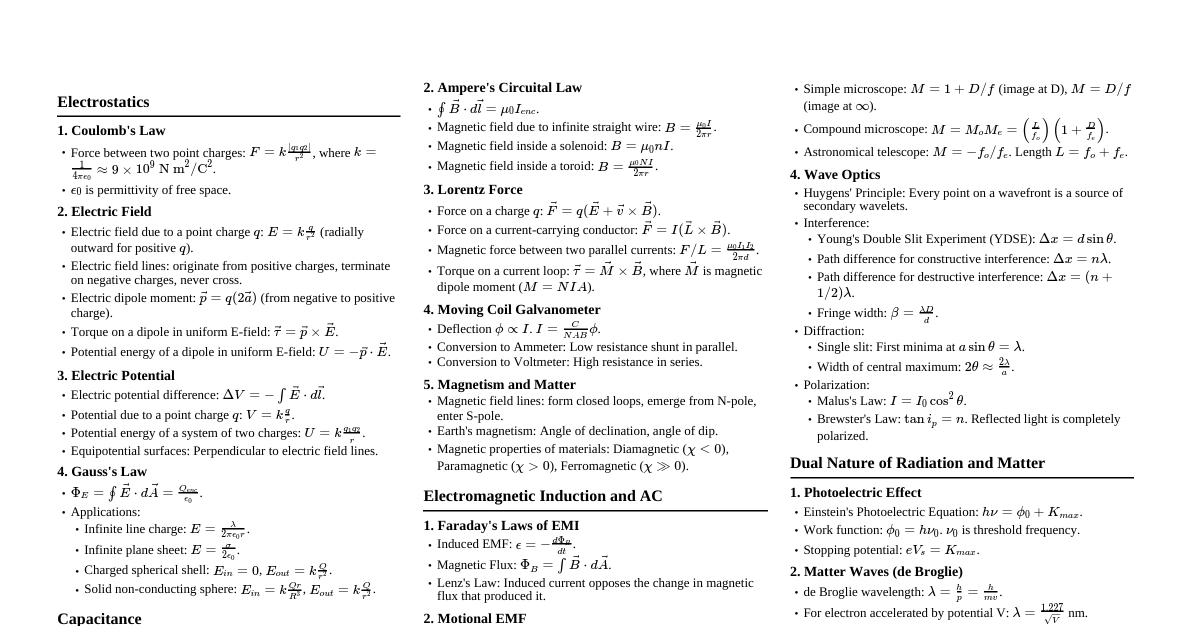
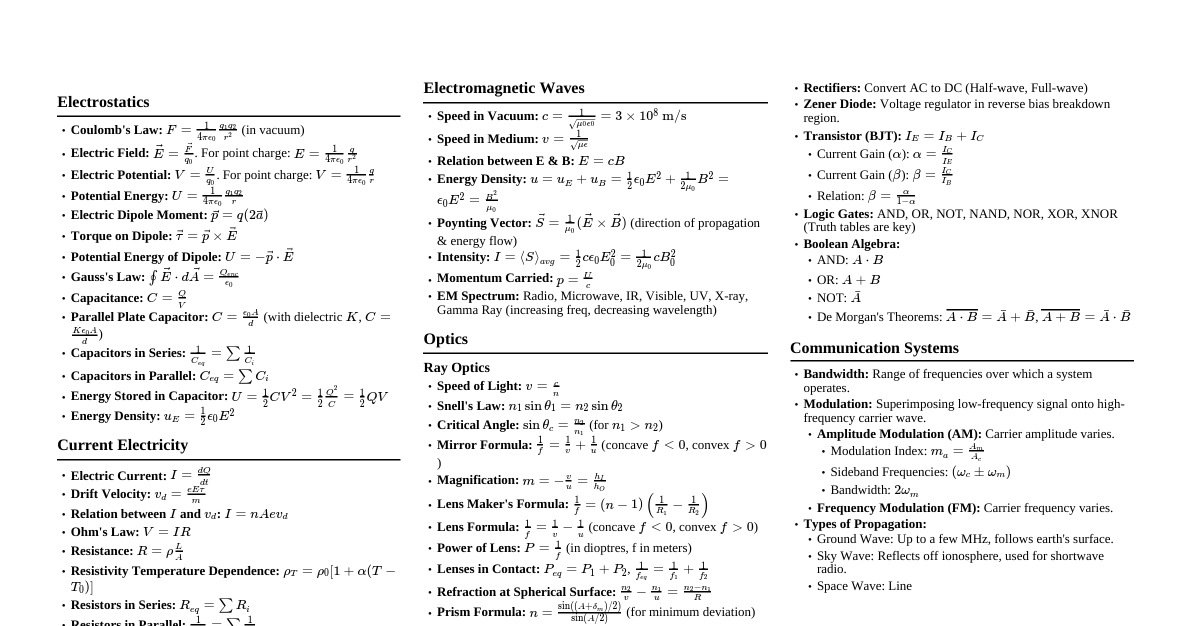
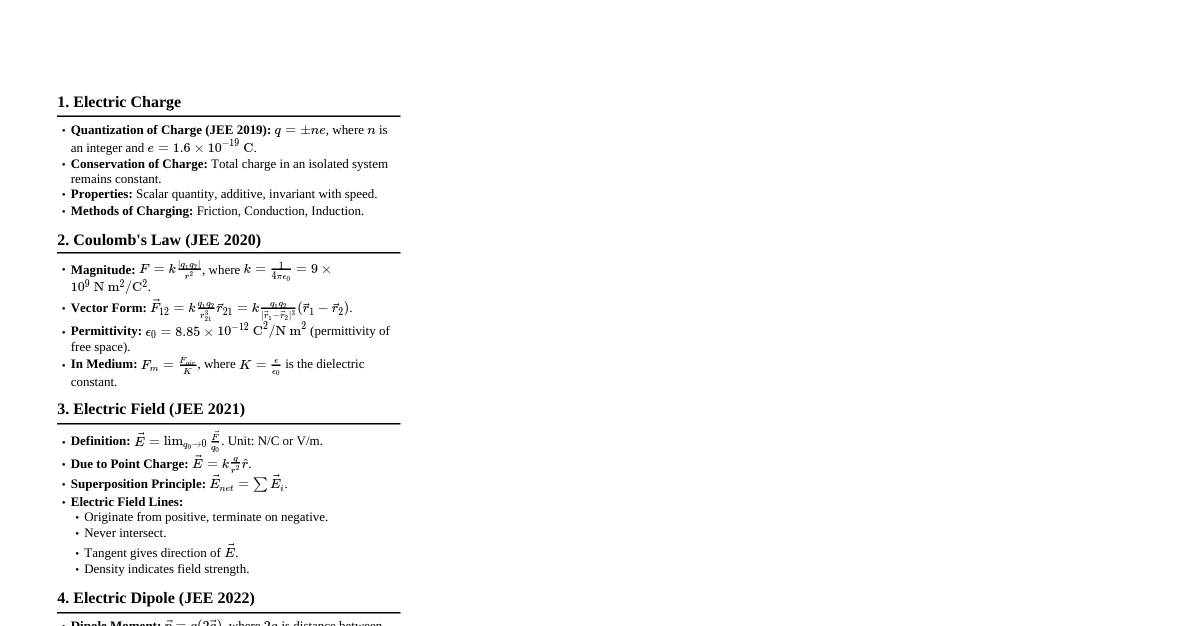
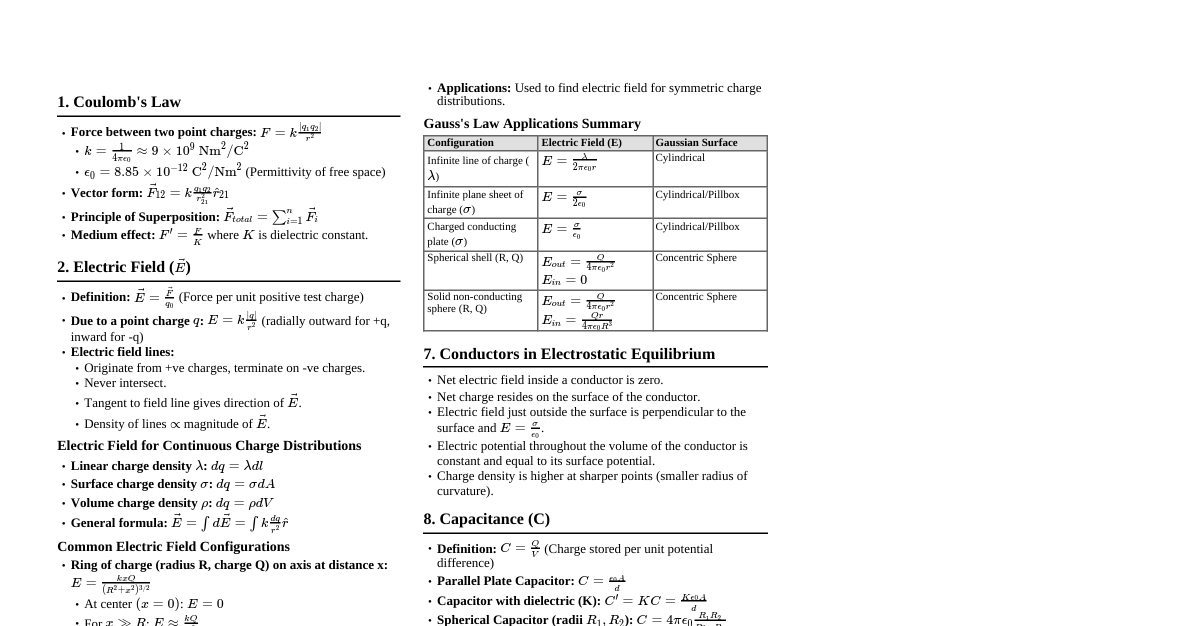
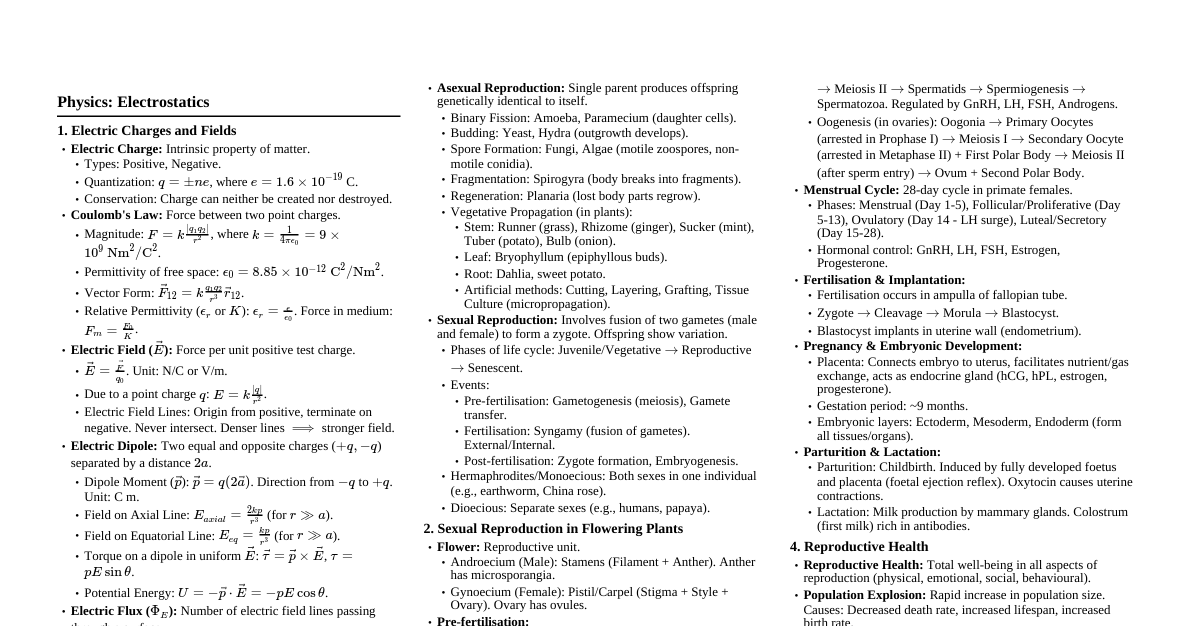
### Introduction to Electrostatics - **Electricity:** Property of rubbed substances to attract light objects. - **Frictional/Static Electricity:** Electricity developed by rubbing or friction. - **Electrified/Electrically Charged:** Substances showing attraction due to rubbing. - **Electric Charge:** Intrinsic property of elementary particles causing electric force. - **Scalar Quantity:** Electric charge is a scalar. - **SI Unit:** Coulomb (C). - **Proton Charge:** $+e$ - **Electron Charge:** $-e$ - **Elementary Charge `e`:** $1.6 \times 10^{-19}$ C ### Charging By Friction When two substances are rubbed together, the one occurring earlier in the triboelectric series acquires a positive charge, and the one later acquires a negative charge. **Triboelectric Series:** 1. Fur 2. Flannel 3. Sealing wax 4. Glass 5. Cotton 6. Paper 7. Silk 8. Human body 9. Wood 10. Metals 11. Rubber 12. Resin 13. Amber 14. Sulphur 15. Ebonite ### Charging By Induction - **Electrostatic Induction:** Phenomenon of temporary electrification of a conductor where opposite charges appear at the closer end and similar charges at the farther end in the presence of a nearby charged body. - **Induced Charges:** Positive and negative charges produced at the ends of the conducting rod. - **Inducing Charge:** The charge on the body (e.g., glass rod) that causes induction. **Basic Properties of Electric Charge:** 1. **Additivity:** Total charge is the algebraic sum of individual charges. 2. **Quantization:** Charge exists in discrete packets, $q = ne$, where $n$ is an integer. 3. **Conservation:** Charge can neither be created nor destroyed. ### Coulomb's Law Coulomb's law states that the force of attraction or repulsion between two stationary point charges $q_1$ and $q_2$ separated by distance $r$: 1. Is directly proportional to the product of their magnitudes: $F \propto q_1 q_2$ 2. Is inversely proportional to the square of the distance between them: $F \propto \frac{1}{r^2}$ 3. Acts along the line joining the two charges. **Mathematical Form:** $$F = k \frac{q_1 q_2}{r^2}$$ Where $k$ is the electrostatic force constant. **In Free Space (SI Units):** $$k = \frac{1}{4 \pi \epsilon_0} = 9 \times 10^9 \text{ Nm}^2 \text{C}^{-2}$$ - $\epsilon_0$ is the permittivity of free space. **Units of Charge:** - **SI Unit:** Coulomb (C). - 1 Coulomb is the amount of charge that repels an equal and similar charge with a force of $9 \times 10^9$ N when placed 1 meter apart in vacuum. - **CGS Unit:** Electrostatic unit of charge (e.s.u. of charge) or statcoulomb (stat C). - 1 e.s.u. of charge repels an identical charge in vacuum at 1 cm with a force of 1 dyne. - **Conversion:** $1 \text{ coulomb} = 3 \times 10^9 \text{ statcoulomb}$ #### Coulomb's Law in Vector Form For two point charges $q_1$ and $q_2$ separated by distance $r$: - Force on charge $q_2$ due to $q_1$: $\vec{F}_{21} = \frac{1}{4 \pi \epsilon_0} \frac{q_1 q_2}{r^2} \hat{r}_{12}$ - $\hat{r}_{12}$ is a unit vector from $q_1$ to $q_2$. - Force on charge $q_1$ due to $q_2$: $\vec{F}_{12} = \frac{1}{4 \pi \epsilon_0} \frac{q_1 q_2}{r^2} \hat{r}_{21}$ - $\hat{r}_{21}$ is a unit vector from $q_2$ to $q_1$. **Important Information from Vector Form:** 1. **Newton's Third Law:** $\vec{F}_{21} = -\vec{F}_{12}$, meaning forces are equal and opposite. 2. **Central Forces:** Coulombian forces act along the line joining the centers of the two charges. - If $q_1 q_2 > 0$ (like charges), forces are repulsive. - If $q_1 q_2 ### Permittivity - **Definition:** Property of a medium that determines the electric force between charges. - The force between charges is affected by the medium. For example, in water, the force is about 1/80th of that in air. - **Relative Permittivity ($\epsilon_r$) or Dielectric Constant ($\kappa$):** - Ratio of the permittivity ($\epsilon$) of the medium to the permittivity ($\epsilon_0$) of free space. $$\epsilon_r = \kappa = \frac{\epsilon}{\epsilon_0} = \frac{F_{vac}}{F_{med}}$$ - It can also be defined as the ratio of the force between two charges in free space to the force between the same charges when placed in the given medium. ### Superposition Principle - **Statement:** When multiple charges interact, the total force on any given charge is the vector sum of the forces exerted on it by all other individual charges. - The force between any two charges is not affected by the presence of other charges. ### Electric Field - **Definition:** Region around a charged body where a force of electrical origin is exerted on another stationary charged body. - **Electric Field Intensity ($\vec{E}$):** Force experienced by a unit positive test charge ($q_0$) placed at that point, without disturbing the source charge. $$\vec{E} = \frac{\vec{F}}{q_0}$$ **Units and Dimensions of Electric Field:** - **SI Unit:** Newton per Coulomb (NC$^{-1}$) or Volt per meter (Vm$^{-1}$). - **Dimensions:** $$[E] = \frac{\text{Force}}{\text{Charge}} = \frac{\text{MLT}^{-2}}{\text{A T}} = [\text{MLT}^{-3}\text{A}^{-1}]$$ - Charge conversion: $1 \text{ C} = 1 \text{ A} \cdot 1 \text{ s}$ #### Electric Field Due to a Point Charge For a point charge $q$ at the origin, the electric field $\vec{E}$ at a point P at distance $r$ is: $$\vec{E} = \frac{1}{4 \pi \epsilon_0} \frac{q}{r^2} \hat{r}$$ - The magnitude of the electric field is: $$E = \frac{1}{4 \pi \epsilon_0} \frac{q}{r^2}$$ #### Superposition Principle of Electric Fields The electric field at any point due to a group of charges is the vector sum of the electric fields produced by each charge individually at that point, assuming all other charges are absent. ### Electric Dipole - **Definition:** A pair of equal and opposite charges ($+q$ and $-q$) separated by a small distance ($2a$). - **Dipole Moment ($\vec{p}$):** Measures the strength of an electric dipole. - **Magnitude:** $p = q \times 2a$ - **Direction:** From the negative charge ($-q$) to the positive charge ($+q$). - **Vector Form:** $\vec{p} = q \times 2\vec{a}$ (where $2\vec{a}$ is the vector from $-q$ to $+q$) - **SI Unit:** Coulomb meter (Cm). #### Electric Field at an Axial Point of an Electric Dipole For an electric dipole with charges $+q$ and $-q$ separated by $2a$, the electric field $\vec{E}_{axial}$ at a point P on the axial line at distance $r$ from the center O (on the side of $+q$): $$\vec{E}_{axial} = \frac{1}{4 \pi \epsilon_0} \frac{2pr}{(r^2 - a^2)^2} \hat{p}$$ - **For a short dipole ($r \gg a$):** $$\vec{E}_{axial} = \frac{1}{4 \pi \epsilon_0} \frac{2p}{r^3} \hat{p}$$ - The direction of $\vec{E}_{axial}$ is along the direction of the dipole moment $\vec{p}$ (towards right). #### Electric Field at an Equatorial Point of an Electric Dipole For an electric dipole with charges $+q$ and $-q$ separated by $2a$, the electric field $\vec{E}_{equa}$ at a point P on the equatorial line at distance $r$ from the center: $$\vec{E}_{equa} = \frac{1}{4 \pi \epsilon_0} \frac{p}{(r^2 + a^2)^{3/2}} (-\hat{p})$$ - The direction of $\vec{E}_{equa}$ is antiparallel to the dipole moment $\vec{p}$. - **For a short dipole ($r \gg a$):** $$\vec{E}_{equa} = \frac{1}{4 \pi \epsilon_0} \frac{p}{r^3} (-\hat{p})$$ #### Comparison of Electric Fields of a Short Dipole - **Axial:** $E_{axial} = \frac{1}{4 \pi \epsilon_0} \frac{2p}{r^3}$ - **Equatorial:** $E_{equa} = \frac{1}{4 \pi \epsilon_0} \frac{p}{r^3}$ - **Relationship:** $E_{axial} = 2 E_{equa}$ - The electric field along the axis is twice that along the equatorial line at the same distance. ### Torque on a Dipole in a Uniform Electric Field When an electric dipole (dipole moment $\vec{p}$) is placed in a uniform electric field $\vec{E}$ at an angle $\theta$: - Force on $+q$: $\vec{F}_+ = q\vec{E}$ (along $\vec{E}$) - Force on $-q$: $\vec{F}_- = -q\vec{E}$ (opposite to $\vec{E}$) - Net force on dipole: $\vec{F}_{total} = q\vec{E} - q\vec{E} = 0$ - **Torque ($\tau$):** The two forces form a couple, producing a torque. $$\tau = \text{Either force} \times \text{Perpendicular distance between forces}$$ $$\tau = (qE) \times (2a \sin\theta)$$ $$\tau = (q \times 2a) E \sin\theta$$ $$\tau = pE \sin\theta$$ - **Vector Form:** $\vec{\tau} = \vec{p} \times \vec{E}$ - The direction of $\vec{\tau}$ is perpendicular to the plane containing $\vec{p}$ and $\vec{E}$, given by the right-hand screw rule. - **Dipole Moment Definition (from torque):** If $E=1$ unit and $\theta=90^\circ$, then $\tau=p$. Hence, dipole moment is the torque acting on an electric dipole placed perpendicular to a uniform electric field of unit strength. ### Electric Field Lines - **Definition:** An electric line of force is a curve along which a small positive charge would tend to move if free. The tangent at any point on the curve gives the direction of the electric field at that point. **Properties of Electric Lines of Force:** 1. **Continuous:** They are continuous smooth curves without breaks. 2. **Origin/Termination:** Start at positive charges and end at negative charges. They cannot form closed loops. If a single charge, they start/end at infinity. 3. **Direction:** The tangent to a line of force at any point gives the direction of the electric field. 4. **No Intersection:** No two lines of force can cross each other. If they did, the field would have two directions at that point, which is impossible. 5. **Normal to Conductor:** Always normal to the surface of a conductor on which charges are in equilibrium. 6. **Lengthwise Contraction:** Tend to contract lengthwise, explaining attraction between unlike charges. 7. **Lateral Expansion:** Tend to expand laterally, explaining repulsion between similar charges. 8. **Field Strength Indication:** - Close together: Strong field. - Far apart: Weak field. - Parallel and equally spaced: Uniform field. 9. **No Passage Through Conductor:** Do not pass through a conductor because the electric field inside a charged conductor is zero. #### Field Lines for Different Charge Configurations - **Positive Point Charge:** Lines radiate outwards. - **Negative Point Charge:** Lines converge inwards. - **Electric Dipole (Equal and Opposite Charges):** Lines originate from positive and terminate on negative, forming curved paths. - **Two Equal Positive Charges:** Lines repel each other and curve away from the region between the charges. - **Positively Charged Plane Conductor:** Lines are parallel, equispaced, and normal to the surface, indicating a uniform electric field. #### Relation Between Electric Field Strength and Density of Lines of Force - Electric field strength is proportional to the density of lines of force. - Strong field: Lines are denser. - Weak field: Lines are sparser. ### Charge Densities 1. **Volume Charge Density ($\rho$):** Charge per unit volume. $$\rho = \frac{dq}{dV}$$ 2. **Surface Charge Density ($\sigma$):** Charge per unit surface area. $$\sigma = \frac{dq}{dS}$$ 3. **Linear Charge Density ($\lambda$):** Charge per unit length. $$\lambda = \frac{dq}{dL}$$ ### Electric Flux - **Definition:** The measure of the total number of electric lines of force passing normally through a given area. It's a property of the electric field. - **For a small planar area element $d\vec{S}$ in an electric field $\vec{E}$:** $$d\Phi_E = \vec{E} \cdot d\vec{S} = E dS \cos\theta$$ - Where $\theta$ is the angle between $\vec{E}$ and the normal to the surface $d\vec{S}$. - **For a large area:** $\Phi_E = \int \vec{E} \cdot d\vec{S}$ #### Area Vector - **Definition:** A vector whose magnitude is the area of the surface and whose direction is perpendicular to the surface. - For a planar area element $dS$, the area vector is $d\vec{S} = dS \hat{n}$, where $\hat{n}$ is the unit vector normal to the plane. ### Gauss's Theorem - **Statement:** The total electric flux ($\Phi_E$) passing through any closed surface (Gaussian surface) is equal to $1/\epsilon_0$ times the net charge ($q_{enclosed}$) enclosed within that surface. - **Mathematically:** $$\Phi_E = \oint_S \vec{E} \cdot d\vec{S} = \frac{q_{enclosed}}{\epsilon_0}$$ #### Gaussian Surface - **Definition:** Any hypothetical closed surface enclosing a charge, chosen to evaluate the surface integral of the electric field. #### Applications of Gauss's Theorem **1. Electric Field Due to an Infinitely Long Straight Charged Wire** - For a wire with uniform linear charge density $\lambda$: $$E = \frac{\lambda}{2 \pi \epsilon_0 r}$$ - The electric field is inversely proportional to the distance $r$ from the wire. **2. Electric Field Due to a Uniformly Charged Infinite Plane Sheet** - For a plane sheet with uniform surface charge density $\sigma$: $$E = \frac{\sigma}{2 \epsilon_0}$$ - The electric field is independent of the distance $r$ from the plane sheet. **3. Electric Field Due to Two Infinite Parallel Plane Sheets** - Consider two sheets with surface charge densities $\sigma_1$ and $\sigma_2$. - **Region I (Left of both sheets):** $\vec{E}_I = -\frac{(\sigma_1 + \sigma_2)}{2 \epsilon_0} \hat{r}$ - **Region II (Between the sheets):** $\vec{E}_{II} = \frac{(\sigma_1 - \sigma_2)}{2 \epsilon_0} \hat{r}$ - **Region III (Right of both sheets):** $\vec{E}_{III} = \frac{(\sigma_1 + \sigma_2)}{2 \epsilon_0} \hat{r}$ - If $\sigma_1 = \sigma$ and $\sigma_2 = -\sigma$: - Region I: $E_I = 0$ - Region II: $E_{II} = \frac{\sigma}{\epsilon_0}$ - Region III: $E_{III} = 0$ **4. Electric Field Due to a Uniformly Charged Spherical Shell** - For a spherical shell of radius R with total charge $q$ (surface charge density $\sigma = q / (4\pi R^2)$): - **Outside the shell ($r > R$):** $$E = \frac{1}{4 \pi \epsilon_0} \frac{q}{r^2}$$ - The field is the same as if all the charge were concentrated at the center. - **On the surface of the shell ($r = R$):** $$E = \frac{1}{4 \pi \epsilon_0} \frac{q}{R^2} = \frac{\sigma}{\epsilon_0}$$ - **Inside the shell ($r