Electrostatics & Reproduction Cheatsheet
Cheatsheet Content
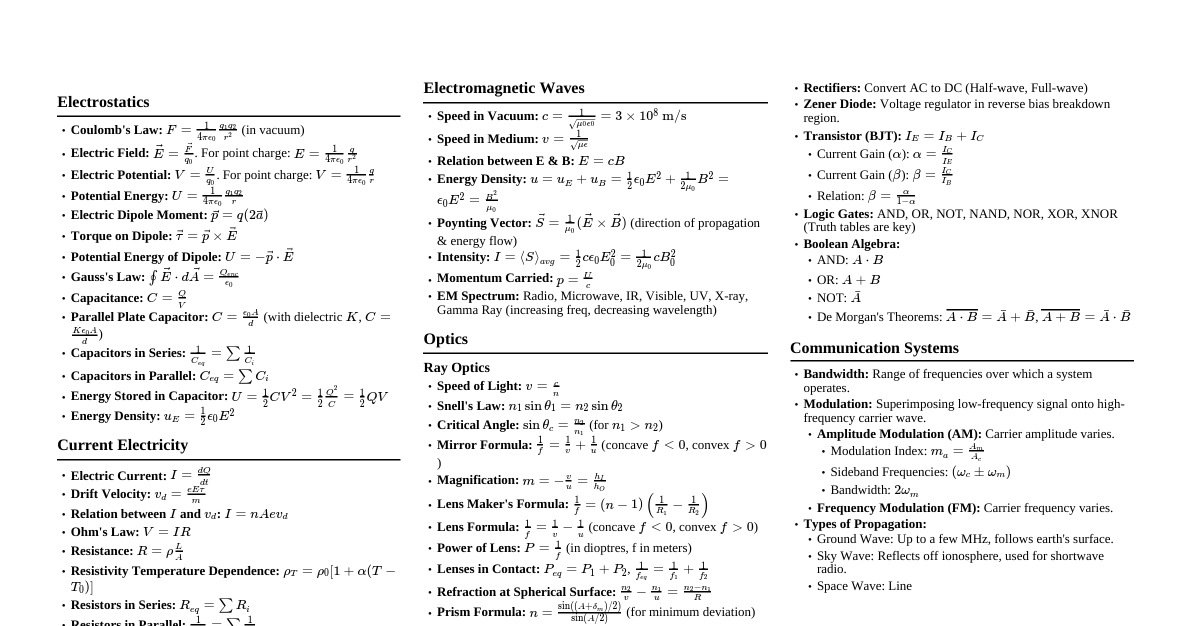
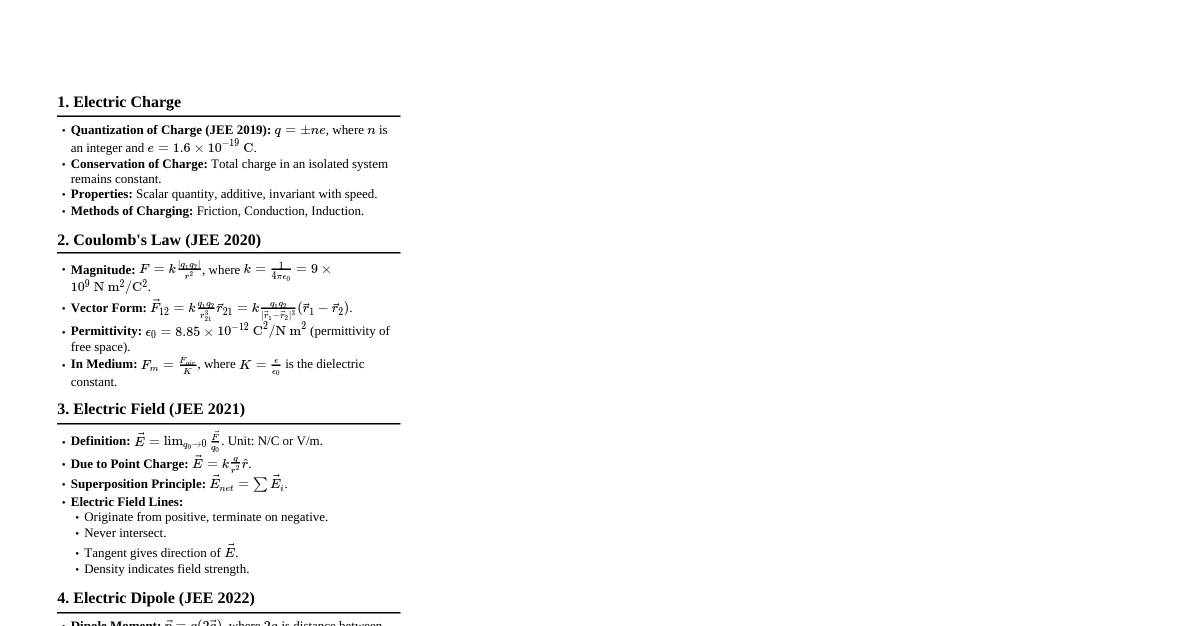
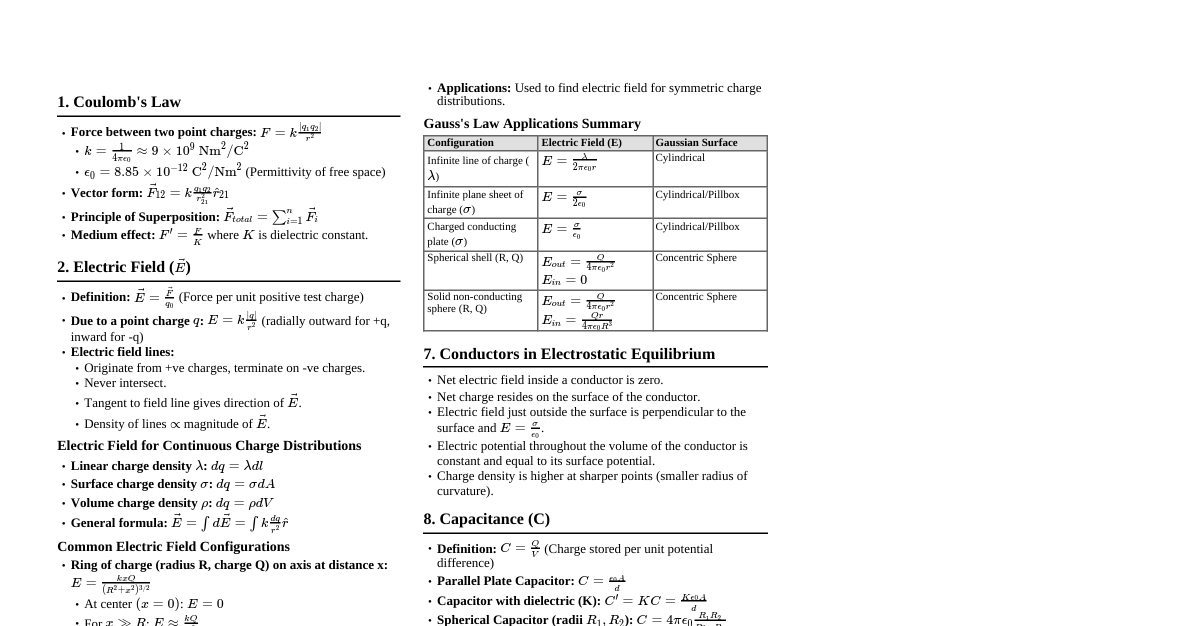
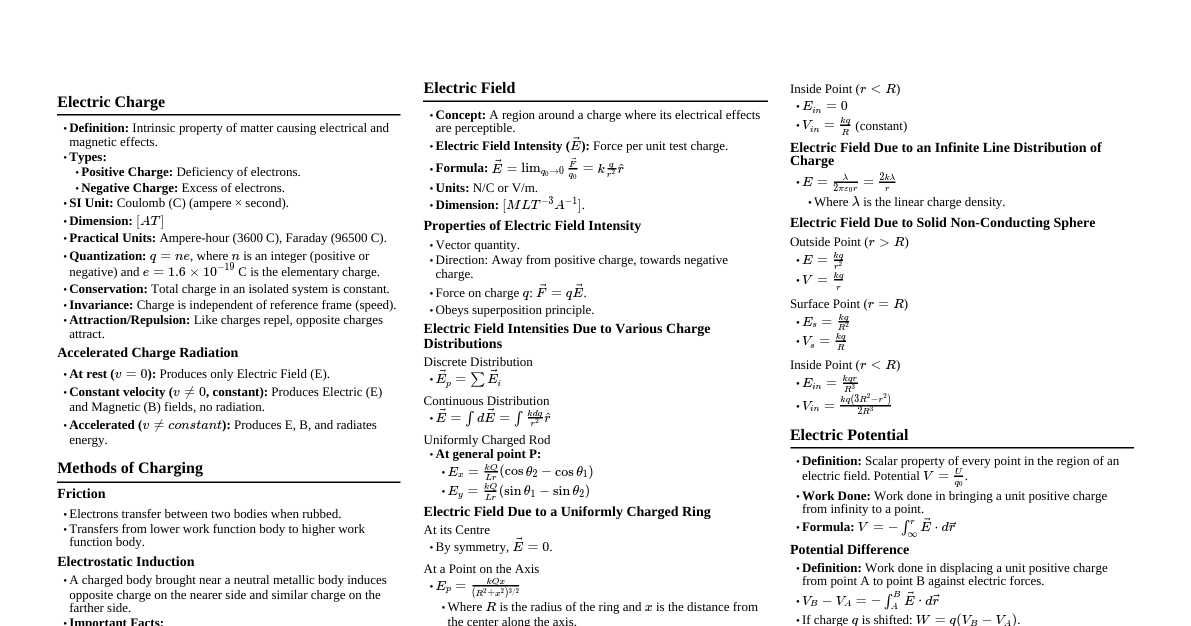
Physics: Electrostatics 1. Electric Charges and Fields Electric Charge: Intrinsic property of matter. Types: Positive, Negative. Quantization: $q = \pm ne$, where $e = 1.6 \times 10^{-19}$ C. Conservation: Charge can neither be created nor destroyed. Coulomb's Law: Force between two point charges. Magnitude: $F = k \frac{|q_1 q_2|}{r^2}$, where $k = \frac{1}{4\pi\epsilon_0} = 9 \times 10^9 \text{ Nm}^2/\text{C}^2$. Permittivity of free space: $\epsilon_0 = 8.85 \times 10^{-12} \text{ C}^2/\text{Nm}^2$. Vector Form: $\vec{F}_{12} = k \frac{q_1 q_2}{r^3} \vec{r}_{12}$. Relative Permittivity ($\epsilon_r$ or $K$): $\epsilon_r = \frac{\epsilon}{\epsilon_0}$. Force in medium: $F_m = \frac{F_0}{K}$. Electric Field ($\vec{E}$): Force per unit positive test charge. $\vec{E} = \frac{\vec{F}}{q_0}$. Unit: N/C or V/m. Due to a point charge $q$: $E = k \frac{|q|}{r^2}$. Electric Field Lines: Origin from positive, terminate on negative. Never intersect. Denser lines $\implies$ stronger field. Electric Dipole: Two equal and opposite charges ($+q, -q$) separated by a distance $2a$. Dipole Moment ($\vec{p}$): $\vec{p} = q(2\vec{a})$. Direction from $-q$ to $+q$. Unit: C m. Field on Axial Line: $E_{axial} = \frac{2kp}{r^3}$ (for $r \gg a$). Field on Equatorial Line: $E_{eq} = \frac{kp}{r^3}$ (for $r \gg a$). Torque on a dipole in uniform $\vec{E}$: $\vec{\tau} = \vec{p} \times \vec{E}$, $\tau = pE \sin\theta$. Potential Energy: $U = -\vec{p} \cdot \vec{E} = -pE \cos\theta$. Electric Flux ($\Phi_E$): Number of electric field lines passing through a surface. $\Phi_E = \int \vec{E} \cdot d\vec{A} = EA \cos\theta$. Unit: N m$^2$/C or V m. Gauss's Law: $\Phi_E = \frac{q_{enc}}{\epsilon_0}$. (Applicable for closed surfaces). Infinite Line Charge: $E = \frac{\lambda}{2\pi\epsilon_0 r}$. Infinite Plane Sheet: $E = \frac{\sigma}{2\epsilon_0}$. Charged Spherical Shell (radius R): Outside ($r>R$): $E = \frac{q}{4\pi\epsilon_0 r^2}$. On surface ($r=R$): $E = \frac{q}{4\pi\epsilon_0 R^2}$. Inside ($r Solid Conducting Sphere: Same as spherical shell. Solid Non-conducting Sphere (uniform charge density $\rho$): Outside ($r>R$): $E = \frac{q}{4\pi\epsilon_0 r^2}$. On surface ($r=R$): $E = \frac{q}{4\pi\epsilon_0 R^2}$. Inside ($r 2. Electrostatic Potential and Capacitance Electric Potential ($V$): Work done per unit charge to bring a test charge from infinity to a point. $V = \frac{W}{q_0}$. Unit: Volt (J/C). Potential difference: $\Delta V = V_B - V_A = -\int_A^B \vec{E} \cdot d\vec{l}$. Due to a point charge $q$: $V = k \frac{q}{r}$. Due to an electric dipole (axial): $V = \frac{kp \cos\theta}{r^2}$ (for $r \gg a$). Equipotential Surfaces: Surfaces with constant electric potential. E-field lines are perpendicular to them. No work done moving charge on such surface. Relation between E and V: $\vec{E} = -\nabla V = -(\frac{\partial V}{\partial x}\hat{i} + \frac{\partial V}{\partial y}\hat{j} + \frac{\partial V}{\partial z}\hat{k})$. For 1D: $E = -\frac{dV}{dr}$. Potential Energy ($U$): Of a system of two charges: $U = k \frac{q_1 q_2}{r}$. In an external field: $U = qV$. For a dipole: $U = -\vec{p} \cdot \vec{E}$. Conductors in Electrostatic Field: Electric field inside a conductor is zero. Net charge resides on the surface. Electric potential is constant throughout the volume and on the surface. Electric field at the surface is normal to the surface: $E = \frac{\sigma}{\epsilon_0}$. Capacitor: Device to store electric charge and energy. Capacitance ($C$): $C = \frac{Q}{V}$. Unit: Farad (F). Parallel Plate Capacitor: $C = \frac{\epsilon_0 A}{d}$. With Dielectric: $C_m = KC_0 = K \frac{\epsilon_0 A}{d}$. $K$ is dielectric constant. Spherical Capacitor: $C = 4\pi\epsilon_0 \frac{ab}{b-a}$. Cylindrical Capacitor: $C = \frac{2\pi\epsilon_0 L}{\ln(b/a)}$. Combination of Capacitors: Series: $\frac{1}{C_{eq}} = \frac{1}{C_1} + \frac{1}{C_2} + ...$. Charge is same, voltage divides. Parallel: $C_{eq} = C_1 + C_2 + ...$. Voltage is same, charge divides. Energy Stored in a Capacitor: $U = \frac{1}{2}CV^2 = \frac{1}{2}QV = \frac{Q^2}{2C}$. Energy Density: $u = \frac{1}{2}\epsilon_0 E^2$. Van de Graaff Generator: Electrostatic generator producing very high direct current voltages. Biology: Reproduction 1. Reproduction in Organisms Reproduction: Biological process by which new individual organisms – "offspring" – are produced from their "parents". Asexual Reproduction: Single parent produces offspring genetically identical to itself. Binary Fission: Amoeba, Paramecium (daughter cells). Budding: Yeast, Hydra (outgrowth develops). Spore Formation: Fungi, Algae (motile zoospores, non-motile conidia). Fragmentation: Spirogyra (body breaks into fragments). Regeneration: Planaria (lost body parts regrow). Vegetative Propagation (in plants): Stem: Runner (grass), Rhizome (ginger), Sucker (mint), Tuber (potato), Bulb (onion). Leaf: Bryophyllum (epiphyllous buds). Root: Dahlia, sweet potato. Artificial methods: Cutting, Layering, Grafting, Tissue Culture (micropropagation). Sexual Reproduction: Involves fusion of two gametes (male and female) to form a zygote. Offspring show variation. Phases of life cycle: Juvenile/Vegetative $\to$ Reproductive $\to$ Senescent. Events: Pre-fertilisation: Gametogenesis (meiosis), Gamete transfer. Fertilisation: Syngamy (fusion of gametes). External/Internal. Post-fertilisation: Zygote formation, Embryogenesis. Hermaphrodites/Monoecious: Both sexes in one individual (e.g., earthworm, China rose). Dioecious: Separate sexes (e.g., humans, papaya). 2. Sexual Reproduction in Flowering Plants Flower: Reproductive unit. Androecium (Male): Stamens (Filament + Anther). Anther has microsporangia. Gynoecium (Female): Pistil/Carpel (Stigma + Style + Ovary). Ovary has ovules. Pre-fertilisation: Microsporangium & Pollen Grain: Microsporangium (pollen sac) contains sporogenous tissue $\to$ Microspore Mother Cells (MMC) $\to$ Meiosis $\to$ Microspores (pollen tetrad) $\to$ Pollen Grains. Pollen grain: Two-layered wall (Exine - sporopollenin, Intine - pectin & cellulose). Two cells: Vegetative cell (large), Generative cell (small). Megasporangium (Ovule) & Embryo Sac: Ovule attached to placenta by funicle. Contains nucellus (nutritive). Megaspore Mother Cell (MMC) in nucellus $\to$ Meiosis $\to$ 4 megaspores (usually 1 functional). Functional megaspore $\to$ 3 mitotic divisions $\to$ 8-nucleate, 7-celled Embryo Sac (Female Gametophyte). Structure of Embryo Sac: Egg apparatus (1 egg cell, 2 synergids), 3 antipodal cells, 1 central cell (2 polar nuclei). Pollination: Transfer of pollen grains from anther to stigma. Self-pollination (Autogamy, Geitonogamy). Cross-pollination (Xenogamy). Agents: Wind (Anemophily), Water (Hydrophily), Animals (Zoophily - insects, birds, bats). Pollen-Pistil Interaction: Chemical dialogue leading to pollen germination on stigma. Pollen tube grows through style to ovule. Fertilisation: (Double Fertilisation - unique to angiosperms) Pollen tube releases 2 male gametes into embryo sac. Syngamy: One male gamete + Egg cell $\to$ Zygote ($2n$). Triple Fusion: Other male gamete + 2 polar nuclei $\to$ Primary Endosperm Nucleus (PEN, $3n$). Post-fertilisation: Zygote $\to$ Embryo. PEN $\to$ Endosperm (nutritive tissue). Ovule $\to$ Seed. Ovary $\to$ Fruit. Ovary wall $\to$ Pericarp (fruit wall). Seed: Contains embryo and food reserves. Non-albuminous (no residual endosperm, e.g., pea, groundnut) or Albuminous (endosperm present, e.g., wheat, maize). Apomixis: Seed formation without fertilisation (e.g., citrus, mango). Polyembryony: Occurrence of more than one embryo in a seed (e.g., citrus). 3. Human Reproduction Male Reproductive System: Primary sex organ: Testes (produce sperm & testosterone). Accessory ducts: Rete testis, Vasa efferentia, Epididymis, Vas deferens, Ejaculatory duct, Urethra. Accessory glands: Seminal vesicles, Prostate gland, Bulbourethral glands (produce seminal plasma). External genitalia: Penis, Scrotum. Female Reproductive System: Primary sex organ: Ovaries (produce ova & female hormones). Accessory ducts: Oviducts (fallopian tubes), Uterus (womb), Vagina. External genitalia: Mons pubis, Labia majora, Labia minora, Hymen, Clitoris (Vulva). Mammary glands: For lactation. Gametogenesis: Spermatogenesis (in testes): Spermatogonia $\to$ Primary Spermatocytes $\to$ Meiosis I $\to$ Secondary Spermatocytes $\to$ Meiosis II $\to$ Spermatids $\to$ Spermiogenesis $\to$ Spermatozoa. Regulated by GnRH, LH, FSH, Androgens. Oogenesis (in ovaries): Oogonia $\to$ Primary Oocytes (arrested in Prophase I) $\to$ Meiosis I $\to$ Secondary Oocyte (arrested in Metaphase II) + First Polar Body $\to$ Meiosis II (after sperm entry) $\to$ Ovum + Second Polar Body. Menstrual Cycle: 28-day cycle in primate females. Phases: Menstrual (Day 1-5), Follicular/Proliferative (Day 5-13), Ovulatory (Day 14 - LH surge), Luteal/Secretory (Day 15-28). Hormonal control: GnRH, LH, FSH, Estrogen, Progesterone. Fertilisation & Implantation: Fertilisation occurs in ampulla of fallopian tube. Zygote $\to$ Cleavage $\to$ Morula $\to$ Blastocyst. Blastocyst implants in uterine wall (endometrium). Pregnancy & Embryonic Development: Placenta: Connects embryo to uterus, facilitates nutrient/gas exchange, acts as endocrine gland (hCG, hPL, estrogen, progesterone). Gestation period: ~9 months. Embryonic layers: Ectoderm, Mesoderm, Endoderm (form all tissues/organs). Parturition & Lactation: Parturition: Childbirth. Induced by fully developed foetus and placenta (foetal ejection reflex). Oxytocin causes uterine contractions. Lactation: Milk production by mammary glands. Colostrum (first milk) rich in antibodies. 4. Reproductive Health Reproductive Health: Total well-being in all aspects of reproduction (physical, emotional, social, behavioural). Population Explosion: Rapid increase in population size. Causes: Decreased death rate, increased lifespan, increased birth rate. Birth Control Methods (Contraception): Natural methods: Coitus interruptus, Lactational amenorrhea, Rhythm method. Barrier methods: Condoms, Diaphragms, Cervical caps. IUDs (Intra-Uterine Devices): Non-medicated (Lippes loop), Copper-releasing (CuT, Cu7), Hormone-releasing (Progestasert, LNG-20). Oral Contraceptives (Pills): Progestogens or progestogen-estrogen combinations. Injectables/Implants: Progestogens. Surgical methods (Sterilisation): Vasectomy (males), Tubectomy (females). MTP (Medical Termination of Pregnancy): Induced abortion. Legal in India up to 20 weeks (with conditions). STIs (Sexually Transmitted Infections)/VDs (Venereal Diseases)/RTIs (Reproductive Tract Infections): Bacterial: Gonorrhea, Syphilis, Chlamydiosis (curable). Viral: Genital herpes, Genital warts, Hepatitis B, HIV/AIDS (incurable). Prevention: Avoid multiple partners, use condoms, early detection, and treatment. Infertility: Inability to conceive after unprotected sexual intercourse. ART (Assisted Reproductive Technologies): IVF-ET (In Vitro Fertilisation - Embryo Transfer): Test tube baby. ZIFT (Zygote Intra Fallopian Transfer). ICSI (Intra Cytoplasmic Sperm Injection). GIFT (Gamete Intra Fallopian Transfer). AI (Artificial Insemination), IUI (Intra Uterine Insemination).