Electric Charges and Fields (JEE)
Cheatsheet Content
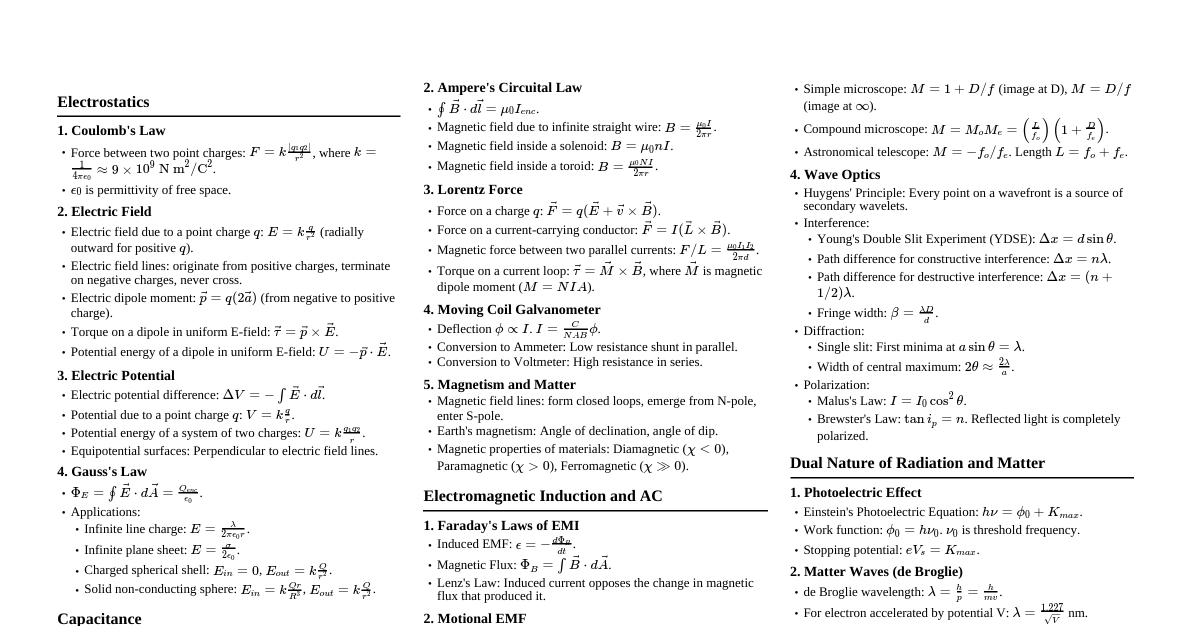
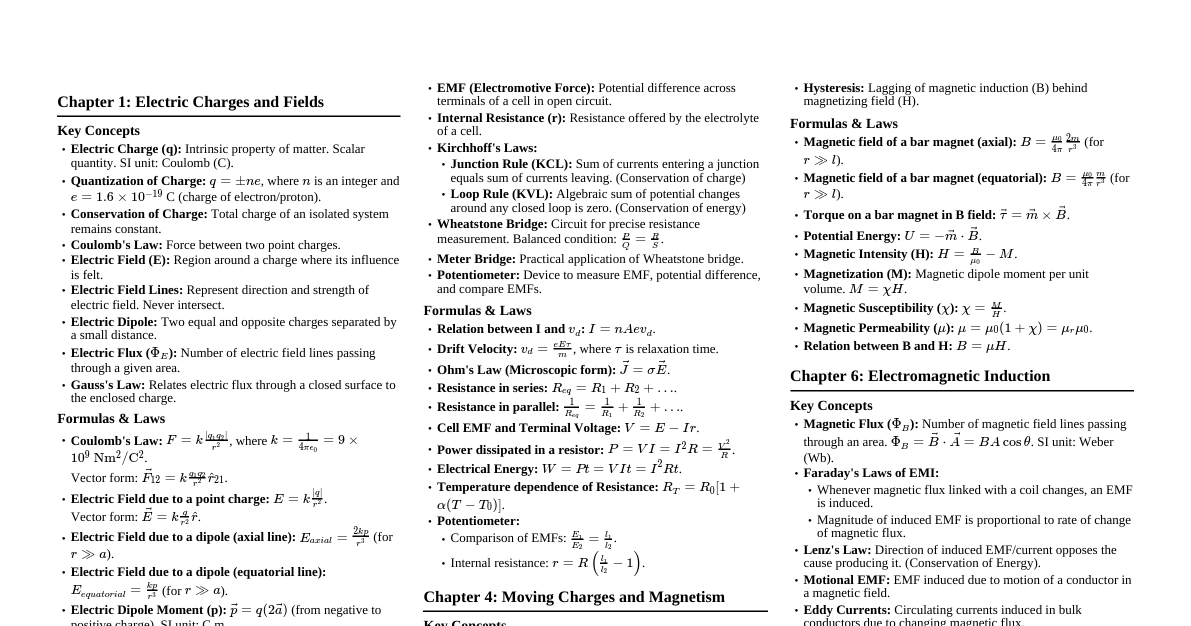
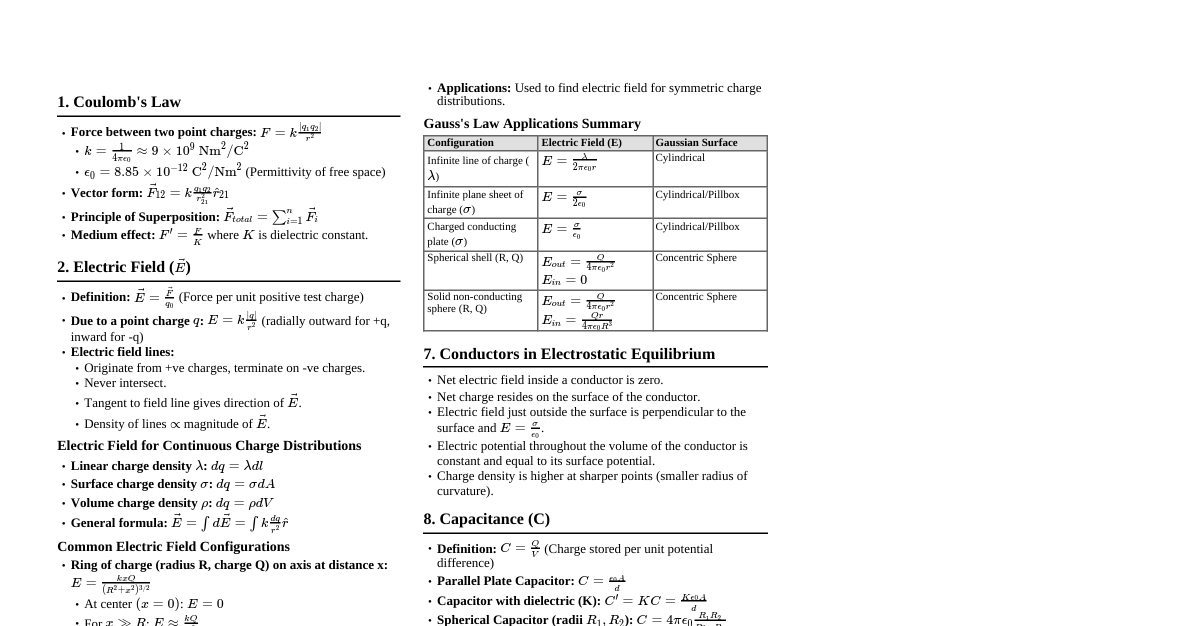
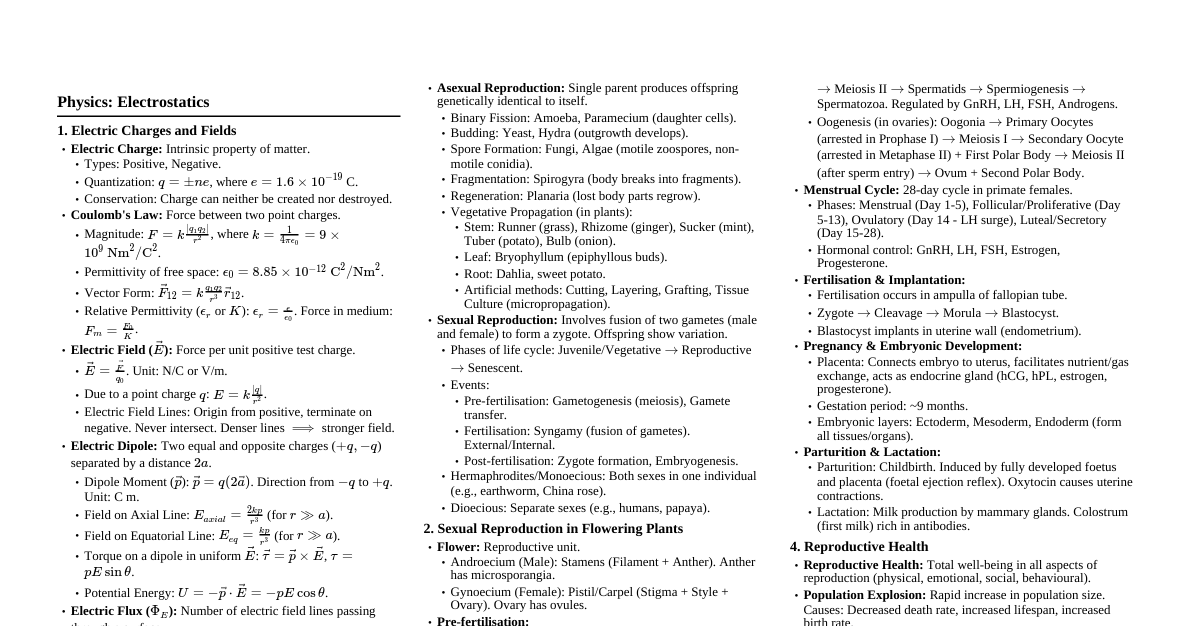
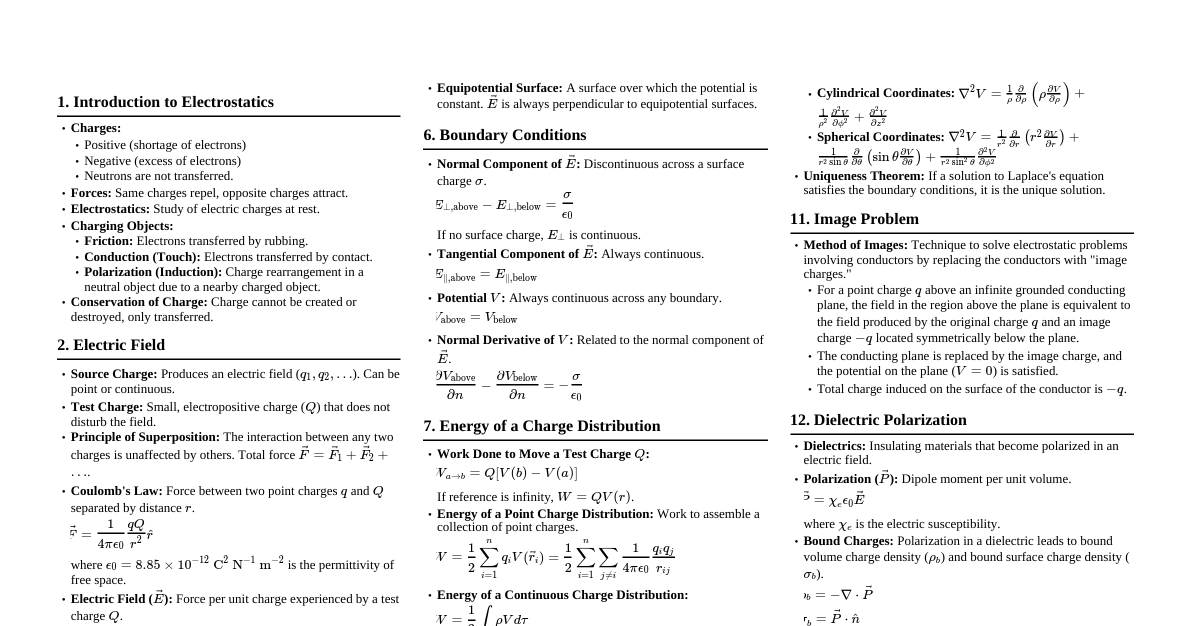
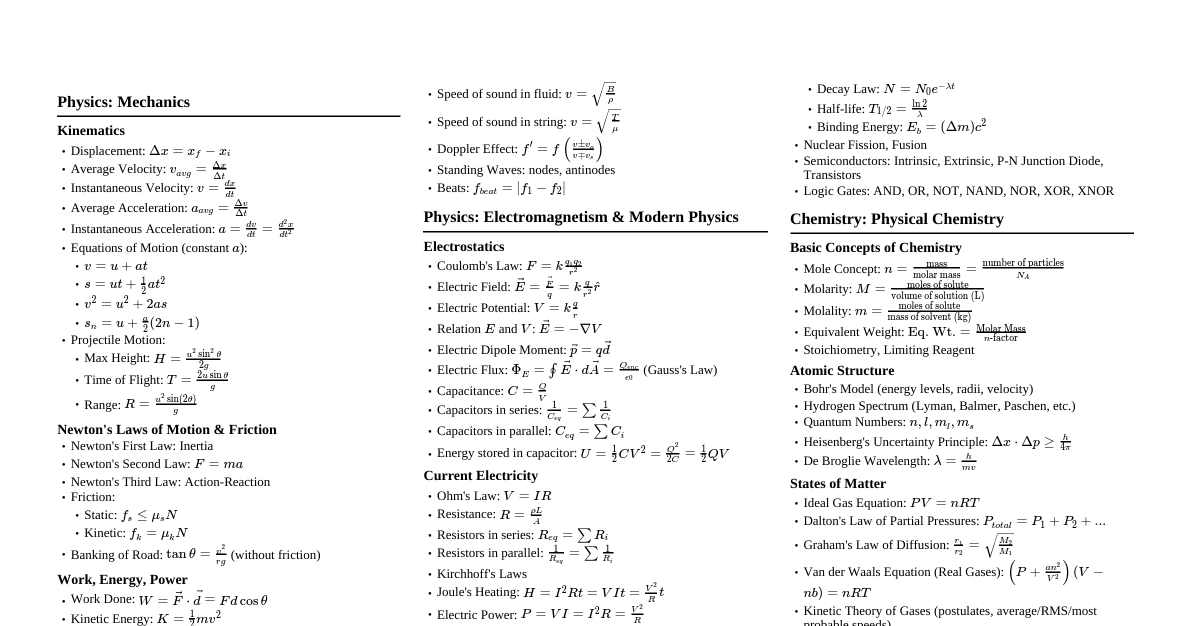
1. Electric Charge Quantization of Charge (JEE 2019): $q = \pm ne$, where $n$ is an integer and $e = 1.6 \times 10^{-19} \text{ C}$. Conservation of Charge: Total charge in an isolated system remains constant. Properties: Scalar quantity, additive, invariant with speed. Methods of Charging: Friction, Conduction, Induction. 2. Coulomb's Law (JEE 2020) Magnitude: $F = k \frac{|q_1 q_2|}{r^2}$, where $k = \frac{1}{4\pi\epsilon_0} = 9 \times 10^9 \text{ N m}^2/\text{C}^2$. Vector Form: $\vec{F}_{12} = k \frac{q_1 q_2}{r_{21}^3} \vec{r}_{21} = k \frac{q_1 q_2}{|\vec{r}_1 - \vec{r}_2|^3} (\vec{r}_1 - \vec{r}_2)$. Permittivity: $\epsilon_0 = 8.85 \times 10^{-12} \text{ C}^2/\text{N m}^2$ (permittivity of free space). In Medium: $F_m = \frac{F_{air}}{K}$, where $K = \frac{\epsilon}{\epsilon_0}$ is the dielectric constant. 3. Electric Field (JEE 2021) Definition: $\vec{E} = \lim_{q_0 \to 0} \frac{\vec{F}}{q_0}$. Unit: N/C or V/m. Due to Point Charge: $\vec{E} = k \frac{q}{r^2} \hat{r}$. Superposition Principle: $\vec{E}_{net} = \sum \vec{E}_i$. Electric Field Lines: Originate from positive, terminate on negative. Never intersect. Tangent gives direction of $\vec{E}$. Density indicates field strength. 4. Electric Dipole (JEE 2022) Dipole Moment: $\vec{p} = q(2\vec{a})$, where $2a$ is distance between charges $-q$ and $+q$. Direction from $-q$ to $+q$. Field on Axial Line: $E_{axial} = \frac{2kp}{r^3}$ (for $r \gg a$). Field on Equatorial Line: $E_{equatorial} = \frac{kp}{r^3}$ (for $r \gg a$). Torque in Uniform Field: $\vec{\tau} = \vec{p} \times \vec{E}$. Magnitude $\tau = pE \sin\theta$. Potential Energy: $U = -\vec{p} \cdot \vec{E} = -pE \cos\theta$. Work Done (JEE 2020): $W = U_f - U_i = pE(\cos\theta_1 - \cos\theta_2)$. 5. Continuous Charge Distributions Linear Charge Density: $\lambda = \frac{dq}{dl}$ (C/m). Surface Charge Density: $\sigma = \frac{dq}{dA}$ (C/m$^2$). Volume Charge Density: $\rho = \frac{dq}{dV}$ (C/m$^3$). 6. Gauss's Law (JEE 2019, 2023) Statement: $\oint \vec{E} \cdot d\vec{A} = \frac{q_{enc}}{\epsilon_0}$. Electric Flux: $\Phi_E = \int \vec{E} \cdot d\vec{A} = EA \cos\theta$. Applications: Infinite Line Charge: $E = \frac{\lambda}{2\pi\epsilon_0 r}$. Infinite Plane Sheet: $E = \frac{\sigma}{2\epsilon_0}$. Uniformly Charged Spherical Shell: Outside ($r > R$): $E = \frac{kq}{r^2}$. Inside ($r Uniformly Charged Solid Sphere: Outside ($r > R$): $E = \frac{kq}{r^2}$. Inside ($r 7. Electric Potential (JEE 2018) Definition: $V = \frac{W}{q_0}$. Unit: Volt (J/C). Scalar quantity. Due to Point Charge: $V = \frac{kq}{r}$. Superposition Principle: $V_{net} = \sum V_i$. Relation between E and V: $\vec{E} = -\vec{\nabla}V = -\left(\frac{\partial V}{\partial x}\hat{i} + \frac{\partial V}{\partial y}\hat{j} + \frac{\partial V}{\partial z}\hat{k}\right)$. Work Done: $W = q(V_B - V_A)$. 8. Electric Potential Energy (JEE 2021) Two Point Charges: $U = \frac{kq_1 q_2}{r}$. System of Charges: Sum of potential energies of all possible pairs. In External Field: For a single charge $q$, $U = qV(r)$. For a Dipole in External Field: $U = -\vec{p} \cdot \vec{E}$. 9. Equipotential Surfaces Locus of points having the same electric potential. No work is done in moving a charge on an equipotential surface. Electric field lines are always perpendicular to equipotential surfaces. Do not intersect each other. 10. Conductor Properties (JEE 2023) Inside a conductor, $\vec{E} = 0$. Net charge resides only on the outer surface. Potential is constant throughout the volume and on the surface. Electric field at the surface is perpendicular to the surface: $E = \frac{\sigma}{\epsilon_0}$.