Physics: Light & Electricity
Cheatsheet Content
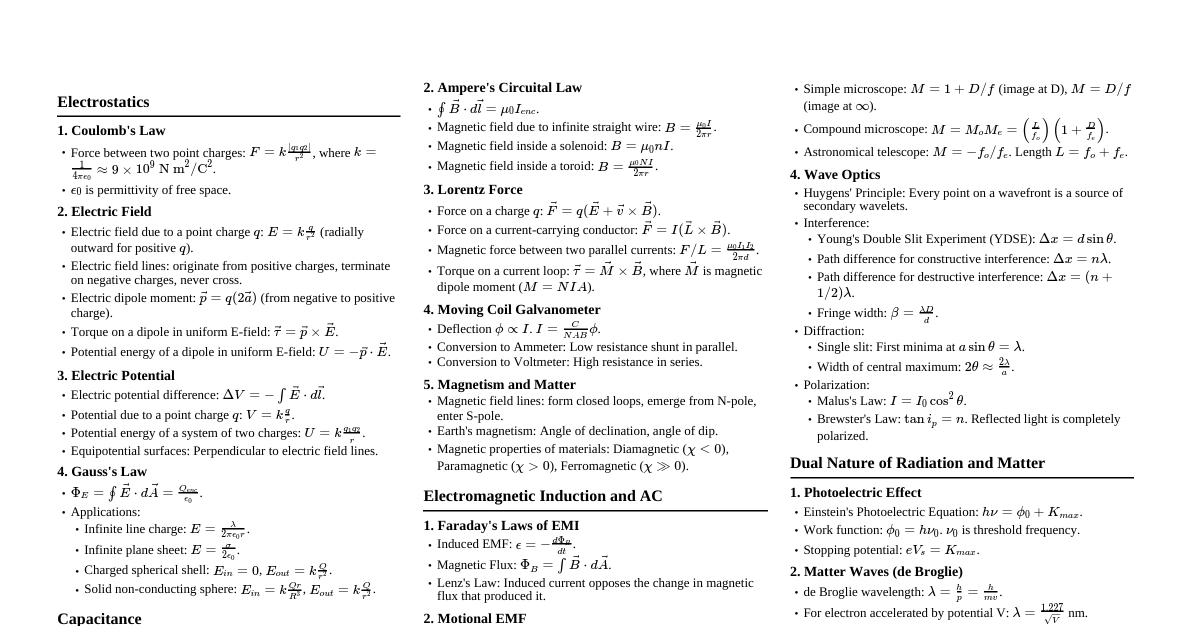
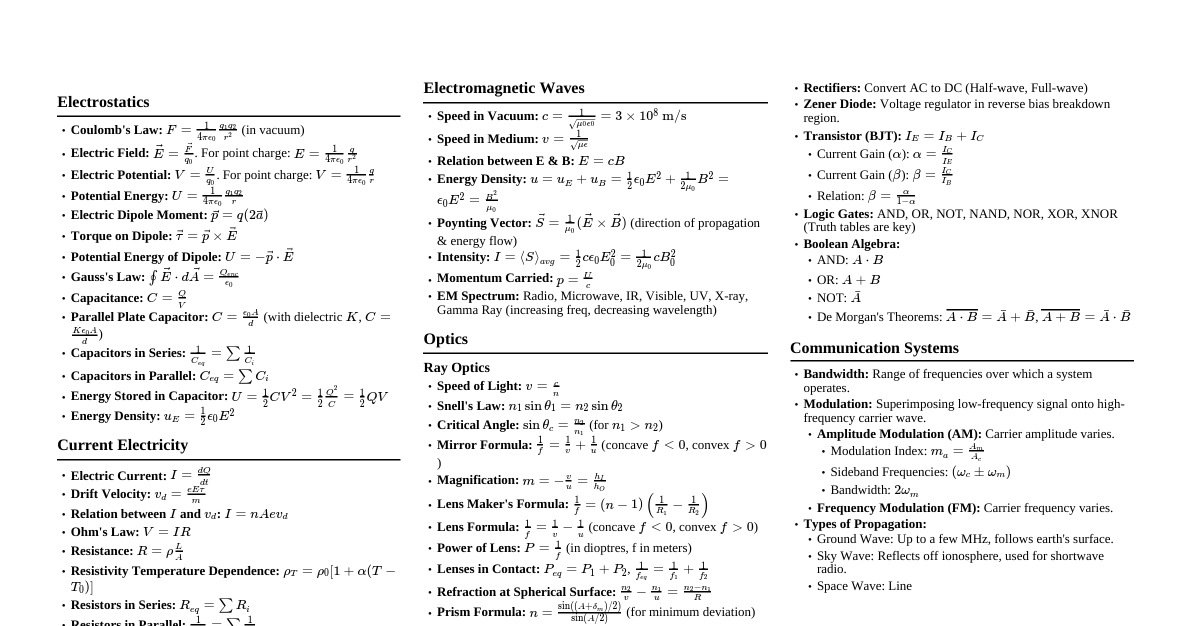
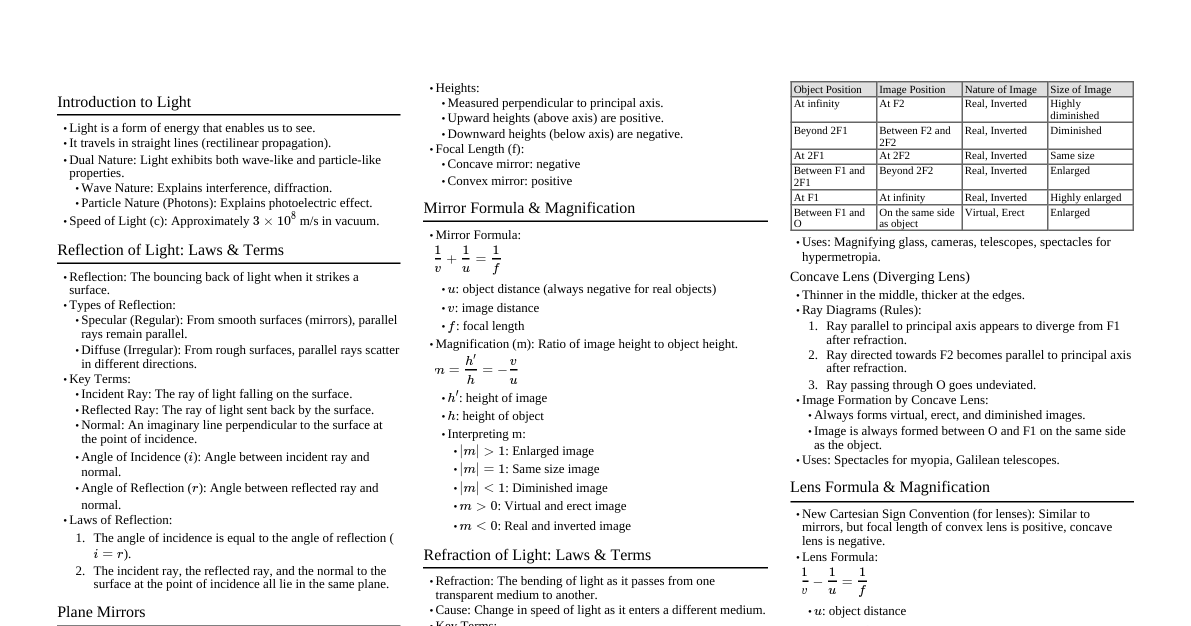
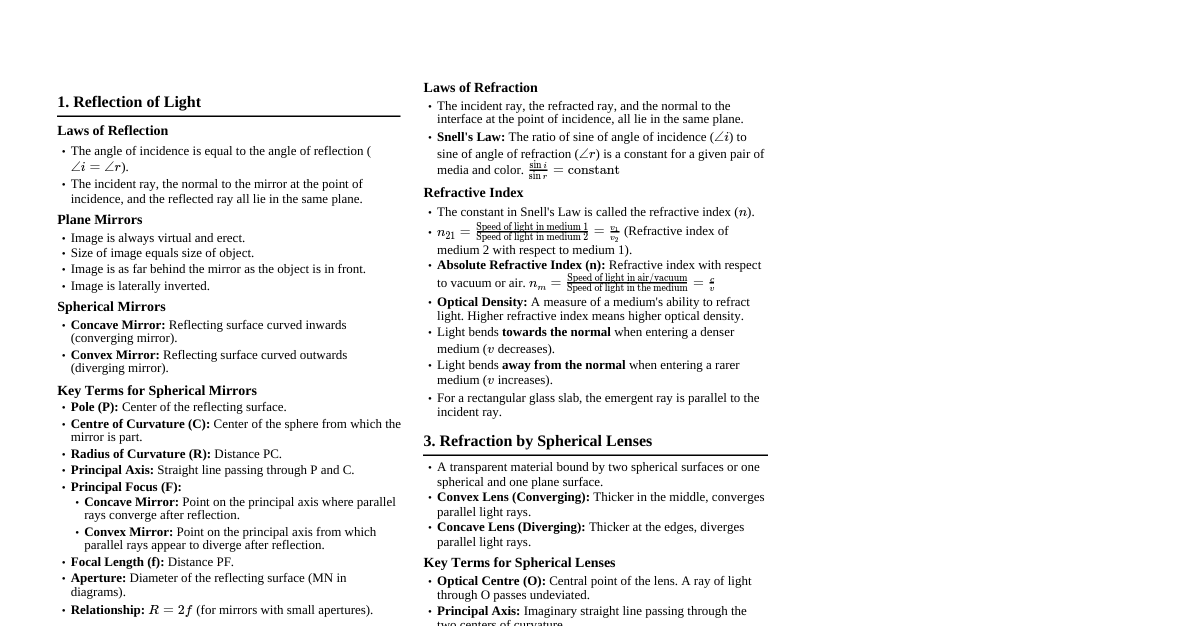
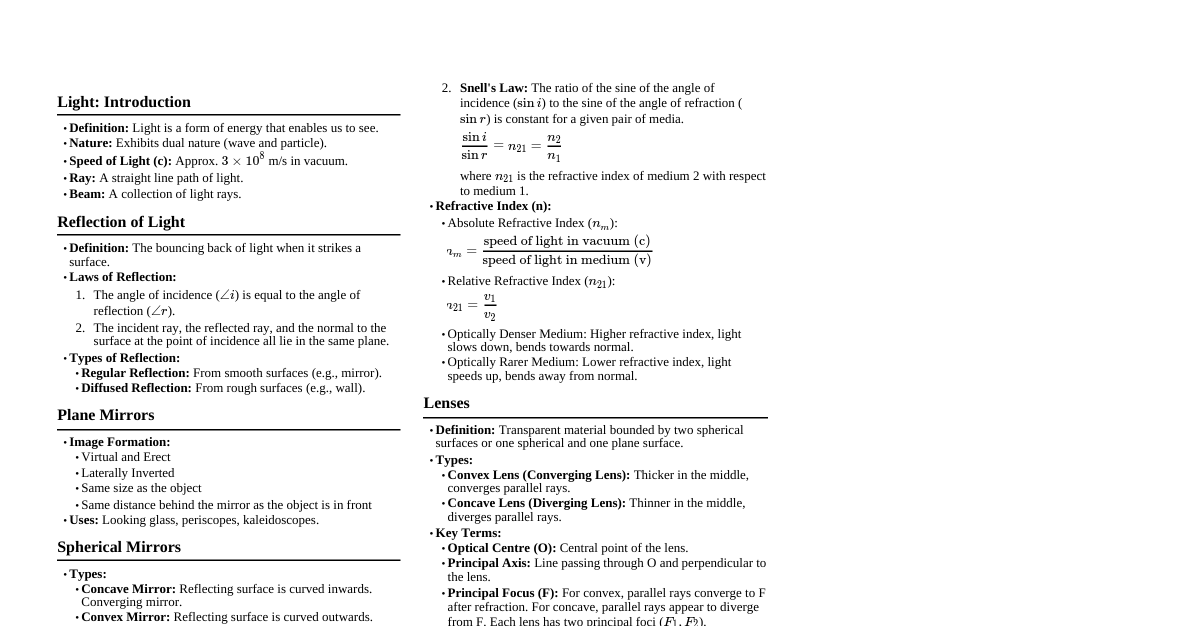
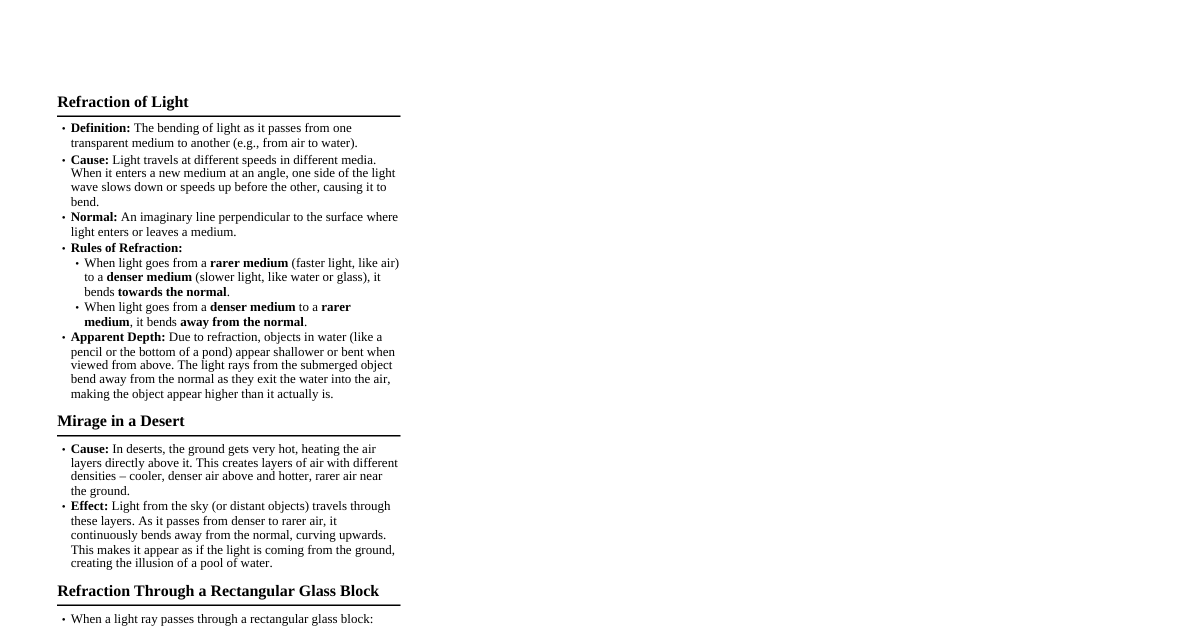
Light: Reflection & Refraction Reflection Law of Reflection: Angle of incidence $i$ equals angle of reflection $r$. $i = r$. Mirror Formula: $\frac{1}{f} = \frac{1}{u} + \frac{1}{v}$ $f$: focal length $u$: object distance $v$: image distance Magnification (Mirror): $m = \frac{h_i}{h_o} = -\frac{v}{u}$ $h_i$: image height $h_o$: object height Sign Convention (Cartesian): Distances measured from pole/optical centre. Distances in direction of incident light are positive, opposite are negative. Heights above principal axis are positive, below are negative. Focal Length of Spherical Mirror: $f = R/2$ (for small apertures) $R$: radius of curvature Refraction Snell's Law: $n_1 \sin i = n_2 \sin r$ $n_1, n_2$: refractive indices of medium 1 and 2 $i$: angle of incidence $r$: angle of refraction Refractive Index: $n = \frac{c}{v}$ $c$: speed of light in vacuum ($3 \times 10^8 \text{ m/s}$) $v$: speed of light in medium Relative Refractive Index: $n_{21} = \frac{n_2}{n_1} = \frac{v_1}{v_2}$ Critical Angle ($\theta_c$): $\sin \theta_c = \frac{n_2}{n_1}$ (for $n_1 > n_2$) Occurs when light travels from denser to rarer medium. Total Internal Reflection (TIR) occurs if $i > \theta_c$. Lens Formula: $\frac{1}{f} = \frac{1}{v} - \frac{1}{u}$ Magnification (Lens): $m = \frac{h_i}{h_o} = \frac{v}{u}$ Lens Maker's Formula: $\frac{1}{f} = (n-1) \left(\frac{1}{R_1} - \frac{1}{R_2}\right)$ $n$: refractive index of lens material w.r.t. surrounding medium $R_1, R_2$: radii of curvature of lens surfaces Power of a Lens ($P$): $P = \frac{1}{f}$ (in Dioptres, if $f$ is in meters) Combination of Thin Lenses: $P_{eq} = P_1 + P_2 + ...$ or $\frac{1}{f_{eq}} = \frac{1}{f_1} + \frac{1}{f_2} + ...$ Electricity Electrostatics Coulomb's Law: $F = k \frac{|q_1 q_2|}{r^2}$ $k = \frac{1}{4\pi\epsilon_0} \approx 9 \times 10^9 \text{ Nm}^2/\text{C}^2$ $\epsilon_0$: permittivity of free space ($8.85 \times 10^{-12} \text{ C}^2/\text{Nm}^2$) Electric Field: $E = \frac{F}{q_0}$ or $E = k \frac{q}{r^2}$ (for point charge) Electric Potential: $V = \frac{W}{q_0}$ or $V = k \frac{q}{r}$ (for point charge) Relation between E and V: $E = -\frac{dV}{dr}$ Electric Potential Energy: $U = k \frac{q_1 q_2}{r}$ Electric Dipole Moment: $\vec{p} = q(2\vec{a})$ Torque on Dipole in E-field: $\vec{\tau} = \vec{p} \times \vec{E}$ Potential Energy of Dipole: $U = -\vec{p} \cdot \vec{E}$ Gauss's Law: $\oint \vec{E} \cdot d\vec{A} = \frac{Q_{enc}}{\epsilon_0}$ Capacitance Capacitance: $C = \frac{Q}{V}$ Parallel Plate Capacitor: $C = \frac{\epsilon A}{d} = \frac{\kappa \epsilon_0 A}{d}$ $\epsilon$: permittivity of dielectric $\kappa$: dielectric constant Energy Stored in Capacitor: $U = \frac{1}{2}CV^2 = \frac{1}{2}\frac{Q^2}{C} = \frac{1}{2}QV$ Capacitors in Series: $\frac{1}{C_{eq}} = \frac{1}{C_1} + \frac{1}{C_2} + ...$ Capacitors in Parallel: $C_{eq} = C_1 + C_2 + ...$ Current Electricity Electric Current: $I = \frac{dQ}{dt}$ Ohm's Law: $V = IR$ Resistance: $R = \rho \frac{L}{A}$ $\rho$: resistivity $L$: length, $A$: cross-sectional area Resistivity Temperature Dependence: $\rho_T = \rho_0 [1 + \alpha(T - T_0)]$ Power Dissipated: $P = VI = I^2R = \frac{V^2}{R}$ Resistors in Series: $R_{eq} = R_1 + R_2 + ...$ Resistors in Parallel: $\frac{1}{R_{eq}} = \frac{1}{R_1} + \frac{1}{R_2} + ...$ Kirchhoff's Junction Rule (KCL): $\sum I_{in} = \sum I_{out}$ Kirchhoff's Loop Rule (KVL): $\sum \Delta V = 0$ (around any closed loop) Drift Velocity: $I = nAev_d$ $n$: number of charge carriers per unit volume $e$: charge of electron Mobility: $\mu = \frac{v_d}{E}$