Electrostatics JEE Cheatsheet
Cheatsheet Content
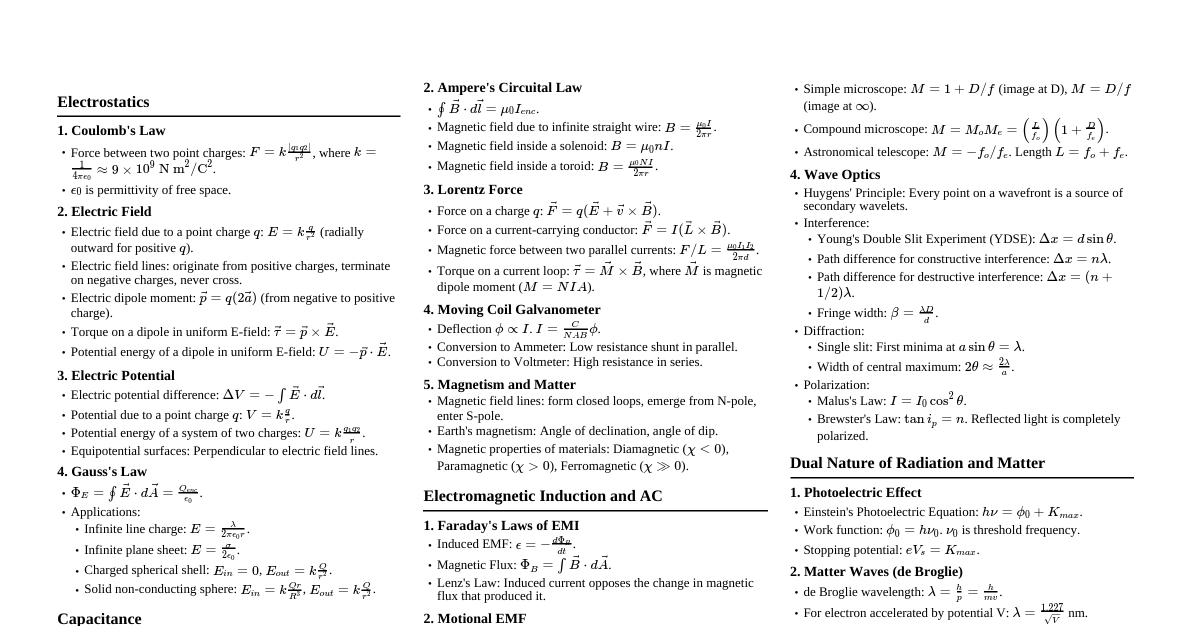
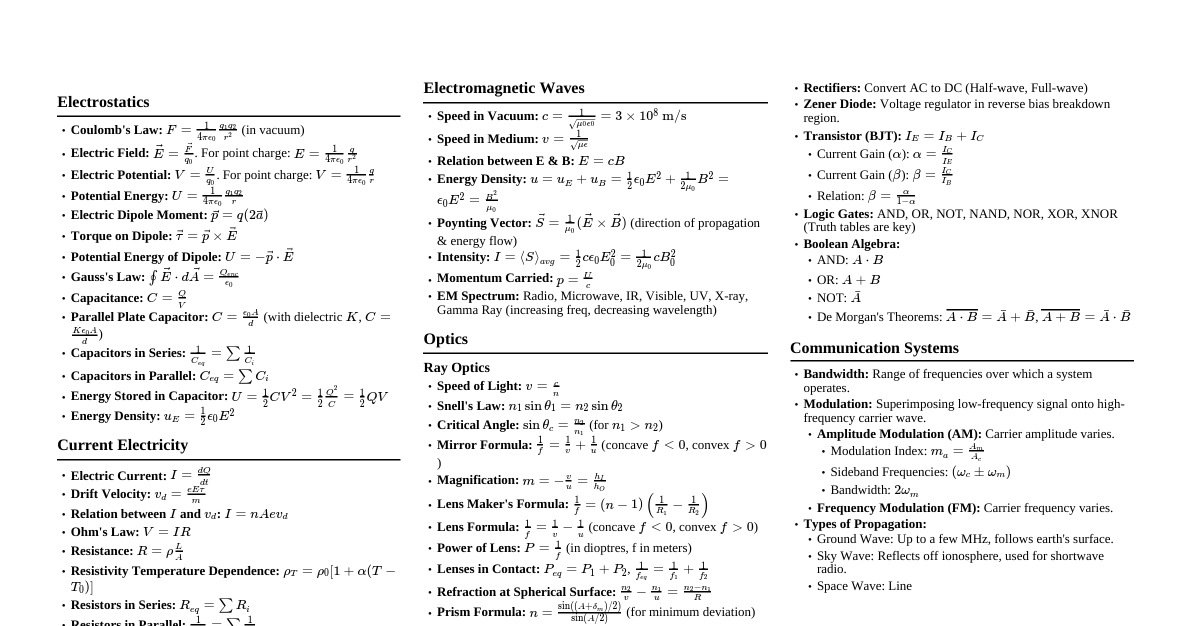
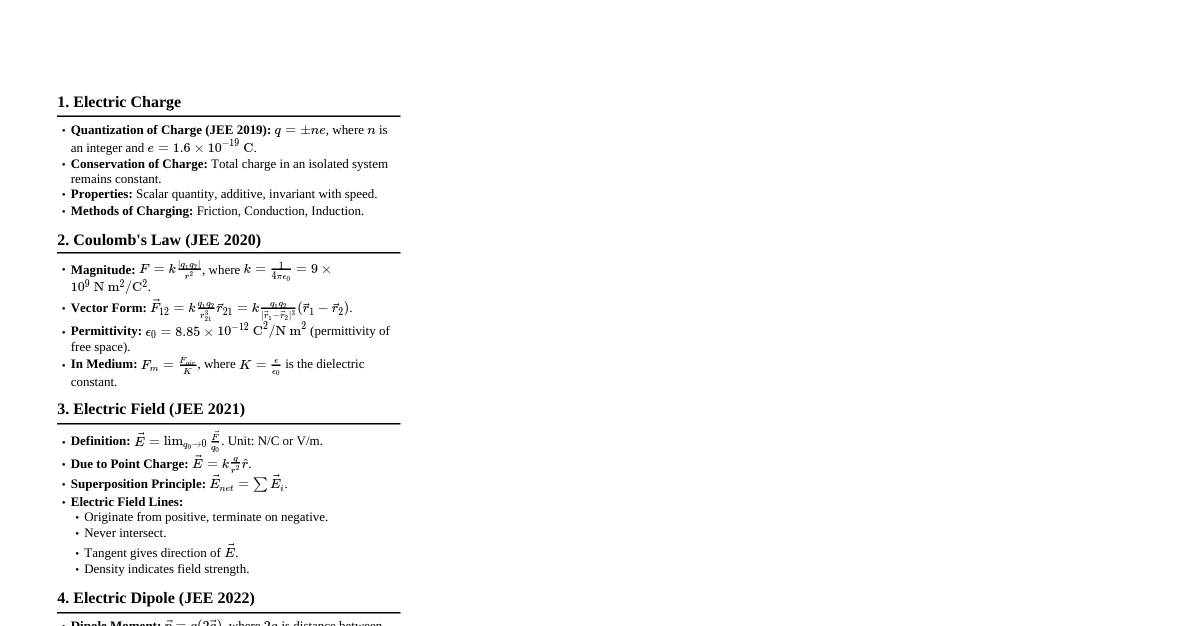
1. Coulomb's Law Force between two point charges: $F = k \frac{|q_1 q_2|}{r^2}$ $k = \frac{1}{4\pi\epsilon_0} \approx 9 \times 10^9 \text{ Nm}^2/\text{C}^2$ $\epsilon_0 = 8.85 \times 10^{-12} \text{ C}^2/\text{Nm}^2$ (Permittivity of free space) Vector form: $\vec{F}_{12} = k \frac{q_1 q_2}{r_{21}^2} \hat{r}_{21}$ Principle of Superposition: $\vec{F}_{total} = \sum_{i=1}^n \vec{F}_i$ Medium effect: $F' = \frac{F}{K}$ where $K$ is dielectric constant. 2. Electric Field ($\vec{E}$) Definition: $\vec{E} = \frac{\vec{F}}{q_0}$ (Force per unit positive test charge) Due to a point charge $q$: $E = k \frac{|q|}{r^2}$ (radially outward for +q, inward for -q) Electric field lines: Originate from +ve charges, terminate on -ve charges. Never intersect. Tangent to field line gives direction of $\vec{E}$. Density of lines $\propto$ magnitude of $\vec{E}$. Electric Field for Continuous Charge Distributions Linear charge density $\lambda$: $dq = \lambda dl$ Surface charge density $\sigma$: $dq = \sigma dA$ Volume charge density $\rho$: $dq = \rho dV$ General formula: $\vec{E} = \int d\vec{E} = \int k \frac{dq}{r^2} \hat{r}$ Common Electric Field Configurations Ring of charge (radius R, charge Q) on axis at distance x: $E = \frac{kxQ}{(R^2 + x^2)^{3/2}}$ At center $(x=0)$: $E=0$ For $x \gg R$: $E \approx \frac{kQ}{x^2}$ Uniformly charged infinite line: $E = \frac{2k\lambda}{r}$ (radially outward) Uniformly charged infinite plane: $E = \frac{\sigma}{2\epsilon_0}$ (perpendicular to plane) Uniformly charged spherical shell (radius R, charge Q): Outside $(r \ge R)$: $E = \frac{kQ}{r^2}$ Inside $(r Uniformly charged solid sphere (radius R, charge Q): Outside $(r \ge R)$: $E = \frac{kQ}{r^2}$ Inside $(r 3. Electric Potential (V) Definition: $V = \frac{U}{q_0}$ (Potential energy per unit positive test charge) Relation to Electric Field: $\vec{E} = -\nabla V = -\left(\frac{\partial V}{\partial x}\hat{i} + \frac{\partial V}{\partial y}\hat{j} + \frac{\partial V}{\partial z}\hat{k}\right)$ Potential difference: $V_B - V_A = -\int_A^B \vec{E} \cdot d\vec{l}$ Due to a point charge $q$: $V = \frac{kq}{r}$ Due to multiple point charges: $V = \sum_{i} \frac{kq_i}{r_i}$ (scalar sum) Common Electric Potential Configurations Ring of charge (radius R, charge Q) on axis at distance x: $V = \frac{kQ}{\sqrt{R^2 + x^2}}$ Uniformly charged spherical shell (radius R, charge Q): Outside $(r \ge R)$: $V = \frac{kQ}{r}$ Inside $(r Uniformly charged solid sphere (radius R, charge Q): Outside $(r \ge R)$: $V = \frac{kQ}{r}$ Inside $(r 4. Electric Potential Energy (U) For two point charges $q_1, q_2$: $U = \frac{kq_1 q_2}{r}$ For a system of charges: Sum of potential energies of all unique pairs. For 3 charges $q_1, q_2, q_3$: $U = \frac{kq_1 q_2}{r_{12}} + \frac{kq_1 q_3}{r_{13}} + \frac{kq_2 q_3}{r_{23}}$ Energy of charge $q$ in potential $V$: $U = qV$ 5. Electric Dipole Dipole moment: $\vec{p} = q(2\vec{a})$ (from -q to +q) Electric field on axial line (at distance r from center): $\vec{E}_{axial} = \frac{2k\vec{p}}{r^3}$ (for $r \gg a$) Electric field on equatorial line (at distance r from center): $\vec{E}_{eq} = -\frac{k\vec{p}}{r^3}$ (for $r \gg a$) Potential on axial line: $V_{axial} = \frac{kp \cos\theta}{r^2}$ (where $\theta$ is angle between $\vec{p}$ and position vector) For point on axis: $V = \frac{kp}{r^2}$ For point on equator: $V = 0$ Torque on dipole in uniform $\vec{E}$: $\vec{\tau} = \vec{p} \times \vec{E}$ Potential energy of dipole in uniform $\vec{E}$: $U = -\vec{p} \cdot \vec{E} = -pE \cos\theta$ Work done in rotating dipole from $\theta_1$ to $\theta_2$: $W = U_2 - U_1 = pE(\cos\theta_1 - \cos\theta_2)$ 6. Gauss's Law Electric Flux: $\Phi_E = \oint \vec{E} \cdot d\vec{A} = \frac{Q_{in}}{\epsilon_0}$ Applications: Used to find electric field for symmetric charge distributions. Gauss's Law Applications Summary Configuration Electric Field (E) Gaussian Surface Infinite line of charge ($\lambda$) $E = \frac{\lambda}{2\pi\epsilon_0 r}$ Cylindrical Infinite plane sheet of charge ($\sigma$) $E = \frac{\sigma}{2\epsilon_0}$ Cylindrical/Pillbox Charged conducting plate ($\sigma$) $E = \frac{\sigma}{\epsilon_0}$ Cylindrical/Pillbox Spherical shell (R, Q) $E_{out} = \frac{Q}{4\pi\epsilon_0 r^2}$ $E_{in} = 0$ Concentric Sphere Solid non-conducting sphere (R, Q) $E_{out} = \frac{Q}{4\pi\epsilon_0 r^2}$ $E_{in} = \frac{Qr}{4\pi\epsilon_0 R^3}$ Concentric Sphere 7. Conductors in Electrostatic Equilibrium Net electric field inside a conductor is zero. Net charge resides on the surface of the conductor. Electric field just outside the surface is perpendicular to the surface and $E = \frac{\sigma}{\epsilon_0}$. Electric potential throughout the volume of the conductor is constant and equal to its surface potential. Charge density is higher at sharper points (smaller radius of curvature). 8. Capacitance (C) Definition: $C = \frac{Q}{V}$ (Charge stored per unit potential difference) Parallel Plate Capacitor: $C = \frac{\epsilon_0 A}{d}$ Capacitor with dielectric (K): $C' = KC = \frac{K\epsilon_0 A}{d}$ Spherical Capacitor (radii $R_1, R_2$): $C = 4\pi\epsilon_0 \frac{R_1 R_2}{R_2 - R_1}$ Isolated Sphere (radius R): $C = 4\pi\epsilon_0 R$ Cylindrical Capacitor: $C = \frac{2\pi\epsilon_0 L}{\ln(R_2/R_1)}$ Capacitors in Series and Parallel Series: $\frac{1}{C_{eq}} = \frac{1}{C_1} + \frac{1}{C_2} + \dots$ (Charge Q is same, voltage divides) Parallel: $C_{eq} = C_1 + C_2 + \dots$ (Voltage V is same, charge divides) Energy Stored in a Capacitor $U = \frac{1}{2}CV^2 = \frac{1}{2}\frac{Q^2}{C} = \frac{1}{2}QV$ Energy density in electric field: $u = \frac{1}{2}\epsilon_0 E^2$ 9. Dielectrics Insulating materials that can be polarized by an electric field. Dielectric constant (K): $K = \frac{E_0}{E_{medium}}$ (Ratio of E-field in vacuum to E-field in medium) Polarization vector ($\vec{P}$): Dipole moment per unit volume. $\vec{P} = \epsilon_0 \chi_e \vec{E}$ Electric susceptibility ($\chi_e$): $K = 1 + \chi_e$ Bound charges: Induced charges on dielectric surfaces due to polarization. 10. Important Diagrams Electric Field Lines + Single Positive Charge - Single Negative Charge + - Electric Dipole Field Lines Capacitor Combinations C1 C2 Series Connection C1 C2 Parallel Connection