Class 9 Physics Cheatsheet
Cheatsheet Content
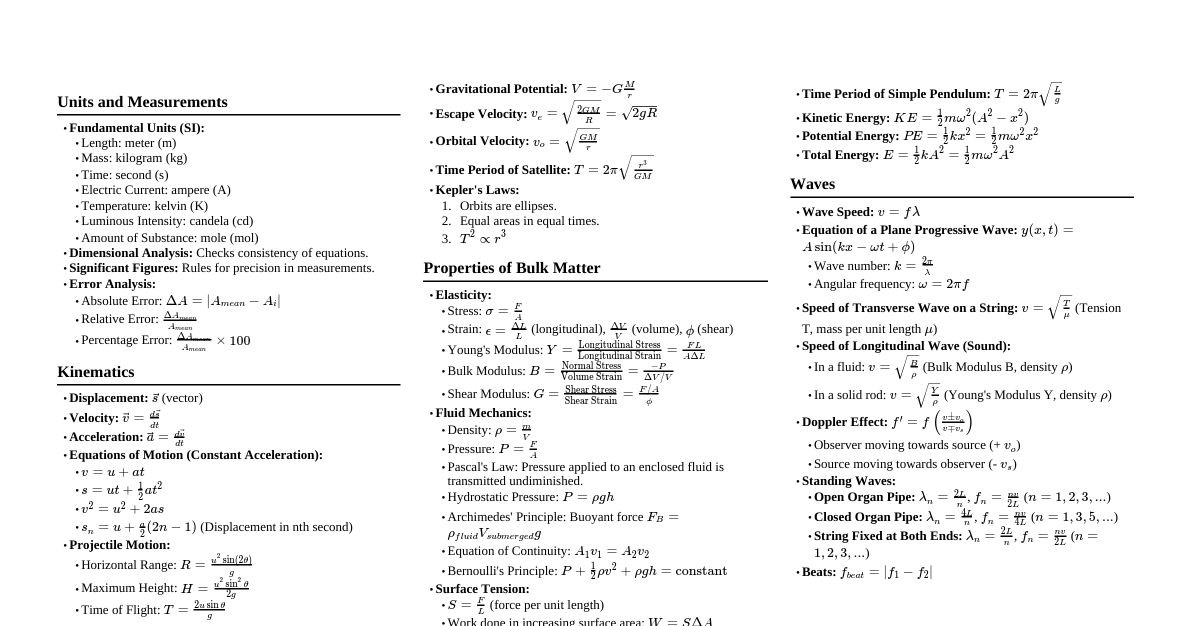
### Motion - **Definition:** Change in position of an object with respect to time. - **Types of Motion:** - **Uniform Motion:** Constant velocity, zero acceleration. - **Non-Uniform Motion:** Changing velocity, non-zero acceleration. - **Key Terms & Formulas:** - **Distance (d):** Total path length covered. Scalar quantity. Unit: meter (m). - **Displacement (s):** Shortest distance from initial to final position. Vector quantity. Unit: meter (m). - **Speed (v):** Distance covered per unit time. $v = \frac{d}{t}$. Scalar. Unit: m/s. - **Velocity ($\vec{v}$):** Displacement per unit time. $\vec{v} = \frac{\vec{s}}{t}$. Vector. Unit: m/s. - **Acceleration ($\vec{a}$):** Rate of change of velocity. $\vec{a} = \frac{\vec{v} - \vec{u}}{t}$. Vector. Unit: m/s$^2$. - Positive acceleration: Velocity increases. - Negative acceleration (retardation/deceleration): Velocity decreases. - **Equations of Motion (for uniformly accelerated motion):** 1. $v = u + at$ 2. $s = ut + \frac{1}{2}at^2$ 3. $v^2 = u^2 + 2as$ Where: $u$ = initial velocity, $v$ = final velocity, $a$ = acceleration, $t$ = time, $s$ = displacement. - **Graphical Representation:** - **Distance-Time Graph:** - Slope = Speed. - Straight line = Uniform speed. - Curved line = Non-uniform speed. - **Velocity-Time Graph:** - Slope = Acceleration. - Area under graph = Displacement. - Straight line (constant slope) = Uniform acceleration. - Horizontal line = Uniform velocity (zero acceleration). - Curved line = Non-uniform acceleration. ### Force and Laws of Motion - **Force:** An external agent that can change or tend to change the state of rest or motion of an object. Unit: Newton (N). - **Balanced Forces:** Net force is zero; does not cause change in state of motion. - **Unbalanced Forces:** Net force is non-zero; causes change in state of motion (acceleration). - **Newton's Laws of Motion:** 1. **First Law (Law of Inertia):** An object at rest stays at rest, and an object in motion stays in motion with the same speed and in the same direction unless acted upon by an unbalanced force. - **Inertia:** Tendency of an object to resist changes in its state of motion. - Inertia of Rest: Resists change from rest. - Inertia of Motion: Resists change from motion. - Inertia of Direction: Resists change in direction. - Mass is a measure of inertia. 2. **Second Law:** The rate of change of momentum of an object is directly proportional to the applied unbalanced force in the direction of the force. - $F = ma$ (Force = mass $\times$ acceleration) - **Momentum ($\vec{p}$):** Product of mass and velocity. $\vec{p} = m\vec{v}$. Vector. Unit: kg m/s. - Change in momentum: $\Delta p = m(v-u)$. 3. **Third Law:** To every action, there is an equal and opposite reaction. - Forces always occur in pairs. Action and reaction forces act on different bodies. - **Conservation of Momentum:** In an isolated system (no external forces), the total momentum before and after an interaction remains constant. - $m_1 u_1 + m_2 u_2 = m_1 v_1 + m_2 v_2$ - Applications: Recoil of a gun, collisions. ### Gravitation - **Universal Law of Gravitation (Newton):** Every object in the universe attracts every other object with a force that is directly proportional to the product of their masses and inversely proportional to the square of the distance between their centers. - $F = G \frac{m_1 m_2}{r^2}$ - $G$ = Universal Gravitational Constant = $6.67 \times 10^{-11} \text{ Nm}^2/\text{kg}^2$. - **Free Fall:** Motion of objects under the influence of gravity alone. - Acceleration due to gravity ($g$): - On Earth's surface, $g \approx 9.8 \text{ m/s}^2$. - Value changes with altitude and depth. - Equations of motion for free fall: (replace $a$ with $g$) 1. $v = u + gt$ 2. $h = ut + \frac{1}{2}gt^2$ 3. $v^2 = u^2 + 2gh$ - For upward motion, use $-g$. For downward motion, use $+g$. - **Mass (m):** Amount of matter in an object. Scalar. Constant everywhere. Unit: kg. - **Weight (W):** Force with which an object is attracted towards the Earth. $W = mg$. Vector. Unit: Newton (N). - Weight changes with $g$. Weight on Moon $\approx \frac{1}{6}$ Weight on Earth. - **Thrust:** Force acting perpendicular to a surface. Unit: N. - **Pressure:** Force per unit area. $P = \frac{F}{A}$. Unit: Pascal (Pa) or N/m$^2$. - Pressure in fluids increases with depth. - **Buoyancy (Upthrust):** Upward force exerted by a fluid on an immersed object. - **Archimedes' Principle:** When an object is wholly or partially immersed in a fluid, it experiences an upward force (buoyant force) that is equal to the weight of the fluid displaced by it. - An object floats if its density is less than the fluid's density. - An object sinks if its density is more than the fluid's density. - An object remains suspended if its density is equal to the fluid's density. - **Relative Density:** Ratio of the density of a substance to the density of water (at $4^\circ\text{C}$). Unitless. - Relative Density = $\frac{\text{Density of substance}}{\text{Density of water}}$ ### Work, Energy, and Power - **Work (W):** Force acting on an object causes displacement in the direction of the force. - $W = F \times s \times \cos\theta$ (where $\theta$ is angle between force and displacement). - If force and displacement are in the same direction, $W = F \times s$. - Unit: Joule (J). 1 J = 1 Nm. - Work is zero if: (1) $F=0$, (2) $s=0$, (3) $\theta = 90^\circ$ (force perpendicular to displacement). - **Energy (E):** Capacity to do work. Unit: Joule (J). - **Kinetic Energy (KE):** Energy possessed by an object due to its motion. - $KE = \frac{1}{2}mv^2$ - **Potential Energy (PE):** Energy possessed by an object due to its position or state. - **Gravitational Potential Energy:** $PE = mgh$ (for an object at height $h$). - **Law of Conservation of Energy:** Energy can neither be created nor destroyed, but it can be transformed from one form to another. Total energy in an isolated system remains constant. - $KE + PE = \text{Constant}$ (for free falling object, neglecting air resistance). - **Power (P):** Rate at which work is done or energy is transferred. - $P = \frac{W}{t} = \frac{E}{t}$ - $P = F \times v$ (for constant velocity). - Unit: Watt (W). 1 W = 1 J/s. - Commercial unit of energy: kilowatt-hour (kWh). 1 kWh = $3.6 \times 10^6$ J. ### Sound - **Sound:** A form of energy that produces the sensation of hearing. Produced by vibrations. - **Wave Nature of Sound:** - **Longitudinal Wave:** Particles of the medium vibrate parallel to the direction of wave propagation. (Sound waves are longitudinal). - **Transverse Wave:** Particles of the medium vibrate perpendicular to the direction of wave propagation. (Light waves are transverse). - **Characteristics of a Sound Wave:** - **Wavelength ($\lambda$):** Distance between two consecutive compressions or rarefactions. Unit: m. - **Amplitude (A):** Maximum displacement of particles from their mean position. Determines loudness. Unit: m. - **Frequency ($\nu$ or $f$):** Number of oscillations per second. Determines pitch. Unit: Hertz (Hz). - **Time Period (T):** Time taken for one complete oscillation. $T = \frac{1}{\nu}$. Unit: s. - **Speed of Sound (v):** Distance covered by a sound wave per unit time. - $v = \lambda \times \nu$ - Speed of sound is maximum in solids, then liquids, then gases. - Speed of sound increases with temperature. - **Reflection of Sound:** - **Echo:** Repetition of sound due to reflection from a distant obstacle. - Minimum distance for distinct echo in air at $22^\circ\text{C}$ is $17.2$ m. - **Reverberation:** Persistence of sound due to multiple reflections in an enclosed space. - **Range of Hearing:** - **Audible Range:** 20 Hz to 20,000 Hz for humans. - **Infrasound:** Frequencies below 20 Hz. (e.g., elephants, whales). - **Ultrasound:** Frequencies above 20,000 Hz. (e.g., bats, dogs, medical imaging - SONAR). - **Applications of Ultrasound:** - Medical imaging (ultrasonography). - Industrial flaw detection. - SONAR (Sound Navigation And Ranging) - used to measure depths of oceans, locate underwater objects.