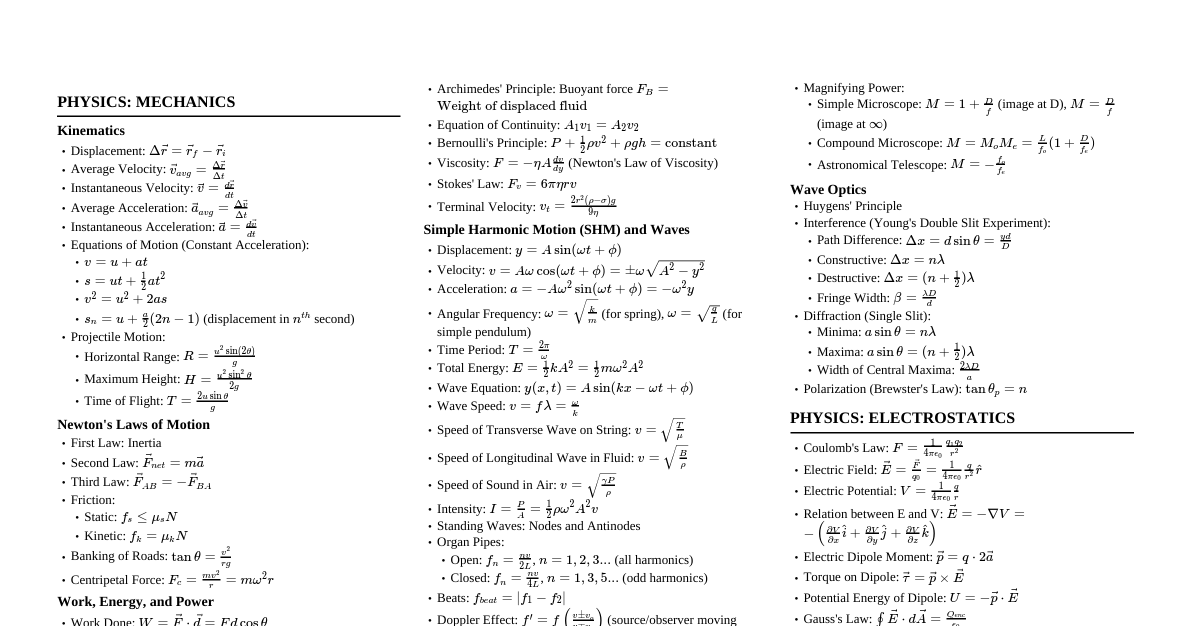
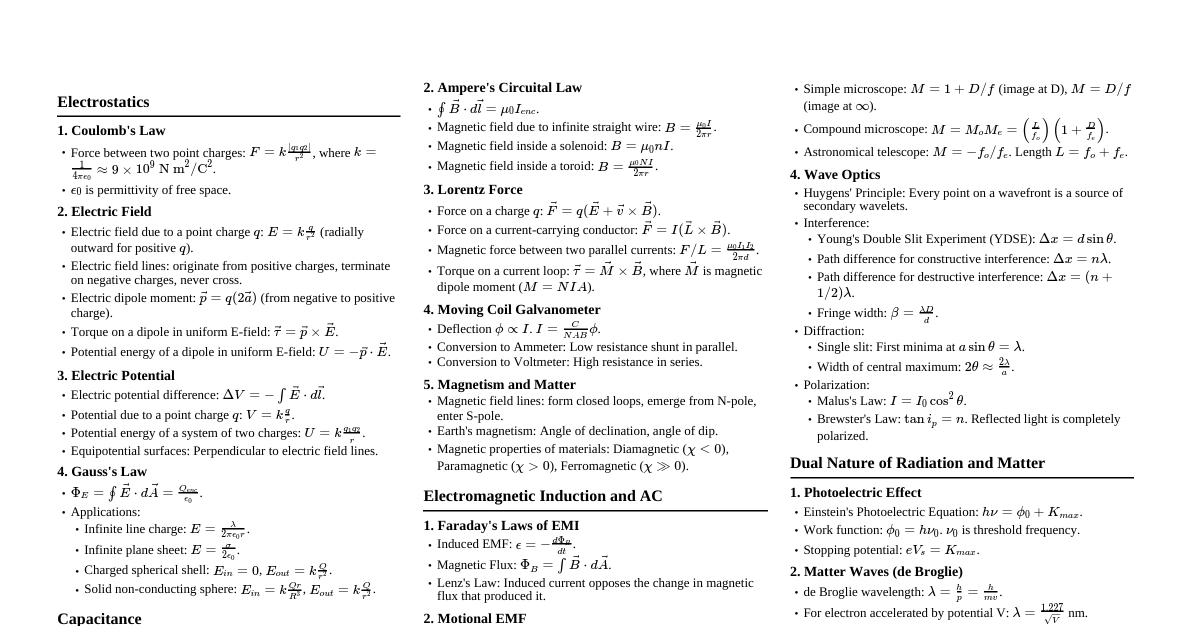
JEE Physics Cheatsheet 2026
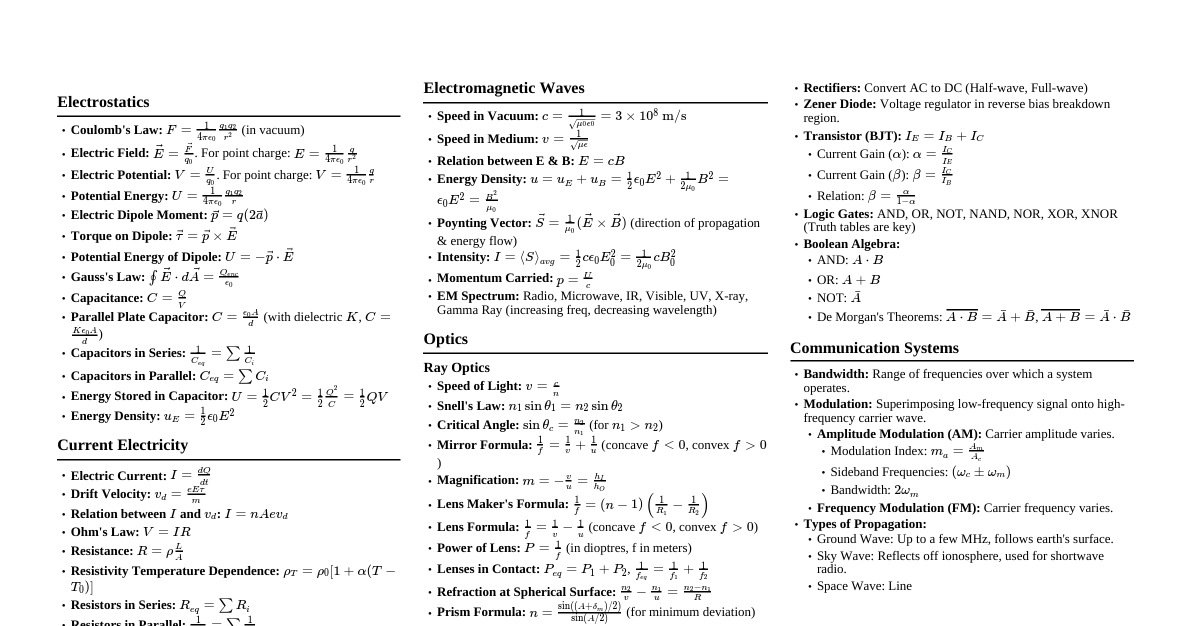
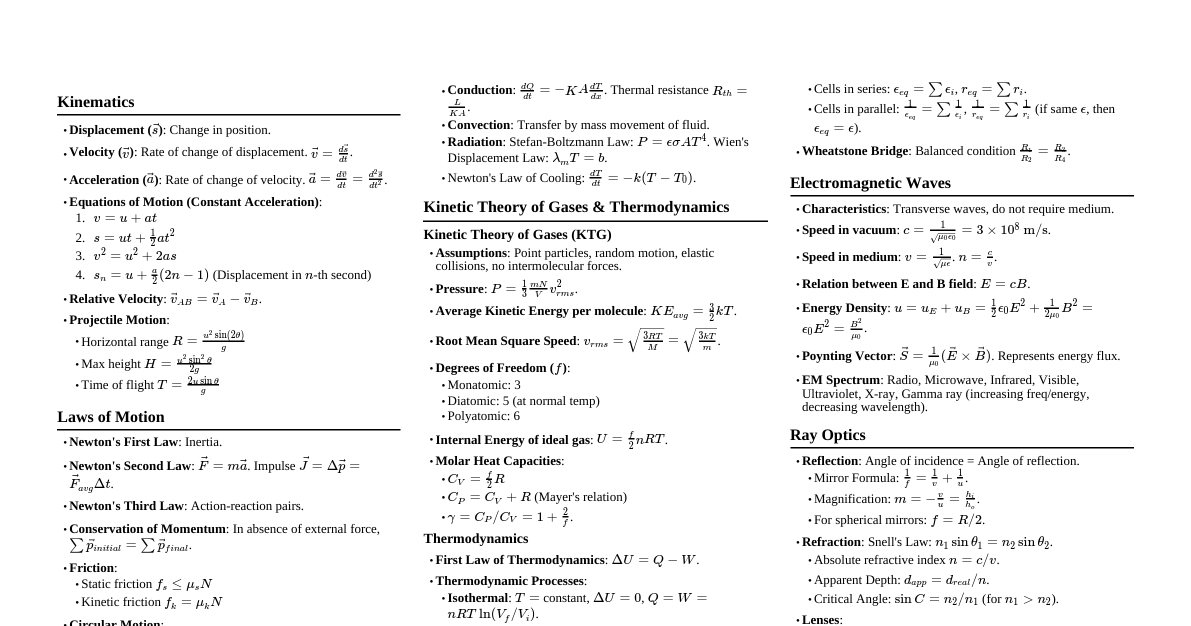
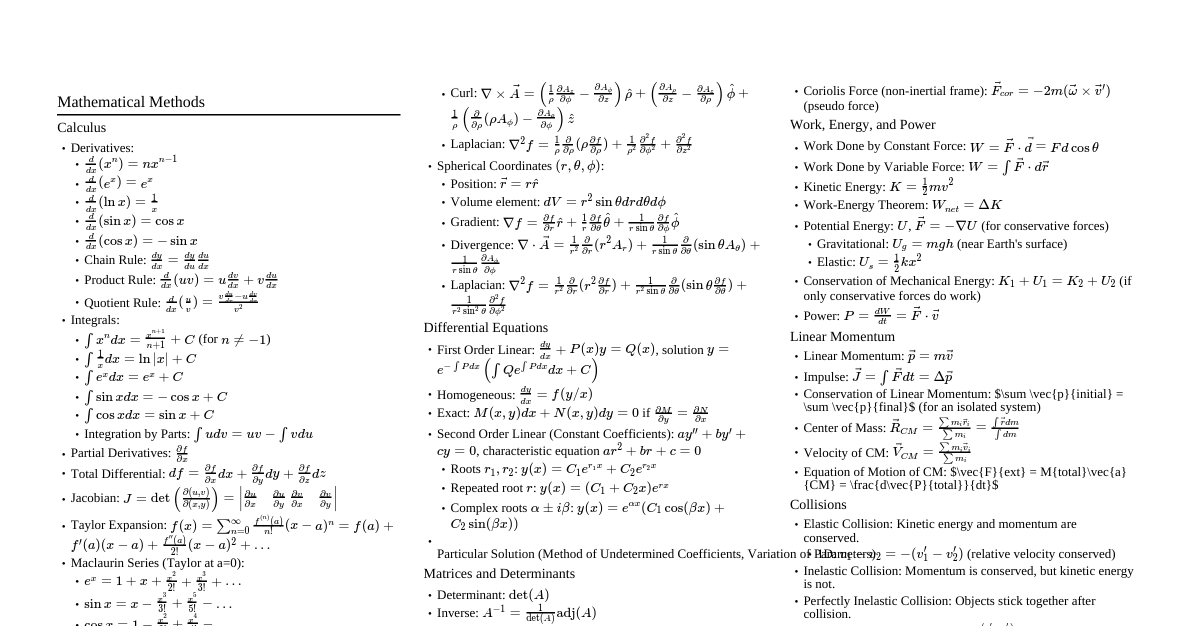
Cheatsheet Content
### How to Use This Cheatsheet This cheatsheet is designed for rapid revision and score maximization. - **[H]**: High-frequency, must-score topics. Prioritize. - **[M]**: Medium-frequency, important for good rank. - **[L]**: Less frequent but can be tricky, don't ignore. - Read through concepts, then memorize formulas, then practice numerical patterns. - Use Assertion-Reasoning sections to train critical thinking. - Regularly review edge cases and common traps. ### Units, Dimensions & Errors #### Units & Dimensions [H] - **Fundamental Quantities (7):** Mass (kg), Length (m), Time (s), Electric Current (A), Temperature (K), Luminous Intensity (cd), Amount of Substance (mol). - **Derived Units:** Combinations of fundamental units. - **Dimensional Formula:** $[M^a L^b T^c A^d K^e ...]$. - **Principle of Homogeneity:** Dimensions of each term in an equation must be the same. Used to check correctness of equations, derive relations. - **Same Physical Quantity:** Only quantities with same dimensions can be added or subtracted. - **Dimensionless Quantities:** Angle, strain, specific gravity, refractive index, Reynolds number. - Can be unitless (strain) or have units (angle: radian). - **Trigonometric, Logarithmic, Exponential functions:** Arguments must be dimensionless. - **Common Dimensions:** - Velocity: $[LT^{-1}]$ - Acceleration: $[LT^{-2}]$ - Force: $[MLT^{-2}]$ (Newton) - Work/Energy/Torque: $[ML^2T^{-2}]$ (Joule) - Power: $[ML^2T^{-3}]$ (Watt) - Pressure/Stress/Elastic Modulus: $[ML^{-1}T^{-2}]$ (Pascal) - Momentum/Impulse: $[MLT^{-1}]$ - Surface Tension: $[MT^{-2}]$ - Planck's Constant $(h)$: $[ML^2T^{-1}]$ - Permittivity of Free Space $(\epsilon_0)$: $[M^{-1}L^{-3}T^4A^2]$ - Permeability of Free Space $(\mu_0)$: $[MLT^{-2}A^{-2}]$ - Resistance $(R)$: $[ML^2T^{-3}A^{-2}]$ - Capacitance $(C)$: $[M^{-1}L^{-2}T^4A^2]$ - Inductance $(L)$: $[ML^2T^{-2}A^{-2}]$ #### Errors [H] - **Absolute Error ($\Delta A$):** $|A_{mean} - A_i|$. - **Mean Absolute Error ($\overline{\Delta A}$):** Average of absolute errors. - **Relative Error:** $\frac{\overline{\Delta A}}{A_{mean}}$. - **Percentage Error:** $\frac{\overline{\Delta A}}{A_{mean}} \times 100\%$. - **Propagation of Errors:** - **Addition/Subtraction:** $Z = A \pm B \implies \Delta Z = \Delta A + \Delta B$. (Absolute errors add) - **Multiplication/Division:** $Z = AB$ or $Z = A/B \implies \frac{\Delta Z}{Z} = \frac{\Delta A}{A} + \frac{\Delta B}{B}$. (Relative errors add) - **Power:** $Z = A^n \implies \frac{\Delta Z}{Z} = n \frac{\Delta A}{A}$. - **General:** If $Z = A^p B^q / C^r \implies \frac{\Delta Z}{Z} = p \frac{\Delta A}{A} + q \frac{\Delta B}{B} + r \frac{\Delta C}{C}$. - **Least Count (LC):** Smallest value that can be measured by an instrument. Error is often $\pm LC$ or $\pm LC/2$. - **Significant Figures:** 1. All non-zero digits are significant. 2. Zeros between non-zero digits are significant. 3. Leading zeros (before non-zero digits) are NOT significant. 4. Trailing zeros (at end of number) are significant if the number contains a decimal point. 5. Trailing zeros are NOT significant if no decimal point (e.g., 100 has 1 sig fig, 100.0 has 4). - **Addition/Subtraction:** Result has same number of decimal places as the number with the fewest decimal places. - **Multiplication/Division:** Result has same number of significant figures as the number with the fewest significant figures. - **Rounding Off:** 5 followed by non-zero digits: round up. 5 followed by zeros (or nothing): round up if preceding digit is odd, keep as is if even. - **[Insight]:** Errors always add up in magnitude. Percentage error is useful for multiplication/division. - **[Trap]:** For $Z = A \pm B$, percentage errors do NOT simply add. First find $\Delta Z$, then calculate percentage error. #### Experimental Physics Core - **Vernier Calipers:** - **LC:** (Value of 1 Main Scale Division (MSD)) / (Total number of Vernier Scale Divisions (VSD)). - **Reading:** MSD reading + (VSD coincidence $\times$ LC) - Zero Error. - **Zero Error:** Positive if zero of VSD is ahead of zero of MSD. Negative if behind. - **Screw Gauge:** - **LC:** (Pitch) / (Number of divisions on circular scale). Pitch = distance moved by screw for one full rotation. - **Reading:** Main Scale Reading (MSR) + (Circular Scale Reading (CSR) $\times$ LC) - Zero Error. - **[Insight]:** For both, zero error has to be *subtracted* algebraically. If zero error is positive, final reading is less. If negative, final reading is more. - **Graphs:** - **Slope:** $m = \frac{\Delta y}{\Delta x}$. Represents rate of change. - **Area:** $\int y \, dx$. Represents accumulated quantity. - **Linear graph ($y=mx+c$):** Slope $m$, Y-intercept $c$. - **Parabolic graph ($y=ax^2+bx+c$):** Curved. - **Hyperbolic graph ($y=a/x$):** Decreasing curve. ### Vectors [H] - **Scalar:** Magnitude only (mass, speed, distance, energy, time). - **Vector:** Magnitude and direction, obeys vector addition laws (displacement, velocity, force, acceleration, momentum, electric field). - **Representation:** $\vec{A} = A_x \hat{i} + A_y \hat{j} + A_z \hat{k}$. - **Magnitude:** $|\vec{A}| = \sqrt{A_x^2 + A_y^2 + A_z^2}$. - **Unit Vector:** $\hat{A} = \frac{\vec{A}}{|\vec{A}|}$. Direction only. - **Vector Addition (Triangle Law, Parallelogram Law):** - $\vec{R} = \vec{A} + \vec{B} \implies |\vec{R}| = \sqrt{A^2 + B^2 + 2AB \cos\theta}$. - Direction: $\tan\alpha = \frac{B \sin\theta}{A + B \cos\theta}$. - **Vector Subtraction:** $\vec{A} - \vec{B} = \vec{A} + (-\vec{B})$. Angle between $\vec{A}$ and $-\vec{B}$ is $(180^\circ - \theta)$. - **Dot Product (Scalar Product):** $\vec{A} \cdot \vec{B} = |\vec{A}||\vec{B}|\cos\theta = A_x B_x + A_y B_y + A_z B_z$. - Result is scalar. - If $\vec{A} \cdot \vec{B} = 0$ and $\vec{A}, \vec{B}$ are non-zero, then $\vec{A} \perp \vec{B}$. - $\hat{i} \cdot \hat{i} = \hat{j} \cdot \hat{j} = \hat{k} \cdot \hat{k} = 1$. - $\hat{i} \cdot \hat{j} = \hat{j} \cdot \hat{k} = \hat{k} \cdot \hat{i} = 0$. - **Cross Product (Vector Product):** $\vec{A} \times \vec{B} = |\vec{A}||\vec{B}|\sin\theta \hat{n}$. - Result is vector, $\hat{n}$ is unit vector perpendicular to plane of $\vec{A}$ and $\vec{B}$ (Right-Hand Thumb Rule). - Magnitude of $\vec{A} \times \vec{B}$ is area of parallelogram formed by $\vec{A}$ and $\vec{B}$. - If $\vec{A} \times \vec{B} = 0$ and $\vec{A}, \vec{B}$ are non-zero, then $\vec{A} \parallel \vec{B}$. - $\hat{i} \times \hat{i} = \hat{j} \times \hat{j} = \hat{k} \times \hat{k} = 0$. - $\hat{i} \times \hat{j} = \hat{k}$, $\hat{j} \times \hat{k} = \hat{i}$, $\hat{k} \times \hat{i} = \hat{j}$. - $\hat{j} \times \hat{i} = -\hat{k}$, etc. - Determinant form: $\vec{A} \times \vec{B} = \begin{vmatrix} \hat{i} & \hat{j} & \hat{k} \\ A_x & A_y & A_z \\ B_x & B_y & B_z \end{vmatrix}$. - **Resolution of Vectors:** A vector can be resolved into components along perpendicular axes. $A_x = A \cos\theta$, $A_y = A \sin\theta$. - **[Insight]:** Vector addition is commutative ($\vec{A}+\vec{B}=\vec{B}+\vec{A}$) and associative. Cross product is anti-commutative ($\vec{A} \times \vec{B} = - \vec{B} \times \vec{A}$). - **[Pattern]:** Finding angle between two vectors $\theta = \cos^{-1}\left(\frac{\vec{A} \cdot \vec{B}}{|\vec{A}||\vec{B}|}\right)$. - **[Trap]:** "Resultant of two forces is maximum when angle is $0^\circ$ (sum of magnitudes) and minimum when angle is $180^\circ$ (difference of magnitudes)." ### Kinematics [H] - **Position ($\vec{r}$):** Location of a particle. - **Displacement ($\Delta \vec{r}$):** Change in position ($\vec{r}_f - \vec{r}_i$). Vector quantity. - **Distance:** Total path length covered. Scalar quantity. - **Velocity ($\vec{v}$):** Rate of change of position. - **Average Velocity:** $\frac{\Delta \vec{r}}{\Delta t}$. - **Instantaneous Velocity:** $\vec{v} = \frac{d\vec{r}}{dt}$. - **Speed:** Magnitude of velocity. - **Average Speed:** $\frac{\text{Total distance}}{\text{Total time}}$. - **Acceleration ($\vec{a}$):** Rate of change of velocity. - **Average Acceleration:** $\frac{\Delta \vec{v}}{\Delta t}$. - **Instantaneous Acceleration:** $\vec{a} = \frac{d\vec{v}}{dt} = \frac{d^2\vec{r}}{dt^2}$. - **Kinematic Equations (Constant Acceleration):** 1. $v = u + at$ 2. $s = ut + \frac{1}{2}at^2$ 3. $v^2 = u^2 + 2as$ 4. $s = \left(\frac{u+v}{2}\right)t$ 5. $s_n = u + \frac{a}{2}(2n-1)$ (Displacement in $n^{th}$ second) - **Applicability:** ONLY when acceleration 'a' is constant. - **Units:** $u, v$ (m/s); $a$ (m/s$^2$); $s$ (m); $t$ (s). - **Motion under Gravity:** $a = -g$ (taking upward as positive). - Max height: $H = \frac{u^2}{2g}$. - Time of flight: $T = \frac{2u}{g}$. - **Relative Velocity:** - $\vec{v}_{AB} = \vec{v}_A - \vec{v}_B$. (Velocity of A with respect to B) - $\vec{v}_{BA} = \vec{v}_B - \vec{v}_A = -\vec{v}_{AB}$. - **1D:** If moving in same direction, $v_{rel} = |v_A - v_B|$. If opposite, $v_{rel} = v_A + v_B$. - **River-Boat Problems:** - **Boat w.r.t. river:** $\vec{v}_{br}$. - **River w.r.t. ground:** $\vec{v}_{rg}$. - **Boat w.r.t. ground:** $\vec{v}_{bg} = \vec{v}_{br} + \vec{v}_{rg}$. - **Minimum time to cross:** Boat rows perpendicular to river flow. $t_{min} = \frac{d}{v_{br}}$. Drift $x = v_{rg} \times t_{min}$. - **Minimum drift to cross:** Boat rows at angle $\theta$ such that $\vec{v}_{bg}$ is perpendicular to river flow. $v_{bg} = \sqrt{v_{br}^2 - v_{rg}^2}$. $t = \frac{d}{\sqrt{v_{br}^2 - v_{rg}^2}}$. Condition: $v_{br} > v_{rg}$. - **Rain-Man Problems:** $\vec{v}_{rain,man} = \vec{v}_{rain,ground} - \vec{v}_{man,ground}$. Man holds umbrella opposite to $\vec{v}_{rain,man}$. - **Projectile Motion:** - **Launch at angle $\theta$ with horizontal from ground:** - Time of flight: $T = \frac{2u \sin\theta}{g}$. - Maximum height: $H = \frac{u^2 \sin^2\theta}{2g}$. - Horizontal Range: $R = \frac{u^2 \sin(2\theta)}{g}$. Max range at $\theta=45^\circ$. - Equation of trajectory: $y = x \tan\theta - \frac{gx^2}{2u^2 \cos^2\theta}$. - **Launch from height H:** Use $y = H + (u \sin\theta)t - \frac{1}{2}gt^2$ for vertical motion, $x = (u \cos\theta)t$ for horizontal. - **Uniform Circular Motion:** - Speed $v$ constant, velocity direction changes. - Centripetal acceleration: $a_c = \frac{v^2}{r} = \omega^2 r$. Direction towards center. - Centripetal force: $F_c = m a_c = \frac{mv^2}{r} = m\omega^2 r$. - Angular velocity: $\omega = \frac{d\theta}{dt} = \frac{v}{r}$. - Angular acceleration: $\alpha = \frac{d\omega}{dt}$. - Tangential acceleration: $a_t = r\alpha$. Changes speed. - Total acceleration: $\vec{a} = \vec{a}_c + \vec{a}_t$. Magnitude $|\vec{a}| = \sqrt{a_c^2 + a_t^2}$. - **[Insight]:** Distance $\ge$ |Displacement|. Average speed $\ge$ |Average velocity|. - **[Insight]:** In projectile motion, horizontal velocity is constant ($u \cos\theta$), vertical velocity changes due to gravity. Acceleration is always $g$ downwards. - **[Trap]:** For relative velocity, remember to use vector subtraction. Don't just subtract magnitudes. - **[Trick]:** For projectile, range is same for $\theta$ and $(90^\circ - \theta)$. Max product of range and height for $\theta = 45^\circ$. - **[A/R]:** *Assertion:* A particle in uniform circular motion has constant speed. *Reason:* Its velocity is constant. (A: True, R: False, velocity direction changes). ### Newton's Laws of Motion (NLOM) [H] - **Newton's First Law (Law of Inertia):** An object at rest stays at rest, and an object in motion stays in motion with the same speed and in the same direction unless acted upon by an unbalanced force. Defines inertial frame. - **Newton's Second Law:** $\vec{F}_{net} = m\vec{a}$. - If $\vec{F}_{net} = 0$, then $\vec{a} = 0$. - Force is rate of change of momentum: $\vec{F} = \frac{d\vec{p}}{dt}$. - If mass is changing: $\vec{F} = m\frac{d\vec{v}}{dt} + \vec{v}\frac{dm}{dt}$. (Rocket propulsion) - Unit of force: Newton (N). $1 N = 1 kg \cdot m/s^2$. - **Newton's Third Law:** To every action, there is an equal and opposite reaction. - Action-reaction forces act on *different* bodies. - They are simultaneous. - They are always equal in magnitude and opposite in direction. - **Momentum ($\vec{p}$):** $\vec{p} = m\vec{v}$. Unit: kg m/s. - **Impulse ($\vec{J}$):** $\vec{J} = \int \vec{F} dt = \Delta \vec{p} = \vec{p}_f - \vec{p}_i$. - Impulse-Momentum Theorem: Impulse acting on an object equals the change in its momentum. - Unit: Ns or kg m/s. - **Forces:** - **Weight ($W$):** $W = mg$. Acts downwards. - **Normal Force ($N$):** Perpendicular to surface, prevents interpenetration. - **Tension ($T$):** Force transmitted through a string/cable/rope. Pulling force. - **Friction Force ($f$):** Opposes relative motion or tendency of relative motion. - **Static Friction ($f_s$):** $0 \le f_s \le \mu_s N$. Self-adjusting, acts when no relative motion. - **Kinetic Friction ($f_k$):** $f_k = \mu_k N$. Acts when there is relative motion. - Always $\mu_s \ge \mu_k$. - **Angle of Repose ($\theta_R$):** Angle at which block just begins to slide on inclined plane. $\tan\theta_R = \mu_s$. - **Angle of Friction ($\theta_f$):** Angle between resultant of normal reaction and friction force with normal reaction. $\tan\theta_f = \mu_s$. (For limiting friction) - **Free Body Diagram (FBD):** Diagram showing all forces acting *on* a single body. Essential for solving NLOM problems. - **Apparent Weight in a Lift:** - Lift stationary or constant velocity: $N = mg$. - Lift accelerating upwards: $N = m(g+a)$. Apparent weight increases. - Lift accelerating downwards: $N = m(g-a)$. Apparent weight decreases. - Lift in free-fall ($a=g$ downwards): $N = 0$. Apparent weight is zero (weightlessness). - **Connected Bodies:** Tension is internal force, cancels out for system. Acceleration same for all connected parts. - **Spring Force:** $F_s = -kx$. (Hooke's Law) $k$ is spring constant. - **[Insight]:** $\vec{F}_{net}=0$ implies constant velocity (including zero velocity). - **[Insight]:** Friction is proportional to normal force, not contact area. - **[Pattern]:** Block on inclined plane: resolve $mg$ into $mg\sin\theta$ (down plane) and $mg\cos\theta$ (perpendicular to plane). Normal force $N=mg\cos\theta$. - **[Trick]:** For Atwood machine/pulley systems, if rope is massless and inextensible, tension is same throughout the rope, and acceleration of connected masses is same. - **[Trap]:** Action-reaction pairs don't cancel because they act on *different* bodies. - **[A/R]:** *Assertion:* Static friction is a self-adjusting force. *Reason:* It acts only when object is about to move. (A: True, R: True, R is correct explanation of A). ### Work, Energy & Power [H] - **Work ($W$):** Done by a force $\vec{F}$ causing displacement $\vec{s}$. - $W = \vec{F} \cdot \vec{s} = Fs \cos\theta$. (Constant force) - $W = \int \vec{F} \cdot d\vec{s}$. (Variable force) - Unit: Joule (J). $1 J = 1 N \cdot m$. - Work can be positive, negative, or zero. - Positive: Force component in direction of displacement. - Negative: Force component opposite to direction of displacement (e.g., friction). - Zero: Force perpendicular to displacement (e.g., centripetal force). - **Energy:** Capacity to do work. Scalar quantity. Unit: Joule. - **Kinetic Energy (KE):** Energy due to motion. - $KE = \frac{1}{2}mv^2$. - **Work-Energy Theorem:** $W_{net} = \Delta KE = KE_f - KE_i$. - $W_{net}$ is work done by *all* forces. - **Potential Energy (PE):** Energy due to position or configuration. - **Gravitational PE:** $PE_g = mgh$. (Near Earth's surface) - **Elastic PE:** $PE_s = \frac{1}{2}kx^2$. (For a spring stretched/compressed by $x$) - **Conservative Forces:** Work done is independent of path, depends only on initial and final positions. Total mechanical energy is conserved. - Examples: Gravitational force, electrostatic force, spring force. - $W_c = -\Delta PE$. - **Non-Conservative Forces:** Work done depends on path. Mechanical energy is NOT conserved. - Examples: Friction, air resistance, viscous force. - $W_{nc} = \Delta E_{mech} = \Delta KE + \Delta PE$. - **Conservation of Mechanical Energy:** If only conservative forces do work, $KE_i + PE_i = KE_f + PE_f$. - **Power ($P$):** Rate of doing work. - $P = \frac{dW}{dt}$. - Average Power: $P_{avg} = \frac{W}{\Delta t}$. - Instantaneous Power: $P = \vec{F} \cdot \vec{v}$. - Unit: Watt (W). $1 W = 1 J/s$. - $1 \text{ horsepower (hp)} = 746 \text{ W}$. - **Vertical Circle Motion:** - Minimum speed at bottom to complete circle: $v_{bottom} = \sqrt{5gR}$. - Minimum speed at top to complete circle: $v_{top} = \sqrt{gR}$. - Tension at bottom: $T_{bottom} = 6mg$. - Tension at top: $T_{top} = 0$ (just completing circle). - **[Insight]:** Work done by non-conservative forces equals the change in total mechanical energy. - **[Insight]:** Power is a scalar, but $\vec{F} \cdot \vec{v}$ relates to its vector nature. - **[Proportionality]:** $KE \propto v^2$. If velocity doubles, KE becomes 4 times. - **[Trap]:** For variable force, always use integration $\int \vec{F} \cdot d\vec{s}$. For constant force, use $F s \cos\theta$. - **[A/R]:** *Assertion:* Work done by friction is always negative. *Reason:* Friction always opposes motion. (A: False, R: True. Work done by friction can be zero if no relative motion, or positive if friction aids motion in some frames, e.g., block on accelerating truck). ### Centre of Mass & Collisions [H] - **Centre of Mass (CM):** A point where entire mass of system is assumed to be concentrated. - **Discrete particles:** $\vec{r}_{CM} = \frac{\sum m_i \vec{r}_i}{\sum m_i}$. - $x_{CM} = \frac{\sum m_i x_i}{\sum m_i}$, $y_{CM} = \frac{\sum m_i y_i}{\sum m_i}$, $z_{CM} = \frac{\sum m_i z_i}{\sum m_i}$. - **Continuous bodies:** $\vec{r}_{CM} = \frac{\int \vec{r} dm}{\int dm}$. - $x_{CM} = \frac{\int x dm}{\int dm}$, etc. - **Velocity of CM:** $\vec{v}_{CM} = \frac{\sum m_i \vec{v}_i}{\sum m_i} = \frac{\vec{P}_{total}}{M_{total}}$. - **Acceleration of CM:** $\vec{a}_{CM} = \frac{\sum m_i \vec{a}_i}{\sum m_i} = \frac{\vec{F}_{ext}}{M_{total}}$. - **Conservation of Momentum:** If no external force acts on a system ($\vec{F}_{ext} = 0$), total linear momentum of the system remains constant ($\vec{P}_{total} = \text{constant}$). - $\vec{p}_1 + \vec{p}_2 + ... = \text{constant}$. - $\vec{v}_{CM}$ remains constant. - **Collisions:** Interaction between bodies, typically short duration. - **Momentum is ALWAYS conserved** in any collision (if no external forces). - **Kinetic Energy conservation depends on collision type.** - **Coefficient of Restitution ($e$):** $e = \frac{\text{Relative velocity of separation}}{\text{Relative velocity of approach}} = \frac{|v_2 - v_1|}{|u_1 - u_2|}$. - $0 \le e \le 1$. - **Types of Collisions:** 1. **Elastic Collision ($e=1$):** Both momentum and KE are conserved. - In 1D: $u_1 + v_1 = u_2 + v_2$. - Special case: If $m_1 = m_2$, then velocities exchange ($v_1=u_2, v_2=u_1$). - If $m_2 \gg m_1$ and $u_2=0$, then $v_1 \approx -u_1$ and $v_2 \approx 0$. - If $m_1 \gg m_2$ and $u_2=0$, then $v_1 \approx u_1$ and $v_2 \approx 2u_1$. 2. **Inelastic Collision ($0 ### Rotational Mechanics [H] - **Analogy with Linear Motion:** | Linear Quantity | Rotational Quantity | Relation | |-----------------|---------------------|----------| | Displacement $x$ | Angular displacement $\theta$ | $x = r\theta$ | | Velocity $v$ | Angular velocity $\omega$ | $v = r\omega$ | | Acceleration $a$ | Angular acceleration $\alpha$ | $a_t = r\alpha$ | | Mass $m$ | Moment of Inertia $I$ | $I = \sum m_i r_i^2$ | | Force $F$ | Torque $\tau$ | $\tau = rF\sin\theta$ | | Momentum $p$ | Angular Momentum $L$ | $L = I\omega$ | | KE = $\frac{1}{2}mv^2$ | KE = $\frac{1}{2}I\omega^2$ | | - **Torque ($\vec{\tau}$):** Rotational analogue of force. $\vec{\tau} = \vec{r} \times \vec{F}$. - Magnitude: $\tau = rF\sin\theta = F \cdot r_\perp = r \cdot F_\perp$. ($r_\perp$ is perpendicular distance from axis to line of action of force). - Unit: N m. - **Newton's Second Law for Rotation:** $\vec{\tau}_{net} = I\vec{\alpha}$. - **Moment of Inertia ($I$):** Rotational analogue of mass. Resistance to change in rotational motion. - **Discrete particles:** $I = \sum m_i r_i^2$. - **Continuous bodies:** $I = \int r^2 dm$. - **Radius of Gyration ($K$):** $I = MK^2$. - **Parallel Axis Theorem:** $I = I_{CM} + Md^2$. ($I_{CM}$ is MOI about CM, $d$ is distance between axes). - **Perpendicular Axis Theorem (for planar bodies):** $I_z = I_x + I_y$. (If $x, y$ axes are in plane, $z$ axis is perpendicular to plane). - **Angular Momentum ($\vec{L}$):** $\vec{L} = \vec{r} \times \vec{p} = \vec{r} \times (m\vec{v})$. - For rigid body: $\vec{L} = I\vec{\omega}$. - **Conservation of Angular Momentum:** If $\vec{\tau}_{ext} = 0$, then $\vec{L}_{total} = \text{constant}$. - $I_1\omega_1 = I_2\omega_2$. - **Rotational Kinematic Equations (Constant Angular Acceleration $\alpha$):** 1. $\omega = \omega_0 + \alpha t$ 2. $\theta = \omega_0 t + \frac{1}{2}\alpha t^2$ 3. $\omega^2 = \omega_0^2 + 2\alpha\theta$ - **Rolling Motion (without slipping):** - $v_{CM} = R\omega$. - $a_{CM} = R\alpha$. - Total Kinetic Energy: $KE_{total} = KE_{translational} + KE_{rotational} = \frac{1}{2}Mv_{CM}^2 + \frac{1}{2}I_{CM}\omega^2$. - $KE_{total} = \frac{1}{2}Mv_{CM}^2 \left(1 + \frac{K^2}{R^2}\right)$. - **Acceleration of rolling body on incline:** $a = \frac{g\sin\theta}{1 + K^2/R^2}$. (Smaller $K^2/R^2$ means faster roll). - **Friction in rolling:** Static friction is required for pure rolling. No work done by static friction. - **Equilibrium:** - **Translational Equilibrium:** $\sum \vec{F} = 0$. - **Rotational Equilibrium:** $\sum \vec{\tau} = 0$. - For a body to be in complete equilibrium, both conditions must be met. - **[Insight]:** MOI depends on mass distribution and axis of rotation. - **[Insight]:** For rolling without slipping, the point of contact with the ground is instantaneously at rest. - **[Proportionality]:** For a given torque, angular acceleration $\alpha \propto 1/I$. More inertia, less acceleration. - **[Pattern]:** Comparing rolling bodies on an incline: Solid sphere ($K^2/R^2=2/5$), disc ($K^2/R^2=1/2$), ring ($K^2/R^2=1$). Sphere rolls fastest, ring slowest. - **[Trick]:** When calculating torque, choose axis of rotation smartly to eliminate unknown forces (e.g., normal force, hinge force). - **[Trap]:** Use $I_{CM}$ for rotational KE and for rolling motion formulas, NOT $I$ about point of contact. - **[A/R]:** *Assertion:* A solid sphere rolls down an incline faster than a hollow sphere of same mass and radius. *Reason:* The solid sphere has a smaller moment of inertia about its diameter compared to the hollow sphere. (A: True, R: True, R is correct explanation of A). ### Gravitation [H] - **Newton's Law of Universal Gravitation:** $F = G \frac{m_1 m_2}{r^2}$. - $G = 6.67 \times 10^{-11} N m^2/kg^2$. - Force is always attractive. Acts along line joining centers. - **Acceleration due to gravity ($g$):** - On Earth's surface: $g = G \frac{M_E}{R_E^2}$. - **Variation with altitude ($h$):** $g_h = g \left(1 - \frac{2h}{R_E}\right)$ for $h \ll R_E$. - More accurately: $g_h = g \left(\frac{R_E}{R_E+h}\right)^2$. - **Variation with depth ($d$):** $g_d = g \left(1 - \frac{d}{R_E}\right)$. - At center of Earth, $g=0$. - **Variation with latitude ($\lambda$):** $g_\lambda = g - R_E \omega^2 \cos^2\lambda$. - Max $g$ at poles ($\lambda=90^\circ$), Min $g$ at equator ($\lambda=0^\circ$). - **Gravitational Potential Energy ($PE_g$):** Work done to bring a mass from infinity to a point. - $PE_g = -\frac{GMm}{r}$. (Reference at infinity, $PE=0$) - Change in PE: $\Delta PE_g = GMm \left(\frac{1}{r_1} - \frac{1}{r_2}\right)$. - **Gravitational Potential ($V_g$):** $V_g = -\frac{GM}{r}$. (PE per unit mass). Unit: J/kg. - **Escape Velocity ($v_e$):** Minimum velocity required to escape Earth's gravitational field. - $v_e = \sqrt{\frac{2GM}{R}} = \sqrt{2gR}$. - For Earth: $v_e \approx 11.2 \text{ km/s}$. - **Orbital Velocity ($v_o$):** Velocity required to maintain a stable orbit at radius $r$. - For circular orbit: $\frac{mv_o^2}{r} = \frac{GMm}{r^2} \implies v_o = \sqrt{\frac{GM}{r}}$. - Note: $v_e = \sqrt{2} v_o$. - **Time Period of Satellite ($T$):** - $T = \frac{2\pi r}{v_o} = 2\pi \sqrt{\frac{r^3}{GM}}$. - **Kepler's Third Law:** $T^2 \propto r^3$. - **Energy of Satellite in Orbit:** - $KE = \frac{1}{2}mv_o^2 = \frac{GMm}{2r}$. - $PE = -\frac{GMm}{r}$. - Total Energy: $E = KE + PE = -\frac{GMm}{2r}$. - **[Insight]:** Total energy of orbiting satellite is negative, indicating bound state. - **Geostationary Satellite:** - Period $T=24$ hours. - Orbits in equatorial plane. - Height from Earth's surface: $\approx 36000$ km. - **Weightlessness:** Occurs when effective $g=0$ (e.g., free fall, orbiting satellite). - **[Insight]:** Gravitational field is conservative. Work done by gravity depends only on initial and final positions. - **[Proportionality]:** $F \propto 1/r^2$. If distance doubles, force becomes 1/4. - **[Trap]:** Don't confuse $g$ variation formulas. For altitude, use $(1-2h/R)$ for small $h$, otherwise use $(R/(R+h))^2$. For depth, it's linear. - **[Trick]:** For a point *inside* a uniform spherical shell, $F=0$ and $V_g = -\frac{GM}{R}$ (constant). - **[A/R]:** *Assertion:* The value of $g$ is maximum at the poles and minimum at the equator. *Reason:* Earth is not a perfect sphere and rotates about its axis. (A: True, R: True, R is correct explanation of A). ### Properties of Matter #### Elasticity [M] - **Stress ($\sigma$):** Restoring force per unit area. $\sigma = F/A$. Unit: Pa or N/m$^2$. - **Normal Stress:** Perpendicular to surface (tensile or compressive). - **Shearing Stress:** Tangential to surface. - **Strain ($\epsilon$):** Fractional change in dimension. Dimensionless. - **Longitudinal Strain:** $\Delta L/L$. - **Volume Strain:** $\Delta V/V$. - **Shearing Strain:** $\phi = x/h$. (Angle of shear). - **Hooke's Law:** Stress $\propto$ Strain (within elastic limit). - **Modulus of Elasticity ($E$):** Ratio of stress to strain. - **Young's Modulus ($Y$):** $Y = \frac{\text{Longitudinal Stress}}{\text{Longitudinal Strain}} = \frac{F/A}{\Delta L/L}$. For solids only. - **Bulk Modulus ($B$):** $B = \frac{\text{Normal Stress}}{\text{Volume Strain}} = \frac{-P}{\Delta V/V}$. For solids, liquids, gases. ($P$ is pressure). - **Compressibility:** $K = 1/B$. - **Shear Modulus ($G$ or $\eta$):** $G = \frac{\text{Shearing Stress}}{\text{Shearing Strain}} = \frac{F_t/A}{\phi}$. For solids only. - **Poisson's Ratio ($\nu$):** $\nu = -\frac{\text{Lateral Strain}}{\text{Longitudinal Strain}}$. Dimensionless. $0 \le \nu \le 0.5$. - **Relationships between elastic constants:** - $Y = 3B(1-2\nu)$ - $Y = 2G(1+\nu)$ - $Y = \frac{9BG}{3B+G}$ - **Elastic Potential Energy (per unit volume):** $U = \frac{1}{2} \text{Stress} \times \text{Strain} = \frac{1}{2} Y (\text{Strain})^2 = \frac{1}{2Y} (\text{Stress})^2$. - **Breaking Stress:** Maximum stress a material can withstand before breaking. - **[Insight]:** A stiffer material has a higher Young's Modulus. Rubber is more elastic than steel (recovers shape faster), but steel is more elastic in terms of Young's Modulus (requires more stress for same strain). - **[Trap]:** Elasticity refers to the ability to regain original shape, not how easily it stretches. #### Fluids [H] - **Pressure ($P$):** Force per unit area. $P = F/A$. Unit: Pa or N/m$^2$. - **Pressure at depth $h$ in a fluid:** $P = P_0 + \rho gh$. ($P_0$ is atmospheric pressure, $\rho$ is fluid density). - **Pascal's Law:** Pressure applied to an enclosed incompressible fluid is transmitted undiminished to every portion of the fluid and the walls of the containing vessel. - Hydraulic lift: $F_1/A_1 = F_2/A_2$. - **Archimedes' Principle:** Buoyant force $F_B$ = Weight of fluid displaced = $\rho_{fluid} V_{submerged} g$. - Acts upwards through the center of buoyancy (CM of displaced fluid). - Floating: $F_B = W_{object}$. $\rho_{object} V_{object} g = \rho_{fluid} V_{submerged} g \implies \frac{V_{submerged}}{V_{object}} = \frac{\rho_{object}}{\rho_{fluid}}$. - **Equation of Continuity:** For incompressible, non-viscous fluid in steady flow: $A_1 v_1 = A_2 v_2 = \text{constant}$. (Volume flow rate $Q = Av$ is constant). - **[Insight]:** Where area is smaller, velocity is higher. - **Bernoulli's Principle:** For streamline flow of an ideal fluid: $P + \frac{1}{2}\rho v^2 + \rho gh = \text{constant}$. - **Applicability:** Incompressible, non-viscous, steady, streamline flow. - **[Insight]:** If velocity increases, pressure decreases (and vice versa) for same height. - **Torricelli's Law:** Velocity of efflux from an orifice at depth $h$ below free surface: $v = \sqrt{2gh}$. (From Bernoulli's, assuming $P=P_0$ at both surfaces, and $v_{top} \approx 0$). - **Range of efflux:** $x = 2\sqrt{h(H-h)}$. (Max range at $h=H/2$). - **[Trap]:** Bernoulli's principle applies along a streamline, not necessarily between two points across different streamlines if there's turbulence or viscosity. #### Surface Tension [M] - **Surface Tension ($S$ or $\sigma$ or $T$):** Force per unit length acting perpendicular to an imaginary line on the surface of a liquid. - $S = F/L$. Unit: N/m. - Also defined as surface energy per unit area. $S = E/A$. Unit: J/m$^2$. (Numerically equal). - **Surface Energy:** Energy required to increase the surface area of a liquid. - Work done $W = S \Delta A$. - **Excess Pressure inside a liquid drop/bubble:** - **Liquid Drop:** $\Delta P = \frac{2S}{R}$. (One free surface) - **Soap Bubble:** $\Delta P = \frac{4S}{R}$. (Two free surfaces) - **Air Bubble in liquid:** $\Delta P = \frac{2S}{R}$. (One free surface) - **Capillary Action:** Rise or fall of liquid in a narrow tube. - **Capillary Rise/Fall Formula:** $h = \frac{2S \cos\theta}{\rho gr}$. - $\theta$: Angle of contact. - If $\theta 90^\circ$ (non-wetting liquid, e.g., mercury-glass), $h$ is negative (fall). - If $\theta = 90^\circ$, $h=0$. - **Angle of Contact ($\theta$):** Angle between tangent to liquid surface and solid surface inside the liquid. - **[Insight]:** Surface tension arises from cohesive forces between liquid molecules. Molecules at surface have higher potential energy. - **[Proportionality]:** Capillary rise $h \propto 1/r$. Narrower tube, higher rise. - **[Trap]:** Remember factor of 2 for soap bubble's two free surfaces when calculating excess pressure. #### Viscosity [L] - **Viscosity ($\eta$):** Internal friction in a fluid. Resistance to flow. - **Viscous Force ($F_v$):** $F_v = -\eta A \frac{dv}{dy}$. (Newton's Law of Viscosity). - $\frac{dv}{dy}$ is velocity gradient. - Unit: Poiseuille (Pl) or N s/m$^2$ or Pa s. (1 Poise = 0.1 Pa s). - **Stoke's Law:** Viscous force on a spherical body of radius $r$ moving with velocity $v$ in a fluid: $F_v = 6\pi \eta r v$. - **Terminal Velocity ($v_T$):** Constant velocity attained by a body falling through a viscous fluid when viscous force + buoyant force = gravitational force. - $v_T = \frac{2r^2 (\rho_p - \rho_f) g}{9\eta}$. ($\rho_p$ is density of particle, $\rho_f$ is density of fluid). - **[Insight]:** Terminal velocity is reached when net force is zero. - **[Proportionality]:** $v_T \propto r^2$. Larger particles fall faster. - **[Trap]:** Remember to include buoyant force in terminal velocity calculations. ### Oscillations (SHM, Damped, Forced) [H] #### Simple Harmonic Motion (SHM) [H] - **Definition:** A special type of periodic motion where the restoring force is directly proportional to the displacement from the equilibrium position and acts opposite to the displacement. $F = -kx$. - **Differential Equation:** $\frac{d^2x}{dt^2} + \omega^2 x = 0$. - **Displacement:** $x(t) = A \sin(\omega t + \phi)$ or $x(t) = A \cos(\omega t + \phi)$. - $A$: Amplitude (maximum displacement). - $\omega$: Angular frequency (rad/s). $\omega = \sqrt{k/m}$. - $\phi$: Initial phase. - **Velocity:** $v(t) = \frac{dx}{dt} = A\omega \cos(\omega t + \phi) = \pm \omega \sqrt{A^2 - x^2}$. - Max velocity: $v_{max} = A\omega$ (at equilibrium $x=0$). - **Acceleration:** $a(t) = \frac{dv}{dt} = -A\omega^2 \sin(\omega t + \phi) = -\omega^2 x$. - Max acceleration: $a_{max} = A\omega^2$ (at extreme positions $x=\pm A$). - **Time Period ($T$):** Time for one complete oscillation. $T = \frac{2\pi}{\omega}$. - For spring-mass system: $T = 2\pi \sqrt{m/k}$. - For simple pendulum: $T = 2\pi \sqrt{L/g}$ (for small angles). - For compound pendulum: $T = 2\pi \sqrt{I/mgd}$. - For torsion pendulum: $T = 2\pi \sqrt{I/C}$. - **Frequency ($f$ or $\nu$):** Number of oscillations per second. $f = 1/T = \omega/2\pi$. Unit: Hz. - **Energy in SHM:** - **Kinetic Energy:** $KE = \frac{1}{2}mv^2 = \frac{1}{2}m\omega^2(A^2-x^2)$. - **Potential Energy:** $PE = \frac{1}{2}kx^2 = \frac{1}{2}m\omega^2 x^2$. - **Total Energy:** $E = KE + PE = \frac{1}{2}kA^2 = \frac{1}{2}m\omega^2 A^2$. - **[Insight]:** Total energy is constant and proportional to square of amplitude. - **Springs in series/parallel:** - **Series:** $\frac{1}{k_{eq}} = \frac{1}{k_1} + \frac{1}{k_2} + ...$ (Effective spring is softer, $T$ increases). - **Parallel:** $k_{eq} = k_1 + k_2 + ...$ (Effective spring is stiffer, $T$ decreases). - **[Insight]:** SHM is projection of uniform circular motion on a diameter. - **[Pattern]:** Oscillations of liquid in U-tube: $T = 2\pi \sqrt{L/(2g)}$, where $L$ is total liquid column length. - **[Trap]:** Small angle approximation for pendulum ($\sin\theta \approx \theta$) is crucial for SHM. - **[A/R]:** *Assertion:* The time period of a simple pendulum increases with the length of the pendulum. *Reason:* The restoring force on the pendulum bob is proportional to its displacement from the mean position. (A: True, R: True, but R is not the correct explanation of A. R explains SHM, A is specific to pendulum). #### Damped & Forced Oscillations [M] - **Damped Oscillations:** Oscillations where amplitude decreases over time due to dissipative forces (e.g., friction, air resistance). - Damping force: $F_d = -bv$. ($b$ is damping constant). - Equation: $m\frac{d^2x}{dt^2} + b\frac{dx}{dt} + kx = 0$. - Displacement: $x(t) = A_0 e^{-bt/2m} \cos(\omega' t + \phi)$. - Angular frequency of damped oscillation: $\omega' = \sqrt{\omega_0^2 - (b/2m)^2}$. ($\omega_0 = \sqrt{k/m}$). - **[Insight]:** Energy is lost to the damping medium. - **Forced Oscillations:** An external periodic force drives the oscillator. - Equation: $m\frac{d^2x}{dt^2} + b\frac{dx}{dt} + kx = F_0 \sin(\omega_d t)$. ($\omega_d$ is driving frequency). - Steady-state amplitude: $A = \frac{F_0}{\sqrt{m^2(\omega_d^2 - \omega_0^2)^2 + b^2\omega_d^2}}$. - **Resonance:** Occurs when driving frequency ($\omega_d$) is equal or very close to the natural frequency ($\omega_0$) of the oscillator. - Amplitude becomes maximum. - **[Insight]:** Damping reduces the amplitude at resonance and broadens the resonance peak. - **Quality Factor ($Q$):** Measure of damping. $Q = \frac{\omega_0}{\Delta\omega} = \frac{\omega_0 m}{b}$. - High Q factor means less damping, sharper resonance. - **[Trap]:** Natural frequency vs. damped frequency vs. driving frequency. Resonance occurs at natural frequency. ### Waves & Sound [H] #### Wave Motion [H] - **Wave:** Disturbance that propagates through a medium, transferring energy without transferring matter. - **Types of Waves:** - **Transverse:** Oscillations perpendicular to wave propagation (e.g., light, string waves). - **Longitudinal:** Oscillations parallel to wave propagation (e.g., sound). - **Wave Equation (1D):** $y(x,t) = A \sin(kx - \omega t + \phi)$. - $A$: Amplitude. - $k$: Angular wave number = $2\pi/\lambda$. ($\lambda$ is wavelength). - $\omega$: Angular frequency = $2\pi f$. ($f$ is frequency). - $v$: Wave speed = $\omega/k = f\lambda$. - $\phi$: Initial phase. - **Speed of Transverse Wave on a String:** $v = \sqrt{T/\mu}$. ($T$ is tension, $\mu$ is linear mass density $m/L$). - **Speed of Sound (Longitudinal Wave):** - In solids: $v = \sqrt{Y/\rho}$. - In liquids: $v = \sqrt{B/\rho}$. - In gases: $v = \sqrt{\gamma P/\rho} = \sqrt{\gamma RT/M}$. ($\gamma = C_p/C_v$). - **Intensity of Wave ($I$):** Power transmitted per unit area. $I = \frac{1}{2}\rho v \omega^2 A^2$. - **[Proportionality]:** $I \propto A^2$. - **Principle of Superposition:** When two or more waves overlap, the resultant displacement at any point and time is the vector sum of the displacements due to individual waves. - **Interference:** Superposition producing a resultant wave of greater, smaller, or same amplitude. - **Constructive:** Phase difference $\Delta\phi = 2n\pi$, path difference $\Delta x = n\lambda$. - **Destructive:** Phase difference $\Delta\phi = (2n+1)\pi$, path difference $\Delta x = (n+1/2)\lambda$. - **Standing Waves (Stationary Waves):** Formed by superposition of two identical waves traveling in opposite directions. - **Nodes:** Points of zero displacement (constant, maximum pressure variation). - **Antinodes:** Points of maximum displacement (constant, minimum pressure variation). - Distance between consecutive node-antinode: $\lambda/4$. - Distance between consecutive nodes/antinodes: $\lambda/2$. - **String fixed at both ends:** - Fundamental frequency (1st harmonic): $f_1 = \frac{v}{2L}$. - Overtones: $f_n = n f_1 = n \frac{v}{2L}$. (All harmonics are present). - **Open Organ Pipe (open at both ends):** - Fundamental frequency: $f_1 = \frac{v}{2L}$. - Overtones: $f_n = n f_1 = n \frac{v}{2L}$. (All harmonics are present). - **Closed Organ Pipe (closed at one end):** - Fundamental frequency: $f_1 = \frac{v}{4L}$. - Overtones: $f_n = (2n-1) f_1 = (2n-1) \frac{v}{4L}$. (Only odd harmonics are present). - **[Insight]:** End correction for pipes: $L_{eff} = L + 0.6r$. - **Beats:** Produced by superposition of two waves of slightly different frequencies. - Beat frequency: $f_{beat} = |f_1 - f_2|$. - **[Insight]:** Used for tuning musical instruments. - **Doppler Effect:** Apparent change in frequency of sound (or light) due to relative motion between source and observer. - $f' = f \left(\frac{v \pm v_O}{v \mp v_S}\right)$. - $v$: speed of sound in medium. - $v_O$: speed of observer. - $v_S$: speed of source. - Use '+' for $v_O$ if observer moves towards source, '-' if away. - Use '-' for $v_S$ if source moves towards observer, '+' if away. - **Special Case (Observer moving, source stationary):** $f' = f \left(1 \pm \frac{v_O}{v}\right)$. - **Special Case (Source moving, observer stationary):** $f' = f \left(\frac{v}{v \mp v_S}\right)$. - **Shock Waves:** Formed when source moves faster than speed of sound (supersonic). - Mach number: $M = v_S/v$. - **[Insight]:** For waves, frequency depends only on source, speed depends only on medium, wavelength depends on both. - **[Trap]:** Doppler effect sign conventions are crucial. Draw diagram for relative motion. - **[A/R]:** *Assertion:* Sound waves cannot be polarized. *Reason:* Sound waves are longitudinal in nature. (A: True, R: True, R is correct explanation of A). ### Thermal Physics [H] #### Kinetic Theory of Gases (KTG) [H] - **Assumptions:** Point particles, elastic collisions, random motion, negligible intermolecular forces, short collision time. - **Pressure of an Ideal Gas:** $P = \frac{1}{3} \frac{N}{V} m \langle v^2 \rangle = \frac{1}{3} \rho \langle v^2 \rangle$. ($\langle v^2 \rangle$ is mean square velocity). - **Average Kinetic Energy per molecule:** $KE_{avg} = \frac{1}{2} m \langle v^2 \rangle = \frac{3}{2} kT$. ($k = R/N_A$ is Boltzmann constant). - **[Insight]:** Temperature is a measure of average KE of molecules. - **Root Mean Square (RMS) Speed:** $v_{rms} = \sqrt{\langle v^2 \rangle} = \sqrt{\frac{3kT}{m}} = \sqrt{\frac{3RT}{M_m}}$. ($M_m$ is molar mass). - **Most Probable Speed:** $v_p = \sqrt{\frac{2kT}{m}} = \sqrt{\frac{2RT}{M_m}}$. - **Average Speed:** $v_{avg} = \sqrt{\frac{8kT}{\pi m}} = \sqrt{\frac{8RT}{\pi M_m}}$. - **Degrees of Freedom ($f$):** Number of independent ways in which a molecule can absorb energy. - Monatomic (He, Ne): $f=3$ (translational). - Diatomic (O$_2$, N$_2$): $f=5$ (3 translational + 2 rotational) at room temp. $f=7$ (3T+2R+2V) at high temp. - Polyatomic (CO$_2$, NH$_3$): $f=6$ (3 translational + 3 rotational) at room temp. - **Law of Equipartition of Energy:** For a system in thermal equilibrium, the total energy is distributed equally among its degrees of freedom, with each degree of freedom contributing $\frac{1}{2}kT$ per molecule or $\frac{1}{2}RT$ per mole. - **Internal Energy ($U$):** $U = N \left(\frac{f}{2}kT\right) = n \left(\frac{f}{2}RT\right)$. - **Molar Specific Heat:** - At constant volume ($C_v$): $C_v = \frac{f}{2}R$. - At constant pressure ($C_p$): $C_p = C_v + R = \left(\frac{f}{2}+1\right)R$. (Mayer's relation) - **Ratio of specific heats ($\gamma$):** $\gamma = \frac{C_p}{C_v} = 1 + \frac{2}{f}$. - Monatomic: $f=3 \implies \gamma = 5/3 = 1.67$. - Diatomic: $f=5 \implies \gamma = 7/5 = 1.4$. - Polyatomic: $f=6 \implies \gamma = 8/6 = 1.33$. - **Mean Free Path ($\lambda$):** Average distance a molecule travels between successive collisions. - $\lambda = \frac{1}{\sqrt{2}\pi d^2 n}$. ($d$ is molecular diameter, $n$ is number density $N/V$). - **[Insight]:** KTG explains macroscopic properties from microscopic behavior. - **[Proportionality]:** $v_{rms} \propto \sqrt{T}$. - **[Trap]:** Use correct $M_m$ (molar mass in kg/mol) for $v_{rms}$ formula involving $R$. #### Thermodynamics [H] - **Thermodynamic System:** A collection of matter within a clearly defined boundary. - **Thermodynamic Variables:** Pressure (P), Volume (V), Temperature (T), Internal Energy (U), Entropy (S). - **Zeroth Law:** If two systems are each in thermal equilibrium with a third system, then they are in thermal equilibrium with each other. (Defines temperature). - **First Law of Thermodynamics:** $\Delta U = Q - W$. - $Q$: Heat supplied TO the system. (+ve if added, -ve if removed). - $W$: Work done BY the system. (+ve if expansion, -ve if compression). - $\Delta U$: Change in internal energy. (Depends only on initial and final states, independent of path). - **Work Done by a Gas:** $W = \int P dV$. - On P-V diagram, work is area under P-V curve. - Clockwise cycle: Net work positive. - Anti-clockwise cycle: Net work negative. - **Thermodynamic Processes:** 1. **Isothermal (T = constant):** - $PV = \text{constant}$. ($P \propto 1/V$). - $\Delta U = 0$. - $Q = W = nRT \ln(V_f/V_i) = nRT \ln(P_i/P_f)$. 2. **Adiabatic (Q = 0):** No heat exchange. - $PV^\gamma = \text{constant}$. $T V^{\gamma-1} = \text{constant}$. $T^\gamma P^{1-\gamma} = \text{constant}$. - $\Delta U = -W$. - $W = \frac{nR(T_i - T_f)}{\gamma - 1} = \frac{P_i V_i - P_f V_f}{\gamma - 1}$. - **[Insight]:** Adiabatic curve is steeper than isothermal on P-V diagram. 3. **Isobaric (P = constant):** - $V \propto T$. - $W = P\Delta V = P(V_f - V_i) = nR(T_f - T_i)$. - $Q = n C_p \Delta T$. - $\Delta U = n C_v \Delta T$. 4. **Isochoric (V = constant):** - $P \propto T$. - $W = 0$. - $Q = \Delta U = n C_v \Delta T$. 5. **Cyclic Process:** $\Delta U = 0$. $Q_{net} = W_{net}$. - **Second Law of Thermodynamics:** - **Kelvin-Planck Statement:** Impossible to construct a device which operates in a cycle and produces no effect other than the extraction of heat from a single reservoir and the performance of an equivalent amount of work. (No perfect heat engine). - **Clausius Statement:** Impossible to construct a device which operates in a cycle and produces no effect other than the transfer of heat from a colder body to a hotter body. (No perfect refrigerator). - **Heat Engine:** Converts heat into work. - Efficiency: $\eta = \frac{W}{Q_H} = 1 - \frac{Q_C}{Q_H}$. ($Q_H$ is heat from hot reservoir, $Q_C$ is heat rejected to cold reservoir). - **Carnot Engine (Ideal):** $\eta_{Carnot} = 1 - \frac{T_C}{T_H}$. (Depends only on reservoir temperatures in Kelvin). - **Refrigerator/Heat Pump:** Transfers heat from cold to hot. - Coefficient of Performance (COP): - Refrigerator: $COP_R = \frac{Q_C}{W} = \frac{Q_C}{Q_H - Q_C} = \frac{T_C}{T_H - T_C}$. - Heat Pump: $COP_{HP} = \frac{Q_H}{W} = \frac{Q_H}{Q_H - Q_C} = \frac{T_H}{T_H - T_C}$. - $COP_{HP} = COP_R + 1$. - **Entropy ($S$):** Measure of disorder. $\Delta S = \frac{Q_{rev}}{T}$. - Second law implies $\Delta S_{universe} \ge 0$. - **[Insight]:** $\Delta U$ is a state function. Q and W are path functions. - **[Trap]:** Use absolute temperatures (Kelvin) in Carnot efficiency and COP formulas. - **[A/R]:** *Assertion:* The adiabatic expansion of a gas is accompanied by a fall in temperature. *Reason:* In adiabatic expansion, there is no exchange of heat between the system and surroundings. (A: True, R: True, R is correct explanation of A, as work is done by gas at expense of internal energy). #### Heat Transfer [H] - **Modes of Heat Transfer:** 1. **Conduction:** Transfer of heat through molecular vibrations and collisions without actual movement of matter. - Rate of heat flow ($dQ/dt$ or $H$): $H = -KA \frac{dT}{dx}$. ($K$ is thermal conductivity). - For a rod of length $L$ and temp diff $\Delta T$: $H = KA \frac{\Delta T}{L}$. - **Thermal Resistance:** $R_{th} = \frac{L}{KA}$. - **Series combination:** $R_{eq} = R_1 + R_2 + ... \implies \frac{L_1+L_2}{K_{eq}A} = \frac{L_1}{K_1A} + \frac{L_2}{K_2A}$. - **Parallel combination:** $\frac{1}{R_{eq}} = \frac{1}{R_1} + \frac{1}{R_2} + ... \implies K_{eq}(A_1+A_2) = K_1A_1 + K_2A_2$. 2. **Convection:** Transfer of heat by actual movement of fluid particles. - Natural convection (due to density difference). - Forced convection (using fan/pump). 3. **Radiation:** Transfer of heat through electromagnetic waves. No medium required. - **Stefan-Boltzmann Law:** Power radiated by a black body: $P = \sigma A T^4$. - $\sigma = 5.67 \times 10^{-8} W/m^2 K^4$ (Stefan-Boltzmann constant). - For a non-black body (emissivity $e$): $P = e \sigma A T^4$. - **Net Power loss/gain:** $P_{net} = e \sigma A (T^4 - T_0^4)$. ($T_0$ is ambient temperature). - **Wien's Displacement Law:** $\lambda_m T = b$. ($b = 2.898 \times 10^{-3} mK$ is Wien's constant). - $\lambda_m$ is wavelength corresponding to maximum emissive power. - **[Insight]:** Hotter bodies radiate at shorter wavelengths (e.g., blue stars are hotter than red stars). - **Kirchhoff's Law:** Good absorbers are good emitters. Emissivity $e$ = Absorptivity $a$. - **Newton's Law of Cooling:** Rate of cooling $\frac{dT}{dt} \propto (T - T_0)$ for small temperature differences. - $T(t) = T_0 + (T_{initial} - T_0)e^{-kt}$. - **Calorimetry:** $Q = mc\Delta T$ (for specific heat $c$). $Q = mL$ (for latent heat $L$). - **Thermal Expansion:** - **Linear:** $\Delta L = L_0 \alpha \Delta T$. ($\alpha$ is coefficient of linear expansion). - **Area:** $\Delta A = A_0 \beta \Delta T$, where $\beta = 2\alpha$. - **Volume:** $\Delta V = V_0 \gamma \Delta T$, where $\gamma = 3\alpha$. - **[Insight]:** Conduction is dominant in solids, convection in fluids, radiation in vacuum. - **[Proportionality]:** Radiation power $\propto T^4$. - **[Trap]:** Use absolute temperatures (Kelvin) for Stefan-Boltzmann and Wien's Law. - **[A/R]:** *Assertion:* A body with shiny surface is a poor absorber but a good reflector of heat. *Reason:* Good reflectors are poor absorbers. (A: True, R: True, R is correct explanation of A, due to Kirchhoff's law). ### Electrostatics [H] - **Charge (q):** Scalar quantity. Unit: Coulomb (C). - Quantization of charge: $q = \pm ne$. ($e = 1.6 \times 10^{-19}$ C). - Conservation of charge: Total charge in an isolated system is conserved. - **Coulomb's Law:** Force between two point charges. - $F = \frac{1}{4\pi\epsilon_0} \frac{q_1 q_2}{r^2}$. - $\epsilon_0 = 8.85 \times 10^{-12} C^2/Nm^2$ (permittivity of free space). - $\frac{1}{4\pi\epsilon_0} = 9 \times 10^9 Nm^2/C^2$. - In a medium with dielectric constant $K$: $F_m = \frac{F_{air}}{K}$. - **Electric Field ($\vec{E}$):** Force experienced by a unit positive test charge. $\vec{E} = \vec{F}/q_0$. - Unit: N/C or V/m. - **Due to a point charge $q$:** $E = \frac{1}{4\pi\epsilon_0} \frac{q}{r^2}$. (Radially outward for +q, inward for -q). - **Electric field lines:** Originate from +ve charge, terminate on -ve charge. Never cross. Density represents field strength. - **Electric Dipole:** Two equal and opposite charges (+q and -q) separated by a small distance $2a$. - **Dipole Moment ($\vec{p}$):** $\vec{p} = q(2\vec{a})$. Direction from -q to +q. Unit: C m. - **Field on Axial Line:** $E_{axial} = \frac{1}{4\pi\epsilon_0} \frac{2pr}{(r^2-a^2)^2} \approx \frac{1}{4\pi\epsilon_0} \frac{2p}{r^3}$ (for $r \gg a$). - **Field on Equatorial Line:** $E_{equatorial} = \frac{1}{4\pi\epsilon_0} \frac{p}{(r^2+a^2)^{3/2}} \approx \frac{1}{4\pi\epsilon_0} \frac{p}{r^3}$ (for $r \gg a$). - **[Insight]:** $E_{axial} = 2 E_{equatorial}$ (for large $r$). - **Torque on a dipole in uniform $\vec{E}$:** $\vec{\tau} = \vec{p} \times \vec{E}$. - **Potential Energy of a dipole in uniform $\vec{E}$:** $U = -\vec{p} \cdot \vec{E}$. - **Electric Potential ($V$):** Work done per unit positive test charge to bring it from infinity to a point. - $V = W/q_0$. Unit: Volt (V) or J/C. - **Due to a point charge $q$:** $V = \frac{1}{4\pi\epsilon_0} \frac{q}{r}$. (Scalar). - **Due to multiple point charges:** $V = \sum V_i = \frac{1}{4\pi\epsilon_0} \sum \frac{q_i}{r_i}$. - **Relation between E and V:** $\vec{E} = -\nabla V$. For 1D, $E = -\frac{dV}{dx}$. - **[Insight]:** E points in direction of decreasing potential. - **Equipotential Surfaces:** Surfaces where electric potential is constant. - Electric field lines are always perpendicular to equipotential surfaces. - No work is done moving a charge on an equipotential surface. - **Electric Potential Energy of system of charges:** $U = \frac{1}{4\pi\epsilon_0} \frac{q_1 q_2}{r_{12}} + \frac{1}{4\pi\epsilon_0} \frac{q_1 q_3}{r_{13}} + ...$ (Sum of all pairs). - **Gauss's Law:** $\oint \vec{E} \cdot d\vec{A} = \frac{Q_{enclosed}}{\epsilon_0}$. - **Applications:** - **Infinite line charge:** $E = \frac{\lambda}{2\pi\epsilon_0 r}$. - **Infinite plane sheet of charge:** $E = \frac{\sigma}{2\epsilon_0}$. - **Uniformly charged spherical shell:** - Outside (r > R): $E = \frac{1}{4\pi\epsilon_0} \frac{Q}{r^2}$, $V = \frac{1}{4\pi\epsilon_0} \frac{Q}{r}$. (Like point charge). - Inside (r R): $E = \frac{1}{4\pi\epsilon_0} \frac{Q}{r^2}$, $V = \frac{1}{4\pi\epsilon_0} \frac{Q}{r}$. - Inside (r ### Capacitors [H] - **Capacitance ($C$):** Ability of a conductor to store electric charge. $C = Q/V$. - Unit: Farad (F). $1 F = 1 C/V$. - **For isolated sphere:** $C = 4\pi\epsilon_0 R$. - **Parallel Plate Capacitor:** $C = \frac{\epsilon_0 A}{d}$. - With dielectric $K$: $C = \frac{K\epsilon_0 A}{d}$. - **Spherical Capacitor:** $C = 4\pi\epsilon_0 \frac{ab}{b-a}$. - **Cylindrical Capacitor:** $C = \frac{2\pi\epsilon_0 L}{\ln(b/a)}$. - **Combination of Capacitors:** - **Series:** $\frac{1}{C_{eq}} = \frac{1}{C_1} + \frac{1}{C_2} + ...$ - Charge is same on each capacitor. Voltage divides. - **Parallel:** $C_{eq} = C_1 + C_2 + ...$ - Voltage is same across each capacitor. Charge divides. - **Energy Stored in a Capacitor:** $U = \frac{1}{2}CV^2 = \frac{1}{2}QV = \frac{Q^2}{2C}$. - Energy density: $u = \frac{1}{2}\epsilon_0 E^2$. - **Effect of Dielectric:** - **If battery connected (V constant):** $Q$ increases ($Q'=KQ$), $C$ increases ($C'=KC$), $E$ decreases ($E'=E/K$), $U$ increases ($U'=KU$). - **If battery disconnected (Q constant):** $V$ decreases ($V'=V/K$), $C$ increases ($C'=KC$), $E$ decreases ($E'=E/K$), $U$ decreases ($U'=U/K$). - **Dielectric Strength:** Maximum electric field a dielectric can withstand without breakdown. - **Van de Graaff Generator:** Used to produce very high potentials. - **[Insight]:** Capacitors store energy in the electric field between plates. - **[Trick]:** For complex circuits, identify series/parallel combinations. Use symmetry if present. - **[Trap]:** Remember whether battery remains connected or not when dielectric is inserted. This determines what remains constant (V or Q). - **[A/R]:** *Assertion:* A capacitor blocks DC but allows AC. *Reason:* The impedance of a capacitor is inversely proportional to the frequency of the AC current. (A: True, R: True, R is correct explanation of A). ### Current Electricity [H] - **Electric Current ($I$):** Rate of flow of charge. $I = \frac{dQ}{dt}$. - Unit: Ampere (A). $1 A = 1 C/s$. - Direction: Conventionally, direction of flow of positive charge. - **Current Density ($\vec{J}$):** Current per unit cross-sectional area. $\vec{J} = I/A$. - Vector quantity. $\vec{J} = n e \vec{v}_d$. ($n$ is number density of free electrons, $e$ is electron charge, $\vec{v}_d$ is drift velocity). - **Drift Velocity ($\vec{v}_d$):** Average velocity of free electrons in a conductor in presence of electric field. - $\vec{v}_d = -\frac{e\vec{E}}{m}\tau$. ($\tau$ is relaxation time). - **Ohm's Law:** $V = IR$. - For a material: $\vec{J} = \sigma \vec{E}$ or $\vec{E} = \rho \vec{J}$. ($\sigma$ is conductivity, $\rho$ is resistivity). - **Resistance ($R$):** Opposition to current flow. $R = \rho \frac{L}{A}$. - Unit: Ohm ($\Omega$). - **Effect of Temperature on Resistance:** $R_T = R_0(1 + \alpha(T-T_0))$. ($\alpha$ is temperature coefficient of resistance). - **Combination of Resistors:** - **Series:** $R_{eq} = R_1 + R_2 + ...$ (Current is same, voltage divides). - **Parallel:** $\frac{1}{R_{eq}} = \frac{1}{R_1} + \frac{1}{R_2} + ...$ (Voltage is same, current divides). - **Electrical Power ($P$):** Rate at which electrical energy is converted to other forms. - $P = VI = I^2R = \frac{V^2}{R}$. Unit: Watt (W). - **Heat produced:** $H = P t = I^2Rt$. (Joule's Law of Heating). - **Electromotive Force (EMF, $\mathcal{E}$):** Work done by non-electrical forces per unit charge in moving charge from lower to higher potential inside battery. - Terminal Voltage ($V_{terminal}$): Voltage across terminals of a cell. - **Cell discharging:** $V_{terminal} = \mathcal{E} - Ir$. ($r$ is internal resistance). - **Cell charging:** $V_{terminal} = \mathcal{E} + Ir$. - **Power delivered by source:** $P_{source} = \mathcal{E}I$. - **Power dissipated in external circuit:** $P_{ext} = I^2R_{ext}$. - **Power dissipated in internal resistance:** $P_{int} = I^2r$. - **Condition for maximum power transfer:** $R_{ext} = r$. Max power $P_{max} = \frac{\mathcal{E}^2}{4r}$. - **Kirchhoff's Laws:** 1. **Junction Rule (KCL):** Sum of currents entering a junction equals sum of currents leaving it. (Conservation of charge). $\sum I = 0$. 2. **Loop Rule (KVL):** Sum of potential drops around any closed loop is zero. (Conservation of energy). $\sum V = 0$. - **Wheatstone Bridge:** Balanced condition: $\frac{P}{Q} = \frac{R}{S}$. Current through galvanometer is zero. - **Meter Bridge:** Application of Wheatstone bridge. $\frac{R}{S} = \frac{l_1}{100-l_1}$. - **Potentiometer:** - **Principle:** $V \propto L$. Potential gradient $k = V/L$. - **Comparing EMFs:** $\frac{\mathcal{E}_1}{\mathcal{E}_2} = \frac{L_1}{L_2}$. - **Internal Resistance:** $r = R\left(\frac{L_1}{L_2} - 1\right)$. ($L_1$ is balancing length for cell, $L_2$ for cell with shunt $R$). - **[Insight]:** Drift velocity is very small, but current is large due to immense number of free electrons. - **[Trick]:** For complex circuits, use nodal analysis or Kirchhoff's laws. Look for symmetry. - **[Trap]:** Distinguish between EMF and terminal voltage. EMF is constant for a cell, terminal voltage varies with current. - **[A/R]:** *Assertion:* A potentiometer is preferred over a voltmeter for measuring EMF. *Reason:* A potentiometer draws no current from the cell when measuring EMF. (A: True, R: True, R is correct explanation of A). ### Magnetic Effects of Current [H] - **Biot-Savart Law:** Magnetic field $d\vec{B}$ due to current element $I d\vec{l}$. - $d\vec{B} = \frac{\mu_0}{4\pi} \frac{I d\vec{l} \times \vec{r}}{r^3}$. - $\mu_0 = 4\pi \times 10^{-7} Tm/A$ (permeability of free space). - **Magnetic field due to current distributions:** - **Straight current-carrying wire:** $B = \frac{\mu_0 I}{4\pi d} (\sin\theta_1 + \sin\theta_2)$. - For infinite wire: $B = \frac{\mu_0 I}{2\pi d}$. - **Circular loop at center:** $B = \frac{\mu_0 I}{2R}$. - **Circular loop on axis:** $B = \frac{\mu_0 I R^2}{2(R^2+x^2)^{3/2}}$. - **Ampere's Circuital Law:** $\oint \vec{B} \cdot d\vec{l} = \mu_0 I_{enclosed}$. - **Applications:** - **Long straight wire:** $B = \frac{\mu_0 I}{2\pi r}$. - **Solenoid:** $B = \mu_0 n I$. ($n$ is number of turns per unit length). - Inside is uniform, outside is practically zero. - **Toroid:** $B = \frac{\mu_0 N I}{2\pi r}$. ($N$ is total turns). - **Force on a moving charge in magnetic field:** $\vec{F} = q(\vec{v} \times \vec{B})$. - Magnitude: $F = qvB\sin\theta$. - Direction: Right-Hand Rule. - **Motion:** If $\vec{v} \perp \vec{B}$, charge moves in a circular path. - Radius: $r = \frac{mv}{qB}$. - Time Period: $T = \frac{2\pi m}{qB}$. (Independent of $v$ and $r$). - If $\vec{v}$ has component parallel to $\vec{B}$, motion is helical. - Pitch of helix: $p = (v\cos\theta)T$. - **Lorentz Force:** Force on a charge in combined electric and magnetic fields. $\vec{F} = q(\vec{E} + \vec{v} \times \vec{B})$. - **Force on a current-carrying conductor in magnetic field:** $\vec{F} = I(\vec{L} \times \vec{B})$. - For straight wire: $F = BIL\sin\theta$. - **Force between two parallel current-carrying wires:** $F/L = \frac{\mu_0 I_1 I_2}{2\pi d}$. - Attractive if currents are in same direction, repulsive if opposite. - Defines 1 Ampere. - **Torque on a current loop in magnetic field:** $\vec{\tau} = \vec{M} \times \vec{B}$. - **Magnetic Dipole Moment ($\vec{M}$):** $\vec{M} = NI\vec{A}$. Direction of $\vec{A}$ by Right-Hand rule. Unit: A m$^2$. - Potential Energy: $U = -\vec{M} \cdot \vec{B}$. - **Moving Coil Galvanometer:** Measures current. - Deflection $\phi \propto I$. $I = C_G \phi$. ($C_G$ is galvanometer constant). - **Sensitivity:** Current sensitivity ($I_S = \phi/I$) and Voltage sensitivity ($V_S = \phi/V$). - **Conversion of Galvanometer:** - **Ammeter:** Low resistance shunt ($R_s$) in parallel. $I_g R_g = (I - I_g) R_s$. - **Voltmeter:** High resistance ($R_{series}$) in series. $V = I_g (R_g + R_{series})$. - **Hall Effect:** When a current-carrying conductor is placed in a magnetic field, a voltage (Hall voltage) is developed perpendicular to both current and magnetic field. - Hall voltage $V_H = \frac{IB}{net}$. ($n$ is charge carrier density, $e$ is charge, $t$ is thickness). - **[Insight]:** Magnetic field lines form closed loops. No magnetic monopoles. - **[Trick]:** Use Right-Hand Rule for directions of force, magnetic field, and dipole moment. - **[Trap]:** Remember the difference between Biot-Savart (for current element) and Ampere's Law (for symmetric current distributions). - **[A/R]:** *Assertion:* A current-carrying wire loop placed in a uniform magnetic field does not experience a net force. *Reason:* The forces on opposite sides of the loop are equal and opposite. (A: True, R: True, R is correct explanation of A). ### Magnetism & Matter [M] - **Magnetic Dipole:** - **Magnetic Dipole Moment ($\vec{M}$):** $\vec{M} = m(2\vec{l})$. ($m$ is pole strength). Unit: A m$^2$ or J/T. - **Bar magnet:** Behaves like a magnetic dipole. - **Earth's Magnetic Field:** Behaves like a giant bar magnet. - **Magnetic Field Lines:** Originate from North pole, terminate on South pole (outside magnet). Form continuous closed loops. Never intersect. - **Torque on a magnetic dipole in $\vec{B}$:** $\vec{\tau} = \vec{M} \times \vec{B}$. - **Potential Energy of a magnetic dipole in $\vec{B}$:** $U = -\vec{M} \cdot \vec{B}$. - **Magnetic Field due to a bar magnet:** (Similar to electric dipole) - **Axial Line:** $B_{axial} = \frac{\mu_0}{4\pi} \frac{2M}{r^3}$. - **Equatorial Line:** $B_{equatorial} = \frac{\mu_0}{4\pi} \frac{M}{r^3}$. - **Gauss's Law for Magnetism:** $\oint \vec{B} \cdot d\vec{A} = 0$. - **[Insight]:** Implies magnetic monopoles do not exist. Magnetic field lines always form closed loops. - **Magnetic Intensity ($\vec{H}$):** Auxiliary field to describe magnetization. $H = B/\mu_0 - M$. - **Magnetization ($\vec{M}$):** Magnetic dipole moment per unit volume. - **Magnetic Susceptibility ($\chi_m$):** $\chi_m = M/H$. - **Magnetic Permeability ($\mu$):** $\mu = \mu_0 (1+\chi_m) = \mu_0 \mu_r$. - Relative permeability $\mu_r = 1+\chi_m$. - **Classification of Magnetic Materials:** 1. **Diamagnetic:** Weakly repelled by magnetic fields. $\chi_m$ is small, negative ($ 0$). $\mu_r > 1$. Varies inversely with T (Curie's Law: $\chi_m \propto 1/T$). (e.g., Al, Na, O$_2$). 3. **Ferromagnetic:** Strongly attracted by magnetic fields. $\chi_m$ is large, positive. $\mu_r \gg 1$. Exhibit hysteresis. (e.g., Fe, Ni, Co). - **Curie Temperature:** Above this temperature, ferromagnetic materials become paramagnetic. - **Earth's Magnetism:** - **Magnetic Declination ($\alpha$):** Angle between geographic meridian and magnetic meridian. - **Magnetic Dip or Inclination ($\delta$):** Angle that the total magnetic field of Earth makes with the horizontal at a place. - At poles, $\delta = 90^\circ$. At equator, $\delta = 0^\circ$. - **Horizontal Component ($B_H$):** $B_H = B_E \cos\delta$. - **Vertical Component ($B_V$):** $B_V = B_E \sin\delta$. - $\tan\delta = B_V/B_H$. - **[Insight]:** Diamagnetism arises from orbital motion of electrons (induced dipole). Paramagnetism arises from permanent dipoles aligning with external field. Ferromagnetism from permanent dipoles in domains. - **[Trap]:** Earth's magnetic poles are not aligned with geographic poles. - **[A/R]:** *Assertion:* Diamagnetic materials are repelled by magnetic fields. *Reason:* Diamagnetic materials have permanent magnetic dipoles. (A: True, R: False, diamagnetic materials do not have permanent dipoles, paramagnetics do). ### Electromagnetic Induction (EMI) [H] - **Magnetic Flux ($\Phi_B$):** Number of magnetic field lines passing through a given area. - $\Phi_B = \int \vec{B} \cdot d\vec{A} = BA \cos\theta$. - Unit: Weber (Wb). $1 Wb = 1 T m^2$. - **Faraday's Laws of EMI:** 1. Whenever magnetic flux linked with a coil changes, an EMF is induced. 2. The magnitude of induced EMF is directly proportional to the rate of change of magnetic flux. $\mathcal{E} = -N \frac{d\Phi_B}{dt}$. ($N$ is number of turns). - **Lenz's Law:** The direction of induced EMF (and current) is such that it opposes the cause producing it. (Conservation of energy). - **Motional EMF:** EMF induced in a conductor moving in a magnetic field. - For a straight conductor of length $L$ moving with velocity $\vec{v}$ perpendicular to uniform $\vec{B}$: $\mathcal{E} = B L v$. - If $\vec{v}, \vec{L}, \vec{B}$ are not mutually perpendicular, use $\mathcal{E} = (\vec{v} \times \vec{B}) \cdot \vec{L}$. - **Eddy Currents:** Induced circulating currents in bulk conductors when magnetic flux changes. - Used in induction furnaces, electromagnetic damping. - Minimized by using laminated cores. - **Self-Inductance ($L$):** Property of a coil to oppose change in current flowing through it. - $\Phi_B = LI$. - Induced EMF: $\mathcal{E} = -L \frac{dI}{dt}$. - Unit: Henry (H). $1 H = 1 Wb/A$. - **Inductance of a solenoid:** $L = \mu_0 n^2 A l$. ($n$ is turns/length, $A$ is area, $l$ is length). - **Mutual Inductance ($M$):** Property of two coils by which a change in current in one coil induces an EMF in the other. - $\Phi_{21} = M I_1$. - Induced EMF in coil 2: $\mathcal{E}_2 = -M \frac{dI_1}{dt}$. - $M_{12} = M_{21} = M$. - **Coefficient of Coupling ($k$):** $M = k \sqrt{L_1 L_2}$. ($0 \le k \le 1$). - **Energy Stored in an Inductor:** $U = \frac{1}{2}LI^2$. - Energy density: $u_B = \frac{B^2}{2\mu_0}$. - **RL Circuit:** - **Growth of current:** $I(t) = I_0 (1 - e^{-t/\tau})$, where $I_0 = \mathcal{E}/R$ and $\tau = L/R$ (time constant). - **Decay of current:** $I(t) = I_0 e^{-t/\tau}$. - **AC Generator (Dynamo):** Converts mechanical energy to electrical energy. - Induced EMF: $\mathcal{E} = NBA\omega \sin(\omega t)$. - Max EMF: $\mathcal{E}_{max} = NBA\omega$. - **Transformer:** Changes AC voltage/current. - $\frac{V_S}{V_P} = \frac{N_S}{N_P} = \frac{I_P}{I_S}$. ($S$ for secondary, $P$ for primary). - Efficiency $\eta = \frac{P_{out}}{P_{in}} = \frac{V_S I_S}{V_P I_P}$. - **Step-up transformer:** $N_S > N_P \implies V_S > V_P, I_S I_P$. - **[Insight]:** EMI is the basis for electric generators, transformers, and many other technologies. - **[Trap]:** Lenz's Law is crucial for determining direction of induced current/EMF. - **[A/R]:** *Assertion:* A bar magnet falling through a long hollow metal cylinder experiences a retarding force. *Reason:* Eddy currents are produced in the metal cylinder. (A: True, R: True, R is correct explanation of A, by Lenz's law). ### Alternating Current (AC) [H] - **Alternating EMF/Current:** Changes polarity periodically. - $V = V_0 \sin(\omega t)$, $I = I_0 \sin(\omega t + \phi)$. - $V_0, I_0$: Peak values. - $\omega = 2\pi f$: Angular frequency. - **RMS Value (Root Mean Square):** Effective value of AC. - $V_{rms} = V_0/\sqrt{2}$. $I_{rms} = I_0/\sqrt{2}$. - Average power is calculated using RMS values. - **Average Value:** - For full cycle, average of AC is zero. - For half cycle: $I_{avg} = 2I_0/\pi \approx 0.637 I_0$. $V_{avg} = 2V_0/\pi$. - **Phasor Diagram:** Rotating vector representation of AC quantities. - **AC Circuit Elements:** 1. **Resistor (R):** - $V$ and $I$ are in phase ($\phi=0$). - $X_R = R$. - Power factor $\cos\phi = 1$. - Average power $P_{avg} = V_{rms} I_{rms} = I_{rms}^2 R = V_{rms}^2/R$. 2. **Inductor (L):** - Current lags voltage by $90^\circ$ ($\phi = -\pi/2$). - Inductive Reactance: $X_L = \omega L = 2\pi f L$. - Power factor $\cos\phi = 0$. - Average power $P_{avg} = 0$. 3. **Capacitor (C):** - Current leads voltage by $90^\circ$ ($\phi = \pi/2$). - Capacitive Reactance: $X_C = \frac{1}{\omega C} = \frac{1}{2\pi f C}$. - Power factor $\cos\phi = 0$. - Average power $P_{avg} = 0$. - **LCR Series Circuit:** - **Impedance ($Z$):** Total opposition to current flow. $Z = \sqrt{R^2 + (X_L - X_C)^2}$. - **Phase Angle ($\phi$):** $\tan\phi = \frac{X_L - X_C}{R}$. - $V_{rms} = I_{rms} Z$. - **Power Factor ($\cos\phi$):** $\cos\phi = R/Z$. - **Average Power:** $P_{avg} = V_{rms} I_{rms} \cos\phi = I_{rms}^2 R$. (Power dissipated only in resistor). - **Resonance in LCR Series Circuit:** - Occurs when $X_L = X_C$. - Resonant frequency: $f_0 = \frac{1}{2\pi\sqrt{LC}}$. - At resonance: $Z = R$ (minimum impedance), $I_{rms}$ is maximum, $\phi = 0$, power factor $\cos\phi = 1$. - **Quality Factor ($Q$):** $Q = \frac{\omega_0 L}{R} = \frac{1}{\omega_0 C R} = \frac{1}{R}\sqrt{\frac{L}{C}}$. - High Q means sharper resonance, more selective circuit. - **LC Oscillations:** - Energy oscillates between electric field of capacitor and magnetic field of inductor. - Frequency of oscillation: $f = \frac{1}{2\pi\sqrt{LC}}$. - **Choke Coil:** Inductor used to control AC current without significant power loss (due to $P_{avg}=0$ for ideal inductor). - **[Insight]:** Reactance is frequency dependent. Inductor opposes high frequency, capacitor opposes low frequency. - **[Trick]:** "ELI the ICE man" - EMF (voltage) Lags Current in Inductor; Current Leads EMF in Capacitor. - **[Trap]:** Power factor is crucial for power calculations. Only $R$ dissipates power. - **[A/R]:** *Assertion:* An inductor is called a choke coil. *Reason:* An inductor is a reactive component and consumes no power in an AC circuit. (A: True, R: True, R is correct explanation of A). ### Ray Optics [H] - **Reflection:** - **Laws:** Angle of incidence ($i$) = Angle of reflection ($r$). Incident ray, reflected ray, normal are in same plane. - **Plane Mirror:** Image is virtual, erect, laterally inverted, same size, same distance behind mirror as object in front. - If mirror rotates by $\theta$, reflected ray rotates by $2\theta$. - Number of images formed by two inclined mirrors: $n = \frac{360^\circ}{\theta} - 1$. - **Spherical Mirrors (Concave/Convex):** - **Mirror Formula:** $\frac{1}{f} = \frac{1}{v} + \frac{1}{u}$. ($f$ is focal length, $v$ is image distance, $u$ is object distance). - **Magnification:** $m = \frac{h_i}{h_o} = -\frac{v}{u}$. - **Sign Convention (Cartesian):** Pole is origin, incident light from left. Distances to right are positive, left negative. Above principal axis positive, below negative. - **Refraction:** - **Snell's Law:** $\frac{\sin i}{\sin r} = \frac{n_2}{n_1} = \frac{v_1}{v_2} = \frac{\lambda_1}{\lambda_2}$. ($n$ is refractive index). - Frequency of light does not change during refraction. - **Critical Angle ($C$):** $\sin C = n_2/n_1$ (for $n_1 > n_2$). Angle of incidence in denser medium for which angle of refraction in rarer medium is $90^\circ$. - **Total Internal Reflection (TIR):** Occurs when $i > C$ and light travels from denser to rarer medium. - **Refraction through a plane surface:** Apparent depth $h' = h/n$. - **Refraction through a spherical surface:** $\frac{n_2}{v} - \frac{n_1}{u} = \frac{n_2 - n_1}{R}$. - **Lenses (Concave/Convex):** - **Lens Maker's Formula:** $\frac{1}{f} = (n-1)\left(\frac{1}{R_1} - \frac{1}{R_2}\right)$. - **Thin Lens Formula:** $\frac{1}{f} = \frac{1}{v} - \frac{1}{u}$. - **Magnification:** $m = \frac{h_i}{h_o} = \frac{v}{u}$. - **Power of Lens ($P$):** $P = 1/f$ (in meters). Unit: Dioptre (D). - **Combination of Lenses (thin, in contact):** $\frac{1}{F_{eq}} = \frac{1}{f_1} + \frac{1}{f_2} + ... \implies P_{eq} = P_1 + P_2 + ...$ - **Prism:** - Angle of deviation $\delta = (i+e) - A$. ($A$ is prism angle). - **Minimum Deviation:** Occurs when $i=e$ and $r_1=r_2=A/2$. - $n = \frac{\sin((A+\delta_m)/2)}{\sin(A/2)}$. - **Dispersion:** Splitting of white light into constituent colors. - **Angular Dispersion:** $\theta = \delta_V - \delta_R = (n_V - n_R)A$. - **Dispersive Power ($\omega$):** $\omega = \frac{n_V - n_R}{n_Y - 1} = \frac{\theta}{\delta_Y}$. ($n_Y$ is refractive index for yellow/mean light). - **Human Eye:** - **Myopia (nearsightedness):** Corrected by concave lens. - **Hypermetropia (farsightedness):** Corrected by convex lens. - **Optical Instruments:** - **Simple Microscope:** Magnification $M = 1 + D/f$ (image at $D=25$cm). $M = D/f$ (image at infinity). - **Compound Microscope:** $M = M_o M_e = \left(\frac{L}{f_o}\right)\left(1 + \frac{D}{f_e}\right)$. ($L$ is tube length). - **Astronomical Telescope:** - Magnification $M = -f_o/f_e$ (image at infinity). - Length $L = f_o + f_e$. - **Galilean Telescope:** $M = f_o/f_e$. $L = f_o - f_e$. - **[Insight]:** Real images can be projected, virtual images cannot. Concave mirror/convex lens can form both real/virtual. Convex mirror/concave lens always form virtual. - **[Trick]:** Remember sign conventions rigorously. Draw ray diagrams for complex systems. - **[Trap]:** For lens formula, $v$ and $u$ signs are opposite to mirror formula when using Cartesian convention for real object. - **[A/R]:** *Assertion:* A convex mirror is always used as a rear-view mirror in vehicles. *Reason:* A convex mirror gives a wider field of view and forms virtual, erect, and diminished images. (A: True, R: True, R is correct explanation of A). ### Wave Optics [H] - **Huygens' Principle:** 1. Every point on a wavefront is a source of secondary wavelets. 2. These wavelets spread out in all directions with speed of light in the medium. 3. The new wavefront is the envelope of these secondary wavelets. - **Interference:** Superposition of two coherent waves. - **Conditions for sustained interference:** Coherent sources (constant phase difference), monochromatic light, sources close to each other, small source size. - **Young's Double Slit Experiment (YDSE):** - Path difference $\Delta x = d \sin\theta = \frac{yd}{D}$. ($d$ is slit separation, $D$ is screen distance, $y$ is distance from central maximum). - **Constructive Interference (Bright Fringes):** $\Delta x = n\lambda$. - Position: $y_n = \frac{n\lambda D}{d}$. - **Destructive Interference (Dark Fringes):** $\Delta x = (n + \frac{1}{2})\lambda$. - Position: $y_n = \frac{(2n+1)\lambda D}{2d}$. - **Fringe Width ($\beta$):** $\beta = \frac{\lambda D}{d}$. - **Intensity:** $I = I_{max} \cos^2(\Delta\phi/2)$. - $I_{max} = (\sqrt{I_1} + \sqrt{I_2})^2$. If $I_1=I_2=I_0$, then $I_{max} = 4I_0$. - $I_{min} = (\sqrt{I_1} - \sqrt{I_2})^2$. If $I_1=I_2=I_0$, then $I_{min} = 0$. - **[Insight]:** Interference redistributes light energy, it does not create or destroy it. - **Diffraction:** Bending of light waves around obstacles or through small apertures. - **Single Slit Diffraction:** - Minima: $a \sin\theta = n\lambda$. ($a$ is slit width). - Maxima: $a \sin\theta = (2n+1)\lambda/2$. (Approximate). - Central maximum is twice as wide as other maxima. - **Angular width of central maximum:** $2\theta = \frac{2\lambda}{a}$. - **Linear width of central maximum:** $W = \frac{2\lambda D}{a}$. - **Rayleigh's Criterion for Resolution:** Two objects are just resolvable when the center of the diffraction pattern of one is directly over the first minimum of the diffraction pattern of the other. - **Resolving Power of Telescope:** $RP = \frac{1.22\lambda}{D}$ (angle). - **Resolving Power of Microscope:** $RP = \frac{2n \sin\theta}{1.22\lambda} = \frac{2NA}{1.22\lambda}$ (distance). ($NA$ is numerical aperture). - **Polarization:** Restriction of light vibrations to a single plane. (Only for transverse waves). - **Brewster's Law:** When unpolarized light is incident at Brewster's angle ($i_p$), reflected light is completely polarized (perpendicular to plane of incidence). - $\tan i_p = n$. Reflected and refracted rays are perpendicular. - **Malus's Law:** Intensity of transmitted light through an analyzer: $I = I_0 \cos^2\theta$. ($I_0$ is intensity of polarized light incident on analyzer, $\theta$ is angle between transmission axes). - **[Insight]:** Interference involves superposition of waves from multiple sources. Diffraction involves superposition of wavelets from different parts of the *same* wavefront. - **[Trap]:** For diffraction, central maximum is bright. For interference, central fringe is bright. - **[A/R]:** *Assertion:* Diffraction of light is more easily observed than diffraction of sound. *Reason:* Wavelength of light is much smaller than wavelength of sound. (A: False, R: True. Diffraction is more pronounced when wavelength is comparable to obstacle size. Sound has larger wavelength, so it diffracts more easily). ### Dual Nature of Matter & Radiation [H] - **Photon:** Quantum of electromagnetic radiation. - Energy: $E = hf = hc/\lambda$. ($h = 6.626 \times 10^{-34}$ J s is Planck's constant). - Momentum: $p = h/\lambda = E/c$. - Rest mass of photon is zero. - **Photoelectric Effect:** Emission of electrons from a metal surface when light of suitable frequency falls on it. - **Einstein's Photoelectric Equation:** $KE_{max} = hf - \phi_0$. - $KE_{max}$: Maximum kinetic energy of emitted electrons. - $\phi_0 = hf_0$: Work function (minimum energy required for electron emission). - $f_0$: Threshold frequency (minimum frequency required). - **Stopping Potential ($V_0$):** $eV_0 = KE_{max}$. - **Laws of Photoelectric Effect:** 1. Instantaneous process. 2. Threshold frequency exists. 3. $KE_{max}$ depends on frequency, not intensity. 4. Photocurrent depends on intensity, not frequency. - **De Broglie Wavelength:** Every moving particle has a wave associated with it. - $\lambda = h/p = h/(mv)$. - For an electron accelerated through potential $V$: $\lambda = \frac{1.227}{\sqrt{V}}$ nm. - **[Insight]:** De Broglie wavelength is significant for microscopic particles. - **Davisson-Germer Experiment:** Experimentally confirmed wave nature of electrons. - **[Insight]:** Light exhibits both wave and particle nature. Matter also exhibits wave-particle duality. - **[Proportionality]:** $KE_{max}$ is linear with $f$, but independent of intensity. Photocurrent is linear with intensity. - **[Trap]:** Work function is material dependent. Threshold frequency is minimum frequency for emission. - **[A/R]:** *Assertion:* Photoelectric effect demonstrates the wave nature of light. *Reason:* The kinetic energy of photoelectrons is proportional to the intensity of incident light. (A: False, photoelectric effect demonstrates particle nature. R: False, KE depends on frequency, not intensity). ### Atoms [H] - **Rutherford's Alpha Scattering Experiment:** - Most alpha particles passed undeflected $\implies$ atom mostly empty space. - Few deflected at large angles $\implies$ positive charge concentrated in small nucleus. - **Distance of closest approach ($r_0$):** $r_0 = \frac{1}{4\pi\epsilon_0} \frac{(Ze)(2e)}{KE}$. - **Impact Parameter ($b$):** Perpendicular distance of velocity vector of alpha particle from center of nucleus. - **Bohr's Model of Hydrogen Atom:** 1. Electrons orbit in stable, non-radiating orbits (stationary states). 2. Electrons can only exist in orbits where angular momentum is quantized: $L = mvr = n \frac{h}{2\pi}$. ($n$ is principal quantum number). 3. Electrons emit/absorb energy only when jumping between stationary states: $E_2 - E_1 = hf$. - **Formulas for Hydrogen Atom (based on Bohr's model):** - **Radius of $n^{th}$ orbit:** $r_n = \frac{n^2 h^2 \epsilon_0}{\pi m e^2} = n^2 a_0$. ($a_0 = 0.529 \text{ Å}$ is Bohr radius). - **Velocity of electron in $n^{th}$ orbit:** $v_n = \frac{1}{n} \frac{e^2}{2\epsilon_0 h} = \frac{c\alpha}{n}$. ($\alpha \approx 1/137$ is fine structure constant). - **Energy of electron in $n^{th}$ orbit:** $E_n = -\frac{me^4}{8\epsilon_0^2 h^2 n^2} = -\frac{13.6}{n^2}$ eV. - **[Insight]:** Energy is negative, indicating electron is bound. $E \propto 1/n^2$. - **Spectral Series of Hydrogen:** - **Rydberg Formula:** $\frac{1}{\lambda} = R_H \left(\frac{1}{n_f^2} - \frac{1}{n_i^2}\right)$. ($R_H = 1.097 \times 10^7 m^{-1}$ is Rydberg constant). - **Lyman Series:** $n_f=1$ (UV region). - **Balmer Series:** $n_f=2$ (Visible region). - **Paschen Series:** $n_f=3$ (Infrared region). - **Brackett Series:** $n_f=4$ (Infrared region). - **Pfund Series:** $n_f=5$ (Infrared region). - **Ionization Energy:** Energy required to remove an electron from an atom ($E_\infty - E_1 = 0 - (-13.6) = 13.6$ eV for H atom). - **X-rays:** High energy EM waves. - **Continuous X-rays (Bremsstrahlung):** Produced when electrons are decelerated. - Minimum wavelength: $\lambda_{min} = hc/(eV)$. ($V$ is accelerating voltage). - **Characteristic X-rays:** Produced when electrons transition between inner shells. - **Moseley's Law:** $\sqrt{f} = a(Z-b)$. ($Z$ is atomic number). - **[Insight]:** Bohr's model successfully explained H-like atoms but failed for multi-electron atoms. - **[Trap]:** Ionization potential vs. excitation potential. Ionization potential removes electron, excitation potential moves to higher orbit. - **[A/R]:** *Assertion:* Bohr's model is applicable to multi-electron atoms. *Reason:* Bohr's model assumes that electrons orbit in specific energy levels. (A: False, R: True, but R is not the correct explanation of A. Bohr's model works well for H-like atoms, not multi-electron due to electron-electron repulsion). ### Nuclei & Radioactivity [H] - **Nucleus:** Composed of protons (Z) and neutrons (N). Mass number $A = Z+N$. - **Atomic Mass Unit (amu):** $1 \text{ amu} = 1.6605 \times 10^{-27}$ kg. - Equivalent energy: $1 \text{ amu } c^2 = 931.5$ MeV. - **Size of Nucleus:** $R = R_0 A^{1/3}$. ($R_0 \approx 1.2 \times 10^{-15}$ m). - **[Insight]:** Nuclear density is roughly constant for all nuclei. - **Mass Defect ($\Delta M$):** Difference between sum of masses of individual nucleons and mass of nucleus. - $\Delta M = (Z m_p + N m_n) - M_{nucleus}$. - **Binding Energy ($BE$):** Energy equivalent of mass defect. - $BE = \Delta M c^2$. - **Binding Energy per Nucleon ($BE/A$):** Measure of nuclear stability. - Max $BE/A$ at $A \approx 56$ (Iron), indicating highest stability. - **Radioactivity:** Spontaneous disintegration of unstable nuclei. - **Law of Radioactive Decay:** $N = N_0 e^{-\lambda t}$. - $N$: Number of undecayed nuclei at time $t$. - $N_0$: Initial number of nuclei. - $\lambda$: Decay constant. - **Half-life ($T_{1/2}$):** Time for half of nuclei to decay. $T_{1/2} = \frac{\ln 2}{\lambda} = \frac{0.693}{\lambda}$. - **Mean Life ($\tau$):** Average lifetime of a nucleus. $\tau = 1/\lambda = T_{1/2}/0.693$. - **Activity ($A$):** Rate of decay. $A = -\frac{dN}{dt} = \lambda N$. - Unit: Becquerel (Bq) or Curie (Ci). $1 \text{ Ci} = 3.7 \times 10^{10} \text{ Bq}$. - **Types of Radioactive Decay:** 1. **Alpha ($\alpha$) decay:** Emission of $^4_2$He nucleus. - $^A_Z X \to ^{A-4}_{Z-2} Y + ^4_2 He$. 2. **Beta ($\beta$) decay:** - **$\beta^-$ decay:** Neutron to proton. $^A_Z X \to ^A_{Z+1} Y + e^- + \bar{\nu}_e$. ($\bar{\nu}_e$ is antineutrino). - **$\beta^+$ decay:** Proton to neutron. $^A_Z X \to ^A_{Z-1} Y + e^+ + \nu_e$. ($\nu_e$ is neutrino). 3. **Gamma ($\gamma$) decay:** Emission of high-energy photons from excited nucleus. - $^A_Z X^* \to ^A_Z X + \gamma$. (No change in A or Z). - **Nuclear Fission:** Heavy nucleus splits into two or more lighter nuclei. Releases large energy. (e.g., Uranium in nuclear reactor). - **Nuclear Fusion:** Two or more light nuclei combine to form a heavier nucleus. Releases even larger energy. (e.g., Sun's energy, hydrogen bomb). - Requires very high temperature and pressure. - **[Insight]:** Nuclear forces are short-range, attractive, much stronger than electrostatic forces, charge-independent. - **[Trap]:** In $\beta^-$ decay, atomic number increases by 1. In $\beta^+$ decay, atomic number decreases by 1. Mass number remains same. - **[A/R]:** *Assertion:* Nuclear fission is used in nuclear power plants. *Reason:* Nuclear fission releases a large amount of energy that can be converted into electrical energy. (A: True, R: True, R is correct explanation of A). ### Semiconductors & Logic Gates [H] #### Semiconductors [H] - **Energy Bands:** - **Valence Band:** Highest energy band completely filled with electrons at 0K. - **Conduction Band:** Lowest energy band that is empty at 0K. - **Energy Gap ($E_g$):** Energy difference between valence and conduction bands. - Conductors: $E_g \approx 0$. (Bands overlap). - Insulators: $E_g > 3$ eV. - Semiconductors: $E_g \approx 1$ eV. (Si: 1.1 eV, Ge: 0.72 eV). - **Intrinsic Semiconductors:** Pure semiconductors. - Number of electrons in conduction band ($n_e$) equals number of holes in valence band ($n_h$). $n_e = n_h = n_i$. - Conductivity depends on temperature. - **Extrinsic Semiconductors:** Doped semiconductors. 1. **N-type Semiconductor:** Doped with pentavalent impurities (P, As, Sb). - Donor impurities. Majority carriers are electrons. $n_e \gg n_h$. 2. **P-type Semiconductor:** Doped with trivalent impurities (B, Al, In). - Acceptor impurities. Majority carriers are holes. $n_h \gg n_e$. - **Mass action law:** $n_e n_h = n_i^2$. (Holds for both intrinsic and extrinsic). - **P-N Junction Diode:** Formed by joining P-type and N-type semiconductors. - **Depletion Region:** Region near junction devoid of free charge carriers. Contains immobile ions. - **Potential Barrier:** Voltage developed across depletion region. - **Forward Bias:** P-side connected to positive, N-side to negative. - Depletion region narrows, barrier height decreases, current flows. - **Reverse Bias:** P-side connected to negative, N-side to positive. - Depletion region widens, barrier height increases, very small leakage current flows. - **Breakdown Voltage:** Reverse voltage at which current increases sharply (Zener breakdown, avalanche breakdown). - **Rectifier:** Converts AC to DC. - **Half-wave rectifier:** Uses one diode. Output frequency = Input frequency. - **Full-wave rectifier:** Uses two/four diodes. Output frequency = $2 \times$ Input frequency. - **Zener Diode:** Heavily doped P-N junction, designed to operate in reverse breakdown region. Used as voltage regulator. - **LED (Light Emitting Diode):** Forward biased P-N junction that emits light when electrons and holes recombine. - **Photodiode:** Reverse biased P-N junction that generates current when exposed to light. - **Solar Cell:** P-N junction that converts solar energy into electrical energy. Works on photovoltaic effect. - **Transistor (BJT - Bipolar Junction Transistor):** - NPN or PNP structure. Three terminals: Emitter (E), Base (B), Collector (C). - Used as amplifier and switch. - **Active Region:** Used for amplification. - **Saturation Region:** Used as ON switch. - **Cut-off Region:** Used as OFF switch. - **Current gain:** $\alpha = I_C/I_E$. $\beta = I_C/I_B$. - Relation: $\beta = \frac{\alpha}{1-\alpha}$. $I_E = I_B + I_C$. - **[Insight]:** Doping significantly increases conductivity. - **[Trap]:** Forward bias reduces depletion region, reverse bias increases it. - **[A/R]:** *Assertion:* A Zener diode is used as a voltage regulator. *Reason:* The voltage across a Zener diode remains almost constant even when the current through it changes over a wide range in reverse breakdown. (A: True, R: True, R is correct explanation of A). #### Logic Gates [H] - **Logic Gate:** Digital circuit that follows certain logical relationship between input and output voltages. - **Boolean Algebra:** Rules for manipulating binary variables. - **Truth Table:** Shows output for all possible input combinations. - **Basic Gates:** 1. **AND gate:** Output is 1 only if ALL inputs are 1. $Y = A \cdot B$. 2. **OR gate:** Output is 1 if ANY input is 1. $Y = A + B$. 3. **NOT gate (Inverter):** Output is inverse of input. $Y = \bar{A}$. - **Universal Gates:** Can be used to construct any other logic gate. 1. **NAND gate:** $Y = \overline{A \cdot B}$. (NOT AND) 2. **NOR gate:** $Y = \overline{A + B}$. (NOT OR) - **Derived Gates:** 1. **XOR gate (Exclusive OR):** Output is 1 if inputs are different. $Y = A \oplus B = A\bar{B} + \bar{A}B$. 2. **XNOR gate (Exclusive NOR):** Output is 1 if inputs are same. $Y = \overline{A \oplus B} = A B + \bar{A}\bar{B}$. - **De Morgan's Theorems:** 1. $\overline{A \cdot B} = \bar{A} + \bar{B}$. 2. $\overline{A + B} = \bar{A} \cdot \bar{B}$. - **[Insight]:** NAND and NOR gates are "universal" because they can form AND, OR, NOT. - **[Trick]:** Memorize truth tables for all basic and universal gates. - **[Trap]:** Confusing NAND/NOR with AND/OR. Remember the "NOT" part. ### Experimental Physics: Graphs, Measurements, Errors [H] (Content largely covered in Units, Dimensions & Errors. This section focuses on overall strategy.) - **Graphical Analysis:** - **Slope:** $\frac{\Delta y}{\Delta x}$. Represents the rate of change of the y-quantity with respect to the x-quantity. - e.g., v-t graph slope = acceleration, x-t graph slope = velocity. - **Area:** $\int y \, dx$. Represents the accumulated quantity. - e.g., v-t graph area = displacement, F-x graph area = work. - **Identifying Relationships:** - Linear: $y = mx+c$. - Parabolic: $y = ax^2 + bx + c$. - Hyperbolic: $y = a/x$. - **[Insight]:** Often, a non-linear relationship can be linearized by plotting different variables (e.g., $y$ vs $x^2$). - **Measurements:** - **Accuracy:** How close a measurement is to the true value. - **Precision:** How close repeated measurements are to each other. - **Least Count Error:** Smallest division on instrument. - **Zero Error:** Non-zero reading when it should be zero. - Positive Zero Error: Actual Reading = Observed Reading - Positive Zero Error. - Negative Zero Error: Actual Reading = Observed Reading + |Negative Zero Error|. - **Random Errors:** Unpredictable fluctuations, reduced by taking multiple readings and averaging. - **Systematic Errors:** Consistent errors, due to faulty calibration, environmental conditions, or incorrect technique. Cannot be reduced by averaging. - **Error Propagation (Recap):** - Addition/Subtraction: Absolute errors add. - Multiplication/Division: Relative errors add. - Powers: Relative error multiplied by power. - **Significant Figures (Recap):** Rules for expressing precision. - **[Trick]:** For graphs, first check axes. Then check slope and area interpretation. - **[Trap]:** Don't confuse accuracy vs. precision. A precise measurement might not be accurate if there's a systematic error. - **[A/R]:** *Assertion:* A zero error in a measuring instrument can be eliminated by taking multiple readings and averaging them. *Reason:* Zero error is a type of random error. (A: False, R: False. Zero error is a systematic error). ### High-Value Cross-Chapter Sections #### Graph Intelligence [H] - **x-t graph:** - Slope = velocity. - Straight line: constant velocity. - Curved line: changing velocity (acceleration). - Slope increasing: increasing velocity. - Slope decreasing: decreasing velocity. - Area has no physical meaning. - **v-t graph:** - Slope = acceleration. - Area = displacement. - Straight line: constant acceleration. - Curved line: changing acceleration. - **a-t graph:** - Area = change in velocity. - Slope has no physical meaning. - **F-x graph:** - Area = Work done. - Slope = $dF/dx$. - **P-V graph (Thermodynamics):** - Area under curve = Work done BY gas. - Clockwise cycle: Net work done positive. - Anti-clockwise cycle: Net work done negative. - Isothermal curve is less steep than adiabatic curve. - **I-V graph (Current Electricity):** - For ohmic conductor: Straight line through origin. Slope $1/R$. - For non-ohmic: Curved. - **B-t graph (EMI):** - Slope = $dB/dt$. If this is constant, induced EMF is constant. - Area = change in magnetic flux (if B is uniform over area). - **$\Phi$-t graph (EMI):** - Slope = Induced EMF ($|\mathcal{E}| = |d\Phi/dt|$). - **[Insight]:** Always check units on axes to interpret slope and area correctly. - **[Trick]:** Visual inspection of concavity can tell about increasing/decreasing slope (acceleration). - **[Trap]:** Area under x-t graph is NOT distance. Area under v-t graph is displacement, not necessarily distance (unless motion is unidirectional). #### Dimensional & Estimation Tools [H] - **Dimensional Analysis Shortcuts:** - Check dimensions of options. Incorrect dimensions immediately rule out options. - If an equation is dimensionally correct, it might be correct. If dimensionally incorrect, it's definitely wrong. - **[Example]:** $T = 2\pi \sqrt{L/g}$ (correct). $T = 2\pi \sqrt{g/L}$ (incorrect). - **Order-of-Magnitude Thinking:** - Estimate values to powers of 10. - Helps to quickly check if an answer is reasonable. - **[Example]:** Speed of light is $3 \times 10^8$ m/s. Radius of Earth is $6.4 \times 10^6$ m. - **Unit Conversion Traps:** - Be careful with prefixes (nano, micro, milli, kilo, mega, giga). - $1 \text{ eV} = 1.6 \times 10^{-19}$ J. - $1 \text{ amu} = 931.5$ MeV. - Degrees vs. Radians for angles in formulas (e.g., SHM, waves). - **Estimation-style MCQs:** - Round off numbers to nearest power of 10 or significant digit. - Perform mental calculations. - Look for options that are widely separated. - **[Trick]:** Use approximations like $\pi \approx 3$, $\sqrt{2} \approx 1.4$, $\sqrt{3} \approx 1.7$, $e \approx 2.7$. - **[Insight]:** Dimensional analysis can often reduce the number of options or even lead to the correct formula. - **[Trap]:** Forgetting to convert all units to SI before calculation. #### Modern Physics Memory Core [H] - **Constants to Remember:** - $e = 1.6 \times 10^{-19}$ C (electron charge) - $m_e = 9.1 \times 10^{-31}$ kg (electron mass) - $m_p = 1.672 \times 10^{-27}$ kg (proton mass) - $m_n = 1.674 \times 10^{-27}$ kg (neutron mass) - $h = 6.626 \times 10^{-34}$ J s (Planck's constant) - $c = 3 \times 10^8$ m/s (speed of light) - $k = 1.38 \times 10^{-23}$ J/K (Boltzmann constant) - $R = 8.314$ J/mol K (Gas constant) - $\sigma = 5.67 \times 10^{-8}$ W/m$^2$ K$^4$ (Stefan-Boltzmann constant) - $1/(4\pi\epsilon_0) = 9 \times 10^9 Nm^2/C^2$ - $\mu_0/(4\pi) = 10^{-7} Tm/A$ - $R_H = 1.097 \times 10^7 m^{-1}$ (Rydberg constant) - $1 \text{ eV} = 1.6 \times 10^{-19}$ J - $1 \text{ amu} = 931.5$ MeV/$c^2$ - **Threshold Relations:** - Photoelectric effect: $hf_0 = \phi_0$. - Pair production: $E_{photon} \ge 2m_e c^2 \approx 1.02$ MeV. - **Nuclear Relations:** - $R = R_0 A^{1/3}$ (Nuclear radius). - $T_{1/2} = 0.693/\lambda$ (Half-life). - $N = N_0 e^{-\lambda t}$ (Decay law). - **Semiconductor Truth Tables:** (Refer to Logic Gates section) - **Logic Gate Shortcuts:** (Refer to Logic Gates section) - **[Insight]:** Memorizing these constants and relations saves time and reduces calculation errors. - **[Trap]:** Using wrong values for constants or not converting units properly. ### Final Exam-Focused Additions - **Most Repeated Conceptual Traps in JEE Physics:** - **Friction:** Can be zero, positive, negative. Static friction is self-adjusting. - **Work-Energy Theorem:** Work done by *all* forces = change in KE. - **Conservation of Mechanical Energy:** Only if *only* conservative forces do work. - **Momentum vs. KE:** Momentum always conserved in collisions (no external force), KE only in elastic. - **Circular Motion:** Uniform circular motion has constant speed, but changing velocity (so acceleration is non-zero). - **Thermodynamics:** Q and W are path functions, $\Delta U$ is state function. Remember signs for Q and W. - **Gauss's Law:** Only for *enclosed* charge. - **Capacitors with Dielectric:** If battery connected (V constant), if disconnected (Q constant). - **Lenz's Law:** Direction opposes *change* in flux. - **Doppler Effect:** Sign convention based on relative motion. - **Wave-Particle Duality:** Light behaves as particle in photoelectric effect, wave in interference/diffraction. - **Bohr's Model:** Only for H-like atoms. - **Radioactivity:** Half-life is statistical, not deterministic. Decay rate is proportional to number of active nuclei. - **"If stuck, think this way" heuristics:** - **No external force/torque:** Conserve momentum/angular momentum. - **No non-conservative forces (or their work is zero):** Conserve mechanical energy. - **Symmetry:** Use Gauss's Law (electrostatics), Ampere's Law (magnetostatics), or simplify problems. - **Variable force/acceleration:** Use calculus (integration/differentiation). - **Multiple forces/complex geometry:** Draw FBD, resolve forces, apply Newton's laws. - **AC Circuits:** Use phasors, impedance, power factor. - **Optics:** Always draw ray diagrams, use sign conventions strictly. - **Modern Physics:** Check energy conservation, momentum conservation. - **What to skip under time pressure:** - Lengthy derivations (focus on formulas and conditions). - Extremely complex, multi-concept problems (unless it's a known pattern). - Rare topics (L). - **Mental checklist before marking an option:** 1. **Units:** Are units consistent and correct for the quantity? 2. **Dimensions:** Is the formula dimensionally sound? 3. **Order of Magnitude:** Is the answer physically reasonable (e.g., speed of light, planetary distances)? 4. **Signs:** Are vector directions and scalar signs correct? 5. **Limiting Cases:** Does the formula/answer make sense for extreme values (e.g., $R \to \infty$, $t \to 0$)? 6. **Significant Figures:** Does the answer have appropriate significant figures? - **Physics concepts that look easy but cause most negatives:** - **Sign conventions in Optics/Electromagnetism:** Very common error source. - **Direction of vectors:** Force, E-field, B-field, torque. - **Understanding conceptual nuances:** e.g., difference between speed and velocity, distance and displacement, heat and internal energy. - **Applying conservation laws correctly:** Identifying when they apply and what is conserved. - **Error propagation:** Especially with multiple operations. - **Reading comprehension:** Misinterpreting question (e.g., "by the gas" vs "on the gas"). ### Appendix A: Representative JEE-style numericals (concise solutions) 1. **Kinematics:** A ball is thrown vertically upwards with initial velocity $u$. Find max height and time of flight. - Given: $u$. Required: $H, T$. - Logic: At max height $v=0$. For time of flight, total displacement = 0. - Solution: $v^2 = u^2 + 2as \implies 0^2 = u^2 - 2gH \implies H = u^2/(2g)$. $v = u + at \implies 0 = u - g(T/2) \implies T = 2u/g$. 2. **NLOM:** Two blocks $m_1, m_2$ connected by a string over pulley. Find acceleration and tension. - Given: $m_1, m_2$. Required: $a, T$. - Logic: Draw FBD for each block. Apply $F_{net}=ma$. - Solution: Assuming $m_1 > m_2$: $m_1g - T = m_1a$ $T - m_2g = m_2a$ Add equations: $(m_1-m_2)g = (m_1+m_2)a \implies a = \frac{(m_1-m_2)g}{m_1+m_2}$. Substitute $a$ into either equation to find $T$. 3. **Work-Energy:** Block slides down rough incline (height $h$, angle $\theta$). Find speed at bottom. - Given: $m, h, \mu_k, \theta$. Required: $v$. - Logic: Work-Energy theorem: $\Delta KE = W_g + W_f$. - Solution: $W_g = mgh$. $W_f = -\mu_k N d = -\mu_k (mg\cos\theta) (h/\sin\theta) = -\mu_k mgh \cot\theta$. $\frac{1}{2}mv^2 - 0 = mgh - \mu_k mgh \cot\theta \implies v = \sqrt{2gh(1 - \mu_k \cot\theta)}$. 4. **CM & Collisions:** Bullet $m$ hits block $M$ and sticks. Find combined velocity. - Given: $m, M, u_{bullet}$. Required: $V_{final}$. - Logic: Perfectly inelastic collision. Conserve momentum. - Solution: $mu_{bullet} + M(0) = (m+M)V_{final} \implies V_{final} = \frac{mu_{bullet}}{m+M}$. 5. **Rotational:** Solid cylinder rolls down incline without slipping. Find acceleration. - Given: $R, M, \theta$. Required: $a$. - Logic: $F_{net} = Ma_{CM}$, $\tau_{net} = I_{CM}\alpha$. For rolling, $a_{CM} = R\alpha$. - Solution: Forces: $Mg\sin\theta$ down, $f_s$ up (friction). $Mg\sin\theta - f_s = Ma_{CM}$ $f_s R = I_{CM}\alpha = I_{CM}(a_{CM}/R)$ For solid cylinder $I_{CM} = \frac{1}{2}MR^2$. So $f_s = \frac{1}{2}Ma_{CM}$. $Mg\sin\theta - \frac{1}{2}Ma_{CM} = Ma_{CM} \implies Mg\sin\theta = \frac{3}{2}Ma_{CM} \implies a_{CM} = \frac{2}{3}g\sin\theta$. 6. **Gravitation:** Satellite orbits at height $h$. Find orbital velocity and time period. - Given: $M_E, R_E, h$. Required: $v_o, T$. - Logic: Centripetal force = Gravitational force. Use $r = R_E+h$. - Solution: $\frac{mv_o^2}{r} = \frac{GM_E m}{r^2} \implies v_o = \sqrt{\frac{GM_E}{r}}$. $T = \frac{2\pi r}{v_o} = 2\pi r \sqrt{\frac{r}{GM_E}} = 2\pi \sqrt{\frac{r^3}{GM_E}}$. 7. **SHM:** Mass $m$ attached to spring $k$. Find time period. - Given: $m, k$. Required: $T$. - Logic: Standard formula for spring-mass system. - Solution: $T = 2\pi\sqrt{m/k}$. 8. **Waves:** Open organ pipe length $L$. Find fundamental frequency. - Given: $L, v_{sound}$. Required: $f_1$. - Logic: Open pipe has antinodes at both ends. $\lambda_1 = 2L$. - Solution: $f_1 = v/\lambda_1 = v/(2L)$. 9. **Thermodynamics:** Monoatomic gas undergoes adiabatic expansion from $(P_1, V_1, T_1)$ to $(P_2, V_2, T_2)$. Find work done. - Given: $P_1, V_1, T_1, P_2, V_2, T_2$. Required: $W$. - Logic: Adiabatic work formula. $\gamma = 5/3$ for monoatomic. - Solution: $W = \frac{P_1V_1 - P_2V_2}{\gamma - 1} = \frac{nR(T_1 - T_2)}{\gamma - 1}$. 10. **Electrostatics:** Point charge $q$. Find E-field and V at distance $r$. - Given: $q, r$. Required: $E, V$. - Logic: Standard formulas. - Solution: $E = \frac{1}{4\pi\epsilon_0} \frac{q}{r^2}$. $V = \frac{1}{4\pi\epsilon_0} \frac{q}{r}$. 11. **Capacitors:** Two capacitors $C_1, C_2$ in series. Find equivalent capacitance. - Given: $C_1, C_2$. Required: $C_{eq}$. - Logic: Series combination rule. - Solution: $\frac{1}{C_{eq}} = \frac{1}{C_1} + \frac{1}{C_2} \implies C_{eq} = \frac{C_1 C_2}{C_1 + C_2}$. 12. **Current Electricity:** Resistors $R_1, R_2$ in parallel. Find equivalent resistance. - Given: $R_1, R_2$. Required: $R_{eq}$. - Logic: Parallel combination rule. - Solution: $\frac{1}{R_{eq}} = \frac{1}{R_1} + \frac{1}{R_2} \implies R_{eq} = \frac{R_1 R_2}{R_1 + R_2}$. 13. **Magnetic Effects:** Long straight wire current $I$. Find B-field at distance $r$. - Given: $I, r$. Required: $B$. - Logic: Ampere's Law or Biot-Savart. - Solution: $B = \frac{\mu_0 I}{2\pi r}$. 14. **EMI:** Coil with $N$ turns, area $A$, in magnetic field $B$ rotating with $\omega$. Find induced EMF. - Given: $N, A, B, \omega$. Required: $\mathcal{E}$. - Logic: Faraday's law. $\Phi_B = NBA\cos(\omega t)$. - Solution: $\mathcal{E} = -N \frac{d\Phi_B}{dt} = -N \frac{d}{dt}(NBA\cos(\omega t)) = NBA\omega \sin(\omega t)$. 15. **AC:** LCR series circuit at resonance. Find impedance and phase angle. - Given: L, C, R. Required: $Z, \phi$. - Logic: At resonance $X_L=X_C$. - Solution: $Z = \sqrt{R^2 + (X_L - X_C)^2} = \sqrt{R^2 + 0^2} = R$. $\tan\phi = \frac{X_L - X_C}{R} = 0 \implies \phi = 0$. 16. **Ray Optics:** Object at $u$ from convex lens of focal length $f$. Find image distance. - Given: $u, f$. Required: $v$. - Logic: Thin lens formula. - Solution: $\frac{1}{f} = \frac{1}{v} - \frac{1}{u} \implies \frac{1}{v} = \frac{1}{f} + \frac{1}{u}$. 17. **Wave Optics:** YDSE with slit distance $d$, screen distance $D$, wavelength $\lambda$. Find fringe width. - Given: $d, D, \lambda$. Required: $\beta$. - Logic: Standard formula. - Solution: $\beta = \frac{\lambda D}{d}$. 18. **Dual Nature:** Light of frequency $f$ incident on metal with work function $\phi_0$. Find max KE of photoelectrons. - Given: $f, \phi_0, h$. Required: $KE_{max}$. - Logic: Einstein's photoelectric equation. - Solution: $KE_{max} = hf - \phi_0$. 19. **Atoms:** Electron in $n^{th}$ orbit of H-atom. Find energy. - Given: $n$. Required: $E_n$. - Logic: Bohr's energy formula. - Solution: $E_n = -13.6/n^2$ eV. 20. **Nuclei:** Radioactive substance has half-life $T_{1/2}$. What fraction remains after $t=2T_{1/2}$? - Given: $T_{1/2}$. Required: $N/N_0$. - Logic: After one half-life, $1/2$ remains. After two, $1/4$ remains. - Solution: $N/N_0 = (1/2)^{t/T_{1/2}} = (1/2)^{2T_{1/2}/T_{1/2}} = (1/2)^2 = 1/4$. ### Appendix B: Assertion–Reasoning rapid drill (with logic) 1. **A:** A body can have acceleration even if its velocity is zero. **R:** Acceleration is the rate of change of velocity. - **Logic:** A is True (e.g., body thrown up at highest point). R is True. R is correct explanation of A. 2. **A:** Work done by a conservative force is path independent. **R:** A conservative force is one whose work done around a closed path is zero. - **Logic:** A is True. R is True. R is a consequence of A (path independence implies zero work in closed loop). R is correct explanation of A. 3. **A:** A solid sphere rolls without slipping on an inclined plane. The work done by friction is zero. **R:** The point of contact of the rolling body with the plane is instantaneously at rest. - **Logic:** A is True. R is True. R is correct explanation of A (since point of contact is at rest, no relative displacement, hence no work by static friction). 4. **A:** Earth's magnetic field does not protect us from solar flares. **R:** Solar flares consist of high energy photons. - **Logic:** A is False (Earth's magnetic field *does* deflect charged particles from solar flares). R is False (Solar flares primarily emit charged particles, not just photons). 5. **A:** In a series LCR circuit, resonance occurs when $X_L = X_C$. **R:** At resonance, the impedance of the circuit is minimum. - **Logic:** A is True. R is True. R is correct explanation of A (minimum impedance leads to maximum current). 6. **A:** The critical angle is maximum for red light. **R:** The refractive index is least for red light. - **Logic:** A is True ($\sin C = 1/n$, so smaller $n$ means larger $C$). R is True. R is correct explanation of A. 7. **A:** Photoelectric effect shows that light has a particle nature. **R:** The phenomenon of interference shows that light has a wave nature. - **Logic:** A is True. R is True. Both statements are correct, but R is *not* the explanation of A. 8. **A:** If a nucleus emits a gamma ray, its atomic number and mass number do not change. **R:** Gamma rays are electromagnetic radiation. - **Logic:** A is True. R is True. R is correct explanation of A (gamma ray is energy release, not particle emission). 9. **A:** The base of a transistor is made very thin and lightly doped. **R:** This reduces the recombination rate of charge carriers in the base region. - **Logic:** A is True. R is True. R is correct explanation of A (to allow most carriers from emitter to reach collector). 10. **A:** An ideal voltmeter has infinite resistance. **R:** An ideal voltmeter draws no current from the circuit branch across which it is connected. - **Logic:** A is True. R is True. R is correct explanation of A (if it draws no current, its resistance must be infinite). ### Appendix C: Ultra-compact last-hour revision list - **Formulas:** - Kinematics: $v=u+at, s=ut+1/2at^2, v^2=u^2+2as$. - NLOM: $F=ma, p=mv, J=\Delta p$. - Work-Energy: $W=Fs\cos\theta, KE=1/2mv^2, PE_g=mgh, PE_s=1/2kx^2, P=Fv$. - CM: $\vec{r}_{CM}=\frac{\sum m_i \vec{r}_i}{\sum m_i}$, Momentum conservation. - Rotational: $\tau=I\alpha, L=I\omega, KE_{rot}=1/2I\omega^2, I=I_{CM}+Md^2$. - Gravitation: $F=GMm/r^2, g=GM/R^2, v_e=\sqrt{2gR}, v_o=\sqrt{gR}, T^2 \propto r^3$. - Fluids: $P=P_0+\rho gh, F_B=\rho V g, A_1v_1=A_2v_2, P+1/2\rho v^2+\rho gh=$ const. - SHM: $x=A\sin(\omega t+\phi), v=\omega\sqrt{A^2-x^2}, a=-\omega^2x, T=2\pi\sqrt{m/k}, T=2\pi\sqrt{L/g}$. - Waves: $v=f\lambda, v=\sqrt{T/\mu}, v=\sqrt{\gamma P/\rho}, f' = f (\frac{v \pm v_O}{v \mp v_S})$. - Thermo: $\Delta U=Q-W, W=\int PdV, PV^\gamma=$ const., $\eta=1-T_C/T_H$. - EM: $F=kq_1q_2/r^2, E=kq/r^2, V=kq/r, E=-dV/dr, \Phi=Q_{enc}/\epsilon_0$. - Capacitors: $C=Q/V, C=\epsilon_0 A/d, U=1/2CV^2$. - Current: $V=IR, R=\rho L/A, P=I^2R, V_{term}=\mathcal{E}-Ir$. - Mag. Effects: $dB=(\mu_0/4\pi)Idl\sin\theta/r^2, B=\mu_0I/(2\pi r), F=q(\vec{v}\times\vec{B}), F=I(\vec{L}\times\vec{B}), \tau=\vec{M}\times\vec{B}$. - EMI: $\mathcal{E}=-N d\Phi/dt, \mathcal{E}=Blv, U=1/2LI^2$. - AC: $V_{rms}=V_0/\sqrt{2}, I_{rms}=I_0/\sqrt{2}, X_L=\omega L, X_C=1/(\omega C), Z=\sqrt{R^2+(X_L-X_C)^2}, f_0=1/(2\pi\sqrt{LC}), P=V_{rms}I_{rms}\cos\phi$. - Optics: $1/f=1/v+1/u, m=-v/u, n_1\sin i=n_2\sin r, \sin C=n_2/n_1, 1/f=(n-1)(1/R_1-1/R_2)$. - Wave Optics: $\beta=\lambda D/d, a\sin\theta=n\lambda, I=I_0\cos^2\theta$. - Modern: $E=hf, p=h/\lambda, KE_{max}=hf-\phi_0, E_n=-13.6/n^2, 1/\lambda=R_H(1/n_f^2-1/n_i^2), N=N_0e^{-\lambda t}, T_{1/2}=0.693/\lambda$. - Semiconductors: $n_e n_h = n_i^2, \beta = \alpha/(1-\alpha)$. - **Key Concepts:** - Vector vs. Scalar - Conservation Laws (Energy, Momentum, Angular Momentum) - Work-Energy Theorem - FBDs - Right Hand Rules (for EM) - Kirchhoff's Laws - Sign Conventions (Optics) - Wave nature vs. Particle nature - Energy levels - p-n junction biasing - **Common Traps:** - Units and Dimensions - Sign errors - Misapplying formulas (e.g., constant acceleration) - Forgetting specific conditions (e.g., ideal gas, small angles) ### Appendix D: Rapid self-test (one-line Q&A) 1. What is the dimension of Planck's constant? **[ML$^2$T$^{-1}$]** 2. What is the relative error in $Z=A^2B$? **$2(\Delta A/A) + (\Delta B/B)$** 3. When is the range of a projectile maximum? **$45^\circ$** 4. What is the condition for conservation of linear momentum? **Net external force is zero.** 5. What is the rotational analogue of mass? **Moment of Inertia** 6. How does $g$ vary inside Earth? **Linearly decreases to zero at center.** 7. What is the SI unit of surface tension? **N/m or J/m$^2$** 8. What is the phase difference between velocity and displacement in SHM? **$\pi/2$** 9. What determines the speed of sound in a medium? **Elasticity and density of medium.** 10. What is the relation between $C_p$ and $C_v$? **$C_p - C_v = R$** 11. What is the efficiency of a Carnot engine at 0K cold reservoir? **100%** 12. What is the electric field inside a charged conductor? **Zero** 13. What happens to capacitance if dielectric is inserted and battery is disconnected? **Increases** 14. What is the condition for maximum power transfer in a circuit? **External resistance equals internal resistance.** 15. What is the direction of Lorentz force on a positive charge? **Perpendicular to both $\vec{v}$ and $\vec{B}$ (Right-Hand Rule)** 16. What is Gauss's Law for magnetism? **$\oint \vec{B} \cdot d\vec{A} = 0$** 17. What is the phase relationship between current and voltage in a pure inductor? **Current lags voltage by $90^\circ$.** 18. What is the formula for mirror magnification? **$m = -v/u$** 19. What is the condition for destructive interference in YDSE? **Path difference = $(n+1/2)\lambda$** 20. What is the effect of increasing light intensity on $KE_{max}$ of photoelectrons? **No effect** 21. What is the energy of the ground state of a hydrogen atom? **$-13.6$ eV** 22. What is the relation between half-life and decay constant? **$T_{1/2} = 0.693/\lambda$** 23. What are majority carriers in N-type semiconductor? **Electrons** 24. What are universal logic gates? **NAND and NOR** 25. What does the area under a v-t graph represent? **Displacement**